
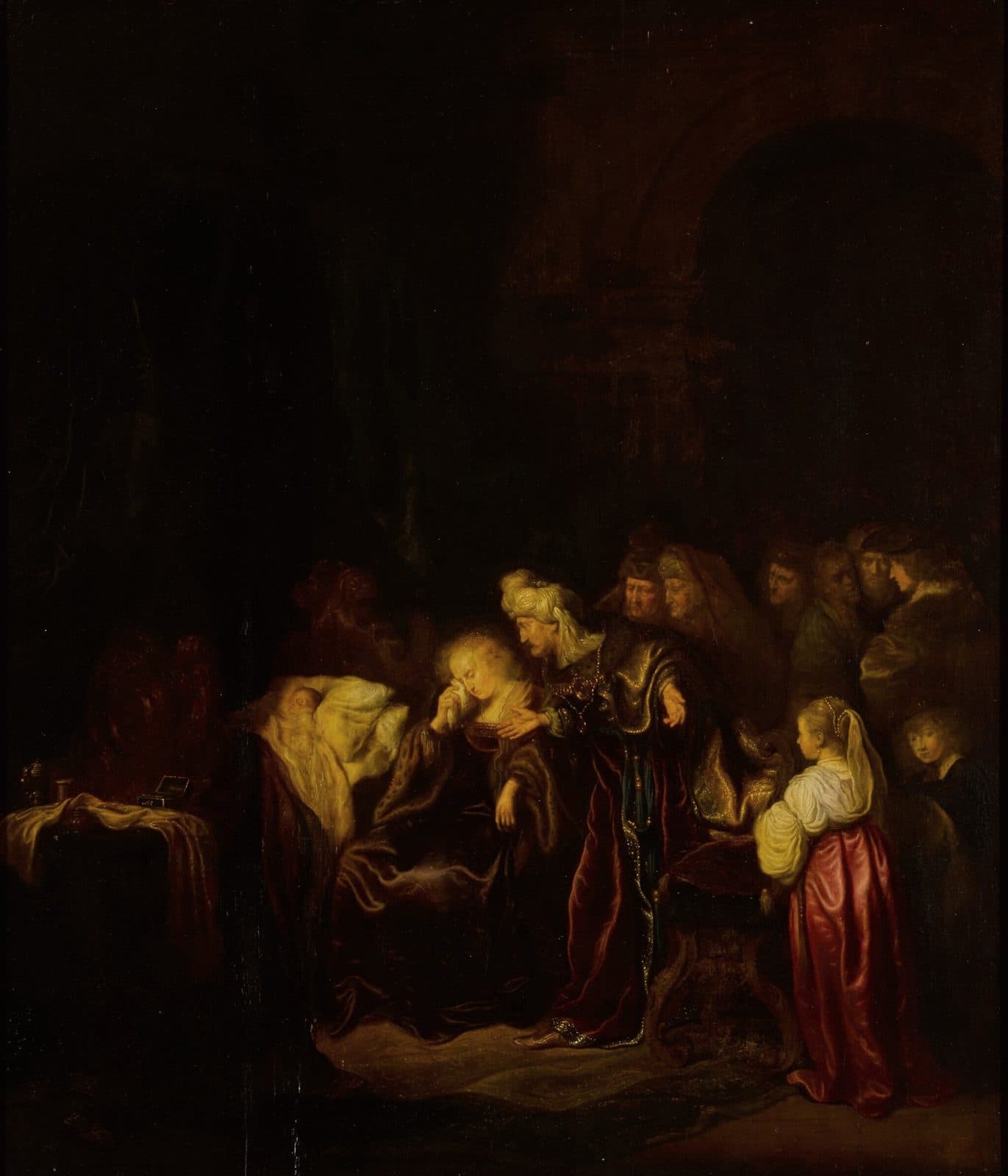
2 Samuel 12 · Story · Grief and Loss
David and the Child Who Died
David fasted and wept while his son was ill, and when the child died he rose, worshiped and ate.
Scripture never gives the name of the child whose death this account records.
But now that he is dead, why should I fast? Can I bring him back again? I will go to him, but he will not return to me.”
- Where
- Jerusalem
- Who
- David, Nathan, Solomon
Summary
For seven days David pleaded with God for a dying son, fasting and lying on the ground. When the answer came, he explained that prayer had been his part while the child lived. His words about going to the child are read as the grave, as a reunion or as both. Grief and worship stand side by side in one man on one day.
- The child was the son of David and Bathsheba, and Nathan foretold his death after David confessed his sin (2 Samuel 12:13 to 14).
- David set aside the signs of mourning on the day the child died (2 Samuel 12:20).
- David said that he would go to the child and that the child would not return to him (2 Samuel 12:23).
- The LORD loved the next son, Solomon, and sent Nathan to name him Jedidiah (2 Samuel 12:24 to 25).
A Father and a Dying Son
The account follows David through the illness and death of a child and the days after.
Grief and loss, the trial this study belongs to, has few accounts in Scripture as close to a parent's experience as this one. In 2 Samuel 12:15 to 25 King David prays and fasts for a sick child. He meets the child's death and speaks of going to him.
The question this study answers is what David did with his grief before and after the child died, and what his words in 2 Samuel 12:23 can and cannot be taken to promise. It sets the events on a timeline and tells each scene with its verses. It sets out three readings of David's words with the teachers who hold them, and it gives the words of a preacher who spoke to grieving parents.
The child was born to Bathsheba after David took her from Uriah and had Uriah killed (2 Samuel 11:27 and 2 Samuel 12:9).
Seven Days and After
Ten events run from Nathan's word to the naming of the next son.
David's seven days of pleading end in worship, and the account closes on a son the LORD loved.
- Nathan tells David that the son will die"the son born to you will surely die"2 Samuel 12:13 to 14
- The LORD strikes the child, and he falls ill"the LORD struck the child that Uriah’s wife had borne to David"2 Samuel 12:15
- David pleads with God, fasts and lies on the ground"spent the night lying in sackcloth on the ground"2 Samuel 12:16
- The elders of his household try to raise him"but he was unwilling and would not eat anything with them"2 Samuel 12:17
- The child dies on the seventh day"David’s servants were afraid to tell him"2 Samuel 12:18
- David sees the whispering and asks"Is the child dead?"2 Samuel 12:19
- David washes, worships in the house of the LORD and eats"went into the house of the LORD and worshiped"2 Samuel 12:20
- The servants question the change in himHis servants ask him to explain his eating after the death (2 Samuel 12:21).2 Samuel 12:21
- David comforts Bathsheba, and Solomon is born"Then David comforted his wife Bathsheba"2 Samuel 12:24
- Nathan brings the name Jedidiah"to name him Jedidiah because the LORD loved him"2 Samuel 12:25
A timeline of ten events, each card carrying words of its verse from the Berean text.
David washes, worships in the house of the LORD and eats, The servants question the change in him, David comforts Bathsheba, and Solomon is born, Nathan brings the name Jedidiah
The Story Told in Order
Each scene of 2 Samuel 12:15 to 25 is told with its verses.
David pleaded for the boy for seven days2 Samuel 12:15 to 17
When the child fell ill, David pleaded with God for him. He fasted and lay through the night on the ground in his house (2 Samuel 12:16). He would neither get up nor eat when the elders of his household came to him (2 Samuel 12:17).
The servants were afraid to tell him2 Samuel 12:18 to 19
On the seventh day the child died. The servants reasoned that a man who would not listen to them while the child lived might harm himself when he heard. David saw them whispering, understood, and asked; they told him the child was dead (2 Samuel 12:18 to 19).
Where grief brings a fear of self-harm, as the servants feared here, the care of a doctor stands beside prayer and never in its place.
David rose, worshiped and ate2 Samuel 12:20
Then David got up from the ground and made himself ready (2 Samuel 12:20). He went into the house of the LORD to worship before he went home, and there he asked for food and ate.
David explained his fast2 Samuel 12:22
David answered, “While the child was alive, I fasted and wept, for I said, ‘Who knows? The LORD may be gracious to me and let him live.’David's answer shows that his fast was a plea for mercy while mercy might still be shown, and that he had left the outcome with the LORD.
Washing, Oil and the End of Mourning
In Israel a mourner went without oil.
So Joab sent to Tekoa to bring a wise woman from there. He told her, “Please pretend to be a mourner; put on clothes for mourning and do not anoint yourself with oil. Act like a woman who has mourned for the dead a long time.This scene from later in David's reign shows the outward signs Israel kept in grief.
What the Text Leaves Unsaid
Two things a reader may want to know are left untold in the account.
The account records no word of Bathsheba during the seven days or after the death.
David names no place when he speaks of going to the child, and the account adds no comment of its own on his words.
Teachers on David's Grief
John Chrysostom drew a lesson for grieving parents from David's words.
died 407 · John Chrysostom
HOMILIES ON COLOSSIANS 8
The quotation1 quotation
“King David loved his child, and sat indeed in sackcloth and ashes, but he neither brought soothsayers, nor enchanters, (although there were such then, as Saul shows,) but he made supplication to God. So do thou likewise: as that just man did, so do thou also; the same words say thou, when thy child is dead, ‘I shall go to him, but he will not come to me.’ This is true wisdom, this is affection. However much thou mayst love thy child, thou wilt not love so much as he did then. For even though his child were born of adultery, yet that blessed man's love of the mother was at its height, and ye know that the offspring shares the love of the parents. And so great was his love toward it, that he even wished it to live, though it would be his own accuser, but still he gave thanks to God.”
John Chrysostom · Homilies on Colossians 8 · on 2 Samuel 12:22 to 23Patristic
I Will Go to Him
Teachers have read David's words in 2 Samuel 12:23 in three ways.
The Hebrew of the clause is short: ʼănî hōlēk ʼēlāyw, I am going to him. Hōlēk is a participle of hâlak, the common verb to go.
David would follow the child to the graveKeil and Delitzsch, citing Clericus; Adam Clarke
Keil and Delitzsch, in their Biblical Commentary on the Old Testament, cite the scholar Clericus for the sense of the words. In that reading David would go to the dead, and the dead would not come to him.
Adam Clarke wrote in his Commentary on the Bible that the words "may only mean, I also shall die, and be gathered to my fathers, as he is."
All his sons and daughters tried to comfort him, but he refused to be comforted. “No,” he said. “I will go down to Sheol mourning for my son.” So his father wept for him.Jacob uses the same picture of a father going down to Sheol, where his son is, which supports this reading.
David expected to be with the child againAmbrose of Milan; Matthew Henry
“Thus David wept for his son who was about to die; he did not grieve for him when dead. He wept that he might not be snatched from him, but he ceased to weep when he was snatched away, for he knew that he was with Christ. And that you may know what I declare is true, he wept for his incestuous son Amnon when he was killed, and he mourned for the parricide Absalom when he perished, saying, ‘My son Absalom, my son Absalom!’”
Ambrose of Milan · Consolation on the Death of Emperor Valentinian 47.48 · on 2 Samuel 12:20 to 23Patristic
Matthew Henry, in his Commentary on the Whole Bible, read the verse the same way: "We shall be with them shortly, to part no more."
David would die first and then find the child in heavenJohn Wesley
John Wesley, in his Explanatory Notes upon the Old Testament, joined the two readings. His gloss on the words reads, "Into the state of the dead in which he is, and into heaven, where I doubt not I shall find him."
The verse is read in more than one way, and the text itself does not settle it. A parent who takes comfort from it takes it with Ambrose, Henry and Wesley, and the believer's hope for the dead rests on wider ground in the resurrection of Jesus (1 Thessalonians 4:14).
Weeping and Worship
Two grieving men in Scripture turned to worship in their loss.
David pleaded while there was time to plead, and when the answer came he took his grief into the house of the LORD.
Then Job stood up, tore his robe, and shaved his head. He fell to the ground and worshiped, saying: “Naked I came from my mother’s womb, and naked I will return. The LORD gave, and the LORD has taken away. Blessed be the name of the LORD.”Job met the loss of his children by falling to the ground in worship, and David too went to worship after his son died.
Sources
Scripture is the Berean Standard Bible.
- STEP Bible, the Translators Amalgamated Hebrew Old Testament (TAHOT), Tyndale House, Cambridge, CC BY 4.0, with Strong's numbers, morphology, glosses and transliterations.
- STEP Bible, the Brief lexicon of Extended Strongs for Hebrew (TBESH), Tyndale House, Cambridge, CC BY 4.0.
- Carl Friedrich Keil and Franz Delitzsch, Biblical Commentary on the Old Testament (1857 to 1878), on 2 Samuel 12:23.
- Adam Clarke, Commentary on the Bible, on 2 Samuel 12:23.
- Ambrose of Milan, Consolation on the Death of Emperor Valentinian, 47 to 48.
- Matthew Henry, Commentary on the Whole Bible (1710), on 2 Samuel 12:23.
- John Wesley, Explanatory Notes upon the Old Testament (1765), on 2 Samuel 12:23.
- John Chrysostom, Homilies on Colossians, 8.
Keep Studying
Read it1
Studies1
People and groups5
Places1