
Place
Mount Gilboa
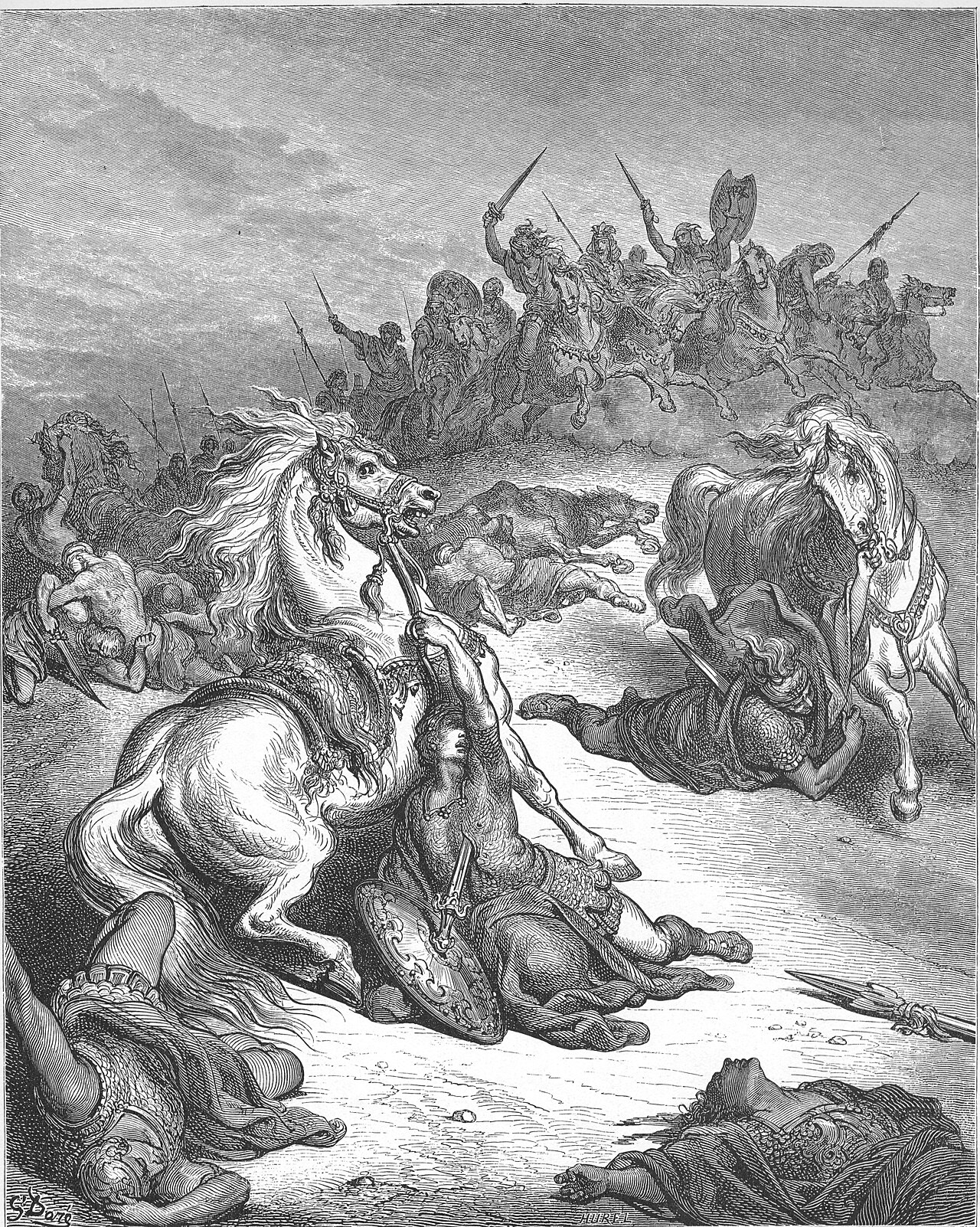
Gustave Doré, La Sainte Bible (Tours: Alfred Mame et fils, 1866). Public domain.
Summary
The ridge above the Jezreel valley where Saul and Jonathan fell before the Philistines and where David’s lament asked that no dew or rain fall, with Gideon’s spring of Harod at its foot.
- Mount Gilboa is a ridge on the southern edge of the Jezreel valley. Israel's first king died on it, and three of his sons died with him.
- The night before the battle Saul went to a medium at Endor, after God gave him no answer by dreams or Urim or prophets.
- The Philistines hung Saul's body on the wall of Beth-shan and put his armor in a temple. The men of Jabesh-gilead walked all night to take the bodies down.
- David wrote the lament that made the ridge famous. "O mountains of Gilboa, may you have no dew or rain" is a line in a funeral song, and the mountain still gets rain.
- Generations earlier, at the spring of Harod at the foot of the same ridge, God cut Gideon's army down to three hundred men and won with them.
On this page
In Scripture
- Verses
- 5
- Books
- 3
Near Mount Gilboa
- Jezreel8.9 km · 5.5 mi NW
- Shunem13 km · 7.9 mi NW
- Nain15 km · 9.1 mi NW
- Mount Tabor20 km · 12 mi N
- Dothan24 km · 15 mi SW
- Nazareth24 km · 15 mi NW
Straight-line distances, computed from the gazetteer coordinates.
Where it is
the country around it
- Coordinates
- 32.5098° N, 35.4084° Efind it on the Atlas →
- Region
- Jezreel Valley
- Kind of place
- Mountain
2 places the record names with Mount Gilboa, the farthest 13 km away
- 1The two camps face each other across the valley1 Samuel 28:4 · 13 kmThe Philistines came together and camped at Shunem, while Saul gathered all Israel and camped at Gilboa.
- 2Israel camped by the spring in Jezreel1 Samuel 29:1 · 8.9 kmNow the Philistines brought all their forces together at Aphek, while Israel camped by the spring in Jezreel.
- Located: the gazetteer fixes one site
- Placed: the point stands for an area, or is rounded
- A dashed line ends at a place the gazetteer does not fix
Not located: The Temple. The gazetteer records no location for it, so it is not marked.
Why Mount Gilboa matters
What has been found
the evidence, and where it is disputed
The death of Saul and the lament of David
1 Samuel 31 with 2 Samuel 1, in the order the text tells it
Read 1 Samuel 31 with 2 Samuel 1, in the order the text tells it
- The line breaks on the ridge1 Samuel 31:1Now the Philistines fought against Israel, and the men of Israel fled before them, and many fell slain on Mount Gilboa.
- Three of Saul's sons are killed1 Samuel 31:2The Philistines followed hard after Saul and his sons, and they killed Saul’s sons Jonathan, Abinadab, and Malchishua.
- The archers reach the king1 Samuel 31:3When the battle intensified against Saul, the archers overtook him and wounded him critically.
- Saul falls on his own sword1 Samuel 31:4Then Saul said to his armor-bearer, “Draw your sword and run it through me, or these uncircumcised men will come and run me through and torture me!” But his armor-bearer was terrified and refused to do it. So Saul took his own sword and fell on it.
- The house of Saul dies in one day1 Samuel 31:6So Saul, his three sons, his armor-bearer, and all his men died together that same day.
- The armor in a temple, the body on a wall1 Samuel 31:10They put his armor in the temple of the Ashtoreths and hung his body on the wall of Beth-shan.
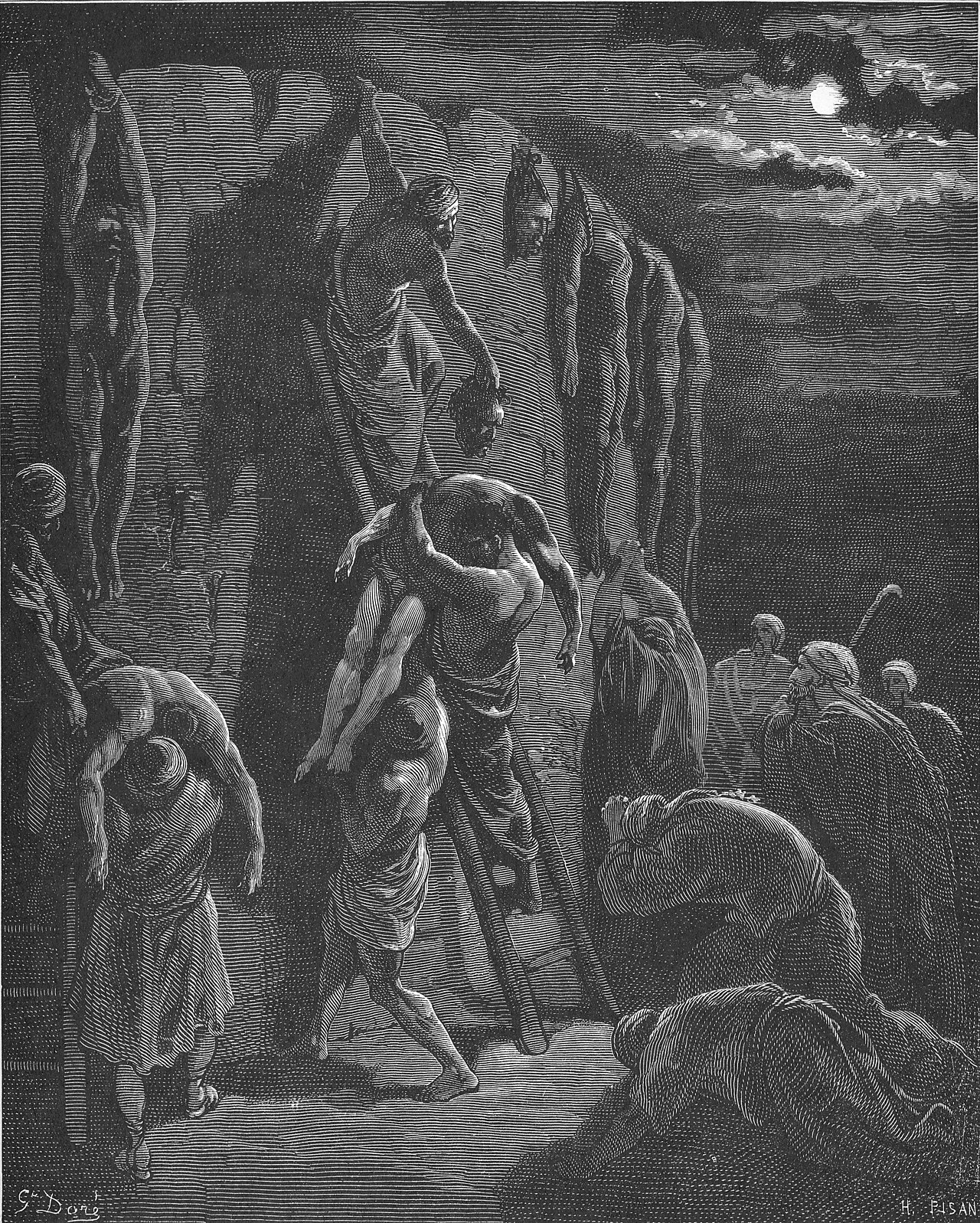
- Jabesh-gilead comes for the bodies at night1 Samuel 31:12all their men of valor set out, journeyed all night, and retrieved the bodies of Saul and his sons from the wall of Beth-shan. When they arrived at Jabesh, they burned the bodies there.
- David answers the Amalekite2 Samuel 1:14So David asked him, “Why were you not afraid to lift your hand to destroy the LORD’s anointed?”
- The lament begins2 Samuel 1:19“Your glory, O Israel, lies slain on your heights. How the mighty have fallen!
- The line the mountain is known by2 Samuel 1:21O mountains of Gilboa, may you have no dew or rain, no fields yielding offerings of grain. For there the shield of the mighty was defiled, the shield of Saul, no longer anointed with oil.
The narrator tells the reader how Saul died before anyone else in the story gets to speak. Saul asks his armor-bearer to run him through, the armor-bearer refuses, and Saul falls on his own sword (31:4 to 31:5). Three days later an Amalekite arrives at Ziklag with the crown and a different account, in which he himself finished the wounded king. David does not weigh the two stories. He takes the man at his own word about lifting a hand against the LORD's anointed, and has him executed. The lament that follows never mentions the quarrel between the two men. It praises Saul.
Saul at Endor: the night before the battleWhat happened here, in order
in the order the canon tells it
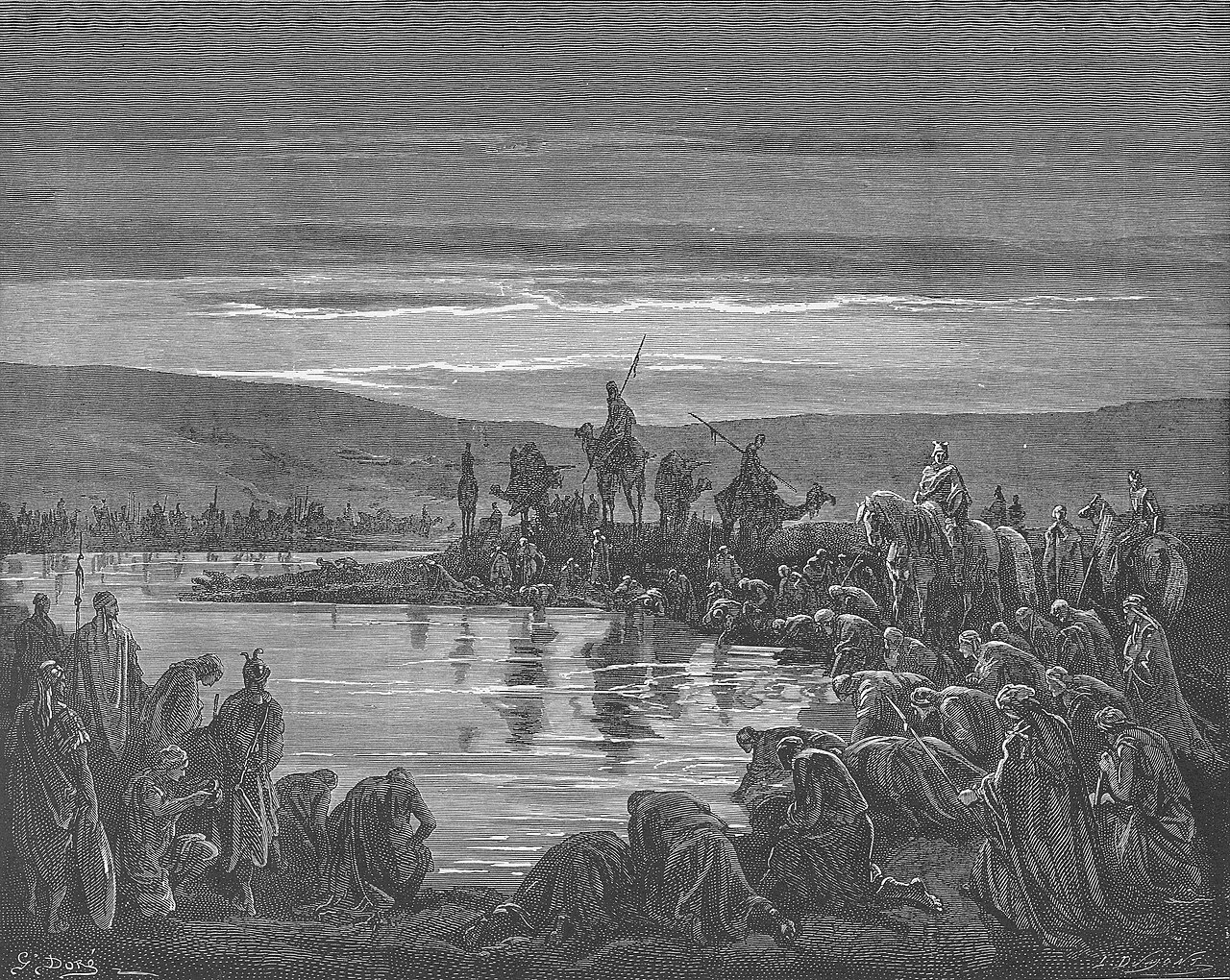
- Gideon camps at the spring of Harod below the ridgeJudges 7:1Early in the morning Jerubbaal (that is, Gideon) and all the men with him camped beside the spring of Harod. And the camp of Midian was north of them in the valley near the hill of Moreh.
- The army is cut down to three hundred menJudges 7:7Then the LORD said to Gideon, “With the three hundred men who lapped the water I will save you and deliver the Midianites into your hand. But all the others are to go home.”
- Nahash besieges Jabesh-gilead, and Saul relieves the town1 Samuel 11:2But Nahash the Ammonite replied, “I will make a treaty with you on one condition, that I may put out everyone’s right eye and bring reproach upon all Israel.”
- The two camps face each other across the valley1 Samuel 28:4The Philistines came together and camped at Shunem, while Saul gathered all Israel and camped at Gilboa.
- Saul asks God and gets no answer1 Samuel 28:6He inquired of the LORD, but the LORD did not answer him by dreams or Urim or prophets.
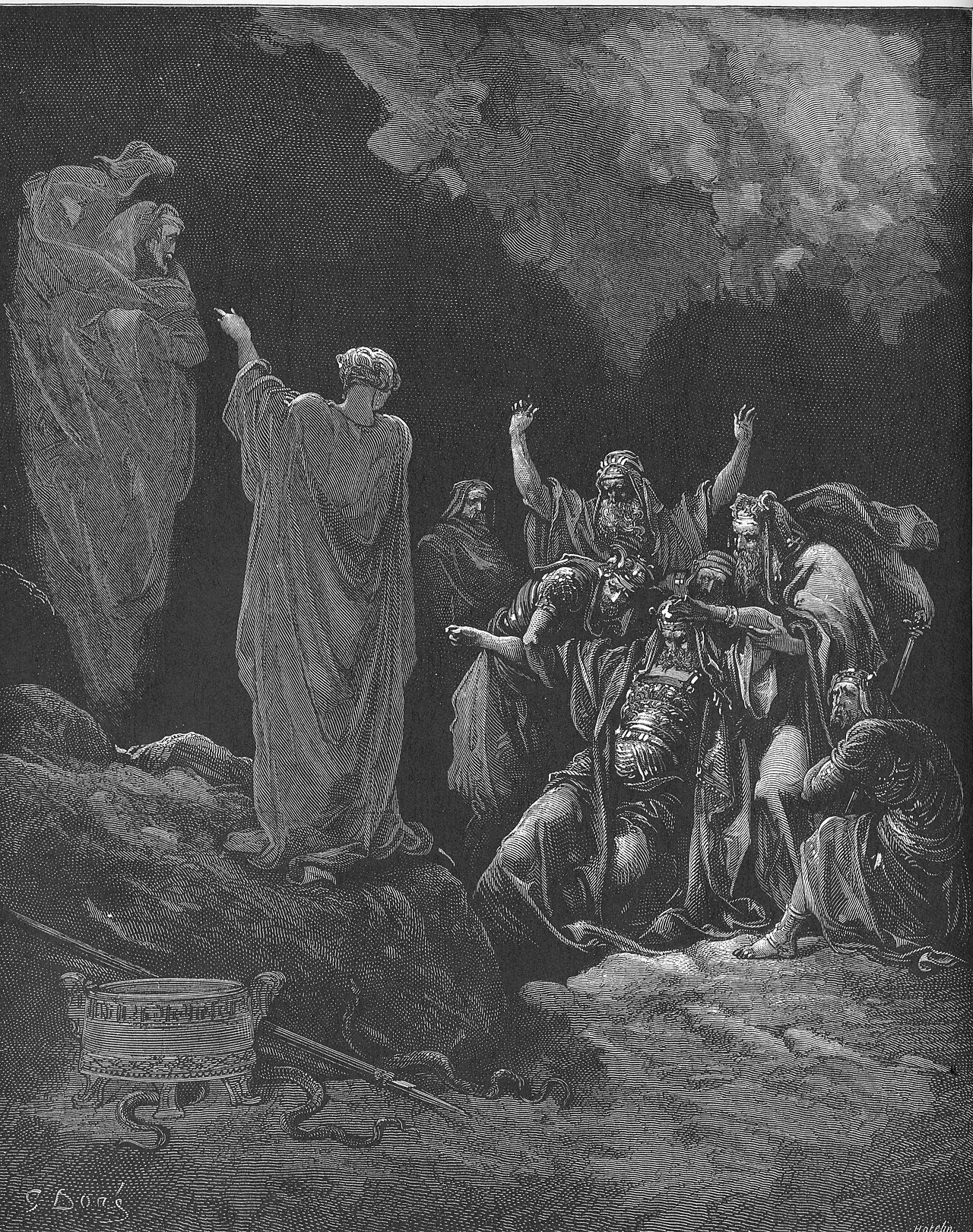
- The king sends for a medium1 Samuel 28:7Then Saul said to his servants, “Find me a woman who is a medium, so I can go and consult her.” “There is a medium at Endor,” his servants replied.
- The word Saul is given at Endor1 Samuel 28:19Moreover, the LORD will deliver Israel with you into the hand of the Philistines, and tomorrow you and your sons will be with me. And the LORD will deliver the army of Israel into the hand of the Philistines.”
- Israel camped by the spring in Jezreel1 Samuel 29:1Now the Philistines brought all their forces together at Aphek, while Israel camped by the spring in Jezreel.
- Israel is broken on Mount Gilboa1 Samuel 31:1Now the Philistines fought against Israel, and the men of Israel fled before them, and many fell slain on Mount Gilboa.
- Saul falls on his own sword1 Samuel 31:4Then Saul said to his armor-bearer, “Draw your sword and run it through me, or these uncircumcised men will come and run me through and torture me!” But his armor-bearer was terrified and refused to do it. So Saul took his own sword and fell on it.
- The armor in a temple and the body on the wall of Beth-shan1 Samuel 31:10They put his armor in the temple of the Ashtoreths and hung his body on the wall of Beth-shan.
- The bones buried under the tamarisk at Jabesh1 Samuel 31:13Then they took their bones and buried them under the tamarisk tree in Jabesh, and they fasted seven days.
- The Amalekite brings the crown to Ziklag2 Samuel 1:10So I stood over him and killed him, because I knew that after he had fallen he could not survive. And I took the crown that was on his head and the band that was on his arm, and I have brought them here to my lord.”
- The line of the lament the mountain is known by2 Samuel 1:21O mountains of Gilboa, may you have no dew or rain, no fields yielding offerings of grain. For there the shield of the mighty was defiled, the shield of Saul, no longer anointed with oil.
- David blesses the men of Jabesh-gilead2 Samuel 2:5So David sent messengers to the men of Jabesh-gilead to tell them, “The LORD bless you, because you showed this kindness to Saul your lord when you buried him.
- The bones of Saul and Jonathan buried at Zela2 Samuel 21:14And they buried the bones of Saul and his son Jonathan in Zela in the land of Benjamin, in the tomb of Saul’s father Kish. After they had done everything the king had commanded, God answered their prayers for the land.
- The Chronicler names the first reason Saul died1 Chronicles 10:13So Saul died for his unfaithfulness to the LORD, because he did not keep the word of the LORD and even consulted a medium for guidance,
- The Chronicler names the second, and the crown passes1 Chronicles 10:14and he failed to inquire of the LORD. So the LORD put him to death and turned the kingdom over to David son of Jesse.
Where it points
The voices
each quoted from the work named
DAVID was a poet and when he found that his best-beloved friend had fallen by the arrows of the Philistines, he wept greatly and then he cheered his heart by writing the very fine elegy which, in later years was called, "The Song of the Bow." Even if David's lamentation is judged according to the canons of literary taste, it must be placed among the first of poetical compositions.
Gilboa - Now called Jebel Fukuak. But the ancient name is preserved in the village of Jelbon, situated on the south side of the mountain. It was separated from Shunem (see the marginal reference) by the deep valley of Jezreel.
En-dor--"the fountain of the circle" (that figure being constantly affected by magicians) was situated directly on the other side of the Gilboa range, opposite Tabor; so that, in this midnight adventure, Saul had to pass over the shoulder of the ridge on which the Philistines were encamped.
4 more teachers on these versesMatthew Henry · Adam Clarke · John Gill · Jamieson, Fausset & Brown
He knew the heinousness of the sin of witchcraft, else he would not have cut off those that had familiar spirits; yet now he had recourse to that as an oracle which he had before condemned as an abomination. It is common for men to inveigh severely against those sins which they are in no temptation to, but afterwards to be themselves overcome by them.
This act of the men of Jabesh-gilead was an act of gratitude due to Saul, who, at the very commencement of his reign, rescued them from Nahash, king of the Ammonites, (see 1Sa 11:1, etc.), and by his timely succours saved them from the deepest degradation and the most oppressive tyranny. This heroic act, with the seven days’ fast, showed that they retained a due sense of their obligation to this unfortunate monarch.
let there be no dew, neither let there be rain upon you; which is not to understood as a real imprecation; for David would never curse any part of the land of Israel, for which he had so great a regard; but only as a poetical figure, expressing his concern for, and abhorrence of what happened on those mountains; much less did this in reality take place, as some have feigned, as if never dew nor rain descended on them (t) afterwards; which has been refuted by travellers, particularly Borchard (u), who, speaking of this mountain, says, that as he was upon it, there was such a violent shower fell, that he was wet through his clothes; and in the year 1273, laying all night upon this hill, there was a great dew fell upon him:
but not in the spirit of a humble penitent, nor with the believing confidence of a sincere worshipper. His enquiry was, in fact, a mere mockery, and his total want of all right religious impressions was manifested by his rushing from God to a wretched impostor in the service of the devil
Mount Gilboa in Scripture
5 verses name it, in 3 books
Open a book to read its mentions here. Text: Berean Standard Bible.
Old TestamentNew Testamentsegment width = share of mentions
Old Testament3 books · 5 mentions
1 Samuel2 mentions
2 Samuel1 mention
1 Chronicles2 mentions
The account
Read the account as one telling
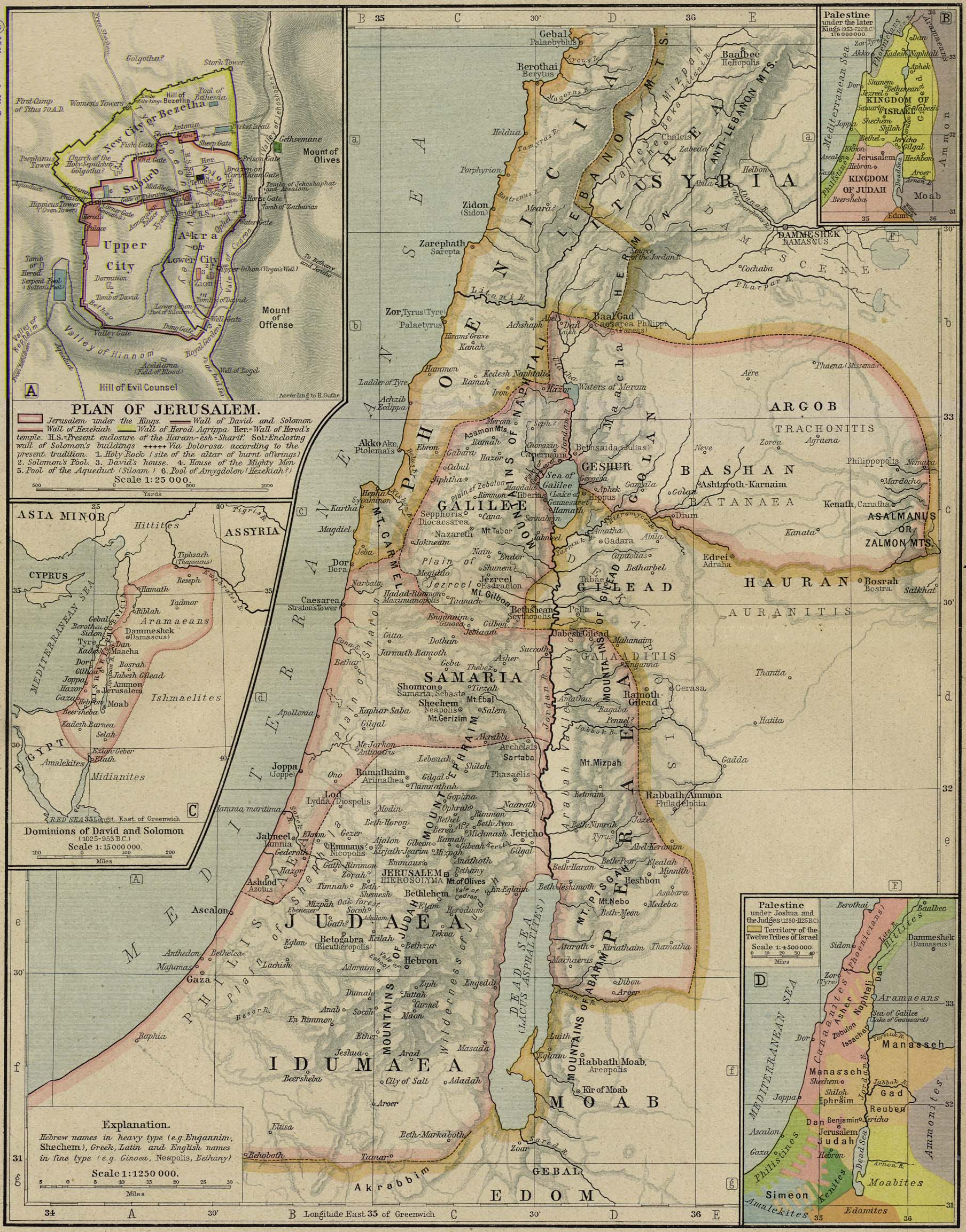
Mount Gilboa is a limestone ridge rather than a single peak. It runs about fifteen to eighteen kilometres from northwest to southeast along the southeastern edge of the Jezreel valley, and standard gazetteers put its high point near five hundred metres. Its northern face drops steeply into the Harod valley, which runs east from Jezreel down to the Jordan. Its southern side falls away more gently toward the hills of Samaria. The Arabic name of the ridge is Jebel Fuqu'a, and the village of Jelbon on the southern slope preserves the ancient name. Albert Barnes recorded both facts in the nineteenth century, spelling the Arabic as Jebel Fukuak.
The ground below the ridge decided every battle fought here. The Jezreel valley is the one broad flat corridor across northern Israel, and it carried the international road from the coast east toward Beth-shean and the Jordan crossings. Chariots work on that floor. Israel had known it since the settlement, when the tribe of Joseph complained that the Canaanites of the valley had iron chariots, both in Beth-shean and in the Valley of Jezreel, and Judges 1:27 records that Manasseh never drove them out. The ridge above the valley suits infantry and holds no water on top, so an army can stand there but cannot stay.
The first event Scripture sets at the foot of this ridge belongs to the age of the judges. Gideon camped beside the spring of Harod with Midian to the north near the hill of Moreh. God told him the army was too large, sent home everyone who was afraid, then sifted the rest at the water until three hundred men were left. The reason is given in the text itself: the LORD said the people were too many for Him to hand Midian over, lest Israel glorify themselves over Him. The proclamation in Judges 7:3 sends the fearful home from Mount Gilead, which is east of the Jordan, and readers have offered three explanations for that wording. They are set out in the archaeology section below.
Generations later the Philistines came up the same valley. They mustered at Aphek on the coastal plain while Israel camped by the spring in Jezreel, and David, who had been living under the Philistine king Achish at Ziklag, was sent home before the fighting because the Philistine commanders did not trust him. The armies then took their final positions. The Philistines camped at Shunem on the north side of the valley, and Saul gathered all Israel and camped at Gilboa.
On the night before the battle Saul asked God what to do and got no answer by dreams or Urim or prophets. Samuel was dead and buried at Ramah, and Saul had driven the mediums and spiritists out of the land himself. He put on different clothes, took two men, and walked around the hill of Moreh in the dark to the village of Endor, which lay on the far side of the enemy camp. He asked the woman there to bring up Samuel. She saw something that terrified her, screamed, and told the king she knew who he was. What Saul heard was what Samuel had already told him in life, with one thing added: tomorrow you and your sons will be with me.
The next day Israel broke. Jonathan, Abinadab and Malchishua were killed, the archers found Saul and wounded him, and Saul asked his armor-bearer to run him through so the Philistines could not take him alive. The armor-bearer refused, and Saul fell on his own sword. The armor-bearer fell on his. Towns along the valley and beyond the Jordan emptied as the news travelled. The Philistines came the next morning to strip the dead, found the king and his sons, cut off Saul's head, sent the news around their own cities, put his armor in a temple and fastened his body to the wall of Beth-shan. The Chronicler adds that the head was hung in the temple of Dagon.
Jabesh-gilead heard. Their fighting men crossed the Jordan, walked through the night, took the bodies down from the wall, carried them home and burned them, kept the bones and buried them under a tree, and fasted seven days. Saul's first act as king, forty years earlier, had been to break the Ammonite siege of that same town when Nahash offered its men their lives for their right eyes.
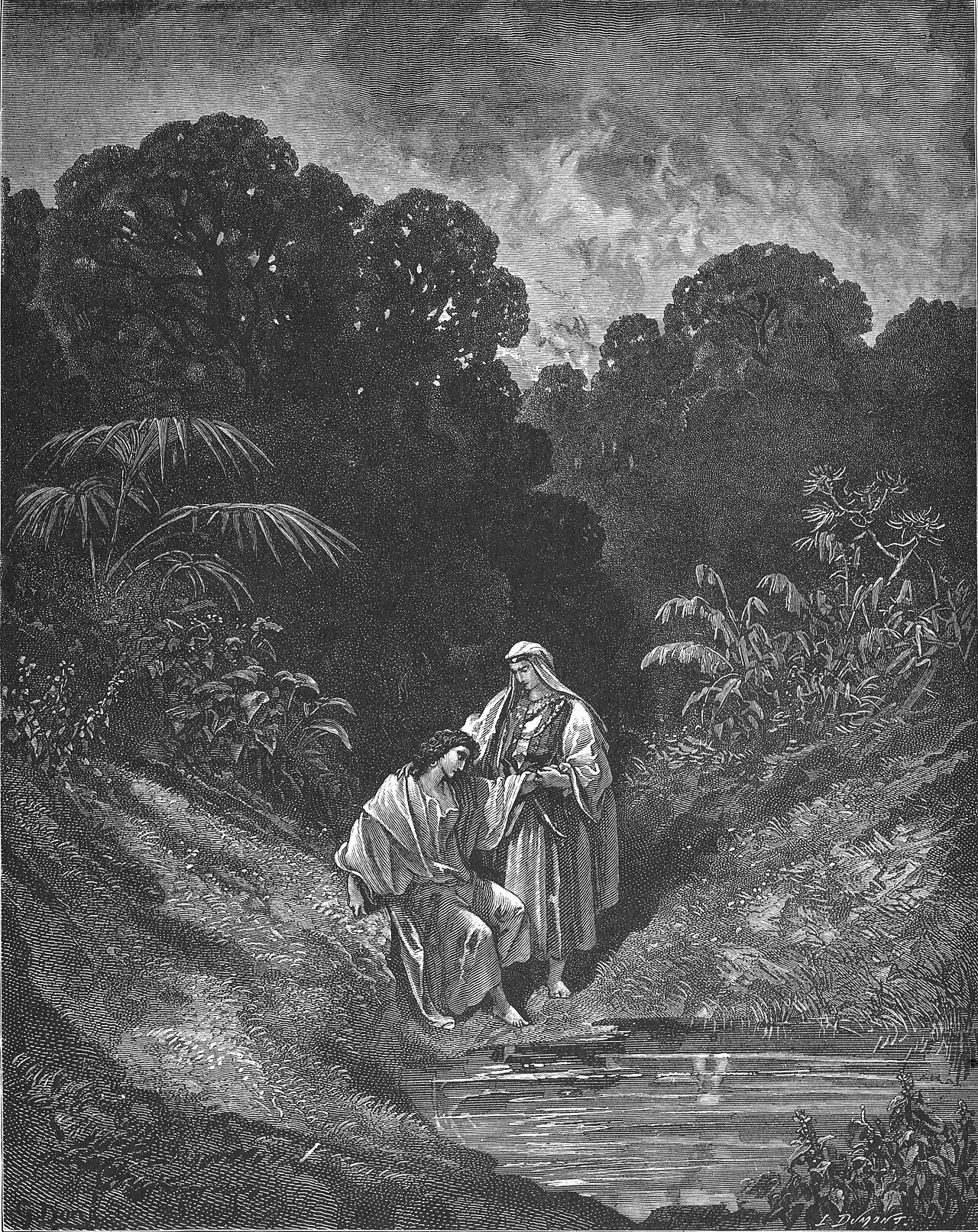
David was at Ziklag. On the third day a man arrived with torn clothes and dust on his head, carrying Saul's crown and armband, and told a story in which he himself had finished the wounded king. David and his men tore their clothes, mourned and fasted until evening, and then David had the man executed for saying he had lifted his hand against the LORD's anointed. He wrote a lament and ordered that the sons of Judah be taught it. The song names no grievance. It calls Saul and Jonathan beloved and delightful in life, swifter than eagles and stronger than lions, tells the daughters of Israel to weep for the king who clothed them in scarlet, and turns on the ridge itself: O mountains of Gilboa, may you have no dew or rain.
Common questions
Where is Mount Gilboa, and what does it look like?
Gilboa is a limestone ridge on the southeastern edge of the Jezreel valley, running about fifteen to eighteen kilometres and rising to roughly five hundred metres. Its northern face drops steeply into the Harod valley, and the village of Jelbon on the southern slope preserves the ancient name.
Israel camped on the ridge and the Philistines camped at Shunem on the far side of the valley. That put a plain between the two armies and gave the chariots the flat ground.
Did Samuel really appear to Saul at Endor?
Readers differ; the positions are named
Readers have taken three positions for eighteen centuries. One holds that Samuel really appeared, permitted by God and outside the medium's power, and that reading runs from Sirach and Josephus through Justin Martyr, Origen, Methodius and Augustine to Clarke, Barnes and Wesley. A second holds that a spirit took Samuel's form, and Tertullian, Hippolytus, John Calvin and Matthew Henry are among its holders.
A third holds that the woman staged the whole scene. Barnes and Clarke both report that reading and both set it aside for this case, on the ground that she was frightened by what she saw and broke her own disguise. The full treatment is on the Saul at Endor study.
Is it ever right to consult a medium?
No. Scripture forbids it by name, more than once, and calls the practice detestable. Saul had enforced that law himself and driven the mediums out of the land before he went looking for one at night.
The Chronicler names the consultation as one of the two reasons Saul died. The account records what the king did without approving it, and it is not evidence that the practice works.
How did Saul die? The two accounts do not agree.
Readers differ; the positions are named
First Samuel says the archers wounded Saul, that his armor-bearer refused to finish him, and that Saul fell on his own sword with the armor-bearer following him. Three days later an Amalekite arrived at Ziklag with Saul's crown and armband and told David he had killed the king himself.
Most commentators read the Amalekite's story as a lie told to buy favour from the next king, since the narrator has already given the true account. Adam Clarke calls it a fabrication, and Jamieson, Fausset and Brown say the inspired narrative in 1 Samuel 31 must be taken as the true one. Others have suggested he found a dying man and finished him. David did not investigate. He executed the man on his own testimony for lifting a hand against the LORD's anointed.
Why did the men of Jabesh-gilead walk all night for a body?
Saul's first act as king had been to relieve their town when Nahash the Ammonite besieged it and offered them terms that would have put out every man's right eye. They never forgot it.
When they heard what the Philistines had done, their fighting men crossed the Jordan, took the bodies off the wall at Beth-shan, burned them so the mutilation could not be displayed again, kept the bones and buried them, then fasted seven days. David's first message as king of Judah was to bless them for it.
Did God curse Mount Gilboa so that it gets no rain?
No. The line comes from David's funeral song and not from God, and it uses the poetic form that curses a day or a place out of grief, as Job and Jeremiah both do. The ridge receives ordinary hill country rainfall.
John Gill answered the legend in the eighteenth century by citing a medieval traveller who was soaked by a shower on the mountain and slept under a heavy dew there in 1273. John Wesley calls the line "no proper imprecation," and Albert Barnes sets it beside Job 3.
Where was Beth-shan, and what has been dug there?
Readers differ; the positions are named
Beth-shan is the mound of Tell el-Husn, about ten to twelve kilometres east of the ridge, where the Harod valley meets the Jordan valley. The University of Pennsylvania Museum excavated it from 1921 to 1933 under Clarence Fisher, Alan Rowe and Gerald FitzGerald, and the Hebrew University excavated it again from 1989 to 1996 under Amihai Mazar.
Rowe identified two of the temples he found as the temple of Ashtoreth and the temple of Dagon named in 1 Samuel 31:10 and 1 Chronicles 10:10. Mazar's redating of those levels means that identification is no longer treated as established. The temples, the city wall and the Egyptian garrison monuments are not in doubt. Which building held Saul's armor is.
Why is the death of Saul told twice, in 1 Samuel and again in 1 Chronicles?
The Chronicler opens his account of David's reign by retelling the day it began, and he adds two details 1 Samuel does not carry. Saul's head was fastened in the temple of Dagon, and the bones were buried under an oak rather than a tamarisk.
He then does what 1 Samuel never does and states the verdict outright, in two verses, naming the two failures. Albert Barnes sets the differences between the two accounts out side by side.
What happened to Saul's bones in the end?
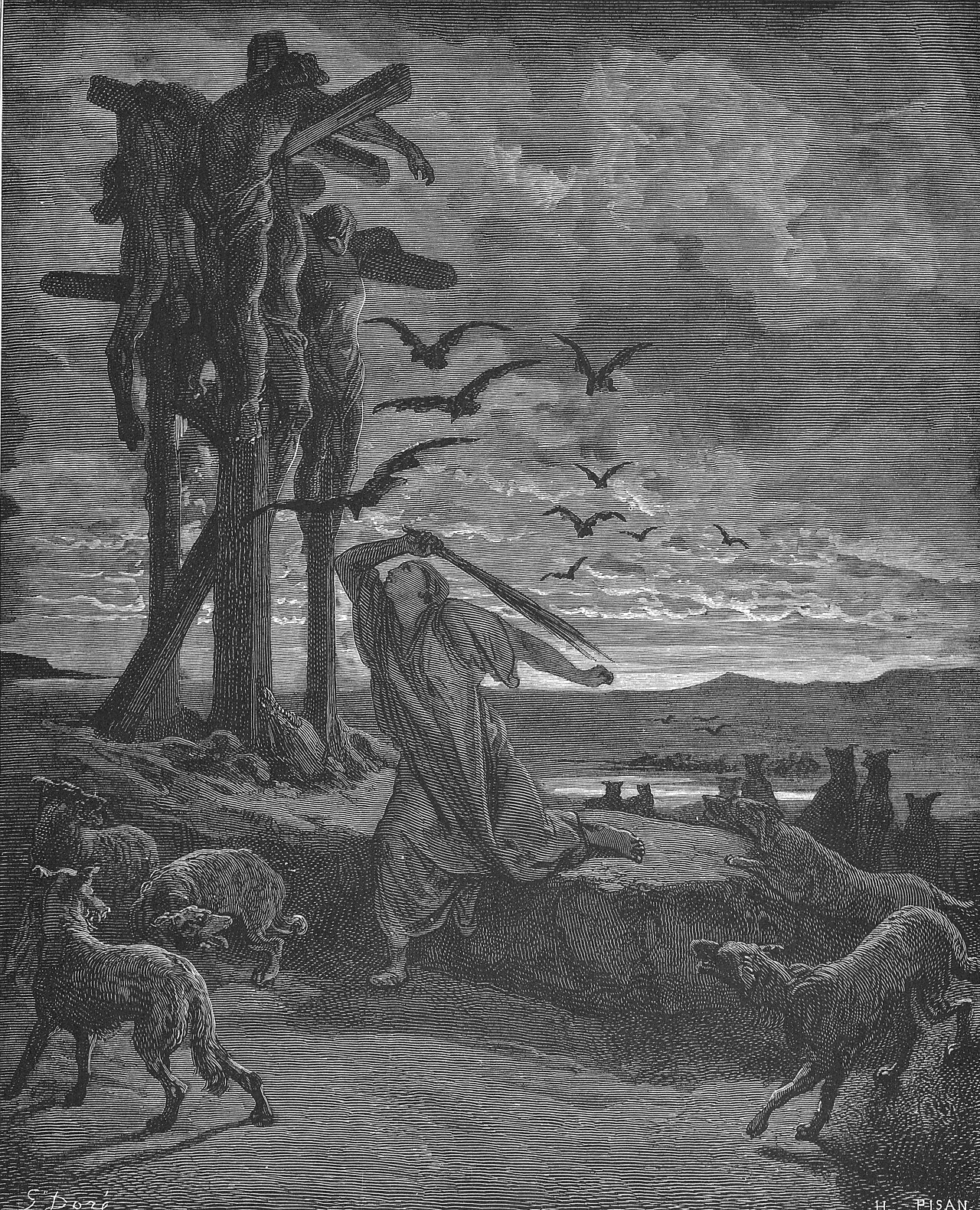
They did not stay at Jabesh. Years later, after a famine and the execution of seven of Saul's descendants, Rizpah kept watch over the exposed bodies of her sons until David heard of it.
He sent for the bones of Saul and Jonathan from the men of Jabesh-gilead and buried them, with the others, in Zela in Benjamin, in the tomb of Saul's father Kish. Zela has not been located on the ground.
Notable art
5 verified pieces depicting Mount Gilboa
Sources cited
- OpenBible.info Bible Geocoding: Mount Gilboaread 2026-08-20The coordinates on this page. Used under CC-BY with attribution to OpenBible.info.
- Berean Standard BibleAll Scripture text on this page, translation_id 3 in the site's verse store. Public domain since 2023.
- Charles H. Spurgeon, The Metropolitan Tabernacle Pulpit, Sermon No. 2336, “The Love Of Jonathan and the Love Of Jesus” (1893)The voices block on 2 Samuel 1:26 and the reading of Jonathan's love carried in the Christ section. Public domain, lightly modernized CCEL text.
- Albert Barnes, Notes, Explanatory and Practical, on the Old and New Testaments (1832 to 1869)Gilboa and Jelbon at 1 Samuel 28:4, the spring of Harod and the hill of Moreh at Judges 7:1, the Ashkelon reading at 1 Samuel 31:10, the burning and the tamarisk at 31:12 and 31:13, the public square at 2 Samuel 21:12, and the form of the elegy at 2 Samuel 1:21 and 1:25. Public domain.
- Robert Jamieson, A. R. Fausset and David Brown, Commentary Critical and Explanatory on the Whole Bible (1871)Endor and the night walk at 1 Samuel 28:4, the survey of holders on the appearance at 28:8 to 28:14, the Amalekite's story at 2 Samuel 1:2, the bare ridge at 1:21, the name Harod at Judges 7:1, and the verdict at 1 Chronicles 10:14. Public domain.
- Matthew Henry, Commentary on the Whole Bible (1710)Saul's inconsistency at 1 Samuel 28:7, the impersonation reading at 28:17, Josephus on the woman's hospitality at 28:24, and respect for the dead at 31:12. Public domain.
- Adam Clarke, Commentary on the Bible (1832)The Hebrew of 1 Samuel 28:7 and the location of Endor, the appearance at 28:12, the gratitude of Jabesh-gilead at 31:11, the Amalekite's fabrication at 2 Samuel 1:2, the Mount Gilead problem at Judges 7:3, and the Targum at 1 Chronicles 10:14. Public domain.
- John Wesley, Explanatory Notes upon the Old Testament (1765)The reading of 2 Samuel 1:21 as no proper imprecation, and the reading of the appearance at Endor as genuine. Public domain.
- John Gill, An Exposition of the Old Testament (1748 to 1763)The note on 2 Samuel 1:21 that answers the dry-mountain legend, and through it the testimony of Burchard of Mount Sion, whose name Gill spells Borchard. Public domain.
- Burchard of Mount Sion, Descriptio Terrae SanctaeThe Dominican traveller of the 1270s and 1280s, soaked by a shower on Gilboa and covered by dew there in 1273. Reaches this page through Gill's citation.
- Richard Chenevix Trench, Shipwrecks of Faith (1867)Quoted inside Albert Barnes's note on 1 Samuel 28:11 and credited there. Public domain.
- Edward Robinson, Biblical Researches in Palestine, Mount Sinai and Arabia Petraea (1841)The identification of the spring of Harod with Ain Jalud at the foot of the ridge. Public domain.
- C. R. Conder and H. H. Kitchener, The Survey of Western Palestine (London: Palestine Exploration Fund, 1881 to 1883)The survey of the Gilboa ridge, the Harod valley and the hill of Moreh, and the alternative spring identification Barnes credits to Conder. Public domain.
- Alan Rowe, The Topography and History of Beth-shan (Philadelphia: University of Pennsylvania Press, 1930), and The Four Canaanite Temples of Beth-shan, Part I (1940)The Pennsylvania expedition's own reports and the source of the identifications of the temple of Ashtoreth and the temple of Dagon.
- Gerald M. FitzGerald, Beth-shan Excavations 1921 to 1923: The Arab and Byzantine Levels (Philadelphia: University of Pennsylvania Press, 1931)The third director's report from the same expedition.
- Yigael Yadin and Shulamit Geva, Investigations at Beth Shean: The Early Iron Age Strata, Qedem 23 (Jerusalem: Hebrew University Institute of Archaeology, 1986)The re-examination of the Pennsylvania stratigraphy that preceded the new excavation.
- Amihai Mazar, Excavations at Tel Beth-Shean 1989 to 1996 (Jerusalem: Israel Exploration Society, volumes from 2006)The Hebrew University excavation and the redating that unsettled Rowe's temple identifications.
- Nelson Glueck, Explorations in Eastern Palestine, Annual of the American Schools of Oriental Research (1934 to 1951)The proposal of Tell el-Maqlub for Jabesh-gilead.
- Peter M. Fischer, Tell Abu al-Kharaz in the Jordan Valley (Vienna: Austrian Academy of Sciences Press, volumes from 2006)The excavation behind the competing proposal for Jabesh-gilead. Fischer sets out the case rather than claiming the identification is proven.
- James Ussher, The Annals of the World (1650 to 1654)The 1056 BC date for Saul's death, named as one chronology among several. Public domain.
- Ben Sira, Sirach 46:20 (about 180 BC, Greek translation about 132 BC)The earliest surviving Jewish comment on the night at Endor, that Samuel prophesied after his death. A labelled study resource on this site and never canon.
- Flavius Josephus, Antiquities of the Jews 6.14 (AD 93 or 94)The first century retelling of Endor and the battle, the praise of the woman's hospitality, and the praise of Saul's courage. Josephus's reading of the woman reaches this page through Matthew Henry's note on 1 Samuel 28:24. Public domain.
- Pseudo-Philo, Liber Antiquitatum Biblicarum 64 (first century AD)A first century Jewish retelling of Israel's history, surviving in Latin, which names the medium Sedecla and makes her the daughter of a Midianite diviner. Verified 2026-09-02 against the standard English texts of M. R. James (1917) and Daniel J. Harrington in Charlesworth's Old Testament Pseudepigrapha. Named, dated and placed as a witness to first century reading, never as history.
- Pirkei de Rabbi Eliezer, chapter 33A narrative midrash usually dated to the eighth or ninth century AD in the land of Israel, which has Saul go to the woman of Endor, the wife of Zephaniah and the mother of Abner. Checked at Sefaria 2026-09-02. Late reception, named, dated and placed, never presented as a historical report.
- Leviticus Rabbah 26:7The midrash that lists Saul's trespasses and reads the plural of "a god coming up out of the earth" at 1 Samuel 28:13 as Samuel rising with others. Checked at Sefaria 2026-09-02 and cited at the section, not the chapter alone. Named, dated and placed.
- Targum to Chronicles, on 1 Chronicles 10:13 to 10:14A late Aramaic paraphrase, usually placed in the medieval period, which names Saul's transgression, the commandment about Amalek and the consulting of Pythons. It reaches this page through Adam Clarke's note, and the wording was verified 2026-09-02.
- Justin Martyr, Dialogue with Trypho 105 (about AD 155 to 165)The earliest surviving Christian comment on Endor, using the episode as proof that souls survive death. Public domain, Ante-Nicene Fathers edition.
- Tertullian, A Treatise on the Soul 57 (about AD 210 to 213)Regularly cited as the father of the impersonation reading. He grants the Endor case as an exception before ruling out the general possibility, and this page does not flatten him. Public domain.
- Hippolytus of Rome, Exegetical Fragments (about AD 235)The fullest early argument that a demon could not recall a soul and produced the form instead. Public domain.
- Origen of Alexandria, Homilies on 1 Kings (that is, 1 Samuel) 5, and Homilies on Judges 9 (about AD 240)The argument that no demon could deliver the prophecy of 1 Samuel 28:17 to 28:19, and the reading of Judges 7:3 as Christ dismissing the fearful. Origen's 1 Kings is 1 Samuel, and the citation says so.
- Methodius of Olympus, On the Resurrection 3.2 (about AD 300)Named among the holders of the reading that Samuel really appeared. Public domain.
- Ambrose of Milan, On the Duties of the Clergy 3.9 (about AD 391)David's conduct toward Saul read as the case where the virtuous act proved the useful one. Public domain.
- John Chrysostom, Homilies on 2 Timothy, homily 7 (about AD 400)Jonathan held up as the scriptural instance of friendship, from a work on 2 Timothy. Public domain.
- Augustine of Hippo, On the Care of the Dead 15.18 (about AD 421) and Explanations of the Psalms 68 (about AD 415)Augustine states the impersonation reading fairly before answering it from Sirach 46:20, and reads Gideon's three hundred as a sign of the cross through the Greek letter tau. Public domain.
- John Calvin, Sermons on 1 Samuel, and Commentary on Isaiah at Isaiah 8:19Cited for his position on the Endor question only. The site's quote pool holds no Calvin row on any verse in this brief, so he is named and not quoted, and no quote has been supplied from elsewhere.
- Gustave Doré, La Sainte Bible (Tours: Alfred Mame et fils, 1866)The six engravings on this page. Public domain.
- James Strong, Strong's Exhaustive ConcordanceThe lexicon floor behind the page: h1533 Gilboa, h5874 En-Dor, h178 'ob the medium's spirit, h3049 yidde'oni the spiritist, h4899 mashiach anointed, h2491 chalal pierced, and h1368 gibbor mighty.
Keep studying
On this page
Keep this page