
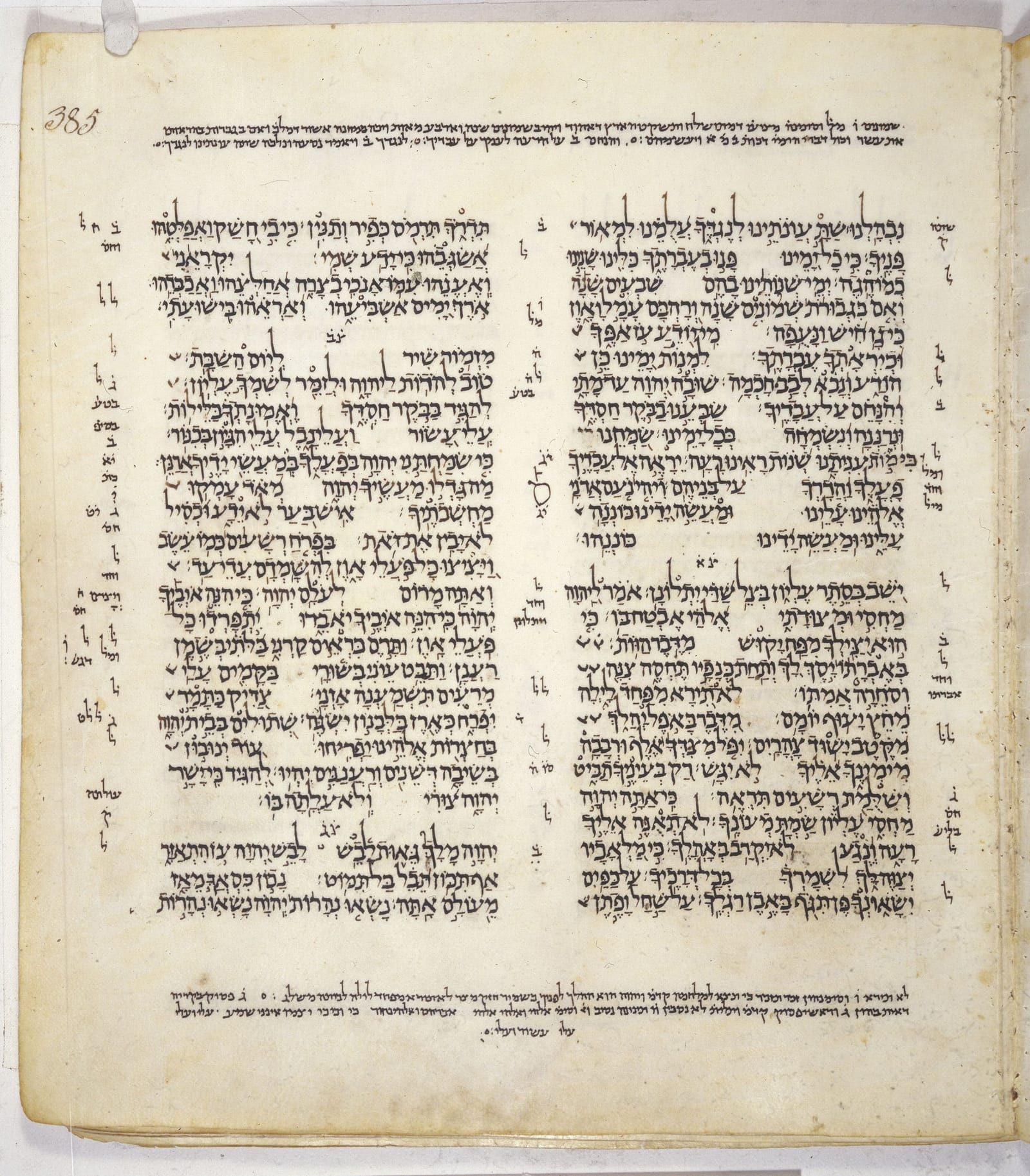
The Leningrad Codex, folio 385a, 1008 to 1011. Public domain.
Psalms 24, 48, 82, 94, 81, 93 and 92 · Passage · Featured Study
The Psalm of the Day in the Temple
The Mishnah names seven psalms the Levites sang in the Temple, one for each day of the week.
Rabbi Akiva tied each day's psalm to the work God did on that day of creation.
It is good to praise the LORD, and to sing praises to Your name, O Most High, to proclaim Your loving devotion in the morning and Your faithfulness at night
- The passage
- Psalm 92:1 to 15, Psalm 24:1 to 10, Psalm 93:1 to 5, 1 Chronicles 23:30, 2 Chronicles 29:27 to 28
- Books
- Psalms, 1 Chronicles, 2 Chronicles
- Hold in memory
- Psalm 92:1 to 2
Summary
The Greek Bible's headings give five of the seven psalms their day, and the Hebrew gives a day to the Sabbath psalm alone.
- The day's psalm closed the morning service, as Edersheim describes it.
- Hezekiah's restored worship began the song of the LORD when the burnt offering began.
- Readers part on whether the Sabbath psalm looks to God's rest or to the age to come.
The Song at the Daily Offering
The Law fixed the daily offering, and the song followed it.
The Psalm of the Day in the Temple takes up the psalms the Levites sang at the daily offering. The question it answers is which psalm was sung on which day, how it was sung, and why each was chosen. It sets the Law's offering beside the Levites' charge, then gives the week as the Mishnah lists it and the reasons the Talmud gives.
And tell them that this is the offering made by fire you are to present to the LORD as a regular burnt offering each day: two unblemished year-old male lambs. Offer one lamb in the morning and the other at twilight,The morning lamb is the offering the Mishnah's song accompanies.
They were also to stand every morning to give thanks and praise to the LORD, and likewise in the evening.David's charge sets the Levites' praise at the hours of the two lambs.
The Psalms of the Week
Mishnah Tamid 7:4 lists the seven psalms in the order of the days.
The seven psalms run from Psalm 24 on the first day to Psalm 92 on the Sabbath.
- The first dayPsalm 24on the first day of the weekGod acquired the world, gave it to man and ruled alone in it
- The second dayPsalm 48on the second day of the weekGod divided His works and reigned over them
- The third dayPsalm 82NoneGod revealed the dry land and made the world ready for His assembly
- The fourth dayPsalm 94for the fourth day of the weekGod made the sun and the moon and will punish those who worship them
- The fifth dayPsalm 81NoneGod made the birds and the fish to praise His name
- The sixth dayPsalm 93for the day before the SabbathGod finished His work and reigned over all of it
- The SabbathPsalm 92for the Sabbath-dayfor the day that is all Sabbath
A sequence of the seven days with the psalm the Mishnah gives each, the heading the Greek Bible prints over it in Brenton's translation, and the reason the Talmud gives. None marks a psalm whose Greek heading names no day.
How the Psalm Was Sung
Mishnah Tamid 7:3 sets the song at the pouring of the wine on the altar.
Two priests with silver trumpets sounded a long blast, a series of short blasts and a long blast. As the High Priest stooped to pour the wine, his deputy waved the cloths, and ben Arza, whose task was the cymbal, struck it. The Levites began the psalm of the day, and at the end of each section the priests blew again and the people in the court bowed down.
Alfred Edersheim, in The Temple, describes the psalm as sung in three sections, with three blasts of the trumpets after each.
And Hezekiah ordered that the burnt offering be sacrificed on the altar. When the burnt offering began, the song of the LORD and the trumpets began as well, accompanied by the instruments of David king of Israel. The whole assembly was worshiping, the singers were singing, and the trumpeters were playing. All this continued until the burnt offering was completed.Chronicles times the song by the burnt offering, as the Mishnah does.
“All had hitherto been preparatory. Now Hezekiah gave orders that ‘the burnt offering’ - i. e. the daily morning sacrifice - should be offered upon the brass altar in front of the porch, thus restoring and reinstituting the regular temple-service. A burst of music gave notice to the people of the moment when the old worship recommenced.”
Albert Barnes · Notes, Explanatory and Practical, on the Old and New Testaments (1832-1869) · on 2 Chronicles 29:27Evangelical
The Sabbath Psalm
The heading of Psalm 92 gives the psalm to the Sabbath day.
The Berean text leaves the heading outside its numbered verses. In the Hebrew Bible the heading is the first verse, mizmor shir leyom hashabbat, so the Hebrew verse numbers of Psalm 92 run one higher than the English.
Jerome, who counts the psalms as the Greek Bible does, preached on this psalm as the ninety-first. No one keeps the Sabbath, he taught, who has not first passed through the six days.
For You, O LORD, have made me glad by Your deeds; I sing for joy at the works of Your hands.The psalm gives its reason for joy in the works of God's hands.
A Week of Creation
Rosh Hashanah 31a records the seven reasons as a teaching of the sages.
Two of the seven show the method plainly.
The earth is the LORD’s, and the fullness thereof, the world and all who dwell therein.Psalm 24 is the song of the first day.
The LORD reigns! He is robed in majesty; the LORD has clothed and armed Himself with strength. The world indeed is firmly established; it cannot be moved.Psalm 93 is the song of the sixth day.
What the Text Leaves Unsaid
Of the passages that tell of the Levites' song, none names a psalm for a day.
The Mishnah says what the Levites sang and does not say when the custom began. Of the seven psalms, only Psalm 92 carries its day in its Hebrew heading.
How the Teachers Read It
Jerome preached on the heading of Psalm 93 as a word about Christ.
Jerome (died 420)
The heading Jerome read over Psalm 93 gives the psalm to the Sabbath, where Brenton's Greek text reads the day before the Sabbath and notes that Codex Alexandrinus reads the Sabbath day.
“The title of the present psalm is this: A psalm of praise of David, on the day of the sabbath, when the earth was inhabited. On the sabbath day is our rest, and the inhabiting of the earth is ours. 'And the Word was made flesh, and dwelt among us.' Our earth, therefore, has been inhabited. Let us see, then, what this dwelling accomplishes, and with what praises it is extolled.”
Jerome · Homily 70, on Psalm 92 (Alternate Series) · on Psalm 93:1Patristic
Two Readings of the Sabbath Psalm
The Talmud records two answers to why Psalm 92 belongs to the seventh day.
A song for the age to comeMishnah Tamid 7:4; Rabbi Akiva in Rosh Hashanah 31a
The Mishnah and Rabbi Akiva read the Sabbath of the heading as the day that is all Sabbath, the world to come. The Talmud sets beside it Rav Katina's word that the world stands six thousand years and lies waste one. Edersheim reports the reading as the Sabbath of the end, when the LORD reigns over all.
The objection: Rabbi Nehemiah asked why the sages read six psalms by days already past and the seventh by a day to come, and he read all seven by the past.
A song for the day God restedRabbi Nehemiah in Rosh Hashanah 31a
Rabbi Nehemiah gives the same reasons for the first six days and reads the seventh by the creation week as well: the psalm belongs to the Sabbath because on it God rested.
The objection: the Mishnah, which records the list of the week, gives the forward reading in its own words.
There remains, then, a Sabbath rest for the people of God.Hebrews stands with the forward reading among the Christian Scriptures.
Books to Read Next
One work sets the psalm of the day inside the whole of the Temple's service.
The Temple: Its Ministry and Services as They Were in the Time of Jesus Christ
Alfred Edersheim · 1908 printing
Edersheim walks through the morning and evening service, the singers and the order of the psalms from the Mishnah.
READ IT FREE AT THE INTERNET ARCHIVE →The Song Restored
Ezra records the Levites' song at the founding of the temple after the exile.
The daily song belonged to the first temple, and it was taken up again when the second was founded.
When the builders had laid the foundation of the temple of the LORD, the priests in their apparel with trumpets, and the Levites (the sons of Asaph) with cymbals, took their positions to praise the LORD, as David king of Israel had prescribed. And they sang responsively with praise and thanksgiving to the LORD: “For He is good; for His loving devotion to Israel endures forever.” Then all the people gave a great shout of praise to the LORD, because the foundation of the house of the LORD had been laid.The song returns with the house the exiles founded.
Sources
Scripture is the Berean Standard Bible.
- Mishnah Tamid 7:3 and 7:4, Hebrew text (Torat Emet, public domain) with the William Davidson English (CC-BY-NC)
- Talmud Bavli, Rosh Hashanah 31a, William Davidson edition (CC-BY-NC)
- Psalm 92:1 in the Hebrew, Miqra according to the Masorah, with the JPS English.
- The Septuagint in Brenton's translation (1844)
- Alfred Edersheim, The Temple: Its Ministry and Services as They Were in the Time of Jesus Christ (London: Religious Tract Society, 1908 printing)
- Albert Barnes, Notes on the Old Testament, on 2 Chronicles 29:27.
- Jerome, Homily 70, on Psalm 92 (Alternate Series), the Hebrew Psalm 93.
- Jerome, Homily 21, on Psalm 91, the Hebrew Psalm 92.
Keep Studying
Read it8
Studies10
People and groups5
Go further2
Trials of life1