
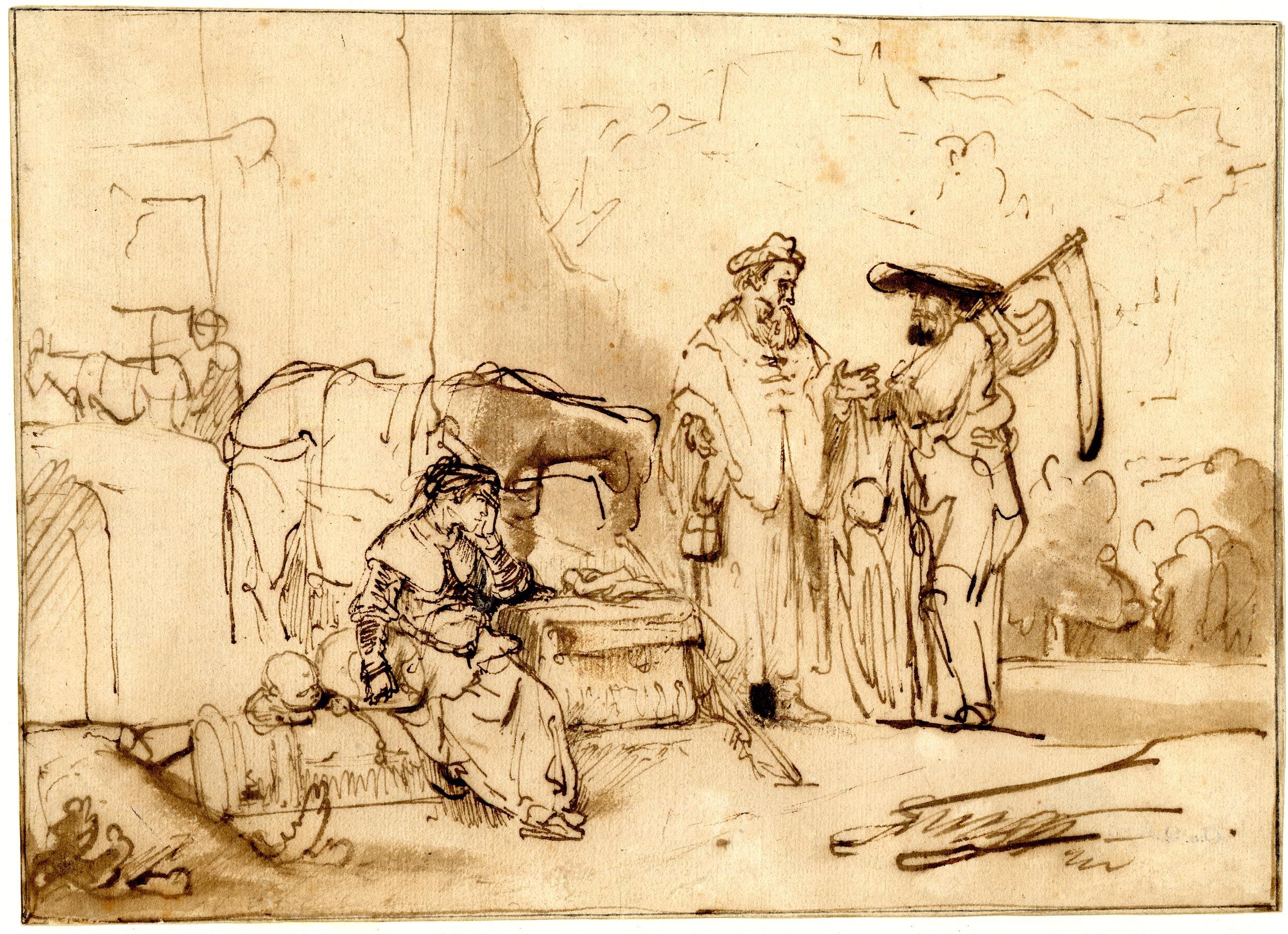
Attributed to Rembrandt, The Man of Gibeah Offers Hospitality to the Levite and his Concubine, 1642 to 1646. Public domain.
Judges 19:12 to 20:48 · Place · Featured Study
Gibeah
Gibeah was a town of Benjamin and the home of Saul, Israel's first king (1 Samuel 10:26).
They stopped to go in and lodge in Gibeah. The Levite went in and sat down in the city square, but no one would take them into his home for the night.
- Today
- Tell el-Ful, north of Jerusalem, by Albright's identification
- Region
- The hill country of Benjamin
- First named
- Judges 19:12 “…We will go on to Gibeah.”
- Last named
- Hosea 10:9 “Since the days of Gibeah you have…”
The one man in Gibeah who took the Levite in came from the hill country of Ephraim (Judges 19:16).
Summary
The name Gibeah stands in 44 verses from Joshua to Hosea, and three places bear it.
- Israel set an ambush around Gibeah and burned the town (Judges 20:29 and 40).
- Archaeologists still differ on whether the hill of Tell el-Ful is the town.
- The Benjamites refused to hand over the wicked men of Gibeah and gathered there to fight (Judges 20:13 to 14).
A Town of Benjamin
The Levite of Judges 19 chose Gibeah over Jebus for the night because Gibeah was a town of Israel.
This study asks where Gibeah stood and why its name became a byword in Israel.
But his master replied, “We will not turn aside to the city of foreigners, where there are no Israelites. We will go on to Gibeah.” He continued, “Come, let us try to reach one of these towns to spend the night in Gibeah or Ramah.” So they continued on their journey, and the sun set as they neared Gibeah in Benjamin.These verses mark Gibeah as Israelite ground on the road north from Jebus.
Strong's dictionary of 1890 gives Gibeah as the name of three places in the land. The common noun gibeah means a hill.
Joshua 15:57 names a Gibeah among the towns of Judah, and Joshua 24:33 a Gibeah of Phinehas in Ephraim. The Gibeah of Benjamin is the town of Judges 19.
The study of the Levite's concubine tells the night at Gibeah and the war on Benjamin in full.
Gibeah on Bartholomew's Plate of Saul's Kingdom
Bartholomew's plate of 1915 shows the kingdom of Israel in Saul's day in pink.
The towns of Judges 19 to 21 run from Bethlehem north to Shiloh and east across the Jordan to Jabesh-gilead.
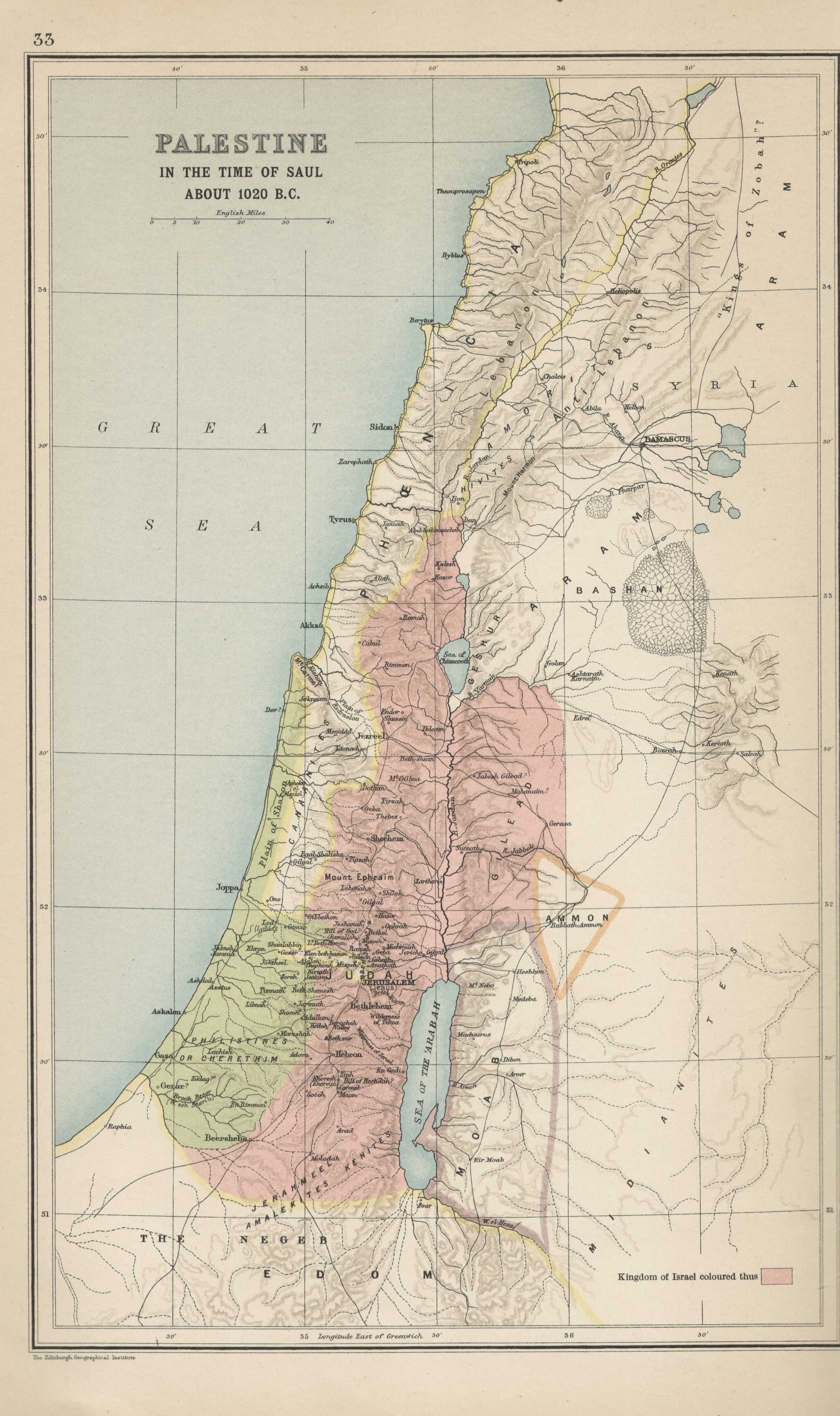
- BethlehemThe Levite's concubine came from Bethlehem in Judah. Bartholomew's placing, known: the southernmost of the four points.Judges 19:1
- GibeahSaul stayed under the pomegranate tree on its outskirts. Bartholomew's placing, probable: he prints Gibeah without a query beside Geba, though its site is contested.1 Samuel 14:2
- ShilohJudges 21:19 places Shiloh north of Bethel and south of Lebonah, as the plate does. Bartholomew's placing, known.Judges 21:19
- Jabesh-gileadIsrael took four hundred young women from this town for the Benjamites. Bartholomew's placing, proposed: he prints it with a query east of the Jordan, the easternmost point.Judges 21:12
John Bartholomew and Co., Palestine in the Time of Saul, about 1020 B.C., 1915. Public domain; National Library of Israel, Eran Laor Cartographic Collection; File:John Bartholomew & Co., Palestine in the time of Saul About 1020 B.C (FL36567147 3907208).jpg.
Four numbered points, each where the plate prints the place, with north at the top. Its key colours the kingdom of Israel pink, and it prints a scale of English miles.
Gibeah Through Scripture, in Order
Passages from Judges to Hosea set the town in a crime, a war, a king's reign and a prophet's warning.
Five of the seven moments fall in Saul's reign or its aftermath.
- Judges 20:37
- The men in ambush rush on Gibeah and put the whole city to the sword
- 1 Samuel 10:26
- The men whose hearts God had touched go with Saul to Gibeah
- 1 Samuel 11:4
- Messengers bring the news to Gibeah of Saul, and the people weep aloud
- 1 Samuel 13:2
- A thousand men stand with Jonathan in Gibeah of Benjamin
- 1 Samuel 22:6
- Saul sits under the tamarisk on the hill at Gibeah, spear in hand
- 2 Samuel 21:6
- The Gibeonites ask for seven of Saul's sons to hang at Gibeah of Saul
- Hosea 5:8
- Hosea calls for the ram's horn in Gibeah and the trumpet in Ramah
In the order of the canon, each with its verse.
The March Past Gibeah
Isaiah 10 names the towns an army would pass on the road south to Jerusalem.
Assyria has entered Aiath and passed through Migron, storing their supplies at Michmash. They have crossed at the ford: “We will spend the night at Geba.” Ramah trembles; Gibeah of Saul flees. Cry aloud, O Daughter of Gallim! Listen, O Laishah! O wretched Anathoth! Madmenah flees; the people of Gebim take refuge. Yet today they will halt at Nob, shaking a fist at the mount of Daughter Zion, at the hill of Jerusalem.Gibeah of Saul stands near the end of the march, a few towns short of Nob.
George Adam Smith, the Scottish scholar, read this passage in 1897 as a march Isaiah pictured from the north. Smith judged that the Assyrian army did not march on Zion this way, and that when it came twenty years later it probably came by Beth-horon or another of the western passes.
What the Text Leaves Unsaid
Judges 19 gives no name to the Levite, to his concubine or to the old man of Gibeah.
In all three chapters on Gibeah the only man named is Phinehas the priest, with his fathers Eleazar and Aaron (Judges 20:28).
The Days of Gibeah
Hosea twice makes Gibeah the measure of Israel's sin in his own century.
They have deeply corrupted themselves as in the days of Gibeah; He will remember their guilt; He will punish their sins.The verse names no event and trusts the reader to know Judges 19.
Since the days of Gibeah you have sinned, O Israel, and there you have remained. Did not the battle in Gibeah overtake the sons of iniquity?The second charge adds the battle that followed the crime.
Judges closes its account of Gibeah with its refrain that in those days there was no king in Israel (Judges 21:25).
Voices on Gibeah
Three commentators wrote on the town's welcome, its road and its hill.
Matthew Henry (1662 to 1714)
Matthew Henry, the English Puritan commentator, sets the old man of Gibeah beside Lot in Sodom.
“If Gibeah was like Sodom, this old man was like Lot in Sodom, who sat in the gate to invite strangers, Gen. xix. Thus Job opened his doors to the traveller, and would not suffer him to lodge in the street, Job xxxi. How ready he was to give credit to the Levite's account of himself when he saw no reason at all to question the truth of it.”
Matthew Henry · Commentary on the Whole Bible · on Judges 19:17Puritan
Albert Barnes (1798 to 1870)
Albert Barnes, the American commentator, explains how the hill served the town's defenders in the first battle.
“Gibeah, being on a hill, was difficult of access to an attacking army, and gave great advantage to the defenders, who fought from higher ground, and probably defended a narrow pass, while their companions on the walls could gall the assailants with their slingstones.”
Albert Barnes · Notes, Explanatory and Practical, on the Old and New Testaments (1832-1869) · on Judges 20:21Evangelical
Jamieson, Fausset & Brown (1802 to 1910)
Jamieson, Fausset and Brown, in their Commentary of 1871, add why Jebus was still a foreign town and how far the travellers had come.
“Jebus being still, though not entirely (Jud 1:8) in the possession of the old inhabitants, the Levite resisted the advice of his attendant to enter it and determined rather to press forward to pass the night in Gibeah, which he knew was occupied by Israelites. The distance from Beth-lehem to Jerusalem is about six miles.”
Jamieson, Fausset & Brown · Commentary Critical and Explanatory on the Whole Bible · on Judges 19:10 to 12Reformed
Where Gibeah Stood
Archaeologists differ on whether Tell el-Ful is the Gibeah of Judges and of Saul.
Then Samuel went to Ramah, but Saul went up to his home in Gibeah of Saul.The verse names Ramah and Gibeah of Saul together, as Isaiah 10:29 does.
Gibeah is Tell el-FulWilliam Foxwell Albright, Annual of the American Schools of Oriental Research 4
William Foxwell Albright, the archaeologist, dug the hill of Tell el-Ful north of Jerusalem and titled his report Excavations and Results at Tell el-Fûl (Gibeah of Saul). Easton's Bible Dictionary of 1897 reports that Gibeah had been identified with Tell el-Ful, about 3 miles north of Jerusalem.
The objection: Israel Finkelstein, the archaeologist, reads the pottery of the hill as the remains of a watchtower of the Assyrian age.
The hill was PirathonIsrael Finkelstein, 2011
Finkelstein, in the Palestine Exploration Quarterly of 2011, rejects Tell el-Ful as Gibeah and proposes that the hill was the ancient Pirathon.
The objection: Isaiah 10:29 still sets Gibeah of Saul on the road north of Jerusalem beside Ramah and Geba, so any site proposed for it must stand on that road.
A Tribe Kept Alive
Six hundred men of Benjamin survived the war on Gibeah at the rock of Rimmon (Judges 20:47).
I ask then, did God reject His people? Certainly not! I am an Israelite myself, a descendant of Abraham, from the tribe of Benjamin.Paul names himself a son of that tribe as proof that God has not rejected His people.
Sources
Scripture is the Berean Standard Bible.
- James Strong, Exhaustive Concordance of the Bible (1890), Hebrew dictionary, entries 1389 and 1390.
- George Adam Smith, The Historical Geography of the Holy Land, fourth edition (London, 1897), pages 291 to 292.
- William Foxwell Albright, Excavations and Results at Tell el-Fûl (Gibeah of Saul), Annual of the American Schools of Oriental Research 4.
- Easton's Bible Dictionary (1897), entry Gibeah.
- Israel Finkelstein, Tell el-Ful Revisited: The Assyrian and Hellenistic Periods (with a New Identification), Palestine Exploration Quarterly 143 (2011), pages 106 to 118, as reviewed by Astrid Nunn in Abstracta Iranica 34 to 36.
- Matthew Henry, Commentary on the Whole Bible (1710), on Judges 19:17.
- Albert Barnes, Notes, Explanatory and Practical, on the Old and New Testaments, on Judges 20:21.
- Jamieson, Fausset and Brown, Commentary Critical and Explanatory on the Whole Bible (1871), on Judges 19:10 to 12.
Keep Studying
Read it4
Studies4
People and groups5
Subjects1