
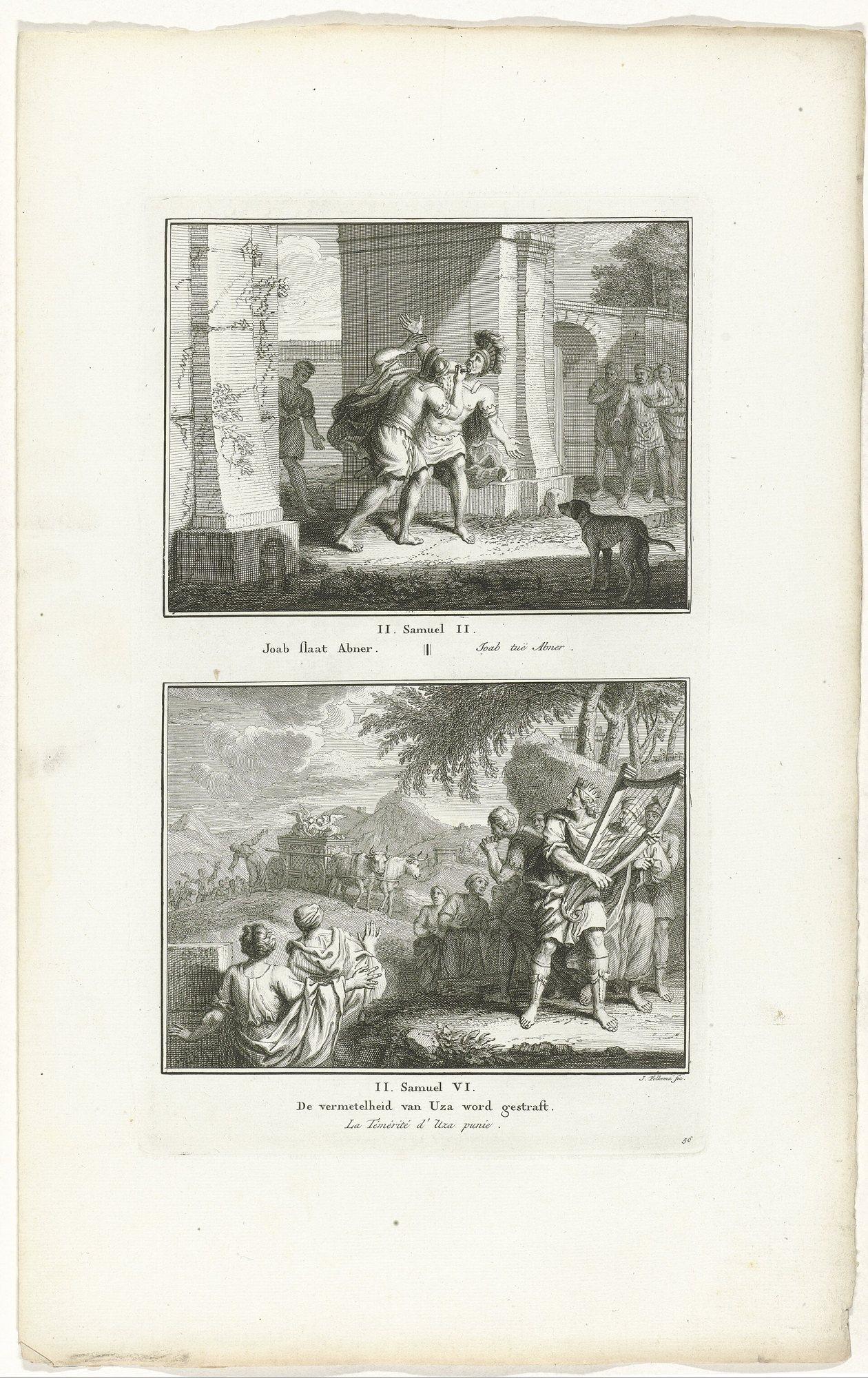
Jacob Folkema, Joab kills Abner and the death of Uza, 1791. Public domain.
1 Chronicles 13 and 15 · Story · Featured Study
The Death of Uzza and the Holiness of the Ark
Chronicles records Uzza's death beside the ark and the consecration of the Levites before the ark moved again.
Uzza put his hand on the ark when the oxen stumbled, and the Chronicler names that act as the cause of his death.
It was because you Levites were not with us the first time that the LORD our God burst forth in anger against us. For we did not consult Him about the proper order.”
It was because you Levites were not with us the first time that the LORD our God burst forth in anger against us. For we did not consult Him about the proper order.”
- Where
- Kiriath-jearim, Jerusalem
- Who
- David, Uzzah, Obed-edom
- When
- early in David's reign over all Israel, with three months between the two processions
Summary
David and all Israel agreed to bring the ark of God from Kiriath-jearim. They set it on a new cart. At the threshing floor of Chidon the oxen stumbled. Uzza took hold of the ark, and the LORD struck him down. David was afraid and left the ark with Obed-edom. Three months later he told the Levites why the first attempt had failed.
- The threshing place is Chidon in Chronicles and Nacon in Samuel.
- God blessed Obed-edom's household while the ark stayed there.
- Five readings of the judgment stand with their objections.
The Death at Chidon
David put the plan to the assembly, and the procession stopped at a threshing floor.
David conferred with the commanders of thousands and of hundreds and then put the plan to the whole assembly of Israel. He asked whether it seemed good to them and whether it was of the LORD their God, and the assembly agreed.
Then let us bring back the ark of our God, for we did not inquire of Him in the days of Saul.”The assembly agreed to this reason in the next verse.
They carried the ark from the house of Abinadab on a new cart, with Uzza and Ahio guiding it, while David and all Israel celebrated before God with songs and instruments.
When they came to the threshing floor of Chidon, Uzzah reached out and took hold of the ark, because the oxen had stumbled. And the anger of the LORD burned against Uzzah, and He struck him down because he had put his hand on the ark. So he died there before God.Second Samuel 6:7 gives the reason in a different word.
David was angry and afraid. He named the place Perez-uzza and took the ark aside to the house of Obed-edom the Gittite.
The study of David's dance tells the same day from 2 Samuel 6, with the law for carrying the ark and the second procession.
Two Accounts of One Day
Chronicles and 2 Samuel tell the first procession with six differences.
The two books differ on the place name, the stated reason and the place of death.
| Detail | 1 Chronicles 13 | 2 Samuel 6 |
|---|---|---|
| Who was gathered | All Israel, from the River Shihor in Egypt to Lebo-hamath | The chosen men of Israel, thirty thousand |
| The threshing floor | Chidon | Nacon |
| The cause given | His touch of the ark | For his irreverence |
| Where he died | There before God | Beside the ark of God |
| David's fear | David feared God | David feared the LORD |
| What comes next | Hiram's envoys, David's sons and two battles with the Philistines | The report that the LORD had blessed Obed-edom |
Six steps lead from the new cart to the consecrated Levites.
- The ark is set on a new cartKiriath-jearim1 Chronicles 13:7
- Uzza takes hold of the ark and diesChidon1 Chronicles 13:10
- The ark stays with Obed-edomObed-edom's household1 Chronicles 13:14
- David builds houses and pitches a tent for the arkThe City of David1 Chronicles 15:1
- David gathers the descendants of Aaron and the LevitesJerusalem1 Chronicles 15:4
- The priests and Levites consecrate themselvesJerusalem1 Chronicles 15:14
Six steps of 1 Chronicles 13 to 15, each with its place and its verse.
Two Verbs That Tie the Chapters
Two Hebrew verbs join chapter 13 to chapter 15, and 2 Samuel 6:7 gives its reason in a rare term.
The Hebrew verb of 1 Chronicles 13:3 and of 1 Chronicles 15:13 is dârash, to seek, written in the same form. The first verse names Saul's years and the second names the first procession.
The verb for the LORD's bursting forth against Uzza in 1 Chronicles 13:11 returns in 1 Chronicles 15:13, in David's words to the Levites. The Hebrew dictionary of James Strong gives it as pârats, to break out.
Second Samuel 6:7 gives the cause as shal, a word that dictionary counts once in the Old Testament and glosses as a fault. Albert Barnes calls the Hebrew difficult.
The Council Before the Cart
Chronicles opens the story with David asking the assembly.
Matthew Henry marks the council of 1 Chronicles 13:1 to 4 as a part of the story that Samuel lacks.
Albert Barnes holds that the captains of thousands and of hundreds were probably an order already established in the tribes. In his judgment David was the first to treat these officers as representatives of the people and to consult them on public affairs.
Jamieson, Fausset and Brown hold that the ark had been left in culpable neglect during Saul's reign. John Gill reads David's words as a judgment on Saul himself, whom he calls indifferent to religion.
What the Text Leaves Unsaid
Two things are left untold, about Uzza's tribe and about Obed-edom.
First Chronicles 13:7 gives neither driver of the cart a tribe. Second Samuel 6:3 calls them the sons of Abinadab.
First Chronicles 26:4 to 5 lists an Obed-edom among the Levite gatekeepers, with eight sons, and adds that God had blessed him. Adam Clarke takes the Gittite of 1 Chronicles 13 to be this Levite, who had sojourned at Gath; the text does not join the two in one verse.
The God Who Struck and Helped
The Chronicler sets God's help to the Levites beside His anger at Chidon.
And because God helped the Levites who were carrying the ark of the covenant of the LORD, they sacrificed seven bulls and seven rams.The help is named as the reason for the sacrifice.
Then Moses said to Aaron, “This is what the LORD meant when He said: ‘To those who come near Me I will show My holiness, and in the sight of all the people I will reveal My glory.’” But Aaron remained silent.The words came after a death at the sanctuary, as Uzza's did.
Therefore, since we are receiving an unshakable kingdom, let us be filled with gratitude, and so worship God acceptably with reverence and awe. “For our God is a consuming fire.”The letter carries the same awe into the new covenant.
The study of Nadab and Abihu tells their story, and the study of holiness gathers the Bible's teaching on the holy.
Voices on Uzza
One commentator draws a lesson from the failed procession.
Matthew Henry (1662 to 1714)
Commentary on the Whole Bible
The note reads David's confession as a rule for every act of worship.
“‘We did not go about our work considerately; and therefore we sped so ill.’ Note, It is not enough that we do that which is good, but we must do it well--not enough that we seek God in a due ordinance, but we must seek after him, in a due order.”
on 1 Chronicles 15:13Puritan
Why Did Uzza Die?
Each reading of the judgment stands here with its holders and an objection.
The law forbade the touchJohn Gill, Josephus, and Keil and Delitzsch
John Gill holds that the Levites were absent from the first procession, where their duty lay, and that Uzza was no Levite. Josephus writes that God struck him dead because he was not a priest and yet touched the ark. Keil and Delitzsch hold that Uzza had no idea of the ark's unapproachable holiness.
The Jewish Encyclopedia reports the rabbis' reasoning from Sotah 35a: if the ark could bear those who bore it, so much the more could it bear itself.
The objection: Adam Clarke judges that Uzza sinned through ignorance and haste, with no time to reflect when the oxen stumbled.
A lesson in awe for all IsraelJamieson, Fausset and Brown, Salvian the Presbyter and Adam Clarke
Jamieson, Fausset and Brown hold that the divine purpose was to inspire awe of His majesty, submission to His law and veneration for the symbols of His worship. Salvian the Presbyter, in The Governance of God, taught from such cases that nothing which pertains to God may be considered lightly. Clarke adds that the people might have lost their respect for the ark had Uzza touched it unpunished.
The objection: 1 Chronicles 13:10 gives the cause in Uzza's own act.
The leaders' disorder, borne by one manDavid in 1 Chronicles 15:13, with Matthew Henry
David's words of 1 Chronicles 15:13 lay the fault on the order of the first procession. Matthew Henry holds that the rule was express and that David himself forgot it and put the ark on a cart.
The objection: the anger of the LORD burned against Uzza himself, by 1 Chronicles 13:10.
His heart was unpreparedPacian of Barcelona
Pacian of Barcelona, in On Penitents, wrote that Uzza touched the side of the ark without having examined his conscience.
The objection: the Chronicler records the act and gives no word of Uzza's thoughts.
A story that explains a place nameCurtis and Madsen
Curtis and Madsen allow that Uzza's death while the ark was moved may be historical. They also allow that the story may have begun as an explanation of the local name Perez-uzza.
The objection: both books tell the death first and give the name as David's answer to it (1 Chronicles 13:11; 2 Samuel 6:8).
Books to Read Next
Both works are in the public domain, and each has a free copy to read.
A Critical and Exegetical Commentary on the Books of Chronicles
Edward Lewis Curtis and Albert Alonzo Madsen · 1910
Curtis and Madsen weigh whether the story of Uzza explains the name Perez-uzza.
Read at the Internet ArchiveBiblical Commentary on the Books of Samuel
C. F. Keil and F. Delitzsch · 1880
Keil's note on 2 Samuel 6 is the one his commentary on Chronicles sends the reader to.
Read at the Internet ArchiveSought in the Proper Order
The second procession went up with rejoicing and brought the ark home.
Who may ascend the hill of the LORD? Who may stand in His holy place?The psalm asks the question the two processions answered.
Sources
Scripture is the Berean Standard Bible.
- Matthew Henry, Commentary on the Whole Bible (1710), on 1 Chronicles 13:1 to 3.
- Matthew Henry, Commentary on the Whole Bible (1710), on 1 Chronicles 15:2.
- Matthew Henry, Commentary on the Whole Bible (1710), on 1 Chronicles 15:13.
- Matthew Henry, Commentary on the Whole Bible (1710), on 2 Samuel 6:6.
- Albert Barnes, Notes, Explanatory and Practical, on the Old and New Testaments (1832 to 1869), on 1 Chronicles 13:1.
- Albert Barnes, Notes, Explanatory and Practical, on the Old and New Testaments (1832 to 1869), on 1 Chronicles 15:13.
- Albert Barnes, Notes, Explanatory and Practical, on the Old and New Testaments (1832 to 1869), on 2 Samuel 6:7.
- Jamieson, Fausset and Brown, Commentary Critical and Explanatory on the Whole Bible (1871), on 1 Chronicles 13:1 to 3.
- Jamieson, Fausset and Brown, Commentary Critical and Explanatory on the Whole Bible (1871), on 2 Samuel 6:6 to 8.
- John Gill, Exposition of the Old Testament (1748 to 1763), on 1 Chronicles 13:3.
- John Gill, Exposition of the Old Testament (1748 to 1763), on 1 Chronicles 15:13.
- Adam Clarke, Commentary on the Bible (1832), on 2 Samuel 6:6.
- Adam Clarke, Commentary on the Bible (1832), on 2 Samuel 6:7.
- Adam Clarke, Commentary on the Bible (1832), on 1 Chronicles 13:14.
- Salvian the Presbyter, The Governance of God 6.10, dated 500 in its quotation row.
- Pacian of Barcelona, On Penitents 6.3, dated 391 in its quotation row.
- C. F. Keil and F. Delitzsch, Biblical Commentary on the Books of Samuel (Edinburgh: T. and T. Clark, 1880), on 2 Samuel 6:6 to 7, to which their note on 1 Chronicles 13 refers.
- Edward Lewis Curtis and Albert Alonzo Madsen, A Critical and Exegetical Commentary on the Books of Chronicles, International Critical Commentary (New York: Scribner, 1910), on 1 Chronicles 13:9 to 11.
- Flavius Josephus, Antiquities of the Jews 7.4.2, translated by William Whiston.
- The Jewish Encyclopedia, article Uzza, Uzzah, citing Sotah 35a.
Keep Studying
Subjects1
Values2