
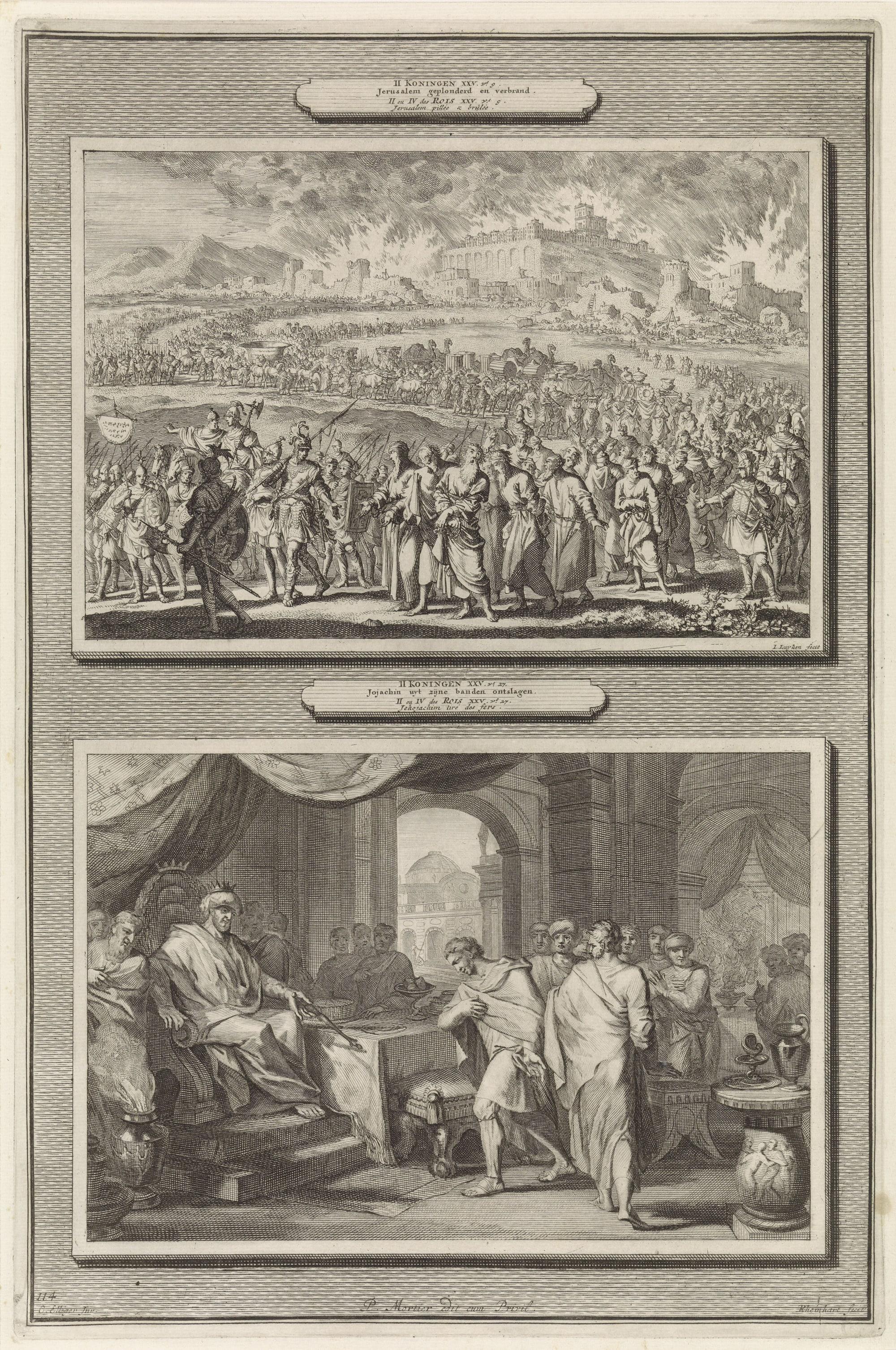
Jan Luyken and Andreas Reinhard after Ottmar Elliger, 1700. Public domain.
2 Kings 25:27 to 30 · Story · Featured Study
Jehoiachin Released and the Lamp of David
Kings names a lamp for David three times and closes with David's heir freed from prison in Babylon.
After thirty-seven years a prisoner, the heir of David was dressed again as a king.
Yet for the sake of His servant David, the LORD was unwilling to destroy Judah, since He had promised to maintain a lamp for David and his descendants forever.
Yet for the sake of His servant David, the LORD was unwilling to destroy Judah, since He had promised to maintain a lamp for David and his descendants forever.
- Where
- Babylon
- Who
- Jehoiachin, Evil Merodach, David
- When
- Jehoiachin was freed soon after the death of Nebuchadnezzar
Summary
Jehoiachin gave himself up to Nebuchadnezzar. Long afterward a new ruler in Babylon set him free, gave him honour and fed him for life. Kings had promised David a lamp.
- The wording of the release recalls Joseph's rise and David's kindness to Jonathan's son.
- The ruler who freed him may have reigned only a short time.
- Keil reads the last scene as hope for David's line, and Clarke as the close of the kingdom.
The Four Verses at the End
The book of Kings ends with a captive king's change of clothes and a seat at a foreign table.
On the twenty-seventh day of the twelfth month of the thirty-seventh year of the exile of Judah’s King Jehoiachin, in the year Evil-merodach became king of Babylon, he released King Jehoiachin of Judah from prison. And he spoke kindly to Jehoiachin and set his throne above the thrones of the other kings who were with him in Babylon. So Jehoiachin changed out of his prison clothes, and he dined regularly at the king’s table for the rest of his life. And the king provided Jehoiachin a daily portion for the rest of his life.Every reading of the release starts from these verses.
Jeremiah's book ends with the same account in nearly the same words.
The study of the last kings of Judah tells how Jehoiachin came to Babylon, and weighs the day of his release against Jeremiah's.
The Lamp of David, and Three Echoes
Keil hears two older stories in the release.
Six verses name a lamp for David, from his own battles to the psalm of his anointed.
- David's men swear he will not go out to battle againDavid himself, the lamp of Israel2 Samuel 21:17
- Ahijah's word to JeroboamOne tribe kept for Solomon's son1 Kings 11:36
- The reign of AbijamA son raised up to succeed him1 Kings 15:4
- The reign of Jehoram, who married Ahab's daughterThe kingdom of Judah under Jehoram2 Kings 8:19
- The same reign in ChroniclesThe covenant made with David2 Chronicles 21:7
- Psalm 132, which asks the LORD to remember DavidDavid's heir, the king the LORD chosePsalm 132:17
Six verses in the order of the books, each with what the lamp names there.
Keil hears Joseph and Mephibosheth in the four verses.
| In 2 Kings 25 | The older text | Who was raised there |
|---|---|---|
| The release, in Hebrew a lifting of the head | Pharaoh will lift up your head | The cupbearer, in Joseph's prison |
| The prison garments put off | Pharaoh clothed him in garments of fine linen | Joseph |
| A place at the royal table | You will always eat at my table | Mephibosheth, son of Jonathan |
The Raised Throne Among the Captive Kings
Commentators read the raised throne as a literal seat or as a place of honour.
Hitzig and Thenius, as Keil reports them, took the higher throne literally. Keil reads it as a figure for a more honoured place. He takes the other kings as dethroned captives kept at court to add to its splendour, as Cyrus kept Croesus at his side.
Albert Barnes also takes them as captive kings and points to Judges 1:7. He notes that eastern kings fed many people at court, and a few had the privilege of sitting at the royal table itself.
Adam Clarke comments on the same words in Jeremiah 52:32. He reads them as a more honoured seat than any of the captive princes had, probably near the king's person.
Who Was Evil-merodach?
Two accounts preserved by Josephus give Nebuchadnezzar's son very different reigns.
Josephus, in Against Apion, quotes Berossus, whom he calls a Chaldean by birth. Berossus writes that Evil-merodach governed in a lawless and impure manner, and that Neriglissoor, his sister's husband, killed him after two years.
In the Antiquities of the Jews, Josephus gives Evil-merodach eighteen years. He says the king freed Jeconiah because Nebuchadnezzar had not kept faith with him after he gave himself up to save the city.
Keil and Delitzsch follow Berossus and judge the eighteen years evidently false. Keil adds that no safe conjecture can be made about the king's motives for the pardon.
Ishodad of Merv, in his Books of Sessions, gives a tradition that Nebuchadnezzar had imprisoned this son for ruling badly in his absence.
What the Text Leaves Unsaid
The account leaves the king's motive and his fellow captives unexplained.
The text gives no reason for the pardon, and it names none of the other kings who were with Jehoiachin in Babylon.
It does not say whether Jehoiachin outlived the king who freed him. Keil notes that the favour could have continued under the next king. Adam Clarke reports the opinion that Jehoiachin fell with his protector about two years later.
A Sign of Hope, or the End of the Kingdom?
Two readings of the last scene stand with their holders.
A sign that the line would not be cast offC. F. Keil and F. Delitzsch
Keil finds the higher ground of the release in God's decree that the seed of David, though severely chastised, should not be utterly rejected. He calls it a comforting sign to the captives. The LORD would one day end their banishment if they turned to him with all their heart.
I will be his Father, and he will be My son. When he does wrong, I will discipline him with the rod of men and with the blows of the sons of men. But My loving devotion will never be removed from him as I removed it from Saul, whom I moved out of your way.Keil names these verses of the promise to David.
The objection: the four verses give no word of the LORD and name no return.
The close of the kingdom's historyAdam Clarke and John Wesley
Adam Clarke closes his notes on Kings with the catastrophe of the Jewish kings, people and state. He calls it the consequence of rebellion against the Majesty of heaven. At the end of Jeremiah, John Wesley writes that here ends the history of the kingdom of Judah. He then turns to the severe judgment of God on the people.
The objection: the book chose to end on the king's kindness and a portion for life, and Keil reads that choice as deliberate.
Voices on the Release
Matthew Henry read the change of clothes as a picture of the death of the saints.
Matthew Henry (1662 to 1714)
Commentary on the Whole Bible
How this text has been taught
“However the death of afflicted saints is to them such a change as this was to Jehoiachin: it will release them out of their prison, shake off the body, that prison-garment, and open the way to their advancement; it will send them to the throne, to the table, of the King of kings, the glorious liberty of God's children.”
on 2 Kings 25:29Puritan
What Is David's Lamp?
Three readings of the lamp have their holders, and each meets an objection from the texts.
A son on the throne, and at last the MessiahAdam Clarke, John Wesley and Matthew Henry
Adam Clarke reads the lamp as a posterity that would never fail, with the royal line never extinct, in reference to the Messiah. John Wesley reads it as a successor in David's family for ever, and above all the Messiah. Matthew Henry holds that the house of David was kept because the Messiah must come from it.
The objection: Kings sets the lamp in Jerusalem, and the book ends with David's heir in Babylon.
A house that goes onAlbert Barnes
Albert Barnes calls the exact meaning of the expression doubtful. He suggests that the light stands for a continuing home.
The objection: 2 Samuel 21:17 calls David himself the lamp of Israel.
The lamp prepared was John the BaptistAugustine of Hippo
Augustine, in his Sermon 308A, took the lamp prepared for the anointed in Psalm 132:17 to be John the Baptist. In his reading, Christ's enemies were put to shame when the light of that lamp was brought out.
The objection: in Kings the lamp is a son of David raised up to reign in Jerusalem.
Books to Read Next
Both works are in the public domain, and each has a free copy to read.
Biblical Commentary on the Old Testament, on 2 Kings
C. F. Keil and F. Delitzsch · 1857 to 1878
Keil sets the release beside Joseph and Mephibosheth and weighs the reign of Evil-merodach.
Read at Bible HubNotes, Explanatory and Practical, on the Old and New Testaments
Albert Barnes · 1832 to 1869
Barnes reads the captive kings and the royal table of 2 Kings 25:28 to 29.
Read at Bible HubA Horn for David
Albert Barnes holds that the horn promised to David in Psalm 132:17 had no first reference to the Messiah. He judges that Luke 1:69 rightly applies it to him as a son of David.
He has raised up a horn of salvation for us in the house of His servant David,Barnes sends his readers to this verse from his note on the psalm.
Sources
Scripture is the Berean Standard Bible.
- C. F. Keil and F. Delitzsch, Biblical Commentary on the Old Testament (1857 to 1878), on 2 Kings 25:27 to 30.
- Flavius Josephus, Against Apion 1.19 and 1.20, quoting Berossus, translated by William Whiston.
- Flavius Josephus, Antiquities of the Jews 10.11.2, translated by William Whiston.
- Ishodad of Merv, Books of Sessions, on 2 Kings 25:27.
- Albert Barnes, Notes, Explanatory and Practical, on the Old and New Testaments (1832 to 1869), on 2 Kings 25:28 and 2 Kings 25:29.
- Albert Barnes, Notes, on 1 Kings 11:36.
- Adam Clarke, Commentary on the Bible (1832), on Jeremiah 52:32.
- Adam Clarke, Commentary on the Bible (1832), on 1 Kings 11:36.
- Adam Clarke, Commentary on the Bible (1832), on 2 Kings 25:30.
- John Wesley, Explanatory Notes upon the Old Testament (1765), on Psalm 132:17.
- John Wesley, Explanatory Notes upon the Old Testament (1765), on Jeremiah 52:34.
- Matthew Henry, Commentary on the Whole Bible (1710), on 1 Kings 11:36.
- Matthew Henry, Commentary on the Whole Bible (1710), on 2 Kings 25:29.
- Albert Barnes, Notes, on Psalm 132:17.
- Augustine of Hippo, Sermon 308A.8, on Psalm 132:17 and 18.
Keep Studying
Studies5
People and groups7
Places2
Symbols1
Doctrines1