
Joshua to Esther · Book · Featured Study
The Historical Books
Twelve books, Joshua to Esther, carry Israel's history from the crossing of the Jordan to the rebuilt walls of Jerusalem.
Over nearly ten centuries on the early reckoning, Israel takes the land, loses it to two empires and is brought back by a third.
- Date
- from the conquest of Canaan to the return from Babylon, about 1406 to 430 BC on the early reckoning (proposed)
- Written by
- Not named in the books themselves, Joshua, Samuel, Jeremiah and Ezra among the writers, on the reading of the Babylonian Talmud, compiled in about AD 450 to 550 (Bava Batra 15a)
- Occasion
- A history told as the keeping and breaking of the covenant.
- Edition
- The Hebrew text, read in English in the Berean Standard Bible
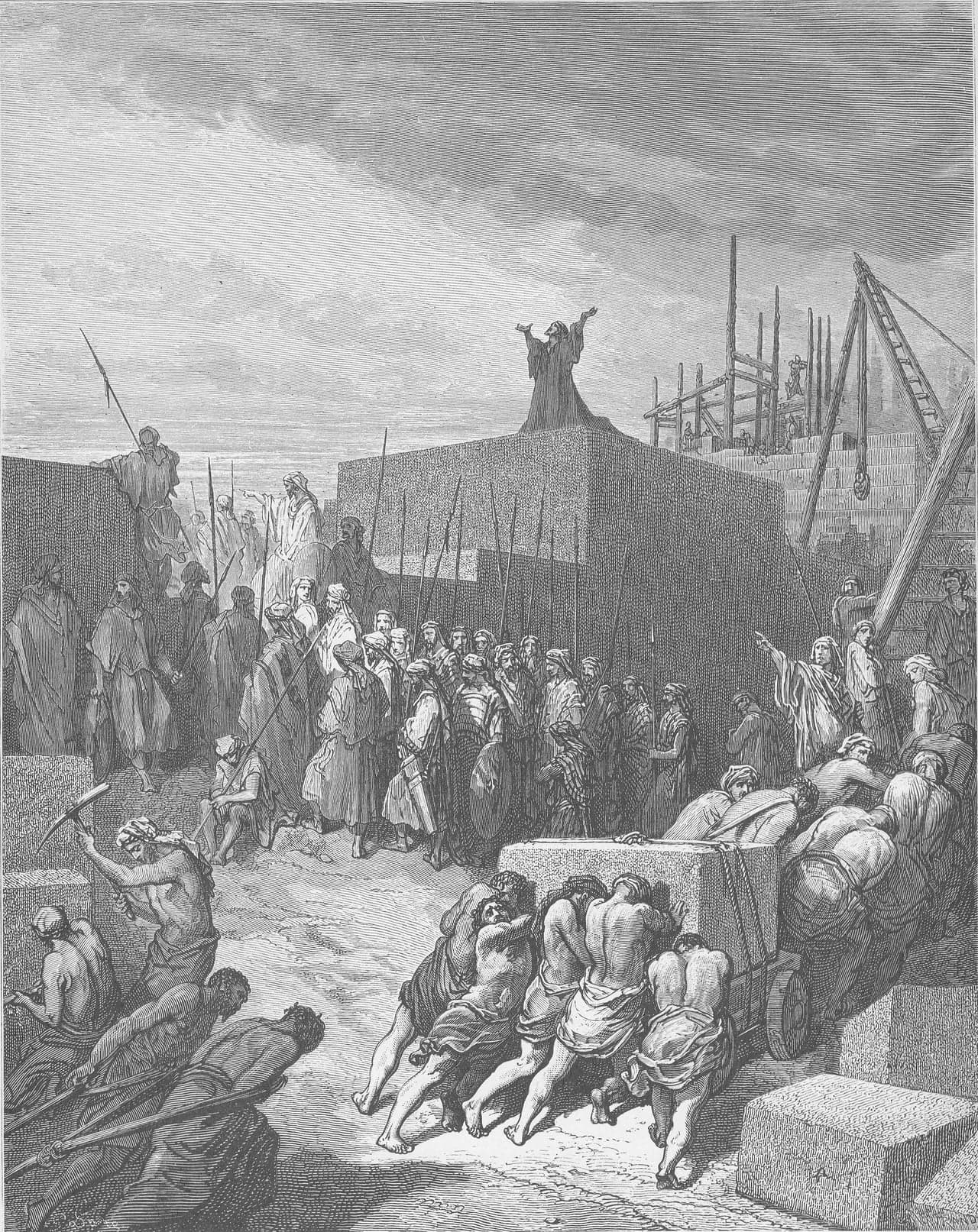
Gustave Doré, The Rebuilding of the Temple Is Begun, 1866. Public domain.
Summary
The historical books are the twelve books from Joshua to Esther that tell Israel's story from the conquest of Canaan to the return from exile. The Christian Old Testament sets them between the Torah and the poetic books. They judge each generation by the covenant, and they carry the promise to David's house from his throne through the exile.
- The account runs in five movements: the conquest, the judges, the united kingdom, the divided kingdom and the return.
- Solomon began the temple 480 years after the exodus, in the fourth year of his reign (1 Kings 6:1).
- The kingdom divided after Solomon, and both halves went into exile, the north to Assyria and Judah to Babylon.
- Cyrus of Persia let the exiles go home, and the last of the twelve books is set in the court of a later Persian king.
The Arc
Each movement turns on one verse.
The divided kingdom is the longest of the five movements, about 344 years.
To scale: 5 of 5 stops dated; a ring is approximate; a bar is a span; a mark that would lie on another stands in a lane under the axis.
- The conquestabout 1406 BCJoshua leads Israel over the Jordan, takes the land and divides it by lot among the tribes.Joshua 21:45
- The judgesabout 1375 to 1050 BCIsrael turns from the LORD, is oppressed, cries out and is rescued, again and again.Judges 21:25
- The united kingdomabout 1050 to 930 BCSaul, David and Solomon reign over all twelve tribes, and Solomon builds the temple.1 Kings 6:1
- The divided kingdom930 to 586 BCIsrael in the north and Judah in the south go their own ways until each is taken into exile.2 Kings 17:6
- The return538 to 445 BCExiles go home in three companies: under Zerubbabel after Cyrus's decree of 538 BC, under Ezra with the law about 458 BC, and under Nehemiah to rebuild the wall about 445 BC.Ezra 1:2
A timeline of the five movements of the historical books, with the dates of the early reckoning.
The conquest ends in Joshua 21.
Not one of all the LORD’s good promises to the house of Israel had failed; everything was fulfilled.Every later failure in these books is measured against this verdict on the LORD's word.
Judges ends with a refrain that explains the disorder of the whole era. Ruth is set in the same days and follows one family of Bethlehem whose line leads to David (Ruth 4:17).
In those days there was no king in Israel; everyone did what was right in his own eyes.The refrain prepares for 1 Samuel, where Israel asks for a king.
Samuel anoints Saul and then David, and Kings dates the start of Solomon's temple from the exodus.
In the four hundred and eightieth year after the Israelites had come out of the land of Egypt, in the month of Ziv, the second month of the fourth year of Solomon’s reign over Israel, he began to build the house of the LORD.This verse is the anchor of the early reckoning: 480 years from the exodus to the temple's foundation.
The kingdom divides after Solomon's death (1 Kings 12). Samaria falls to Assyria in 722 BC, and Jerusalem falls to Babylon in 586 BC (2 Kings 25:9).
In the ninth year of Hoshea, the king of Assyria captured Samaria and carried away the Israelites to Assyria, where he settled them in Halah, in Gozan by the Habor River, and in the cities of the Medes.From here the account follows Judah alone.
The exiles who came home finish the second temple in 516 BC (Ezra 6:15).
“This is what Cyrus king of Persia says: ‘The LORD, the God of heaven, who has given me all the kingdoms of the earth, has appointed me to build a house for Him at Jerusalem in Judah.Ezra opens with the decree that sends the first company of exiles home.
1 Kings 6:1, 2 Kings 17:6, Ezra 1:2
The Books
Each of the twelve books belongs to one of the five movements, drawn to scale by its chapters.
2 Chronicles is the longest of the twelve books at thirty-six chapters, and Ruth the shortest at four.
- The conquest
- The judges
- The united kingdom
- The divided kingdom
- The return
The twelve counts as a table
| Book | Chapters | Movement | Verse |
|---|---|---|---|
| Joshua | 24 | The conquest | Joshua 1:1 |
| Judges | 21 | The judges | Judges 1:1 |
| Ruth | 4 | The judges | Ruth 1:1 |
| 1 Samuel | 31 | The united kingdom | 1 Samuel 1:1 |
| 2 Samuel | 24 | The united kingdom | 2 Samuel 1:1 |
| 1 Kings | 22 | The united kingdom | 1 Kings 1:1 |
| 2 Kings | 25 | The divided kingdom | 2 Kings 1:1 |
| 1 Chronicles | 29 | The united kingdom | 1 Chronicles 1:1 |
| 2 Chronicles | 36 | The divided kingdom | 2 Chronicles 1:1 |
| Ezra | 10 | The return | Ezra 1:1 |
| Nehemiah | 13 | The return | Nehemiah 1:1 |
| Esther | 10 | The return | Esther 1:1 |
Each bar is one book's chapters in the Berean Standard Bible, coloured by its movement; the table under the bars gives each book's opening verse.
Chronicles retells the united and divided kingdoms, and Esther stands among the Jews who stayed in Persia.
| Book | What it holds |
|---|---|
| Joshua | The land taken and divided, the promises to the fathers made good. |
| Judges | The cycle of turning away, oppression and rescue, tribe by tribe. |
| Ruth | A Moabite widow's loyalty and Boaz's redemption, ending with David's name. |
| 1 Samuel | The last judge, the first king and the shepherd anointed in his place. |
| 2 Samuel | David's reign, from Hebron to Jerusalem, and Absalom's revolt. |
| 1 Kings | Solomon's temple, then the split into two kingdoms under two kings. |
| 2 Kings | Both kingdoms to their ends, Samaria taken by Assyria and Jerusalem by Babylon. |
| 1 Chronicles | The genealogies from Adam, then David's reign and his plans for the temple. |
| 2 Chronicles | Solomon and the kings of Judah, to Cyrus's decree. |
| Ezra | The altar and the temple rebuilt, then Ezra's coming with the law. |
| Nehemiah | Jerusalem's wall rebuilt in fifty-two days and the law read aloud. |
| Esther | A Jewish queen in the Persian court and the deliverance of her people. |
2 Kings, 1 Chronicles, 2 Chronicles, Ezra, Nehemiah, Esther
The Divided Kingdom and Its Prophets
After Solomon the account follows two kingdoms, and the prophets spoke into each.
The northern kingdom, Israel, held ten tribes and was later ruled from Samaria. Jeroboam set up golden calves at Bethel and Dan (1 Kings 12:28 to 30), and Kings judges the northern kings by that sin.
Judah kept David's line at Jerusalem. Kings explains why the LORD spared it through the reigns of wicked kings.
Nevertheless, for the sake of David, the LORD his God gave him a lamp in Jerusalem by raising up a son to succeed him and to make Jerusalem strong.After Abijam's reign Kings says Judah stood for David's sake.
Yet for the sake of His servant David, the LORD was unwilling to destroy Judah, since He had promised to maintain a lamp for David and his descendants forever.Under Jehoram the same promise holds Judah back from destruction.
Kings and Chronicles record the reigns, and the books of the prophets keep what the prophets said to those kings and their people.
The prophets of the north spoke before 722 BC, and Jeremiah spoke in Judah until 586 BC.
| Prophet | Kingdom | When |
|---|---|---|
| Elijah and Elisha | Israel, the north | The ninth century BC, under Ahab and his sons |
| Amos and Hosea | Israel, the north | The eighth century BC, before the fall of Samaria |
| Isaiah and Micah | Judah, the south | The eighth century BC, from Uzziah to Hezekiah |
| Jeremiah | Judah, the south | From Josiah's thirteenth year to the fall of Jerusalem |
Dating the Arc
Readers agree on the dates of the falls and the return and differ on the date of the conquest.
The early date: the conquest about 1406 BC1 Kings 6:1 read as a count of years
Solomon's fourth year falls about 966 BC, and 480 years before it gives an exodus about 1446 BC. Forty years in the wilderness then set the crossing of the Jordan about 1406 BC. Eugene Merrill holds this reading in Kingdom of Priests (1987).
The late date: the conquest in the thirteenth century BCThe 480 years read as a round figure
This reading ties the store city of Rameses in Exodus 1:11 to Ramesses II and takes the 480 years of 1 Kings 6:1 as a round or summed figure. K. A. Kitchen holds it in On the Reliability of the Old Testament (2003), placing the exodus about 1260 BC.
Books to Read Next
Josephus and Thiele can each be read free online.
Antiquities of the Jews
Flavius Josephus, tr. William Whiston · 1737
Books 5 to 11 retell the history from Joshua to the Persian kings, with details the biblical books do not give.
Read it at Project GutenbergThe Mysterious Numbers of the Hebrew Kings
Edwin R. Thiele · 1951
It works through every reign of Israel and Judah and fits them to the dates of Assyria and Babylon.
Borrow it at the Internet ArchiveThe Law Read in the Rebuilt City
The history ends with the exiles back in the land and the house of God rebuilt.
The books judge Israel by the covenant: obedience brings blessing, rebellion brings exile, and mercy brings the people back.
So they read from the Book of the Law of God, explaining it and giving insight, so that the people could understand what was being read.The history that opened with the Book of the Law given to Joshua (Joshua 1:8) closes with the same law read aloud.
The lamp kept burning for David in these books is the promise of 2 Samuel 7:16. The New Testament reads that promise at Luke 1:32 to 33.
He will be great and will be called the Son of the Most High. The Lord God will give Him the throne of His father David, and He will reign over the house of Jacob forever. His kingdom will never end!”The angel names Mary's Son as the King of David's line whose kingdom will never end.
Sources
Scripture is the Berean Standard Bible.
- Babylonian Talmud, Bava Batra 14b to 15a, William Davidson edition.
- Edwin R. Thiele, The Mysterious Numbers of the Hebrew Kings (Chicago, 1951; rev. 1983)
- Eugene H. Merrill, Kingdom of Priests: A History of Old Testament Israel (Baker, 1987)
- K. A. Kitchen, On the Reliability of the Old Testament (Eerdmans, 2003)
- Flavius Josephus, Antiquities of the Jews, tr. William Whiston (1737)
- Sefaria's index record of Bava Batra, for the date and place of the Babylonian Talmud's compilation.
Keep Studying
Read it13
Studies7
- The Judges' Cycle: the pattern across all twelve judges
- The Torah: Deuteronomy ends at Moses' grave and Joshua opens at the Jordan
- The Major Prophets: Isaiah, Jeremiah, Ezekiel and Daniel
- The Twelve: the shorter prophets, era by era
- Wisdom and the Poets
- What the Chronicler Leaves Out, and Why
Show the next 1 title
People and groups13
Show the next 6 titles
Doctrines9
Subjects1