
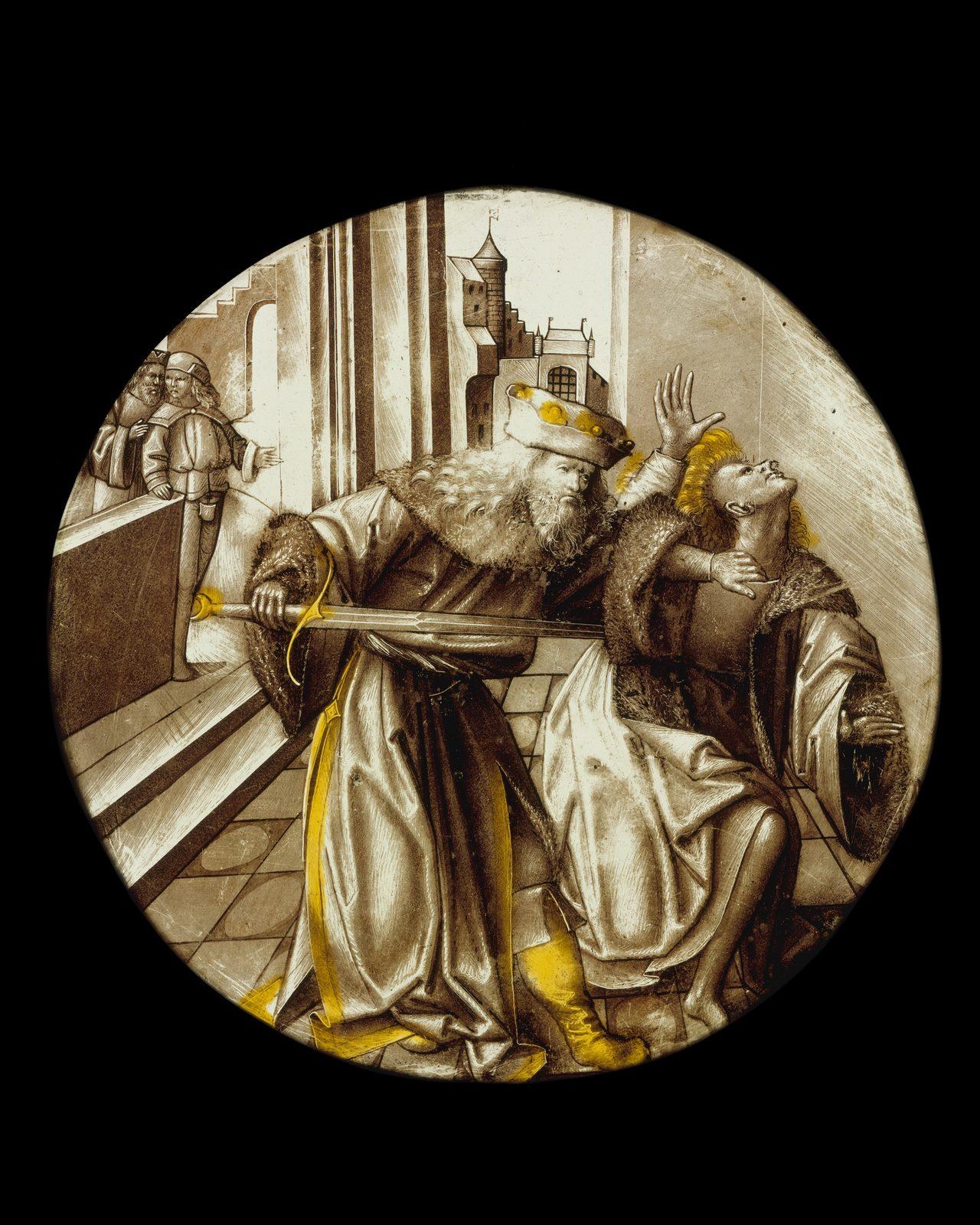
North Netherlandish glass painter, Roundel with Joab Murdering Abner, 1510 to 1520. Public domain.
1 Samuel 14 to 2 Samuel 3 · Person · Featured Study
Abner son of Ner
Saul's commander kept the house of Saul standing for years after Gilboa.
At sunset on the day of Gibeon, Abner called across the hills to Joab, “Must the sword devour forever?”
Then the king said to his servants, “Do you not realize that a great prince has fallen today in Israel?
- Died
- at Hebron, in the reign of Ish-bosheth
- Family
- father: Ner son of Abiel; cousin: Saul; son: Jaasiel
- Places
- Jezreel, Hebron
- First named
- 1 Samuel 14:50 “…commander of his army was Abner, the son…”
- Last named
- 1 Chronicles 27:21 “…Benjamin was Jaasiel son of Abner;”
Summary
Abner son of Ner commanded Saul's army. After Saul died he made Saul's son Ish-bosheth king over Israel and led its war against David's house. When Ish-bosheth accused him over Saul's concubine, he went over to David and promised to bring all Israel with him. He was killed in the gate of Hebron before he could keep that promise, and David mourned him as a prince.
- He dedicated spoil for the house of the LORD, as 1 Chronicles 26:28 records.
- Ish-bosheth lost courage when he heard that Abner had died.
- Ish-bosheth's head was buried in Abner's tomb at Hebron.
Where Abner Stands in Scripture
His name runs from Saul's household to the lists of David's officers.
Abner is named sixty-three times in fifty-three verses, in 1 Samuel, 2 Samuel, 1 Kings and 1 Chronicles. Thirty-eight of those verses are in 2 Samuel 2 and 3, in the account of Ish-bosheth's reign.
The text first names him in the list of Saul's household, beside Saul's wife and children.
His wife’s name was Ahinoam daughter of Ahimaaz. The name of the commander of his army was Abner, the son of Saul’s uncle Ner.The list closes the account of Saul's early wars, before the LORD rejects him in 1 Samuel 15.
His Life, Turn by Turn
His life runs from Saul's court to a tomb at Hebron.
He served Saul and Saul's son, and he died bringing Israel over to David.
- Named commander of Saul's armySaul's house1 Samuel 14:50
- Brings David to Saul with Goliath's head in his handthe valley of Elah1 Samuel 17:57
- Sits beside Saul at the New Moon feastSaul's table1 Samuel 20:25
- Sleeps beside Saul while David takes the spear and jugSaul's camp1 Samuel 26:7
- Makes Ish-bosheth king over IsraelMahanaim2 Samuel 2:8 to 9
- Is beaten by David's servantsthe pool of Gibeon2 Samuel 2:17
- Strikes down Asahel with the butt of his spearon the way from Gibeon2 Samuel 2:23
- Breaks with Ish-bosheth over RizpahMahanaim2 Samuel 3:7 to 8
- Feasts with David and leaves in peaceHebron2 Samuel 3:20 to 21
- Buried while the king weeps at the tombHebron2 Samuel 3:32
Six of the ten turns fall after the death of Saul.
Strikes down Asahel with the butt of his spear, Breaks with Ish-bosheth over Rizpah, Feasts with David and leaves in peace, Buried while the king weeps at the tomb
From Saul's Camp to the Gate of Hebron
His story runs from 1 Samuel 26 to 2 Samuel 3.
Abner served Saul through his pursuit of David, and after Saul's death he decided who would rule the northern tribes.
The guard who slept1 Samuel 26; Albert Barnes
So David said to Abner, “You are a man, aren’t you? And who in Israel is your equal? Why then did you not protect your lord the king when one of the people came to destroy him?David called this from a hilltop across the gulf to the man charged with the king's life.
Albert Barnes, in his Notes, reads the taunt as witness to Abner's standing as a warrior, and he judges that David blamed Saul's pursuit partly on Abner.
A king made at Mahanaim2 Samuel 2:8 to 11
Meanwhile, Abner son of Ner, the commander of Saul’s army, took Saul’s son Ish-bosheth, moved him to Mahanaim, and made him king over Gilead, Asher, Jezreel, Ephraim, and Benjamin—over all Israel.The men of Judah had already anointed David king at Hebron in 2 Samuel 2:4.
Ish-bosheth reigned two years. When he later rebuked Abner, he was too afraid of him to say another word.
The pool of Gibeon2 Samuel 2:12 to 32
Then Abner said to Joab, “Let us have the young men get up and compete before us.” “Let them get up,” Joab replied.This is the first meeting of Abner and Joab in the text.
Twelve men of each side killed one another, and the battle went against Abner. Asahel son of Zeruiah, fleet of foot like a wild gazelle, chased him.
Once again, Abner warned Asahel, “Stop chasing me. Why should I strike you to the ground? How could I show my face to your brother Joab?” But Asahel refused to turn away; so Abner thrust the butt of his spear into his stomach, and it came out his back, and he fell dead on the spot. And every man paused when he came to the place where Asahel had fallen and died.Abner's second warning names the feud he feared.
Abner turns to David2 Samuel 3:6 to 21
May God punish Abner, and ever so severely, if I do not do for David what the LORD has sworn to him: to transfer the kingdom from the house of Saul and to establish the throne of David over Israel and Judah, from Dan to Beersheba.”Abner gives the LORD's oath to David as the ground of what he now means to do.
He sent messengers to David and came to Hebron with twenty men. David set him one condition before he would see him.
Death in the gate2 Samuel 3:22 to 38
When Abner returned to Hebron, Joab pulled him aside into the gateway, as if to speak to him privately, and there Joab stabbed him in the stomach. So Abner died on account of the blood of Joab’s brother Asahel.The narrator gives the cause in the same verse as the blow, before David speaks.
Rashi, on 2 Samuel 3:26, explains the place name Bor-hasirah, the well of Sirah, by a saying of the rabbis: a well and a thorn caused Abner's death. He had dismissed the jug of water David took from Saul's head, and he had said that a thorn tore the corner of Saul's robe.
David declared himself and his kingdom guiltless of Abner's blood, ordered the people into sackcloth, and walked behind the bier himself.
A Commander Between Two Houses
Commentators hold that Ish-bosheth's kingdom stood by Abner alone.
Jamieson, Fausset and Brown judge that Ish-bosheth's kingdom would probably never have existed without Abner. Albert Barnes writes that only Abner's influence had kept the elders of Israel from declaring for David.
Now Abner conferred with the elders of Israel and said, “In the past you sought David as your king. Now take action, because the LORD has said to David, ‘Through My servant David I will save My people Israel from the hands of the Philistines and of all their enemies.’”This speech prepared the way for the covenant the elders made with David at Hebron in 2 Samuel 5:3.
The Family of Abner
His family runs from his grandfather Abiel to his son Jaasiel.
By 1 Samuel 14:51 he and Saul were the sons of two brothers.
Generation 1
- AbielHis grandfather, the father of Ner and Kish
Generation 2
Generation 3
Generation 4
- Ish-boshethSaul's son, whom he made king
- JaasielHis son, officer over Benjamin under David
Jaasiel is the one son of Abner the text names.
The Places of His Last Years
Four places mark his last years, from Jezreel to Hebron.
His last years ran from the northern lands of Ish-bosheth to David's city in Judah.
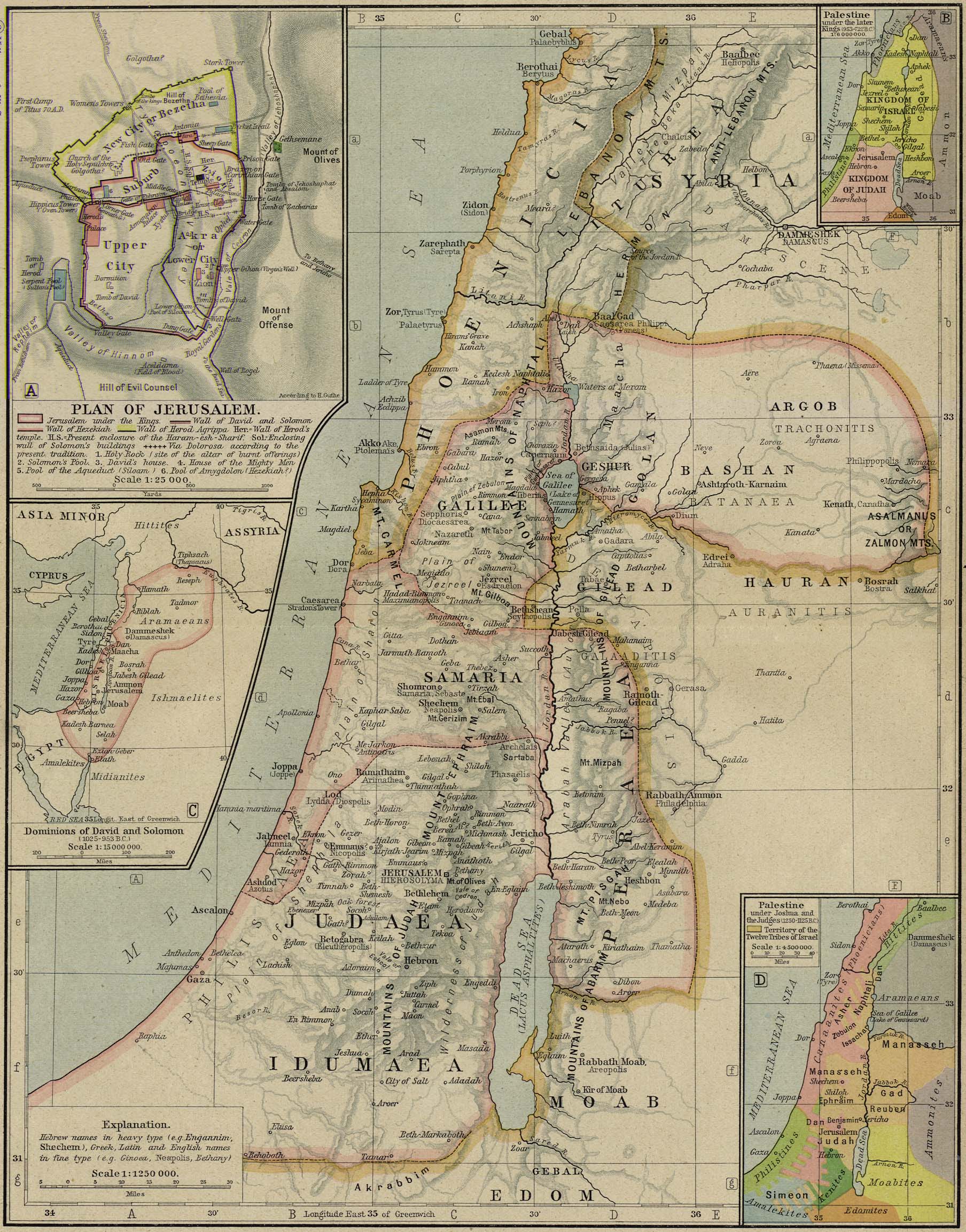
- 1Jezreel, One of the lands Abner set under Ish-bosheth's rule. 2 Samuel 2:9
- 2Mahanaim, Ish-bosheth's court stood there, and Abner marched out from it to Gibeon. 2 Samuel 2:12
- 3Gibeon, Abner's men met Joab's at its pool. 2 Samuel 2:13
- 4Hebron, Abner was killed in its gate and buried there. 2 Samuel 3:32
Not placed: Mahanaim (2), Gibeon (3).
Base map: Reference map of ancient Palestine, Rand McNally reference map (1926), public domain. Each place stands at its place page's coordinates, set on the plate by Jerusalem and Damascus, as the plate prints them.
Abner crossed the Jordan to reach Mahanaim after the battle.
Questions His Life Raises
Three questions answered from the text and its readers
Why did Abner go over to David?2 Samuel 3:8 to 12; Matthew Henry; Adam Clarke
Abner named the LORD's oath, but Adam Clarke asks why he had not acted on it before and says that by his own words he had been fighting against God. Matthew Henry finds the reason in revenge for Ish-bosheth's charge, and yet he sees God's hand in it: God can make men serve His kingdom who have no love for it.
Could Abner have spared Asahel?2 Samuel 2:19 to 23; C. F. Keil; Adam Clarke
C. F. Keil writes that Abner killed Asahel in battle, after repeated warnings, and only to save his own life. Adam Clarke adds that Asahel was the faster runner, so Abner had to kill or be killed.
So Abner told him, “Turn to your right or to your left, seize one of the young men, and take his equipment for yourself.” But Asahel would not stop chasing him.Abner first offered Asahel a lesser prize than himself.
Was Ish-bosheth's charge about Rizpah true?2 Samuel 3:7 to 8; Matthew Henry
Meanwhile, Saul had a concubine named Rizpah, the daughter of Aiah. So Ish-bosheth questioned Abner, “Why did you sleep with my father’s concubine?”Ish-bosheth's question opened the quarrel that turned Abner to David.
Matthew Henry first says it does not appear whether the charge was true. On the next verse he suspects Abner was guilty, because Abner answers in anger without denying it.
What the Text Leaves Unsaid
Three things the text does not tell about him
The text gives no age for Abner and names no wife. It does not say where he was on the day of Gilboa, when Saul and his sons fell.
How David Mourned Him
David's lament and Solomon's sentence both rank Abner over the man who killed him.
And the king sang this lament for Abner: “Should Abner die the death of a fool? Your hands were not bound, your feet were not fettered. As a man falls before the wicked, so also you fell.” And all the people wept over him even more.David's dirge for Abner follows his dirge for Saul and Jonathan in 2 Samuel 1.
John Wesley, in his Explanatory Notes, answers the question of the lament.
“Was he cut off by the hand of justice for his crimes? Nothing less; but by Joab's malice and treachery. It is a sad thing to die as a fool dieth, as they do that any way shorten their own days: and indeed all they that make no provision for another world.”
John Wesley · Explanatory Notes upon the Old Testament · on 2 Samuel 3:33Evangelical
The LORD will bring his bloodshed back upon his own head, for without the knowledge of my father David he struck down two men more righteous and better than he when he put to the sword Abner son of Ner, commander of Israel’s army, and Amasa son of Jether, commander of Judah’s army.Solomon gave this ground when he sent Benaiah against Joab.
Voices on Abner
Gregory the Dialogist read Abner's warnings to Asahel as a lesson for pastors.
How this text has been taught1 voice, Gregory the Dialogist
Gregory the Dialogist, in his Book of Pastoral Rule, held up Abner's warnings to Asahel as the way to meet a man who attacks in passion. When such a man cannot be avoided, Gregory taught, he is to be struck sparingly and with respectful caution, never with open rebuke.
Kin to the King: the Generations of Ner
First Samuel and Chronicles set Ner in different generations.
Ner was the father of Kish, Kish was the father of Saul, and Saul was the father of Jonathan, Malchishua, Abinadab, and Esh-baal.Chronicles sets Saul's line among the families of Gibeon.
Abner was Saul's cousinGregory the Dialogist, John Gill and C. F. Keil
Gregory the Dialogist, in his Commentary on 1 Kings, reads 1 Samuel 14:51 to make Abner the son of the brother of Saul's father. John Gill calls Abner Saul's own cousin, and C. F. Keil reads the verse as naming Kish and Ner both sons of Abiel.
The objection is that 1 Chronicles 8:33 and 1 Chronicles 9:39 make Ner the father of Kish.
Abner was Saul's uncleAlbert Barnes and Jamieson, Fausset and Brown
Albert Barnes, in his note on 1 Chronicles 8:33, sets the line as Abiel, then Ner, then Kish and Abner, then Saul, and prefers it to the line read from 1 Samuel. Jamieson, Fausset and Brown take Abiel and Ner as two names of one man.
The objection is that 1 Samuel 14:50 calls Ner Saul's uncle in so many words.
Books to Read Next
Both works are in the public domain, and each has a free copy to read.
Biblical Commentary on the Books of Samuel
C. F. Keil and F. Delitzsch · 1880
Keil weighs the death of Asahel and the killing in the gate in his notes on 2 Samuel 2 and 3.
Read at the Internet ArchiveA Critical and Exegetical Commentary on the Books of Samuel
Henry Preserved Smith · 1899
Smith sets the Hebrew of 2 Samuel 2 and 3 beside the Greek version.
Read at the Internet ArchiveWhen the Sword Is Put Away
Abner was stabbed in the gate of Hebron on the day he left David in peace. Isaiah foresaw a day when the nations would give up war.
Then He will judge between the nations and arbitrate for many peoples. They will beat their swords into plowshares and their spears into pruning hooks. Nation will no longer take up the sword against nation, nor train anymore for war.The promise belongs to the last days, when all peoples come up to the house of the God of Jacob.
Sources
Scripture is the Berean Standard Bible.
- James Strong, Exhaustive Concordance of the Bible, 1890, entry H74.
- C. F. Keil and F. Delitzsch, Biblical Commentary on the Books of Samuel, T. and T. Clark, 1880, pp. 149 and 306.
- Henry Preserved Smith, A Critical and Exegetical Commentary on the Books of Samuel, T. and T. Clark, 1899.
- Rashi (1040 to 1105), on 2 Samuel 3:26, The Metsudah Tanach series, Lakewood, N.J. (CC-BY)
- Albert Barnes, Notes, Explanatory and Practical, on the Old and New Testaments, 1832 to 1869, on 1 Samuel 26:15, 2 Samuel 3:17 and 1 Chronicles 8:33.
- Matthew Henry, Commentary on the Whole Bible, 1710, on 2 Samuel 3:7, 2 Samuel 3:8, 2 Samuel 3:9 to 10 and 2 Samuel 3:12.
- Adam Clarke, Commentary on the Bible, 1832, on 2 Samuel 2:21 and 2 Samuel 3:9.
- Jamieson, Fausset and Brown, Commentary Critical and Explanatory on the Whole Bible, 1871, on 2 Samuel 2:8 and 1 Chronicles 8:33.
- John Gill, Exposition of the Old Testament, 1748 to 1763, on 2 Samuel 2:8.
- John Wesley, Explanatory Notes upon the Old Testament, 1765, on 2 Samuel 3:33.
- Gregory the Dialogist (Gregory the Great, died 604), The Book of Pastoral Rule 3.16, and Commentary on 1 Kings 5.4.
Keep Studying
Read it4
Studies1
People and groups7