
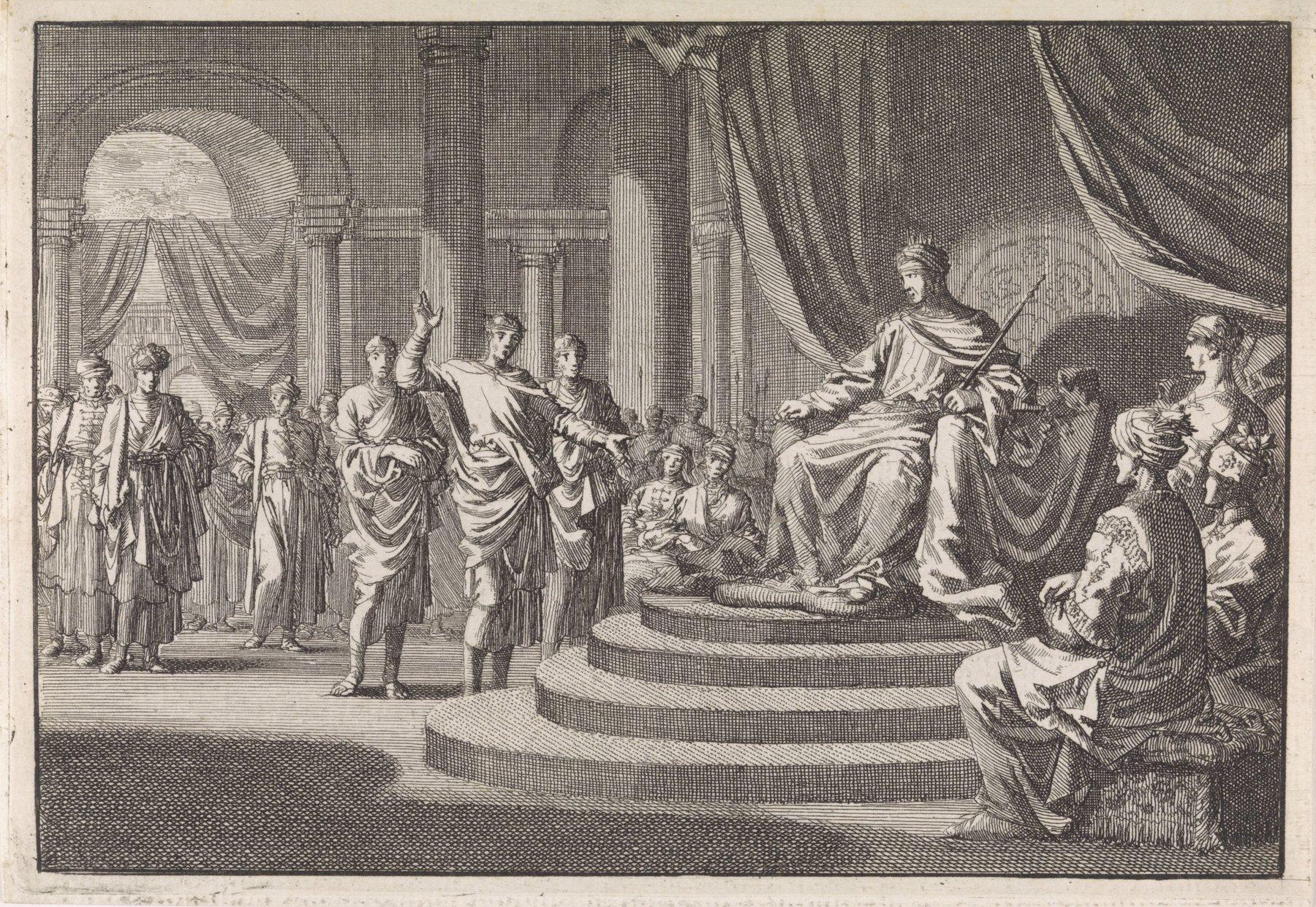
Jan Luyken, Zerubbabel before King Darius, 1704. Public domain.
Ezra 2 to 5 and Zechariah 4 · Person · Featured Study
Zerubbabel
Zerubbabel came home from Babylon with the first company of exiles and stood in the royal line of Jeconiah.
“The hands of Zerubbabel have laid the foundation of this house, and his hands will complete it. Then you will know that the LORD of Hosts has sent me to you.
- Family
- father, in 1 Chronicles 3:19: Pedaiah; father, in Ezra, Haggai and Matthew: Shealtiel; grandfather: Jeconiah; brother: Shimei; sons: Meshullam and Hananiah; daughter: Shelomith
- Places
- Babylon, Jerusalem
- First named
- 1 Chronicles 3:19 “The sons of Pedaiah: Zerubbabel and Shimei.…”
- Last named
- Luke 3:27 “…of Rhesa, the son of Zerubbabel, the son…”
The book of Haggai ends with the LORD calling him My servant.
Summary
Zerubbabel built the altar, began the house of the LORD and heard the words of Haggai and Zechariah spoken to him by name. Matthew and Luke both name him in the line of Jesus.
- Nehemiah 12 lists the priests and Levites who went up with him and Jeshua.
- First Chronicles 3:19 to 20 names eight of his children, with Shelomith the one daughter.
- Scripture records nothing of his death.
Where Zerubbabel Stands in Scripture
He stands in 1 Chronicles, Ezra, Nehemiah, Haggai, Zechariah, Matthew and Luke.
The Berean text names Zerubbabel in 24 verses, from 1 Chronicles 3:19 to Luke 3:27. Haggai holds seven of them, Ezra six and Zechariah four.
accompanied by Zerubbabel, Jeshua, Nehemiah, Seraiah, Reelaiah, Mordecai, Bilshan, Mispar, Bigvai, Rehum, and Baanah. This is the count of the men of Israel:His place at the head of the list marks him as the leader of the company.
Nehemiah 12:47 later names the days of Zerubbabel and of Nehemiah, when all Israel gave the daily portions for the singers and gatekeepers.
His Life, Turn by Turn
His life runs from the line of the captive king to the word of Haggai 2:23.
Zerubbabel built the altar before the house, and the prophets' word set him to the work again.
- Born in the line of Jeconiah the captiveNot recorded1 Chronicles 3:17 to 19
- Returns to JudahFrom Babylon to JudahEzra 2:1 to 2
- Builds the altar with Jeshua and the priestsJerusalemEzra 3:2
- Begins the work on the house in the second yearJerusalemEzra 3:8
- Obeys the word of the LORD through HaggaiJerusalemHaggai 1:12
- Hears the command to be strong and workJerusalemHaggai 2:4
- Is called the LORD's servant and chosenJerusalemHaggai 2:23
Seven turns of his life, each with the verse that records it.
Two Lines Through One Man
Keil and Barnes explain how Matthew and Luke can both reach Zerubbabel.
After the exile to Babylon: Jeconiah was the father of Shealtiel, Shealtiel the father of Zerubbabel,By Keil's reading, Shealtiel inherits from Jeconiah here.
the son of Joanan, the son of Rhesa, the son of Zerubbabel, the son of Shealtiel, the son of Neri,Here, by Keil's reading, Shealtiel is named by his birth.
Keil joins the two lines through an heiress. He reads the Hebrew word the Berean text renders the captive, in the list of Jeconiah's line, as the name of a son of Jeconiah, Assir, who left only a daughter. She married Neri of the house of David through Nathan, and their son Shealtiel inherited as Jeconiah's son.
Albert Barnes, in his Notes, also brings Shealtiel into the inheritance from Nathan's line. He holds that the line of Solomon ended with Assir, and the inheritance passed by the law of Numbers 27 to Shealtiel and his brothers.
The Circle of Zerubbabel
Twelve people stand around him in the text, from Jeconiah to the prophets.
His family is the royal line, and his fellow workers are a priest and two prophets.
| Person | Generation | Tie to Zerubbabel |
|---|---|---|
| Jeconiah | 1 | The head of his line, called the captive |
| Shealtiel | 2 | Named his father in Ezra and Haggai, and a son of Jeconiah in Chronicles |
| Pedaiah | 2 | Listed with Shealtiel among Jeconiah's descendants, and named his father in Chronicles |
| Shimei | 3 | His brother |
| Meshullam and Hananiah | 4 | His sons |
| Shelomith | 4 | His daughter |
| Abiud | 4 | His son in Matthew's line |
| Rhesa | 4 | His son in Luke's line |
| Jeshua son of Jozadak | The high priest who built beside him | |
| Haggai | The prophet who brought him the word of the LORD | |
| Zechariah | The prophet who brought him the word about his hands |
Abiud, Rhesa, Jeshua son of Jozadak, Haggai, Zechariah
The Places of His Life
Three places mark his story, from the city of the exile to the house of God.
Zerubbabel came up from the exile and worked in Jerusalem.
- 1Babylon, The city from which the exiles came up with him. Ezra 2:1
- 2Judah, The province he governed. Haggai 1:1
- 3Jerusalem, The site of the house of God, where the altar was built and the foundation laid. Ezra 3:2 to 10
Not placed: Judah (2).
The coasts and rivers are simplified; each place stands at its place page's coordinates.
Babylon, the province of Judah and Jerusalem, each with its verse.
Questions His Life Raises
Two questions answered from the text and its commentators
Was Sheshbazzar another name for Zerubbabel?Ezra 1:8; John Wesley; Albert Barnes; Jamieson, Fausset and Brown; Adam Clarke
Cyrus king of Persia had them brought out by the hand of Mithredath the treasurer, who counted them out to Sheshbazzar the prince of Judah.The question turns on the man this verse names.
John Wesley, Albert Barnes, and Jamieson, Fausset and Brown take Sheshbazzar for Zerubbabel himself. Wesley says the Chaldeans gave him that name, and he gives the name Zerubbabel the sense a stranger in Babylon. Jamieson, Fausset and Brown compare the court names given to Daniel and his friends.
Adam Clarke agrees, and reports others who took Sheshbazzar for a Persian or Chaldean officer sent by Cyrus to help the returning Jews.
The study of the second temple weighs the laying of its foundation.
Why did he build the altar before the house?Ezra 3:6; John Wesley
On the first day of the seventh month, the Israelites began to offer burnt offerings to the LORD, although the foundation of the temple of the LORD had not been laid.This verse sets the order the question asks about.
John Wesley holds that the altar was the more pressing need. He gives three reasons: to make atonement for the people's sins, to seek God's help for the building, and to strengthen the builders for the work.
What the Text Leaves Unsaid
Ezra does not name Zerubbabel at the finishing and dedication of the house.
Ezra 6:14 to 18 credits the building to the elders, and the feast to the priests, the Levites and the rest of the exiles.
Leave this work on the house of God alone. Let the governor and elders of the Jews rebuild this house of God on its original site.Darius's decree speaks of the governor of the Jews and gives no name.
My Servant, Chosen
Henry, Barnes and Clarke read the last word of Haggai three ways.
On that day, declares the LORD of Hosts, I will take you, My servant, Zerubbabel son of Shealtiel, declares the LORD, and I will make you like My signet ring, for I have chosen you, declares the LORD of Hosts.”Each of the three readings rests on this verse.
Matthew Henry calls it an honorable mention, the title of servant that God gave Moses and David. He gives the promise a special reference to Christ, who descended from Zerubbabel.
Barnes holds that the shaking of heaven and the nations in Haggai 2:21 to 22 did not come in Zerubbabel's time. He reads the promise as given to Zerubbabel and his descendants, and chiefly to Christ.
Clarke reads the signet as high dignity and trust given to Zerubbabel, with God's care over him for a hard work.
Voices on Zerubbabel
Basil of Caesarea wrote on the line of David after the return.
Basil of Caesarea (died 379)
LETTER 236.2
Basil, in Letter 236, read the return as the end of rule by David's line.
“When Jerusalem was demolished by Nebuchadnezzar, the kingdom was destroyed, and no longer were there hereditary successions to the sovereignty as formerly; at that time, moreover, being out of power, the posterity of David were living in captivity. But, when the followers of Salathiel and Zerubbabel returned, they led the people more democratically, transferring the rule henceforth to the priesthood because of the intermingling of the priestly and royal tribes.”
on Ezra 3:8 to 9Patristic
Son of Pedaiah or Son of Shealtiel?
Commentators give three explanations of why Chronicles and Ezra name different fathers.
The sons of Pedaiah: Zerubbabel and Shimei. The children of Zerubbabel:Here Chronicles gives the first of the two fathers.
Then Jeshua son of Jozadak and his fellow priests, along with Zerubbabel son of Shealtiel and his associates, began to build the altar of the God of Israel to sacrifice burnt offerings on it, as it is written in the Law of Moses the man of God.Here Ezra gives the second.
An heir by levirate marriageC. F. Keil; Albert Barnes
Keil holds that Shealtiel died without a son, and that his brother Pedaiah married the widow under the law of Deuteronomy 25:5 to 10. Zerubbabel, their first son, was counted Shealtiel's son and heir. Barnes calls him Shealtiel's heir and legal son, by birth his nephew.
The objection: Wesley reads the two fathers as father and grandfather, with no levirate marriage.
A grandson by descentJohn Wesley; Calmet, in Adam Clarke; David Kimchi, in John Gill
John Wesley reads 1 Chronicles 3:18 as the sons of Shealtiel, so that Zerubbabel is the son of Pedaiah and the grandson of Shealtiel. Clarke reports Calmet's reading of the verse the same way, and John Gill reports it from Kimchi.
The objection: Keil holds that the Hebrew conjunction before Malchiram makes the six men of 1 Chronicles 3:18 brothers of Shealtiel, and Gill also takes them for his brothers.
A list disordered in the copyingJamieson, Fausset and Brown; Houbigant, in Adam Clarke
Jamieson, Fausset and Brown suspect that the verses after Jeconiah have been dislocated. Clarke reports Houbigant's view that the words the sons of Pedaiah should be dropped, and notes that the Arabic and Syriac lack Pedaiah.
The objection: Gill keeps the verses as they stand and takes the six men for sons of Jeconiah.
The Plumb Line in His Hand
Zechariah's word ends with the plumb line in Zerubbabel's hand.
For who has despised the day of small things? But these seven eyes of the LORD, which scan the whole earth, will rejoice when they see the plumb line in the hand of Zerubbabel.”The verse sets the small beginning beside the eyes of the LORD.
Sources
Scripture is the Berean Standard Bible.
- C. F. Keil and F. Delitzsch, Biblical Commentary on the Old Testament, on 1 Chronicles 3:17 to 19.
- Albert Barnes, Notes, Explanatory and Practical, on the Old and New Testaments (1832 to 1869), on 1 Chronicles 3:17 and 3:19.
- Albert Barnes, Notes, on Haggai 2:21.
- Albert Barnes, Notes, on Ezra 1:8.
- John Wesley, Explanatory Notes upon the Old Testament (1765), on 1 Chronicles 3:18.
- John Wesley, Explanatory Notes upon the Old Testament (1765), on Ezra 1:8.
- Adam Clarke, Commentary on the Bible (1832), on 1 Chronicles 3:18 and 3:19.
- Adam Clarke, Commentary on the Bible (1832), on Ezra 1:8.
- Adam Clarke, Commentary on the Bible (1832), on Haggai 2:23.
- John Gill, Exposition of the Old Testament (1748 to 1763), on 1 Chronicles 3:18.
- Jamieson, Fausset and Brown, Commentary Critical and Explanatory on the Whole Bible (1871), on 1 Chronicles 3:18.
- Jamieson, Fausset and Brown, Commentary (1871), on Ezra 1:8.
- Matthew Henry, Commentary on the Whole Bible (1710), on Haggai 2:23.
- John Wesley, Explanatory Notes upon the Old Testament (1765), on Ezra 3:2.
- Jamieson, Fausset and Brown, Commentary (1871), on Ezra 2:2.
- The Rijksmuseum record of RP-P-OB-45.155.
- Basil of Caesarea, Letter 236.2 (379), on Ezra 3:8 to 9.
- Jan Luyken, Zerubbabel voor koning Darius, etching, 1704, Rijksmuseum RP-P-OB-45.155; the museum marks it with the Public Domain Mark 1.0.
Keep Studying
Read it5
Studies11
People and groups10
Subjects5
Church history1