
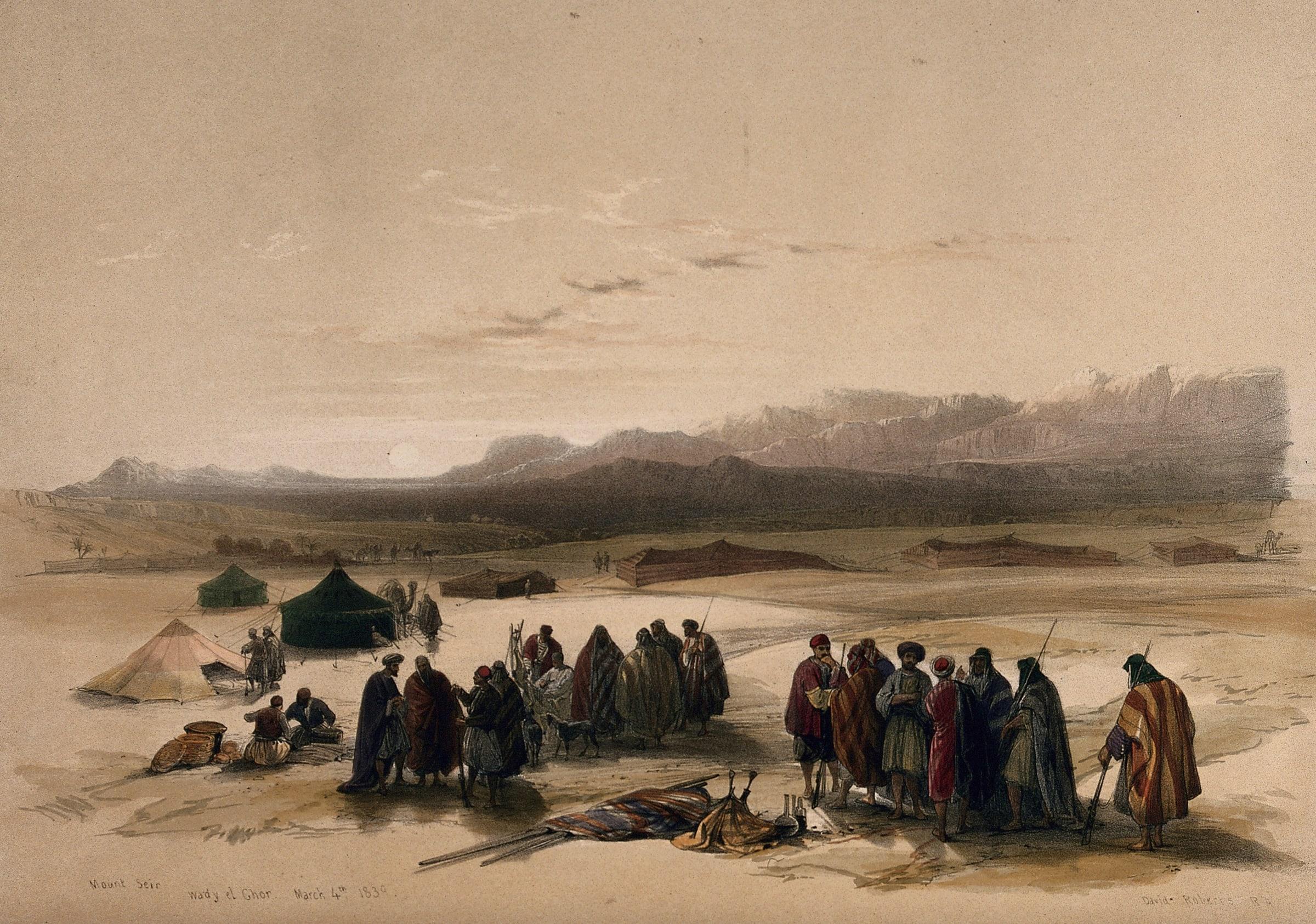
Louis Haghe after David Roberts, Encampment in the desert, 1849. CC BY 4.0.
Deuteronomy 1:1 to 4:49 · Place · Featured Study
Arabah
The Arabah takes in at least the Jordan's valley from Chinnereth to the Salt Sea (Deuteronomy 3:17).
Resume your journey and go to the hill country of the Amorites; go to all the neighboring peoples in the Arabah, in the hill country, in the foothills, in the Negev, and along the seacoast to the land of the Canaanites and to Lebanon, as far as the great River Euphrates.
- Today
- The Jordan Valley, the Dead Sea and the Wadi Arabah
- Region
- The rift of the Jordan and the Salt Sea, from the Sea of Galilee south
- First named
- Numbers 22:1 “Then the Israelites traveled on and camped in…”
- Last named
- Zechariah 14:10 “All the land from Geba to Rimmon south…”
David Roberts drew this camp on 4 March 1839, and the print is lettered Mount Seir and Wady el Ghor.
Summary
Moses spoke to all Israel in the Arabah (Deuteronomy 1:1).
- Joshua took the Arabah (Joshua 11:16).
- David and his men were in the Arabah (1 Samuel 23:24).
- Ezekiel was told the river runs down into the Arabah to make the sea fresh (Ezekiel 47:8).
The Valley Deuteronomy Names
The LORD's command at Horeb, which Moses repeats in Deuteronomy 1:6 to 7, names the Arabah among the regions Israel was sent to.
This study asks how far the Arabah runs.
The Jordan River in the Arabah bordered it from Chinnereth to the Sea of the Arabah (the Salt Sea) with the slopes of Pisgah to the east.Moses gives the stretch of the Arabah that bordered the land of Reuben and Gad.
The study of Sihon and Og sets out the land of Reuben and Gad east of the Jordan.
Word data for the Hebrew Bible counts the word ʿarabah 61 times. The count takes in the plains of Moab, where Israel camped across from Jericho (Numbers 22:1), and the plains of Jericho (2 Kings 25:5).
The Arabah on Bartholomew's Plate
The plate draws the valley floor in green between the western hills and the eastern plateau.
Adam stands on the valley floor between the Sea of Chinnereth and the Salt Sea.
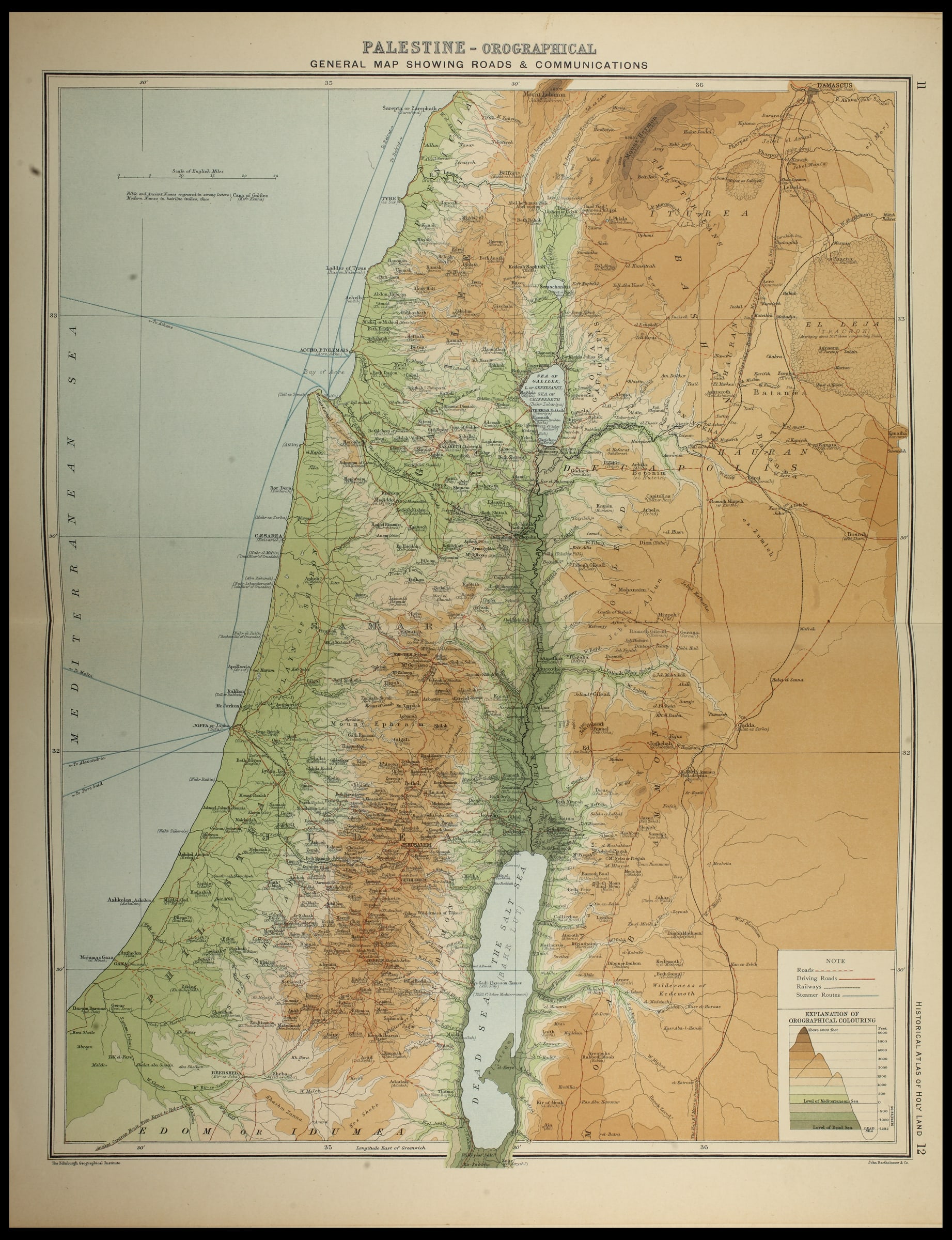
- Sea of ChinnerethJabin sent word to the kings of the north in the Arabah south of it. Bartholomew's placing, known: he prints the Sea of Galilee, the Lake of Gennesaret or the Sea of Chinnereth, the northernmost of the three points.Joshua 11:2
- AdamThe Jordan's water backed up as far as Adam while Israel crossed. Bartholomew's placing, probable: on the east bank of the Jordan a little south of the mouth of the Jabbok.Joshua 3:16
- Salt SeaDeuteronomy 4:49 calls it the Sea of the Arabah. Bartholomew's placing, known: he prints the Dead Sea or the Salt Sea, the southernmost of the three points.Deuteronomy 4:49
John Bartholomew and Co., Palestine, Orographical, in George Adam Smith's Atlas of the Historical Geography of the Holy Land, 1915. Public domain; File:John Bartholomew & Co., Palestine - Orographical General map showing roads & communications (FL46962154 3907122).jpg.
Three numbered points, each where Bartholomew's plate of 1915 prints the place, with north at the top. They draw the valley as Deuteronomy 4 and Joshua 3 and 11 name it, at Israel's entry into the land and its conquest. The plate sets Bible names in strong letters and modern names in hairline italics, and its roads, railways and steamer routes are those of 1915. It prints a scale of English miles.
Deuteronomy 11:30 names a Gilgal beside the Oak of Moreh, and the figure does not place that Gilgal.
The study of the crossing tells the crossing at Adam in full.
The Arabah After Deuteronomy, in Order
Passages from 2 Samuel to Amos set the valley in war, in flight and at a border.
Three of the five are journeys made by night in or toward the Arabah.
- Abner's retreatAbner son of Ner, commander of Saul's army, marches all night through the Arabah, crosses the Jordan, marches all morning and reaches Mahanaim2 Samuel 2:29
- Ish-bosheth's murderThe killers of Ish-bosheth son of Saul carry his head all night by way of the Arabah2 Samuel 4:7
- Jeroboam's reignJeroboam son of Jehoash restores Israel's border to the Sea of the Arabah, as the LORD spoke through Jonah2 Kings 14:25
- The fall of JerusalemThe men of war flee Jerusalem by night toward the Arabah2 Kings 25:4
- Amos's warningA nation will oppress Israel from Lebo-hamath to the Brook of the ArabahAmos 6:14
In the order of the canon, each with its verse.
A Valley Lower Than the Level of the Sea
In 1897 the Scottish scholar George Adam Smith gave the valley floor as lower than the sea from just south of Lake Huleh to a point south of the Dead Sea.
Smith wrote The Historical Geography of the Holy Land. Smith found no single name for the trench from the Lebanons to the Red Sea. He joined two names and called it the Jordan-'Arabah Valley.
Smith gives the Lake of Galilee as 680 feet under the level of the sea. He says the valley descends for sixty-five miles more, and he gives the Dead Sea as 1,290 feet under it. Smith traces the fault under the valley about 350 miles, from northern Syria to the Gulf of Akaba.
What the Text Leaves Unsaid
The opening verse of Deuteronomy names six places around the spot where Moses spoke and describes none of them.
Deuteronomy 1:1 sets the place where Moses spoke opposite Suph, and the name Suph stands only there in the Hebrew Bible. The Hebrew dictionary of James Strong (1890) glosses Suph as the Reed Sea. Jamieson, Fausset and Brown note in their Commentary that the word for sea is not in the Hebrew of the verse. They suggest Suph was a place known for its reeds.
The Desert That Blooms
Isaiah sets the valley's word in a promise, and Jeremiah sets it in a curse.
In Isaiah 35:1, Isaiah 40:3 and the first desert of Jeremiah 17:6, the Hebrew word is ʿarabah, the word Deuteronomy uses for the valley. Zechariah 14:10 uses the name itself, where the Berean text prints a plain.
The wilderness and the land will be glad; the desert will rejoice and blossom like a rose.Here the word for the valley names the desert that will rejoice.
A voice of one calling: “Prepare the way for the LORD in the wilderness; make a straight highway for our God in the desert.This verse sets the desert in a promise of God's coming.
This is what the LORD says: “Cursed is the man who trusts in mankind, who makes the flesh his strength and turns his heart from the LORD. He will be like a shrub in the desert; he will not see when prosperity comes. He will dwell in the parched places of the desert, in a salt land where no one lives.Jeremiah pictures the curse on the one who trusts in man by the same dry country.
Voices on the Arabah
Three commentators wrote on the valley's road, its plain and the river Ezekiel saw.
Jerome (died 420)
Jerome, the translator of the Latin Bible, reads Ezekiel's river by the Hebrew and the Greek and then by what the waters signify.
“These waters that come out, either into the Galilee of the Gentiles, according to the Septuagint, or (as it is more accurately contained in Hebrew) into the hills of the eastern sand, and they descend to the plains of the desert, or to Arabia, they will enter the sea, or to the ends of the sea, and the waters will be healed. We previously said that waters either signify the grace of baptism or the Evangelical doctrine.”
Jerome · Commentary on Ezekiel · on Ezekiel 47:8Patristic
John Gill (1697 to 1771)
John Gill, the English Baptist commentator, takes the plain of Deuteronomy 4:49 for the plains of Moab.
“The plains of Moab, on that side of Jordan to the east: even unto the sea of the plain; the sea of Sodom, the salt sea: under the springs of Pisgah; that rose from Mount Pisgah, the same with Ashdothpisgah, Deu 3:17.”
John Gill · Exposition of the Old Testament (1748-1763) · on Deuteronomy 4:49Reformed
Albert Barnes (1798 to 1870)
Albert Barnes, the American commentator, gives the meaning of the name of the town the Arabah road came from.
“Elath (Akaba) is at the northern extremity of the eastern arm of the Red Sea, and gives to that arm the name of the Elanitic Gulf. The name means ‘trees;’ and is still justified by the grove of palm-trees at Akaba.”
Albert Barnes · Notes, Explanatory and Practical, on the Old and New Testaments (1832-1869) · on Deuteronomy 2:8Evangelical
How Far the Arabah Runs
Readers differ on whether the name reaches past the Salt Sea toward the Red Sea.
So we passed by our brothers, the descendants of Esau, who live in Seir. We turned away from the Arabah road, which comes up from Elath and Ezion-geber, and traveled along the road of the Wilderness of Moab.Here Deuteronomy ties the name to a road.
From Galilee to the Red SeaJames Strong, 1890
Strong's dictionary takes the Arabah, with the article, as the valley of the Jordan and its continuation to the Red Sea.
The objection: Deuteronomy 3:17 and Joshua 12:3 run the Arabah they bound from Chinnereth to the Salt Sea.
The Jordan Valley above allGeorge Adam Smith, 1897
Smith, in an appendix to The Historical Geography of the Holy Land, holds that the name with the article is generally confined to the Jordan Valley. In a note on the Dead Sea he reports the American scholar Edward Robinson's line of white cliffs south of that sea, beyond which the Arabs called the valley El 'Arabah.
The objection: Deuteronomy 2:8 gives the valley's name to a road that came up from the south, far beyond the Jordan.
A Highway in the Desert
Matthew 3:1 to 2 has John the Baptist preach repentance in the wilderness of Judea.
This is he who was spoken of through the prophet Isaiah: “A voice of one calling in the wilderness, ‘Prepare the way for the Lord, make straight paths for Him.’”Matthew sets the voice in the wilderness, gives the second line as make straight paths for Him, and leaves out in the desert and a highway for our God.
Sources
Scripture is the Berean Standard Bible.
- James Strong, Exhaustive Concordance of the Bible (1890), Hebrew dictionary, entries 6160 and 5489.
- The Hebrew text tagged word by word with Strong's numbers.
- George Adam Smith, The Historical Geography of the Holy Land, fourth edition (London, 1897), pages 46 to 47, 469 to 470, 507 and 657.
- Albert Barnes, Notes, Explanatory and Practical, on the Old and New Testaments, on Deuteronomy 2:8.
- John Gill, Exposition of the Old Testament (1748 to 1763), on Deuteronomy 4:49.
- Jamieson, Fausset and Brown, Commentary Critical and Explanatory on the Whole Bible (1871), on Deuteronomy 1:1.
- Jerome, Commentary on Ezekiel, on Ezekiel 47:8.
Keep Studying
Read it4
People and groups7
Places10
Symbols1
Doctrines1