
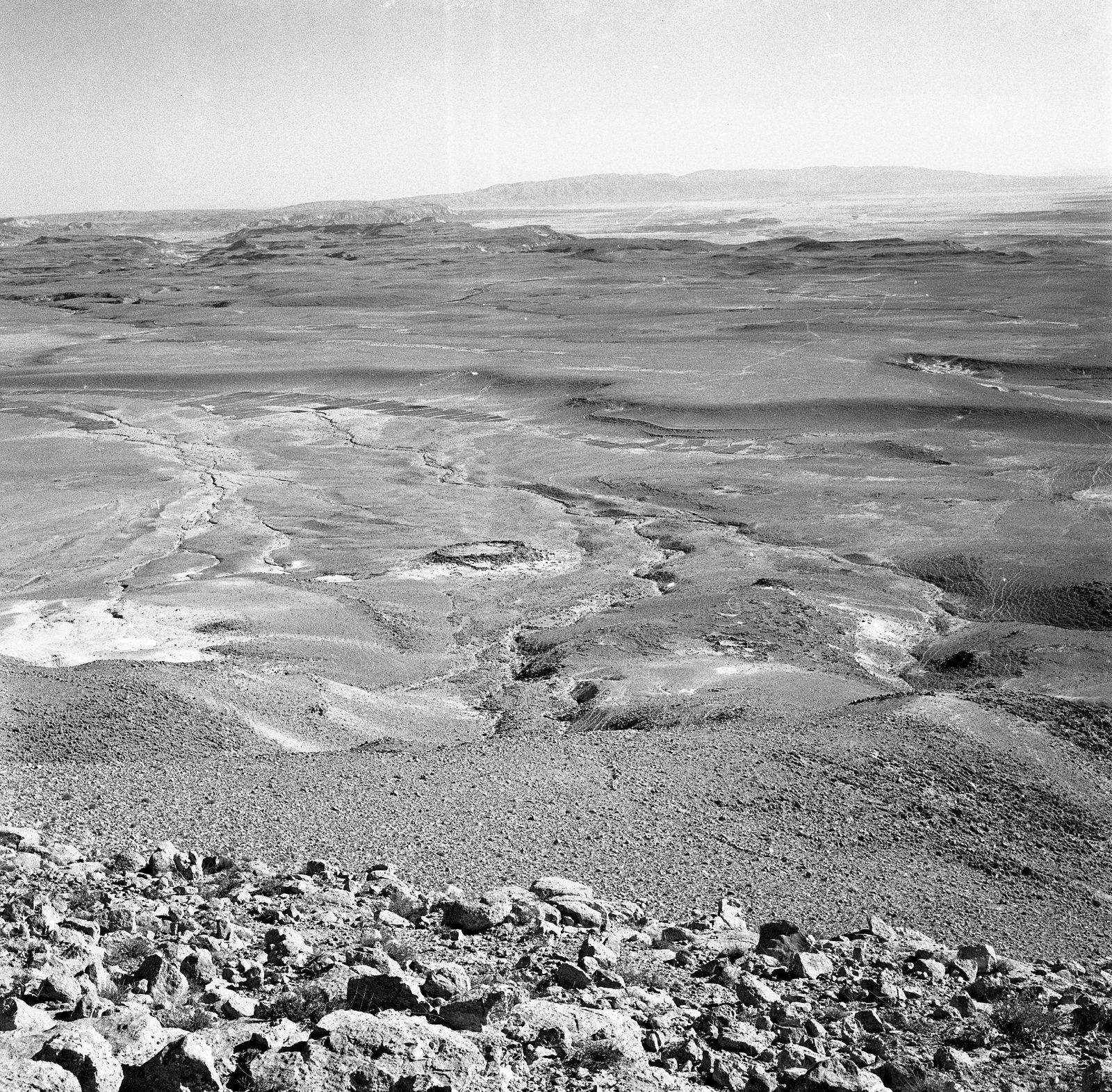
Benno Rothenberg, Ein Qedeis (December 1961), CC BY 4.0
Numbers 20:1 · Place · Featured Study
The Wilderness of Zin
The wilderness lay on the southern edge of the land promised to Israel, beside the border of Edom.
Scripture names Zin ten times in nine verses of Numbers, Deuteronomy and Joshua, by the count of the STEP Bible lexicon of Tyndale House.
In the first month, the whole congregation of Israel entered the Wilderness of Zin and stayed in Kadesh. There Miriam died and was buried.
- Region
- South of Canaan, beside the border of Edom
- First named
- Numbers 13:21 “…out the land from the Wilderness of Zin…”
- Last named
- Joshua 15:3 “proceeded south of the Ascent of Akrabbim, continued…”
Summary
The Wilderness of Zin is the dry country of Israel's camp at Kadesh in Numbers 20.
- The Desert of Sin of Exodus 16:1 lay between Elim and Sinai.
- In Moses' message, Kadesh is a city at the rim of Edom's country (Numbers 20:16).
- Rehob marked the north end of the spies' search from Zin (Numbers 13:21).
Zin and the Desert of Sin
The STEP Bible lexicon spells the two names with different first letters, tsade for Zin and samekh for Sin.
So they went up and spied out the land from the Wilderness of Zin as far as Rehob, toward Lebo-hamath.This is the first verse of the Berean text to name Zin, at the southern end of the spies' search.
Where was the Wilderness of Zin, and is it the desert Israel crossed after the Red Sea? That lexicon glosses Zin as a part of the desert. Its entry for Sin reads the name of an Egyptian town and probably the desert adjoining. It covers both the town the Berean prints as Pelusium in Ezekiel 30:15 to 16 and the desert of Exodus 16. John Wesley, in his Explanatory Notes of 1765, on Numbers 13:21, puts Zin in the south of Canaan and the wilderness of Sin near Egypt. Numbers 13:3 has Moses send the spies out from the Wilderness of Paran.
Zin on Fuller's Plate
Thomas Fuller's atlas A Pisgah-Sight of Palestine holds this plate of Judah. Each name on its dotted line is a place of Joshua 15:2 to 4 or Numbers 34:3 to 5.
The plate runs Judah's southern border from the Salt Sea past Akrabbim, Zin and Kadesh-barnea to the Brook of Egypt.
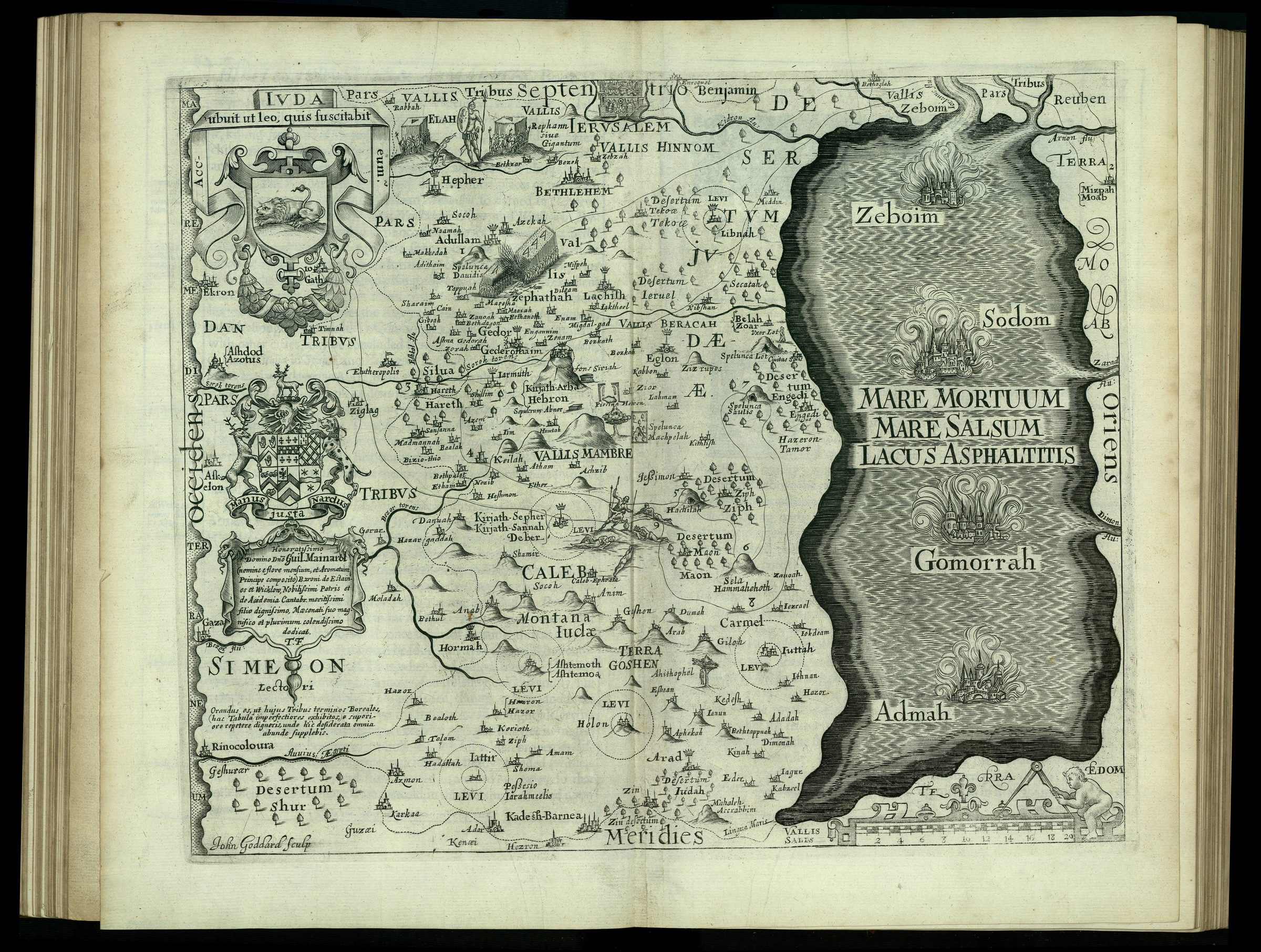
- Salt SeaThe book of Joshua starts Judah's southern border at the bay on the sea's southern tip. OpenBible rates the identification known.Joshua 15:2
- Ascent of AkrabbimThe plate prints Mahaleh Accrabbim beside a hill on the line west of the sea. OpenBible rates the identification probable.Numbers 34:4
- ZinThe plate draws a town named Zin on the line. OpenBible scores Zin here as another name for the wilderness at 880, known, and notes it as a possible settlement.Numbers 34:4
- Wilderness of ZinThe plate writes Zin desertum along the border itself. OpenBible rates the identification known.Numbers 34:3
- Kadesh-barneaThe plate sets Kadesh-Barnea north of the line, so the border passes south of it. OpenBible scores the spring Ain el Qudeirat at 864, known, and Ein Qedeis below zero.Numbers 34:4
- HezronThe plate prints Hezron by the line. OpenBible rates the identification probable.Joshua 15:3
- AddarThe plate spells the name Adar. OpenBible rates the identification proposed.Joshua 15:3
- KarkaThe plate spells it Karkaa, where its line curves north. OpenBible rates the identification probable.Joshua 15:3
- AzmonBoth books name Azmon as the last town before the border joins the brook. OpenBible rates the identification probable.Joshua 15:4
- Brook of EgyptThe plate prints Fluvius Aegypti to the sea. OpenBible rates the identification probable.Numbers 34:5
- EdomNumbers 34:3 runs the border along Edom, which the plate prints as Aedom beyond the sea's southern end. OpenBible rates the identification known.Numbers 34:3
Thomas Fuller, Iuda, A Pisgah-Sight of Palestine, 1650, engraved by John Goddard. Public domain (PD-old-assumed); Eran Laor Cartographic Collection, National Library of Israel; Wikimedia Commons, File:Thomas_Fuller,_Iuda_(FL199985442_2368566).jpg.
Eleven places are numbered where the plate Iuda prints them. John Goddard, whose name is signed at its foot, engraved it for the atlas of 1650. The OpenBible gazetteer weighs each proposed site of a place with a score. A score of 800 or more is read here as known, 500 to 799 as probable and under 500 as proposed. The plate is a seventeenth-century maker's drawing, north is at the top, and it is not to a modern scale.
Kadesh in Zin
Two commentaries date it in different terms.
Wesley, on Numbers 13:26, sets Israel's coming to the other Kadesh, which he places in the wilderness of Sin, in the fortieth year. Wesley takes the year from Numbers 33:37 to 38. The Berean prints that camp as Kadesh in the Wilderness of Zin (Numbers 33:36). Jamieson, Fausset and Brown, in their Commentary Critical and Explanatory of 1871, on Numbers 20:1, count it Israel's second arrival at Kadesh. They set it after an interval of thirty-eight years, by Deuteronomy 2:14. Wesley holds that the spies' Kadesh-barnea was another place.
The quarrel over water and the message to Edom came at Kadesh, and Aaron's death followed on Mount Hor.
- At KadeshWith no water, the people quarrel, and Moses strikes the rockNumbers 20:11
- From KadeshMoses asks the king of Edom for passage on the King's Highway and is refusedNumbers 20:17
- On the roadThe congregation sets out from Kadesh and comes to Mount HorNumbers 20:22
- On Mount HorAaron dies on the mountain, and Israel mourns him thirty daysNumbers 20:29
Numbers 20:2 to 29 tells the four events in this order.
The Southern Border
Joshua 15:3 lists Hezron, Addar and Karka on the line where Numbers 34:4 has Hazar-addar.
Your southern border will extend from the Wilderness of Zin along the border of Edom. On the east, your southern border will run from the end of the Salt Sea, cross south of the Ascent of Akrabbim, continue to Zin, and go south of Kadesh-barnea. Then it will go on to Hazar-addar and proceed to Azmon,The LORD names Zin twice in the line, once as the wilderness and once as a point between Akrabbim and Kadesh-barnea.
Joshua 15:1 gives Judah's lot the Wilderness of Zin as its southern boundary.
On the south side it will run from Tamar to the waters of Meribath-kadesh, and along the Brook of Egypt to the Great Sea. This will be the southern boundary.The Lord GOD gives these boundaries from Ezekiel 47:13. Deuteronomy 32:51 sets Meribah-kadesh in Zin.
Meribah in Zin
The quarrel over water at Kadesh gave the place a second name, the waters of Meribah.
Numbers 27:14 and Deuteronomy 32:51 both name the Wilderness of Zin as the place of the waters of Meribah.
What Scripture Leaves Unsaid
The text leaves two questions open.
No verse sets a boundary between the Wilderness of Zin and the Wilderness of Paran.
Numbers 20 does not say how long the congregation stayed at Kadesh before it set out for Mount Hor.
The Wilderness of Kadesh in Psalm 29
A psalm of David names a Wilderness of Kadesh that the voice of the LORD shakes.
The voice of the LORD shakes the wilderness; the LORD shakes the Wilderness of Kadesh.In Psalm 29:6 the LORD makes Lebanon and Sirion skip; in this verse the wilderness shakes.
The OpenBible gazetteer files this Wilderness of Kadesh under Zin. The psalm itself does not say which Kadesh it means.
Albert Barnes on Kadesh and the Border
Both quotations come from Albert Barnes's Notes on the Old and New Testaments.
Albert Barnes (1798 to 1870)
For Barnes the road out of Kadesh belongs to the last of the forty years.
“Num. 20 and Num. 21 narrate the journey of the people from Kadesh round Mount Seir to the heights of Pisgah, near the Jordan, and the various incidents connected with that journey (compare Num 33:37-41). This formed the third and last stage of the progress of Israel from Sinai to Canaan, and took place in the fortieth year of the Exodus. The incidents are apparently not narrated in a strictly chronological order (see Num 21:1).”
Albert Barnes · Notes, Explanatory and Practical, on the Old and New Testaments (1832-1869) · on Numbers 20:1Evangelical
He names the glens by which the border climbs from the Dead Sea.
“The southern boundary commenced at the Dead Sea. The broad and desolate valley by which the depressed bed of that sea is protected toward the south, is called the Ghor. A deep narrow glen enters it at its southwest corner; it is called Wady-el-Fikreh, and is continued in the same southwestern direction, under the name of Wady el-Marrah; a wady which loses itself among the hills belonging to ‘the wilderness of Zin;’ and Kadesh-barnea (see Num 13:26 note), which is ‘in the wilderness of Zin,’ will be, as the text implies, the southernmost point of the southern boundary.”
Albert Barnes · Notes, Explanatory and Practical, on the Old and New Testaments (1832-1869) · on Numbers 34:3Evangelical
A Rest That Remains
For if Joshua had given them rest, God would not have spoken later about another day. There remains, then, a Sabbath rest for the people of God.The letter reads the entry under Joshua as short of God's rest.
Joshua son of Nun led Israel over the Jordan in Joshua 3. Hebrews 4:14 then names Jesus the Son of God as the great high priest who has passed through the heavens. The verse bids its readers hold firmly to what they profess.
Sources
Scripture is the Berean Standard Bible.
- STEP Bible TBESH glosses (Tyndale House, CC BY 4.0), entries h6790 Zin and h5512 Sin.
- OpenBible.info, Bible Geocoding Data, ancient places (CC BY 4.0)
- John Wesley, Explanatory Notes upon the Old Testament (1765), on Numbers 13:21.
- John Wesley, Explanatory Notes upon the Old Testament (1765), on Numbers 13:26.
- Jamieson, Fausset and Brown, Commentary Critical and Explanatory on the Whole Bible (1871), on Numbers 20:1.
- Albert Barnes, Notes, Explanatory and Practical, on the Old and New Testaments (1832 to 1869, the years the store records for the edition), on Numbers 20:1.
- Albert Barnes, Notes, Explanatory and Practical, on the Old and New Testaments (1832 to 1869, the years the store records for the edition), on Numbers 34:3.
Keep Studying
Read it4
Places9
Doctrines1