
Dan
Summary
The northern limit of the land, where the tribe of Dan settled after taking Laish and where Jeroboam set up one of his two golden calves.
- Dan is the northern end of the land, which is why Scripture says from Dan to Beersheba when it means all of Israel.
- The town was called Laish until six hundred armed Danites burned it and renamed it after their forefather.
- The graven image they carried north stood there from the days of the judges until the captivity of the land.
- Jeroboam set one of his two golden calves in Dan, and the northern kingdom kept the calves to the end.
- A basalt fragment dug from the mound carries the words house of David, the earliest inscription outside the Bible to name that dynasty.
On this page
In Scripture
- Verses
- 62
- Books
- 16
Near Dan
- Mount Hermon27 km · 17 mi NE
- Zarephath39 km · 24 mi NW
- Capernaum42 km · 26 mi S
- Tyre43 km · 27 mi W
- Sea of Galilee48 km · 30 mi S
- Cana of Galilee63 km · 39 mi SW
Straight-line distances, computed from the gazetteer coordinates.
Where it is
the country around it
- Coordinates
- 33.2487° N, 35.6525° Efind it on the Atlas →
- Region
- Northern border, at the foot of Hermon
- Kind of place
- City
1 place the record names with Dan, the farthest 68 km away
- Located: the gazetteer fixes one site
- A dashed line ends at a place the gazetteer does not fix
Not located: Hazor, Assyria, Bashan, Moab. The gazetteer records no location for them, so they are not marked.
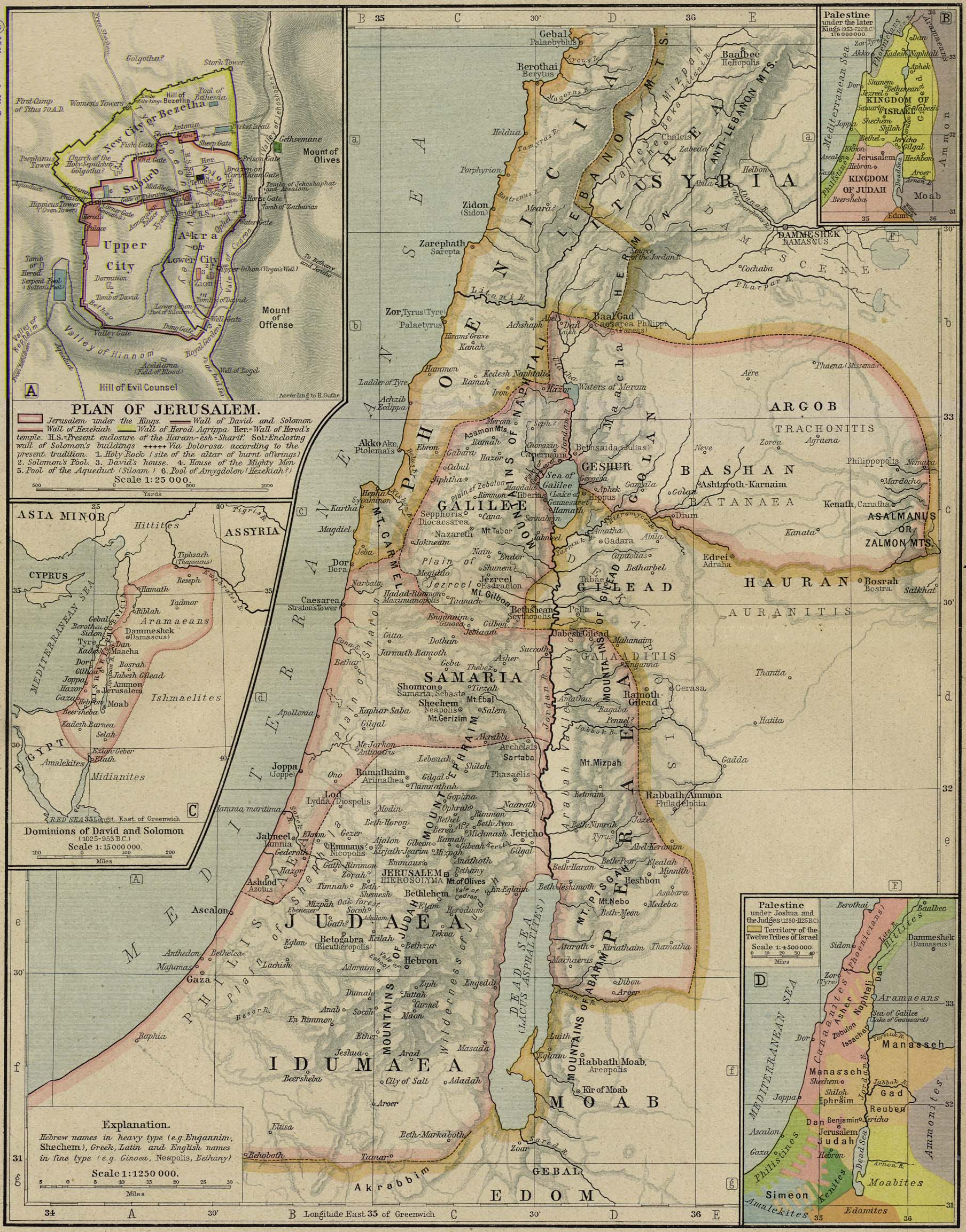
Why Dan matters
What has been found
the evidence, and where it is disputed
The Danite migration, and the founding of Dan
Judges 17 and 18, in the order it happens
Read Judges 17 and 18, in the order it happens
- Silver dedicated to the LORD, and made into an imageJudges 17:3And when he had returned the eleven hundred shekels of silver to his mother, she said, “I wholly dedicate the silver to the LORD for my son’s benefit, to make a graven image and a molten idol. Therefore I will now return it to you.”
- The frame the narrator puts over the whole accountJudges 17:6In those days there was no king in Israel; everyone did what was right in his own eyes.
- Micah hires a Levite for ten shekels a yearJudges 17:10“Stay with me,” Micah said to him, “and be my father and priest, and I will give you ten shekels of silver per year, a suit of clothes, and your provisions.”
- A tribe with no inheritance goes lookingJudges 18:1In those days there was no king in Israel, and the tribe of the Danites was looking for territory to occupy. For up to that time they had not come into an inheritance among the tribes of Israel.
- The hired priest sends the spies offJudges 18:6And the priest told them, “Go in peace. The LORD is watching over your journey.”
- Laish: tranquil, unsuspecting, and aloneJudges 18:7So the five men departed and came to Laish, where they saw that the people were living securely, like the Sidonians, tranquil and unsuspecting. There was nothing lacking in the land and no oppressive ruler. And they were far away from the Sidonians and had no alliance with anyone.
- The shrine emptied while six hundred men wait at the gateJudges 18:17And the five men who had gone to spy out the land went inside and took the graven image, the ephod, the household idols, and the molten idol, while the priest stood at the entrance of the gate with the six hundred armed men.
- Laish struck and burnedJudges 18:27After they had taken Micah’s idols and his priest, they went to Laish, to a tranquil and unsuspecting people, and they struck them with their swords and burned down the city.
- The city renamedJudges 18:29They named it Dan, after their forefather Dan, who was born to Israel—though the city was formerly named Laish.
- The image, and an expiry date the reader cannot yet readJudges 18:30The Danites set up idols for themselves, and Jonathan son of Gershom, the son of Moses, and his sons were priests for the tribe of Dan until the day of the captivity of the land.
The tribe left its old camp name behind it. Mahaneh-dan, where the Spirit of the LORD first stirred Samson between Zorah and Eshtaol in Judges 13:25, is the same name the migrating six hundred gave their camp near Kiriath-jearim in 18:12. Dan is in two places for the rest of the story.
The Judges study: the era this belongs toWhat happened here, in order
in the order the canon tells it
- Abram's pursuit reaches a place the text calls DanGenesis 14:14And when Abram heard that his relative had been captured, he mobilized the 318 trained men born in his household, and they set out in pursuit as far as Dan.
- Rachel names Bilhah's son DanGenesis 30:6Then Rachel said, “God has vindicated me; He has heard my plea and given me a son.” So she named him Dan.
- Jacob's blessing calls Dan a serpent by the roadGenesis 49:17He will be a snake by the road, a viper in the path that bites the horse’s heels so that its rider tumbles backward.
- Moses blesses Dan as a lion's cub out of BashanDeuteronomy 33:22Concerning Dan he said: “Dan is a lion’s cub, leaping out of Bashan.”
- Moses is shown the land as far as DanDeuteronomy 34:1Then Moses went up from the plains of Moab to Mount Nebo, to the top of Pisgah, which faces Jericho. And the LORD showed him the whole land—from Gilead as far as Dan,
- The allotment lost, and Leshem taken and renamedJoshua 19:47(Later, when the territory of the Danites was lost to them, they went up and fought against Leshem, captured it, and put it to the sword. So they took possession of Leshem, settled there, and renamed it after their father Dan.)
- The Amorites push the Danites off their plainJudges 1:34The Amorites forced the Danites into the hill country and did not allow them to come down into the plain.
- Laish becomes DanJudges 18:29They named it Dan, after their forefather Dan, who was born to Israel—though the city was formerly named Laish.
- Moses's grandson serves the shrine, until the captivity of the landJudges 18:30The Danites set up idols for themselves, and Jonathan son of Gershom, the son of Moses, and his sons were priests for the tribe of Dan until the day of the captivity of the land.
- The image stands the whole time the house of God is at ShilohJudges 18:31So they set up for themselves Micah’s graven image, and it was there the whole time the house of God was in Shiloh.
- From Dan to Beersheba, secure under Solomon1 Kings 4:25Throughout the days of Solomon, Judah and Israel dwelt securely from Dan to Beersheba, each man under his own vine and his own fig tree.
- Jeroboam sets the second calf in Dan1 Kings 12:29One calf he set up in Bethel, and the other in Dan.
- The people walk as far as Dan to worship1 Kings 12:30And this thing became a sin; the people walked as far as Dan to worship before one of the calves.
- Ben-hadad takes Dan on the northern border1 Kings 15:20And Ben-hadad listened to King Asa and sent the commanders of his armies against the cities of Israel, conquering Ijon, Dan, Abel-beth-maacah, and the whole land of Naphtali, including the region of Chinnereth.
- Jehu destroys Baal worship and keeps the calves2 Kings 10:29but he did not turn away from the sins that Jeroboam son of Nebat had caused Israel to commit—the worship of the golden calves at Bethel and Dan.
- Tiglath-pileser carries the northern country away2 Kings 15:29In the days of Pekah king of Israel, Tiglath-pileser king of Assyria came and captured Ijon, Abel-beth-maacah, Janoah, Kedesh, Hazor, Gilead, and Galilee, including all the land of Naphtali, and he took the people as captives to Assyria.
- The snorting of enemy horses heard from DanJeremiah 8:16The snorting of enemy horses is heard from Dan. At the sound of the neighing of mighty steeds, the whole land quakes. They come to devour the land and everything in it, the city and all who dwell in it.
- Men swearing by the god of DanAmos 8:14Those who swear by the guilt of Samaria and say, ‘As surely as your god lives, O Dan,’ or, ‘As surely as the way of Beersheba lives’—they will fall, never to rise again.”
- Dan given the first portion in the restored landEzekiel 48:1“Now these are the names of the tribes: At the northern frontier, Dan will have one portion bordering the road of Hethlon to Lebo-hamath and running on to Hazar-enan on the border of Damascus with Hamath to the north, and extending from the east side to the west side.
- A gate of Dan in the wall of the cityEzekiel 48:32On the east side, which will be 4,500 cubits long, there will be three gates: the gate of Joseph, the gate of Benjamin, and the gate of Dan.
Where it points
The voices
each quoted from the work named
The tribe of Dan found its portion to be rather too small, so the people held a council to decide what was to be done. They resolved to send a small body of men to spy out the land—these spies came, in due time, to a place called Laish, which they found to be inhabited by certain people who dwelt there carelessly, in supposed security, "after the manner of the Sidonians." They were attacked without any notice and the tribe of Dan took their territory and added it to their own. I do not, in the least degree, commend the action of these people.
Called the name of the city Dan - This city was afterwards very remarkable as one of the extremities of the promised land. The extent of the Jewish territories was generally expressed by the phrase, From Dan to Beer-Sheba; that is, From the most northern to the southern extremity.
In the Hebrew text the name here rendered Manasseh is written MN)- SH. Without the “N” (nun) suspended over the line, the word may be read: Moses, whose son was Gershom Exo 2:22, whose son or descendant Jonathan clearly was. The Masoretes, probably grieved that a descendant of Moses should have been implicated in idolatrous worship, adopted this expedient for disguising the fact without absolutely falsifying the text. The Vulgate has “Moses”, the Septuagint “Manasses”.
4 more teachers on these versesJohn Gill · Matthew Henry · Jamieson, Fausset & Brown · Bonaventure
And the children of Dan set up the graven image,.... In their new city Dan, and very probably had a house built for it, peculiar to it, in the same place where Jeroboam, in later times, set up one of his golden calves.
He intended, no doubt, by these to represent, or rather make present, not any false god, as Moloch or Chemosh, but the true God only, the God of Israel, the God that brought them up out of the land of Egypt
Dan is a lion's whelp--His proper settlement in the south of Canaan being too small, he by a sudden and successful irruption, established a colony in the northern extremity of the land.
In the third mystery, that of the calling of the fathers, the Antichrist is represented by Dan. And some commentators choose to say that he will literally belong to the tribe of Dan. I would not dare to assert that it will be so.
Dan in Scripture
62 verses name it, or one of its other names (Laish, Leshem, Tel Dan), in 16 books
Open a book to read its mentions here. Text: Berean Standard Bible.
Old TestamentNew Testamentsegment width = share of mentions
Old Testament16 books · 62 mentions
Genesis5 mentions
- Genesis 14:14And when Abram heard that his relative had been captured, he mobilized the 318 trained men born in his household, and they set out in pursuit as far as Dan.
- Genesis 30:6Then Rachel said, “God has vindicated me; He has heard my plea and given me a son.” So she named him Dan.
- Genesis 35:25The sons of Rachel’s maidservant Bilhah were Dan and Naphtali.
- Genesis 46:23The son of Dan: Hushim.
- Genesis 49:16Dan shall provide justice for his people as one of the tribes of Israel.
Exodus4 mentions
- Exodus 1:4Dan and Naphtali; Gad and Asher.
- Exodus 31:6Moreover, I have selected Oholiab son of Ahisamach, of the tribe of Dan, as his assistant. I have also given skill to all the craftsmen, that they may fashion all that I have commanded you:
- Exodus 35:34And the LORD has given both him and Oholiab son of Ahisamach, of the tribe of Dan, the ability to teach others.
- Exodus 38:23With him was Oholiab son of Ahisamach, of the tribe of Dan, an engraver, designer, and embroiderer in blue, purple, and scarlet yarn and fine linen.
Leviticus1 mention
Numbers9 mentions
- Numbers 1:12from Dan, Ahiezer son of Ammishaddai;
- Numbers 1:38From the sons of Dan, according to the records of their clans and families, counting the names of all those twenty years of age or older who could serve in the army,
- Numbers 1:39those registered to the tribe of Dan numbered 62,700.
- Numbers 2:25On the north side, the divisions of Dan are to camp under their standard:
- Numbers 2:31The total number of men in the camp of Dan is 157,600; they shall set out last, under their standards.”
- Numbers 10:25Finally, the divisions of the camp of Dan set out under their standard, serving as the rear guard for all units, with Ahiezer son of Ammishaddai in command.
- Numbers 13:12from the tribe of Dan, Ammiel son of Gemalli;
- Numbers 26:42These were the descendants of Dan by their clans: The Shuhamite clan from Shuham. These were the clans of Dan.
1 further mention in Numbers, read them in the book.
Deuteronomy3 mentions
- Deuteronomy 27:13And these tribes shall stand on Mount Ebal to deliver the curse: Reuben, Gad, Asher, Zebulun, Dan, and Naphtali.
- Deuteronomy 33:22Concerning Dan he said: “Dan is a lion’s cub, leaping out of Bashan.”
- Deuteronomy 34:1Then Moses went up from the plains of Moab to Mount Nebo, to the top of Pisgah, which faces Jericho. And the LORD showed him the whole land—from Gilead as far as Dan,
Joshua5 mentions
- Joshua 19:40The seventh lot came out for the clans of the tribe of Dan:
- Joshua 19:47(Later, when the territory of the Danites was lost to them, they went up and fought against Leshem, captured it, and put it to the sword. So they took possession of Leshem, settled there, and renamed it after their father Dan.)
- Joshua 19:48This was the inheritance of the clans of the tribe of Dan, including these cities and their villages.
- Joshua 21:5The remaining descendants of Kohath received ten cities by lot from the tribes of Ephraim, Dan, and the half-tribe of Manasseh.
- Joshua 21:23From the tribe of Dan they were given Elteke, Gibbethon,
Judges9 mentions
- Judges 5:17Gilead remained beyond the Jordan. Dan, why did you linger by the ships? Asher stayed at the coast and remained in his harbors.
- Judges 13:25And the Spirit of the LORD began to stir him at Mahaneh-dan, between Zorah and Eshtaol.
- Judges 18:7So the five men departed and came to Laish, where they saw that the people were living securely, like the Sidonians, tranquil and unsuspecting. There was nothing lacking in the land and no oppressive ruler. And they were far away from the Sidonians and had no alliance with anyone.
- Judges 18:12They went up and camped at Kiriath-jearim in Judah. That is why the place west of Kiriath-jearim is called Mahaneh-dan to this day.
- Judges 18:14Then the five men who had gone to spy out the land of Laish said to their brothers, “Did you know that one of these houses has an ephod, household gods, a graven image, and a molten idol? Now think about what you should do.”
- Judges 18:27After they had taken Micah’s idols and his priest, they went to Laish, to a tranquil and unsuspecting people, and they struck them with their swords and burned down the city.
- Judges 18:29They named it Dan, after their forefather Dan, who was born to Israel—though the city was formerly named Laish.
- Judges 18:30The Danites set up idols for themselves, and Jonathan son of Gershom, the son of Moses, and his sons were priests for the tribe of Dan until the day of the captivity of the land.
1 further mention in Judges, read them in the book.
1 Samuel2 mentions
2 Samuel6 mentions
- 2 Samuel 3:10to transfer the kingdom from the house of Saul and to establish the throne of David over Israel and Judah, from Dan to Beersheba.”
- 2 Samuel 3:15So Ish-bosheth sent and took Michal from her husband Paltiel son of Laish.
- 2 Samuel 17:11Instead, I advise that all Israel from Dan to Beersheba—a multitude like the sand on the seashore—be gathered to you, and that you yourself lead them into battle.
- 2 Samuel 24:2So the king said to Joab the commander of his army, who was with him, “Go now throughout the tribes of Israel from Dan to Beersheba and register the troops, so that I may know their number.”
- 2 Samuel 24:6Then they went to Gilead and the land of Tahtim-hodshi, and on to Dan-jaan and around to Sidon.
- 2 Samuel 24:15So the LORD sent a plague upon Israel from that morning until the appointed time, and seventy thousand of the people from Dan to Beersheba died.
1 Kings4 mentions
- 1 Kings 4:25Throughout the days of Solomon, Judah and Israel dwelt securely from Dan to Beersheba, each man under his own vine and his own fig tree.
- 1 Kings 12:29One calf he set up in Bethel, and the other in Dan.
- 1 Kings 12:30And this thing became a sin; the people walked as far as Dan to worship before one of the calves.
- 1 Kings 15:20And Ben-hadad listened to King Asa and sent the commanders of his armies against the cities of Israel, conquering Ijon, Dan, Abel-beth-maacah, and the whole land of Naphtali, including the region of Chinnereth.
2 Kings1 mention
1 Chronicles4 mentions
- 1 Chronicles 2:2Reuben, Simeon, Levi, Judah, Issachar, Zebulun, Dan, Joseph, Benjamin, Naphtali, Gad, and Asher.
- 1 Chronicles 12:35From Dan: 28,600 prepared for battle.
- 1 Chronicles 21:2So David said to Joab and the commanders of the troops, “Go and count the Israelites from Beersheba to Dan and bring me a report, so that I may know their number.”
- 1 Chronicles 27:22and over Dan was Azarel son of Jeroham. These were the leaders of the tribes of Israel.
2 Chronicles3 mentions
- 2 Chronicles 2:14He is the son of a woman from the daughters of Dan, and his father is a man of Tyre. He is skilled in work with gold and silver, bronze and iron, stone and wood, purple, blue, and crimson yarn, and fine linen. He is experienced in every kind of engraving and can execute any design that is given him. He will work with your craftsmen and with those of my lord, your father David.
- 2 Chronicles 16:4And Ben-hadad listened to King Asa and sent the commanders of his armies against the cities of Israel, conquering Ijon, Dan, Abel-maim, and all the store cities of Naphtali.
- 2 Chronicles 30:5So they established a decree to circulate a proclamation throughout Israel, from Beersheba to Dan, that the people should come to keep the Passover of the LORD, the God of Israel, in Jerusalem. For they had not observed it as a nation as prescribed.
Jeremiah2 mentions
- Jeremiah 4:15For a voice resounds from Dan, proclaiming disaster from the hills of Ephraim.
- Jeremiah 8:16The snorting of enemy horses is heard from Dan. At the sound of the neighing of mighty steeds, the whole land quakes. They come to devour the land and everything in it, the city and all who dwell in it.
Ezekiel3 mentions
- Ezekiel 48:1“Now these are the names of the tribes: At the northern frontier, Dan will have one portion bordering the road of Hethlon to Lebo-hamath and running on to Hazar-enan on the border of Damascus with Hamath to the north, and extending from the east side to the west side.
- Ezekiel 48:2Asher will have one portion bordering the territory of Dan from east to west.
- Ezekiel 48:32On the east side, which will be 4,500 cubits long, there will be three gates: the gate of Joseph, the gate of Benjamin, and the gate of Dan.
The account
Read the account as one telling
Before Israel, the town at the springs was called Laish. The five men who scouted it reported a people living securely, tranquil and unsuspecting, with nothing lacking in the land, no oppressive ruler, no alliance with anyone and no help within reach. Genesis 14:14 and Deuteronomy 34:1 already use the name Dan for a northern point long before Judges 18 gives this city that name, and the question that raises is answered further down this page.
The tribe of Dan was given the coastal plain west of Benjamin. Joshua 19:40 to 19:46 lists the towns: Zorah, Eshtaol, Aijalon, Ekron, Gath-rimmon, and the territory across from Joppa. Samson was born in that country, at Zorah, and the Spirit of the LORD first stirred him there. The tribe never held the allotment. Judges 1:34 says the Amorites forced the Danites into the hill country and would not let them come down into the plain, and Joshua 19:47 says the territory was lost to them.
So the tribe went north and took a town that was not its own. The account above tells it in the order Judges gives it: the spies, the shrine in the hill country of Ephraim, the stolen images and the stolen priest, the burning of Laish, and the new name.
The shrine they set up outlasted them. Judges 18:30 names the priest who served it, Jonathan son of Gershom, the son of Moses, and says his sons served after him until the day of the captivity of the land. Judges 18:31 measures the same thing another way: the graven image stood at Dan the whole time the house of God was at Shiloh.
Once the city had the name, the name became a boundary marker. Judges 20:1, 1 Samuel 3:20, 2 Samuel 3:10 and 24:2, and 1 Kings 4:25 all say from Dan to Beersheba to mean the whole country. Chronicles reverses it both times it uses the phrase, from Beersheba to Dan, which is a southern writer counting from home. Adam Clarke put the reason plainly in 1832: Dan stood at the utmost northern extremity of the land as Beersheba stood at the southern.
When the kingdom divided after Solomon, Dan became a shrine of state. Jeroboam gives his own reason in 1 Kings 12:26 and 12:27: if the people went up to Jerusalem to sacrifice, they would return to Rehoboam and kill him. He made two golden calves, set one in Bethel and the other in Dan, and told Israel that these were the gods who brought them up out of the land of Egypt. John Gill noticed in the eighteenth century that Jeroboam was building on ground that already had a history, since the images of Micah had been at Dan since the judges.
The city sat on the road an invader would use. Ben-hadad of Aram struck it first when Asa of Judah paid him to break his treaty with Israel, and 1 Kings 15:20 and 2 Chronicles 16:4 both name Dan at the head of the list of towns he took. Jehu wiped out Baal worship in Israel and kept the calves at Bethel and Dan, which is what 2 Kings 10:29 records. Amos heard men swearing by the god of Dan. Jeremiah heard the noise of an invading army twice, both times beginning at Dan.
Then the sentence in Judges landed. Tiglath-pileser of Assyria took the northern country and carried its people away, 2 Kings 15:29, and Samaria itself fell in the ninth year of Hoshea, 2 Kings 17:6. The captivity of the land that Judges 18:30 had named centuries earlier arrived on the city where the image stood.
Common questions
Genesis 14:14 says Abram chased the raiders as far as Dan, but the city was not named Dan until Judges 18. How does that work?
Readers differ; the positions are named
Three positions are held and Scripture does not settle the question. The first is that a later hand updated the old name to the name readers knew, the way an editor might write in a familiar place name. Adam Clarke states that position outright on Joshua 19:47, calling that verse "another of the marginal or explicative notes which were added by some later hand."
The second is that the Dan of Genesis 14 is a different place from the northern city, since 2 Samuel 24:6 names a Dan-jaan on Joab's route and the region carried more than one similar name. The third holds to Mosaic authorship and reads the updated names as inspired later editing, noting that Deuteronomy 34 narrates Moses's own death and burial and so was plainly finished by another hand. This page names all three and reaches no verdict.
Was the attack on Laish justified?
The text does not say so, and it goes out of its way to describe the opposite. The people of Laish are called tranquil and unsuspecting, with no oppressive ruler, far from the Sidonians and with no alliance with anyone, and the narrator repeats the point after the killing at 18:28: "There was no one to deliver them."
Nobody in the chapter asks God whether to go. The only word from God in it comes from a hired priest the Danites were about to steal. Charles Spurgeon preached on the passage in 1896 and said of the Danites, "I do not, in the least degree, commend the action of these people." The wider question of the conquest and the Canaanites is a different question from this raid and is handled in its own study.
Was Micah's shrine idolatry, or just irregular worship?
Both, and the passage is careful about it. Micah's mother dedicates the silver to the LORD, and Micah says, "Now I know that the LORD will be good to me, because a Levite has become my priest." They meant the God of Israel. What they made was a graven image and a molten idol, they built a shrine outside the place God had chosen, and they hired a priest for wages.
Adam Clarke argued in 1832 that Micah was sincere and deserved more praise than blame. Matthew Henry read the same scene as idolatry that had bewitched him. The narrator's own frame sits over the whole thing at 17:6: "In those days there was no king in Israel; everyone did what was right in his own eyes."
What was the golden calf at Dan, and did Jeroboam mean it as a false god?
Jeroboam's stated reason is political. If his people went up to Jerusalem to sacrifice, he says in 12:26 and 12:27, they would go back to Rehoboam and kill him. His words when he presents the calves name the exodus, which is the God of Israel and not a Canaanite deity.
Matthew Henry wrote in 1710 that Jeroboam meant the calves "to represent, or rather make present, not any false god, as Moloch or Chemosh, but the true God only." That is what made them work and what made them fatal. Jehu, who destroyed Baal worship in Israel, kept the calves at Bethel and Dan.
Judges 18:30 calls the priest Jonathan son of Gershom, the son of Moses. Is that really Moses's grandson?
Readers differ; the positions are named
That is what the Berean Standard Bible reads, and Gershom is named as Moses's son at Exodus 2:22. The Hebrew text of the verse carries a small letter nun raised above the line, which turns the name into Manasseh instead of Moses. The Vulgate reads Moses and the Septuagint reads Manasses, and translations still split on it.
Albert Barnes explained the raised letter as the work of scribes "probably grieved that a descendant of Moses should have been implicated in idolatrous worship," who "adopted this expedient for disguising the fact without absolutely falsifying the text." This page gives the reading and the mark and leaves the choice with the reader.
Why is Dan missing from the list of tribes in Revelation 7?
Readers differ; the positions are named
Revelation 7:5 to 7:8 names twelve tribes and Dan is not among them. Manasseh appears alongside Joseph, and Levi is included though Levi held no land. Three explanations are old.
The first is the Antichrist tradition. From at least the fourth century, writers connected Dan's absence with the serpent of Genesis 49:17 and taught that the Antichrist would come from Dan. Ambrose says it plainly in 397; Bede in 735 reports it as something "it is said"; Bonaventure in 1257 names the tradition and then writes, "I would not dare to assert that it will be so." The second is idolatry: Dan held a shrine from the days of the judges and a calf after that, and Adam Clarke read the omission as Dan and Ephraim being "the principal promoters of idolatry." The third works from the tribal lists themselves, where Dan is missing from the genealogies of 1 Chronicles and the Revelation list is irregular in more ways than one. A fourth proposal, offered without any manuscript to support it, is that a copyist read the Hebrew word for Dan as the start of Manasseh's name and wrote the wrong tribe into the list.
This page names all three and settles nothing. It adds the fact that keeps the question from becoming erasure: Ezekiel 48:1 gives Dan the first portion in the restored land, and 48:32 sets a gate of Dan in the city wall.
What does from Dan to Beersheba mean, and why those two towns?
They were the practical ends of the land. Dan stood at the northern springs of the Jordan and Beersheba at the southern edge of the settled country, so naming both was Israel's way of saying the whole of it. Adam Clarke put it exactly that way in 1832.
The phrase runs through Judges, Samuel and Kings, and Chronicles reverses it to from Beersheba to Dan both times it uses it. Its last appearance is the saddest. Hezekiah sends word from Beersheba to Dan to come and keep the Passover, after the northern kingdom has already been carried away.
What has been dug up at Dan, and what does the House of David stone prove?
Readers differ; the positions are named
The mound at the Jordan springs has been excavated across many seasons, first under Avraham Biran and later under David Ilan. The find that carries beyond the site is an Aramaic victory inscription recovered in fragments in 1993 and 1994 and dated to about 840 to 835 BC. In it an Aramean king boasts of killing kings of Israel and of the House of David.
It is the earliest known inscription outside the Bible to name David's dynasty, and an enemy carved it within roughly a century and a half of David's lifetime. What it does not do is name David himself or describe anything he did. It carries the letters bytdwd, house of David. Niels Peter Lemche, Thomas L. Thompson and Philip R. Davies each pressed that reading after the find, Davies suggesting the phrase might be a place name rather than a dynasty. Most epigraphers read it as the dynasty. The full case is set out further up this page.
Why does 1 Enoch put its writer at the waters of Dan?
1 Enoch is a Second Temple Jewish work and a labeled study resource on this site, never Scripture. In it the Watchers come down on the summit of Mount Hermon, and Enoch is sent to carry their petition. The text then puts him at this place: "And I went off and sat down at the waters of Dan, in the land of Dan, to the south of the west of Hermon: I read their petition till I fell asleep."
The geography is the geography of this page. A Jewish writer of the Second Temple period put the springs of Dan just below and west of Hermon and treated that ground as where the Watchers' business was transacted. That is reception history, quoted here with its editor and date named. It explains nothing in Judges or Kings and is not offered as if it did.
Sources cited
- OpenBible.info Bible Geocoding: Danread 2026-09-02The coordinates on this page. Used under CC-BY with attribution to OpenBible.info.
- Berean Standard BibleEvery verse quoted on this page. Public domain since 2023.
- Adam Clarke, Commentary on the Bible (1832)Quoted on Judges 18:29 and cited on Joshua 19:47 and Revelation 7:5. Public domain.
- Albert Barnes, Notes, Explanatory and Practical, on the Old and New Testaments (1832 to 1869)Quoted on Judges 18:30 and on the site of Laish. Public domain.
- Matthew Henry, Commentary on the Whole Bible (1710)Quoted on 1 Kings 12:28, on what the calves were meant to be. Public domain.
- John Gill, Exposition of the Old Testament (1748 to 1763)Quoted on Judges 18:30, on the ground under both shrines. Public domain.
- Jamieson, Fausset & Brown, Commentary Critical and Explanatory on the Whole Bible (1871)Quoted on Deuteronomy 33:22 and cited on Genesis 49:17. Public domain.
- Charles H. Spurgeon, The Metropolitan Tabernacle Pulpit, Sermon No. 2490: "The Danger of Carnal Security" (1896)Quoted on Judges 18:7, including his refusal to commend the raid. Public domain.
- Ambrose of Milan, On the Blessings of the Patriarchs (397)Named as the earliest quotable witness on this site to the Antichrist-from-Dan reading of Genesis 49:17. Public domain.
- Bede, Commentary on Revelation (735)Cited for reporting the same tradition as something said, rather than asserting it. Public domain.
- Bonaventure, Collations on the Hexaemeron, Collation 15 (1257)Quoted on Genesis 49:17, naming the tradition and declining to affirm it. Public domain.
- Jerome, Hebrew Questions on Genesis (420)Quoted on Genesis 14:14 for the geography of Dan at the sources of the Jordan. His derivation of the name Jordan from Jor and Dan is his own and later work does not follow it. Public domain.
- R. H. Charles, The Book of Enoch (London: SPCK, 1917)The translation behind the 1 Enoch 13:7 quotation, held in the site's apocrypha store as a labeled Second Temple study resource and never as Scripture. Public domain.
- The Tel Dan Stele record in this site's evidence registryThe date of about 840 to 835 BC, the 1993 to 1994 recovery, the Israel Museum as holder, and the reading of bytdwd as house of David rather than David himself.
- Nelson Glueck School of Biblical Archaeology, Tel Dan excavation historyAvraham Biran's thirty-three seasons, 1966 to 1999, and the new expedition under David Ilan launched in 2005. The institution that has directed the dig.
- Center for Online Judaic Studies, Bamah at Tel Dan, 10th century BCEThe high place platform, its ashlar masonry, and the four-horned altar base, and the Middle Bronze and Iron Age gate complexes. No excavation report itself was available in this pass; this page summarizes the published findings.
- Niels Peter Lemche and Thomas L. Thompson, "Did Biran Kill David? The Bible in the Light of Archaeology," Journal for the Study of the Old Testament 64 (1994)Cited on the Tel Dan Stele's bytdwd reading.
- Philip R. Davies, "'House of David' Built on Sand: The Sins of the Biblical Maximizers," Biblical Archaeology Review 20.4 (1994)Cited on the proposal that bytdwd could be a place name rather than a dynasty.
- Josephus, Antiquities of the Jews, Book 5, Chapter 3 (Whiston translation)Cited on the Danite migration and the founding of the city of Dan, agreeing with the account in Judges 18.
- Life in the Holy Land, Sources of the Jordan RiverCited on the spring at Dan as the largest of the Jordan's three headwater springs.
- Reading Acts (Phillip J. Long), Why are Dan and Ephraim Missing in Revelation 7?Cited on the proposal that a copyist confused the Hebrew for Dan with the start of Manasseh's name. No manuscript is named because none was confirmed.
Keep studying
On this page
Studies29
Every page that names it1
Doorway2
Keep this page