
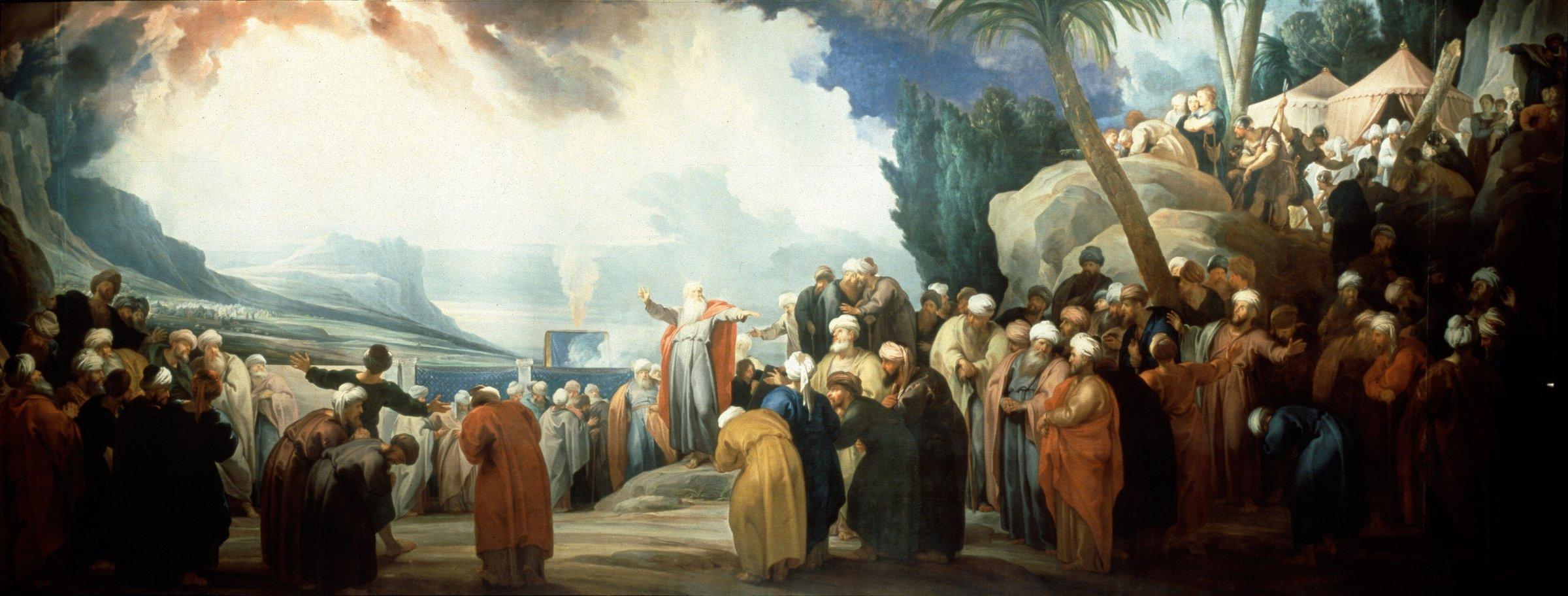
Jacob de Wit, Moses Elects the Council of Seventy Elders, 1737. Public domain.
Mark 10:42 to 44 and Hebrews 13:17 · Subject · Featured Study
Leadership
Scripture asks those who lead to fear God, to be honest and able, and to serve the people in their care, and it holds them to account.
For lack of guidance, a nation falls, but with many counselors comes deliverance.
- Books
- Mark, Exodus, Joshua, Nehemiah, Hebrews
- Hold in memory
- Mark 10:43, Hebrews 13:17
Hebrews tells a church to remember the leaders who spoke God's word to it.
Summary
In the Bible a leader rules under God and answers to Him.
- The Law, the histories, the Psalms and the letters each describe the leader God approves.
- Jesus told the Twelve that leading among them means serving.
- Saul and Uzziah fell, one by fear of the people and one by pride.
What Scripture Asks of a Leader
Moses could not carry the people alone, and God gave him help.
Jethro told Moses that the task was too heavy for him alone. Later the LORD put a share of the Spirit that was on Moses upon seventy elders, so that they would bear the burden with him.
David's last words describe the king God approves. Psalm 78 sets David's care of the sheep beside his care of Israel.
The Marks of a Leader, From Exodus to Romans
Seven passages name what is asked of those who lead.
What Scripture asks of those who lead, in the order of the canon.
| What is asked | Spoken to or of |
|---|---|
| Leaders are to be capable, God-fearing, trustworthy and averse to dishonest gain. | the judges Moses would appoint |
| Leaders are to be wise, understanding and respected. | the leaders of the tribes |
| The leader is to be strong and very courageous. | Joshua |
| The ruler rules with justice, in the fear of God. | the king |
| David shepherded with integrity of heart and skillful hands. | David |
| The one whose gift is leading is to lead with diligence. | the church at Rome |
| Paul asks the church to imitate him as he imitates Christ. | the church at Corinth |
Called and Charged
Joshua took up the work Moses laid down, and Nehemiah called a city to rebuild.
Then Moses called for Joshua and said to him in the presence of all Israel, “Be strong and courageous, for you will go with this people into the land that the LORD swore to their fathers to give them, and you shall give it to them as an inheritance. The LORD Himself goes before you; He will be with you. He will never leave you nor forsake you. Do not be afraid or discouraged.”The charge comes in public, with a promise beside it.
This Book of the Law must not depart from your mouth; meditate on it day and night, so that you may be careful to do everything written in it. For then you will prosper and succeed in all you do. Have I not commanded you to be strong and courageous? Do not be afraid; do not be discouraged, for the LORD your God is with you wherever you go.”The LORD ties Joshua's success to the book of the Law.
Then I said to them, “You see the trouble we are in. Jerusalem lies in ruins, and its gates have been burned down. Come, let us rebuild the wall of Jerusalem, so that we will no longer be a disgrace.” I also told them about the gracious hand of my God upon me, and what the king had said to me. “Let us start rebuilding,” they replied, and they set their hands to this good work.Nehemiah names the city's disgrace, and the people answer him.
John Wesley reads their answer as a resolve to build with vigour, diligence and resolution.
The Account a Leader Gives
Those who lead and teach will answer to God.
Obey your leaders and submit to them, for they watch over your souls as those who must give an account. To this end, allow them to lead with joy and not with grief, for that would be of no advantage to you.The church is told why its leaders keep watch.
Matthew Henry, in his Commentary on the Whole Bible, writes of what that account means for the people who hear.
“It is the interest of hearers that the account their ministers give of them may be with joy, and not with grief. If faithful ministers be not successful, the grief will be theirs, but the loss will be the people's. Faithful ministers have delivered their own souls, but a fruitless and faithless people's blood and ruin will be upon their own heads.”
Matthew Henry · Commentary on the Whole Bible · on Hebrews 13:17Puritan
Not many of you should become teachers, my brothers, because you know that we who teach will be judged more strictly.James sets a stricter judgment over those who teach.
Two kings of Scripture show how a leader falls.
Then Saul said to Samuel, “I have sinned; I have transgressed the LORD’s commandment and your instructions, because I feared the people and obeyed their voice.Saul's confession names the fear that ruled him.
But when Uzziah grew powerful, his arrogance led to his own destruction. He was unfaithful to the LORD his God, for he entered the temple of the LORD to burn incense on the altar of incense.The Chronicler names what undid a strong king of Judah.
1 Samuel 15:24, 2 Chronicles 26:16
Leading Among Believers
Jesus set His disciples apart from the rulers of the nations.
So Jesus called them together and said, “You know that those regarded as rulers of the Gentiles lord it over them, and their superiors exercise authority over them. But it shall not be this way among you. Instead, whoever wants to become great among you must be your servant, and whoever wants to be first must be the slave of all.Jesus answers James and John's request for the seats beside Him.
Peter later charged the elders to be examples to the flock and to lord it over no one in their care.
if it is encouraging, let him encourage; if it is giving, let him give generously; if it is leading, let him lead with diligence; if it is showing mercy, let him do it cheerfully.Paul lists leading among the gifts that grace gives.
In his notes on the New Testament, Wesley glosses the one who leads as one who has the care of a flock.
Paul's letters to Timothy and Titus list what an overseer of the church must be.
When the Righteous Flourish
Proverbs sets a whole people's joy or groaning on the kind of person who rules them.
When the righteous flourish, the people rejoice, but when the wicked rule, the people groan.The proverb names what a people feel under those who lead them.
Sources
Scripture is the Berean Standard Bible.
- John Wesley, Explanatory Notes upon the Old Testament (1765), on Nehemiah 2:18.
- John Wesley, Explanatory Notes upon the New Testament (1755), on Romans 12:8.
- Matthew Henry, Commentary on the Whole Bible (1710), on Hebrews 13:17.
Keep Studying
People and groups10
Doctrines6
Go further2
Values2