
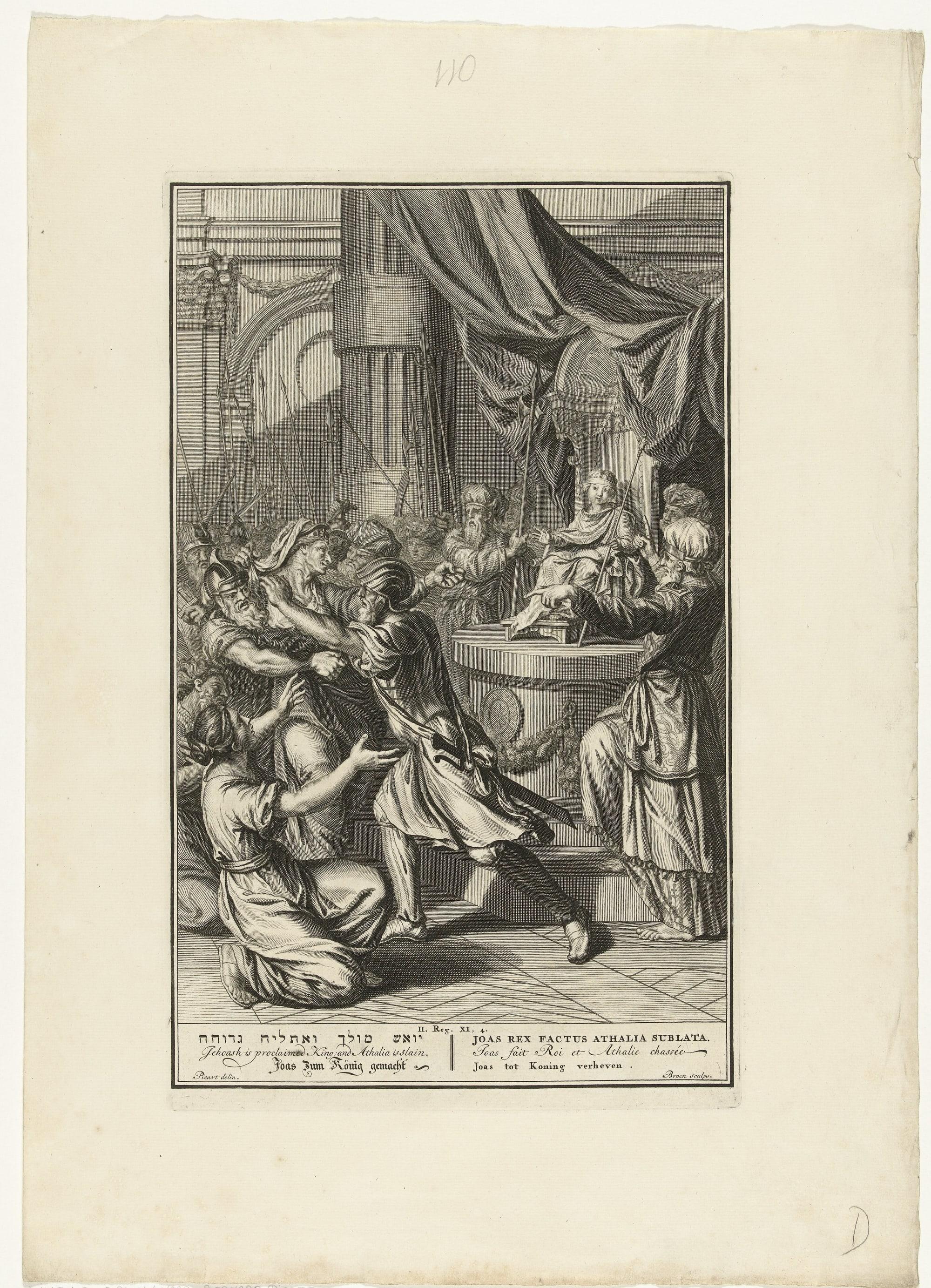
After Bernard Picart, Joash Made King and Athaliah Seized, 1711 to 1720. Public domain.
2 Kings 11:1 to 21 · Story · Featured Study
Athaliah and the Six Hidden Years
A queen of Ahab's house ruled Judah while the last heir of David's line grew up in secret.
A priest and his wife kept a baby hidden in the temple while his grandmother ruled.
And Joash remained hidden with his nurse in the house of the LORD for six years while Athaliah ruled the land.
And Joash remained hidden with his nurse in the house of the LORD for six years while Athaliah ruled the land.
- Where
- Jerusalem
- Who
- Athaliah, Jehosheba, Joash, Jehoiada, Mattan
- When
- Athaliah ruled Judah for six years before Joash was crowned
Summary
A queen from the house of Ahab seized the throne of Judah and tried to wipe out the royal line. One grandson survived her. When the boy was seven, the priest presented him to the guards, and the queen's reign ended in a single day.
- Two books tell the coup, one through soldiers and one through temple servants.
- The day closed with the boy seated on his throne.
- Commentators give three motives for the queen's massacre.
Two Accounts of the Seventh Year
Kings and Chronicles tell the same day and differ on the names, the guards and the gates.
Kings tells the day through the royal guard, and Chronicles through the Levites.
| Point | 2 Kings 11 | 2 Chronicles 22 and 23 |
|---|---|---|
| The sister who hid Joash | Jehosheba, daughter of King Joram | Jehoshabeath, daughter of King Jehoram and wife of Jehoiada |
| Whom Jehoiada brought in | The commanders of hundreds, the Carites and the guards | The commanders, with the Levites and the heads of the families of Israel |
| Who stood around the king | The guards, with weapons in hand | The Levites, with weapons in hand |
| A gate named for the watch | The gate of Sur | The Foundation Gate |
| Who brought out the king's son | Jehoiada | Jehoiada and his sons |
| The covenant | Between the LORD, the king and the people | Between Jehoiada, the king and the people |
| The way into the palace | The Gate of the Guards | The Upper Gate |
The seventh-year day ran from an oath in the temple to a king on the throne.
- Jehoiada puts the commanders under oath and shows them the king's sonthe house of the LORD2 Kings 11:4
- The commanders take King David's spears and shieldsthe house of the LORD2 Kings 11:10
- Jehoiada crowns the boy and gives him the Testimonythe house of the LORD2 Kings 11:12
- Athaliah sees the king by the pillar and cries treasonthe house of the LORD2 Kings 11:14
- Athaliah is put to deaththe horses' entrance to the palace grounds2 Kings 11:16
- Jehoiada makes the covenantthe house of the LORD2 Kings 11:17
- The people tear down the temple of Baal and kill Mattanthe temple of Baal2 Kings 11:18
- Joash takes his seat on the royal thronethe royal palace2 Kings 11:19
Eight steps of 2 Kings 11:4 to 19 in order, each with its place and its verse.
The people tear down the temple of Baal and kill Mattan, Joash takes his seat on the royal throne
The Crown and the Testimony
Commentators explain the second of the two gifts at the coronation.
Then Jehoiada brought out the king’s son, put the crown on him, presented him with the Testimony, and proclaimed him king. They anointed him, and the people clapped their hands and declared, “Long live the king!”Here the priest makes the boy king.
Albert Barnes takes the Testimony to be the Book of the Law kept by the ark. He thinks it was set on the king's head, perhaps to show that he stood under the Law of his country. John Wesley holds that it was put into the king's hand to remind him of his duty. That duty, as Deuteronomy 17:18 commands, was to read and copy the Law.
Adam Clarke thinks it was probably the Law written on a roll of vellum, which served as his sceptre. He calls the clapping of hands the first record of that sign of joy. He also calls the crowning the first on record of a child of seven made king.
Barnes also reads the pillar as a raised stand from which the king of Judah addressed the people in the temple court.
The House of Ahab in Judah
Athaliah came to Judah by a royal marriage into the house of David.
Kings names Ahaziah's mother Athaliah, the granddaughter of Omri king of Israel.
And Jehoram walked in the ways of the kings of Israel, just as the house of Ahab had done. For he married a daughter of Ahab and did evil in the sight of the LORD.Kings blames Jehoram's reign on his marriage.
Albert Barnes holds that Athaliah guided the policy of Judah as wife and mother of its kings. In his reading she set up the worship of Baal there and kept a close alliance with Israel. Jehu's revolt, he writes, touched her nearly. Jehu had killed forty-two relatives of Ahaziah at the well of Beth-eked.
What the Text Leaves Unsaid
Kings gives Athaliah's six years one clause and names no deed of her reign.
Barnes writes that the writer dismisses her reign as one he scorns to speak of.
For the sons of that wicked woman Athaliah had broken into the house of God and had even used the sacred objects of the house of the LORD for the Baals.Barnes draws from this verse that she worked to set up the worship of Baal in Judah.
Neither account names the nurse, gives Joash's age when he was hidden or says how many royal heirs were killed.
The Promise Behind the Crowning
Chronicles gives Jehoiada's reason for crowning the boy in the promise to David's line.
the whole assembly made a covenant with the king in the house of God. “Behold, the king’s son!” said Jehoiada. “He must reign, just as the LORD promised concerning the descendants of David.The priest gives his reason for the coup in this verse.
Matthew Henry reads the chapter as David's promised lamp almost put out by Athaliah's malice and yet wonderfully kept.
The study of Jehoiachin's release traces the lamp promised to David through the books of Kings.
Voices on Athaliah
One voice from the eighteenth century is given on the covenant.
Matthew Henry (1662 to 1714)
Commentary on the Whole Bible
How this text has been taught
“God had already, on his part, promised to be their God (Jehoiada could show them that in the book of the testimony); now the king and people on their part must covenant and agree that they will be the Lord's people: in this covenant, the king stands upon the same level with his subjects and is as much bound as any of them to serve the Lord.”
on 2 Kings 11:17Puritan
Why Did Athaliah Kill the Royal Heirs?
The verse gives her son's death as the occasion, and no motive.
When Athaliah the mother of Ahaziah saw that her son was dead, she proceeded to annihilate all the royal heirs.Each reading of her motive starts from this verse.
Ambition and self-defenceJamieson, Fausset and Brown
The objection: the narrator names no plan of Athaliah's beyond the killing itself.
War on God's promise to DavidIshodad of Merv
Ishodad of Merv, in his Books of Sessions, held that she meant to reign against the will of God by fighting God's promises.
The objection: the text gives no word of Athaliah about David's house, so the motive is read from the outcome.
Judgment on the house of JehoramJohn Wesley and Matthew Henry
John Wesley calls the slaughter the fruit of Jehoshaphat's marrying his son into the idolatrous house of Ahab. He reads it as a judgment God permitted to show how he abhors such alliances. Matthew Henry holds that God visited the sins of Joram and Ahaziah on their children.
The objection: the text says Athaliah set out to destroy the heirs, and it gives no word of the LORD sending her.
Books to Read Next
Both works are in the public domain, and each has a free copy to read.
Notes, Explanatory and Practical, on the Old and New Testaments
Albert Barnes · 1832 to 1869
Barnes reads Athaliah's reign, the Testimony and the pillar in his notes on 2 Kings 11.
Read at Bible HubBiblical Commentary on the Old Testament, on 2 Kings
C. F. Keil and F. Delitzsch · 1857 to 1878
Keil reads 2 Kings 11 verse by verse beside 2 Chronicles 23.
Read at Bible HubThe Kindness Forgotten
Joash did right all the days Jehoiada instructed him, and the Chronicler records how the king turned after the priest died.
Thus King Joash failed to remember the kindness that Zechariah’s father Jehoiada had extended to him. Instead, Joash killed Jehoiada’s son. As he lay dying, Zechariah said, “May the LORD see this and call you to account.”The verse shows the end of the bond that began in the hidden years.
Sources
Scripture is the Berean Standard Bible.
- Flavius Josephus, Antiquities of the Jews 9.7.1, translated by William Whiston.
- C. F. Keil and F. Delitzsch, Biblical Commentary on the Old Testament (1857 to 1878), on 2 Kings 11.
- Jamieson, Fausset and Brown, Commentary Critical and Explanatory on the Whole Bible (1871), on 2 Kings 11:1.
- Albert Barnes, Notes, Explanatory and Practical, on the Old and New Testaments (1832 to 1869), on 2 Kings 11:1.
- Albert Barnes, Notes, on 2 Kings 11:3.
- Albert Barnes, Notes, on 2 Kings 11:12 and 2 Kings 11:14.
- John Wesley, Explanatory Notes upon the Old Testament (1765), on 2 Kings 11:1.
- John Wesley, Explanatory Notes upon the Old Testament (1765), on 2 Kings 11:12.
- Adam Clarke, Commentary on the Bible (1832), on 2 Kings 11:12 and 2 Kings 11:21.
- Matthew Henry, Commentary on the Whole Bible (1710), on 2 Kings 11:1.
- Matthew Henry, Commentary on the Whole Bible (1710), on 2 Kings 11:17.
- Matthew Henry, Commentary on the Whole Bible (1710), on 2 Kings 11:17 to 21.
- Ishodad of Merv, Books of Sessions, on 2 Kings 11:1.
Keep Studying
Read it4
People and groups7
Show the next 1 title
Places2