
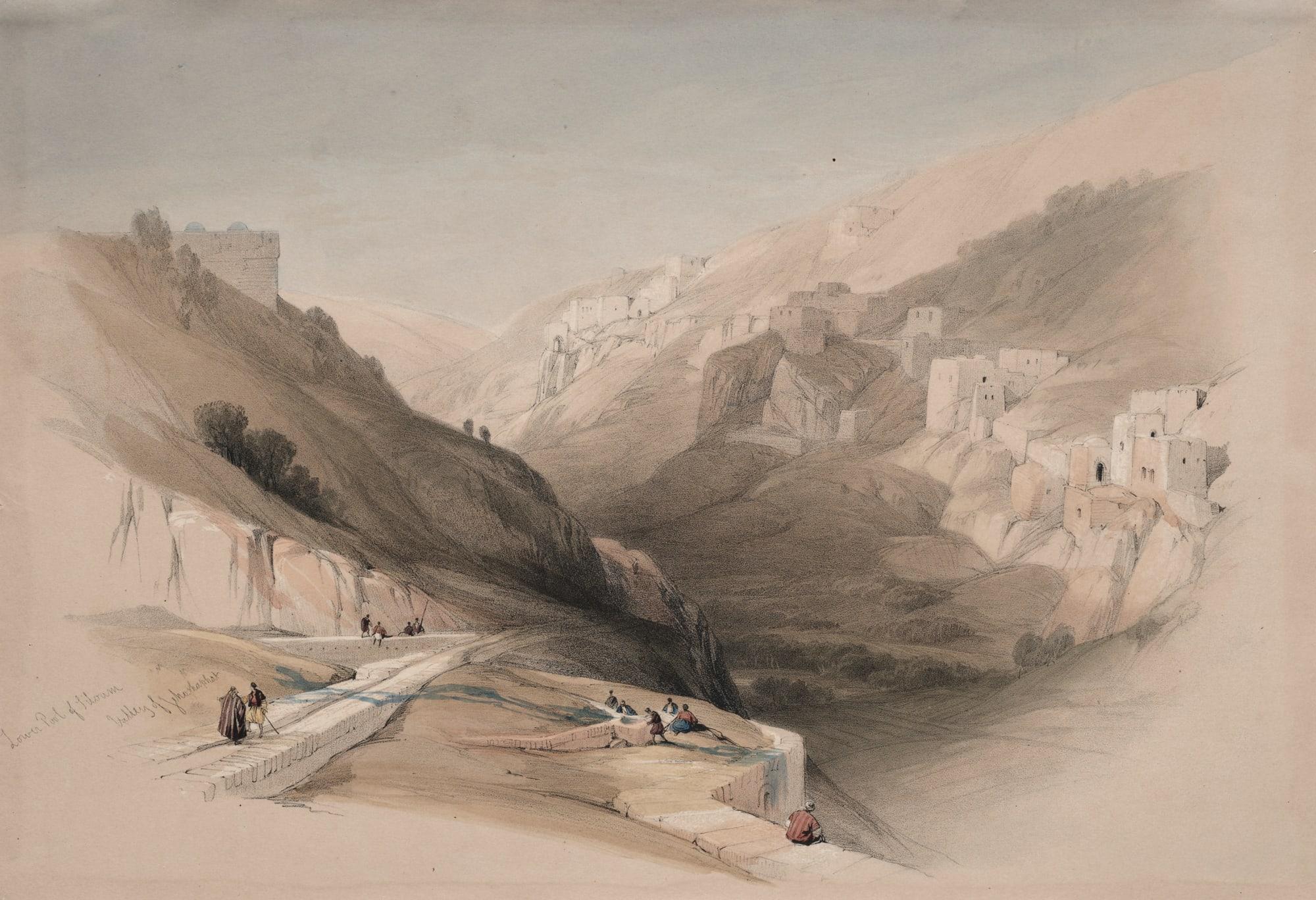
David Roberts, Lower Pool of Siloam, Valley of Jehoshaphat, 1839. CC0.
2 Samuel 5:7 · Place · Featured Study
Zion
Zion is the Jebusite fortress David captured and renamed the City of David.
Nevertheless, David captured the fortress of Zion (that is, the City of David).
- Today
- Jerusalem
- Region
- The hills of Jerusalem, between the Kidron and Hinnom valleys
- First named
- 2 Samuel 5:7 “…David captured the fortress of Zion (that is,…”
- Last named
- Revelation 14:1 “…the Lamb standing on Mount Zion, and with…”
The psalmist calls on worshippers to march around Zion and count her towers.
Summary
In Samuel and Kings, Zion is a hill of Jerusalem. In the Psalms and the prophets, it stands for the city and its people.
- David was buried in the City of David (1 Kings 2:10). Peter said his tomb was still there (Acts 2:29).
- Solomon kept Pharaoh's daughter there until his palace and the temple were built (1 Kings 3:1).
- The Berean text names Zion in 167 verses, 51 of them in Isaiah and 40 in the Psalms.
The Fortress of Zion
2 Samuel and 1 Chronicles both record the capture in the same words.
This study asks which hill of Jerusalem Scripture calls Zion and how the name came to cover more than a fortress. It sets the hills on a plan of the city, follows the name through the record and weighs where the stronghold stood.
The capture takes four verses: the Jebusites' taunt, the water shaft, and David's building from the supporting terraces inward (2 Samuel 5:6 to 9). Chronicles adds that Joab went up first and became chief commander (1 Chronicles 11:6).
In the Hebrew text the name stands 154 times.
The study of Jebusite Jerusalem teaches the town David took, and the study of Zion and Jerusalem teaches what the name pictures.
Zion on the Plan
John Bartholomew's historical atlas drew Jerusalem as it stood under David.
Red lines mark the walls of David's city, between the spring and the Pool of Siloam.
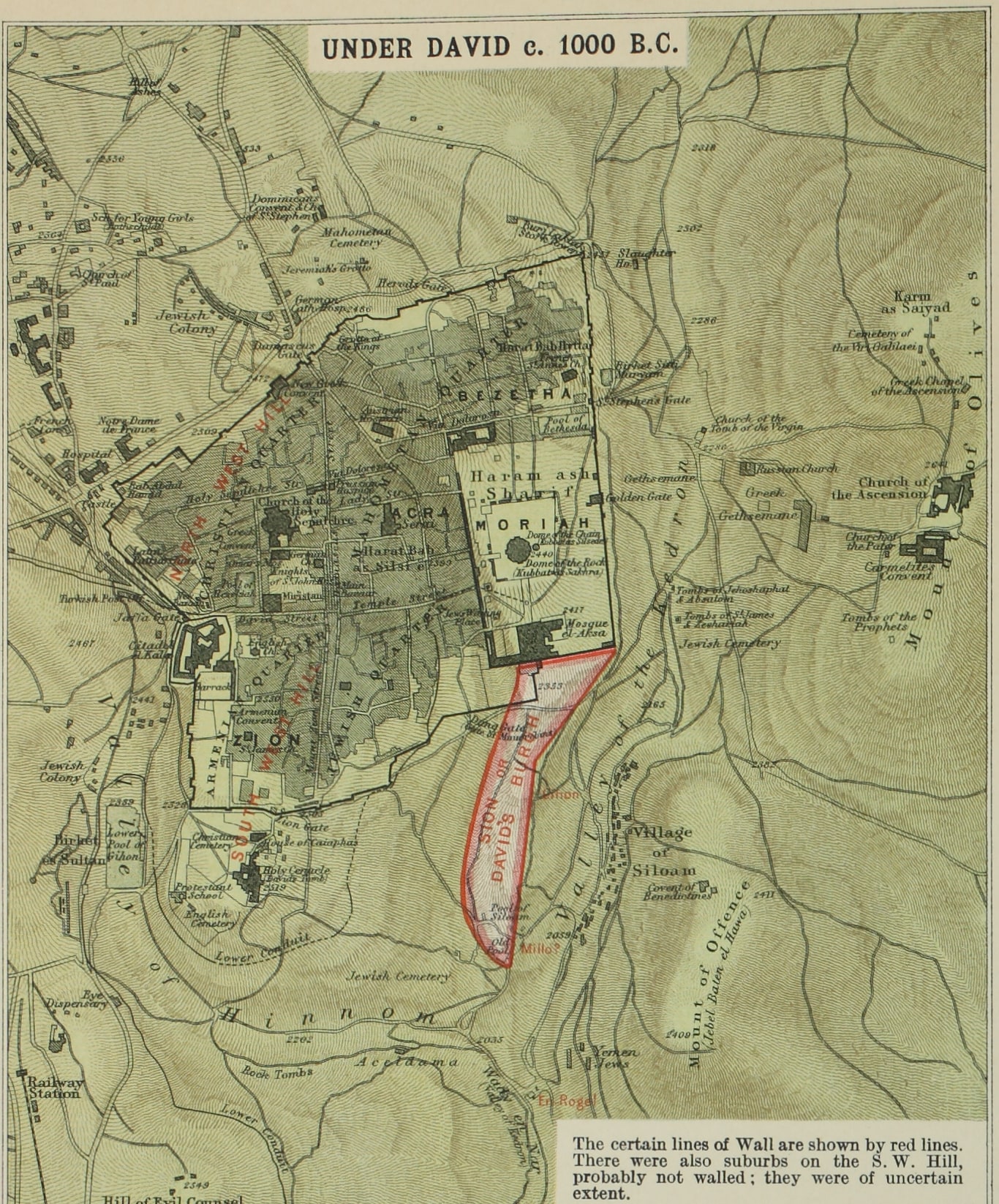
- Sion or David's BurghDavid built houses for himself in the City of David and pitched a tent there for the ark. The plate letters Sion or David's Burgh inside red lines its key calls the certain lines of wall, with no query.1 Chronicles 15:1
- GihonDavid sent Solomon down to Gihon to be anointed. The plate prints Gihon in red on the east side of the ridge, with no query.1 Kings 1:33
- Pool of SiloamJesus sent the man born blind to wash in the Pool of Siloam. The plate prints it at the south tip of the ridge, with no query.John 9:7
- MilloSolomon's forced labour built the supporting terraces. The plate prints Millo with a query at the south tip, so its place is proposed.1 Kings 9:15
- MoriahGad told David to build an altar on the threshing floor of Araunah. The plate letters Moriah inside the Haram ash Sharif, north of David's walls, with no query.2 Samuel 24:18
John Bartholomew and Co., Jerusalem at Different Periods, the panel Under David, about 1000 B.C., from plates 47 and 48 of a historical atlas of the Holy Land. Public domain; File:John Bartholomew & Co., Jerusalem at different periods (FL46962213 3908149).jpg.
Five numbered points, each where the plate prints the place, with north at the top. The panel shows Jerusalem under David, one of six on the plate. It letters the later name Zion on the south-west hill, outside the red walls. Its key says the suburbs on that hill were of uncertain extent.
The study of Mount Moriah teaches the hill where Solomon built, and the study of Solomon's Temple teaches the house that stood on it.
Zion in Scripture, in Order
Eight verses, each naming Zion, show where the name stood in each age.
The ark comes to the fortress first, and Hebrews closes the list with the city above.
- The ark comes to JerusalemDavid brings the ark of God from the house of Obed-edom into the City of David with rejoicing2 Samuel 6:12
- Hezekiah's reignIsaiah promises survivors from Zion while Assyria threatens the city2 Kings 19:31
- The king's psalmThe LORD installs His King on Zion, His holy mountainPsalm 2:6
- The psalm of the cityMount Zion is called the city of the great KingPsalm 48:2
- The exileThe captives weep by the rivers of Babylon when they remember ZionPsalm 137:1
- The last daysThe nations go up to the mountain of the LORD, for the law goes forth from ZionIsaiah 2:3
- The entry into JerusalemMatthew quotes the word to the Daughter of Zion as Jesus rides into the cityMatthew 21:5
- The letter to the HebrewsBelievers have come to Mount Zion, the heavenly JerusalemHebrews 12:22
Eight moments from 2 Samuel to Hebrews in the order of the canon, each with its verse.
The entry into Jerusalem, The letter to the Hebrews
Three studies tell three of these moments whole: the ark of the covenant, Hezekiah and Sennacherib, and the entry into Jerusalem.
The City Beside the Spring
Two waters, the Gihon spring and the Pool of Siloam, mark where the City of David stood.
The Fountain Gate was repaired by Shallun son of Col-hozeh, ruler of the district of Mizpah. He rebuilt it, roofed it, and installed its doors, bolts, and bars. He also repaired the wall of the Pool of Shelah near the king’s garden, as far as the stairs that descend from the City of David.The verse is the plainest link between the City of David and the waters of Siloam.
Albert Barnes, the American commentator, sets the pool of Siloah at the south-western foot of the temple hill, near the lower end of the Tyropoeon. He writes on Nehemiah 3:15 that a flight of steps led from that valley up the steep sides of Ophel. In his reading the steps probably reached the City of David a little south of the temple.
As for the rest of the acts of Hezekiah, along with all his might and how he constructed the pool and the tunnel to bring water into the city, are they not written in the Book of the Chronicles of the Kings of Judah?Chronicles adds that the water ran to the west side of the City of David (2 Chronicles 32:30).
What the Text Leaves Unsaid
Scripture never says how the name passed from the fortress to the temple hill.
Some psalms use the name for the hill of the temple, while Kings still uses it for the City of David. No verse records when or why the name moved.
Plowed Like a Field
Micah warned that Zion would be plowed, and the elders of the land later recalled how Hezekiah answered him.
Therefore, because of you, Zion will be plowed like a field, Jerusalem will become a heap of rubble, and the temple mount a wooded ridge.This is the warning the elders quoted at Jeremiah's trial.
Did Hezekiah king of Judah or anyone else in Judah put him to death? Did Hezekiah not fear the LORD and seek His favor, and did not the LORD relent of the disaster He had pronounced against them? But we are about to bring great harm on ourselves!”The elders used Hezekiah's answer to argue for sparing Jeremiah.
Matthew Henry on Zion
Henry's commentary of 1710 weighs why God chose this hill for His sanctuary.
Matthew Henry (1662 to 1714)
“The situation must needs be every way agreeable, when Infinite Wisdom chose it for the place of the sanctuary; and that which made it beautiful was that it was the mountain of holiness, for there is a beauty in holiness.”
Matthew Henry · Commentary on the Whole Bible · on Psalm 48:2Puritan
Which Hill Was the Stronghold?
Josephus, the commentators and the atlas makers have set David's Zion on three different hills of Jerusalem.
At that time Solomon assembled before him in Jerusalem the elders of Israel—all the tribal heads and family leaders of the Israelites—to bring up the ark of the covenant of the LORD from Zion, the City of David.Each reading of the stronghold's hill has to fit this verse.
The south-eastern ridge by the springM. G. Easton and the Bartholomew atlas plate
The objection: the plate's red walls enclose only a narrow strip of that ridge.
The temple hillAlbert Barnes and John Wesley
Barnes, on 2 Samuel 5:7, holds that the ancient Zion was the hill on which the temple stood, with the castle just north of the temple, and that the modern Zion lies south-west of it. John Wesley, the Methodist preacher, calls Zion strictly a hill on the north part of Jerusalem, with a fort called the City of David. He makes the temple hill of Moriah a part of Zion or its neighbour.
The objection: 2 Chronicles 3:1 sets the temple on Mount Moriah, on the threshing floor of Ornan.
The upper city on the western hillFlavius Josephus, and Jamieson, Fausset and Brown
Josephus, in The Wars of the Jews 5.4.1, describes Jerusalem on two hills. He says King David called the higher one, which held the upper city, the Citadel. Jamieson, Fausset and Brown, on 2 Samuel 5:9, set David's bastions on the northern side of Mount Zion. They held that the Jebusites still lived in the lower part of the city.
The objection: 1 Kings 1:33 sends Solomon down from the city to Gihon, at the foot of the eastern ridge.
The City to Come
The Zion of David's day was a hill a worshipper could walk around. Hebrews looks past it to a city still to come.
For here we do not have a permanent city, but we are looking for the city that is to come.The verse turns the reader from Jerusalem to the city of God.
Sources
Scripture is the Berean Standard Bible.
- The site's lexicon, entry h6726 (Strong's number 6726), with its count of the Hebrew text.
- Albert Barnes, Notes, Explanatory and Practical, on the Old and New Testaments (1832 to 1869), on Nehemiah 3:15.
- Albert Barnes, Notes, Explanatory and Practical, on the Old and New Testaments (1832 to 1869), on 2 Samuel 5:7.
- John Wesley, Explanatory Notes upon the Old Testament (1765), on Psalm 2:6.
- Jamieson, Fausset and Brown, Commentary Critical and Explanatory on the Whole Bible (1871), on 2 Samuel 5:9.
- Matthew Henry, Commentary on the Whole Bible (1710), on Psalm 48:2.
- Flavius Josephus, The Wars of the Jews, trans. William Whiston, 5.4.1.
- M. G. Easton, Illustrated Bible Dictionary (1897), entry Zion.
Keep Studying
Studies4
Places9