
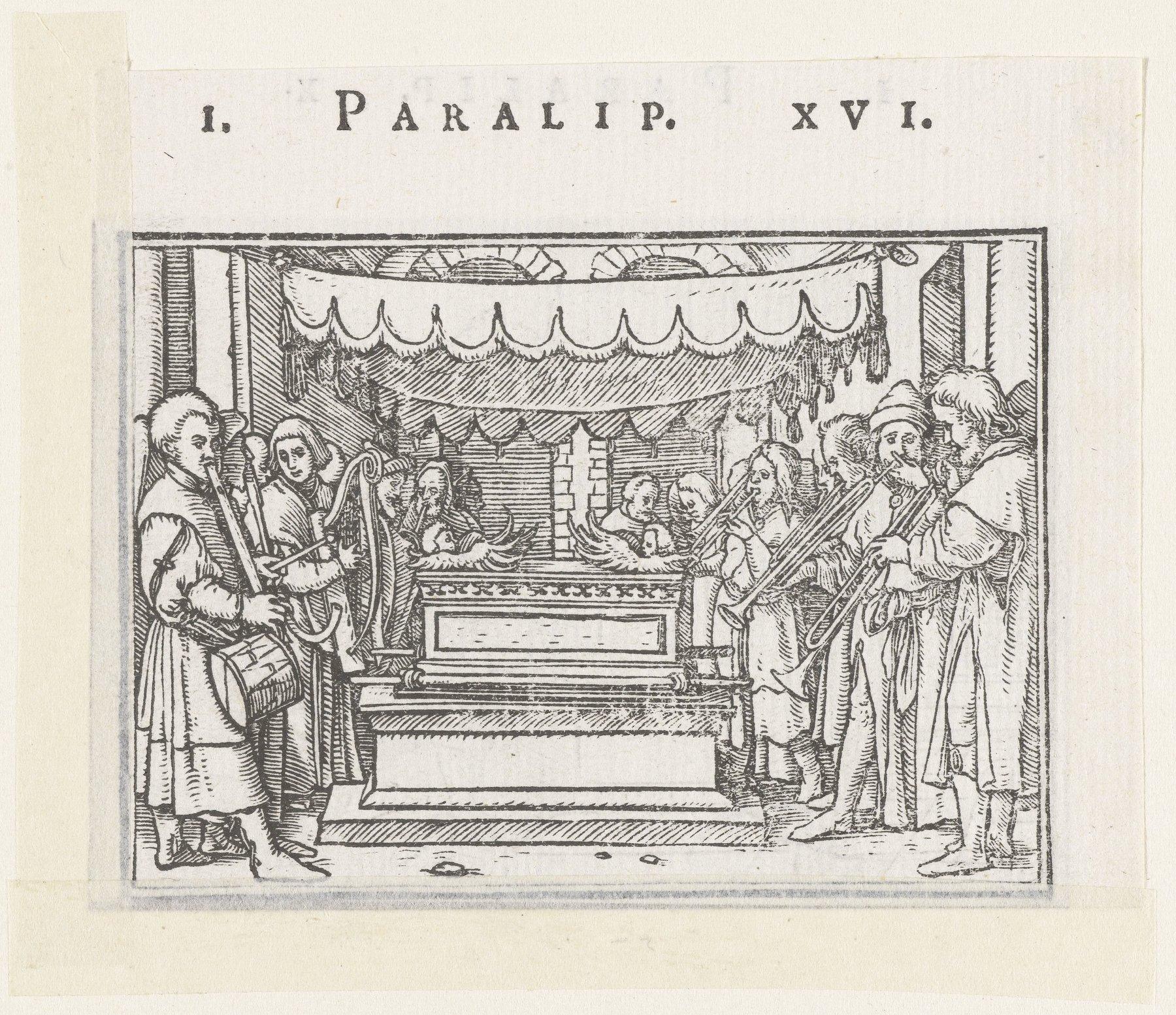
Hans Holbein the Younger, Levites making music before the ark, 1538. Public domain.
1 Chronicles 16:37 to 42 · Place · Featured Study
The Two Sanctuaries: the Tent in Jerusalem and the Tabernacle at Gibeon
Under David the ark stood in a tent in Jerusalem while the tabernacle of Moses and its altar stood at Gibeon.
Solomon went up to Gibeon to inquire of the LORD at the bronze altar Bezalel had made.
For the tabernacle of the LORD that Moses had made in the wilderness and the altar of burnt offering were presently at the high place in Gibeon,
- Today
- Jerusalem and Gibeon
- Region
- The hills of Judah and Benjamin
- First named
- 1 Chronicles 16:1 “So they brought the ark of God and…”
- Last named
- 2 Chronicles 5:5 “and they brought up the ark and the…”
Summary
In 1 Chronicles 16 David splits the priests and Levites between two places. In 2 Chronicles 5 the ark and the Tent of Meeting come into the temple together. Commentators give three reasons for the split.
- Chronicles calls the site at Gibeon a high place, and 1 Kings 3:4 calls it the great high place.
- David's fear of the angel's sword kept him from the altar at Gibeon.
- The Hebrew word for David's tent is 'ohel, and the word for the tabernacle is mishkan.
Two Places of Worship
First Chronicles 16 sets one company of Levites before the ark and another before the tabernacle.
So David left Asaph and his brothers there before the ark of the covenant of the LORD, to minister there regularly according to the daily requirements,This is the first half of the division.
And David left Zadok the priest and his fellow priests before the tabernacle of the LORD at the high place in Gibeon to regularly present burnt offerings to the LORD on the altar of burnt offerings, morning and evening, according to all that was written in the Law of the LORD, which He had commanded Israel to keep.This is the second half of the division.
C. F. Keil writes that the tabernacle of Moses, with its altar of burnt offering, remained the general place of worship for the whole people. It did so while the ark was apart from it. To carry on the service at both places, David divided the staff of priests and Levites.
The study of Gibeon teaches the city where the tabernacle stood.
Jerusalem and Gibeon on the Survey Sheet of 1879
Sheet XVII of the Palestine Exploration Fund's map of Western Palestine draws both places at one inch to a statute mile.
Both sanctuaries stand on one sheet of the survey.
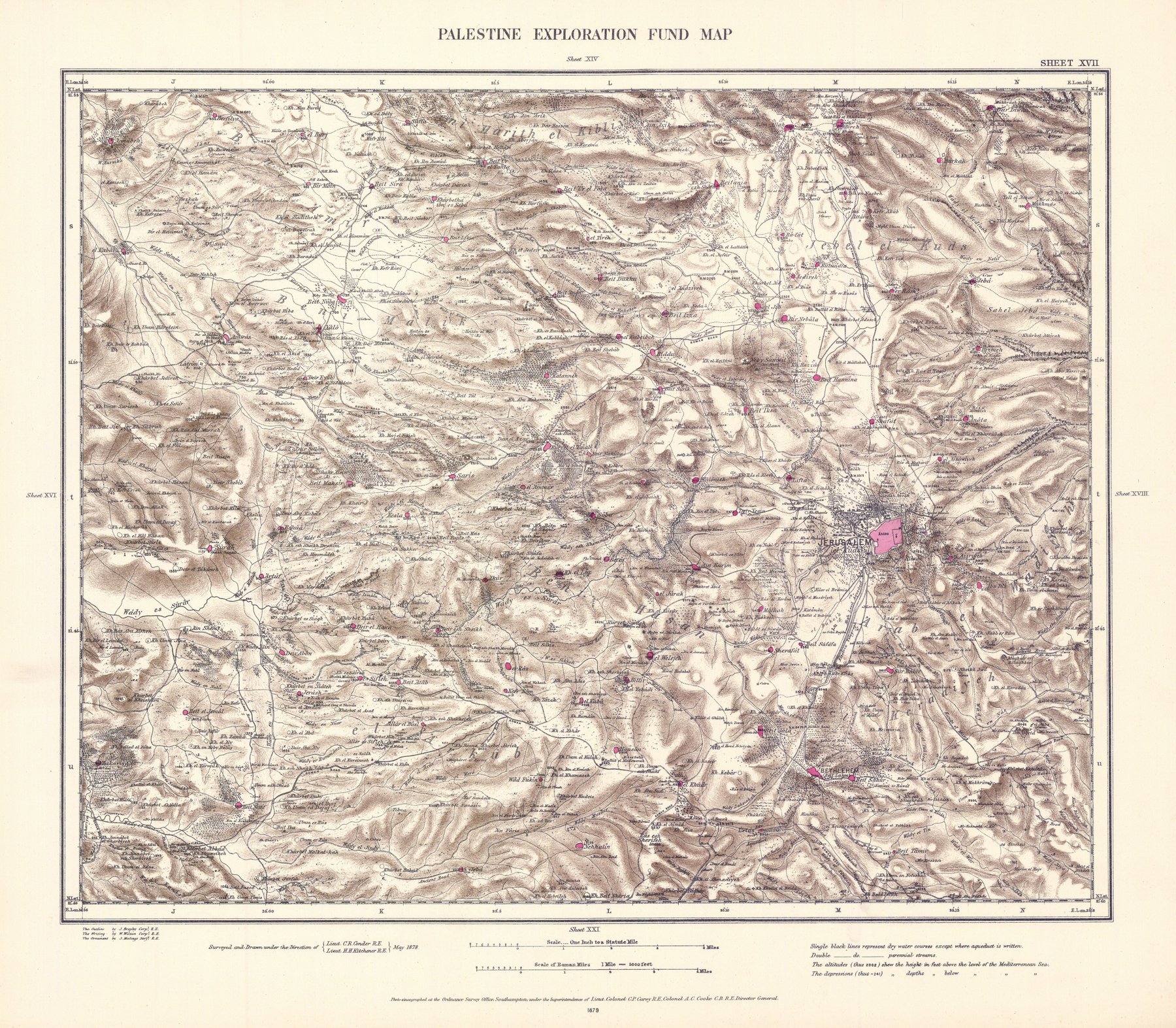
- JerusalemDavid set the ark in the tent he had pitched for it. The sheet draws the walled city and letters it Jerusalem (el Kuds); the place is known.1 Chronicles 16:1
- GibeonSolomon returned from the high place there to Jerusalem to reign. The sheet letters the village the study of Gibeon identifies as the site; the place is known.2 Chronicles 1:13
C. R. Conder and H. H. Kitchener, Palestine Exploration Fund Map, sheet XVII, Ordnance Survey Office, Southampton, 1879. Public domain; National Library of Israel; File:Survey of Western Palestine 1880.17.jpg.
Two numbered points, each where the sheet prints the place, with north at the top. C. R. Conder and H. H. Kitchener surveyed the land for the Palestine Exploration Fund from 1872 to 1877. The Ordnance Survey Office at Southampton printed the sheet in 1879.
From Two Altars to One House
Six moments from Chronicles carry the two sanctuaries from David's tent to Solomon's temple.
Chronicles carries the ark and the tabernacle from two places to the one house of the temple.
- The ark leaves Kiriath-jearimDavid and all Israel go up to bring the ark of God from Kiriath-jearim1 Chronicles 13:5 to 6
- The ark in David's tentBurnt offerings and peace offerings are made before God on the day the ark arrives1 Chronicles 16:1
- The service dividedAsaph's company and Zadok's company take their posts1 Chronicles 16:37 to 42
- The threshing floorDavid sacrifices at the threshing floor where the LORD answered him1 Chronicles 21:28 to 30
- Solomon at GibeonSolomon and the whole assembly go up to the high place at Gibeon2 Chronicles 1:3
- The templeThe ark and the Tent of Meeting are brought up together2 Chronicles 5:5
In the order of the text, each with its verse.
Was There an Altar Before the Ark?
Commentators disagree on whether sacrifice went on in Jerusalem after the day the ark arrived.
So they brought the ark of God and placed it inside the tent that David had pitched for it. And they presented burnt offerings and peace offerings before God. When David had finished sacrificing the burnt offerings and peace offerings, he blessed the people in the name of the LORD.All three readings start from the offerings of this one day.
John Wesley holds that no incense was burned and no sacrifice offered before the ark, because the altars were not there. He reads the singing in Jerusalem as an early form of spiritual worship.
In Keil's reading David built an altar beside the tent in Zion and set up a settled worship there, without an express command of God. Adam Clarke counts two high priests and two services, Zadok at Gibeon and Abiathar in Jerusalem.
Who Served at Each Sanctuary
David appointed priests, singers and gatekeepers for both places in 1 Chronicles 16.
Gibeon kept the priests and the altar, and Jerusalem kept the ark and the chief singer.
| Place | Who served | Their work |
|---|---|---|
| Jerusalem | Asaph and his brothers | They ministered before the ark day by day |
| Jerusalem | Obed-edom son of Jeduthun and Hosah | They kept the gates |
| Jerusalem | Benaiah and Jahaziel the priests | They blew the trumpets before the ark |
| Gibeon | Zadok and his fellow priests | They offered the burnt offerings morning and evening |
| Gibeon | Heman and Jeduthun | They gave thanks with trumpets and cymbals |
| Gibeon | The sons of Jeduthun | They were stationed at the gate |
What the Text Leaves Unsaid
Chronicles never says when the tabernacle came to Gibeon or why David left it there.
The tabernacle first stands at Gibeon in 1 Chronicles 16:39 with no account of its coming. No verse says why David did not bring the ark to the tabernacle at Gibeon.
Now David had brought the ark of God from Kiriath-jearim to the place he had prepared for it, because he had pitched a tent for it in Jerusalem.Chronicles explains only where the ark had gone.
Here Shall Be the House
The threshing floor where David sacrificed became the place of the altar for all Israel.
but David could not go before it to inquire of God, because he was afraid of the sword of the angel of the LORD.The verse gives the reason he stayed away.
Then David said, “Here shall be the house of the LORD God, as well as the altar of burnt offering for Israel.”This verse names the site where the two would be joined.
Keil notes that the LORD's command through Gad sent David to the threshing floor instead of Gibeon or the ark. In his reading the fire from heaven consecrated it as a place of sacrifice.
Voices on the Two Sanctuaries
Jamieson, Fausset and Brown and Matthew Henry wrote on the worship divided between Jerusalem and Gibeon.
How this text has been taught2 voices, Jamieson, Fausset and Brown, and Matthew Henry
Jamieson, Fausset and Brown, on 1 Chronicles 16:40, write that in David's time worship was performed at two places where the sacred things handed down from Moses were kept.
Matthew Henry, on 1 Chronicles 21:30, writes that the symbols of unity were not insisted on so much as unity itself. In his reading David sacrificed at the threshing floor as long as he lived, while the altar at Gibeon was still kept up.
Why Were There Two Sanctuaries?
Three readings explain why the ark and the tabernacle stood apart under David.
And Solomon and the whole assembly went to the high place at Gibeon because it was the location of God’s Tent of Meeting, which Moses the servant of the LORD had made in the wilderness.Wellhausen rests his reading on this verse.
The people, however, were still sacrificing on the high places because a house for the Name of the LORD had not yet been built.Wellhausen sets this older account against it.
A provisional order until the templeC. F. Keil
The objection: 1 Chronicles 16:37 to 42 sets the order in place without calling it temporary.
The old tent kept where it stoodAlbert Barnes; Jamieson, Fausset and Brown
Albert Barnes supposes that David wanted something newer and finer for the ark, and so let the old tabernacle keep its place. Jamieson, Fausset and Brown suggest that the people of Gibeon were unwilling to part with it. They also suggest that it had no use in Jerusalem, where a more solid house was planned.
The objection: the text gives neither reason, and Jamieson, Fausset and Brown leave the choice between theirs open.
The Chronicler's reading of Kings by the LawJulius Wellhausen
Julius Wellhausen held that 1 Kings 3:1 to 4 knows only a high place at Gibeon. That account excuses Solomon's sacrifice there because no house had yet been built. In his reading the Chronicler, bringing the history into line with the Law, placed the tabernacle at Gibeon. The notes of 1 Chronicles 16:39 and 1 Chronicles 21:29 depend on 2 Chronicles 1:3.
The objection: 1 Kings 8:4 brings the Tent of Meeting up into the temple with the ark. Wellhausen answered that the clause was added by a later hand.
Books to Read Next
Wellhausen's Prolegomena is in the public domain and free to read.
Prolegomena to the History of Israel
Julius Wellhausen · 1885
Its first chapter, The Place of Worship, takes up the tabernacle and the sanctuaries of Israel's history.
Read at Project GutenbergBrought Up Together
Then the priests brought the ark of the covenant of the LORD to its place in the inner sanctuary of the temple, the Most Holy Place, beneath the wings of the cherubim.The ark's last move ends the time of two sanctuaries.
Sources
Scripture is the Berean Standard Bible.
- C. F. Keil and F. Delitzsch, Biblical Commentary on the Old Testament, on 1 Chronicles 16:37 to 42.
- C. F. Keil and F. Delitzsch, on 1 Chronicles 21:28 to 30.
- C. F. Keil and F. Delitzsch, on 2 Chronicles 1:3 to 6.
- John Wesley, Explanatory Notes upon the Old Testament (1765), on 1 Chronicles 16:37.
- Adam Clarke, Commentary on the Bible (1832), on 1 Chronicles 16:39.
- Albert Barnes, Notes, Explanatory and Practical, on the Old and New Testaments (1832 to 1869), on 1 Chronicles 15:1.
- Jamieson, Fausset and Brown, Commentary Critical and Explanatory on the Whole Bible (1871), on 1 Chronicles 15:1.
- Jamieson, Fausset and Brown, Commentary (1871), on 1 Chronicles 16:40.
- Matthew Henry, Commentary on the Whole Bible (1710), on 1 Chronicles 21:30.
- Julius Wellhausen, Prolegomena to the History of Israel, chapter 1, the place of worship, in the English of Black and Menzies (1885)
- Berean Standard Bible, 1 Kings 3:4 and 2 Chronicles 1:13.
- Hans Holbein (II), cut by Veit Rudolf Specklin, Levieten musiceren voor ark van het verbond, woodcut, 1538, Rijksmuseum RP-P-OB-4511Z(V); the museum marks it with the Public Domain Mark 1.0.
Keep Studying
Read it4
Studies5
People and groups4
Places9
Symbols1
Doctrines1