
Ruth 1:8, 2:20 and 3:10 · Loyalty Given Freely
Chesed, the Loyalty No Law Compels
The word comes once in each of the book's first three chapters, and the fourth chapter shows its acts at the gate without naming it.
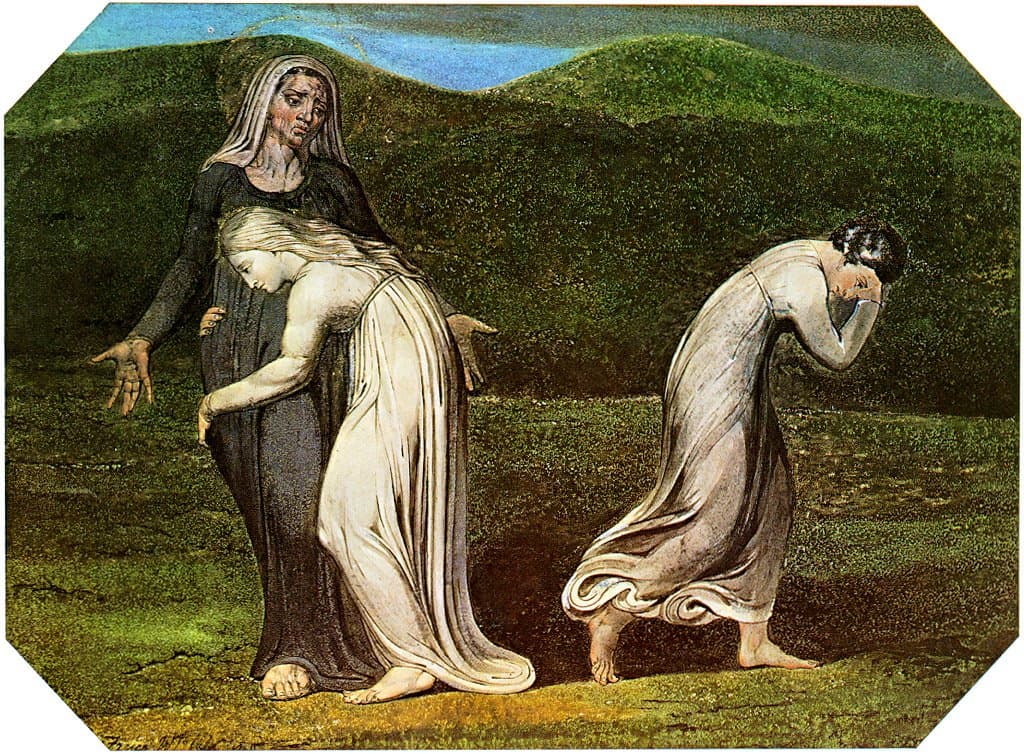
William Blake, Naomi entreating Ruth and Orpah to return to the land of Moab, 1795; Wikimedia Commons file 1795-William-Blake-Naomi-entreating-Ruth-Orpah.jpg; Public domain.
THE ARTWORKBlake painted the parting of Ruth 1:14 as two movements on one hillside: Ruth clinging to Naomi on the left while Orpah walks away weeping on the right.
In the book of Ruth the word chesed names a loyalty given where nothing required it, by two widows, by a landowner and by the LORD.
Summary
The Berean text renders chesed as loving devotion in Ruth 1:8 and as kindness in Ruth 2:20 and 3:10.
- Naomi releases her daughters-in-law in Ruth 1:8 and prays that the LORD will show them loving devotion, as they have shown to their dead and to her.
- Boaz lets Ruth gather more than the gleaning law leaves for the poor, and at the threshing floor he praises her request as a greater kindness than her first.
- Readers divide over whether Ruth 2:20 praises the kindness of the LORD or the kindness of Boaz.
- Hosea and Micah name chesed among the things God asks of His people, and Jesus sends the Pharisees to learn Hosea 6:6 and cites it again in a grainfield.
Chesed at Its Three Turns in Ruth
Naomi speaks the word twice and Boaz once, on the road, at home and at the threshing floor.
Then Naomi said to her two daughters-in-law, “Go back, each of you to your mother’s home. May the LORD show you loving devotion, as you have shown to your dead and to me.The kindness Naomi praises was shown in Moab and on the road, by two women who stayed with a widow who could promise them nothing.
Then Naomi said to her daughter-in-law, “May he be blessed by the LORD, who has not withdrawn His kindness from the living or the dead.” Naomi continued, “The man is a close relative. He is one of our kinsman-redeemers.”Here the word reaches past the grave, since the dead it names are Naomi's husband and sons.
Then Boaz said, “May the LORD bless you, my daughter. You have shown more kindness now than before, because you have not run after the younger men, whether rich or poor.Boaz's words make a widow's choice of husband an act of chesed, so the book counts a marriage among the loyalties the word names.
| Verse | Speaker | Who shows chesed | To whom |
|---|---|---|---|
| Ruth 1:8 | Naomi | Orpah and Ruth, and the LORD in Naomi's prayer | Those who had died, and Naomi, and in return Orpah and Ruth |
| Ruth 2:20 | Naomi | The LORD or Boaz | The living and the dead |
| Ruth 3:10 | Boaz | Ruth | Boaz names no one, and Matthew Henry reads it as her husband's family |
The lexicon glosses the word, chêçêd (H2617), as kindness and counts 247 occurrences in the Old Testament.
Ibn Ezra (Rabbi Abraham ibn Ezra, 1089 to 1164, Spain) names the dead of Ruth 1:8 as Mahlon and Chilion, the sons Naomi lost in Moab.
Ruth 3:10, the first kindness and the last1 quotation
“She received not the addresses of young men (much less did she seek them) whether poor or rich, but was willing to marry as the divine law directed, though it was to an old man, because it was for the honour and interest of the family into which she had matched, and for which she had an entire kindness.”
Matthew Henry · Commentary on the Whole Bible · on Ruth 3:10Puritan
Albert Barnes, in his Notes on Ruth 3:10, renders the Hebrew as making the last kindness better than the first. He takes the last to be Ruth's willingness to accept Boaz, advanced in years as he was.
Adam Clarke, in his Commentary on the Bible, wrote of the same words that it is not easy to find out what Boaz means.
What Each One Owed, and What Each One Gave
Seven steps follow the book from the road out of Moab to the birth of Obed.
- Asked by law or custom
- Naomi released them to go back to their mothers' homes
- Given beyond it
- They had shown chesed to their dead husbands and to Naomi
- Text
- Ruth 1:8
- Asked by law or custom
- Naomi urged her to follow Orpah back to her people and her gods
- Given beyond it
- She bound herself to Naomi, her people and her God until death
- Text
- Ruth 1:15 to 17
- Asked by law or custom
- The law left the gleanings and the forgotten sheaf for the foreigner and the widow
- Given beyond it
- He let her glean among the sheaves and had stalks pulled out for her
- Text
- Ruth 2:15 to 16
- Asked by law or custom
- Naomi names no claim on Him
- Given beyond it
- Naomi blesses Him for kindness to the living and the dead
- Text
- Ruth 2:20
- Asked by law or custom
- She was free to marry a younger man, rich or poor
- Given beyond it
- She asked a kinsman-redeemer of her husband's family to take her
- Text
- Ruth 3:9 to 10
- Asked by law or custom
- The nearer redeemer had the first right, and he gave it up
- Given beyond it
- Boaz bought the land and took Ruth to raise up the name of the dead
- Text
- Ruth 4:9 to 10
- Asked by law or custom
- Naomi had prayed that each widow would find rest in a husband's home
- Given beyond it
- The LORD enabled Ruth to conceive, and the women bless Him for a redeemer
- Text
- Ruth 4:13 to 14
Seven stations in the order of the book, each with what was asked, what was given beyond it and its verse.
The Steps in Their Verses
Four steps of the chain rest on verses beyond the three that name the word.
Step 2. Ruth 1:15 to 17, the oath after the release1 passage
“Look,” said Naomi, “your sister-in-law has gone back to her people and her gods; follow her back home.” But Ruth replied: “Do not urge me to leave you or to turn from following you. For wherever you go, I will go, and wherever you live, I will live; your people will be my people, and your God will be my God. Where you die, I will die, and there I will be buried. May the LORD punish me, and ever so severely, if anything but death separates you and me.”Ruth swears by the LORD, the God she has just taken as her own, so the act that begins her chesed is also her turn to Israel's God.
Step 3. Ruth 2:15 to 16, the harvest beyond the gleaning law1 passage
When Ruth got up to glean, Boaz ordered his young men, “Even if she gathers among the sheaves, do not insult her. Rather, pull out for her some stalks from the bundles and leave them for her to gather. Do not rebuke her.”Verse 16 is where Boaz's kindness becomes deliberate, since the stalks are left for Ruth on purpose.
The laws of the gleanings and the forgotten sheaf, in Leviticus 19:9 to 10 and Deuteronomy 24:19, are set out on the page Gleaning and the Corner of the Field.
Rashi (Rabbi Shlomo Yitzchaki, 1040 to 1105, Troyes, France) reads the order of verse 16 as telling the reapers to act as though they had forgotten the stalks they left.
Step 6. Ruth 4:9 to 10, the redeemer who stood second1 passage
At this, Boaz said to the elders and all the people, “You are witnesses today that I am buying from Naomi all that belonged to Elimelech, Chilion, and Mahlon. Moreover, I have acquired Ruth the Moabitess, Mahlon’s widow, as my wife, to raise up the name of the deceased through his inheritance, so that his name will not disappear from among his brothers or from the gate of his home. You are witnesses today.”Boaz names the witnesses twice, so the kindness he does for the dead is fixed in public before the elders.
The redeemer's law that Boaz kept, and the refusal of the nearer man in Ruth 4:6, are set out on the pages The Kinsman-Redeemer and Levirate Marriage.
Step 7. Ruth 4:13 to 14, the LORD blessed for a redeemer1 passage
So Boaz took Ruth, and she became his wife. And when he had relations with her, the LORD enabled her to conceive, and she gave birth to a son. Then the women said to Naomi, “Blessed be the LORD, who has not left you this day without a kinsman-redeemer. May his name become famous in Israel.Naomi said in Ruth 1:21 that the LORD had brought her back empty, and here the LORD's own act answers her.
What the Book Leaves Unsaid
The book of Ruth records three things without comment.
The narrator passes no judgment on Orpah, whom Naomi describes in Ruth 1:15 as gone back to her people and her gods.
The book gives Ruth's oath of Ruth 1:16 to 17 in her own words and cites no law or custom that asked it of her.
No one in the book hears the LORD speak, and the narrator names His acts only twice, when He provides food in Ruth 1:6 and when He enables Ruth to conceive in Ruth 4:13.
Chesed After Ruth
David, Hosea, Micah and Jesus act on or ask for the loyalty Ruth showed.
The word's counts across the whole Old Testament and its English renderings are set out on the page Hesed, the LORD's Loving Devotion.
Then David asked, “Is there anyone left from the house of Saul to whom I can show kindness for the sake of Jonathan?”David's question opens the clearest story after Ruth of a man who goes looking for someone to show chesed to.
“Do not be afraid,” said David, “for surely I will show you kindness for the sake of your father Jonathan. I will restore to you all the land of your grandfather Saul, and you will always eat at my table.”David's kindness takes the form of land and a place at his table, as Boaz's took the form of land and a household for Ruth.
Adam Clarke, in his Commentary on the Bible, takes the kindness of God in 2 Samuel 9:3 to mean the highest kindness.
1 Samuel 20:14 to 15, the oath behind David's search1 passage
And as long as I live, treat me with the LORD’s loving devotion, that I may not die, and do not ever cut off your loving devotion from my household—not even when the LORD cuts off every one of David’s enemies from the face of the earth.”Jonathan asked David for the LORD's loving devotion to his household, so 2 Samuel 9 is a promise kept as well as a kindness given.
What shall I do with you, O Ephraim? What shall I do with you, O Judah? For your loyalty is like a morning mist, like the early dew that vanishes. Therefore I have hewn them by the prophets; I have slain them by the words of My mouth, and My judgments go forth like lightning. For I desire mercy, not sacrifice, and the knowledge of God rather than burnt offerings.Verse 4 uses the word for Israel's loyalty and verse 6 for what God desires, so the chapter judges a people by the measure Ruth met.
With what shall I come before the LORD when I bow before the God on high? Should I come to Him with burnt offerings, with year-old calves? Would the LORD be pleased with thousands of rams, with ten thousand rivers of oil? Shall I present my firstborn for my transgression, the fruit of my body for the sin of my soul? He has shown you, O man, what is good. And what does the LORD require of you but to act justly, to love mercy, and to walk humbly with your God?Micah asks for chesed to be loved as well as done, beside justice and a humble walk with God.
On hearing this, Jesus said, “It is not the healthy who need a doctor, but the sick. But go and learn what this means: ‘I desire mercy, not sacrifice.’ For I have not come to call the righteous, but sinners.”Jesus tells the Pharisees to go and learn Hosea 6:6, and His call of sinners to Himself is the meaning He gives it.
If only you had known the meaning of ‘I desire mercy, not sacrifice,’ you would not have condemned the innocent.The second time, Jesus uses the verse to defend hungry disciples in a grainfield, the setting of Ruth's gleaning.
In 33 verses chesed stands beside faithfulness, and in 20 of them the LORD shows both.
- The LORD
- People
- Open or shared
The five counts as a table
| Group | Verses | Who shows them | Verse |
|---|---|---|---|
| The LORD, in the Law and the Prophets | 6 | The LORD | Exodus 34:6 |
| The LORD, in the Psalms | 14 | The LORD | Psalm 89:14 |
| People, in the Law and the Prophets | 6 | People | Genesis 47:29 |
| People, in Proverbs | 2 | People | Proverbs 3:3 |
| Open or shared between God and a person | 5 | Open or shared | 1 Kings 3:6 |
Five bars from zero, one for each group of verses, coloured by who shows chesed and faithfulness.
The 33 verses in their five groups1 table
| Group | The verses |
|---|---|
| The LORD, in the Law and the Prophets | Genesis 24:27, Genesis 32:10, Exodus 34:6, 2 Samuel 2:6, 2 Samuel 15:20, Micah 7:20 |
| The LORD, in the Psalms | Psalm 25:10, Psalm 26:3, Psalm 40:10, Psalm 40:11, Psalm 57:3, Psalm 57:10, Psalm 61:7, Psalm 69:13, Psalm 86:15, Psalm 89:14, Psalm 108:4, Psalm 115:1, Psalm 117:2, Psalm 138:2 |
| People, in the Law and the Prophets | Genesis 24:49, Genesis 47:29, Joshua 2:12, Joshua 2:14, Hosea 4:1, Zechariah 7:9 |
| People, in Proverbs | Proverbs 3:3, Proverbs 20:28 |
| Open or shared between God and a person | 1 Kings 3:6, Psalm 85:10, Proverbs 14:22, Proverbs 16:6, Isaiah 16:5 |
Teachers on the Loyalty Ruth Showed
Six quotations, from Ambrose of Milan in the fourth century to Albert Barnes in the nineteenth.
Ambrose of Milan on Ruth 1:16 and the definition of the Law
“Ruth, who surpassed the definition of the Law, and entered into the Church, and became an Israelite, and deserved to be counted among the greater ones of the Lord's family, because of the choice of her mind and not her body, is a great example for us, because in her the figure of our entrance into the Church of the Lord, who are gathered from the nations, preceded.”
Ambrose of Milan · Commentary on Luke · on Ruth 1:16Patristic
John Chrysostom on Hosea 6:6, mercy from God and to one another
“Great is the principle of mercy to God. Not only his to us, but also that issuing from us to our fellow servants. In the Old Testament and the New, God lays down innumerable laws pertaining to this matter. He orders us to be benevolent continually in all quarters, through words, money and deeds. And Moses throughout—up and down, here and there—scatters words about these matters in all his legislations. And in the person of God the prophets shout, ‘I desire mercy, and not sacrifice.’ And all the apostles act and speak in harmony with these prophetic words. Therefore let us not neglect the matter. By mercy we greatly benefit ourselves, not the poor only. We receive much more than we provide.”
John Chrysostom · Homilies on Repentance and Almsgiving 10:5.22 · on Hosea 6:6 to 7Patristic
Matthew Henry on Hosea 6:6 in the Saviour's mouth
“Our Saviour quotes this to show that moral duties are to be preferred before rituals whenever they come in competition, and to justify himself in eating with publicans and sinners, because it was in mercy to the souls of men, and in healing on the sabbath day, because it was in mercy to the bodies of men, to which the ceremony of singularity in eating and the sabbath-rest must give way, Matt. ix.”
Matthew Henry · Commentary on the Whole Bible · on Hosea 6:6Puritan
Matthew Henry on Matthew 12:7 and mercy to the body
“It was used before, ch. ix. 13 , in vindication of mercy to the souls of men; here, of mercy to their bodies. The rest of the sabbath was ordained for man's good, in favour of the body, Deut. v. 14 .”
Matthew Henry · Commentary on the Whole Bible · on Matthew 12:7Puritan
Augustine on Micah 6:8 and the offering the LORD seeks
“You ask what you should offer: offer yourself. For what else does the Lord seek of you but you? Because of all earthly creatures he has made nothing better than you, he seeks yourself from yourself, because you have lost yourself.”
Augustine of Hippo · SERMON 48:2 · on Micah 6:8Patristic
Albert Barnes on Proverbs 3:3, mercy and truth bound together
“The two elements of a morally perfect character: (1) ‘Mercy,’ shutting out all forms of selfishness and hate. (2) ‘Truth,’ shutting out all deliberate falsehood, all hypocrisy, conscious or unconscious. The words that follow possibly refer to the Eastern custom of writing sacred names on pieces of papyrus or parchment, and wearing them around the neck, as charms and talismans against evil. Compare, however, 1Pe 3:3-4.”
Albert Barnes · Notes, Explanatory and Practical, on the Old and New Testaments (1832-1869) · on Proverbs 3:3Evangelical
Whose Kindness Ruth 2:20 Praises
Two readings of the verse, each with its holders and the strongest objection to it.
The kindness of the LORD
On this reading the one who has not withdrawn His kindness is the LORD, as the Berean text prints it with a capital.
Albert Barnes, in his Notes on Ruth 2:20, finds the LORD's kindness to the dead in the hope of an heir to carry on their name, and in His care for their widows.
The kindness of Boaz
The notes of the Metsudah Five Megillot (Lakewood, 2001) to Rashi's comment on this verse refer the kindness to the dead to what Boaz did for Elimelech and his sons, citing Ibn Ezra. They give a second form of the reading from Alshich, in which the kindness is the readiness of Boaz to marry Ruth for the sake of her husband's name.
The objection is Ruth 4:14, where the women bless the LORD for not leaving Naomi without a redeemer, so the book itself gives the credit for Boaz's kindness to the LORD.
Books to Read Next
Three commentaries with notes on Ruth, from 1710 to the nineteenth century.
Commentary on the Whole Bible
Matthew Henry · 1710
Henry's commentary has notes on every chapter of Ruth and on Hosea, so a reader can follow the word from Ruth into the prophets in one work.
Commentary on the Bible
Adam Clarke · 1832
Clarke takes the living of Ruth 2:20 to be Naomi and Ruth themselves.
Notes, Explanatory and Practical, on the Old and New Testaments
Albert Barnes · 1832 to 1869
Barnes on Ruth 1:14 sets kindness of manner against self-sacrificing love, as the words and conduct of Orpah and Ruth show them.
The Kindness of God Our Savior
But when the kindness of God our Savior and His love for mankind appeared, He saved us, not by the righteous deeds we had done, but according to His mercy, through the washing of new birth and renewal by the Holy Spirit. This is the Spirit He poured out on us abundantly through Jesus Christ our Savior,Paul sets salvation on God's kindness and mercy, apart from any righteous deeds that could claim it.
But love your enemies, do good to them, and lend to them, expecting nothing in return. Then your reward will be great, and you will be sons of the Most High; for He is kind to the ungrateful and wicked. Be merciful, just as your Father is merciful.Jesus makes the Father's kindness to the ungrateful the measure for His hearers, and Ruth and Boaz are the Old Testament's picture of it.
Keep studying
Read it2
Studies6
Places1
Doctrines10
Peoples and groups2