
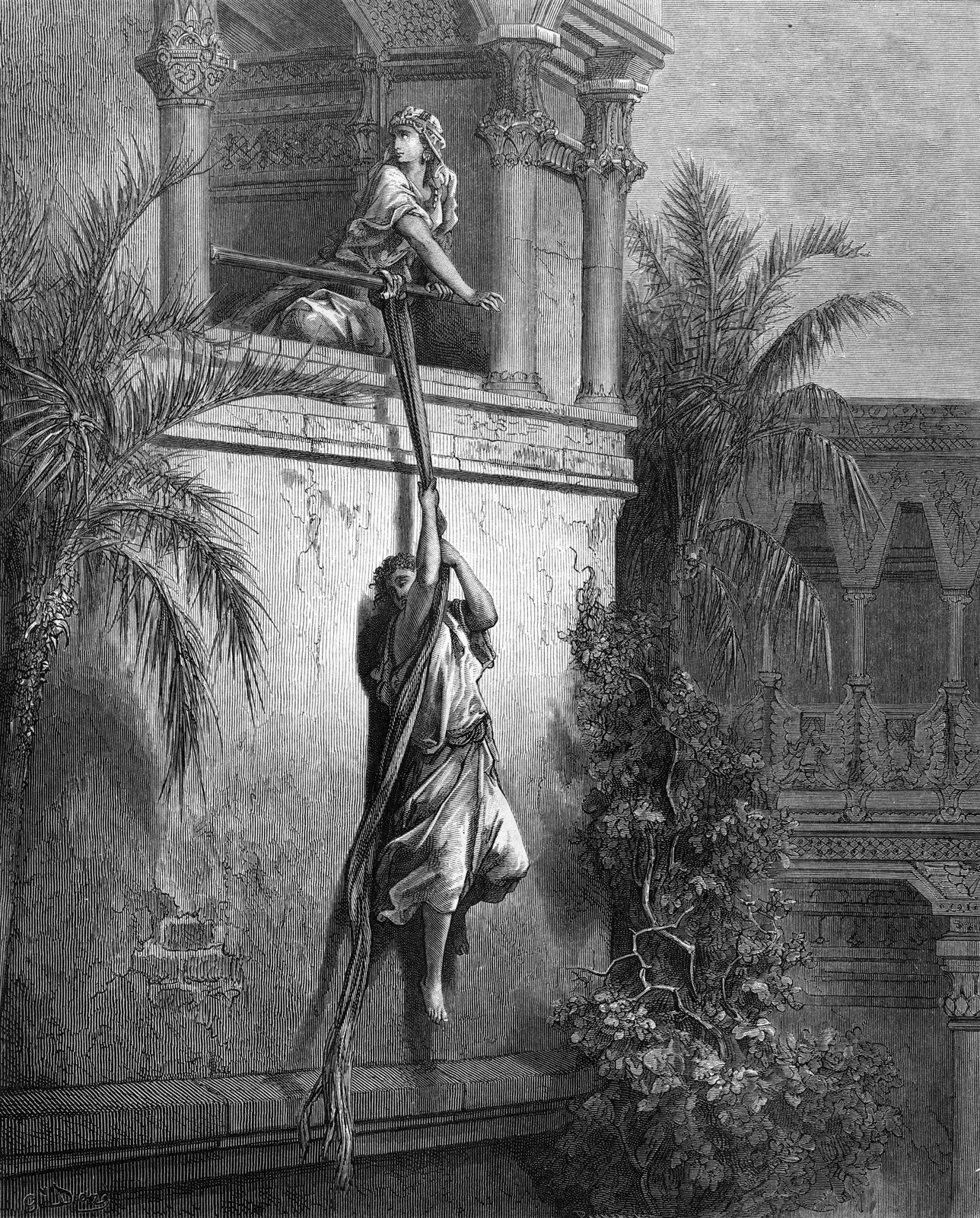
Gustave Doré, Michal Lets David Escape, 1865. Public domain.
1 Samuel 18 to 2 Samuel 6 · Person · Featured Study
Michal
Her life turned on her father's war against the man she married.
When Saul sent men to kill David in the night, Michal let him down through a window.
Now Saul’s daughter Michal loved David, and when this was reported to Saul, it pleased him.
- Family
- father: Saul; sister: Merab; brother: Jonathan; brother: Ish-bosheth; husband: David; husband: Paltiel son of Laish
- Places
- Gallim, Bahurim, Hebron, Jerusalem
- First named
- 1 Samuel 14:49 “…named Merab (his firstborn) and Michal (his younger…”
- Last named
- 1 Chronicles 15:29 “…City of David, Saul’s daughter Michal looked down…”
Summary
Michal was the younger daughter of King Saul. She loved David and became his wife. Saul later gave her to another man, and after Saul's death she was brought back to David. On the day the ark came to Jerusalem she despised David.
- Saul gave her to David hoping the bride price would get David killed.
- She deceived her father to cover David's escape.
- David set her return as the price of his covenant with Abner.
- Ish-bosheth her brother sent for her when David demanded her return.
Where Michal Stands in Scripture
Her name stands in 1 Samuel, 2 Samuel and 1 Chronicles.
Michal is named eighteen times. She stood between two royal houses: she was the daughter of Israel's first king and the wife of the man God chose to replace him.
Her story runs through David's rise at Saul's court, his flight, his years at Hebron and the day the ark came to Jerusalem. Most turns of it were decided by the men around her, and the text gives her own words only four times.
When Saul realized that the LORD was with David and that his daughter Michal loved David, he grew even more afraid of David. So from then on Saul was David’s enemy.Saul's fear of David had begun in 1 Samuel 18:12, after the spear.
Her Life, Turn by Turn
Her life runs from Saul's house to the City of David.
Michal was taken from David once and brought back once.
- Named in the list of Saul's childrenSaul's house1 Samuel 14:49
- Loves David, and Saul is pleasedSaul's court1 Samuel 18:20
- Given to David for the bride priceSaul's court1 Samuel 18:27
- Warns David to run that nightDavid's house1 Samuel 19:11
- Lowers him from the windowDavid's house1 Samuel 19:12
- Tells Saul that David threatened herbefore Saul1 Samuel 19:17
- Given by Saul to Palti son of Laishwhile David fled1 Samuel 25:44
- Taken from Paltiel at David's demandon the road to Bahurim2 Samuel 3:15 to 16
- Looks down on David dancingJerusalem2 Samuel 6:16
- Meets David with her chargeDavid's house2 Samuel 6:20
Two of the ten turns take place at a window.
Given by Saul to Palti son of Laish, Taken from Paltiel at David's demand, Looks down on David dancing, Meets David with her charge
From Saul's House to David's
Her story runs from 1 Samuel 18 to 2 Samuel 6.
Michal's story runs beside the war between her father's house and her husband's, and each turn of that war moves her.
The bride price1 Samuel 18:17 to 29
Saul replied, “Say to David, ‘The king desires no other dowry but a hundred Philistine foreskins as revenge on his enemies.’” But Saul intended to cause David’s death at the hands of the Philistines.Saul had already hurled his spear at David in 1 Samuel 18:11.
David and his men killed two hundred Philistines and brought the price in full.
The night at the window1 Samuel 19:11 to 17; Matthew Henry
Then Saul sent messengers to David’s house to watch him and kill him in the morning. But David’s wife Michal warned him, “If you do not run for your life tonight, tomorrow you will be dead!” So Michal lowered David from the window, and he ran away and escaped.This is the first time the text shows her acting on her own.
She laid a household idol in the bed with goat hair at its head and told the messengers David was ill. When Saul asked why she had deceived him, she said David had threatened to kill her.
Matthew Henry, in his Commentary on the Whole Bible, takes Michal's side against her father.
“What a base spirit was Saul of, to expect that, because Michal was his daughter, she must therefore betray her own husband to him unjustly. Ought she not to forsake and forget her father and her father's house, to cleave to her husband? Those that themselves will be held by no bonds of reason or religion are ready to think that others should as easily break those bonds.”
Matthew Henry · Commentary on the Whole Bible · on 1 Samuel 19:17Puritan
Given to Palti, and taken back1 Samuel 25:44; 2 Samuel 3:12 to 16; Albert Barnes
While David was a fugitive, Saul gave her to Palti son of Laish, from Gallim.
After Saul's death, Abner offered to bring all Israel over to David. David set one condition.
“Good,” replied David, “I will make a covenant with you. But there is one thing I require of you: Do not appear before me unless you bring Saul’s daughter Michal when you come to see me.” Then David sent messengers to say to Ish-bosheth son of Saul, “Give me back my wife, Michal, whom I betrothed to myself for a hundred Philistine foreskins.”David sent this demand to Saul's son while Abner was bringing the tribes over.
Her husband followed her, weeping all the way to Bahurim. Then Abner said to him, “Go back.” So he returned home.Her second husband's grief is all the text tells of that marriage.
Albert Barnes, in his Notes on the Old and New Testaments, gives three reasons for David's demand.
“David’s motive in requiring the restitution of Michal was partly his affection for her, and his memory of her love for him; partly the wish to wipe out the affront put upon him in taking away his wife, by obtaining her return; and partly, also, a politic consideration of the effect on Saul’s partisans of a daughter of Saul being David’s queen.”
Albert Barnes · Notes, Explanatory and Practical, on the Old and New Testaments (1832-1869) · on 2 Samuel 3:13Evangelical
The day the ark came in2 Samuel 6:16 to 23
As soon as David returned home to bless his own household, Saul’s daughter Michal came out to meet him. “How the king of Israel has distinguished himself today!” she said. “He has uncovered himself today in the sight of the maidservants of his subjects, like a vulgar person would do.” But David said to Michal, “I was dancing before the LORD, who chose me over your father and all his house when He appointed me ruler over the LORD’s people Israel. I will celebrate before the LORD, and I will humiliate and humble myself even more than this. Yet I will be honored by the maidservants of whom you have spoken.”David turns her words about honour back on her.
The page David Danced Before the Ark teaches the dance and the readings of her charge.
A King's Daughter in a Divided House
Saul gave both his daughters in marriage to serve his own aims.
Saul offered Merab to David to send him against the Philistines, and Michal to be a snare to him.
Albert Barnes, in his Notes on 1 Samuel 25:44, reads the gift to Palti as the mark of Saul's final break with David.
Now the war between the house of Saul and the house of David was protracted. And David grew stronger and stronger, while the house of Saul grew weaker and weaker.Michal's return came near the end of this war.
The Family of Michal
Eight ties, from her father Saul to her husbands
She was the daughter of one king and the wife of the next.
Generation 1
- SaulHer father, who gave her to David and then to Palti
- Ahinoam daughter of AhimaazSaul's wife
Generation 2
- MerabHer older sister, wife of Adriel
- JonathanHer brother, David's friend
- Ish-boshethHer brother, king of Israel after Saul
- DavidHer first husband, who demanded her back
- Paltiel son of LaishHer second husband, who followed her weeping
- Adriel son of BarzillaiMerab's husband, named in 2 Samuel 21:8
Saul's house and David's met in her marriage.
The Places of Her Life
Four places mark her story, from Gallim to Jerusalem.
Her story moves from Benjamin to Hebron and ends in Jerusalem.
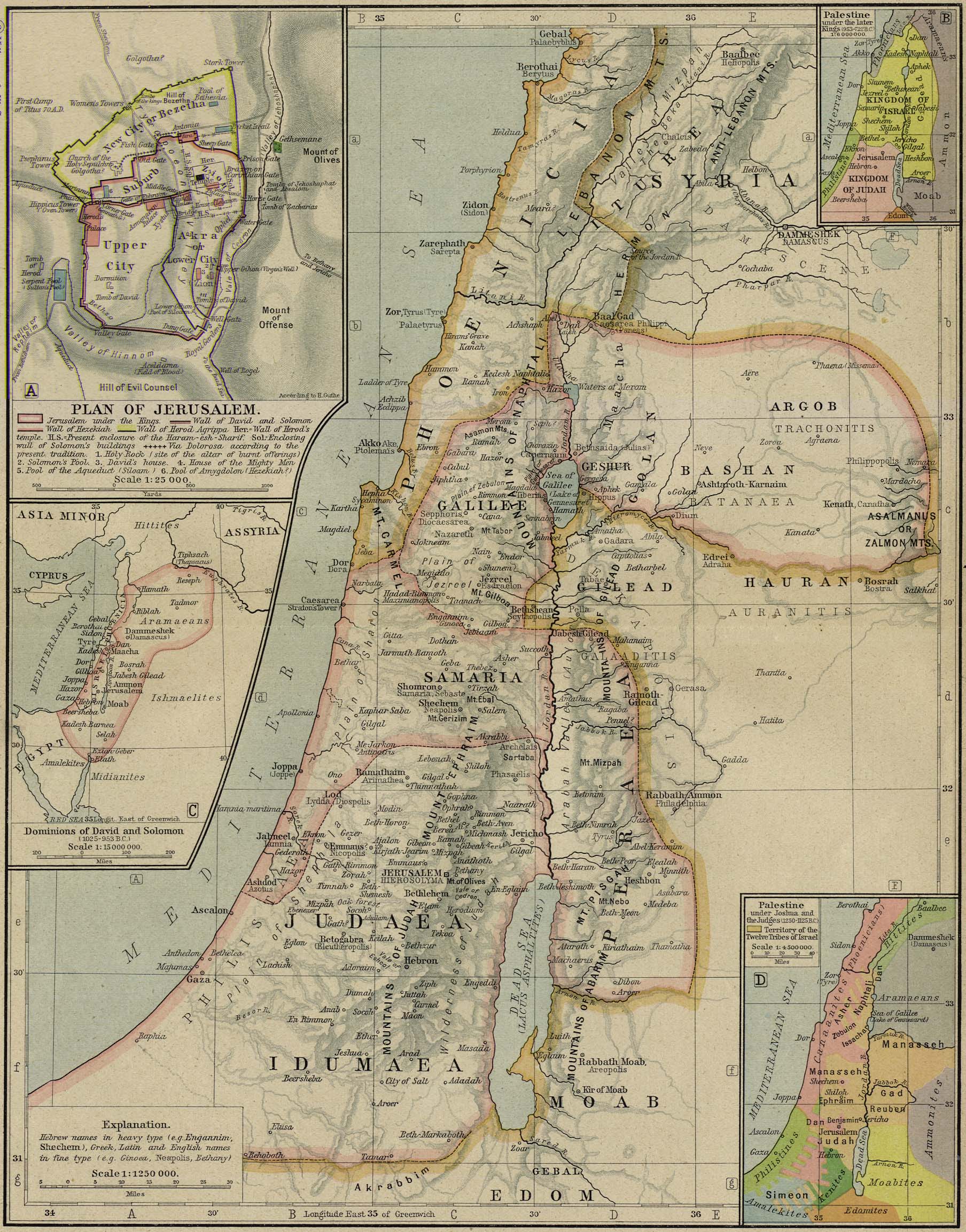
- 1Gallim, The home town of the man Saul gave her to.
- 2Bahurim, The place where Abner sent Paltiel home.
- 3Hebron, David reigned there over Judah when Abner came to him. 2 Samuel 3:20
- 4Jerusalem, The ark was set in the tent David pitched for it there. 2 Samuel 6:17
Not placed: Gallim (1), Bahurim (2).
Base map: Reference map of ancient Palestine, Rand McNally reference map (1926), public domain. Each place stands at its place page's coordinates, set on the plate by Jerusalem and Damascus, as the plate prints them.
Hebron and Jerusalem were the two royal cities of David.
Questions Her Life Raises
Three questions answered from their verses
Why was there a household idol in David's house?1 Samuel 19:13; Genesis 31:19; 1 Samuel 15:23
The word is teraphim, the household idols Rachel took from her father in Genesis 31:19. It stands fifteen times in the Hebrew Bible.
Samuel used the same word when he rebuked Saul, in the clause that the Berean text renders the wickedness of idolatry.
For rebellion is like the sin of divination, and arrogance is like the wickedness of idolatry. Because you have rejected the word of the LORD, He has rejected you as king.”Samuel spoke this to Saul after the war against Amalek.
Albert Barnes, in his Notes, reads the image as a household god in human form, as large as life. John Gill, in his Exposition, holds that Michal kept it privately, since David would not have allowed it in his house.
Was she right to deceive her father?1 Samuel 19:14 to 17; John Chrysostom; Albert Barnes
She lied twice, first that David was ill and then that he had threatened her.
John Chrysostom, in On the Priesthood, counts her deceit among the ways a life was saved.
“And not in war only, but also in peace the need of deceit may be found, not merely in reference to the affairs of the state but also in private life, in the dealings of husband with wife and wife with husband, son with father, friend with friend, and also children with a parent. For the daughter of Saul would not have been able to rescue her husband out of Saul's hands except by deceiving her father. And her brother, wishing to save him whom she had rescued when he was again in danger, made use of the same weapon as the wife.”
John Chrysostom · On the Priesthood 1.8 · on 1 Samuel 19:13 to 17Patristic
Albert Barnes, in his Notes on the verse, reads her second lie as a way to turn Saul's anger from herself.
Could David lawfully take her back?2 Samuel 3:14; Deuteronomy 24:1 to 4; Adam Clarke
If a man marries a woman, but she becomes displeasing to him because he finds some indecency in her, he may write her a certificate of divorce, hand it to her, and send her away from his house. If, after leaving his house, she goes and becomes another man’s wife, and the second man hates her, writes her a certificate of divorce, hands it to her, and sends her away from his house, or if he dies, then the husband who divorced her first may not remarry her after she has been defiled, for that is an abomination to the LORD. You must not bring sin upon the land that the LORD your God is giving you as an inheritance.Adam Clarke, in his Commentary on the Bible, answers that she had never been divorced and had been taken from David by force, so he kept a legal right to her.
What the Text Leaves Unsaid
Four things the text does not tell about her
The text gives no words of Michal's when she was given to Palti or taken from him. It does not say how long she lived with Paltiel.
Second Samuel 6:23 states that she had no children without naming a cause. The text does not say whether her love for David lasted.
How Scripture Reads Her
Chronicles and Samuel both close her story on the day of the ark.
Of all her life the Chronicler tells only that she looked down and despised David.
As the ark of the covenant of the LORD was entering the City of David, Saul’s daughter Michal looked down from a window and saw King David dancing and celebrating, and she despised him in her heart.The Chronicler sets this verse in his account of the ark brought to Jerusalem.
Both books name her by her father on that day, and David's reply sets the LORD's choice of him beside the house of Saul.
Voices on Michal
Ambrose and Gregory the Dialogist wrote on the dance she despised.
Ambrose of Milan (died 397)
Exposition On Psalm 118, 7.27
Ambrose of Milan, in his Exposition of Psalm 118, set David's dance against Michal's words.
“But even the dancing of the body is considered praiseworthy in honor of God. In fact, David danced before the Ark of the Lord and Michal, the daughter of Saul, saw him dancing and playing musical instruments in the presence of the Lord. After he returned home, she said to him, 'How the king of Israel has distinguished himself today! He has exposed himself in the sight of the maidservants of his servants, as one of the rabble might shamelessly expose himself!'”
on 2 Samuel 6:16Patristic
Gregory the Dialogist (died 604)
Forty Gospel Homilies, Homily 7
Gregory the Dialogist, in his Forty Gospel Homilies, took David's answer to her as a lesson in humility.
“On the contrary, when David despised the power of his kingdom by dancing before the ark of the Lord's covenant, he said: ‘I will play and become more vile than I have become, and I will be humble in my own eyes.’”
on 2 Samuel 6:22Patristic
Whose Sons Are Named in 2 Samuel 21:8?
The Hebrew names Michal, and the Berean text prints Merab.
But the king took Armoni and Mephibosheth, the two sons whom Rizpah daughter of Aiah had borne to Saul, as well as the five sons whom Merab daughter of Saul had borne to Adriel son of Barzillai the Meholathite.Merab was the sister given to Adriel in 1 Samuel 18:19.
A copyist wrote Michal for MerabKeil and Delitzsch, Albert Barnes and H. P. Smith
Keil and Delitzsch hold that the name Michal in the Hebrew rests on an error of memory or a copyist's mistake, because Merab was the daughter given to Adriel. Albert Barnes calls it an obvious error for Merab, and H. P. Smith reads Merab for the same reason.
The objection is that the Hebrew says Michal, and the reading needs a change to the text.
Michal raised her sister's sonsRashi, John Gill, and Jamieson, Fausset and Brown
Rashi keeps the Hebrew and explains that Merab bore the sons and Michal raised them, so they are called by her name. John Gill and Jamieson, Fausset and Brown read them as sons she brought up.
The objection is that the verb in the verse means to bear, as Adam Clarke notes.
Books to Read Next
Both works are in the public domain, and each has a free copy to read.
Biblical Commentary on the Books of Samuel
C. F. Keil and F. Delitzsch · 1880
Keil explains the Hebrew of her story in his notes on 1 Samuel 18 and 2 Samuel 21.
Read at the Internet ArchiveA Critical and Exegetical Commentary on the Books of Samuel
Henry Preserved Smith · 1899
Smith sets the Hebrew beside the Greek version in his notes on her verses.
Read at the Internet ArchiveThe King Who Humbled Himself
Michal saved David's life once, and at the end she despised the king who humbled himself before the LORD. David's greater Son humbled Himself further still.
And being found in appearance as a man, He humbled Himself and became obedient to death—even death on a cross.Paul gives the humbling of Christ as the pattern for His people in Philippians 2:5.
Sources
Scripture is the Berean Standard Bible.
- James Strong, Exhaustive Concordance of the Bible, 1890, entry H8655.
- C. F. Keil and F. Delitzsch, Biblical Commentary on the Books of Samuel, T. and T. Clark, 1880, pp. 461 to 462.
- Henry Preserved Smith, A Critical and Exegetical Commentary on the Books of Samuel, T. and T. Clark, 1899, p. 375.
- Rashi on 2 Samuel 21:8, The Metsudah Tanach series, Lakewood, N.J. (CC-BY)
- Matthew Henry, Commentary on the Whole Bible, 1710, on 1 Samuel 19:17.
- Albert Barnes, Notes, Explanatory and Practical, on the Old Testament, on 2 Samuel 3:13.
- Albert Barnes, Notes, Explanatory and Practical, on the Old Testament, on 1 Samuel 25:44.
- Albert Barnes, Notes, Explanatory and Practical, on the Old Testament, on 1 Samuel 19:13 and 19:17.
- Albert Barnes, Notes, Explanatory and Practical, on the Old Testament, on 2 Samuel 21:8.
- John Gill, Exposition of the Old Testament, 1748 to 1763, on 1 Samuel 19:13 and 2 Samuel 6:23.
- Jamieson, Fausset and Brown, Commentary Critical and Explanatory on the Whole Bible, 1871, on 2 Samuel 21:8.
- Adam Clarke, Commentary on the Bible, 1832, on 2 Samuel 3:16 and 21:8.
- John Chrysostom, On the Priesthood 1.8.
- Ambrose of Milan, Exposition of Psalm 118, 7.27.
- Gregory the Dialogist (Gregory the Great), Forty Gospel Homilies, Homily 7.
Keep Studying
Read it4
Studies5
People and groups8
Show the next 2 titles
Symbols1
Subjects1
Doctrines1