
1 Samuel 17:50
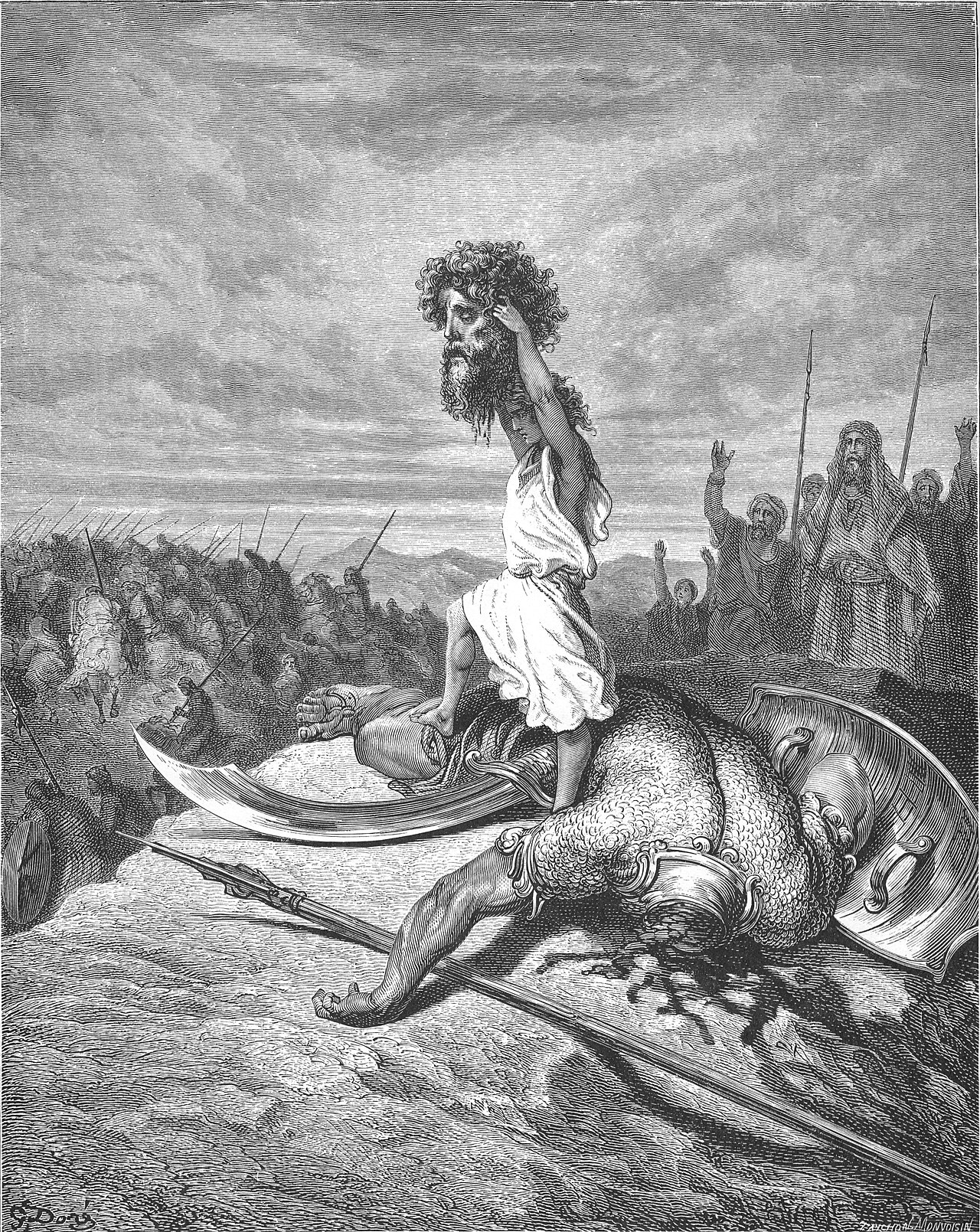
in 1 Samuel 17Thus David prevailed over the Philistine with a sling and a stone; without a sword in his hand he struck down the Philistine and killed him.
BSB
The same verse in ASV and KJV ▾
ASV
So David prevailed over the Philistine with a sling and with a stone, and smote the Philistine, and slew him; but there was no sword in the hand of David.
KJV
So David prevailed over the Philistine with a sling and with a stone, and smote the Philistine, and slew him; but there was no sword in the hand of David.
⋯
This verse in 1 Samuel 17
Commentary
5 notes on this verseSo David prevailed over the Philistine with a sling and with a stone,.... And with them only, without any other warlike weapon: and smote the Philistine, and slew him; smote him with the stone, which brought him to the ground, and then slew him with his own sword, as afterwards related: but there was no sword in the hand of David; when he engaged with the Philistine, and smote him, for he had put off all his armour, 1Sa 17:39.
This site's exposition
no sword in the hand of David
on 1 Samuel 17:50-51
The narrator states it as a fact worth its own clause: David prevailed with a sling and with a stone, and there was no sword in his hand. Then he takes Goliath's own sword and cuts off the giant's head with it, the enemy's weapon turned on the enemy, and the sword surfaces again at Nob in chapter 21, where David says there is none like it. The champion's death breaks the whole army's nerve, exactly as the representative terms of verse 9 promised.
The record, by era
The Medieval Church1 voice
And when David had no sword in his hand, etc. When he had no one and the Lord of his word's minister, through whom he might shatter the pride of the devil by teaching, except whom he himself had first snatched victoriously from the devil; …
The Nineteenth Century2 voices
A commentator
Charles Spurgeon1834–1892
The Metropolitan Tabernacle Pulpit, Sermon No. 2913: “David's First Victory” (lightly modernized text, CCEL edition) · Written before 1892.
proposed
A CAREFUL reading of the whole chapter will well repay your pains. I have selected a verse for convenience, but I need the entire narrative for a text. If you are well versed in the history, we shall have no need of any preface or translation. So we shall proceed at once to regard David in his conflict with Goliath and his victory over him, first, as a type of our Lord Jesus Christ. And, secondly, as an example for ourselves.
A commentator
Charles Spurgeon1834–1892
The Metropolitan Tabernacle Pulpit, Sermon No. 2913: “David's First Victory” (lightly modernized text, CCEL edition) · Written before 1892.
proposed
A CAREFUL reading of the whole chapter will well repay your pains. I have selected a verse for convenience, but I need the entire narrative for a text. If you are well versed in the history, we shall have no need of any preface or translation. So we shall proceed at once to regard David in his conflict with Goliath and his victory over him, first, as a type of our Lord Jesus Christ. And, secondly, as an example for ourselves. As that which is a type of the head always bears a relationship to the members and, as the members of Christ's mystical body now are and shall yet more fully be like Him, it is but one thought, after all, that we shall be following out in the meditation that lies before us. I. Let us begin by calling your attention to the fact that David in this matter WAS A TYPE OF OUR LORD JESUS CHRIST. The early fathers of the Church were very great in opening up typical analogies. So full, indeed, were they in their expositions and so minute in their details, that at length they went too far and degenerated into trifling. Origen, for example, very notably exceeded what can be regarded as wise interpretation in giving spiritual meanings to literal records. And others who essayed to go yet farther than that great master of mysticism, very soon did much damage to the Church of God, bringing precious Truths of God into serious discredit. The study of the types of the Old Testament has scarcely regained its proper place in the Christian Church since the days in which those gracious men, by their imprudent zeal, perverted it. We cannot, however, bring ourselves to think that a good thing ceases to be good because it has, at some time, been turned to an ill account. We think it can still be used properly and profitably.
The words behind it
14 Hebrew wordsEvery Hebrew word of this verse in the order it stands, with what it means and the door to its own study. The last column counts the times a word stands in the whole Bible: the rarer the word, the more the places it appears belong together.
| Hebrew | Sound | Meaning | Word study | In the Bible |
|---|---|---|---|---|
| וַיֶּחֱזַ֨ק | vaiyechezak | and he was strong | H2388 → | 291 times |
| דָּוִ֤ד | david | David | H1732 → | 999 times |
| מִן־ | min- | more than | H4480 → | 1188 times |
| הַפְּלִשְׁתִּי֙ | hapelishti | the Philistine | H6430 → | 287 times |
| בַּקֶּ֣לַע | bakela' | with the sling | H7050 → | 22 times |
| וּבָאֶ֔בֶן | uvaeven | and with the stone | H68 → | 273 times |
| וַיַּ֥ךְ | vaiyakh | and he struck down | H5221 → | 499 times |
| אֶת־ | ʾet- | <obj.> | H853 → | 10935 times |
| הַפְּלִשְׁתִּ֖י | hapelishti | the Philistine | H6430 → | 287 times |
| וַיְמִיתֵ֑הוּ | vaymitehu | and he killed him | H4191 → | 839 times |
| וְחֶ֖רֶב | vecherev | and [was] a sword | H2719 → | 413 times |
| אֵ֥ין | ʾein | there not | H369 → | 789 times |
| בְּיַד־ | beyad- | in [the] hand of | H3027 → | 1618 times |
| דָּוִֽד׃ | david | David | H1732 → | 999 times |
וַיֶּחֱזַ֨קand he was strong
vaiyechezakH2388 →291 times
דָּוִ֤דDavid
davidH1732 →999 times
מִן־more than
min-H4480 →1188 times
הַפְּלִשְׁתִּי֙the Philistine
hapelishtiH6430 →287 times
בַּקֶּ֣לַעwith the sling
bakela'H7050 →22 times
וּבָאֶ֔בֶןand with the stone
uvaevenH68 →273 times
וַיַּ֥ךְand he struck down
vaiyakhH5221 →499 times
אֶת־<obj.>
ʾet-H853 →10935 times
הַפְּלִשְׁתִּ֖יthe Philistine
hapelishtiH6430 →287 times
וַיְמִיתֵ֑הוּand he killed him
vaymitehuH4191 →839 times
וְחֶ֖רֶבand [was] a sword
vecherevH2719 →413 times
אֵ֥יןthere not
ʾeinH369 →789 times
בְּיַד־in [the] hand of
beyad-H3027 →1618 times
דָּוִֽד׃David
davidH1732 →999 times
A shaded row is a word that stands 400 times or fewer in the Bible.
The walk
8 stopsEach card is a verse this one points to, and under it the verses that one points to in turn. Where several paths arrive at the same place, that place is listed first: the text keeps returning to it.
Through
Judges 15:15He found the fresh jawbone of a donkey, reached out his hand and took it, and struck down a thousand men.
it leads to
- Joshua 23:10
One of you can put a thousand to flight, because the LORD your God fights for you, just as He promised.
- Leviticus 26:8
Five of you will pursue a hundred, and a hundred of you will pursue ten thousand, and your enemies will fall by the sword before you.
- Judges 3:31
After Ehud came Shamgar son of Anath. And he too saved Israel, striking down six hundred Philistines with an oxgoad.
- 1 Samuel 17:49–50
Then David reached into his bag, took out a stone, and slung it, striking the Philistine on the forehead. The stone sank into his forehead, and he fell facedown on the ground.
- Joshua 23:10
Through
Judges 3:31After Ehud came Shamgar son of Anath. And he too saved Israel, striking down six hundred Philistines with an oxgoad.
it leads to
- Judges 5:6
In the days of Shamgar son of Anath, in the days of Jael, the highways were deserted and the travelers took the byways.
- Judges 5:6
Through
1 Samuel 17:39David strapped his sword over the tunic and tried to walk, but he was not accustomed to them. “I cannot walk in these,” David said to Saul. “I am not accustomed to them.” So…
it leads to
- 2 Corinthians 10:4–5
The weapons of our warfare are not the weapons of the world. Instead, they have divine power to demolish strongholds.
- 2 Corinthians 10:4–5
Through
1 Samuel 21:9The priest replied, “The sword of Goliath the Philistine, whom you killed in the Valley of Elah, is here; it is wrapped in a cloth behind the ephod. If you want, you may take…
it leads to
- 1 Samuel 17:2
Saul and the men of Israel assembled and camped in the Valley of Elah, arraying themselves for battle against the Philistines.
- 1 Samuel 17:2
Through
1 Samuel 23:21“May you be blessed by the LORD,” replied Saul, “for you have had compassion on me.
it leads to
- 1 Samuel 22:8
Is that why all of you have conspired against me? Not one of you told me that my own son had made a covenant with the son of Jesse. Not one of you has…
- 1 Samuel 22:8
Where this verse is studied
About 1 Samuel
Who and where
1 name in this verse with a page on the site.
This page draws on Bede, Commentary on Samuel; Charles Spurgeon, The Metropolitan Tabernacle Pulpit, Sermon No. 2913: “David's First Victory” (lightly modernized text, CCEL edition); John Gill, Exposition of the Old Testament (1748-1763); John Gill, Exposition of the Old Testament and Keil and Delitzsch, Biblical Commentary on the Books of Samuel.