
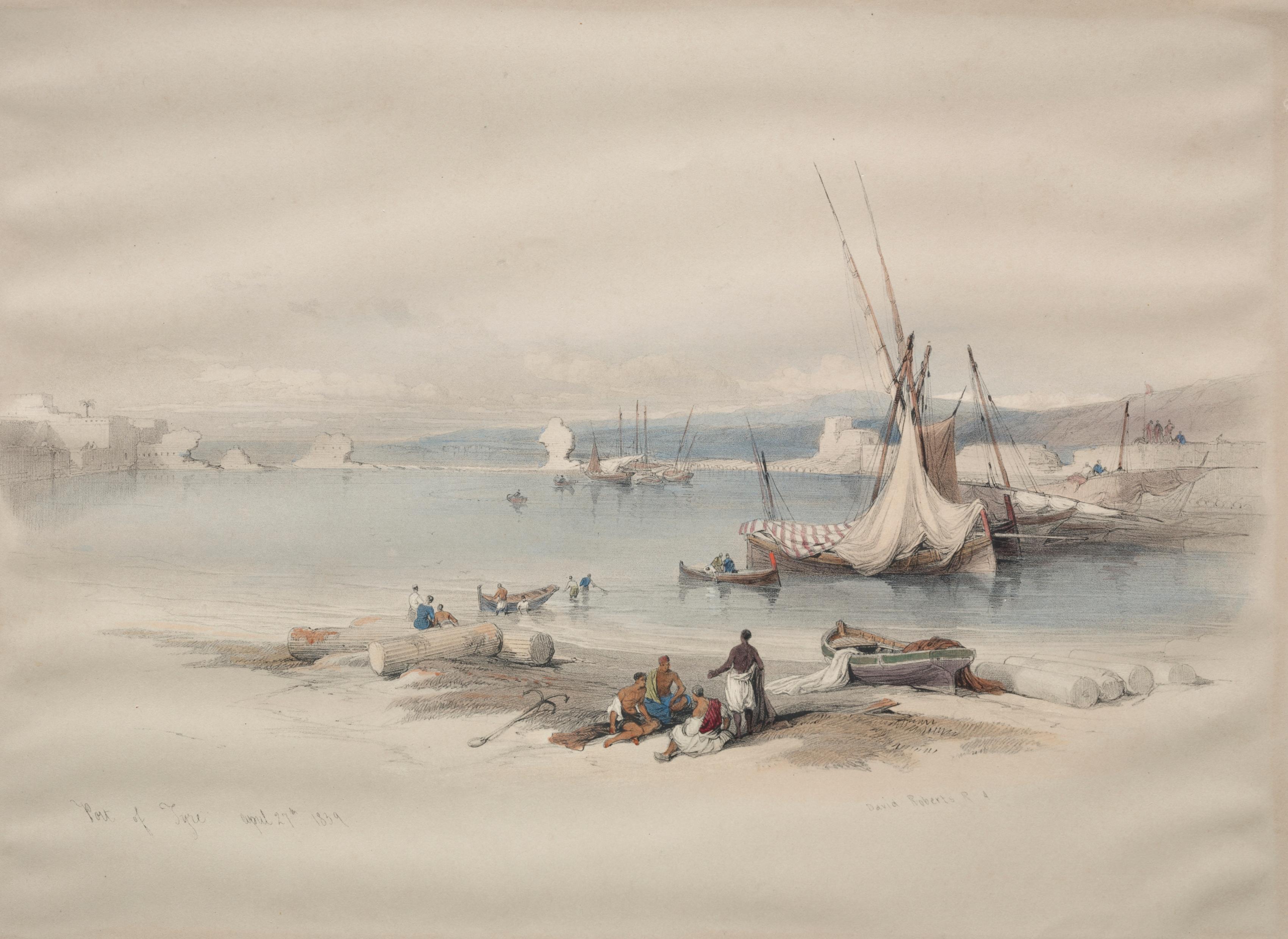
David Roberts, Port of Tyre, 1839. CC0.
Mark 7:24 to 31 · Place · Featured Study
Phoenicia
Phoenicia is the coast north of Israel whose cities lived by trade and sailing.
Sent on their way by the church, they passed through Phoenicia and Samaria, recounting the conversion of the Gentiles and bringing great joy to all the brothers.
- Today
- The coast of modern Lebanon, with parts of the coasts of Syria and Israel
- Region
- The coastal strip between the Lebanon range and the Mediterranean Sea
- First named
- Acts 11:19 “…Stephen traveled as far as Phoenicia, Cyprus, and…”
- Last named
- Acts 21:2 “…a ship crossing over to Phoenicia, we boarded…”
Smith's Dictionary of Greek and Roman Geography judges that the Greek name Phoenicia most likely comes from the palm tree.
Summary
Hiram of Tyre sent men who knew the sea to sail in Solomon's fleet. In the Gospels and Acts its towns hear of Jesus and later receive the gospel.
- Herodotus wrote that the Phoenicians who came with Cadmus brought the alphabet to Greece.
- Strabo judged the purple dye of Tyre the most beautiful of all purples.
- Josephus wrote that the Tyrians still kept letters that Hiram and Solomon had sent each other.
Phoenicia in Scripture
The Berean text gives the name Phoenicia three times, all in Acts.
The Old Testament calls the people of this coast Sidonians, and it names their cities one by one. Mark describes the mother who came to Jesus in the region of Tyre by her origin as Syrophoenician.
John Wesley, the Methodist leader, explains the word by where the land lay.
“The woman was a Greek (that is, a Gentile, not a Jew) a Syrophenician or Canaanite. Canaan was also called Syrophenicia, as lying between Syria, properly so called, and Phenicia.”
John Wesley · Explanatory Notes upon the New Testament · on Mark 7:24Evangelical
The Coast on the Plate
The plate of Palestine in the time of Christ prints the name Phoenicia down the coast west and north of Galilee.
Six towns of the Phoenician coast stand between Gebal in the north and Ptolemais in the south.
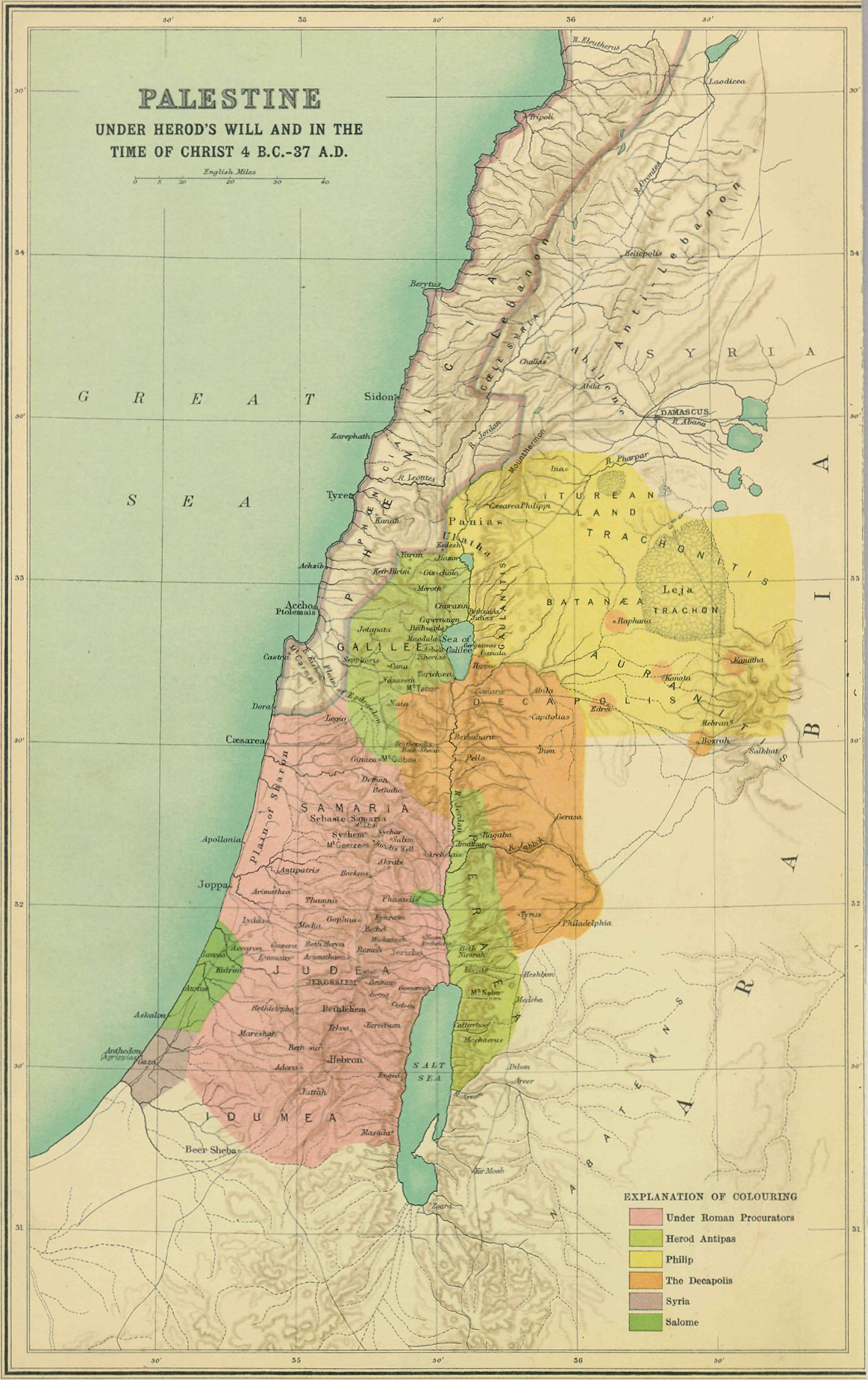
- Known: a score of 800 or more
- Probable: a score of 500 to 799
- 1Gebal, Its elders served Tyre's ships as shipwrights Ezekiel 27:9
- 2Sidon, Julius let Paul visit his friends here and receive their care Acts 27:3
- 3Zarephath, Jesus recalled that Elijah was sent to a widow of this town in Sidon Luke 4:26
- 4Tyre, Ezekiel calls it the merchant of the peoples on many coasts Ezekiel 27:3
- 5Achzib, The tribe of Asher failed to drive out its people Judges 1:31
- 6Ptolemais, Paul greeted the brothers here and stayed a day Acts 21:7
Base map: Palestine in the time of Christ, George Adam Smith, Atlas of the Historical Geography of the Holy Land (1915), public domain. Places with a place page stand at its coordinates and the others at the point cited for each, set on the plate by Jerusalem and Tyre, as the plate prints them.
Six places, each with its verse. Each ring follows the OpenBible.info identification score out of 1,000, as the key gives it.
The two chief cities of the coast each have a study of their own.
Phoenicia from Joshua to Acts
The coast and its people stand in Scripture from the division of the land to Paul's last voyages.
Israel's dealings with this coast run from Joshua's day to the crowds who came to Jesus.
- Joshua's old ageThe LORD promises to drive out all the Sidonians of the hill country from Lebanon to Misrephoth-maimJoshua 13:6
- David's reignHiram king of Tyre sends cedar, carpenters and stonemasons to build David a palace2 Samuel 5:11
- Solomon's templeThe Gebalites work with the builders of Solomon and Hiram on the stone and timber1 Kings 5:18
- Ahab's marriageAhab marries Jezebel, daughter of Ethbaal king of the Sidonians, and serves Baal1 Kings 16:31
- Ezekiel's lamentEzekiel names the men of Sidon and Arvad as the oarsmen of TyreEzekiel 27:8
- Jesus' ministry in GalileeA crowd from the vicinity of Tyre and Sidon comes to Jesus by the seaMark 3:8
Six moments in the order of the canon, each with its verse.
A Land of Sailors
Greek and Roman writers record the bounds, the age and the skills of the land.
Smith's Dictionary of Greek and Roman Geography (1854) follows Pliny in setting Phoenicia between Aradus in the north and the river Chorseas in the south. It calls the land a narrow slip about 120 miles long, and it names Tyre, Sidon and Aradus as the three leading cities.
Herodotus reports that the priests at Tyre dated the temple of their god to the founding of the city, 2,300 years before his visit. He also tells of Phoenicians sent by Necos, king of Egypt, to sail around Libya. They said the sun stood on their right as they sailed, and Herodotus did not believe it.
Strabo wrote that the Sidonians were skilled in astronomy and arithmetic, which they began with practical sums and sailing by night. Gesenius' Hebrew Grammar of 1910 notes that the old Hebrew writing and the Phoenician are nearly identical.
What Scripture Leaves Unsaid
Acts leaves the founding of the church at Tyre untold.
Tyre and Sidon in Jesus' Words
Luke gives the same saying in Luke 10:13 to 14.
“Woe to you, Chorazin! Woe to you, Bethsaida! For if the miracles that were performed in you had been performed in Tyre and Sidon, they would have repented long ago in sackcloth and ashes. But I tell you, it will be more bearable for Tyre and Sidon on the day of judgment than for you.Jesus names the Gentile cities to show how heavy the unbelief of Chorazin and Bethsaida was.
Why Jesus Went to the Region of Tyre
Commentators give two reasons why Jesus went north in Mark 7:24.
Jesus left that place and went to the region of Tyre. Not wanting anyone to know He was there, He entered a house, but was unable to escape their notice.The verse tells where Jesus went and gives no reason for going.
To leave those who opposed HimMatthew Henry, Commentary on the Whole Bible (1710), on Matthew 15:21
Henry reads the visit as a withdrawal from the Pharisees of Matthew 15. When Christ and His disciples could not be quiet among them, he writes, Christ left them.
The objection: Mark says that even in that house His presence became known (Mark 7:24).
A first share for the GentilesTheophylact of Ohrid, Commentary on Mark, on Mark 7:24; Origen of Alexandria, Commentary on Matthew 11.16
Theophylact holds that Jesus crossed into the Gentile regions after the Jews would not believe, because salvation was to pass to the Gentiles. Origen writes that the Gentiles who live on the borders can be saved if they believe.
The objection: in Matthew's account Jesus answers that He was sent only to the lost sheep of the house of Israel (Matthew 15:24).
Books to Read Next
Three older works on Phoenicia are free to read online.
Dictionary of Greek and Roman Geography
William Smith, editor · 1854
The entry on Phoenicia gives its bounds, its cities and the meanings proposed for its name.
Read it free at PerseusThe Histories
Herodotus, translated by A. D. Godley · 1920
The Histories open with where the Phoenicians were said to have come from.
Read it free at PerseusAgainst Apion
Flavius Josephus, translated by William Whiston · 1737
Josephus cites the public records of Tyre on Hiram and Solomon.
Read it free at Project GutenbergPrayer on the Beach
The church at Tyre is the one Phoenician church that Acts shows at prayer.
But when our time there had ended, we set out on our journey. All the disciples, with their wives and children, accompanied us out of the city and knelt down on the beach to pray with us.Paul's farewell is the last word Acts gives of the believers at Tyre.
Sources
Scripture is the Berean Standard Bible.
- William Smith (ed.), Dictionary of Greek and Roman Geography (1854), the entry Phoenicia, signed T.H.D.; public domain.
- Herodotus, The Histories 1.1, 2.44, 4.42 and 5.58, tr. A. D. Godley (Loeb, 1920); public domain.
- Flavius Josephus, Against Apion 1.17 to 18, tr. William Whiston; public domain.
- Strabo, Geography 16.2.23 to 24, tr. H. L. Jones (Loeb, volume 7, 1932); public domain, the translator having died in 1932.
- Gesenius' Hebrew Grammar, ed. E. Kautzsch, tr. A. E. Cowley, second English edition (Oxford, 1910), section 5a, p. 25; public domain.
- OpenBible.info, Bible-Geocoding-Data, ancient.jsonl.
- Matthew Henry, Commentary on the Whole Bible (1710), on Matthew 15:21.
- Theophylact of Ohrid, Commentary on Mark, on Mark 7:24.
- John Wesley, Explanatory Notes upon the New Testament (1755), on Mark 7:24.
- Origen of Alexandria, Commentary on Matthew 11.16, on Mark 7:24.
Keep Studying
Studies1
People and groups5
Symbols1
Church history1
Doctrines1
Go further3