
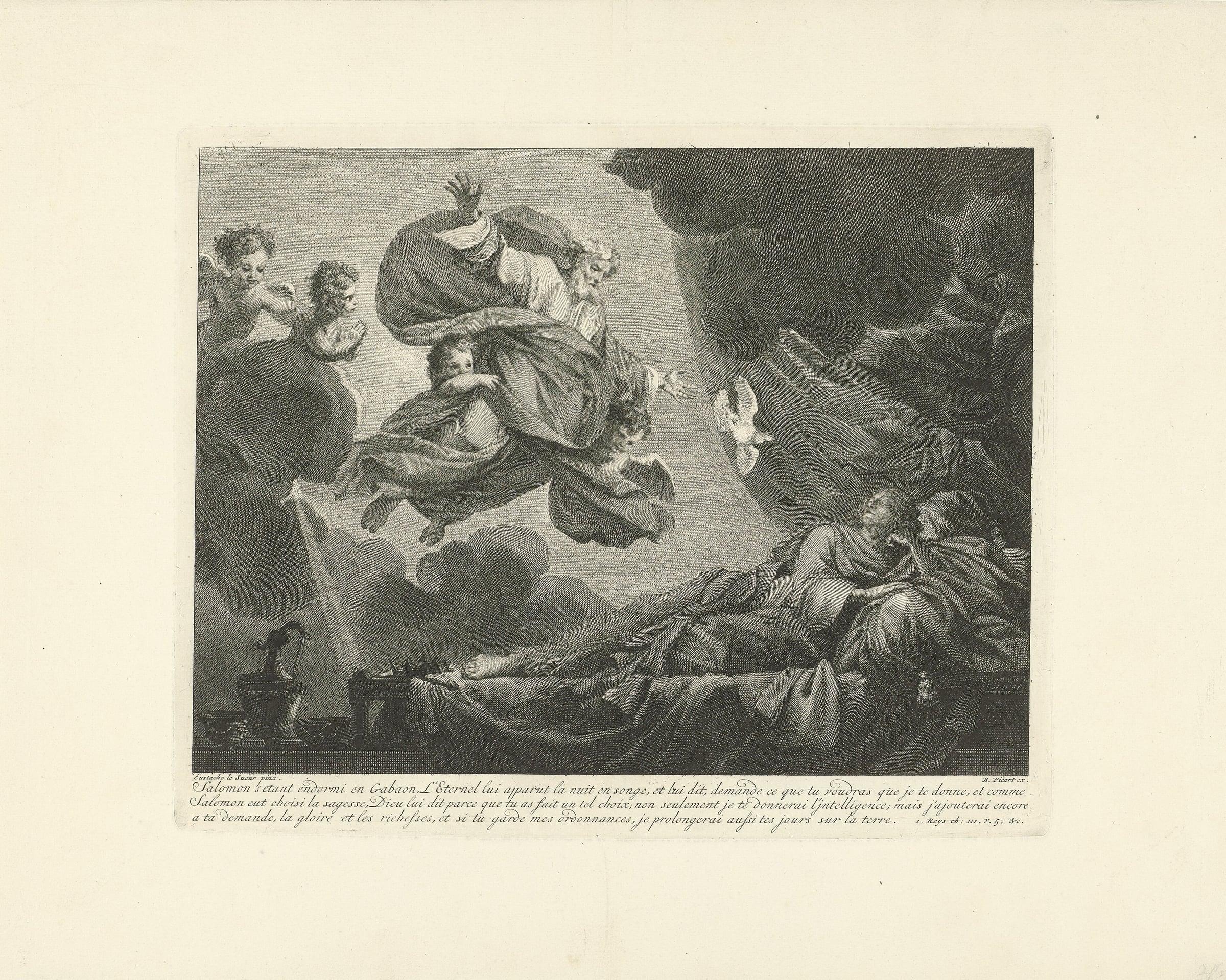
Anonymous engraver after Eustache Lesueur, God verschijnt aan Salomo, 1683 to 1733. CC0.
Joshua 9:3 to 10:14 · Place · Featured Study
Gibeon
Gibeon stood on the plateau of Benjamin north of Jerusalem and became a city of the Levites (Joshua 21:17).
So Adoni-zedek and his people were greatly alarmed, because Gibeon was a great city, like one of the royal cities; it was larger than Ai, and all its men were mighty.
- Today
- El-Jib, north of Jerusalem
- Region
- The plateau of Benjamin
- First named
- Joshua 9:3 “But the people of Gibeon, having heard…”
- Last named
- Jeremiah 41:16 “…he had brought back from Gibeon.”
The French caption under this print names the place of Solomon's dream Gabaon, the French form of Gibeon.
Summary
Gibeon is named in 36 verses, from Joshua 9 to Jeremiah 41.
- It stood at the head of the main road from the coast into the hills.
- Excavation has fixed its site at el-Jib.
- Joshua's prayer for the sun to stand still was spoken over Gibeon (Joshua 10:12).
A Great City
Gibeon stood first of the four cities that made peace with Israel (Joshua 9:17).
This study asks where Gibeon stood and why so much of Israel's history passed through it.
No city made peace with the Israelites except the Hivites living in Gibeon; all others were taken in battle.The record of the conquest in Joshua 11 still remembers Gibeon's treaty.
Joshua 18:25 later lists Gibeon among the towns of Benjamin.
The study of the costly oath tells the ruse and the treaty in full.
Gibeon on Taylor's Plate of Joshua's Miracle
Charles Taylor's plate of 1799 draws Joshua's march from Gilgal and the pursuit from Gibeon on a dial of the hours.
Joshua marched up from Gilgal to Gibeon, and Israel pursued the five kings west and south to Azekah and Makkedah.
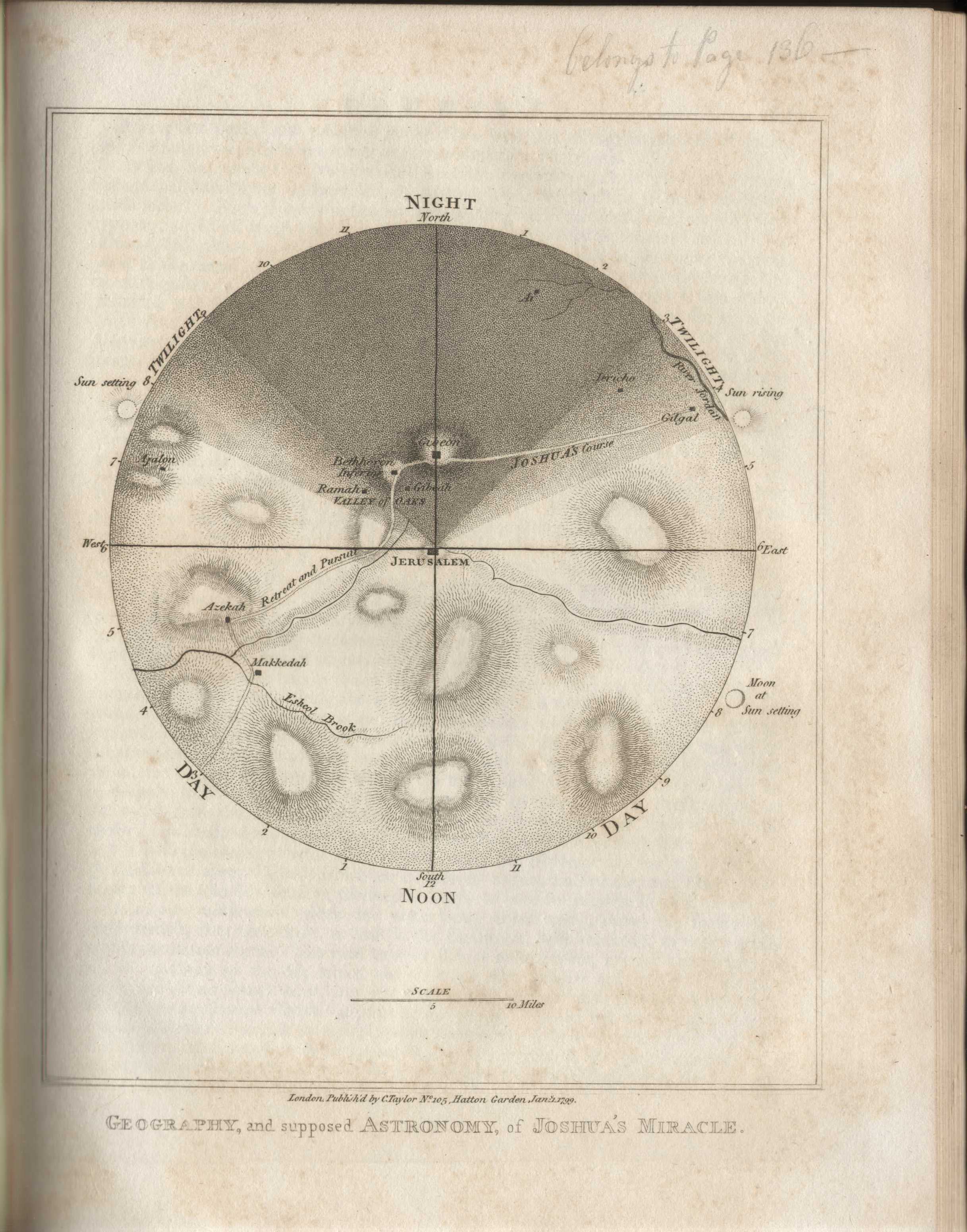
- GilgalJoshua marched all night from Gilgal. Taylor's placing, proposed: by the Jordan, the easternmost point.Joshua 10:9
- GibeonThe LORD threw the five kings into confusion, and Israel defeated them at Gibeon. Taylor's placing, known: due north of Jerusalem, where his course from Gilgal ends.Joshua 10:10
- Beth-horonThe kings fled down the descent from Beth-horon. Taylor's placing, proposed: he prints Beth-horon Inferior, the lower town, just west of Gibeon.Joshua 10:11
- AijalonJoshua called on the moon to stand over the Valley of Aijalon. Taylor's placing, proposed: at the western edge of the dial, the westernmost point.Joshua 10:12
- AzekahThe hailstones fell on the fleeing army as far as Azekah. Taylor's placing, proposed: at the end of the road he marks Retreat and Pursuit.Joshua 10:11
- MakkedahThe five kings hid in the cave at Makkedah. Taylor's placing, proposed: the southernmost point.Joshua 10:16
Charles Taylor, Geography, and supposed Astronomy, of Joshua's Miracle, engraving, London, 1799. Public domain; National Library of Israel, Eran Laor Cartographic Collection; File:Charles Taylor, Geography, and supposed Astronomy, of Joshua's Miracle (FL45602013 3934955).jpg.
Six numbered points, each where Taylor's plate prints the place, with north at the top. Taylor laid the map on a dial of the hours and titled it Geography, and supposed Astronomy, of Joshua's Miracle. The plate prints a scale of ten miles.
Gibeon Through Scripture, in Order
Passages from 2 Samuel to Jeremiah set the city in a contest, a dream, worship, the rebuilding of Jerusalem and a pursuit.
Two of the six moments happen at the great pool of Gibeon.
- 2 Samuel 2:13
- Joab son of Zeruiah with David's men and Abner son of Ner with the men of Ish-bosheth son of Saul take positions on opposite sides of the pool of Gibeon
- 1 Kings 3:4 to 5
- Solomon offers a thousand burnt offerings at Gibeon, and the LORD appears to him in a dream
- 1 Chronicles 16:39
- David leaves Zadok and the priests before the tabernacle of the LORD at the high place in Gibeon
- Nehemiah 3:7
- The men of Gibeon and Mizpah repair a stretch of the wall of Jerusalem
- Jeremiah 28:1
- Hananiah, a prophet from Gibeon, speaks to Jeremiah in the house of the LORD before the priests and all the people
- Jeremiah 41:12
- Ishmael son of Nethaniah, who struck down Gedaliah the governor, is found near the great pool in Gibeon
In the order of the canon, each with its verse.
The study of Solomon's request tells the dream at Gibeon in full.
The Head of the Pass
In 1897 the Scottish scholar George Adam Smith set Gibeon at the top of the road from the coast to Jerusalem.
Smith wrote that three gorges climb from the Valley of Aijalon past the two Beth-horons to the plateau at Gibeon. He gives the plateau of El-Jib as 2400 feet high and about five miles north of Jerusalem.
In Smith's reading Gibeon covered the Beth-horon roads and was the frontier post between David and the house of Saul. He measures six miles from Gibeon to Michmash, the other strong point of that line.
The Name on the Jar Handles
The archaeologist James B. Pritchard dug at el-Jib in 1956 and 1957 and found the name of Gibeon on 27 jar handles.
Pritchard published the inscriptions in 1959 in Hebrew Inscriptions and Stamps from Gibeon. He wrote that el-Jib had been proposed as Gibeon more than a century before, and that the handles fixed the city on the modern map.
Nearly all the handles came from the debris that filled the great rock-cut pool. Below its cylindrical shaft a stepped tunnel ran down another 13 meters to the spring room at the bottom.
What the Text Leaves Unsaid
Saul's killing of the Gibeonites is named in 2 Samuel 21 and told nowhere else.
During the reign of David there was a famine for three successive years, and David sought the face of the LORD. And the LORD said, “It is because of the blood shed by Saul and his family, because he killed the Gibeonites.” At this, David summoned the Gibeonites and spoke to them. (Now the Gibeonites were not Israelites, but a remnant of the Amorites. The Israelites had taken an oath concerning them, but in his zeal for Israel and Judah, Saul had sought to kill them.)Here the broken oath comes to light in David's reign.
Albert Barnes, the American commentator, notes that this slaughter is narrated nowhere, and that the chapter gives no date within David's reign.
The Oath That Held
Israel's leaders kept their word to Gibeon though the treaty was won by a ruse.
All the leaders answered, “We have sworn an oath to them by the LORD, the God of Israel, and now we cannot touch them. This is how we will treat them: We will let them live, so that no wrath will fall on us because of the oath we swore to them.” They continued, “Let them live, but let them be woodcutters and water carriers for the whole congregation.” So the leaders kept their promise.The leaders' answer sets the rule the rest of Scripture holds Israel to.
For the LORD will rise up as at Mount Perazim. He will rouse Himself as in the Valley of Gibeon, to do His work, His strange work, and to perform His task, His disturbing task.Isaiah turns the memory of Gibeon's battle into a warning to Jerusalem.
Voices on Gibeon
Two writers wrote on the city's choice and on its worth in God's sight.
Jerome (died 420)
Jerome, the translator of the Latin Bible, asks where the Gibeonites stand among God's people, since they were spared and then avenged.
“The Gibeonites met the children of Israel, and although other nations were slaughtered, they were kept for hewers of wood and drawers of water. And of such value were they in God's eyes that the family of Saul was destroyed for the wrong done to them. Where would you put them? Among the goats? But they were not slain, and they were avenged by the determination of God. Among the sheep? But holy Scripture says they were not of the same merit as the Israelites.”
Jerome · Against Jovinianus 2.33 · on 2 Samuel 21:1 to 2Patristic
Matthew Henry (1662 to 1714)
Matthew Henry, the English Puritan commentator, sets Gibeon's choice of peace beside the war the other cities chose.
“Other people heard those tidings, and were irritated thereby to make war upon Israel; but the Gibeonites heard them and were induced to make peace with them. Thus the discovery of the glory and grace of God in the gospel is to some a savour of life unto life, but to others a savour of death unto death, 2 Cor. ii.”
Matthew Henry · Commentary on the Whole Bible · on Joshua 9:3Puritan
Was the Treaty a Fault
Commentators differ on whether Israel did wrong in making peace with Gibeon.
Then the men of Israel sampled their provisions, but did not seek the counsel of the LORD.The verse both readings answer.
The treaty was made without the LORDJohn Wesley, 1765
John Wesley, in his Explanatory Notes upon the Old Testament of 1765, judges that God would probably have consented to spare the Gibeonites. He holds that Israel should still have consulted Him and bound them to the true religion.
The objection: the LORD fought for Israel in Gibeon's defence (Joshua 10:6 to 14) and held Israel to the oath that Saul broke (2 Samuel 21:1).
The covenant stood and its breach was judgedJamieson, Fausset and Brown, 1871
Jamieson, Fausset and Brown, in their Commentary of 1871, find no fault charged to Israel for the covenant and a severe judgment for its breach.
The objection: the verse above faults Israel for acting without asking the LORD.
Water Carriers for the Altar
Joshua made the Gibeonites woodcutters and water carriers for the altar of the LORD (Joshua 9:27).
Therefore you are no longer strangers and foreigners, but fellow citizens with the saints and members of God’s household,Paul's word to Gentile believers stands beside the foreigners who served at Israel's altar.
Sources
Scripture is the Berean Standard Bible.
- George Adam Smith, The Historical Geography of the Holy Land, fourth edition (London, 1897), pages 210 and 291.
- James B. Pritchard, Hebrew Inscriptions and Stamps from Gibeon (University Museum, Philadelphia, 1959)
- Matthew Henry, Commentary on the Whole Bible (1710), on Joshua 9:3.
- Jerome, Against Jovinianus 2.33.
- The Hebrew text tagged word by word with Strong's numbers.
- Jamieson, Fausset and Brown, Commentary Critical and Explanatory on the Whole Bible (1871), on Joshua 9:9.
- Albert Barnes, Notes, Explanatory and Practical, on the Old and New Testaments (1832 to 1869), on 2 Samuel 21:1.
- John Wesley, Explanatory Notes upon the Old Testament (1765), on Joshua 9:14.
Keep Studying
Read it4
Studies5
People and groups6
Places8
Show the next 2 titles
Subjects2