
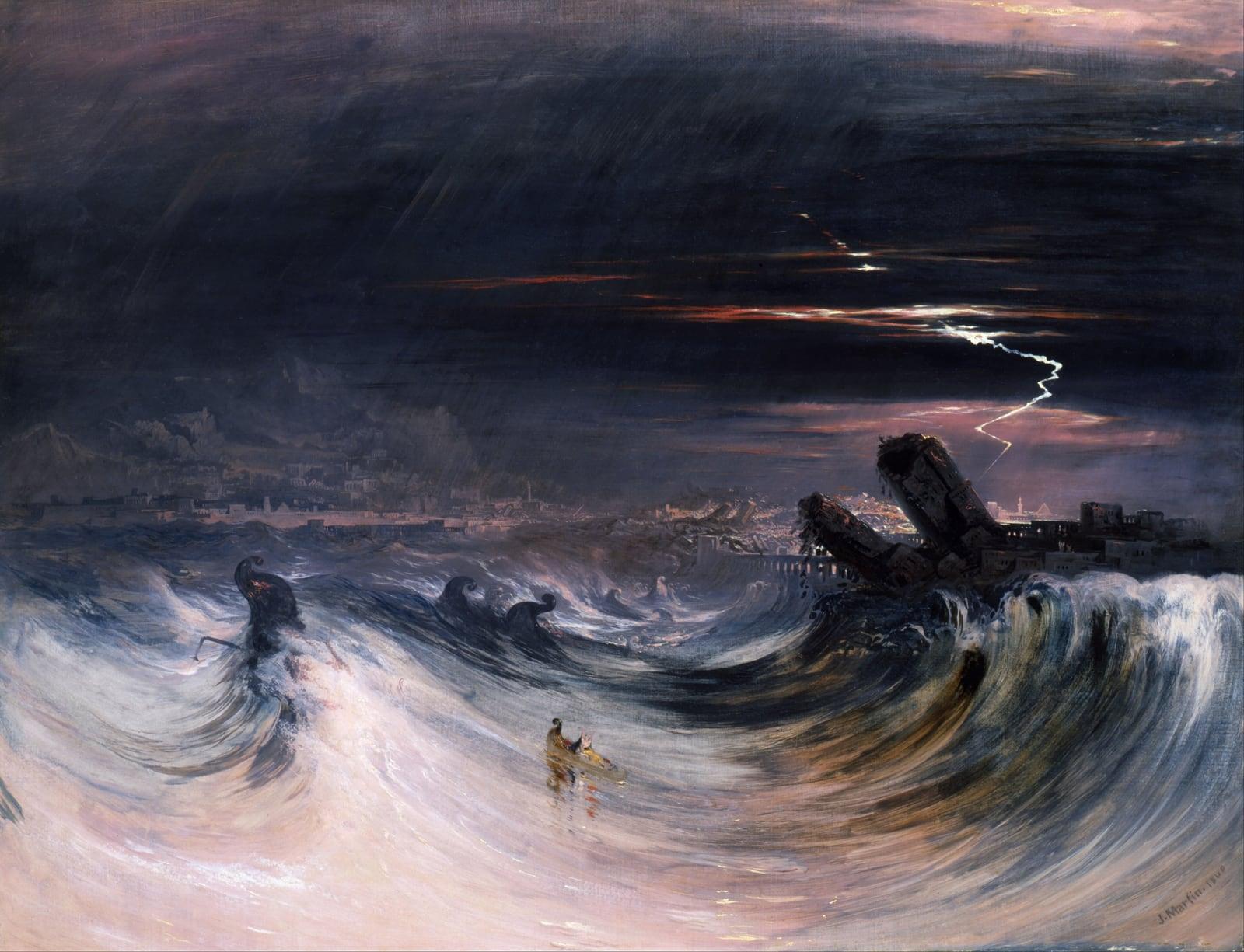
John Martin, The Destruction of Tyre, 1840. Public domain.
1 Kings 5:1 · Place · Featured Study
Tyre, the Merchant City, and Its Fall
Tyre was the Phoenician port on the coast north of Israel whose king, Hiram, was a friend of David and Solomon.
Now when Hiram king of Tyre heard that Solomon had been anointed king in his father’s place, he sent envoys to Solomon; for Hiram had always been a friend of David.
- Today
- es-Sur
- Region
- Tyre lies on the Phoenician coast, north of Acre.
- First named
- Joshua 19:29 “…as the fortified city of Tyre, turned toward…”
- Last named
- Acts 21:7 “…had finished our voyage from Tyre, we landed…”
Grain from the Nile crossed the sea to fill the treasury of Tyre.
Summary
Tyre supplied Israel's first kings with timber and skill, and the prophets foretold its ruin.
- Zechariah says Tyre heaped up silver like dust (Zechariah 9:3).
- Hiram sent Solomon 120 talents of gold (1 Kings 9:14).
- Huram could work gold, silver, bronze, iron, stone and wood (2 Chronicles 2:14).
The Merchant of the Peoples
Tyre grew rich as the trading port of the coast north of Israel.
This study asks what Tyre was to Israel's kings and why the prophets spoke against it. It sets the city and the road of its timber on an atlas plate, follows Tyre through Scripture and weighs the lament for its king.
Easton's Bible Dictionary (1897) describes Tyre in two parts. A rocky fortress stood on the mainland, and the city stood on a small rocky island about half a mile from the shore.
Tell Tyre, who dwells at the gateway to the sea, merchant of the peoples on many coasts, that this is what the Lord GOD says: You have said, O Tyre, ‘I am perfect in beauty.’Ezekiel's lament opens with the city's own boast, and the chapter's long list of trading partners follows from it.
The study of Sidon teaches the port to the north whose men cut Solomon's timber.
The Timber Road on the Map
Four places on the coast and in the hills tie Tyre to Solomon's building.
Hiram's timber came down the coast from Tyre's country to Joppa, and Solomon paid him in part with towns of Galilee.
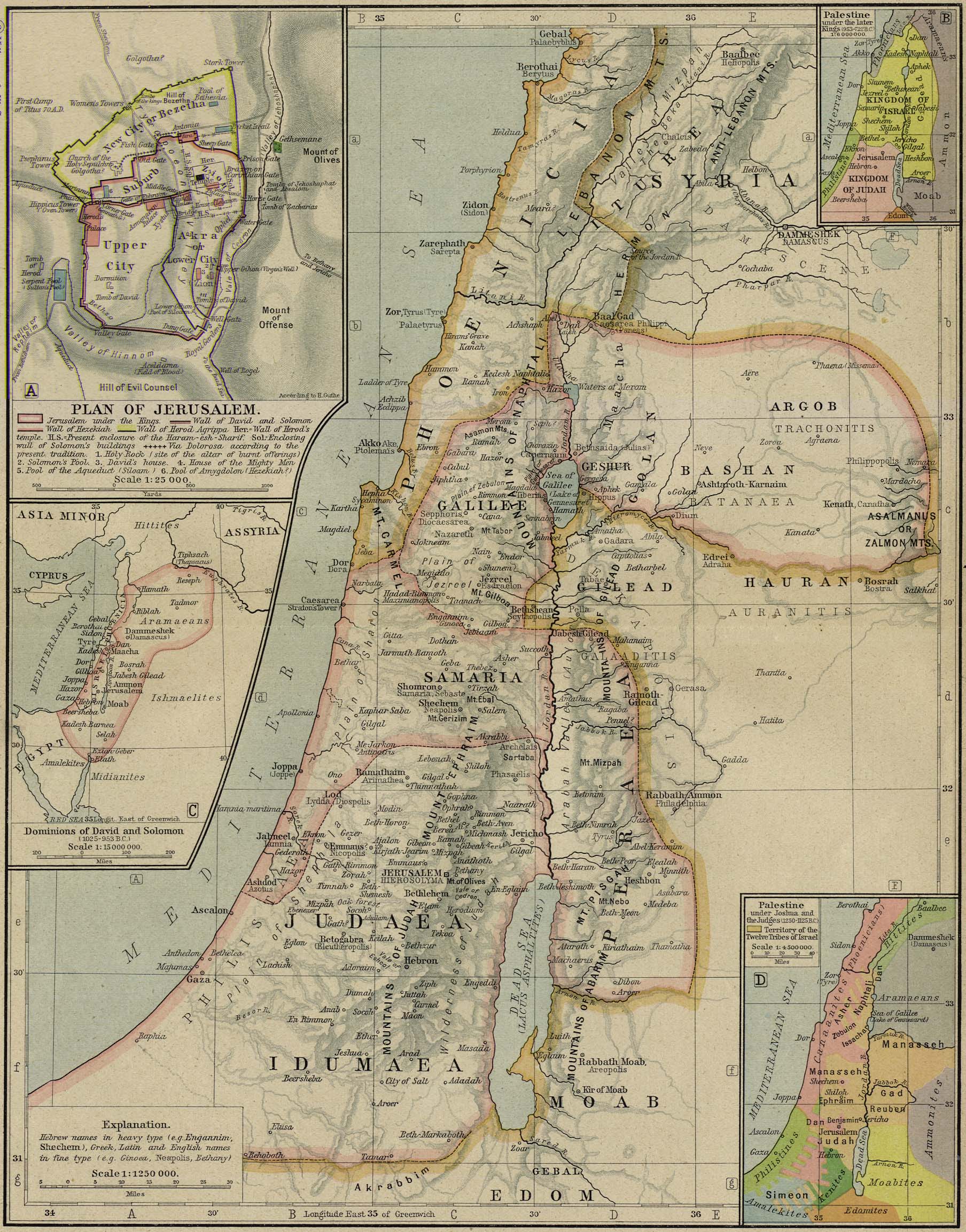
- Located: the site is known
- Proposed: a site OpenBible scores under 500 of 1,000
- The route, in the order the text gives
- 1Tyre, The fortified city of Tyre stood on the border of Asher. Joshua 19:29
- 2Joppa, Hiram's men floated the logs as rafts by sea down to Joppa. 2 Chronicles 2:16
- 3Jerusalem, From Joppa the timber was taken up to Jerusalem. 2 Chronicles 2:16
- 4?Cabul, Hiram called the twenty towns the Land of Cabul. 1 Kings 9:13
Base map: Reference map of ancient Palestine, Rand McNally reference map (1926), public domain. Places with a place page stand at its coordinates and the others at the point cited for each, set on the plate by Jerusalem and Damascus, as the plate prints them.
Four places, each with its verse. The line follows the timber from Tyre's coast to Joppa and on to Jerusalem; Cabul stands off the line, placed from OpenBible's data.
Tyre in Scripture, in Order
The record opens with Hiram's gifts to David and Solomon and closes with a church in the city.
Four of the eight moments are Hiram's dealings with David and Solomon.
- The reign of DavidHiram sends cedar logs, carpenters and stonemasons, and they build David a palace2 Samuel 5:11
- The building of the templeHiram supplies cedar and cypress, and Solomon pays him wheat and oil year after year1 Kings 5:10 to 11
- The bronze workSolomon brings Huram from Tyre to do all his bronze work1 Kings 7:13 to 14
- Solomon's fleetHiram sends his servants, men who knew the sea, to serve in Solomon's fleet1 Kings 9:27
- The oracle of IsaiahIsaiah calls the ships of Tarshish to mourn over Tyre's ruinIsaiah 23:1
- The prophecy of EzekielThe LORD brings Nebuchadnezzar king of Babylon against Tyre from the northEzekiel 26:7
- The days of AmosThe LORD judges Tyre for handing exiles over to Edom and breaking a covenant of brotherhoodAmos 1:9
- Paul's last voyagePaul lands at Tyre and stays seven days with the disciples thereActs 21:3 to 4
Eight moments from 2 Samuel to Acts in the order of the canon, each with its verse.
The days of Amos, Paul's last voyage
The study of Solomon's Temple teaches the house that Hiram's timber and Huram's bronze went into. The study of Ophir and Solomon's Fleets follows Hiram's sailors, and the study of Paul teaches the apostle's life.
The Ship of Ezekiel 27
Ezekiel pictures Tyre as a great ship built and manned from the lands around it.
They constructed all your planking with cypress from Senir. They took a cedar from Lebanon to make a mast for you.The ship is built from the same mountains that supplied Solomon's house.
Its oars were oak from Bashan, and its sail was fine linen from Egypt (Ezekiel 27:6 to 7). Men of Sidon and Arvad rowed it (Ezekiel 27:8).
Judah and the land of Israel traded with you; they exchanged wheat from Minnith, cakes and honey, oil and balm for your merchandise.Israel and Judah appear in the list of Tyre's customers, so the lament touches the prophet's own people.
Albert Barnes, the American commentator, notes on Ezekiel 27:3 that Tyre had two ports. The Sidonian harbour lay to the north and the Egyptian harbour to the south.
Easton's dictionary names the purple dye of Tyre as a source of its wealth. The dye was prized because its colour lasted.
What the Text Leaves Unsaid
Kings records Hiram's blessing of the LORD and never says whether he worshipped Him.
When Hiram received Solomon’s message, he rejoiced greatly and said, “Blessed be the LORD this day! He has given David a wise son over this great people!”This verse is the only evidence Kings gives of Hiram's faith.
Matthew Henry, the English commentator, thinks Hiram worshipped the true God but could not reform his city. Jamieson, Fausset and Brown call the words no proof of that. In their reading Hiram may have honoured the LORD only as the God of the Hebrews.
The Pride of the Gateway
Ezekiel and Isaiah trace Tyre's fall to its pride and to the LORD's purpose.
“Son of man, tell the ruler of Tyre that this is what the Lord GOD says: Your heart is proud, and you have said, ‘I am a god; I sit in the seat of gods in the heart of the sea.’ Yet you are a man and not a god, though you have regarded your heart as that of a god.The charge against the ruler is that he claimed what belongs to God.
The LORD of Hosts planned it, to defile all its glorious beauty, to disgrace all the renowned of the earth.Isaiah sets the ruin of the trading city inside the plan of the LORD.
Ezekiel later records that Nebuchadnezzar's army laboured hard against Tyre and received no wages from it (Ezekiel 29:18). Easton's dictionary adds that Alexander the Great took the city after a siege of seven months.
Voices on Tyre
Matthew Henry drew a rule for honest trade from Solomon's payment to Hiram.
Matthew Henry (1662 to 1714)
“Thus let justice be followed (as the expression is, Deut. xvi. 20 ), justice on both sides, in every bargain. The confirmation of the friendship that was between them hereby.”
Matthew Henry · Commentary on the Whole Bible · on 1 Kings 5:11Puritan
The King of Tyre in Ezekiel 28
Readers differ on whom the lament of Ezekiel 28:12 to 19 addresses.
“Son of man, take up a lament for the king of Tyre and tell him that this is what the Lord GOD says: ‘You were the seal of perfection, full of wisdom and perfect in beauty.Every reading has to account for the lament's opening praise.
The devil behind the kingTertullian, Ambrose, Jerome and Augustine
Ambrose of Milan, in On Paradise, says the prince of Tyre stands for the devil, who was in Eden. Tertullian, in Against Marcion, reads the passage as an angel made good who became corrupt by his own choice.
Jerome, in his Homilies on the Psalms, applies the seal of perfection to the devil before his fall. Augustine, in The City of God 11.15, cites the Eden verse to show that the devil was for a time without sin.
The objection: Ezekiel 28:18 charges the king with dishonest trading and profaned sanctuaries.
A lament for a proud manAdam Clarke and John Gill
Adam Clarke, the Methodist commentator, reads the cherub and the perfect ways as irony kept up through the lament. John Gill, the Baptist commentator, holds that the king was never in Eden. Gill reads Eden as the king's own picture of his safe and pleasant seat at Tyre.
The objection: Ezekiel 28:15 calls him blameless from the day he was created, and Ezekiel 28:16 drives him from the mountain of God.
A type of AntichristJamieson, Fausset and Brown
Jamieson, Fausset and Brown read the cherub as the image of the king of Tyre at his highest. They see the claims of Antichrist as the further reference and compare 2 Thessalonians 2:4.
The objection: Ezekiel names no later figure, and the lament speaks of what the king had already done.
Ezekiel's oracles against Tyre fill chapters 26 to 28 of his book.
Prayer on the Beach
Isaiah called the traders of Tyre princes (Isaiah 23:8). In Paul's day the city held a church.
But when our time there had ended, we set out on our journey. All the disciples, with their wives and children, accompanied us out of the city and knelt down on the beach to pray with us.The merchant city that the prophets judged sent the apostle on his way with prayer.
Sources
Scripture is the Berean Standard Bible.
- James Strong, Exhaustive Concordance of the Bible (1890), Hebrew dictionary, entry 6865.
- M. G. Easton, Illustrated Bible Dictionary, third edition (1897), articles Tyre and Cabul.
- OpenBible.info, Bible Geocoding Data, ancient.jsonl.
- Matthew Henry, Commentary on the Whole Bible (1710), on 1 Kings 5:11.
- Matthew Henry, Commentary on the Whole Bible (1710), on 1 Kings 5:10 to 18.
- Jamieson, Fausset and Brown, Commentary Critical and Explanatory (1871), on 1 Kings 5:7.
- Albert Barnes, Notes, Explanatory and Practical, on the Old and New Testaments (1832 to 1869), on Ezekiel 27:3.
- Ambrose of Milan, On Paradise 2.9 (397), on Ezekiel 28:12 to 13.
- Tertullian, Against Marcion 2.10, on Ezekiel 28:12 to 13.
- Jerome, Homilies on the Psalms 14 (on Psalm 81), on Ezekiel 28:12 to 13.
- Augustine of Hippo, The City of God 11.15, on Ezekiel 28:13.
- Adam Clarke, Commentary on the Bible (1832), on Ezekiel 28:14 and 28:15.
- John Gill, Exposition of the Old Testament (1748 to 1763), on Ezekiel 28:13.
- Jamieson, Fausset and Brown, Commentary Critical and Explanatory (1871), on Ezekiel 28:14.
Keep Studying
Studies1
Places8