
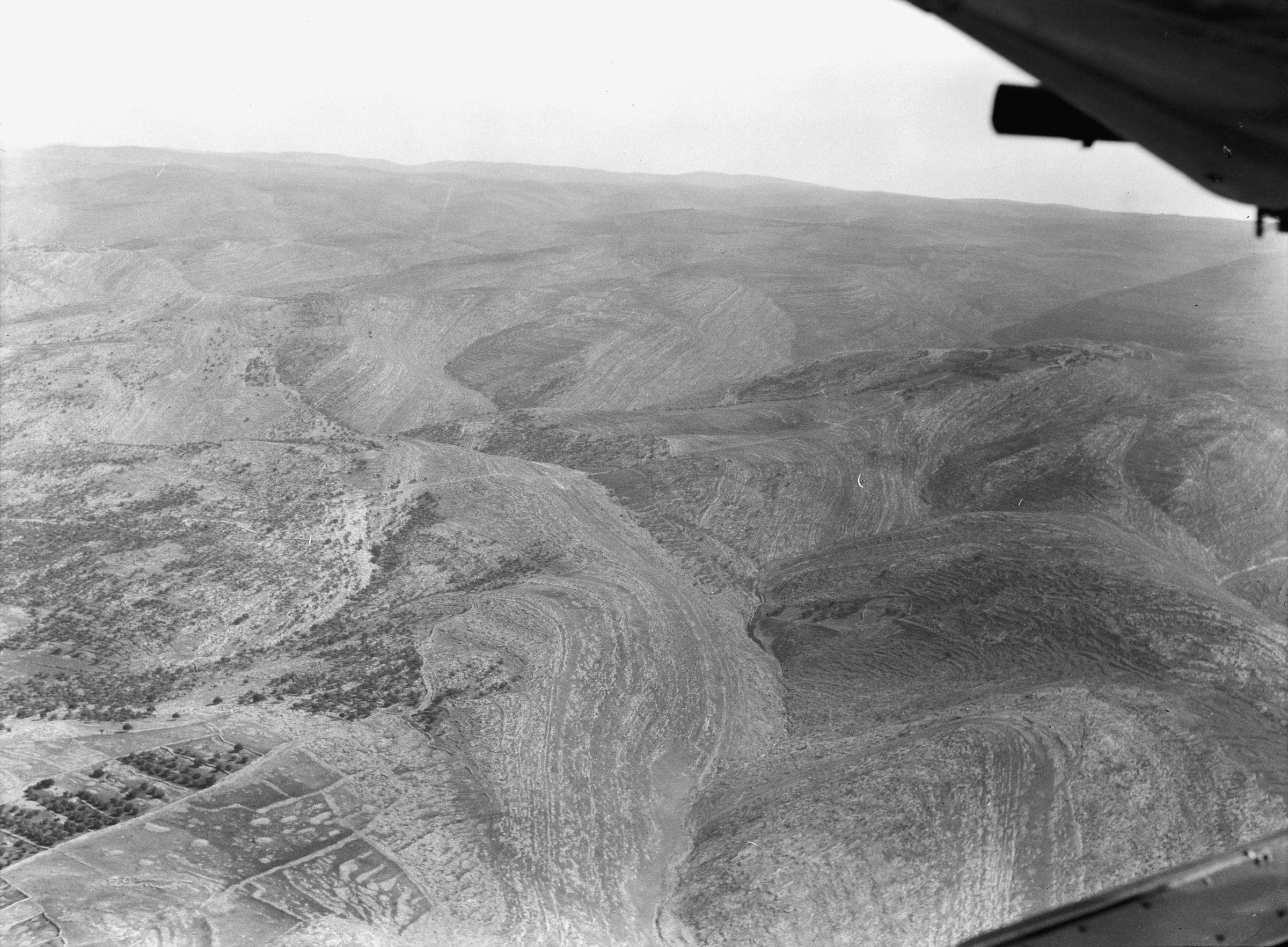
G. Eric and Edith Matson, Valley of Ajalon looking up the valley, 1931. Public domain.
Deuteronomy 1:7 · Place · Featured Study
Shephelah
The book of Joshua names the foothills between the hill country and the coast of the Great Sea (Joshua 9:1).
Resume your journey and go to the hill country of the Amorites; go to all the neighboring peoples in the Arabah, in the hill country, in the foothills, in the Negev, and along the seacoast to the land of the Canaanites and to Lebanon, as far as the great River Euphrates.
- Region
- Judah's western districts
- First named
- Deuteronomy 1:7 “Resume your journey and go to the hill…”
- Last named
- Zechariah 7:7 “Are these not the words that the LORD…”
The Philistines raided the foothills and the Negev of Judah and took six towns.
Summary
Scripture tells of the trees and the flocks of the foothills.
- Solomon made cedar as plentiful as sycamore in the foothills (1 Kings 10:27).
- A man named Baal-hanan kept the olive and sycamore trees of the foothills (1 Chronicles 27:28).
- King Uzziah kept much livestock in the foothills (2 Chronicles 26:10).
The Low Hills
Moses names the foothills in his first speech.
This study asks what the Shephelah is, where it lies, and what Scripture records there. It sets the low hills on an atlas plate of 1915 and follows them through the record. It also gives two readings of what the name covers.
Deuteronomy 1:7 is the first verse in the canon to name the foothills.
In each of the 19 verses that have the Hebrew word shephelah, the Berean text prints foothills. Word data for the Hebrew Bible counts 20 uses, since Joshua 11:16 has the word twice.
The Shephelah on Bartholomew's Plate
The plate letters SHEPHELAH in large capitals across the pale ground of its lower left.
Aijalon, Zorah, Beth-shemesh, Azekah and Socoh lie along the northern valleys, with Mareshah and Lachish to the south-west.
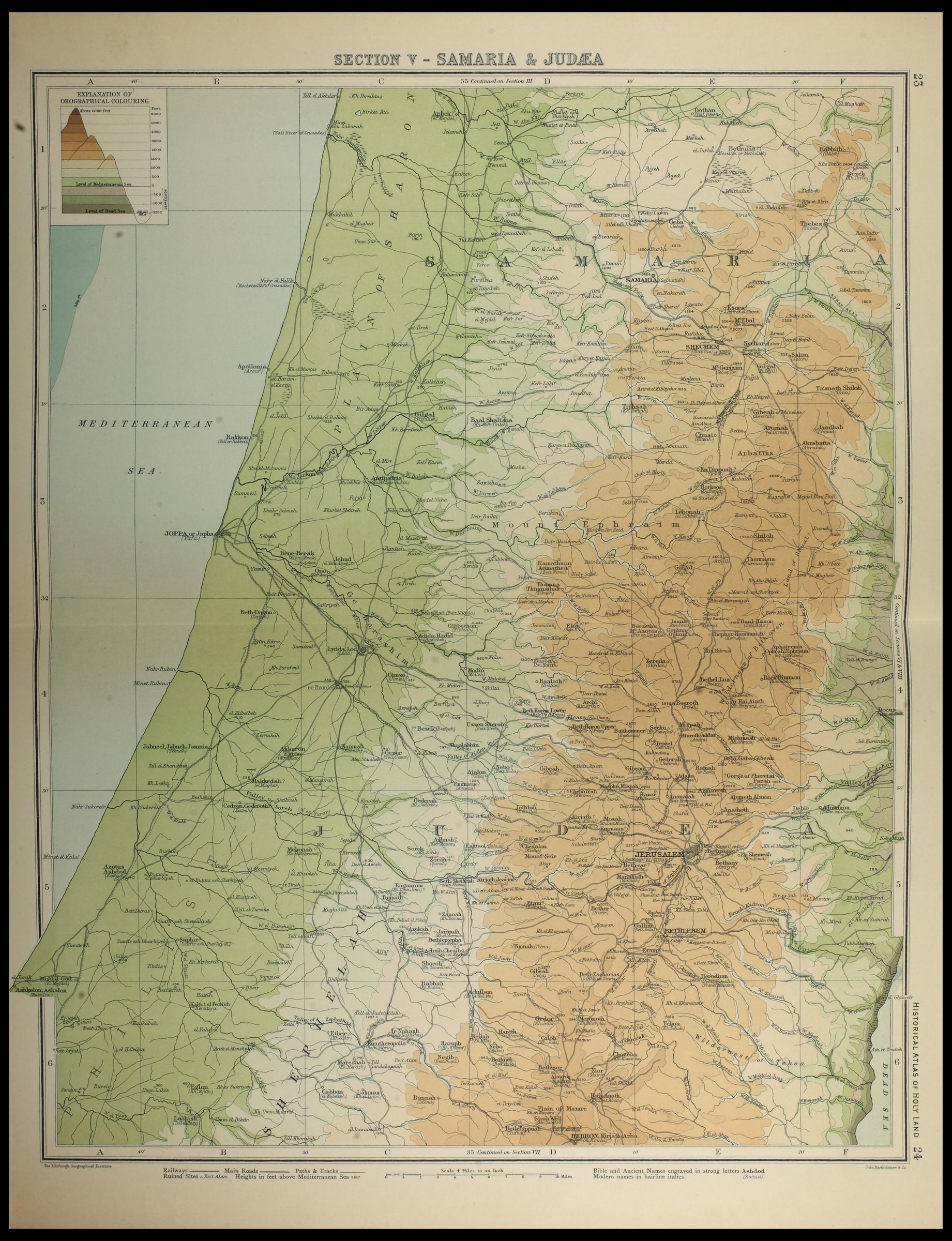
- AijalonJoshua bade the moon stand still over its valley. Bartholomew locates the town as Ajalon, with no query, in the Valley of Ajalon, the northernmost point.Joshua 10:12
- ZorahJoshua lists it beside Eshtaol at the head of the towns of the foothills. Bartholomew locates it with no query, just north of the railway and west of Eshtaol.Joshua 15:33
- Beth-shemeshJehoash king of Israel and Amaziah king of Judah faced each other in battle there. Bartholomew locates it with no query, just south of the railway and south of Zorah.2 Kings 14:11
- AzekahThe LORD cast down hailstones on the Amorites as they fled toward it. Bartholomew proposes the site with a query, on the north side of the Valley of Elah.Joshua 10:11
- SocohThe Philistines gathered at Socoh and camped between it and Azekah. Bartholomew locates it as Shocoh, with no query, south of the Valley of Elah and south-east of Azekah.1 Samuel 17:1
- MareshahKing Rehoboam of Judah built it up among his cities for defence. Bartholomew locates it with no query, beside Eleutheropolis, south-west of Socoh.2 Chronicles 11:8
- LachishIt held out with Azekah as one of the last fortified cities of Judah against Babylon. Bartholomew's plate prints Lachish, with no query, at Tell el Hesy, the south-westernmost point. That identification has since changed.Jeremiah 34:7
John Bartholomew and Co., Section V, Samaria and Judaea, in George Adam Smith's Atlas of the Historical Geography of the Holy Land, 1915. Public domain; File:John Bartholomew & Co., Section V - Samaria & Judaea (FL46962162 3907200).jpg.
Seven numbered points, each where Bartholomew's plate of 1915 prints the place, with north at the top. The plate's key sets Bible names in strong letters and modern names in hairline italics, and it marks the railways and roads of 1915. It prints a scale of four miles to an inch.
Three studies tell what happened at three of these places. They are Samson's life from Zorah, David's fight by Socoh, and the Assyrian siege of Lachish.
The Foothills in Scripture, in Order
The books after Deuteronomy name the foothills in war and in worship.
Joshua and the men of Judah fought in the foothills, and Jeremiah promised worshippers from them on a condition.
- When the news spreadThe kings of the hill country, the foothills and the coast hear the newsJoshua 9:1
- The southern campaignJoshua conquers the hill country, the Negev, the foothills and the slopesJoshua 10:40
- After Joshua's deathThe men of Judah go down to fight the Canaanites in the foothillsJudges 1:9
- Jeremiah's conditionIf Judah keeps the Sabbath holy, people will come from the foothills with offeringsJeremiah 17:24 to 26
Four moments from Joshua to Jeremiah in the order of the canon, each with its verse.
The Valleys Between
George Adam Smith rode through the region and wrote that its valleys explain the wars fought there.
Smith wrote The Historical Geography of the Holy Land, whose fourth edition appeared in 1897. South of Aijalon, he says, a series of valleys runs from Aijalon to near Beersheba and cuts this country off from the central range.
Smith then follows the wide valleys that cross the low hills. Among them are Aijalon, Sorek, where Delilah lived (Judges 16:4), and Elah, where Saul's army camped (1 Samuel 17:2). Each of these cross valleys, he says, runs on by a defile into Judah near an important city. At its coast end each has one of the five cities of the Philistines.
What the Text Leaves Unsaid
Scripture lists the towns of the foothills and draws no line between the foothills and the Philistine plain.
The Jerusalem Talmud, Shebiith 9:2, as Smith cites it, draws a line at Lydda between the low hills and the plain.
Fields Bought Again in the Foothills
Jeremiah and Obadiah give the foothills a promise, and Zechariah looks back to their past.
Fields will be purchased with silver, and deeds will be signed, sealed, and witnessed in the land of Benjamin, in the areas surrounding Jerusalem, and in the cities of Judah—the cities of the hill country, the foothills, and the Negev—because I will restore them from captivity, declares the LORD.”The foothills stand among the districts this promise names.
In the cities of the hill country, the foothills, and the Negev, in the land of Benjamin and the cities surrounding Jerusalem, and in the cities of Judah, the flocks will again pass under the hands of the one who counts them, says the LORD.Flocks counted again in the foothills are a sign of ordinary life restored.
Those from the Negev will possess the mountains of Esau; those from the foothills will possess the land of the Philistines. They will occupy the fields of Ephraim and Samaria, and Benjamin will possess Gilead.Obadiah turns the old border war around, with the people of the foothills taking the Philistine land.
Are these not the words that the LORD proclaimed through the earlier prophets, when Jerusalem and its surrounding towns were populous and prosperous, and the Negev and the foothills were inhabited?’”Zechariah's look back shows what a restored land would have to recover.
Obadiah 1:19, Zechariah 7:7
Voices on the Shephelah
Three commentaries speak to a battle and a raid in these hills.
John Wesley (1703 to 1791)
John Wesley, the Methodist leader, adds Josephus's account of the storm and gives a reason for it.
“Josephus affirms, that thunder and lightning were mixed with the hail, which may seem probable from Hab. iii, 11. They had robbed the true God of his honour, by worshipping the host of heaven, and now the hosts of heaven fights against them, and triumphs in their ruin.”
John Wesley · Explanatory Notes upon the Old Testament · on Joshua 10:11Evangelical
Albert Barnes (1798 to 1870)
Albert Barnes, the American commentator, ties three of the captured towns to earlier events in Chronicles and Joshua.
“Philistia also, eager to retaliate the blows she had received from Uzziah 2Ch 26:6, seized her opportunity. Ajalon and Shocho were among the cities fortified by Rehoboam 2Ch 11:7, 2Ch 11:10; Beth-shemesh Jos 15:10 was famous as the scene of Amaziah’s defeat 2Ch 25:21.”
Albert Barnes · Notes, Explanatory and Practical, on the Old and New Testaments (1832-1869) · on 2 Chronicles 28:18Evangelical
Jamieson, Fausset & Brown (1802 to 1910)
Jamieson, Fausset and Brown read Joshua's words over the Valley of Aijalon as a prayer.
“It would seem, from Jos 10:14, that the command of Joshua was in reality a prayer to God for the performance of this miracle; and that, although the prayers of eminently good men like Moses often prevailed with God, never was there on any other occasion so astonishing a display of divine power made in behalf of His people, as in answer to the prayer of Joshua.”
Jamieson, Fausset & Brown · Commentary Critical and Explanatory on the Whole Bible · on Joshua 10:12 to 15Reformed
What the Name Covers
Readers differ on whether the Shephelah includes the coastal plain or only the low hills.
Ekron, with its towns and villages; from Ekron to the sea, all the cities near Ashdod, along with their villages; Ashdod, with its towns and villages; Gaza, with its towns and villages, as far as the Brook of Egypt and the coastline of the Great Sea.These verses close the list that opens, These were in the foothills.
The slope down to the seaJames Strong, Exhaustive Concordance
The Hebrew dictionary of the American scholar James Strong (1890) glosses the word, with the article, as the maritime slope of Palestine.
The objection: 2 Chronicles 28:18 has the Philistines raid the towns of the foothills, so those towns lay outside the Philistines' own land.
The low hills aloneGeorge Adam Smith, The Historical Geography of the Holy Land
Smith holds that the Shephelah proper was the region of low hills between the plain and the central range. He grants that the name may once have taken in the plain, and he notes that the Septuagint mostly renders it plain.
The objection: the list of Joshua 15:45 to 47 takes the name past the low hills to the coast.
Every Promise Yes in Christ
After the exile the people of Judah settled again in Lachish and its fields and in Azekah, as Nehemiah 11:30 records.
For all the promises of God are “Yes” in Christ. And so through Him, our “Amen” is spoken to the glory of God.Paul sets every promise of God, the promises of the land among them, in Christ.
Sources
Scripture is the Berean Standard Bible.
- The Hebrew text tagged word by word with Strong's numbers.
- James Strong, Exhaustive Concordance of the Bible (1890), Hebrew dictionary, entry 8219.
- George Adam Smith, The Historical Geography of the Holy Land, fourth edition (London, 1897), pages 201 to 205 and 209.
- John Wesley, Explanatory Notes upon the Old Testament (1765), on Joshua 10:11.
- Albert Barnes, Notes, Explanatory and Practical, on the Old and New Testaments, on 2 Chronicles 28:18.
- Jamieson, Fausset and Brown, Commentary Critical and Explanatory on the Whole Bible (1871), on Joshua 10:12.
Keep Studying
Read it4
People and groups12
Places9