
Judges 1 · Subject · Featured Study
The land Israel did not take
Judges 1:19 to 36 and Judges 2:20 to 3:4, with the land that remained in Joshua 13 and the warnings of Exodus 23, Numbers 33 and Deuteronomy 7.
The LORD was with Judah, and they took possession of the hill country; but they could not drive out the inhabitants of the plains because they had chariots of iron.
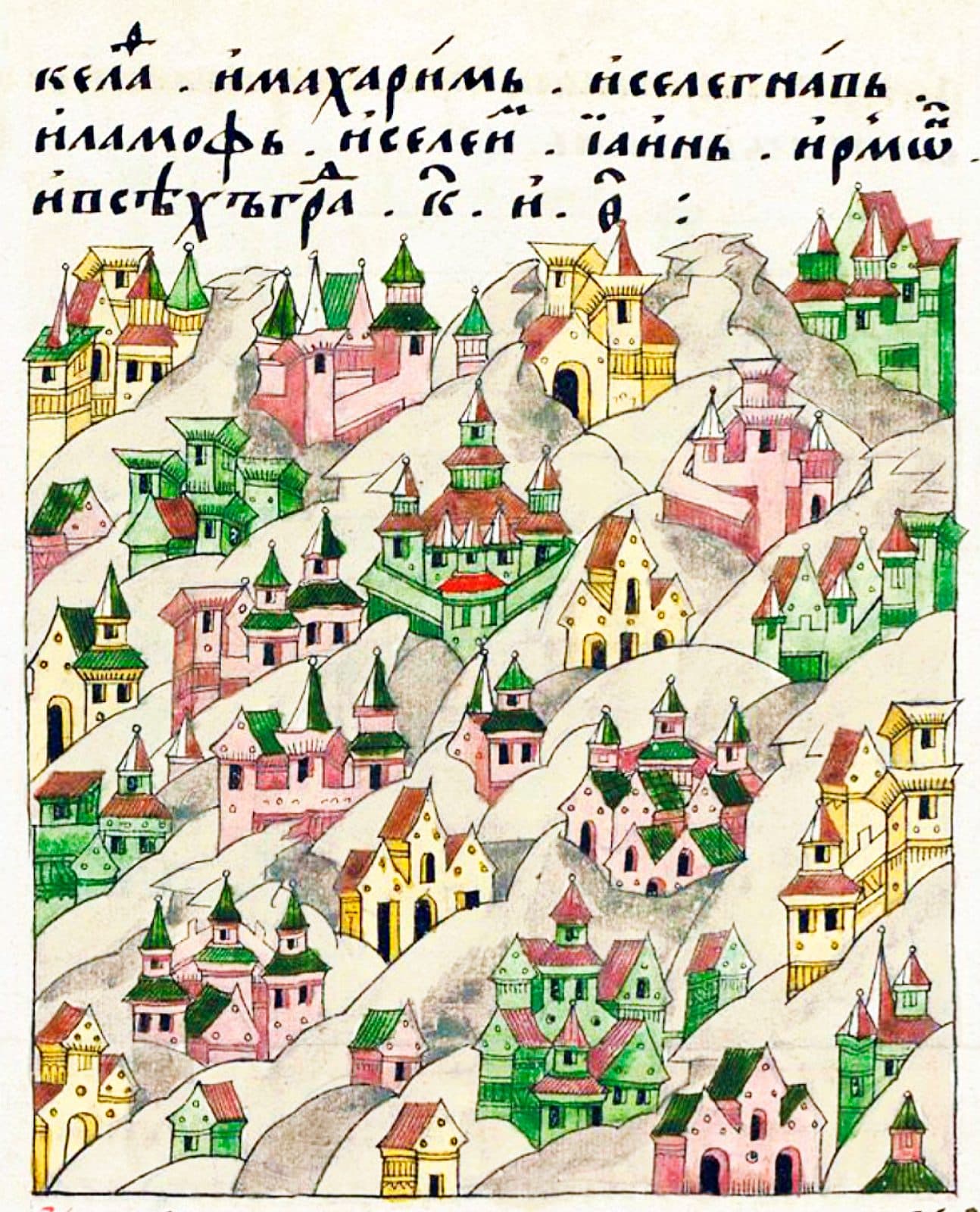
Anonymous Russian illuminators, the towns of Judah's lot, miniature in the Illustrated Chronicle of Ivan the Terrible (the Facial Chronicle), book 2, page 426, 1560s to 1570s. Public domain (published before 1930), via Wikimedia Commons, File:Facial_Chronicle_-_b.02%2C_p.426.jpg.
THE ARTWORKThe illuminators painted the towns of Judah's lot as walled cities crowded on the hills. The lettering above the picture closes the list of Joshua 15:21 to 32, which counts twenty-nine cities in all.
Summary
Judges 1 records, tribe by tribe, the towns of Canaan that Israel left in Canaanite hands after the death of Joshua.
- Seven tribes left twenty-one named towns, and Asher left seven of them, Acco and Sidon among them.
- Where Israel grew stronger, the tribes put the Canaanites to forced labour and still did not drive them out.
- The angel of the LORD at Bochim, and the LORD's word in Judges 2:20 to 3:4, give the nations left as a judgment and a test.
The Record of Judges 1
The chapter opens with the LORD's promise to Judah and ends with a list of towns the tribes did not take.
After the death of Joshua, the Israelites inquired of the LORD, “Who will be the first to go up and fight for us against the Canaanites?” “Judah shall go up,” answered the LORD. “Indeed, I have delivered the land into their hands.”The land is already delivered into Judah's hands, so every town left later is measured against this word.
The Towns Left, Drawn
An atlas plate, the towns left counted by tribe, and the record of each tribe in Judges 1.
Nine places of the record stand on the plate, from Gaza on the coast to Mount Hermon in the north.
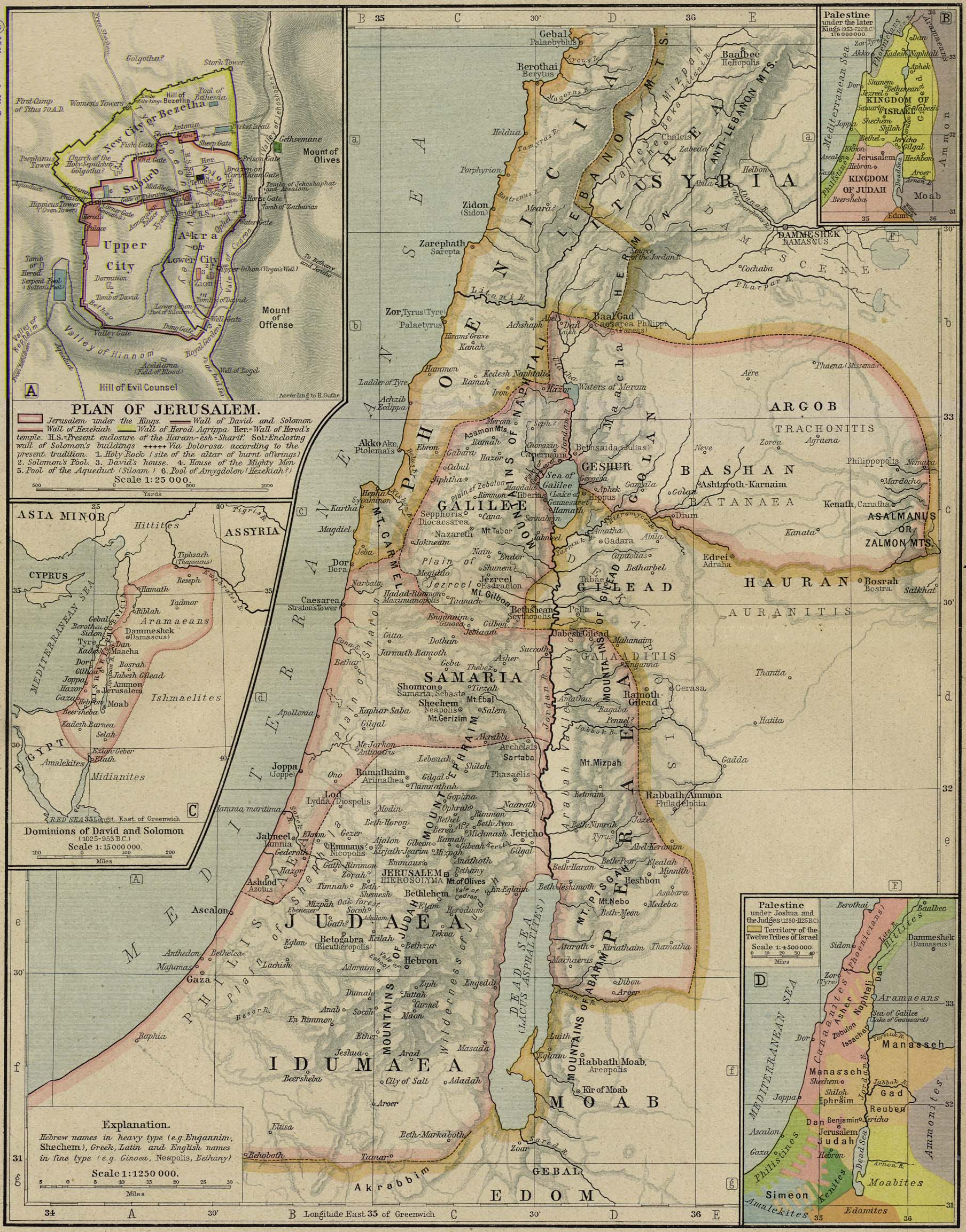
- 1Hebron, Judah gave Hebron to Caleb, who drove out the descendants of the three sons of Anak. Judges 1:20
- 2Bethel, The house of Joseph took the city after a man of Luz showed the spies the way in. Judges 1:22 to 25
- 3Shiloh, With the Tent of Meeting set up here, Joshua asked the seven tribes still without an inheritance how long they would put off possessing the land. Joshua 18:1 to 3
- 4Jerusalem, The men of Judah captured the city, put it to the sword and set it on fire. Judges 1:8
- 5Jericho, The Kenites went up with Judah from the City of Palms, the name Deuteronomy 34:3 gives to the Valley of Jericho. Judges 1:16
- 6Gaza, Judah captured Gaza, and Keil and Delitzsch note that it was in Philistine hands again by the days of Samson. Judges 1:18
- 7Jezreel, The house of Joseph said the Canaanites of the Valley of Jezreel had iron chariots. Joshua 17:16
- 8Gilgal, The messenger who rebuked Israel at Bochim came up from Gilgal. Judges 2:1
- 9Mount Hermon, The Hivites the LORD left lived from Mount Baal-hermon, which Keil and Delitzsch place under Hermon, to Lebo-hamath. Judges 3:3
Base map: Reference map of ancient Palestine, Rand McNally reference map (1926), public domain. Each place stands at its place page's coordinates, set on the plate by Jerusalem and Damascus, as the plate prints them.
Nine places marked on the plate, each with its verse.
Asher left seven towns, the most of the seven tribes named in Judges 1:21 to 35.
- No forced labour named
- Forced labour named
The 7 tribes' counts of towns left as a table
| Tribe | Tribes' counts of towns left | Forced labour | Verse |
|---|---|---|---|
| Benjamin | 1 | No forced labour named | Judges 1:21 |
| Manasseh | 5 | Forced labour named | Judges 1:27 to 28 |
| Ephraim | 1 | No forced labour named | Judges 1:29 |
| Zebulun | 2 | Forced labour named | Judges 1:30 |
| Asher | 7 | No forced labour named | Judges 1:31 to 32 |
| Naphtali | 2 | Forced labour named | Judges 1:33 |
| Dan | 3 | Forced labour named | Judges 1:34 to 35 |
Seven bars from zero, one for each tribe, with the towns the chapter names as left in its lot.
| Tribe | Towns left | What the text says |
|---|---|---|
| Judah | The towns of the plains | Could not, because of the enemy's chariots |
| Judah | Jerusalem | Could not drive out the Jebusites |
| Benjamin | Jerusalem | Failed to drive out the Jebusites |
| Manasseh | Beth-shean, Taanach, Dor, Ibleam and Megiddo | Failed to drive them out, and put them to forced labour when Israel grew stronger |
| Ephraim | Gezer | Failed to drive them out, and Joshua 16:10 calls them forced labourers |
| Zebulun | Kitron and Nahalol | Failed to drive them out, and the Canaanites lived among Zebulun as forced labourers |
| Asher | Acco, Sidon, Ahlab, Achzib, Helbah, Aphik and Rehob | Failed to drive them out, and Asher lived among the Canaanites |
| Naphtali | Beth-shemesh and Beth-anath | Failed to drive them out, and the people of the two towns served Naphtali as forced labourers |
| Dan | Mount Heres, Aijalon and Shaalbim | The Amorites forced Dan into the hill country, and the house of Joseph put them to forced labour |
| The tribes east of the Jordan | Geshur and Maacath | Did not drive them out |
From Promise to Sentence
Texts from Exodus to Judges 2 trace the driving out the LORD promised and the halt He laid on it.
The promise of a driving out little by little became the sentence of Judges 2:21.
- Exodus 23:29 to 30The LORD will not drive the nations out in a single year, but little by little, until Israel becomes fruitful and possesses the land.Exodus 23:29 to 30
- Numbers 33:55Those Israel allows to remain will become barbs in their eyes and thorns in their sides.Numbers 33:55
- Deuteronomy 7:22Israel will not be enabled to eliminate the nations all at once, or the wild animals would multiply.Deuteronomy 7:22
- Joshua 13:1Joshua is old and well along in years, and very much of the land remains to be possessed.Joshua 13:1
- Joshua 23:12 to 13If Israel turns away and intermarries with the nations that remain, the LORD will stop driving them out.Joshua 23:12 to 13
- Judges 1:28Israel grows stronger and presses the Canaanites into forced labour, but never drives them out completely.Judges 1:28
- Judges 2:3The angel of the LORD at Bochim says the LORD will not drive these people out before them.Judges 2:3
- Judges 2:21 to 22The LORD will no longer drive out the nations Joshua left when he died, and will test Israel by them.Judges 2:21 to 22
Eight numbered texts in the order of the books, each with its verse.
The land that remained in Joshua's old ageJoshua 13:6 to 7
All the inhabitants of the hill country from Lebanon to Misrephoth-maim—all the Sidonians—I Myself will drive out before the Israelites. Be sure to divide it by lot as an inheritance to Israel, as I have commanded you. Now therefore divide this land as an inheritance to the nine tribes and the half-tribe of Manasseh.”The LORD promises to drive out the Sidonians Himself and tells Joshua to divide their land by lot before it is taken.
John Wesley, on Joshua 13:6, notes the Chaldee rendering of the promise and then turns to Israel's own part.
“I will do it by my word; so the Chaldee here, as in many other places: by the eternal word, the captain of my host. But the promise of driving them out from before the children of Israel, supposes that the Israelites must use their own endeavours, must go up against them. If Israel, thro' sloth or cowardice let them alone, they are not likely to be driven out.”
John Wesley · Explanatory Notes upon the Old Testament · on Joshua 13:6Evangelical
Thorns in the sidesNumbers 33:55 and Joshua 23:13
know for sure that the LORD your God will no longer drive out these nations before you. Instead, they will become for you a snare and a trap, a scourge in your sides and thorns in your eyes, until you perish from this good land that the LORD your God has given you.Joshua repeats the warning of Numbers 33:55 in stronger words, a snare, a trap and a scourge, until Israel perishes from the land.
Adam Clarke, on Joshua 23:13, explains the snare as a net set by a fowler and the trap as a snare laid on the ground for the foot.
Why little by littleExodus 23:29 to 30 and Deuteronomy 7:22
Adam Clarke, on Deuteronomy 7:22, wrote that Israel was not yet numerous enough to fill the land of the seven nations.
Judges 1:18 and 19 in the Old Witnesses
The Hebrew, Greek and Latin texts and Josephus differ on which Philistine towns Judah took and what stopped it in the plains.
And Judah also captured Gaza, Ashkelon, and Ekron—each with its territory.The Berean text follows the Hebrew, which counts three Philistine towns among Judah's conquests, and the Greek text reads the verse the other way.
The Hebrew of Judges 1:19 has no verb for could, and its negative stands before the infinitive lehorish, to drive out. Keil and Delitzsch supply the sense he was not able.
| Witness | The Philistine towns, Judges 1:18 | The plains, Judges 1:19 |
|---|---|---|
| The Hebrew text and the Berean Standard Bible | Judah captured Gaza, Ashkelon and Ekron | Chariots of iron, rekeb barzel |
| The Greek text printed on New Advent | Judah did not inherit Gaza, Ashkelon, Ekron or Ashdod | Reads the name Rechab where the Hebrew has rekeb |
| The Latin Vulgate | Judah took Gaza, Ashkelon and Ekron | Scythed chariots, falcatis curribus |
| Josephus, Antiquities 5.2.4 | Judah and Simeon took Askelon and Ashdod, and Gaza and Ekron escaped them | Names chariots and gives no word of iron |
Chariots tipped with ironKeil and Delitzsch on Joshua 17:16
Keil and Delitzsch, on Joshua 17:16, held that the iron chariots were not scythe chariots, which came in with Cyrus. They took them for war chariots of wood strengthened with iron, as Egyptian chariots were strengthened with metal nails and tips.
“The hill country is not enough for us,” they replied, “and all the Canaanites who live in the valley have iron chariots, both in Beth-shean with its towns and in the Valley of Jezreel.”The house of Joseph names the same weapon as its reason for not going down into Beth-shean and the Valley of Jezreel.
Josephus on the peace that followedAntiquities 5.2.5 and 5.2.7
Josephus wrote that the Benjamites let the people of Jerusalem pay tribute and that the other tribes did the same, content with the tributes. He added that the Israelites then gave themselves to farming and wealth and were unwilling to go to war.
Judah or Benjamin at JerusalemJoshua 15:63 and Judges 1:21
Joshua 15:63 lays the failure at Jerusalem on Judah, and Judges 1:21 lays it on Benjamin. Albert Barnes explains the change of tribe.
“This verse is nearly identical with Jos 15:63, except in the substitution of Benjamin for Judah. Probably the original reading Judah was altered in later times to Benjamin, because Jebus was within the border of Benjamin, and neither had the Benjamites expelled the Jebusites.”
Albert Barnes · Notes, Explanatory and Practical, on the Old and New Testaments (1832-1869) · on Judges 1:21Evangelical
The Last Towns Taken
Two of the towns Judges 1 names as left came into Israel's hands only under the kings.
Jerusalem fell to David, and Gezer came to Solomon as a dowry from Pharaoh.
- The days of the judgesA Levite refuses to spend the night in Jebus, a city of foreigners where there are no Israelites.Judges 19:11 to 12
- David's reignDavid captures the fortress of Zion from the Jebusites, and it becomes the City of David.2 Samuel 5:6 to 7
- Solomon's reignPharaoh captures Gezer, burns it, kills its Canaanites and gives it to his daughter, Solomon's wife.1 Kings 9:16
- Solomon's reignSolomon conscripts the descendants of the peoples Israel could not destroy as forced labourers.1 Kings 9:20 to 21
A timeline of four texts from Judges to 1 Kings, each with its verse.
The Words of the Record
Two Hebrew words carry the record of Judges 1.
YARASH
Strong's H3423 gives to occupy by driving out the previous tenants and possessing in their place. The verb stands twice in Judges 1:19, once for the land Judah took and once for the people it could not remove.
MAS
Strong's H4522 gives a burden, a tax in the form of forced labour. Judges 1:28, 30, 33 and 35 use it of Canaanites set to work in place of being driven out.
When the forced labour beganJudges 1:28; 1 Kings 9:20 to 21
Adam Clarke, on Joshua 16:10, held that Ephraim brought the people of Gezer to pay tribute although it did not expel them.
To drive out and to inheritJoshua 23:5
Adam Clarke, on Joshua 23:5, noted that the one word yarash means both to expel from an inheritance and to succeed those expelled. Keil and Delitzsch draw the same two senses out of Judges 1:19.
What the Record Leaves Unsaid
Judges 1 is silent on three matters a reader looks for.
The list of Judges 1:21 to 35 does not name Issachar. Keil and Delitzsch took the silence to mean that none of Issachar's towns stayed in Canaanite hands. They set aside the view of Ernst Bertheau in Das Buch der Richter und Ruth that the tribe made no attempt.
The chapter does not name the towns of the plains that Judah could not take, and it does not say when the forced labour of verse 28 began.
Why the Nations Were Left
Judges 2:20 to 3:4 gives two purposes for the nations the LORD left, to test Israel and to teach war.
These are the nations that the LORD left to test all the Israelites who had not known any of the wars in Canaan, if only to teach warfare to the subsequent generations of Israel, especially to those who had not known it formerly:The first purpose concerns Israel's children, who had to meet in battle what their fathers had spared.
These nations were left to test the Israelites, to find out whether they would keep the commandments of the LORD, which He had given their fathers through Moses.The second purpose ties the nations left to the law of Moses, so the war becomes a matter of obedience.
The angel at BochimJudges 2:1 to 5
Now the angel of the LORD went up from Gilgal to Bochim and said, “I brought you up out of Egypt and led you into the land that I had promised to your fathers, and I said, ‘I will never break My covenant with you, and you are not to make a covenant with the people of this land, but you shall tear down their altars.’ Yet you have not obeyed My voice. What is this you have done?The angel names the covenant Israel broke by making a covenant with the people of the land and leaving their altars standing.
When the angel of the LORD had spoken these words to all the Israelites, the people lifted up their voices and wept. So they called that place Bochim and offered sacrifices there to the LORD.The weeping shows that the people heard the rebuke, and the chapter records no altar of the land torn down after it.
Little by little and the halt of Judges 2Keil and Delitzsch on Judges 2:20 to 23
Keil and Delitzsch held that Judges 2:20 to 23 does not contradict Exodus 23:29 to 30 or Deuteronomy 7:22. A driving out over many years served Israel's good, while the halt of Judges 2 was a chastisement for breaking the covenant, meant to bring the people to repentance.
They read the word rendered immediately in Judges 2:23, hastily in their translation, as a limit on the threat, so that the LORD would take up the driving out again whenever Israel returned to Him.
What it meant to learn warKeil and Delitzsch on Judges 3:1 to 2
Keil and Delitzsch held that under Joshua Israel conquered by the help of God, given on condition of obedience, as the defeat after Achan's sin showed. In their reading the generation after Joshua had to learn war again by learning that the people of the LORD fight and conquer only in His power.
The marriages that followedJudges 3:5 to 6
Thus the Israelites continued to live among the Canaanites, Hittites, Amorites, Perizzites, Hivites, and Jebusites. And they took the daughters of these people in marriage, gave their own daughters to their sons, and served their gods.Israel lives among six peoples, intermarries with them and serves their gods, the outcome Deuteronomy 7:3 to 4 foretold.
Voices on the Land Left
Albert Barnes on the land Joshua divided before it was taken, and Origen on the Canaanite within.
Faith in the allotmentAlbert Barnes on Joshua 13:1
Albert Barnes explains why Joshua divided land that Israel did not yet hold.
“Joshua is bidden to allot the whole of the promised land among the twelve tribes in faith that God would perfect in due time that expulsion of the Canaanites which Joshua himself could not carry further (see Jos 11:23).”
Albert Barnes · Notes, Explanatory and Practical, on the Old and New Testaments (1832-1869) · on Joshua 13:1Evangelical
The Canaanite withinOrigen, Homilies on Joshua 22.2
Origen read the Canaanites left in Manasseh's land as the sins still alive in the believer.
“For if at last we come to perfection, then the Canaanite is said to have been exterminated by us and handed over to death. But as to how this is accomplished in our flesh, hear the apostle saying, ‘Mortify your members that are upon the earth: fornication, impurity,’ and the other things that follow. And again it says, ‘For those who belong to Christ have crucified their flesh with its vices and lusts.’”
Origen of Alexandria · Homilies on Joshua 22.2 · on Joshua 17:18Patristic
Could Not, or Would Not
Three readings of why the towns were left, each with its holders and the objection to it
Israel's unbelief and sloth left the townsJohn Wesley; Adam Clarke; Matthew Henry; Rashi
John Wesley, on Judges 1:19 and Joshua 15:63, laid the failure on unbelief, fear and sloth, by which God was provoked to withdraw His help. Adam Clarke, on Joshua 17:12, wrote that Manasseh had neither grace nor courage to go against its enemies. Rashi, on Judges 1:19, gives Targum Jonathan's reading that the valley dwellers held out because Judah had sinned.
“They had not leisure to reduce all the remote and obscure corners of the country in Moses's time, and afterwards they had no mind to it, being easy with what they had. Thus those who are not straitened in God's promises are yet straitened in their own faith, and prayers, and endeavours.”
Matthew Henry · Commentary on the Whole Bible · on Joshua 13:13Puritan
The objection rests on Judges 1:19, which states the inability outright and names the enemy's weapon as its cause.
The Canaanites were too strong in the plainsJosephus; Albert Barnes
Josephus, in Antiquities 5.2.4, gave the flat country and the many chariots as the reason two of the Philistine towns held out. Albert Barnes, on Judges 1:32, finds the same strength in the wording of the Asher verses.
“It is an evidence of the power of the Canaanite in this portion of the land that it is not said (compare Jdg 1:30) that the Canaanites dwelt among the Asherites, but that the Asherites (and Jdg 1:33, Naphtali) ‘dwelt among the Canaanites;’ nor are the Canaanites in Accho, Zidon, and the other Asherite cities, said to have become tributaries.”
Albert Barnes · Notes, Explanatory and Practical, on the Old and New Testaments (1832-1869) · on Judges 1:32Evangelical
The objection rests on Joshua 17:18, where Joshua tells the house of Joseph that it can drive out the Canaanites although they have iron chariots.
The LORD left the nations for His own purposeKeil and Delitzsch; John Gill
Keil and Delitzsch, on Judges 2:20 to 3:4, read the nations left as a chastisement and a school, by which the LORD meant to lead Israel back to obedience. John Gill, on Exodus 23:30, held that the Canaanites were left partly to keep the towns and fields from ruin and partly as trials of whether Israel would serve the LORD.
The objection rests on Judges 2:2 to 3, where the LORD gives His purpose only after the people have disobeyed, so the purpose follows the failure in the text.
Books on Judges 1
Four works on the towns left and the reasons given for them, two of them free to read online.
Biblical Commentary on the Old Testament: Joshua, Judges, Ruth
C. F. Keil and F. Delitzsch, translated by James Martin · 1872
The commentary explains the Hebrew of Judges clause by clause and places each town by the travellers' reports of its day.
Read on archive.orgAntiquities of the Jews
Flavius Josephus, translated by William Whiston · about 94
The fifth book of the Antiquities covers the years from the death of Moses to the death of Eli and tells of the towns left in its second chapter.
Read on Project GutenbergNotes, Explanatory and Practical, on the Old and New Testaments
Albert Barnes · 1832 to 1869
Barnes sets the verses of Judges 1 beside their parallels in Joshua, as at Judges 1:21.
Commentary on the Whole Bible
Matthew Henry · 1710
Henry reads each passage for its use in the reader's own life.
The Rest Joshua Did Not Give
Hebrews reads the unfinished conquest as a rest still to come, and Colossians names the enemy the believer puts to death.
Israel settled beside the people it was told to drive out, and Judges 2:3 warned that their gods would be a snare. The chapter asks the reader to finish what God commands and to make no peace with what He has said must go.
For if Joshua had given them rest, God would not have spoken later about another day. There remains, then, a Sabbath rest for the people of God.Hebrews reads Joshua's unfinished work as proof that God's promise pointed beyond Canaan, and the chapter goes on to Jesus the great high priest.
Put to death, therefore, the components of your earthly nature: sexual immorality, impurity, lust, evil desires, and greed, which is idolatry.Paul tells believers to put to death what belongs to their earthly nature, the verse Origen sets beside the Canaanites left in the land.
Keep studying
Studies7
Peoples and groups2