
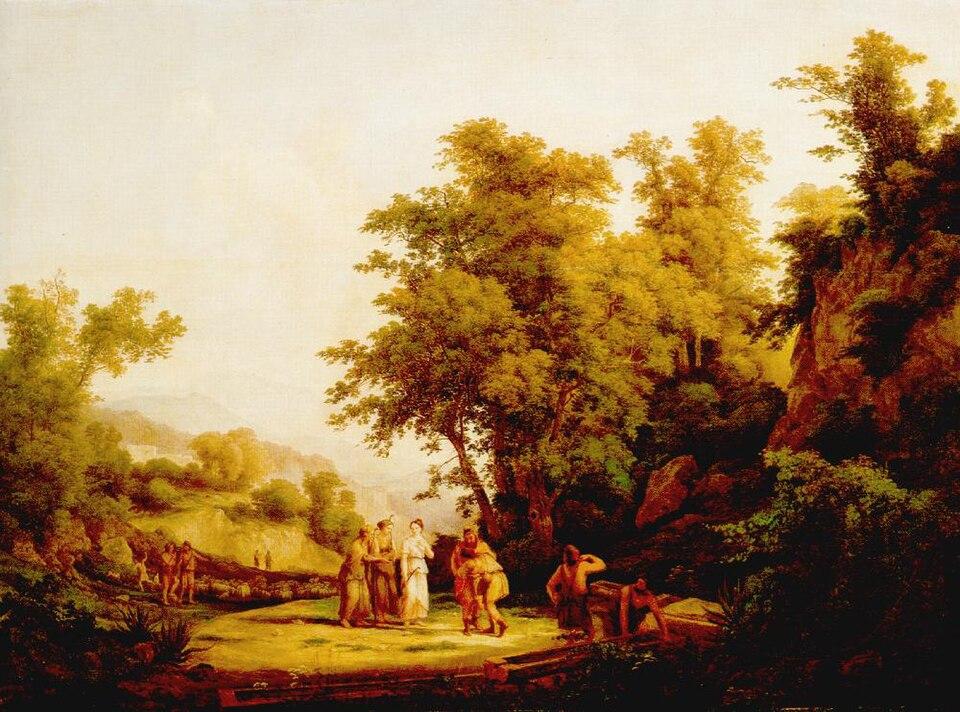
Károly Markó the Elder, Biblical Scene, 1832. Public domain.
Numbers 23:7 · Place · Featured Study
Aram
Aram is the Hebrew name for the people and states north-east of Israel whose tongue was Aramaic.
And Balaam lifted up an oracle, saying: “Balak brought me from Aram, the king of Moab from the mountains of the east. ‘Come,’ he said, ‘put a curse on Jacob for me; come and denounce Israel!’
- Region
- North-east of Israel, from the Lebanon to the Euphrates and the Tigris
- First named
- Genesis 10:22 “…Elam, Asshur, Arphaxad, Lud, and Aram.”
- Last named
- Amos 9:7 “…Philistines from Caphtor, and the Arameans from Kir?”
When the armies of the Chaldeans and the Arameans came, the Rechabites left their tents and took shelter in Jerusalem.
Summary
Aram is a son of Shem, a people north-east of Israel and the land they held.
- Aram bought the goods of Tyre with gems and fine cloth (Ezekiel 27:16).
- Manasseh had an Aramean concubine (1 Chronicles 7:14).
- Geshur and Aram took Kenath and its sixty villages (1 Chronicles 2:23).
Aram in Balaam's Oracle
The one name covers a people, the states they formed and the tongue they spoke.
This study asks what land Scripture calls Aram and who its people were. It sets their states on an atlas plate, follows the name through the record and hears their language in the later books.
Albert Barnes, the American commentator, reads the name as highland in his Notes on Numbers 23:7. He takes it for the whole raised region from the north-eastern frontier of Palestine to the Euphrates and the Tigris.
The lexicon in the site's store counts the name 143 times, and Strong's dictionary glosses it: Aram or Syria, and its inhabitants.
The study of Mesopotamia teaches Aram-naharaim, the country of Abraham's kin beyond the Euphrates, and the study of Balaam teaches the seer from Pethor.
The States of Aram on Smith's Plate
The plate letters the Aramaeans across the land north-east of Israel and sets the names Zobah and Damascus in its largest letters there.
Zobah, Damascus and Geshur each carry the name Aram in Scripture, and the plate sets them north and east of the Sea of Chinnereth.
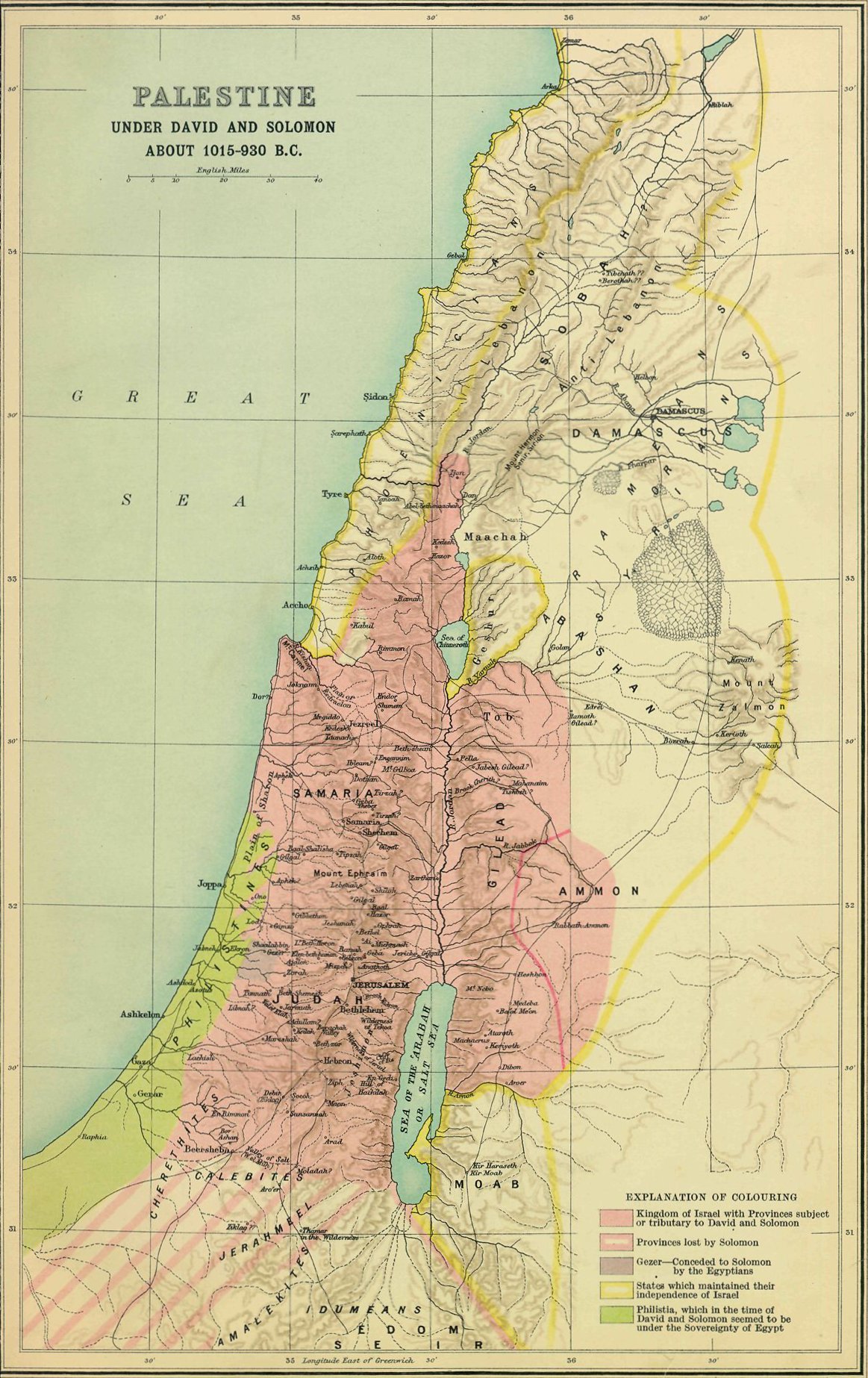
- ZobahHadadezer son of Rehob ruled Zobah and marched out to restore his dominion along the Euphrates. The plate letters the state with no query, between the Lebanon and the Anti-Lebanon, the northernmost point.2 Samuel 8:3
- TibhathDavid took a large amount of bronze from Tibhath and Cun, cities of Hadadezer. The plate prints the town with two queries, so its place is proposed.1 Chronicles 18:8
- DamascusThe Arameans of Damascus came to help Zobah and lost twenty-two thousand men. The plate prints the city with no query, the easternmost point, and its place is known.2 Samuel 8:5
- GeshurAbsalom made his vow while he lived in Geshur of Aram. The plate letters Geshur with no query, east of the Sea of Chinnereth, the southernmost point.2 Samuel 15:8
George Adam Smith, Palestine under David and Solomon, about 1015 to 930 B.C., in his Atlas of the Historical Geography of the Holy Land, 1915. Public domain; File:Palestine under David and Solomon (Smith, 1915).jpg.
Four numbered points, each where George Adam Smith's plate prints the place, with north at the top. The plate's key colours the states that kept their independence of Israel, and it prints a scale in English miles. Its edge stops short of the Euphrates, so Aram-naharaim lies beyond it.
Aram in Scripture, in Order
The name runs from the table of nations to the last days of Judah's kings.
Two of the six moments are David's wars with the states of Aram.
- The table of nationsAram is named among the five sons of ShemGenesis 10:22
- The house of NahorAbraham hears that his brother Nahor's son Kemuel is the father of a son named AramGenesis 22:21
- The days of the judgesIsrael serves the gods of Aram, Sidon and Moab beside the BaalsJudges 10:6
- The war with AmmonThe Ammonites hire Aramean foot soldiers from Beth-rehob and Zobah2 Samuel 10:6
- The battle at HelamArameans from beyond the Euphrates come to Helam, and the subject kings make peace with Israel2 Samuel 10:16 to 19
- The reign of JehoiakimThe LORD sends Aramean raiders with Chaldeans, Moabites and Ammonites against Judah2 Kings 24:2
Six moments from Genesis to 2 Kings in the order of the canon, each with its verse.
The Tongue of Aram
Kings, Ezra and Daniel each name Aramaic as the tongue of officials, of letters or of a royal court.
Strong's dictionary marks the Hebrew word for the language as an adverb, in Aramean, and it stands five times.
Then Eliakim son of Hilkiah, along with Shebnah and Joah, said to the Rabshakeh, “Please speak to your servants in Aramaic, since we understand it. Do not speak with us in Hebrew in the hearing of the people on the wall.”The request shows Aramaic as the tongue of officials and Hebrew as the tongue of the common people.
And in the days of Artaxerxes king of Persia, Bishlam, Mithredath, Tabeel, and the rest of his associates wrote a letter to Artaxerxes. It was written in Aramaic and then translated.Aramaic served as the written tongue between Judah's neighbours and the Persian court.
Jerome, the translator of the Latin Bible, notes in his Commentary on Daniel that the book runs in Hebrew up to Daniel 2:4. From there it runs in the Chaldee language, which the verse calls Syriac.
What the Text Leaves Unsaid
Genesis gives Aram son of Shem four sons and tells no story of him.
Genesis 10:23 lists his sons Uz, Hul, Gether and Mash, and 1 Chronicles 1:17 repeats the list. Neither book says where Aram lived or how his name passed to the land.
From Kir and Back to Kir
Amos gives the Arameans a beginning and an end in the same place.
“Are you not like the Cushites to Me, O children of Israel?” declares the LORD. “Did I not bring Israel up from the land of Egypt, the Philistines from Caphtor, and the Arameans from Kir?The LORD sets Israel's exodus beside the movements of two other peoples.
I will break down the gates of Damascus; I will cut off the ruler of the Valley of Aven and the one who wields the scepter in Beth-eden. The people of Aram will be exiled to Kir,” says the LORD.This oracle opens the book's judgments on the nations around Israel.
Voices on Aram
Albert Barnes, on David's raids in 1 Samuel 27, separates two peoples called Geshurites.
Albert Barnes (1798 to 1870)
“The Geshurites bordered upon the Philistines, and lived in the mountainous district which terminates the desert on the northeast (marginal reference). They were a different tribe, or, at least, a different branch of it, from the Geshurites who lived on the northeast border of Bashan, and were Arameans 2Sa 15:8. The Gezrites, or Gerzites, may be connected with those who gave their name to Mount Gerizim.”
Albert Barnes · Notes, Explanatory and Practical, on the Old and New Testaments (1832-1869) · on 1 Samuel 27:8Evangelical
Geshur of Aram
Readers differ on which Geshur Absalom fled to and why the text calls it Geshur of Aram.
For your servant made a vow while dwelling in Geshur of Aram, saying: ‘If indeed the LORD brings me back to Jerusalem, I will worship the LORD in Hebron.’”It is the one verse that joins Geshur to Aram.
The Aramean Geshur in the northAlbert Barnes and John Gill
Barnes, in the note quoted under Voices on Aram, sets Absalom's Geshur among the Arameans on the border of Bashan. John Gill, the Baptist commentator, reads the verse as Geshur in Syria, where Absalom stayed at the court of his grandfather Talmai (2 Samuel 3:3).
The objection: 1 Samuel 27:8 sets Geshurites in the south near the Philistines, so the name alone does not fix the place.
A slip for EdomAdam Clarke, Commentary on the Bible
Adam Clarke, the Methodist commentator, holds that Talmai's Geshur lay south of Canaan, near Edom. He reads Aram as a copyist's slip for Edom, since the two Hebrew words differ by one letter, and notes that the Syriac and Arabic versions read Edom.
The objection: Joshua 12:5 and Joshua 13:11 set the Geshurites beside the Maacathites on the border of Bashan, in the north.
Once Not a People
The LORD who moved the Arameans and the Philistines as He moved Israel also gathers a people from the nations in Christ. Peter's letter asks the reader to live as one who has received that mercy.
Once you were not a people, but now you are the people of God; once you had not received mercy, but now you have received mercy.Peter tells believers from the nations what mercy has made them.
Sources
Scripture is the Berean Standard Bible.
- James Strong, Exhaustive Concordance of the Bible (1890), Hebrew dictionary, entries 758 and 762.
- Albert Barnes, Notes, Explanatory and Practical, on the Old and New Testaments (1832 to 1869), on Numbers 23:7.
- Jerome, Commentary on Daniel, on Daniel 2:4.
- Albert Barnes, Notes, Explanatory and Practical, on the Old and New Testaments (1832 to 1869), on 1 Samuel 27:8.
- John Gill, Exposition of the Old Testament (1748 to 1763), on 2 Samuel 15:8.
- Adam Clarke, Commentary on the Bible (1832), on 2 Samuel 15:8.
Keep Studying
People and groups6
Places7