
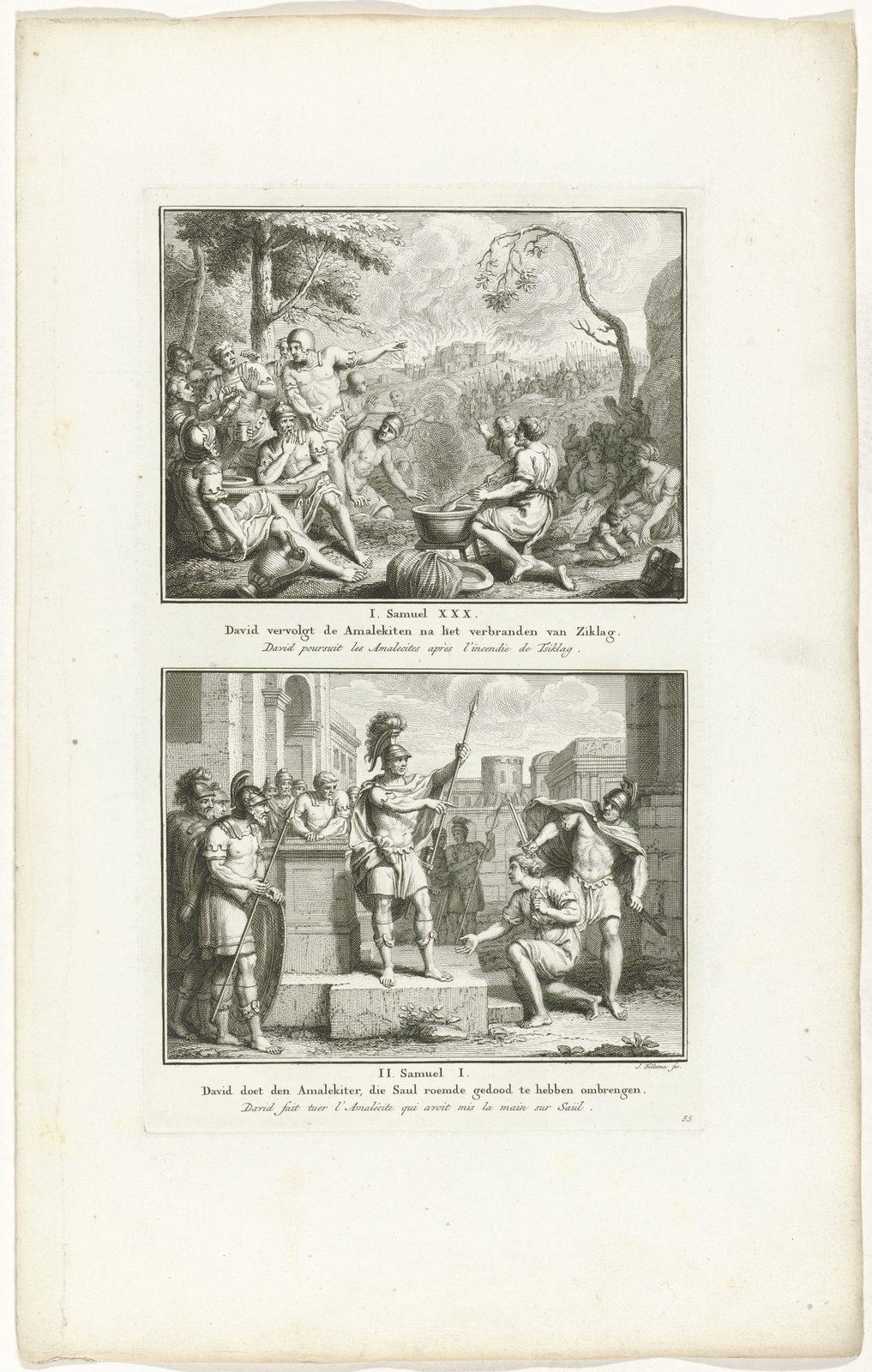
Jacob Folkema, David Pursues the Amalekites, 1791. Public domain.
1 Samuel 31 and 2 Samuel 1 · Story · Featured Study
The death of Saul, and the accounts that differ
The narrator and the Chronicler give one account of the king's end, and the man who brought the news gave another.
Three days after the battle a young man stood before David and said of Saul, "I stood over him and killed him."
So David asked him, “Why were you not afraid to lift your hand to destroy the LORD’s anointed?”
So David asked him, “Why were you not afraid to lift your hand to destroy the LORD’s anointed?”
- Where
- Mount Gilboa, Ziklag
- Who
- Saul, Jonathan, David
- When
- the day after the night at Endor, with the news reaching Ziklag on the third day
Summary
Saul fell in battle with the Philistines on Mount Gilboa, and three of his sons died with him. First Samuel 31 and 1 Chronicles 10 say he fell on his own sword. In 2 Samuel 1 an Amalekite tells David that he killed Saul at Saul's own request, and David has him put to death.
- David later moved the bones to the tomb of Kish in Benjamin.
- The Amalekite brought David Saul's crown and the band from his arm.
- Chronicles adds that the LORD put Saul to death for his unfaithfulness.
- The three readings are a lie, a death in two stages, and two traditions set side by side.
The Last Day on Gilboa
Saul died on Gilboa, and the news reached David at Ziklag.
The Philistines camped at Shunem and Saul at Gilboa. On the day of battle Israel fled, and Jonathan, Abinadab and Malchishua fell.
Saul asked his armor-bearer to kill him, and the man was afraid and refused.
Then Saul said to his armor-bearer, “Draw your sword and run it through me, or these uncircumcised men will come and run me through and torture me!” But his armor-bearer was terrified and refused to do it. So Saul took his own sword and fell on it.The narrator tells the death in this verse.
The Philistines shamed the body, and a town Saul had once rescued gave it burial.
Far to the south a young man reached David with torn clothes and dust on his head.
Then he begged me, ‘Stand over me and kill me, for agony has seized me, but my life still lingers.’ So I stood over him and killed him, because I knew that after he had fallen he could not survive. And I took the crown that was on his head and the band that was on his arm, and I have brought them here to my lord.”The Amalekite tells David the death in his own words.
David and his men tore their clothes and mourned until evening. Then David had the man put to death.
The Days, and the Three Accounts
The days run from Endor to Ziklag, and the three accounts differ point by point.
The news reached David on the third day after he came back to Ziklag.
- The night beforeEndor1 Samuel 28:19
- The day of battleMount Gilboa1 Samuel 31:1 to 6
- The next dayBeth-shan1 Samuel 31:8 to 10
- That nightthe road from Beth-shan1 Samuel 31:12
- Two days of restZiklag2 Samuel 1:1
- The third dayZiklag2 Samuel 1:2
- Seven days of fastingJabesh1 Samuel 31:13
Two of the seven steps take place at Ziklag.
Seven points set the three chapters side by side.
| Point | 1 Samuel 31 | 2 Samuel 1, the Amalekite | 1 Chronicles 10 |
|---|---|---|---|
| Saul's state | Wounded critically by the archers | Leaning on his spear, chariots closing in | Wounded by the archers |
| Who struck the blow | Saul fell on his own sword | The Amalekite, at Saul's request | Saul fell on his own sword |
| The armor-bearer | Fell on his sword and died with him | Not named | Fell on his sword and died |
| Who died with him | His three sons, armor-bearer and all his men | Many of the troops, Saul and Jonathan | His three sons and all his house |
| The crown and the band | Not named | Taken from Saul and brought to David | Not named |
| His body and head | Body hung on the wall of Beth-shan | Not told | Head hung in the temple of Dagon |
| The burial | Under the tamarisk in Jabesh | Not told | Under the oak in Jabesh |
Saul, David and Amalek
The man who claimed the killing came from Amalek, the people Saul had been sent to destroy.
Samuel had sent Saul to destroy Amalek, and Saul spared the king and the best of the flocks. The LORD rejected him as king for it.
Now go and attack the Amalekites and devote to destruction all that belongs to them. Do not spare them, but put to death men and women, children and infants, oxen and sheep, camels and donkeys.’”Saul did not keep this command.
While Saul fought on Gilboa, David pursued an Amalekite raiding party that had burned Ziklag, and only four hundred young men escaped on camels.
Twice David had spared Saul when he could have killed him, and the Amalekite claimed the deed David would not do.
But David said to Abishai, “Do not destroy him, for who can lift a hand against the LORD’s anointed and be guiltless?”David gave this rule to Abishai over the sleeping Saul.
Where the Text Is Silent
The accounts leave three things open.
David does not ask how the man came to have the crown and the band.
First Samuel 31 does not say what became of the crown, or how the Amalekite came to be on the mountain.
The LORD's Anointed
David judged the Amalekite by his own words, and Chronicles names the LORD as the one who ended Saul's reign.
For David had said to the Amalekite, “Your blood be on your own head because your own mouth has testified against you, saying, ‘I killed the LORD’s anointed.’”Keil notes that David did not look further into the truth of the story.
Chronicles looks past the sword to the cause.
So Saul died for his unfaithfulness to the LORD, because he did not keep the word of the LORD and even consulted a medium for guidance, and he failed to inquire of the LORD. So the LORD put him to death and turned the kingdom over to David son of Jesse.Chronicles gives the cause in two verses and says nothing of the Amalekite.
The kingdom passed to David, and Scripture traces his line to Jesus, the Son of David and the Anointed One.
Voices on the Death of Saul
Matthew Henry and Jamieson, Fausset and Brown wrote on the death and on David's sentence.
Matthew Henry (1662 to 1714)
Commentary on the Whole Bible
Matthew Henry, in his Commentary on the Whole Bible, set 1 Samuel 31 beside 1 Chronicles 10:14.
“Saul slew himself, and yet it is said, God slew him. What is done by wicked hands is yet done by the determinate counsel and foreknowledge of God. Those that abandon themselves to the devil shall be abandoned to him; so shall their doom be.”
on 1 Chronicles 10:13 to 14Puritan
Jamieson, Fausset & Brown (1802 to 1910)
Commentary Critical and Explanatory on the Whole Bible
Jamieson, Fausset and Brown, in their Commentary Critical and Explanatory, explained why David's sentence had to be public.
“In present circumstances it was especially important that his principle should be publicly known; and to free himself from the imputation of being in any way accessory to the execrable crime of regicide was the part of a righteous judge, no less than of a good politician.”
on 2 Samuel 1:13 to 15Reformed
How the Accounts Fit
Keil, Josephus and Smith each read the two chapters a different way.
Then Saul said to his armor-bearer, “Draw your sword and run it through me, or these uncircumcised men will come and torture me!” But his armor-bearer was terrified and refused to do it. So Saul took his own sword and fell on it.Chronicles gives the death as 1 Samuel 31:4 gives it.
when someone told me, ‘Look, Saul is dead,’ and thought he was a bearer of good news, I seized him and put him to death at Ziklag. That was his reward for his news!Keil reads this verse as David's judgment on the man's motive.
The Amalekite lied to win David's favourKeil and Delitzsch, Adam Clarke, Jamieson, Fausset and Brown, and Albert Barnes
Keil and Delitzsch hold that the Amalekite invented his account in the hope of a better reward from David, and that only the crown and the band were true. Adam Clarke and Jamieson, Fausset and Brown read the story as a fiction told to win favour, since the narrator has already given the true account.
Albert Barnes, in his Notes on the Old Testament, holds that the man found Saul among the dead and made the story up.
“The Amalekite was one of those who came ‘to strip the slain’ on ‘the morrow’ after the battle 1Sa 31:8, and had the luck to find Saul and possess himself of his crown and bracelet. He probably started off immediately to seek David, and invented the above story, possibly having heard from some Israelite prisoner an account of what really did happen.”
Albert Barnes · Notes, Explanatory and Practical, on the Old and New Testaments (1832-1869) · on 2 Samuel 1:10Evangelical
The objection, which H. P. Smith presses, is that David has no hint the man is untruthful and the author does not suggest it. Keil and Delitzsch answer from 2 Samuel 4:10 that David saw through the man's hope of a reward.
Saul's own thrust failed, and the Amalekite finished himJosephus, Antiquities of the Jews
Josephus, in his Antiquities of the Jews, tells that Saul fell on his sword and could not drive it through. Saul then asked a young Amalekite who stood by to force it through him, and the young man took the bracelet and the crown.
The reading keeps every line of both chapters: Saul's own thrust, and the Amalekite's blow at his request.
The objection is that 1 Samuel 31:5 says the armor-bearer saw that Saul was dead before he fell on his own sword. Josephus sets the armor-bearer's death after the Amalekite's blow.
Two traditions stand side by sideH. P. Smith, 1899
H. P. Smith, in his International Critical Commentary on Samuel, reads the two chapters as two independent streams of tradition. He grants that the easiest answer is a lie, and holds that the narrative itself tells against it.
The objection, which Keil and Delitzsch give, is that the story has an air of untruth in itself: a king leaning on his spear with no armor-bearer beside him, calling to a passing Amalekite.
Books to Read Next
All three works are in the public domain, and each has a free copy to read.
Biblical Commentary on the Books of Samuel
C. F. Keil and F. Delitzsch · 1880
Keil weighs the Amalekite's story against 1 Samuel 31 on pages 286 to 287.
Read at the Internet ArchiveA Critical and Exegetical Commentary on the Books of Samuel
Henry Preserved Smith · 1899
Smith sets out the case for two traditions on pages 251 and 254.
Read at the Internet ArchiveAntiquities of the Jews, Book 6
Flavius Josephus, translated by William Whiston · about 93
Josephus tells the death in two stages in chapter 14.
Read at Project GutenbergHow the Mighty Have Fallen
The accounts differ on the hand that struck Saul, and all three agree that he died that day on Gilboa. David answered the news with grief and with a lament.
“Your glory, O Israel, lies slain on your heights. How the mighty have fallen!This is the lament's refrain, and David ordered the lament taught to the sons of Judah.
Sources
Scripture is the Berean Standard Bible.
- C. F. Keil and F. Delitzsch, Biblical Commentary on the Books of Samuel, T. and T. Clark, 1880, pp. 286 to 287.
- Henry Preserved Smith, A Critical and Exegetical Commentary on the Books of Samuel, International Critical Commentary, T. and T. Clark, 1899, pp. 251 and 254.
- Flavius Josephus, Antiquities of the Jews 6.14.7, translated by William Whiston (finished, by Whiston's note, in A.D. 93)
- Adam Clarke, Commentary on the Bible, 1832, on 2 Samuel 1:2.
- Jamieson, Fausset and Brown, Commentary Critical and Explanatory on the Whole Bible, 1871, on 2 Samuel 1:2 to 12.
- Jamieson, Fausset and Brown, Commentary Critical and Explanatory on the Whole Bible, 1871, on 2 Samuel 1:13 to 15.
- Albert Barnes, Notes, Explanatory and Practical, on the Old Testament, on 2 Samuel 1:10.
- Matthew Henry, Commentary on the Whole Bible, 1710, on 2 Samuel 1:14.
- Matthew Henry, Commentary on the Whole Bible, 1710, on 1 Chronicles 10:13 to 14.
Keep Studying
Read it4
Studies1
People and groups6