
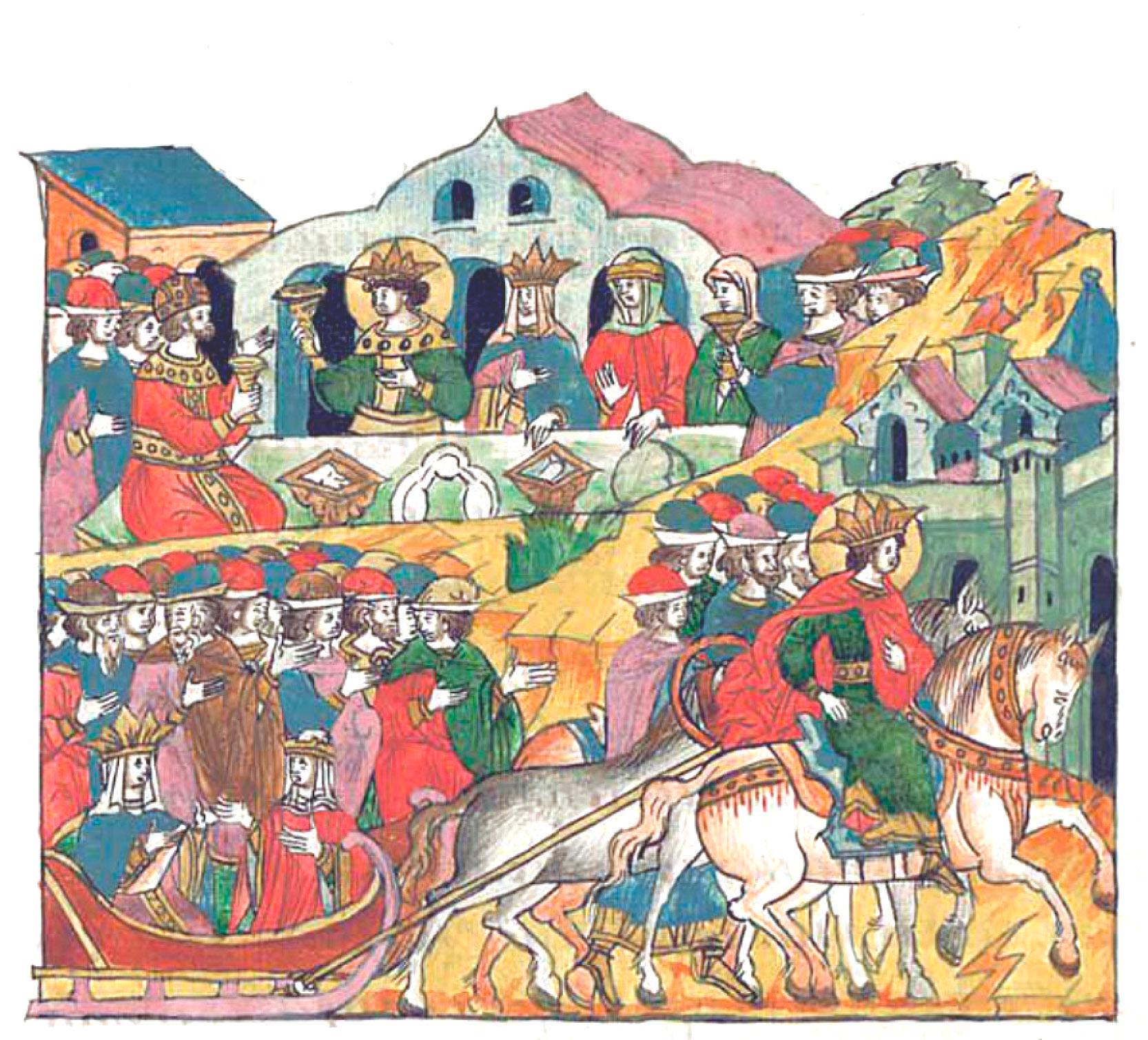
Facial Chronicle, Solomon and Pharaoh's Daughter, Russian manuscript, 1560s to 1570s. Public domain.
1 Kings 3 to 11 · Person · Featured Study
Pharaoh's Daughter and the Alliance With Egypt
Her marriage made the king of Egypt Solomon's father-in-law.
Pharaoh burned the city of Gezer and gave it to his daughter as her dowry when she married Solomon.
Later, Solomon formed an alliance with Pharaoh king of Egypt by marrying his daughter. Solomon brought her to the City of David until he had finished building his palace and the house of the LORD, as well as the wall around Jerusalem.
- Family
- father: Pharaoh king of Egypt; husband: Solomon
- Places
- Jerusalem
- First named
- 1 Kings 3:1 “Later, Solomon formed an alliance with Pharaoh king…”
- Last named
- 1 Kings 11:1 “King Solomon, however, loved many foreign women along…”
Summary
Pharaoh's daughter was a princess of Egypt. Solomon married her early in his reign. The marriage made Egypt and Israel allies.
- She lived in the City of David while Solomon built.
- Solomon built her a palace like his own hall.
- Chronicles gives his reason for moving her.
- Kings names her first among his foreign wives.
Where She Stands in Scripture
Five verses of 1 Kings and one of 2 Chronicles name her, each by her father.
Pharaoh is a title of the kings of Egypt, and these chapters give no personal name for her father.
Her Life, Turn by Turn
Her story runs from her marriage to Solomon's old age.
She came in the alliance with Egypt and is last named among Solomon's foreign wives.
- Married to Solomon and brought to the City of Davidthe City of David1 Kings 3:1
- Her father's gift comes to SolomonGezer1 Kings 9:16
- Solomon builds her a palace like his hallJerusalem1 Kings 7:8
- Moves up from the City of David to her palaceJerusalem1 Kings 9:24
- Named among the foreign women Solomon lovedJerusalem1 Kings 11:1
Solomon spent twenty years on the temple and his palace, by 1 Kings 9:10.
From Egypt to the Palace
Her story is told in pieces across 1 Kings 3 to 11.
The notes on her stand among the accounts of Solomon's reign, his building and his decline.
The dowry of Gezer1 Kings 9:16 to 17, with Adam Clarke
Pharaoh king of Egypt had attacked and captured Gezer. He had set it on fire, killed the Canaanites who lived in the city, and given it as a dowry to his daughter, Solomon’s wife.Joshua had struck down Horam king of Gezer, by Joshua 10:33.
Adam Clarke, in his Commentary on 1 Kings 9:16, holds that the Canaanites had retaken Gezer after Joshua's day and kept it until Pharaoh took it.
A palace of her own1 Kings 7:8, 1 Kings 9:24 and 2 Chronicles 8:11, with Albert Barnes
And the palace where Solomon would live, set further back, was of similar construction. He also made a palace like this hall for Pharaoh’s daughter, whom he had married.The hall was the Hall of Justice, panelled with cedar from floor to ceiling, by 1 Kings 7:7.
Solomon brought the daughter of Pharaoh up from the City of David to the palace he had built for her. For he said, “My wife must not live in the house of David king of Israel, because the places the ark of the LORD has entered are holy.”First Kings 9:24 records the same move without the reason.
Albert Barnes, in his Notes on 1 Kings 9:24, sets the two palaces on the city's two hills.
“Compare the marginal reference. Solomon was not satisfied that Pharaoh’s daughter should remain in the palace of David, which was on Mount Zion, in the immediate vicinity of the temple, because he regarded the whole vicinity of the temple as made holy by the presence of the ark of God. His own palace was on the other (western) hill, probably directly opposite to the temple, the valley of the Tyropoeum running between them.”
Albert Barnes · Notes, Explanatory and Practical, on the Old and New Testaments (1832-1869) · on 1 Kings 9:24Evangelical
Egypt in Solomon's Day
Egypt traded with Solomon and sheltered his enemies.
Solomon’s horses were imported from Egypt and Kue; the royal merchants purchased them from Kue. A chariot could be imported from Egypt for six hundred shekels of silver, and a horse for a hundred and fifty. Likewise, they exported them to all the kings of the Hittites and to the kings of Aram.Solomon kept 12,000 horses in his chariot cities and in Jerusalem, by 1 Kings 10:26.
A Pharaoh of David's day gave Hadad of Edom, later Solomon's enemy, the sister of Queen Tahpenes as his wife.
In the fifth year of Rehoboam’s reign, Shishak king of Egypt came up and attacked Jerusalem. He seized the treasures of the house of the LORD and of the royal palace. He took everything, including all the gold shields that Solomon had made.Albert Barnes, on this verse, points to Shishak's inscription at Karnak.
The Family of Pharaoh's Daughter
Five people are named around her, from her father Pharaoh to Solomon's heir.
She joined the royal houses of Egypt and of David.
Generation 1
- Pharaoh king of EgyptHer father, who made the alliance
- DavidSolomon's father, whose city she lived in
Generation 2
- SolomonHer husband, king of Israel
- Naamah the AmmoniteAnother wife of Solomon
Generation 3
- RehoboamSolomon's son by Naamah, king after him
Naamah came from Ammon, one of the peoples First Kings 11:1 names among Solomon's wives.
The Places of Her Life
Her life touched three places, from Egypt to Gezer and Jerusalem.
She came from Egypt, and her dowry city of Gezer lay west of Jerusalem.
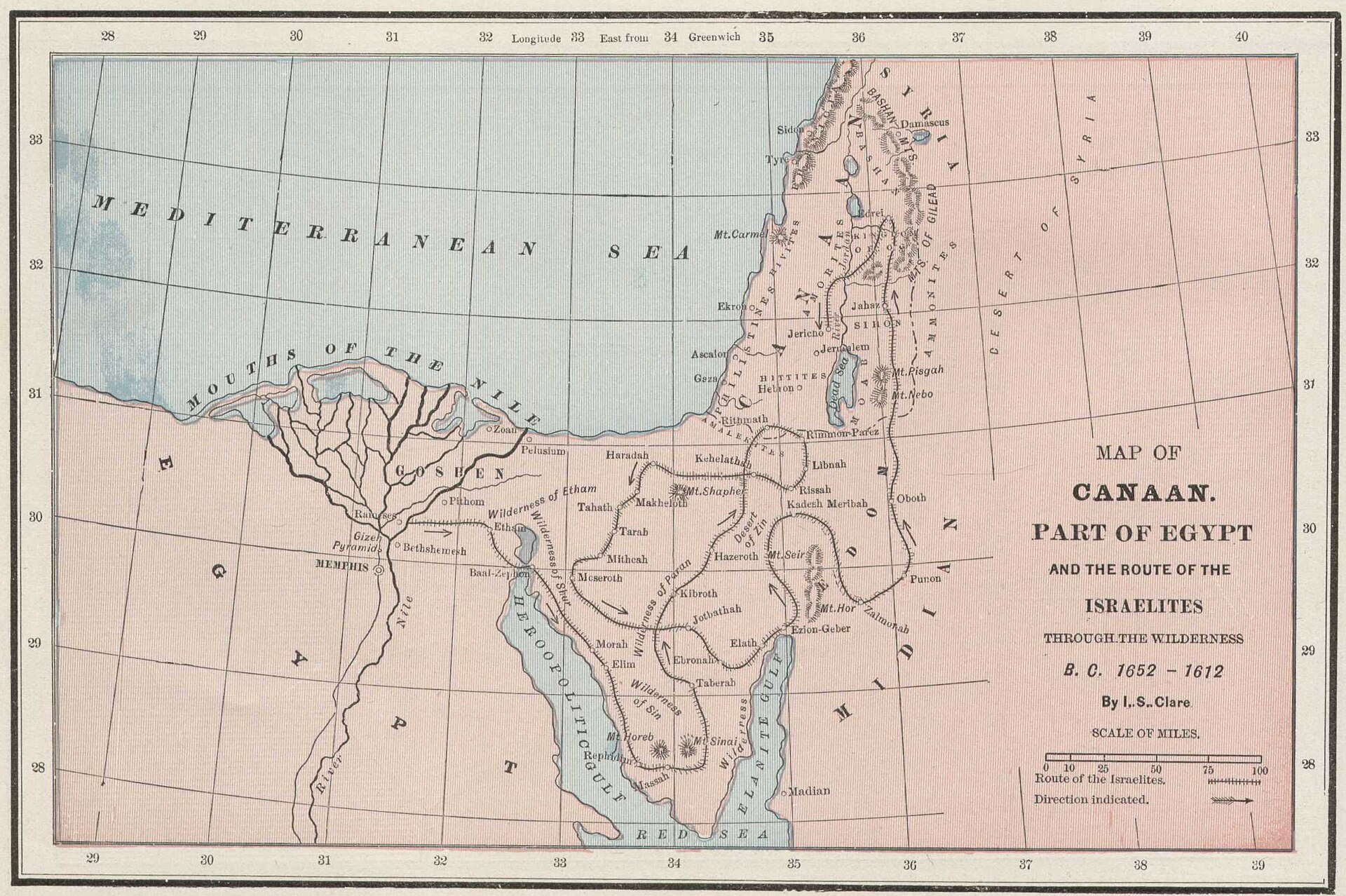
- 1Egypt, Her father's kingdom.
- 2Gezer, Solomon rebuilt it after the dowry. 1 Kings 9:17
- 3Jerusalem, The city of David and of Solomon's palaces. 1 Kings 7:8
Base map: The route of the Israelites through the wilderness, George F. Cram atlas plate, public domain. Places with a place page stand at its coordinates and the others at the point cited for each, set on the plate by Jerusalem and Mount Sinai, as the plate prints them.
Gezer is marked at Tel Gezer, scored 942 of 1,000 by OpenBible.info.
Questions Her Life Raises
The law and her faith raise two questions.
Did the law forbid the marriage?Deuteronomy 7:3 to 4, with Albert Barnes and Adam Clarke
The law forbade Israel to marry the peoples of Canaan, and Exodus 34:16 warns that foreign wives would draw sons to their gods.
Do not intermarry with them. Do not give your daughters to their sons or take their daughters for your sons, because they will turn your sons away from following Me to serve other gods. Then the anger of the LORD will burn against you, and He will swiftly destroy you.The seven nations of Deuteronomy 7:1 are the peoples of Canaan, from the Hittites to the Jebusites.
Albert Barnes, in his Notes on 1 Kings 3:1, holds that Israelites were not forbidden to marry foreign wives who became proselytes. Adam Clarke, on the same verse, reads the marriage as a political measure against the express laws of God.
Did she turn to the LORD?2 Chronicles 8:11, with John Wesley, Matthew Henry and Adam Clarke
Adam Clarke answers that there is no evidence she became a proselyte, and in his Commentary on 2 Chronicles 8:11 he takes Solomon's reason for moving her as proof that he thought her a heathen.
What the Text Leaves Unsaid
The text leaves four things about her unsaid.
Scripture does not give her name. Adam Clarke, on 2 Chronicles 8:11, quotes a rendering of the verse that calls her Bithiah.
The text names no child of hers and does not say when she died. It does not say what became of the alliance when Shishak reigned in Egypt.
How Scripture Reads Her
Her marriage is read against the law of the king in Deuteronomy 17.
King Solomon, however, loved many foreign women along with the daughter of Pharaoh—women of Moab, Ammon, Edom, and Sidon, as well as Hittite women. These women were from the nations about which the LORD had told the Israelites, “You must not intermarry with them, for surely they will turn your hearts after their gods.” Yet Solomon clung to these women in love.The list follows the account of the queen of Sheba's visit in 1 Kings 10.
The writer of Kings, as Barnes reads 1 Kings 11:1, has in mind the three things Deuteronomy 17 forbids a king: much silver and gold, many horses and many marriages.
Did not King Solomon of Israel sin in matters like this? There was not a king like him among many nations, and he was loved by his God, who made him king over all Israel—yet foreign women drew him into sin.Nehemiah said this to men of Judah who had married women of Ashdod, Ammon and Moab.
Voices on Pharaoh's Daughter
Matthew Henry wrote on the horse trade her marriage opened with Egypt.
Matthew Henry (1662 to 1714)
Commentary on the Whole Bible
Matthew Henry, in his Commentary on 1 Kings 10:28 to 29, followed Bishop Patrick.
“The custom to be paid to the king of Egypt for exported chariots and horses out of Egypt was very high, but (as bishop Patrick understands it) Solomon, having married his daughter, got him to compound for the customs, so that he could bring them up cheaper than his neighbours, which obliged them to buy them of him, which he was wise enough no doubt to make his advantage of.”
on 1 Kings 10:28 to 29Puritan
Which Pharaoh Was Her Father?
Commentators propose three kings of Egypt for her father.
Solomon therefore sought to kill Jeroboam. But Jeroboam arose and fled to Egypt, to Shishak king of Egypt, where he remained until the death of Solomon.Barnes and the Speaker's Commentary both set her father before this king, and each gives reasons from his years.
PsinacesAlbert Barnes and the Speaker's Commentary, 1872
Albert Barnes holds that her father must have reigned before Shishak, and that the likelier king is Psinaces, the predecessor of Psusennes II, of a weak Tanite dynasty. The Speaker's Commentary of 1872 calls Psinaces far more likely, because Shishak's first year fell no earlier than Solomon's twenty-fourth.
The objection is that Bunsen, Winer and Brugsch, as the Speaker's Commentary reports, take her father to be Psusennes II.
PsusennesC. F. Keil, 1872, after Winer and Ewald
Keil reports that Winer and Ewald take her father to be Psusennes, the last king of the twenty-first, Tanite dynasty, who reigned thirty-five years, and he finds this the more probable view.
The objection is that the Speaker's Commentary calls Psusennes II improbable by the years of Shishak's reign.
VaphresJamieson, Fausset and Brown, 1871
Jamieson, Fausset and Brown report that the personal name of this king is said to have been Vaphres.
The objection is that Barnes and the Speaker's Commentary name Psinaces in its place.
Books to Read Next
Both works are in the public domain, and each has a free copy to read.
The Books of the Kings
C. F. Keil, translated by James Martin · 1872
Keil sets out the views on her father on page 38, in his note on the marriage.
Read at the Internet ArchiveThe Holy Bible with an Explanatory and Critical Commentary, volume 2
F. C. Cook, editor; Kings by George Rawlinson · 1872
The Speaker's Commentary weighs Psusennes II against Psinaces by the years of Shishak.
Read at the Internet ArchiveAn Alliance and a Heart
Solomon's reign opened with a marriage that made Egypt his ally, and it ended with a heart turned by his wives. Paul warned the church at Corinth against the same kind of yoke.
Do not be unequally yoked with unbelievers. For what partnership can righteousness have with wickedness? Or what fellowship does light have with darkness?Paul goes on in 2 Corinthians 6:16 to call the church the temple of the living God.
Sources
Scripture is the Berean Standard Bible.
- James Strong, Exhaustive Concordance of the Bible, 1890, entry H6547.
- C. F. Keil, The Books of the Kings, translated by James Martin, T. and T. Clark, 1872, p. 38 on 1 Kings 3:1.
- The Holy Bible with an Explanatory and Critical Commentary (the Speaker's Commentary), volume 2, ed. F. C. Cook, John Murray, 1872, on 1 Kings 3:1.
- OpenBible.info, Bible-Geocoding-Data, ancient.jsonl: Egypt, Gezer.
- Albert Barnes, Notes, Explanatory and Practical, on the Old Testament, on 1 Kings 3:1, 9:24 and 11:1.
- Adam Clarke, Commentary on the Bible, 1832, on 1 Kings 3:1, 9:16 and 11:1 and 2 Chronicles 8:11.
- John Gill, Exposition of the Old Testament, 1748 to 1763, on 1 Kings 3:1.
- Matthew Henry, Commentary on the Whole Bible, 1710, on 1 Kings 3:1.
- Jamieson, Fausset and Brown, Commentary Critical and Explanatory on the Whole Bible, 1871, on 1 Kings 3:1.
- John Wesley, Explanatory Notes upon the Old Testament, 1765, on 1 Kings 3:1.
- Matthew Henry, Commentary on the Whole Bible, 1710, on 1 Kings 10:28 to 29.
- Albert Barnes, Notes, Explanatory and Practical, on the Old Testament, on 1 Kings 14:25.
Keep Studying
Read it4
Studies3
People and groups6
Doctrines1
Subjects5