
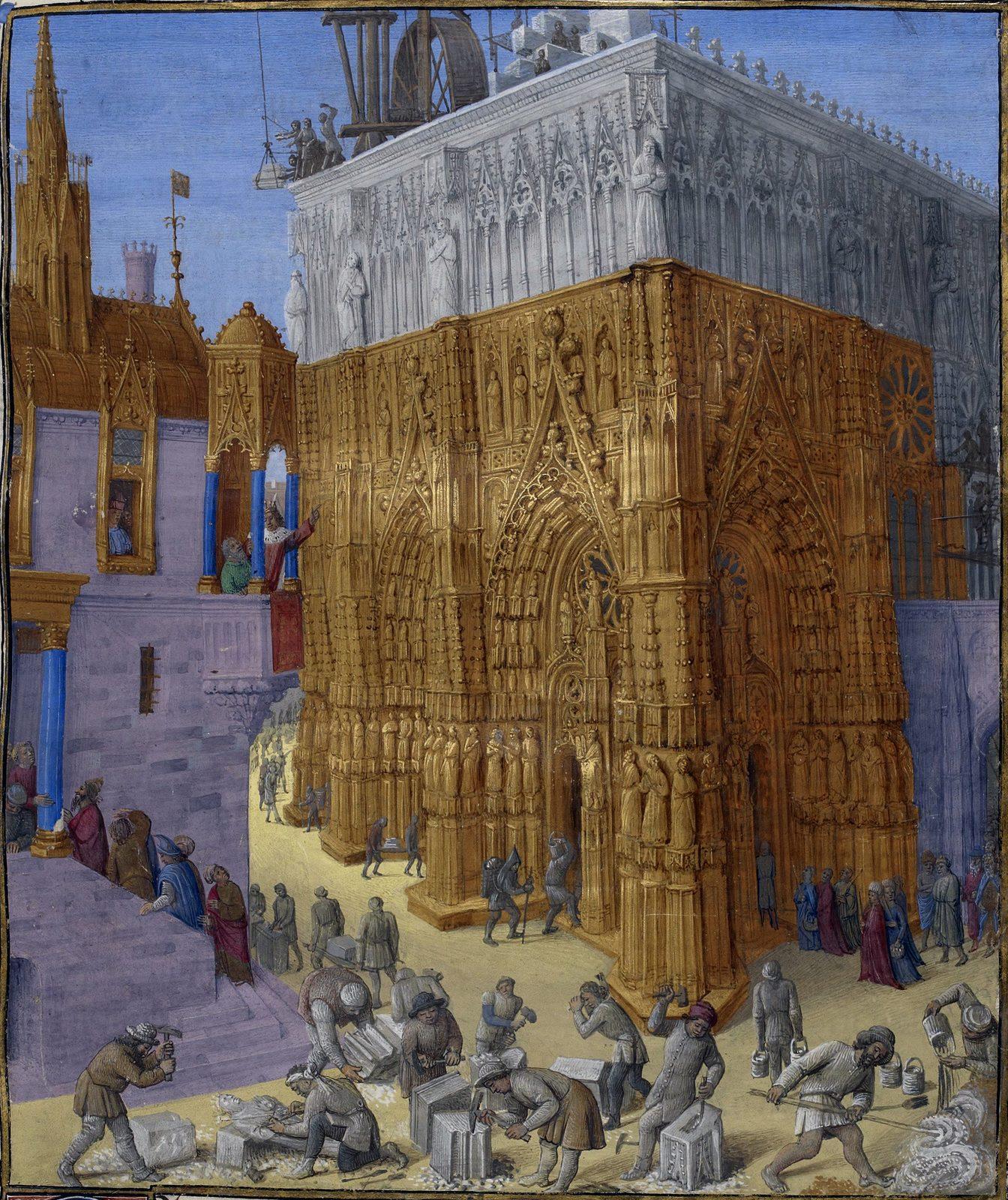
Jean Fouquet, The Building of the Temple of Jerusalem, 1470 to 1475. Public domain.
1 Kings 9 · Subject · Featured Study
The United Monarchy in the Ground
1 Kings 9:15 names Hazor, Megiddo and Gezer among Solomon's works, and excavators have argued since the 1950s over which ruins are his.
The spade found the same gate plan at three of Solomon's cities.
This is the account of the forced labor that King Solomon imposed to build the house of the LORD, his own palace, the supporting terraces, and the wall of Jerusalem, as well as Hazor, Megiddo, and Gezer.
- Books
- 1 Kings, 2 Chronicles
- Hold in memory
- 1 Kings 9:15, Psalm 127:1
Summary
The argument turns on the date of the pottery found with each gate.
- Each gate has six side rooms, three on either side.
- Yigael Yadin said the gates were Solomon's.
- A town at Khirbet Qeiyafa has dates from the time of David.
The Levy of 1 Kings 9
1 Kings 9 lists Solomon's building works and the city Pharaoh gave him.
Pharaoh king of Egypt had attacked and captured Gezer. He had set it on fire, killed the Canaanites who lived in the city, and given it as a dowry to his daughter, Solomon’s wife. So Solomon rebuilt Gezer, Lower Beth-horon,The verse gives Gezer a burning before Solomon's rebuilding, a history a dig can test.
as well as all the store cities that Solomon had for his chariots and horses—whatever he desired to build in Jerusalem, Lebanon, and throughout the land of his dominion.The verse sets the three gated cities inside a building plan for the whole kingdom.
He rebuilt Upper and Lower Beth-horon as fortified cities with walls, gates, and bars,Chronicles adds Upper Beth-horon to the list and says both towns were walled.
In the fifth year of Rehoboam’s reign, Shishak king of Egypt came up and attacked Jerusalem. He seized the treasures of the house of the LORD and of the royal palace. He took everything, including all the gold shields that Solomon had made.Shishak is the Egyptian king Sheshonq I, whose campaign is named again at Gezer below.
2 Chronicles 8:5, 1 Kings 14:25 to 26
The Reigns and the Finds on One Line of Years
The reigns of David and Solomon beside the dates that came out of the ground.
The stele from Dan was set up about ninety years after Solomon's death.
To scale: 5 of 5 stops dated; a ring is approximate; a bar is a span; a mark that would lie on another stands in a lane under the axis.
- David's reign1010 to 970 BCEdwin Thiele's reign dates2 Samuel 5:4
- Burnt olive pits at Khirbet Qeiyafa1000 to 975 BC, at 59.6 percentRadiocarbon measured at Oxford1 Samuel 17:52
- Solomon's reign970 to 930 BCEdwin Thiele's reign dates1 Kings 11:42
- A stele of Sheshonq I, found at Megiddoabout 930 BCMegiddo I (1939), page 611 Kings 14:25
- The Aramaic stele of Danabout 840 BCThe Center for Online Judaic Studies2 Kings 8:28 to 29
Five spans and dates on one axis of years BC, each with its source and its verse.
The Three Gates
The excavators' reports give the plan of each gate.
Yigael Yadin led the Hebrew University's expedition at Hazor from 1955 to 1958 and found a six-chambered gate and casemate walls.
At Megiddo the excavator Guy first called a later gate, number 500, the Solomonic gate. Gordon Loud's excavation found the true Stratum IV gate under its lower courses.
Robert Lamon's account of that gate in Megiddo II (1948) gives four doorways, each about 4.25 metres wide. Its six side chambers are each nearly 3 metres wide by 5 metres deep.
At Gezer the main gate had three pairs of chambers and a central passage. Steven Ortiz and Samuel Wolff tie it to their Stratum 8, a city with a monumental administrative building and casemate walls that was destroyed, probably in Sheshonq's campaign.
Khirbet Qeiyafa
A walled town by the Elah Valley, dug from 2007 to 2013.
Yosef Garfinkel of the Hebrew University and Saar Ganor of the Israel Antiquities Authority led the dig. They found a casemate city wall, a four-chambered gate, a second gate, and an ostracon of five lines written in ink.
They identify the town with Shaaraim, a name that means two gates. They write that its radiocarbon dates fit the time of King David and are too early for Solomon.
Then the men of Israel and Judah charged forward with a shout and pursued the Philistines to the entrance of Gath and to the gates of Ekron. And the bodies of the Philistines were strewn along the Shaaraim road to Gath and Ekron.The verse sets Shaaraim on the road from the Elah Valley toward Gath, where the excavators place their town.
Whose town was it?Nadav Na'aman, 2017; Israel Finkelstein and Alexander Fantalkin, 2012
Nadav Na'aman, in the Journal of Hebrew Scriptures (2017), reads the town as a short-lived revival of the Canaanite groups that remained in the Shephelah. He argues that a young Judah could not have built a stronghold stronger and wealthier than its own capital.
Israel Finkelstein and Alexander Fantalkin, in the journal Tel Aviv (2012), read it as a stronghold of the dynasty of Saul, whose centres of power were Gibeon and Bethel, as Na'aman reports them.
The House of David at Dan
A broken stone from Dan carries the words house of David.
Avraham Biran's expedition found the pieces of an Aramaic victory stele at Dan in 1993 and 1994. Amihai Mazar writes that it kept the name house of David as the name of Judah's dynasty, and he takes it to have been set up by Hazael.
Then Ahaziah went with Joram son of Ahab to fight against Hazael king of Aram at Ramoth-gilead, and the Arameans wounded Joram. So King Joram returned to Jezreel to recover from the wounds that the Arameans had inflicted on him at Ramah when he fought against Hazael king of Aram. Then Ahaziah son of Jehoram king of Judah went down to Jezreel to visit Joram son of Ahab, because Joram had been wounded.Kings sets Hazael, whom Mazar takes as the stele's author, at war with both Israel and Judah.
The Hebrew Words of the Building
Three Hebrew words of Solomon's building, from the lexicon of James Strong.
mas (Hebrew, H4522)
A burden, a tax paid in forced labour; the levy of the verse.
millo (Hebrew, H4407)
A rampart filled in, a citadel; the supporting terraces of Jerusalem.
shaar (Hebrew, H8179)
An opening, a door or gate; the gates Chronicles names in Solomon's cities.
What the Evidence Does Not Settle
Mazar names what the evidence leaves open.
Amihai Mazar writes that the radiocarbon evidence is complicated and permits different readings.
Mazar names scholars who hold the united monarchy was a real kingdom, among them Millard, Dever and Stager. Others, among them Finkelstein, deny it or make it a small state around Jerusalem, and Mazar writes that the historical Solomon is even more elusive.
Albert Barnes on Solomon's Building
Two notes from his commentary on 1 Kings 9.
Albert Barnes (1798 to 1870)
Barnes locates the cities the levy built.
“‘The cities of store’ contained provisions stored up for the troops (compare 2Ch 32:28). They seem to have been chiefly in the north - in Hamath 2Ch 8:4 and Naphtali 2Ch 16:4. On the ‘cities for his chariots,’ see 1Ki 10:26 note. By ‘that which Solomon desired to build’ (see the margin) seem to be intended ‘pleasaunces’ in or near the capital, and in the Lebanon range, built especially for the enjoyment of the king.”
Albert Barnes · Notes, Explanatory and Practical, on the Old and New Testaments (1832-1869) · on 1 Kings 9:19Evangelical
He also weighs what the levy meant for Israel's own men.
“Comparing this with 1Ki 5:13-14, it would seem that a modified service of forced labor for one-third of each year was not regarded as reducing those who were subject to it to the condition of bondmen.”
Albert Barnes · Notes, Explanatory and Practical, on the Old and New Testaments (1832-1869) · on 1 Kings 9:22Evangelical
Whose Century Are the Gates?
Three readings of the tenth century, each with its holder and the objection to it.
The gates are Solomon'sYigael Yadin · The conventional chronology
Yadin dated the gates to Solomon's reign by 1 Kings 9:15, as the Encyclopaedia Judaica reports. Aharoni and Mazar once used the term Iron Age IIA for the tenth century alone.
The objection is Finkelstein's: the pottery of these strata belongs to the ninth century, so the gates are later than Solomon.
The gates are a century laterIsrael Finkelstein · The low chronology
Finkelstein proposed in 1996 to lower the start of Iron Age IIA to the late tenth century and to date the whole of it to the ninth, as Mazar reports him.
The objection is Gezer: Ortiz and Wolff date its Stratum 8, with the gate, to the tenth century by radiocarbon and pottery.
Iron Age IIA spans both centuriesAmihai Mazar · The modified chronology
Mazar proposed from 2003 to 2005 a modified chronology, with Iron Age IIA beginning about 980 BC and running into the ninth century. A tenth-century city and a ninth-century city can then share one kind of pottery.
The objection is the start date: Mazar's 2021 article reports a later start for Iron Age IIA, about 960 to 950 BC.
Books to Read Next
Four reports and articles on the gates and the dates, each free to read.
Megiddo II: Seasons of 1935 to 1939
Gordon Loud · 1948
Loud's final report covers the seasons of 1935 to 1939 at Megiddo.
Read it at the Internet ArchiveThe Beth Shean Valley and its Vicinity in the 10th Century BCE
Amihai Mazar · 2021
Mazar sets out the three chronologies and what the radiocarbon dates allow.
Read it at the Jerusalem Journal of ArchaeologyKhirbet Qeiyafa: Sha'arayim
Yosef Garfinkel and Saar Ganor · 2008
The excavators report the gates, the wall, the ostracon and the radiocarbon dates.
Read it at the Journal of Hebrew ScripturesWas Khirbet Qeiyafa a Judahite City? The Case against It
Nadav Na'aman · 2017
Na'aman makes the case that the town was Canaanite.
Read it at the Journal of Hebrew ScripturesThe Builder and the House
Psalm 127 carries Solomon's name in its heading.
Unless the LORD builds the house, its builders labor in vain; unless the LORD protects the city, its watchmen stand guard in vain.The king who raised the gates is named over a psalm that sets the LORD's work above the builder's.
Sources
Scripture is the Berean Standard Bible.
- Strong's Hebrew dictionary, entries H4522, H4407 and H8179.
- Edwin R. Thiele's reign dates for the kings of Israel and Judah.
- Encyclopaedia Judaica, second edition, Hazor, printed by the Jewish Virtual Library.
- The Gezer entry of the Jewish Virtual Library.
- Gordon Loud, Megiddo II: Seasons of 1935 to 1939, Oriental Institute Publications 62, 1948, Robert S. Lamon, The City Gate, pages 46 to 47.
- Robert S. Lamon and Geoffrey M. Shipton, Megiddo I: Seasons of 1925 to 1934, Oriental Institute Publications 42, 1939.
- Steven M. Ortiz and Samuel R. Wolff, New Evidence for the 10th Century BCE at Tel Gezer, Jerusalem Journal of Archaeology 1 (2021), 221 to 240.
- Ellen White, The Solomonic Gate at Gezer, Bible History Daily, 6 July 2015.
- The Khirbet Qeiyafa Archaeological Project, Hebrew University of Jerusalem.
- Yosef Garfinkel and Saar Ganor, Khirbet Qeiyafa: Sha'arayim, Journal of Hebrew Scriptures 8, article 22 (2008)
- Nadav Na'aman, Was Khirbet Qeiyafa a Judahite City? The Case against It, Journal of Hebrew Scriptures 17, article 7 (2017)
- Amihai Mazar, The Beth Shean Valley and its Vicinity in the 10th Century BCE, Jerusalem Journal of Archaeology 1 (2021), 241 to 271, pages 242 to 245, 259 and 260.
- Tel Dan Stele, c. 840 BCE, Center for Online Judaic Studies.
- Albert Barnes, Notes, Explanatory and Practical, on the Old and New Testaments, 1832 to 1869.