
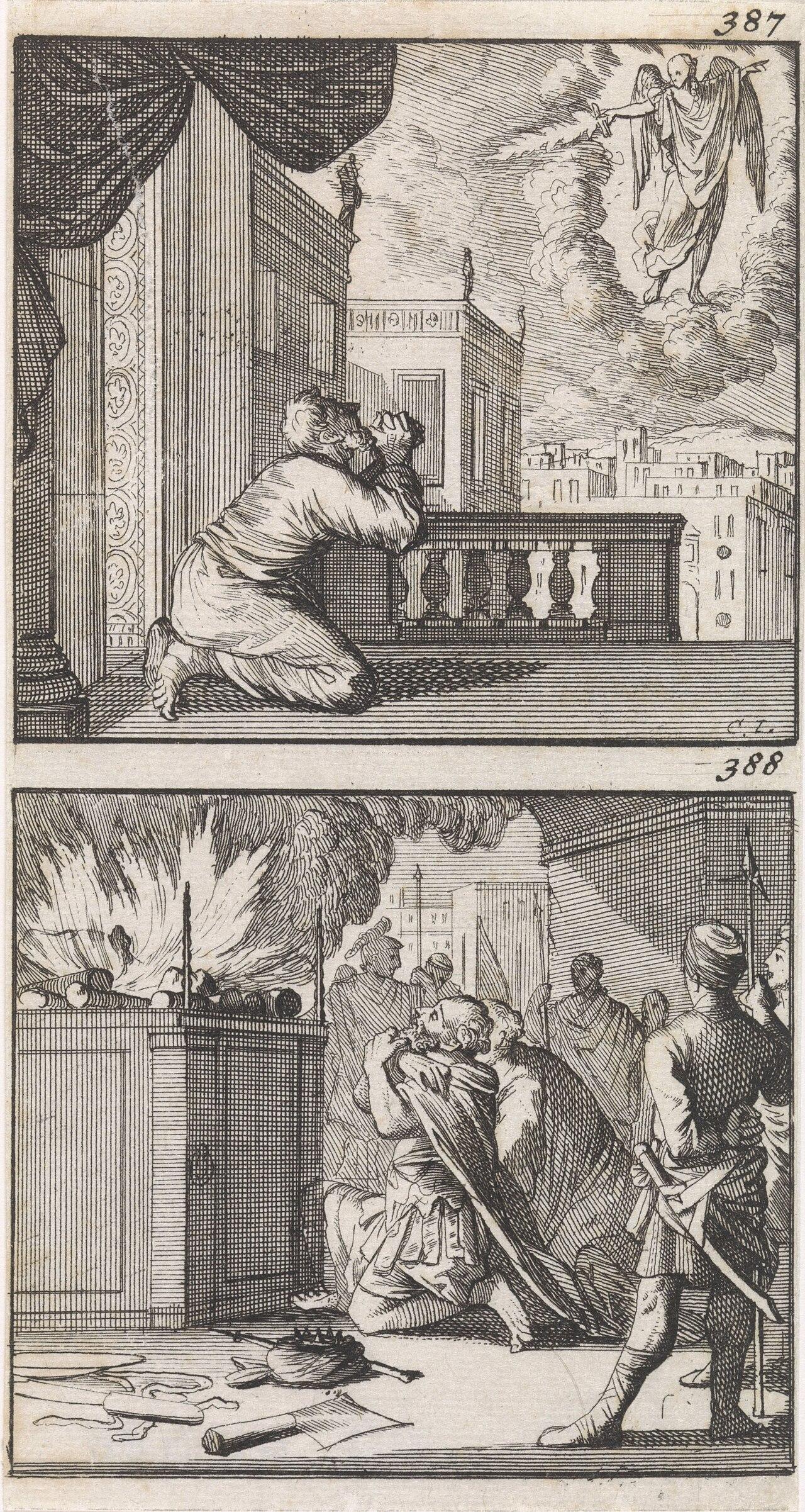
Caspar Luyken, King David Sees the Angel of Death, 1698. Public domain.
2 Samuel 24:1 and 1 Chronicles 21:1 · Debate · Featured Study
Who Moved David to Number Israel
The census David ordered in 2 Samuel 24 ended at an altar on the threshing floor of Araunah.
One Hebrew verb has the LORD for its subject in Samuel and Satan in Chronicles.
After David had numbered the troops, his conscience was stricken and he said to the LORD, “I have sinned greatly in what I have done. Now, O LORD, I beg You to take away the iniquity of Your servant, for I have acted very foolishly.”
After David had numbered the troops, his conscience was stricken and he said to the LORD, “I have sinned greatly in what I have done. Now, O LORD, I beg You to take away the iniquity of Your servant, for I have acted very foolishly.”
- The question
- Samuel says the LORD stirred David up to count Israel, and Chronicles says Satan incited him: how do the two accounts fit?
- The texts
- 2 Samuel 24:1, 1 Chronicles 21:1, James 1:13, Job 2:3
Summary
David had Joab count the fighting men of Israel, and a plague followed. Commentators join the two first verses of the story in three ways.
- Benson and Poole hold that God let Satan tempt the king.
- Barnes reads the satan of Chronicles as a human foe of David.
- A Jewish reference work of 1906 reads it as the Chronicler's later theology.
The Two Verses Side by Side
Each verse stands at the head of its book's story of the count.
Who Moved David to Number Israel takes up the opening verse of the census in 2 Samuel 24 and 1 Chronicles 21. The question it answers is how one event can be traced to the LORD in one book and to Satan in the other. It gives the two verses, the Hebrew they share, the three readings with their holders and objections, and why the count was a sin.
Again the anger of the LORD burned against Israel, and He stirred up David against them, saying, “Go and take a census of Israel and Judah.”Every reading turns on whose is the He of this verse.
Then Satan rose up against Israel and incited David to take a census of Israel.Chronicles gives the same deed to Satan and says nothing of the anger.
Three Readings of Two Verses
The permission reading, the adversary reading and the later-theology reading each answer the same three questions.
The readings part over who the satan of Chronicles is and over how far the two books agree.
| The question | The LORD permitted, the devil tempted | An adversary | The Chronicler's later theology |
|---|---|---|---|
| Who stirred David up in Samuel? | The LORD, by permitting the temptation as a judgment on Israel. | The LORD's anger, or one whom the verse leaves unnamed. | God Himself, as the older account tells it. |
| Who is the satan of Chronicles? | The satan is the devil, the tempter of Job 1 and 2. | The satan is an adversary, a hostile power or person. | Satan as an agent in his own right. |
| How do the two verses fit? | As two causes of one act, the LORD's leave and the devil's deed. | As one event told from the side of the enemy who urged it. | As a later writer's change to an earlier account. |
Each Reading Stated
Each reading rests on its own account of the word satan and of the LORD's part in a sinful act.
The LORD permitted, the devil temptedMatthew Henry; Jamieson, Fausset & Brown; Matthew Poole; the Cambridge Bible for Schools
Matthew Henry read the He of 2 Samuel 24:1 through 1 Chronicles 21:1, as God's leave given to the devil. Jamieson, Fausset & Brown held that God withdrew His supporting grace and Satan was the active mover.
Matthew Poole read Satan in 1 Chronicles 21:1 as standing before the LORD's tribunal to accuse David and to beg leave to tempt him.
The Cambridge Bible for Schools and Colleges took the LORD as the subject in 2 Samuel and read the older record as speaking of His permissive action, the later of Satan's malicious part. It compared the case to that of Job.
When tempted, no one should say, “God is tempting me.” For God cannot be tempted by evil, nor does He tempt anyone.The permission reading rests on this verse, which Jamieson, Fausset & Brown, Benson, Poole and the Cambridge Bible each cite.
An adversaryAlbert Barnes on 2 Samuel 24:1; Ellicott on 1 Chronicles 21:1
Albert Barnes, on 2 Samuel 24:1, rendered 1 Chronicles 21:1 as an adversary stood up against Israel. He gave as his reason that the word has no article there, as it has in Job 1:6, and he compared Hadad and Rezon, each called an adversary to Solomon.
Ellicott offered the same rendering for Chronicles, a hostile influence, and took that influence to be the wrath of God of which Samuel speaks.
The Chronicler's later theologyJoseph Jacobs and Ludwig Blau, the Jewish Encyclopedia (1906)
Joseph Jacobs and Ludwig Blau, writing the article Satan in the Jewish Encyclopedia, held that the Chronicler regards Satan as an independent agent. His source, 2 Samuel 24:1, gave the same act to God, and they allowed that Zoroastrian thought may have shaped the change.
The Same Verb in Both Verses
Both verses use one Hebrew verb for what was done to David, and they part over its subject.
The verses differ in what stands against Israel, in the command and in who is counted.
| Place in the verse | 2 Samuel 24:1 | 1 Chronicles 21:1 |
|---|---|---|
| What stands against Israel | af YHWH lacharot, the anger of the LORD burned, אַף יְהוָה לַחֲרוֹת (h639, h3068, h2734) | vayya'amod satan, Satan rose up, וַיַּעֲמֹד שָׂטָן (h5975, h7854) |
| The verb done to David | vayyaset, and He stirred up, וַיָּסֶת (h5496) | vayyaset, and incited, וַיָּסֶת (h5496) |
| The command | lech meneh, go, count, לֵךְ מְנֵה (h1980, h4487) | limnot, to count, לִמְנוֹת (h4487) |
| Who is counted | Israel and Judah (h3478, h3063) | Israel (h3478) |
The verb sut (h5496) stands eighteen times in the Hebrew Bible, in several forms.
Now please, may my lord the king hear the words of his servant: If the LORD has stirred you up against me, then may He accept an offering. But if men have done it, may they be cursed in the presence of the LORD! For today they have driven me away from sharing in the inheritance of the LORD, saying, ‘Go, serve other gods.’David allows that the LORD may have stirred Saul up against him, the verb of the census verse in Samuel with the LORD as its subject.
Then the LORD said to Satan, “Have you considered My servant Job? For there is no one on earth like him, a man who is blameless and upright, who fears God and shuns evil. He still retains his integrity, even though you incited Me against him to ruin him without cause.”In Job the incitement runs from Satan to the LORD.
The noun satan stands twenty-seven times in the Hebrew Bible. Seventeen carry the article, ha-satan, all of them in Job 1 and 2 and Zechariah 3, and the verse in Chronicles has none.
Whose is the He of 2 Samuel 24:1?Keil and Delitzsch; Benson; John Gill
Keil and Delitzsch, the Cambridge Bible and Ellicott took the LORD as the subject of the verb. Joseph Benson, noting that no subject stands before the verb, rendered the clause there was who moved David, and read it as Satan by the light of Chronicles.
John Gill supplied Satan from Chronicles. He reported too that Abarbanel read the anger itself as the subject, and Ben Gersom and Kimchi the evil inclination of David's heart.
Why the Count Was a Sin
Joab opposed the order and David confessed it as sin, and the commentators sought the reason in the law and the promise.
“When you take a census of the Israelites to number them, each man must pay the LORD a ransom for his life when he is counted. Then no plague will come upon them when they are numbered.The law of the census under Moses is the measure the commentators hold David's count against.
Jamieson, Fausset & Brown held that the sin lay in the design of the census, since a count under Moses for the sanctuary's tax brought no anger. They thought David's design may have been pride in his army, or a standing tax.
David did not count the men aged twenty or under, because the LORD had said that He would make Israel as numerous as the stars of the sky. Joab son of Zeruiah began to count the men but did not finish. For because of this census wrath came upon Israel, and the number was not entered in the Book of the Chronicles of King David.The promise of a numberless people is the second ground the commentators give for the sin.
This command was also evil in the sight of God; so He struck Israel.Chronicles places the fault in the order David gave, before any plague.
What the Text Leaves Unsaid
The verse in Samuel says the LORD's anger burned against Israel again and gives no cause for it.
Rashi wrote on the verse that he did not know what Israel had done. Keil and Delitzsch looked for the guilt in the revolts of Absalom and Sheba, and John Gill reported that Abarbanel did the same.
What Every Reading Holds
Every reading shares three teachings about the king's sin and its end.
DAVID TOOK THE GUILT
Every reading holds that David took the sin on himself and asked that the LORD's hand fall on him and his father's house.
THREE DAYS OF PLAGUE
Every reading holds that the census ended in the plague the king chose through Gad.
A SACRIFICE THAT COST
Every reading holds that David paid for the threshing floor and would not offer the LORD what cost him nothing.
How the Teachers Read It
Two commentators, of the eighteenth century and the nineteenth, speak to the two verses.
Matthew Henry (1662 to 1714)
The Puritan commentator set the devil's part in the census beside his part in the betrayal of Christ.
Read the page on Matthew Henry
“We are sure that God is not the author of sin; he tempts no man: we are told ( 1 Chron. xxi. 1 ) that Satan provoked David to number Israel. Satan, as an enemy, suggested it for a sin, as he put it into the heart of Judas to betray Christ.”
Matthew Henry · Commentary on the Whole Bible · on 2 Samuel 24:1Puritan
Albert Barnes (1798 to 1870)
On the verse in Chronicles Barnes gave the permission reading, and he called the verse the first place Satan is named in the English order of the books.
Read the page on Albert Barnes
“As the books of Scripture are arranged in our Version, Satan is here for the first time by name introduced to us. He appears not merely as an ‘adversary’ who seeks to injure man from without, but as a Tempter able to ruin him by suggesting sinful acts and thoughts from within. In this point of view, the revelation made of him here is the most advanced that we find in the Old Testament. The difficulty in reconciling the statement here, ‘Satan provoked David,’ etc. with that of Samuel, ‘the Lord moved David,’ etc. 2Sa 24:1 is not serious.”
Albert Barnes · Notes, Explanatory and Practical, on the Old and New Testaments (1832-1869) · on 1 Chronicles 21:1Evangelical
The Readings Weighed
Each reading faces one objection that the others press hardest.
The permission reading has the longest line of holders among these commentators.
| Reading | Held by | Tradition | Representative work |
|---|---|---|---|
| The LORD permitted, the devil tempted | Matthew Henry; Jamieson, Fausset & Brown; Matthew Poole; Joseph Benson; Keil and Delitzsch; the Cambridge Bible for Schools | Protestant commentary | Jamieson, Fausset & Brown on 2 Samuel 24:1 (1871) |
| An adversary | Albert Barnes on 2 Samuel 24:1; Ellicott on 1 Chronicles 21:1 | Protestant commentary | Albert Barnes, Notes on the Old Testament, on 2 Samuel 24:1 |
| The Chronicler's later theology | Joseph Jacobs and Ludwig Blau | Jewish historical scholarship | The Jewish Encyclopedia (1906), Satan |
The objection to the permission reading1 paragraph
Albert Barnes on 2 Samuel 24:1 and Ellicott on 1 Chronicles 21:1 press that the verse may name an enemy of Israel and not the devil.
The objection to the adversary reading1 paragraph
The Cambridge Bible on 1 Chronicles 21:1 read the satan there as a hostile spiritual being such as the one of Job 1:6 and Zechariah 3:1. The note in Ellicott's commentary on 2 Samuel 24:1 says that Satan there clearly means the devil.
The objection to the later-theology reading1 paragraph
Keil and Delitzsch held that the mention of Satan cannot be explained merely by a later habit of tracing evil to him. In their reading the Chronicler marks the king's plan as ungodly from its first step.
Books to Read Next
Four works give the readings in the words of their own holders, from Matthew Henry to the Jewish Encyclopedia.
Commentary on the Whole Bible
Matthew Henry · 1710
Henry reads the two accounts of the census together and draws the pastoral lessons of David's choice.
Commentary Critical and Explanatory on the Whole Bible
Jamieson, Fausset & Brown · 1871
Its notes weigh the purpose of the census against the law of Exodus 30.
Notes on the Old Testament
Albert Barnes · 1832 to 1869
Barnes gives the adversary reading on Samuel and the permission reading on Chronicles, each with its ground.
The Jewish Encyclopedia, Satan
Joseph Jacobs and Ludwig Blau · 1906
The article traces the figure of Satan through the Hebrew Bible, the Apocrypha, the New Testament and the rabbis.
READ IT FREE →Into the Hand of the LORD
The account ends with the king's choice of judgment.
Gad set three judgments before David, three years of famine, three months of flight or three days of plague.
David answered Gad, “I am deeply distressed. Please, let us fall into the hand of the LORD, for His mercies are great; but do not let me fall into the hands of men.”David trusts the mercy of the God whose anger he had provoked.
Sources
Scripture is the Berean Standard Bible.
- The Hebrew words of 2 Samuel 24:1 and 1 Chronicles 21:1, and every use of h5496 and h7854.
- Matthew Henry, Commentary on the Whole Bible (1710), on 2 Samuel 24:1 and 1 Chronicles 21:1.
- Jamieson, Fausset & Brown, Commentary Critical and Explanatory on the Whole Bible (1871), on 2 Samuel 24:1 and 1 Chronicles 21:1.
- Albert Barnes, Notes on the Old Testament, on 2 Samuel 24:1 and 1 Chronicles 21:1.
- Matthew Poole, Commentary on the Holy Bible, on 2 Samuel 24:1 and 1 Chronicles 21:1.
- Joseph Benson, Commentary, on 2 Samuel 24:1.
- John Gill, Exposition of the Old Testament (1748 to 1763), on 2 Samuel 24:1.
- Ellicott's Commentary for English Readers, on 2 Samuel 24:1 and 1 Chronicles 21:1.
- The Cambridge Bible for Schools and Colleges, on 2 Samuel 24:1 and 1 Chronicles 21:1.
- C. F. Keil and F. Delitzsch, Biblical Commentary on the Old Testament, on 2 Samuel 24:1 and 1 Chronicles 21:1.
- Joseph Jacobs and Ludwig Blau, Satan, The Jewish Encyclopedia (1906)
- Rashi on 2 Samuel 24:1, the Metsudah Tanach series translation.
Keep Studying
Read it5
Studies9
People and groups4
Places5
Doctrines7