
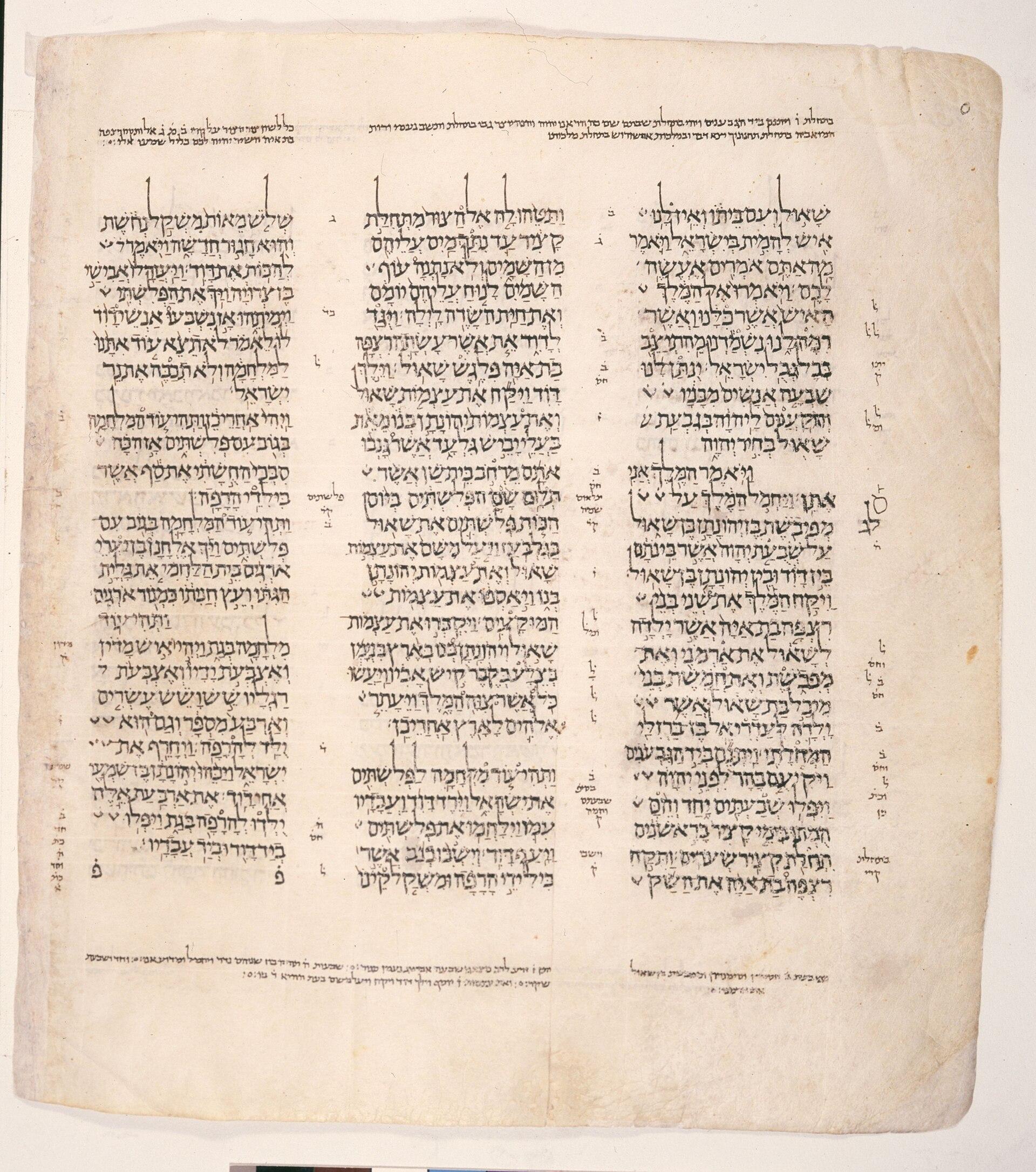
The Leningrad Codex, folio 181b, 1008 to 1011. Public domain.
2 Samuel 21:19 and 1 Chronicles 20:5 · Debate · Featured Study
Elhanan and Goliath, the Text of 2 Samuel 21:19
Two accounts of one battle with a giant of Gath give two names for the man Elhanan killed.
One verse of 2 Samuel gives the death of Goliath to a man other than David.
Thus David prevailed over the Philistine with a sling and a stone; without a sword in his hand he struck down the Philistine and killed him.
- The question
- Whom did Elhanan kill at Gob: Goliath the Gittite, as the Hebrew of Samuel reads, or Lahmi his brother, as Chronicles reads?
- The texts
- 2 Samuel 21:19, 1 Chronicles 20:5, 1 Samuel 17:50, 2 Samuel 21:22
Summary
1 Samuel 17 says David killed Goliath of Gath. In 2 Samuel the Hebrew says Elhanan killed Goliath the Gittite at Gob, and Chronicles says he killed Lahmi, the brother of Goliath. Commentators read the difference in three ways.
- Keil and Delitzsch, Barnes and Clarke read a copyist's slip in Samuel.
- Poole and the Cambridge Bible allow a second giant named Goliath.
- Targum Jonathan and Rashi read Elhanan as a name of David.
The Two Verses Side by Side
2 Samuel 21 and 1 Chronicles 20 tell the same battle against a giant of Gath in almost the same words.
Elhanan and Goliath takes up one line of the list of David's later wars with the Philistines. The question it answers is how the two accounts of the fight at Gob came to differ. It gives the two verses, the Hebrew words where they part, the three readings with their holders and objections, and the books that argue them.
Once again there was a battle with the Philistines at Gob, and Elhanan son of Jair the Bethlehemite killed the brother of Goliath the Gittite, the shaft of whose spear was like a weaver’s beam.The Berean text supplies the brother of Goliath here, and each reading explains why.
Once again there was a battle with the Philistines, and Elhanan son of Jair killed Lahmi the brother of Goliath the Gittite, the shaft of whose spear was like a weaver’s beam.The copyist reading takes this verse as the first wording, and the other readings must account for it.
Three Readings of One Line
The copyist reading, the second-Goliath reading and the reading that Elhanan is David each answer the same two questions.
The readings part over whom Elhanan killed and over how the two verses came to differ.
| The question | A copyist's slip in Samuel | A second Goliath | Elhanan is David |
|---|---|---|---|
| Whom did Elhanan kill at Gob? | Lahmi, the brother of Goliath, as 1 Chronicles 20:5 reads. | A giant of Gath who bore the name Goliath, or one who stood with Goliath as his brother. | Goliath himself, so that the verse retells the duel of 1 Samuel 17. |
| How did the two verses come to differ? | A copyist miscopied the words of Samuel, and Chronicles keeps the first wording. | They differ in wording only, each read as it stands. | The Targum, an Aramaic rendering, and Rashi read Samuel's Elhanan as David and say nothing of how the verses came to differ. |
Each Reading Stated
Each reading rests on its own account of how the two verses came to differ.
A copyist's slip in Samuel3 paragraphs
Keil and Delitzsch held that the words of the two verses presuppose one original text, so that the difference arose from an error in copying. They took the reading of Chronicles as the correct one and named Piscator, Clericus, Michaelis, Movers and Thenius as holding it before them.
Adam Clarke, following Benjamin Kennicott's First Dissertation on the Hebrew Text, traced the slip. Oregim, weavers, slipped out of one line into the other. The word for the Bethlehemite was miscopied from et Lachmi, so that Samuel once read as Chronicles does.
The Pulpit Commentary judged that the Authorized Version was possibly right to treat the present text of Samuel as a corruption of the text of Chronicles.
A second Goliath3 paragraphs
Matthew Poole read the small word et as with, so that Elhanan killed Beth-halachmi, who stood with Goliath the Gittite and was his brother. He allowed too that the giant may have been called another Goliath for his likeness to the first, as John the Baptist was called Elijah.
Radak, Rabbi David Kimchi, read the same words in Hebrew as the one who was with Goliath, and he was his brother.
The Cambridge Bible for Schools and Colleges found no difficulty in supposing that another giant bore the name Goliath. It judged one wording almost certainly an accidental corruption of the other, and it judged it hard to decide which is the original.
Elhanan is David3 paragraphs
Targum Jonathan is the Aramaic rendering of the Prophets. It gives the verse with David the son of Jesse, a weaver of the curtains of the sanctuary, as the one who killed Goliath the Gittite.
Rashi glosses the name Elhanan with the one word David. The note of the Metsudah translation gives the ground, that 1 Samuel 17:51 names David as the one who killed Goliath.
Adam Clarke gives the Targum's rendering of 1 Chronicles 20:5 as well. There David kills Lahmi, the brother of Goliath, on the same day on which he killed Goliath.
The Hebrew Words That Differ
The verb of the killing and the four words of the spear are the same in both.
The Cambridge Bible notes that the words the brother of are found neither in the Hebrew of the verse nor in any of the ancient versions.
The two verses differ in six places.
| Place in the verse | 2 Samuel 21:19 | 1 Chronicles 20:5 |
|---|---|---|
| The battle | hammilchamah, the battle, הַמִּלְחָמָה (h4421) | milchamah, a battle, מִלְחָמָה (h4421) |
| The place | begov, at Gob, בְּגוֹב (h1359) | no place named |
| With the Philistines | im, with, עִם־ (h5973) | et, with, אֶת־ (h854) |
| Elhanan's father | ya'are oregim, יַעְרֵי אֹרְגִים (h3296) | ya'ir, יָעִיר (h3265) |
| The word before the giant | beit hallachmi, the Bethlehemite, בֵּית הַלַּחְמִי (h1022) | et lachmi, Lahmi, אֶת־לַחְמִי (h3902) |
| The giant | et golyat, Goliath, אֵת גָּלְיָת (h1555) | achi golyat, brother of Goliath, אֲחִי גָּלְיָת (h251, h1555) |
| The verb | vayyak, struck, וַיַּךְ (h5221) | vayyak, וַיַּךְ (h5221) |
| The spear | ve'ets chanito kimnor orgim, וְעֵץ חֲנִיתוֹ כִּמְנוֹר אֹרְגִים (h6086, h2595, h4500, h707) | וְעֵץ חֲנִיתוֹ כִּמְנוֹר אֹרְגִים (h6086, h2595, h4500, h707) |
The verb, The spear
The Pulpit Commentary notes that oregim, weavers, stands again at the end of the verse in the weavers' beam. Lahmi, it notes, is part of the Hebrew word for the Bethlehemite. It adds that Jaare is a transposition of the letters of Jair.
The Giants of Gath
Matthew Henry placed these battles toward the end of David's reign.
The line about Elhanan stands third in a list of four battles. Before it David grew weary, and his men swore he would not go out with them again.
So these four descendants of Rapha in Gath fell at the hands of David and his servants.The count of four sets Elhanan's fight among the wars with Rapha's descendants.
2 Samuel 23:24 names Elhanan son of Dodo of Bethlehem among the Thirty. Ellicott took him to be the Elhanan of this battle, and Keil and Delitzsch held them to be two different men.
What the Text Leaves Unsaid
The two accounts leave two things unsaid.
Both accounts date the battle only by the words once again. Chronicles names no place for it. The Cambridge Bible reports that the Septuagint, the Greek translation of the Hebrew Scriptures, reads Rom in one manuscript and Gob in another.
What Every Reading Holds
Every reading shares three teachings about Goliath and the giants of Gath.
GOLIATH OF GATH
Every reading holds that the Goliath of 1 Samuel 17 was a champion from Gath.
THE WEAVER'S BEAM
Every reading holds that both verses use the words 1 Samuel 17 uses of Goliath's spear.
THE LINE OF RAPHA
Every reading holds that the giants of these wars were of the line of Rapha.
How the Teachers Read It
One commentator of the nineteenth century weighs the Hebrew of the verse.
Albert Barnes (1798 to 1870)
Barnes traced the name of Elhanan's father to a copyist's eye straying to the line below.
“The Hebrew text is manifestly very corrupt. First, for ‘Jaare-oregim,’ 1Ch 20:5 gives us the reading Jair. ‘Oregim’ has evidently got in by a transcriber’s error from the line below, where ‘oregim’ is the Hebrew for ‘weavers.’ Again, the word the ‘Bethlehemite’ is very doubtful.”
Albert Barnes · Notes, Explanatory and Practical, on the Old and New Testaments (1832-1869) · on 2 Samuel 21:19Evangelical
The Readings Weighed
Each reading faces one objection that the others press hardest.
Keil and Delitzsch name the copyist reading as the reading of most expositors.
| Reading | Held by | Tradition | Representative work |
|---|---|---|---|
| A copyist's slip in Samuel | Keil and Delitzsch; Albert Barnes; Adam Clarke; the Pulpit Commentary | Protestant commentary | Keil and Delitzsch on 2 Samuel 21:19 |
| A second Goliath | Matthew Poole; Radak; the Cambridge Bible for Schools allows it | Protestant and Jewish commentary | Matthew Poole, Commentary, on 2 Samuel 21:19 |
| Elhanan is David | Targum Jonathan; Rashi | Jewish translation and commentary | Targum Jonathan on 2 Samuel 21:19 |
The objection to the copyist reading1 paragraph
Bertheau and Böttcher, as Keil and Delitzsch report them, held the reverse. They found it hard to see how the words of Samuel could grow out of those of Chronicles. A reader who remembered 1 Samuel 17, they held, had a reason to change Samuel's Goliath into Goliath's brother. Keil and Delitzsch answered that this supposes a deliberate alteration, and that no example of one can be shown in the whole of Chronicles.
The objection to a second Goliath1 paragraph
Keil and Delitzsch called the assumption that there were two Goliaths a very improbable one.
The objection to Elhanan as David1 paragraph
John Gill answered that Goliath was killed in the valley of Elah and not at Gob, and that David had no such name as Elhanan. The Cambridge Bible found no evidence whatever for the idea.
Books to Read Next
Three works give the readings in the words of their own holders, from Rashi to Adam Clarke.
Rashi on 2 Samuel
Rashi · 1075 to 1105
Rashi's short glosses on the Prophets give the Jewish reading that Elhanan is David.
READ IT FREE →Exposition of the Old Testament
John Gill · 1748 to 1763
Gill reads Lahmi in Chronicles as the name of Elhanan's home town.
Commentary on the Bible
Adam Clarke · 1832
Clarke follows Kennicott through the letters of the verse to the reading of Chronicles.
READ IT FREE →The Champion of Gath
The readings meet at the duel in the valley of Elah.
The list of the giants of Gath looks back to the shepherd who faced the first champion of Gath alone.
And all those assembled here will know that it is not by sword or spear that the LORD saves; for the battle is the LORD’s, and He will give all of you into our hands.”David's words before the duel name the source every reading credits for the victory.
Sources
Scripture is the Berean Standard Bible.
- The Hebrew words of 2 Samuel 21:19 and 1 Chronicles 20:5, with Strong's numbers.
- C. F. Keil and F. Delitzsch, Biblical Commentary on the Old Testament, on 2 Samuel 21:19.
- Albert Barnes, Notes on the Old Testament, on 2 Samuel 21:19.
- Adam Clarke, Commentary on the Bible (1832), on 2 Samuel 21:19 and 1 Chronicles 20:5.
- The Pulpit Commentary, on 2 Samuel 21:19.
- The Cambridge Bible for Schools and Colleges, on 2 Samuel 21:19.
- Matthew Poole, Commentary on the Holy Bible, on 2 Samuel 21:19.
- John Gill, Exposition of the Old Testament (1748 to 1763), on 2 Samuel 21:19.
- Ellicott's Commentary for English Readers, on 2 Samuel 21:19.
- Rashi on 2 Samuel 21:19, the Metsudah Tanach series translation, with its note 24.
- Radak (Rabbi David Kimchi) on 2 Samuel 21:19, in Hebrew.
- Targum Jonathan on 2 Samuel 21:19, translated by E. van Staalduine-Sulman (Brill, 2002)
- Matthew Henry's Concise Commentary, on 2 Samuel 21:15 to 22.
Keep Studying
Read it6
Studies7