
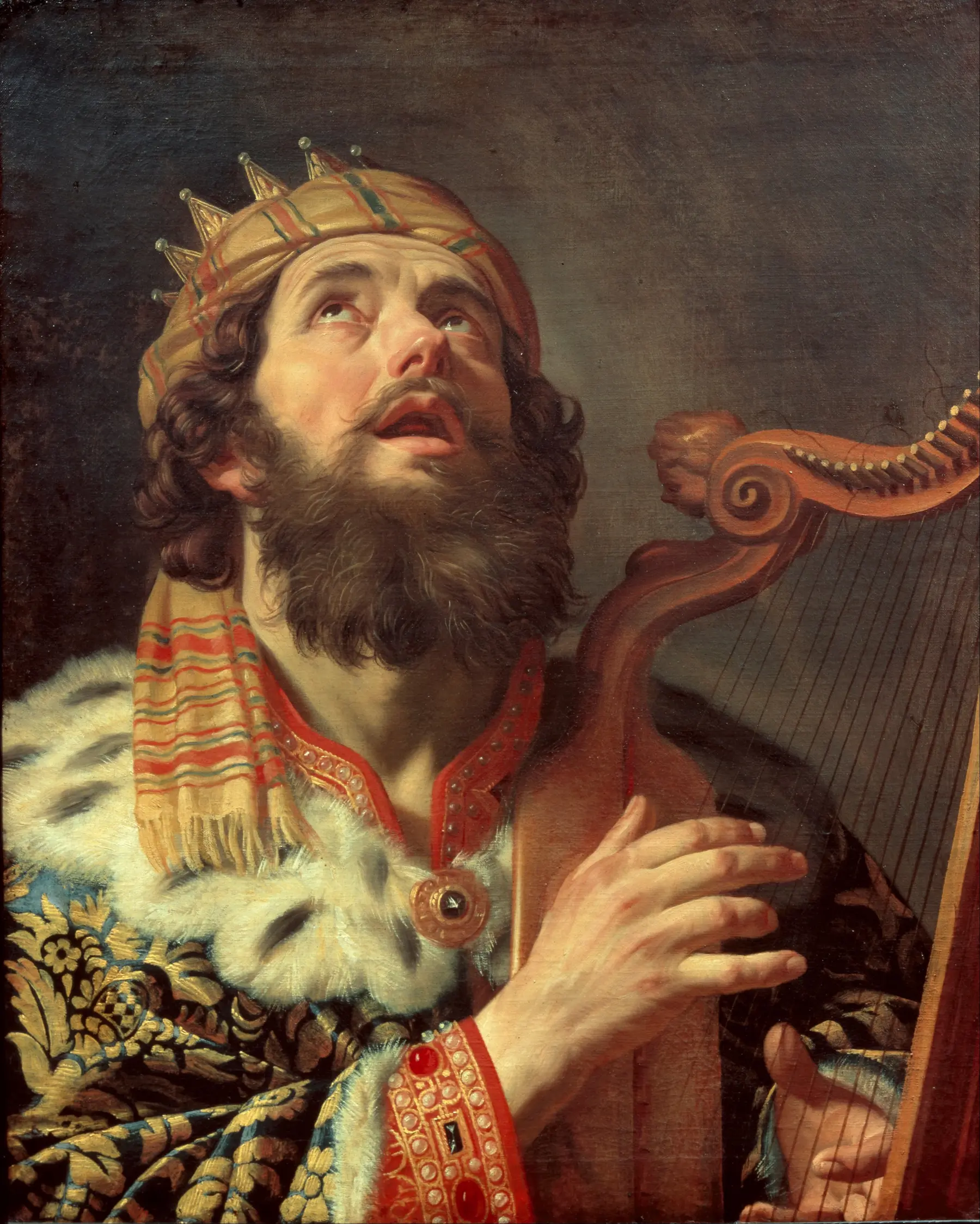
King David Playing the Harp, Gerard van Honthorst, 1622. Public domain.
Old Testament · Book 13 of 66
1 Chronicles
1 Chronicles retells Israel's history from Adam through the reign of David, opening with nine chapters of genealogies. Its account of David dwells on his care for the ark and his preparations for the temple.
1 Chronicles retells Israel's history from Adam through the reign of David, opening with nine chapters of genealogies. Its account of David dwells on his care for the ark and his preparations for the temple.
What is 1 Chronicles about?
1 Chronicles begins with a list of names that runs from Adam to the families who came back from Babylon. It then tells how all Israel came to Hebron and made David king. David brings the ark of God to Jerusalem, and the LORD promises him a house that will last, with a son whose throne will be established forever (17:12). David may not build the house of God himself, so he prepares it: he buys the site, gathers the materials, and orders the priests, Levites and singers who will serve in it. The book ends as Solomon sits on the throne of the LORD and David dies full of years.
All 29 chapters
Every chapter of the book, in one grid. Each cell opens that chapter.
- Adam to the twelve sons1 Chronicles 1
- Judah and David's line1 Chronicles 2 to 4
- Simeon and the east1 Chronicles 5
- Levi1 Chronicles 6
- Other tribes and Saul1 Chronicles 7 to 8
- All Israel resettled1 Chronicles 9
- Saul's end and David's rise1 Chronicles 10 to 12
- The ark and the covenant1 Chronicles 13 to 17
- Wars and the census1 Chronicles 18 to 21
- The house prepared1 Chronicles 22 to 29
Chapters 1 to 9 are the genealogies and chapters 10 to 29 the reign of David. The colour is the division the chapter stands in, and every cell opens that chapter's Study level.
Who wrote it, where, when, for whom, and why?
1 Chronicles names no writer. It names the records it drew on: the Book of the Kings of Israel, where all Israel was recorded in the genealogies (9:1), and the records of Samuel the seer, Nathan the prophet and Gad the seer, where the acts of King David are written from first to last (29:29).
The account runs on in 2 Chronicles, which closes with the decree of Cyrus king of Persia (2 Chronicles 36:22 and 23), and Ezra opens with the same words (Ezra 1:1). Matthew and Luke carry the line of 3:17 to 19, Shealtiel and Zerubbabel, into the genealogy of Jesus (Matthew 1:12; Luke 3:27).
The book is written from Jerusalem after the return. Its last list names the first to resettle their own property in their cities, Israelites, priests, Levites and temple servants (9:2), and the families of Judah, Benjamin, Ephraim and Manasseh who lived in Jerusalem (9:3).
The text places itself after the exile. It says that the LORD sent Judah and Jerusalem into exile by the hand of Nebuchadnezzar (6:15) and that Judah was exiled to Babylon because of their unfaithfulness (9:1). The line of David runs on past Zerubbabel to the seven sons of Elioenai (3:19 to 24), so the book was finished some generations after the return. How many is set out under Where do readers disagree.
The first readers were the families who had come back to their cities (9:2): a people with no king of their own, who needed to know which tribe and which house they belonged to and whether the promises to David still stood.
The book shows a people broken by exile that they are still Israel, counted from Adam (1:1) to the families who came home (9:2). It shows that the promise to David stands, his son's throne established forever (17:14). And it tells them that the LORD is found by those who seek Him (28:9).
As for you, Solomon my son, know the God of your father and serve Him wholeheartedly and with a willing mind, for the LORD searches every heart and understands the intent of every thought. If you seek Him, He will be found by you; but if you forsake Him, He will reject you forever.
1 Chronicles 28:9, Berean Standard Bible.
The world behind it: the first readers lived in a small province under the kings of Persia, whose first king had sent them home to build a house for the LORD at Jerusalem (2 Chronicles 36:23). The temple had been rebuilt in the sixth year of King Darius (Ezra 6:15), and some priests who had lost their family records were excluded from the priesthood (Ezra 2:62).
Sources. 1 Chronicles 1:1, 3:17 to 24, 6:15, 9:1 to 3, 17:14, 28:9 and 29:29; 2 Chronicles 36:22 and 23; Ezra 1:1, 2:62 and 6:15; Matthew 1:12; Luke 3:27. Every verse is read in the Berean Standard Bible.
How is 1 Chronicles arranged, and what is it for?
The five movements the book falls into, what it teaches, what it was written to do, and the shape of its genealogies.
- The genealogiesChapters 1 to 9, 407 verses, turning at 9:1
Nine chapters of names narrow from Adam to Judah and Levi, then widen to all Israel resettled in its cities.
- Saul's end and all Israel at HebronChapters 10 to 12, 101 verses, turning at 10:14
Saul dies in battle, and every tribe comes to Hebron to make David king.
- The ark and the covenantChapters 13 to 17, 130 verses, turning at 17:12
The ark comes to Jerusalem at the second attempt, and God promises David a house that will last forever.
- Wars, the census and the threshing floorChapters 18 to 21, 74 verses, turning at 22:1
David's wars are won, his census brings a plague, and the plague stops at the threshing floor where the house will stand.
- The house prepared and the throne handed onChapters 22 to 29, 230 verses, turning at 29:23
David gathers the materials, orders the priests, Levites, singers, gatekeepers and army, and hands the plan and the throne to Solomon.
The theme
The people who came back from exile are still Israel, one people counted from Adam, with the tribe of the king and the tribe of the house at the centre of the count. God keeps His promise to David: the house He builds for David is a line of kings, and the house David's son builds is the house of the LORD. The kingdom belongs to the LORD, and the son of David sits on the throne of the LORD (29:23).
The purpose
1 Chronicles was written so that a people with no king and a rebuilt temple would know where they came from and what they were for. It gives every family its place in the lists, shows the worship of the house ordered by David, and calls the reader to seek the LORD as David charged Solomon to do (28:9). 2 Chronicles carries the same account on from Solomon to the exile and the decree of Cyrus.
The genealogies narrow to Judah and Levi, then widen to all Israel
- Adam to the twelve sons of Israel1:1 to 2:2
- Judah and David's line2:3 to 4:23, a core
- Simeon and the tribes east of the Jordan4:24 to 5:26
- Levi, the priests and the singers6:1 to 81, a core
- The northern tribes7:1 to 40
- Benjamin and Saul's line8:1 to 40
- Israel resettled in its cities9:1 to 34
From the two cores, chapters 10 to 29 carry two lines.
From Judah, the king
The two lines meetSolomon sits on the throne of the LORD, with the house prepared, 29:23
The genealogies, 1 Chronicles 1 to 9
What the text says in these 9 chapters, and the pages they open on.
The book begins with names. Adam, Seth and Enosh open a list that runs through Noah and Abraham to the twelve sons of Israel. The list then slows for the tribe of Judah and the house of David, whose kings it follows past the exile to the families born in Babylon and after. It slows again for Levi, the priests from Aaron and the singers David set over the music of the house. The other tribes are counted more briefly, Benjamin last with the line of Saul. At 9:1 the list names the exile, and then it names the first families who came back to live in their cities and in Jerusalem.
So all Israel was recorded in the genealogies written in the Book of the Kings of Israel. But Judah was exiled to Babylon because of their unfaithfulness.
- Study
1 Chronicles 1Adam to Abraham, Isaac and IsraelShow the summary and 3 pagesShow summary, 3 pagesHide the summary
The book opens with a bare list of names that begins with Adam, Seth and Enosh. It runs through Noah and his three sons to Abraham, and through Isaac to Esau and Israel.
- The sons of Noah are Shem, Ham and Japheth (1:4).
- The sons of Abraham are Isaac and Ishmael (1:28).
- The chapter closes with the kings and chiefs of Edom, the line of Esau.
On this chapter (3)
- The genealogy of Jesus
The line from Adam and from Abraham as Matthew and Luke give it.
- Why do the genealogies differ from other lists?
Answered under Where do readers disagree, lower on this page, with each reading and who holds it.
- 1 Chronicles 1:1
The verse on its own page, with the commentators on it by era.
- Study
1 Chronicles 2the sons of Israel and the line of Judah to DavidShow the summary and 2 pagesShow summary, 2 pagesHide the summary
The twelve sons of Israel are named, and then Judah takes the floor for the rest of the chapter, the tribe that matters to this book. Through Perez and Hezron the roll marches straight to the point: Ram, Amminadab, Nahshon, Salmon, Boaz, Obed, Jesse: 'and Jesse begat his first-born Eliab,' down to the seventh, and David. Around that spine cluster the wider clans: Jerahmeel's house, Caleb's house, the families of scribes at Jabez, the Kenites. Achar is remembered by his epitaph, 'the troubler of Israel.' The genealogy that Matthew and Luke will later carry to Bethlehem is already laid out here in plain columns.
On this chapter (2)
- The genealogy of Jesus
The line from Adam and from Abraham as Matthew and Luke give it.
- 1 Chronicles 2:15
The verse on its own page, with the commentators on it by era.
- The genealogy of Jesus
- Study
1 Chronicles 3the sons of David and the kings to the exile and beyondShow the summary and 5 pagesShow summary, 5 pagesHide the summary
Chapter 3 lists the sons of David, six born in Hebron and the rest in Jerusalem. It then follows the kings from Solomon to Josiah and the line of Jeconiah the captive past the exile.
- Absalom is named third among the sons born in Hebron (3:2), and Solomon is one of four sons born to Bathsheba (3:5).
- Rehoboam, Asa, Hezekiah and Josiah stand in one run of the kings of Judah (3:10 to 14).
- The line runs on through Shealtiel, Pedaiah and Zerubbabel to the seven sons of Elioenai (3:17 to 24).
On this chapter (5)
- The genealogy of Jesus
The line from Adam and from Abraham as Matthew and Luke give it.
- The exile and return
Judah carried to Babylon and brought home again.
- When was 1 Chronicles written?
Answered under Where do readers disagree, lower on this page, with each reading and who holds it.
- Why do the genealogies differ from other lists?
Answered under Where do readers disagree, lower on this page, with each reading and who holds it.
- 1 Chronicles 3:17
The verse on its own page, with the commentators on it by era.
- Study
1 Chronicles 4Judah's families, Jabez's prayer, and SimeonShow the summary and 2 pagesShow summary, 2 pagesHide the summary
Chapter 4 finishes the families of Judah and gives the families of Simeon. Inside the list stands Jabez, whose short prayer God answered.
- Jabez was more honourable than his brothers, and his mother named him for the pain of his birth (4:9).
- He asked God to bless him and enlarge his territory, and God granted the request (4:10).
- The Simeonites' towns and their search for pasture for their flocks close the chapter (4:39).
On this chapter (2)
- Are the genealogies arranged around Levi?
Answered under Where do readers disagree, lower on this page, with each reading and who holds it.
- 1 Chronicles 4:10
The verse on its own page, with the commentators on it by era.
- Study
1 Chronicles 5Reuben, Gad and the half-tribe of Manasseh east of the JordanShow the summary and 1 pageShow summary, 1 pageHide the summary
The tribes east of the Jordan. Reuben, Gad, and half Manasseh. The Chronicler pauses over Reuben's forfeited birthright, given to Joseph's sons, while noting that the ruler came out of Judah. Then a battle report that doubles as a sermon: against the Hagrites they prevailed because 'they cried to God in the battle, and he was entreated of them, because they put their trust in him.' The same tribes are last seen going the other way. They trespassed against the God of their fathers and went after the gods of the peoples of the land, and God stirred up the kings of Assyria to carry them away. Trust and trespass, with the exile between them.
On this chapter (1)
- 1 Chronicles 5:2
The verse on its own page, with the commentators on it by era.
- 1 Chronicles 5:2
- Study
1 Chronicles 6the high priests and the singers of the houseShow the summary and 4 pagesShow summary, 4 pagesHide the summary
Chapter 6 gives the tribe of Levi: the high priests from Aaron to Jehozadak, who went into captivity, and the singers David set over the music. It ends with the towns given to the Levites.
- Jehozadak went into captivity when the LORD sent Judah and Jerusalem into exile (6:15).
- David put men in charge of the music in the house of the LORD after the ark rested there (6:31).
- Heman, Asaph and Ethan head the three families of singers.
On this chapter (4)
- The priest
The priest who stands between God and the people.
- Worship
What Scripture teaches about the worship of God.
- Are the genealogies arranged around Levi?
Answered under Where do readers disagree, lower on this page, with each reading and who holds it.
- 1 Chronicles 6:31
The verse on its own page, with the commentators on it by era.
- Study
1 Chronicles 7Issachar, Benjamin, Naphtali, Manasseh, Ephraim and AsherShow the summary and 1 pageShow summary, 1 pageHide the summary
The remaining northern tribes are gathered in one sweep (Issachar's mighty men of valor, Benjamin, Naphtali, Manasseh, Ephraim, Asher), mostly muster rolls of fighting men reckoned by their fathers' houses. Two human moments break the surface. Ephraim's sons are killed by the men of Gath 'because they came down to take away their cattle,' and their father mourns many days while his brethren come to comfort him; a later son is named Beriah 'because it went evil with his house.' And in Ephraim's line, almost in passing, stands Joshua the son of Nun. Grief and greatness alike are kept in the register.
On this chapter (1)
- 1 Chronicles 7:1
The verse on its own page, with the commentators on it by era.
- 1 Chronicles 7:1
- Study
1 Chronicles 8Benjamin and the line of SaulShow the summary and 1 pageShow summary, 1 pageHide the summary
Benjamin is taken up again in full, tracing the clans of Geba and Aijalon and the heads of fathers' houses who dwelt in Jerusalem. The list is built toward one household: the family that dwelt at Gibeon, Ner and Kish and 'Kish begat Saul, and Saul begat Jonathan.' Jonathan's son Merib-baal is named, and Micah after him, and generations of Benjamite archers beyond. The Chronicler is quietly setting the stage. Israel's first king and his line are documented honestly and completely, so that the next narrative chapter can show why the kingdom passed out of that house and into David's.
On this chapter (1)
- 1 Chronicles 8:33
The verse on its own page, with the commentators on it by era.
- 1 Chronicles 8:33
- Study
1 Chronicles 9the exile named, and the families who came backShow the summary and 4 pagesShow summary, 4 pagesHide the summary
Chapter 9 turns on the exile: all Israel was recorded in the genealogies, and Judah was exiled to Babylon for its unfaithfulness. It then names the first families who came back to live in their cities and in Jerusalem.
- The first to resettle were Israelites, priests, Levites and temple servants (9:2).
- The gatekeepers keep their posts by families, and the musicians are on duty day and night (9:33).
- The line of Saul is given again as the bridge into the story (9:35 to 44).
On this chapter (4)
- The exile and return
Judah carried to Babylon and brought home again.
- The remnant
The people God keeps when judgment falls.
- Who wrote 1 Chronicles?
Answered under Where do readers disagree, lower on this page, with each reading and who holds it.
- 1 Chronicles 9:1
The verse on its own page, with the commentators on it by era.
The royal line runs through the exile
- David3:1
- Solomon3:5
- Rehoboam3:10
- Eleven kings, Abijah to Amon3:11 to 14
- Josiah3:14
- Jehoiakim3:15
- Jeconiah the captive3:16 to 17Met in Matthew
The exile: Judah was exiled to Babylon because of their unfaithfulness, 9:1
- Shealtiel3:17Met in Matthew and Luke
- Pedaiah3:18 to 19
- Zerubbabel3:19Met in Matthew and Luke
- Hananiah3:19 and 21
- Shecaniah, Shemaiah, Neariah3:21 to 22
- Elioenai3:23
- Seven sons of Elioenai3:24
Characters (4)
Who the text follows. A name with a page carries its door.
Themes (4)
What these chapters raise, each on its own page.
- The genealogy of Jesus
Matthew and Luke carry the line of chapter 3 to Christ.
- The exile and return
Judah carried to Babylon and brought home.
- The remnant
The people God keeps when judgment falls.
- The priest
The line of Aaron that stands between God and the people.
Where the New Testament uses these chapters (2)each marked as a quotation or an allusion, with the evidence
- Probable allusionThe line through the exile, 1 Chronicles 3:17 to 19 at Matthew 1:12. Matthew's genealogy of Jesus runs from Jeconiah to Shealtiel to Zerubbabel after the exile to Babylon. The same three names in the same order, after the same break; Matthew names Shealtiel as Zerubbabel's father, where 3:19 names Pedaiah.
- Probable allusionThe line through the exile, 1 Chronicles 3:17 to 19 at Luke 3:27. Luke's genealogy passes through Zerubbabel, the son of Shealtiel. The two names stand together as they do in 3:17 to 19; Luke's line reaches them through Neri rather than through the kings.
Saul's end and all Israel at Hebron, 1 Chronicles 10 to 12
What the text says in these 3 chapters, and the pages they open on.
The story begins with a battle. The Philistines defeat Israel on Mount Gilboa, Saul falls on his own sword, and he dies with his three sons. The text gives the reason in its own words: Saul was unfaithful, consulted a medium, and did not inquire of the LORD, so the LORD turned the kingdom over to David. All Israel then comes to David at Hebron, and the elders anoint him king. David takes the fortress of Zion, and the book names his mighty men and the armed companies of every tribe who came to Hebron of one mind to make him king.
So Saul died for his unfaithfulness to the LORD, because he did not keep the word of the LORD and even consulted a medium for guidance, and he failed to inquire of the LORD. So the LORD put him to death and turned the kingdom over to David son of Jesse.
- Study
1 Chronicles 10Saul's death, and why he diedShow the summary and 2 pagesShow summary, 2 pagesHide the summary
The Philistines defeat Israel on Mount Gilboa, and Saul and his three sons die. The chapter says why: Saul was unfaithful, consulted a medium and did not inquire of the LORD.
- Saul died together with his three sons and all his house (10:6).
- The men of Jabesh bury the bones of Saul and his sons and fast seven days (10:12).
- The LORD turned the kingdom over to David son of Jesse (10:14).
On this chapter (2)
- Saul at Endor
Saul consults a medium on the night before his death.
- 1 Chronicles 10:13
The verse on its own page, with the commentators on it by era.
- Study
1 Chronicles 11David anointed at Hebron and Zion takenShow the summary and 3 pagesShow summary, 3 pagesHide the summary
All Israel comes to David at Hebron, and the elders anoint him king over Israel. David takes the fortress of Zion, and the chapter names the mighty men who strengthened his kingdom.
- David made a covenant with the elders before the LORD at Hebron (11:3).
- David captured the fortress of Zion, the City of David (11:5).
- The chiefs of his mighty men and their deeds fill the rest of the chapter (11:10 to 47).
On this chapter (3)
- Zion and Jerusalem
The city David takes and the name it carries through Scripture.
- The king
The king of Israel and the King the prophets promise.
- 1 Chronicles 11:3
The verse on its own page, with the commentators on it by era.
- Study
1 Chronicles 12the men of every tribe who came to make David kingShow the summary and 3 pagesShow summary, 3 pagesHide the summary
Chapter 12 counts the men who came over to David, first at Ziklag and then at Hebron. Every tribe sends its armed men, and all Israel is of one mind to make David king.
- Men came to David day after day until he had a great army (12:22).
- The counts run tribe by tribe from Judah's 6,800 to 120,000 from east of the Jordan (12:24 to 37).
- The army eats and drinks with David three days, and there is joy in Israel (12:39 to 40).
On this chapter (3)
- The king
The king of Israel and the King the prophets promise.
- Are the numbers in Chronicles too large?
Answered under Where do readers disagree, lower on this page, with each reading and who holds it.
- 1 Chronicles 12:38
The verse on its own page, with the commentators on it by era.
Every tribe comes to Hebron to make David king
- Judah 12:246,800
- Simeon 12:257,100
- Levi 12:264,600, with Jehoiada and 3,700 men (12:27)
- Benjamin 12:293,000
- Ephraim 12:3020,800
- Half-tribe of Manasseh 12:3118,000
- Issachar 12:32200 chiefs, with all their kinsmen
- Zebulun 12:3350,000
- Naphtali 12:341,000 commanders and 37,000 men
- Dan 12:3528,600
- Asher 12:3640,000
- East of the Jordan 12:37120,000, Reuben, Gad and the half-tribe of Manasseh
Characters (4)
Who the text follows. A name with a page carries its door.
- Saul
The first king, who dies for his unfaithfulness (10:13).
- David
Son of Jesse, made king at Hebron, who brings the ark to Jerusalem and prepares the house.
- Joab
First up into Jebus, and made commander of the army (11:6).
- The men of Issachar
Who understood the times and knew what Israel should do (12:32).
Places (4)
Where the chapters stand.
- Mount Gilboa
Where Saul and his sons fell (10:1).
- Hebron
Where all Israel anointed David king (11:3).
- Zion
The fortress David captures, called the City of David.
- Ziklag
Where men came to David while he was still banished from Saul (12:1).
Themes (3)
What these chapters raise, each on its own page.
- Saul at Endor
The medium Saul consulted before his death.
- The king
The king of Israel and the King the prophets promise.
- Zion and Jerusalem
The city David takes and the name it carries.
The ark and the covenant, 1 Chronicles 13 to 17
What the text says in these 5 chapters, and the pages they open on.
David's first act as king in Jerusalem is to bring up the ark. The first attempt carries it on a new cart; at Chidon the oxen stumble, Uzzah takes hold of the ark, and the LORD strikes him down. The ark waits three months at the house of Obed-edom. At the second attempt the Levites carry it on their shoulders with the poles, as Moses commanded, and all Israel brings it up with singing to the tent in the City of David. Asaph and his brothers are appointed to give thanks there. Then David wants to build the LORD a house, and the LORD answers through Nathan that He will build a house for David instead, and that David's son will build the house of God and reign forever.
But I will set him over My house and My kingdom forever, and his throne will be established forever.
| Where | The Berean text | Whose house |
|---|---|---|
| 2 Samuel 7:16 | Your house and kingdom will endure forever before Me, and your throne will be established forever.The house, the kingdom and the throne are David's. | The house, the kingdom and the throne are David's. |
| 1 Chronicles 17:14 | But I will set him over My house and My kingdom forever, and his throne will be established forever.The house and the kingdom are the LORD's, and David's son is set over them. | The house and the kingdom are the LORD's, and David's son is set over them. |
- Study
1 Chronicles 13the new cart, Uzzah's death, and the house of Obed-edomShow the summary and 4 pagesShow summary, 4 pagesHide the summary
David and all Israel go to bring the ark from Kiriath-jearim on a new cart. At the threshing floor of Chidon the oxen stumble, Uzzah takes hold of the ark, and the LORD strikes him down.
- David gathers all Israel from the River Shihor in Egypt to Lebo-hamath (13:5).
- David names the place Perez-uzzah (13:11).
- The ark stays three months in the house of Obed-edom, and the LORD blesses his household (13:14).
On this chapter (4)
- The ark of the covenant
The chest, what it held, and how it was to be carried.
- The ark and Dagon
The ark among the Philistines before it came to Kiriath-jearim.
- Why did Uzzah die?
Answered under Where do readers disagree, lower on this page, with each reading and who holds it.
- 1 Chronicles 13:10
The verse on its own page, with the commentators on it by era.
- Study
1 Chronicles 14Hiram's cedar, David's sons, and two victories over the PhilistinesShow the summary and 2 pagesShow summary, 2 pagesHide the summary
An interlude of confirmation. Hiram of Tyre sends cedar and masons and carpenters to build David a house, and David perceives 'the LORD had established him as king over Israel and had highly exalted his kingdom for the sake of His people Israel.' His children born in Jerusalem are listed, Solomon among them. Then the Philistines come up twice, and twice David asks God before he moves: the discipline the ark episode taught. The first time he is told to go up, and he breaks them at Baal-perazim like a breach of waters. The second time the answer is different: circle behind, and when you hear the sound of marching in the tops of the mulberry trees, then go out. His fame goes into all lands.
On this chapter (2)
- The king
The king of Israel and the King the prophets promise.
- 1 Chronicles 14:2
The verse on its own page, with the commentators on it by era.
- The king
- Study
1 Chronicles 15the Levites carry the ark as Moses commandedShow the summary and 5 pagesShow summary, 5 pagesHide the summary
David prepares a place for the ark and says that only the Levites may carry it. At the second attempt the Levites carry it on their shoulders with the poles, as Moses commanded, and all Israel brings it up with music.
- David says the LORD burst out against them because they did not consult Him about the proper order (15:13).
- The leaders of the Levites appoint singers with harps, lyres and cymbals (15:16).
- Michal sees David dancing and despises him in her heart (15:29).
On this chapter (5)
- The ark of the covenant
The chest, what it held, and how it was to be carried.
- Order in worship
Worship done in the order God gave for it.
- Worship
What Scripture teaches about the worship of God.
- Why did Uzzah die?
Answered under Where do readers disagree, lower on this page, with each reading and who holds it.
- 1 Chronicles 15:15
The verse on its own page, with the commentators on it by era.
- Study
1 Chronicles 16the ark in the tent and the song of thanksgivingShow the summary and 3 pagesShow summary, 3 pagesHide the summary
The ark is set inside the tent David pitched, and David appoints Asaph and his brothers to give thanks. The song he gives them joins lines found in Psalms 105, 96 and 106.
- Give thanks to the LORD, for He is good; His loving devotion endures forever (16:34).
- Asaph and his brothers minister before the ark in Jerusalem (16:37).
- Zadok and the priests serve before the tabernacle at the high place in Gibeon (16:39).
On this chapter (3)
- Worship
What Scripture teaches about the worship of God.
- The ark of the covenant
The chest, what it held, and how it was to be carried.
- 1 Chronicles 16:34
The verse on its own page, with the commentators on it by era.
- Study
1 Chronicles 17the covenant: a house for David and a throne foreverShow the summary and 4 pagesShow summary, 4 pagesHide the summary
David wants to build a house for the ark, and God tells him through Nathan that he is not the one to build it. Instead the LORD will build a house for David, and David's son will build the house of God and reign forever.
- You are not the one to build Me a house in which to dwell (17:4).
- He will build a house for Me, and I will establish his throne forever (17:12).
- David sits before the LORD and asks, Who am I, O LORD God? (17:16).
On this chapter (4)
- The Davidic covenant
The promise of a house and a throne, and how the New Testament reads it.
- The house
The house God dwells in and the house He builds.
- The throne
The throne of David and the throne of God.
- 1 Chronicles 17:12
The verse on its own page, with the commentators on it by era.
The ark's road from Kiriath-jearim to the City of David
- 1Kiriath-jearimDavid and all Israel go up to bring the ark of God from the house of Abinadab. 13:5 to 6
- 2The threshing floor of ChidonThe oxen stumble, Uzzah takes hold of the ark, and he dies there before God. 13:9 to 10
- 3The house of Obed-edomThe ark stays three months, and the LORD blesses his household. 13:14
- 4The tent in the City of DavidThe Levites carry the ark on their shoulders to the tent David pitched for it. 15:1; 16:1
Characters (3)
Who the text follows. A name with a page carries its door.
- Nathan
The prophet who brings David the word of the covenant.
- Obed-edom
In whose house the ark stayed three months, and whose household the LORD blessed (13:14).
- Michal
Saul's daughter, who despised David dancing before the ark (15:29).
Places (2)
Where the chapters stand.
- Kiriath-jearim
Baalah of Judah, where the ark had rested (13:6).
- Gibeon
Where the tabernacle and the altar stayed, with Zadok and the priests (16:39).
Themes (3)
What these chapters raise, each on its own page.
- The ark of the covenant
The chest, what it held, and how it was to be carried.
- The Davidic covenant
The promise of a house and a throne.
- Worship
What Scripture teaches about the worship of God.
Where the New Testament uses these chapters (2)each marked as a quotation or an allusion, with the evidence
- Explicit quotationThe covenant, 1 Chronicles 17:13 at Hebrews 1:5. Hebrews asks to which of the angels God ever said, I will be His Father, and He will be My Son, and answers with the Son. The words of 17:13, which 2 Samuel 7:14 also carries, are reproduced with a formula of citation.
- Probable allusionThe throne forever, 1 Chronicles 17:12 to 14 at Luke 1:32 to 33. Gabriel tells Mary that God will give her son the throne of His father David and that His kingdom will never end. The throne of David and a reign without end are the two terms of 17:12 to 14 and of 2 Samuel 7:13 to 16.
Wars, the census and the threshing floor, 1 Chronicles 18 to 21
What the text says in these 4 chapters, and the pages they open on.
The LORD makes David victorious wherever he goes: over the Philistines, Moab, Zobah, the Arameans and Edom, and then over Ammon and its hired armies. Three giants of Gath fall to David's men. Then Satan rises up against Israel and incites David to count the people. Joab warns that the count will bring guilt on Israel, and the LORD sends a plague. When the angel stretches out his sword over Jerusalem, David asks for the hand of the LORD to fall on him and not on the people. At the threshing floor of Ornan, David pays the full price, builds an altar, and the LORD answers with fire from heaven. There David says the house of the LORD will stand.
And there he built an altar to the LORD and offered burnt offerings and peace offerings. He called upon the LORD, who answered him with fire from heaven on the altar of burnt offering.
- Study
1 Chronicles 18David's victories and the bronze kept for the houseShow the summary and 3 pagesShow summary, 3 pagesHide the summary
David defeats the Philistines, Moab, Hadadezer of Zobah, the Arameans of Damascus and Edom. He dedicates the plunder to the LORD and reigns over all Israel with justice.
- The bronze David takes from Hadadezer's cities is what Solomon later makes into the bronze Sea and the pillars (18:8).
- The LORD made David victorious wherever he went (18:6 and 13).
- David administered justice and righteousness for all his people (18:14).
On this chapter (3)
- The king
The king of Israel and the King the prophets promise.
- Are the numbers in Chronicles too large?
Answered under Where do readers disagree, lower on this page, with each reading and who holds it.
- 1 Chronicles 18:14
The verse on its own page, with the commentators on it by era.
- Study
1 Chronicles 19Ammon shames David's envoys and hires AramShow the summary and 2 pagesShow summary, 2 pagesHide the summary
David sends envoys to comfort Hanun of Ammon, and Hanun shames them. Ammon hires the Arameans, and Joab and Abishai defeat both armies.
- Hanun shaved the envoys' beards and cut their garments at the hips (19:4).
- Joab tells Abishai: Be strong and let us fight bravely for our people and for the cities of our God (19:13).
- David kills seven thousand charioteers and forty thousand foot soldiers of Aram (19:18).
On this chapter (2)
- Are the numbers in Chronicles too large?
Answered under Where do readers disagree, lower on this page, with each reading and who holds it.
- 1 Chronicles 19:13
The verse on its own page, with the commentators on it by era.
- Study
1 Chronicles 20Rabbah taken and the giants of GathShow the summary and 3 pagesShow summary, 3 pagesHide the summary
Joab besieges and takes Rabbah, and David wears the crown of its king. Three giants of Gath fall to David's men in three battles with the Philistines.
- The crown weighed a talent of gold and was set with precious stones (20:2).
- Elhanan son of Jair killed Lahmi the brother of Goliath the Gittite (20:5).
- Jonathan the son of David's brother Shimei kills a man with six fingers on each hand and six toes on each foot (20:6 to 7).
On this chapter (3)
- David and Goliath
The giant of Gath and the shepherd who faced him.
- Who killed Goliath's brother?
Answered under Where do readers disagree, lower on this page, with each reading and who holds it.
- 1 Chronicles 20:5
The verse on its own page, with the commentators on it by era.
- Study
1 Chronicles 21the census, the plague and the threshing floorShow the summary and 4 pagesShow summary, 4 pagesHide the summary
Satan incites David to count Israel, and Joab warns him that it will bring guilt. The LORD sends a plague, the angel stops at the threshing floor of Ornan, and David buys the site and builds an altar.
- David chooses to fall into the hand of the LORD, for His mercies are very great (21:13).
- David asks for the hand of the LORD to fall on him and not on the people (21:17).
- The LORD answers with fire from heaven on the altar of burnt offering (21:26).
On this chapter (4)
- David as a type of Christ
Where the life of David points ahead to the Son of David.
- Why does 21:1 name Satan where 2 Samuel 24:1 names the anger of the LORD?
Answered under Where do readers disagree, lower on this page, with each reading and who holds it.
- Are the numbers in Chronicles too large?
Answered under Where do readers disagree, lower on this page, with each reading and who holds it.
- 1 Chronicles 21:26
The verse on its own page, with the commentators on it by era.
From the census to the site of the house, in six steps
- 1The censusSatan rises up against Israel and incites David to count the people. 21:1
- 2The countJoab reports 1,100,000 men who drew the sword in all Israel, 470,000 of them in Judah. 21:5
- 3The angel over JerusalemDavid sees the angel of the LORD with a drawn sword stretched out over the city. 21:16
- 4The site boughtDavid pays Ornan six hundred shekels of gold for the threshing floor. 21:25
- 5Fire from heavenThe LORD answers David with fire from heaven on the altar of burnt offering. 21:26
- 6The house namedDavid says: Here shall be the house of the LORD God. 22:1
Characters (4)
Who the text follows. A name with a page carries its door.
- Joab
Commander of the army, who warns David against the census (21:3).
- Gad
David's seer, who brings the LORD's three choices (21:9 to 12).
- Ornan the Jebusite
Who offers his threshing floor as a gift, and is paid the full price (21:22 to 25).
- Elhanan
Who killed Lahmi the brother of Goliath (20:5).
Places (4)
Where the chapters stand.
Themes (2)
What these chapters raise, each on its own page.
- David and Goliath
The giant of Gath and the shepherd who faced him.
- David as a type of Christ
Where the life of David points ahead to the Son of David.
The house prepared and the throne handed on, 1 Chronicles 22 to 29
What the text says in these 8 chapters, and the pages they open on.
David is told he may not build the house because he has shed much blood, and that a son of rest named Solomon will build it. So he prepares it. He names the site, gathers stone, iron, bronze and cedar, and charges Solomon and the leaders to seek the LORD and build. Old and full of years, he makes Solomon king and orders every servant of the house: the Levites counted and divided, the priests in twenty-four divisions, the singers in twenty-four courses, the gatekeepers at the gates, and the army in twelve monthly divisions. He gives Solomon the plan the LORD made clear to him in writing. The people give freely, David blesses the LORD before the assembly, Solomon sits on the throne of the LORD, and David dies full of years.
So Solomon sat on the throne of the LORD as king in place of his father David. He prospered, and all Israel obeyed him.
- Study
1 Chronicles 22the site named, the materials gathered, Solomon chargedShow the summary and 4 pagesShow summary, 4 pagesHide the summary
David names the threshing floor as the site of the house of the LORD and gathers stone, iron, bronze and cedar for it. He charges Solomon to build and the leaders to help him.
- Here shall be the house of the LORD God (22:1).
- David cannot build because he has shed much blood, and a son of rest named Solomon will build it (22:8 to 9).
- Now set your heart and soul to seek the LORD your God (22:19).
On this chapter (4)
- The house
The house God dwells in and the house He builds.
- The Davidic covenant
The promise of a house and a throne, and how the New Testament reads it.
- Why does Chronicles leave out David's sin with Bathsheba and Absalom's revolt?
Answered under Where do readers disagree, lower on this page, with each reading and who holds it.
- 1 Chronicles 22:1
The verse on its own page, with the commentators on it by era.
- Study
1 Chronicles 23the Levites counted and given the work of the houseShow the summary and 3 pagesShow summary, 3 pagesHide the summary
David, old and full of years, makes Solomon king and counts the Levites: 38,000 men thirty years of age or older. He divides them among the sons of Levi and gives them the work of the house.
- 24,000 oversee the work, 6,000 are officers and judges, 4,000 are gatekeepers and 4,000 praise the LORD (23:4 to 5).
- The Levites no longer need to carry the tabernacle (23:26).
- They assist the priests and stand every morning and evening to give thanks and praise to the LORD (23:30).
On this chapter (3)
- Order in worship
Worship done in the order God gave for it.
- The priest
The priest who stands between God and the people.
- 1 Chronicles 23:26
The verse on its own page, with the commentators on it by era.
- Study
1 Chronicles 24the priests divided by lot into their divisionsShow the summary and 3 pagesShow summary, 3 pagesHide the summary
The priests are divided into their courses. Aaron's sons Nadab and Abihu died before their father and had no children, so the line runs through Eleazar and Ithamar; sixteen chief houses from one and eight from the other are sorted 'by lot, one sort with another,' with Zadok and Ahimelech and David presiding so no house can claim precedence by favor. The twenty-four names are read out in order: Jehoiarib first, and eighth in the list Abijah, the course of a certain priest named Zacharias when the angel stood by the altar of incense (Luke 1:5). The rest of the Levites are cast in lots the same way, 'even as their brethren the sons of Aaron.'
On this chapter (3)
- The priest
The priest who stands between God and the people.
- Order in worship
Worship done in the order God gave for it.
- 1 Chronicles 24:5
The verse on its own page, with the commentators on it by era.
- The priest
- Study
1 Chronicles 25the singers set apart in twenty-four coursesShow the summary and 3 pagesShow summary, 3 pagesHide the summary
David and the commanders set apart the sons of Asaph, Heman and Jeduthun to prophesy with lyres, harps and cymbals. They cast lots for twenty-four courses of twelve.
- The singers numbered 288, all trained and skillful in the songs of the LORD (25:7).
- They cast lots young and old alike, teacher as well as pupil (25:8).
- The twenty-fourth lot fell to Romamti-ezer, his sons and his brothers, 12 in all (25:31).
On this chapter (3)
- Worship
What Scripture teaches about the worship of God.
- Order in worship
Worship done in the order God gave for it.
- 1 Chronicles 25:1
The verse on its own page, with the commentators on it by era.
- Study
1 Chronicles 26the gatekeepers and the treasurers of the houseShow the summary and 2 pagesShow summary, 2 pagesHide the summary
The gatekeepers are assigned by lot, gate by gate (east, north, south, the storehouse, the causeway and the Parbar) with Obed-edom's house named as mighty men of valor, 'for God blessed him.' Shelemiah gets the east; his son Zechariah, 'a discreet counsellor,' gets the north. Then the keepers of the treasuries: the dedicated things won in battle by Samuel the seer, Saul, Abner, and Joab, 'dedicated to repair the house of Jehovah.' Finally the officers set over the outward business of Israel, for judgment and for the king's affairs, west of Jordan and east. Doorkeeping and bookkeeping are treated as ministry, laid out with the same care as sacrifice.
On this chapter (2)
- Order in worship
Worship done in the order God gave for it.
- 1 Chronicles 26:1
The verse on its own page, with the commentators on it by era.
- Order in worship
- Study
1 Chronicles 27the army's monthly divisions and the officers of the kingdomShow the summary and 1 pageShow summary, 1 pageHide the summary
The civil and military establishment. Twelve divisions of twenty-four thousand serve month by month through the year, each under a named captain, several of them the mighty men already met in chapter 11. The princes of the tribes are listed, with a note that David did not take the number of those under twenty years old, 'because Jehovah had said he would increase Israel like to the stars of heaven'. And a reminder that wrath came upon Israel over the numbering. Then the stewards of the crown estates: treasuries, field-work, vineyards and wine-cellars, olive and sycamore trees, herds, camels, asses, flocks. Last the counselors: Ahithophel, Hushai 'the king's friend,' and Joab captain of the king's army.
On this chapter (1)
- 1 Chronicles 27:1
The verse on its own page, with the commentators on it by era.
- 1 Chronicles 27:1
- Study
1 Chronicles 28the plan of the house given to SolomonShow the summary and 3 pagesShow summary, 3 pagesHide the summary
David gathers the leaders of Israel and tells them that God chose Solomon to sit on the throne of the kingdom of the LORD. He gives Solomon the plan of the temple that the LORD made clear to him in writing.
- You are not to build a house for My Name, because you are a man of war (28:3).
- If you seek Him, He will be found by you (28:9).
- Be strong and courageous, and do it (28:20).
On this chapter (3)
- The house
The house God dwells in and the house He builds.
- The throne
The throne of David and the throne of God.
- 1 Chronicles 28:9
The verse on its own page, with the commentators on it by era.
- Study
1 Chronicles 29the freewill offering, David's prayer and Solomon enthronedShow the summary and 3 pagesShow summary, 3 pagesHide the summary
The leaders and the people give freely for the house, and David blesses the LORD before the assembly. Solomon is anointed a second time, sits on the throne of the LORD, and David dies full of years.
- Everything comes from You, and from Your own hand we have given to You (29:14).
- Solomon sat on the throne of the LORD as king in place of his father David (29:23).
- David reigned forty years, seven in Hebron and thirty-three in Jerusalem (29:27).
On this chapter (3)
- The throne
The throne of David and the throne of God.
- Worship
What Scripture teaches about the worship of God.
- 1 Chronicles 29:23
The verse on its own page, with the commentators on it by era.
The ordered house: every servant of the house in one table
| Order | Drawn | What the text sets |
|---|---|---|
| The Levites23:3 to 5 | 38,000 men thirty years or older: 24,000 oversee the work of the house, 6,000 officers and judges, 4,000 gatekeepers, 4,000 praise the LORD with instruments. | |
| The priests24:7 to 18 | Twenty-four divisions of the sons of Aaron, their order fixed by lot, the first to Jehoiarib and the twenty-fourth to Maaziah. | |
| The singers25:7 to 31 | Twenty-four courses of twelve, 288 men trained in the songs of the LORD, their order fixed by lot. | |
| The gatekeepers26:1 to 19 | The divisions of the gatekeepers, posted to the gates on each side of the house by lot, young and old alike. | |
| The army27:1 to 15 | Twelve divisions of 24,000 men, one for each month of the year. |
Characters (3)
Who the text follows. A name with a page carries its door.
- Solomon
David's son, chosen to build the house and to sit on the throne of the LORD.
- Zadok
The priest anointed with Solomon, and a head of the priestly divisions (24:3; 29:22).
- Asaph, Heman and Jeduthun
Whose sons were set apart to prophesy with lyres, harps and cymbals (25:1).
Places (1)
Where the chapters stand.
- Jerusalem
Jebus, taken by David, where the ark comes to rest and the house will stand.
Themes (3)
What these chapters raise, each on its own page.
- The house
The house God dwells in and the house He builds.
- The throne
The throne of David and the throne of God.
- Order in worship
Worship done in the order God gave for it.
- Author
- The Chronicler (traditional: Ezra, per rabbinic tradition)
- Date
- Post-exilic, c. 450–400 BC
- Audience
- The post-exilic community rebuilding under Persia
Where do readers disagree?
One list: the readings with their holders, and what the evidence does not settle.
Who wrote 1 Chronicles?
- Ezra the scribe. Held by the Babylonian Talmud, Bava Batra 15a, and by C. F. Keil, Biblical Commentary on the Books of Chronicles (1872).
- An anonymous writer, the Chronicler, in the Persian period. Held by Sara Japhet, I and II Chronicles (1993), H. G. M. Williamson, 1 and 2 Chronicles (1982), and Gary Knoppers, 1 Chronicles 1 to 9 (2003).
What the evidence does not settle: The book names no writer, and both readings agree that whoever wrote it had Samuel and Kings in hand and named older records for the rest (29:29).
The argument in full
Ezra the scribe. 2 Chronicles 36:22 to 23 and Ezra 1:1 to 3 carry the decree of Cyrus in almost the same words, and the Hebrew of the two books stands close in vocabulary and style.
An anonymous writer, the Chronicler, in the Persian period. Japhet and Williamson argued that Chronicles and Ezra-Nehemiah differ in vocabulary and theology enough to point to separate hands, and read the shared decree as an editorial link joining two works.
When was 1 Chronicles written?
- Early in the Persian period, about 450 to 400 BC. Held by Williamson, 1 and 2 Chronicles (1982), and by Martin Selman, 1 Chronicles (1994).
- Late in the Persian period or early in the Greek, the 300s BC. Held by Japhet, I and II Chronicles (1993), and by Knoppers, 1 Chronicles 1 to 9 (2003).
What the evidence does not settle: How the list at 3:19 to 24 is counted: the Hebrew and the Greek carry different numbers of generations past Zerubbabel, and the link at 3:21 can be read as one line or as several families side by side.
The argument in full
Early in the Persian period, about 450 to 400 BC. They read the list of 3:19 to 24 as reaching two or three generations past Zerubbabel.
Late in the Persian period or early in the Greek, the 300s BC. They read the same list as running six generations or more past Zerubbabel, and the book's Hebrew as belonging to a later stage of the language.
Are the genealogies arranged around Levi?
- A concentric order with Levi at the centre. Held by Williamson, 1 and 2 Chronicles; the hourglass on this page draws it.
What the evidence does not settle: Whether the order is a design or the shape of the sources the writer received; no source this page follows names a holder for the second, and the page marks the concentric outline as its own choice.
The argument in full
A concentric order with Levi at the centre. Adam to Israel answers the families who came back; Judah answers Benjamin; Simeon and the east answer the northern tribes; and Levi, the tribe of the house, stands in the middle (1:1 to 9:34).
Why does 21:1 name Satan where 2 Samuel 24:1 names the anger of the LORD?
- One event seen at two heights. Held by Matthew Henry, Exposition of the Old and New Testaments (1706 to 1714), and John Gill, Exposition of the Old Testament (1763).
- An adversary, without the article. Held by Japhet, I and II Chronicles.
What the evidence does not settle: Whether the word is a name or a common noun, and so how the two openings relate.
The argument in full
2 Samuel 24:1 begins: Again the anger of the LORD burned against Israel, and He stirred up David against them. 1 Chronicles 21:1 begins: Then Satan rose up against Israel and incited David to take a census of Israel. The Chronicler tells how the site of the house was found, and the census is the road to Ornan's threshing floor. He keeps David's guilt at full strength: I am the one who has sinned and acted wickedly (21:17).
One event seen at two heights. As in Job 1 and 2, the permission from above and the hostile agent below describe one event.
An adversary, without the article. The Hebrew noun stands without the definite article at 21:1, which elsewhere usually marks the ordinary sense of an adversary rather than a name.
Why does Chronicles leave out David's sin with Bathsheba and Absalom's revolt?
David and Bathsheba, argued in full→- Selection by purpose, for readers who had Samuel and Kings. Held by Martin Selman, 1 Chronicles (1994), and Roddy Braun, 1 Chronicles (1986).
- A David made ideal for a later, priestly audience. Held by Julius Wellhausen, Prolegomena to the History of Israel (1878), and the historical-critical tradition after him.
What the evidence does not settle: How much weight the omissions carry: a choice of subject, or a change to the portrait.
The argument in full
Bathsheba and Absalom are named among David's sons and wives (3:2 and 5), but their stories are not told. The book sends the reader elsewhere for the rest: the acts of King David, from first to last, are indeed written in the Chronicles of Samuel the Seer (29:29).
Selection by purpose, for readers who had Samuel and Kings. The book tells how Israel's worship was founded, and the succession story lies outside that subject. It keeps the census, David's confession at 21:17, and the word that barred him from building, because you have shed so much blood on the ground before Me (22:8).
A David made ideal for a later, priestly audience. Chronicles rewrites the older history in the interest of a later priestly piety.
Are the numbers in Chronicles too large?
- Copying damage in the numerals. Held by Keil, Biblical Commentary on the Books of Chronicles (1872).
- The Hebrew eleph as a unit. Held by John Wenham, Large Numbers in the Old Testament, Tyndale Bulletin 18 (1967).
- Two prices for two purchases. Held by Jamieson, Fausset and Brown, Commentary Critical and Explanatory on the Whole Bible (1871).
- One price stated two ways. Held by John Wesley, Explanatory Notes upon the Old Testament (1765).
What the evidence does not settle: Which count stands closer to the first text; no count outside Scripture checks either, and the prices can be read as two payments or as one.
The argument in full
1 Chronicles 21:5 counts 1,100,000 men who drew the sword in all Israel and 470,000 in Judah, where 2 Samuel 24:9 counts 800,000 in Israel and 500,000 in Judah. David pays Ornan six hundred shekels of gold for the site (21:25), where 2 Samuel 24:24 has fifty shekels of silver for the threshing floor and the oxen.
Copying damage in the numerals. Numbers were the most fragile part of ancient copying, and the differences cluster there.
The Hebrew eleph as a unit. The word read as thousand can mean a unit or a clan, which makes many military totals counts of squads or families.
Two prices for two purchases. David first bought the cattle and the threshing instruments for fifty shekels of silver, and afterwards the whole property on which the temple stood for six hundred shekels of gold.
One price stated two ways. He gave in gold the value of six hundred shekels of silver.
Who killed Goliath's brother?
David and Goliath→- Chronicles keeps the better text. Held by Adam Clarke, Commentary on the Bible (1832), and by Albert Barnes, Notes, Explanatory and Practical, on the Old and New Testaments.
- David killed Lahmi on the day he killed Goliath. The Targum on Chronicles, as quoted by Clarke in the same commentary.
What the evidence does not settle: Which Hebrew text is older; the verses in Samuel and Chronicles rest on the same letters read two ways.
The argument in full
1 Chronicles 20:5 says that Elhanan son of Jair killed Lahmi the brother of Goliath the Gittite. 2 Samuel 21:19 says that Elhanan son of Jair the Bethlehemite killed the brother of Goliath the Gittite, where the Hebrew of Samuel reads Goliath himself.
Chronicles keeps the better text. The Hebrew of Samuel was damaged in copying: the word for weavers slipped in from the line below, and the Bethlehemite is a misreading of the letters that name Lahmi.
David killed Lahmi on the day he killed Goliath. The Aramaic paraphrase names David son of Jesse as the one who killed Lahmi, the brother of Goliath, on the same day he killed Goliath.
Why do the genealogies differ from other lists?
The genealogy of Jesus→- Levirate marriage or adoption in one family. Held by Keil, Biblical Commentary on the Books of Chronicles.
- Son of can mean descendant. Held by Williamson, 1 and 2 Chronicles.
- Independent records kept side by side. Held by Knoppers, 1 Chronicles 1 to 9.
What the evidence does not settle: Which relation the word son names in each list.
The argument in full
1 Chronicles 3:19 names Zerubbabel among the sons of Pedaiah, where Ezra 3:2, Haggai 1:1 and Matthew 1:12 call him the son of Shealtiel, Pedaiah's brother. The Levitical lists of chapter 6 compress generations at some points and run longer than the parallel lists at others.
Levirate marriage or adoption in one family. Pedaiah was the natural father, and Shealtiel, the elder brother, held the legal line.
Son of can mean descendant. One list traces physical descent and the other the succession of the house.
Independent records kept side by side. The Chronicler collected the sources he had without smoothing them into one.
Why did Uzzah die?
The ark of the covenant→- The fault was the method. Held by Barnes, Notes, Explanatory and Practical, on the Old and New Testaments, reading David's own verdict at 15:13.
- The touch was presumption with holy things. Held by Wesley, Explanatory Notes upon the Old Testament (1765), and by Gill, Exposition of the Old Testament (1763), reading Numbers 4:15.
What the evidence does not settle: Whether the weight falls on the cart or on the hand; the text names both, and David names the order.
The argument in full
At the threshing floor of Chidon the oxen stumbled and Uzzah took hold of the ark, and the LORD struck him down because he had put his hand on the ark (13:9 to 10). At the second attempt the Levites carried the ark on their shoulders with the poles, as Moses had commanded (15:15).
The fault was the method. The due order was that the ark be carried on the shoulders of the Kohathite Levites, not set on a cart drawn by oxen; the new cart was the Philistines' way (1 Samuel 6:7).
The touch was presumption with holy things. Uzzah was no Levite, and a right intention does not justify a wrong action; the Kohathites who carried the holy things were forbidden to touch them.
The pages 1 Chronicles opens on
Studies61
Show the next 6 titles
Show the next 6 titles
- David and Goliath
- David as a Type of Christ
- Saul at Endor
- Zion and Jerusalem
- The Historical Books
- The Large Numbers of the Old Testament
Show the next 6 titles
- The Covenants
- What the Chronicler Leaves Out, and Why
- The Genealogies of Christ
- The Kings of Israel & Judah
- Adam to Noah
- Nimrod and the First Kingdoms
Show the next 6 titles
- The Table of Nations
- The Genealogies
- Achan
- The Spirit given for craft: Bezalel and Oholiab
- Amalek and the Standing War
- Ephraim and Manasseh, the two tribes of Joseph
Show the next 6 titles
- Shiloh and the Scepter: Genesis 49:10
- The Birthright
- The Firstborn
- The Younger Set Before the Elder
- The Twelve Tribes
- Samuel
Show the next 6 titles
- The Levitical Towns
- The Sons of Korah
- Jabesh-gilead
- Saul
- The forbidden arts
- Jebusite Jerusalem before David
Show the next 6 titles
- The Threshing Floor
- David Danced Before the Ark
- Thanks for Who He Is
- David's Life in the Psalms: the thirteen historical titles
- Mesopotamia
- David
Show the next 6 titles
Books beside it3
Sources for this page
The painting in the band is King David Playing the Harp, Gerard van Honthorst, 1622. Public domain. The movements, the chapter entries, the graphics and the Context are read off the text of 1 Chronicles. The works behind the readings under Where do readers disagree are the Babylonian Talmud, Bava Batra 15a; C. F. Keil, Biblical Commentary on the Books of Chronicles (1872); Matthew Henry, Exposition of the Old and New Testaments (1706 to 1714); John Gill, Exposition of the Old Testament (1763); John Wesley, Explanatory Notes upon the Old Testament (1765); Adam Clarke, Commentary on the Bible (1832), with the Targum on Chronicles as he quotes it; Albert Barnes, Notes, Explanatory and Practical, on the Old and New Testaments, 1832 to 1869; Jamieson, Fausset and Brown, Commentary Critical and Explanatory on the Whole Bible (1871); Julius Wellhausen, Prolegomena to the History of Israel (1878); John Wenham, Large Numbers in the Old Testament, Tyndale Bulletin 18 (1967); H. G. M. Williamson, 1 and 2 Chronicles, New Century Bible Commentary (1982); Roddy Braun, 1 Chronicles, Word Biblical Commentary (1986); Sara Japhet, I and II Chronicles, Old Testament Library (1993); Martin Selman, 1 Chronicles, Tyndale Old Testament Commentaries (1994); and Gary Knoppers, 1 Chronicles 1 to 9, Anchor Bible (2003). Every verse quoted on this page is the Berean Standard Bible, read from the store.