
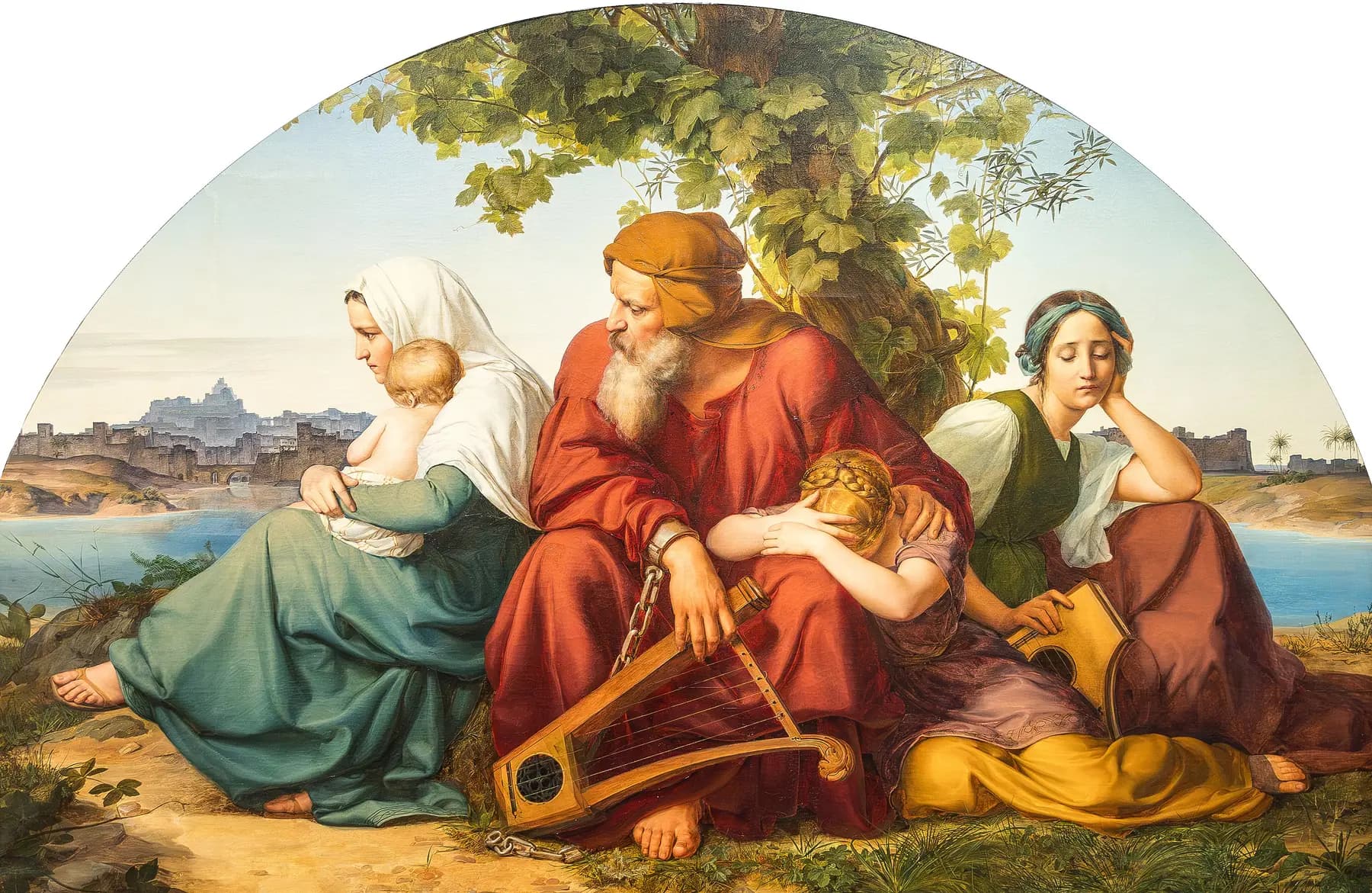
Jews Mourning in Exile, Eduard Bendemann, 1832, Wallraf-Richartz-Museum. Public domain.
Old Testament · Book 12 of 66
2 Kings
2 Kings follows the kings of Israel and Judah from the ministry of Elisha to the fall of both kingdoms. Assyria takes Samaria, Babylon takes Jerusalem, and the book closes with King Jehoiachin released from prison in Babylon.
2 Kings follows the kings of Israel and Judah from the ministry of Elisha to the fall of both kingdoms. Assyria takes Samaria, Babylon takes Jerusalem, and the book closes with King Jehoiachin released from prison in Babylon.
What is 2 Kings about?
2 Kings opens after the death of Ahab, with Elijah's last word to a king who sought another god. It then follows two kingdoms side by side, Israel in the north and Judah in the south, reign by reign, and measures every king by one rule. Prophets warn both, and the book records their call: “Turn from your wicked ways and keep My commandments and statutes” (17:13). Israel falls to Assyria. Judah outlasts it, finds the lost Book of the Law, and still falls to Babylon, and the temple burns. The book ends with a king of David's line released from prison and eating at a foreign king's table.
All 25 chapters
Every chapter of the book, in one grid. Each cell opens that chapter.
- The mantle and the word2 Kings 1 to 8
- Ahab's house removed2 Kings 9 to 12
- The north runs down2 Kings 13 to 17
- Hezekiah and Assyria2 Kings 18 to 20
- Manasseh and Josiah2 Kings 21 to 23
- The fall of Jerusalem2 Kings 24 to 25
The colour is the movement of the book the chapter stands in, and every cell opens that chapter's Study level.
Who wrote it, where, when, for whom, and why?
2 Kings names no writer. It names its sources: the rest of a king's acts, it says, are written in the Book of the Chronicles of the Kings of Israel (1:18) or of the Kings of Judah (8:23 and 20:20), so the writer worked from royal records. It speaks of the exile as a present state, saying Israel was carried to Assyria, where they are to this day (17:23). The rest of Scripture repeats parts of it: Isaiah 36:1 to 39:8 gives the account of 18:13 to 20:19, and Jeremiah 52:31 to 34 gives the book's last scene. In the New Testament, Jesus names Elijah, Elisha and Naaman at Luke 4:25 to 27, and Matthew 1:11 to 12 names Jeconiah at the exile to Babylon.
The book stands in two capitals, Samaria in the north and Jerusalem in the south, with Elisha's works in the towns between them, at Jericho, Bethel, Shunem, Gilgal and Dothan. Aram presses from Damascus, and Assyria and Babylon come from further off. At its close the scene moves to Babylon (25:28).
The book keeps its own count of time. It opens after the death of Ahab (1:1), dates each king by the year of his counterpart in the other kingdom, and ends in the thirty-seventh year of the exile of Jehoiachin (25:27), so its last scene comes long after the burning of the city it records.
The book is written for a people carried away. Israel is taken to Assyria and settled in Halah, in Gozan and in the cities of the Medes (17:6), and Judah is taken into exile, away from its own land (25:21). Its first readers are the people who saw the temple burn and asked why it came.
The book gives its own reason for both falls. Israel went into exile because the people had sinned against the LORD their God, who brought them out of Egypt (17:7), and though the LORD warned Israel and Judah through all His prophets and seers, they would not listen (17:13 and 14). It also gives the reason Judah lasted as long as it did.
Yet for the sake of His servant David, the LORD was unwilling to destroy Judah, since He had promised to maintain a lamp for David and his descendants forever.
2 Kings 8:19, Berean Standard Bible.
The world behind the book is the age of two empires. Assyria takes Samaria in 722 BC and besieges Jerusalem in 701 BC, dates held with high confidence because Assyrian records name the same kings. Babylon takes Jerusalem in 597 BC, a date fixed to the day by the Babylonian Chronicle, and burns it in 586 BC, a date read as 587 BC on another reckoning of the regnal years. The release of Jehoiachin falls in the first year of Evil-merodach of Babylon, about 561 BC, a date set by Babylonian king lists to within a year.
Sources. 2 Kings 1:1, 1:18, 8:19, 8:23, 17:6, 17:7, 17:13 and 14, 17:23, 18:13 to 20:19, 20:20, 25:21, 25:27 and 25:28; Isaiah 36:1 to 39:8; Jeremiah 52:31 to 34; Luke 4:25 to 27; Matthew 1:11 to 12. Every verse is read in the Berean Standard Bible.
How is 2 Kings arranged, and what is it for?
The 6 movements the text falls into, what it teaches and what it was written to do, and the two thrones it measures.
- The mantle and the word2 Kings 1 to 8, 223 verses
Elijah speaks his last word and is taken up, and Elisha takes his cloak and works in the north. It turns at 2:14.
- Ahab's house removed2 Kings 9 to 12, 115 verses
Jehu is anointed and destroys Ahab's house in the north, Athaliah destroys the royal line in the south, and Joash is crowned. It turns at 9:6.
- The north runs down2 Kings 13 to 17, 153 verses
Elisha dies, four kings of Israel are murdered, Assyria takes tribute and captives, and Samaria falls. It turns at 17:6.
- Hezekiah and Assyria2 Kings 18 to 20, 95 verses
Hezekiah removes the high places, Sennacherib besieges Jerusalem, and the Assyrian camp is struck in one night. It turns at 19:35.
- Manasseh and Josiah2 Kings 21 to 23, 83 verses
Manasseh rebuilds every altar his father tore down, and Josiah finds the Book of the Law and tears them down again. It turns at 22:8.
- The fall of Jerusalem2 Kings 24 to 25, 50 verses
Babylon carries Judah away in two deportations and burns the city, and the book closes on a released king. It turns at 25:9.
The theme
The word of the LORD decides the history of both kingdoms. What a prophet says comes to pass, from Ahaziah's death at Elijah's word (1:17) to the fall of each kingdom, which the book records as the word the LORD had spoken through His servants the prophets (17:23 and 24:2). The promise to David holds Judah's line through its worst reigns (8:19).
The purpose
2 Kings was written so that a people in exile would know why the exile came: the covenant was broken for generations, and the prophets had said what would follow. It also keeps the promise to David in view to its last scene.
Two thrones, one rule: every reign and the verdict the book gives it
Israel, the north 12 reigns, 2 Kings 1 to 17
Chapter
Judah, the south 16 reigns, 2 Kings 8 to 25
11
15
17
Samaria falls and Israel is carried to Assyria (17:6). “Only the tribe of Judah remained” (17:18).
24
- Jehoiachin2 Kings 24 to 25evil, 24:9
- Zedekiah2 Kings 24 to 25evil, 24:19
The lamp for David: the promise that spares Judah under Jehoram is still kept on the last page, when a king of David's line is brought out of prison in Babylon.
25:27The mantle and the word, 2 Kings 1 to 8
What the text says in these 8 chapters, 223 verses, and the pages they open on.
Ahaziah king of Israel sends to the god of Ekron, and dies at Elijah's word. Elijah is taken up in a whirlwind, and Elisha takes his cloak and strikes the Jordan. A run of works in the north follows, from a healed spring to a siege lifted overnight. The movement ends with Elisha weeping before Hazael, the man who will scourge Israel.
Then he took the cloak of Elijah that had fallen from him and struck the waters. “Where now is the LORD, the God of Elijah?” he asked. And when he had struck the waters, they parted to the right and to the left, and Elisha crossed over.
- Study
2 Kings 1Ahaziah inquires of Baal-zebub, and fire falls on the captainsShow the summary and 2 pagesShow summary, 2 pagesHide the summary
Ahaziah falls through the lattice of his upper chamber and sends to inquire of Baal-zebub, the god of Ekron, whether he will recover. Elijah meets the messengers on the road with the question that frames the whole book: 'Is it because there is no God in Israel that you are on your way to inquire of Baal-zebub, the god of Ekron?' The king recognizes the hairy man with the leathern girdle and sends captains of fifty to fetch him; twice fire comes down, and the third captain kneels and begs and is spared. Elijah goes down and repeats the sentence in person, and Ahaziah dies. James and John will ask for this same fire, and be rebuked (Luke 9).
On this chapter (2)
- Elijah on Carmel
Elijah's contest with the prophets of Baal, in 1 Kings.
- 2 Kings 1:17
The verse on its own page, with the commentators on it by era.
- Elijah on Carmel
- Study
2 Kings 2Elijah taken up, and Elisha takes his cloakShow the summary and 3 pagesShow summary, 3 pagesHide the summary
Elijah's last walk (Gilgal to Bethel to Jericho to Jordan), with prophets' sons at every stop telling Elisha what he already knows, and Elisha refusing to leave him. The mantle strikes the water and it parts. Asked what he wants, Elisha asks the firstborn's share: 'let me inherit a double portion of your spirit'. Then chariots of fire and horses of fire part them, and Elijah goes up by a whirlwind while Elisha cries, 'My father, my father, the chariots and horsemen of Israel!' He takes the fallen mantle: 'Where now is the LORD, the God of Elijah?', and the water parts again. Fifty men search three days for a body there is none of.
On this chapter (3)
- Elisha and the double portion
The mantle, the double portion and the works of Elisha.
- Were the jeering boys at Bethel children?
Answered under Where do readers disagree, lower on this page, with each reading and who holds it.
- 2 Kings 2:14
The verse on its own page, with the commentators on it by era.
- Elisha and the double portion
- Study
2 Kings 3Three kings against Moab, and water in the valleyShow the summary and 2 pagesShow summary, 2 pagesHide the summary
Moab's king, a sheep-master paying a hundred thousand lambs in tribute, rebels at Ahab's death. Joram, Jehoshaphat, and the king of Edom march the long way round by the wilderness, and after seven days have no water for army or beasts. Jehoshaphat again asks for a prophet, and Elisha. Who will look toward Joram only for Jehoshaphat's sake. Calls for a minstrel, and as he plays the hand of Jehovah comes: 'Make this valley full of trenches.' Without wind or rain water comes by way of Edom at the morning offering; Moab sees it red as blood and rushes the camp, and is routed. The siege ends when Moab's king offers his eldest son on the wall.
On this chapter (2)
- Whose fury ended the Moab campaign?
Answered under Where do readers disagree, lower on this page, with each reading and who holds it.
- 2 Kings 3:17
The verse on its own page, with the commentators on it by era.
- Whose fury ended the Moab campaign?
- Study
2 Kings 4Oil for a widow, and a son raised at ShunemShow the summary and 2 pagesShow summary, 2 pagesHide the summary
Four miracles of ordinary life, small beside Carmel and greater in their tenderness. A prophet's widow whose creditor is coming for her two children has nothing but a pot of oil, and borrowed vessels fill until there is not one more. A woman of Shunem builds a walled chamber for the man of God and is promised a son; when the boy cries 'My head, my head' in the harvest field and dies on her knees, she rides for Elisha and will not let him go, and the child sneezes seven times. Death in the pot of wild gourds is cured with meal; twenty barley loaves feed a hundred men: 'They shall eat, and shall leave thereof.'
On this chapter (2)
- Elisha and the double portion
The mantle, the double portion and the works of Elisha.
- 2 Kings 4:35
The verse on its own page, with the commentators on it by era.
- Elisha and the double portion
- Study
2 Kings 5Naaman washes in the Jordan, and Gehazi takes his silverShow the summary and 3 pagesShow summary, 3 pagesHide the summary
Naaman is great with his master and honorable, a mighty man of valor, and a leper. The thread that saves him starts with a little captive Israelite maid. He arrives with silver, gold, and raiment and a letter that makes Israel's king rend his clothes: 'Am I God, killing and giving life, that this man expects me to cure a leper?' Elisha does not come out, and Naaman rages at being told to wash seven times in Jordan when Abanah and Pharpar are better rivers; his servants reason him down, and 'his flesh was restored and became like that of a little child, and he was clean.' Gehazi runs after the gift, and Naaman's leprosy cleaves to him. Jesus cites this Syrian in Luke 4.
On this chapter (3)
- Naaman the leper
The Syrian commander cleansed in the Jordan.
- Elisha and the double portion
The mantle, the double portion and the works of Elisha.
- 2 Kings 5:14
The verse on its own page, with the commentators on it by era.
- Naaman the leper
- Study
2 Kings 6An axe head floats, and the hills are full of chariotsShow the summary and 2 pagesShow summary, 2 pagesHide the summary
A borrowed axe head falls into the Jordan and iron swims. Then the Syrian king finds his ambushes betrayed, and his servants tell him Elisha declares in Israel 'the very words you speak in your bedroom.' Horses and chariots surround Dothan by night, and the servant despairs until his eyes are opened and the mountain is full of horses and chariots of fire: 'Do not be afraid … for those who are with us are more than those who are with them.' Elisha prays blindness on the raiders, leads them into Samaria, and feeds them home. Later the mercy is gone: Ben-hadad besieges Samaria until an ass's head sells for eighty pieces of silver and two women agree to eat their sons.
On this chapter (2)
- Elisha and the double portion
The mantle, the double portion and the works of Elisha.
- 2 Kings 6:17
The verse on its own page, with the commentators on it by era.
- Elisha and the double portion
- Study
2 Kings 7Four lepers find the Aramean camp emptyShow the summary and 1 pageShow summary, 1 pageHide the summary
Elisha answers the famine with a price list for tomorrow: fine flour a shekel a measure, barley two measures a shekel, in the gate of Samaria. The captain on whose hand the king leans scoffs about windows in heaven, and is told he will see it and not eat of it. That night four lepers at the gate reason that they will die either way, walk into the Syrian camp at twilight, and find it empty. The Lord had made the host hear chariots. They eat and hide spoil, then stop themselves: 'this day is a day of good tidings, and we hold our peace.' Every word comes true, and the scoffing captain is trodden down in the gate.
On this chapter (1)
- 2 Kings 7:16
The verse on its own page, with the commentators on it by era.
- 2 Kings 7:16
- Study
2 Kings 8Elisha weeps before Hazael, and Jehoram reigns in JudahShow the summary and 2 pagesShow summary, 2 pagesHide the summary
The Shunammite, warned of a seven-year famine, sojourns in Philistine country and returns to find her house and land gone; she walks in on Gehazi telling the king that very story, and gets everything back with the produce of the years. Then Elisha goes to Damascus, where the sick Ben-hadad sends Hazael with forty camels' burden of gifts to ask whether he will recover. Elisha stares him down until he is ashamed, and weeps, telling him what he will do to Israel's strongholds and children, and Hazael smothers his master the next day. Judah meanwhile marries into Ahab's house: Jehoram walks in the way of the kings of Israel, and Edom revolts.
On this chapter (2)
- The Davidic covenant
The promise of a house and a throne for David's line.
- 2 Kings 8:19
The verse on its own page, with the commentators on it by era.
- The Davidic covenant
Characters (4)
Who the text follows. A name with a page carries its door.
Places (3)
Where the chapters stand.
- The Jordan
Where Elijah is taken up and Naaman washes.
- Samaria
The capital, besieged by Ben-hadad and relieved.
- Damascus
Where Elisha tells Hazael he will be king.
Themes (2)
What these chapters raise, each on its own page.
- sepher, book
The word for the book's sources and the scroll found.
- rapha, to heal
The word Elisha speaks over the spring at Jericho.
Where the New Testament uses these chapters (3)each marked as a quotation or an allusion, with the evidence
- Explicit quotationNaaman cleansed, 2 Kings 5:14 at Luke 4:27. Jesus names Naaman the Syrian as the one leper cleansed in Elisha's day. Jesus names the man and the prophet in the Nazareth synagogue; he cites the event and does not quote its words.
- Probable allusionFire from heaven, 2 Kings 1:10 at Luke 9:54. James and John ask whether to call down fire from heaven on a Samaritan village. The request echoes the words of Elijah's answer to the captains, and Jesus rebukes it.
- Probable allusionThe Shunammite's son, 2 Kings 4:35 at Hebrews 11:35. Women received back their dead, raised to life again. Hebrews names no one; the Shunammite at 4:35 and the widow of Zarephath at 1 Kings 17:22 are the two Old Testament mothers the line fits.
Ahab's house removed, 2 Kings 9 to 12
What the text says in these 4 chapters, 115 verses, and the pages they open on.
Jehu, an army commander, is anointed king over Israel and destroys the house of Ahab and the servants of Baal, but keeps Jeroboam's calves. In Jerusalem, Athaliah kills the royal heirs and rules for six years while the infant Joash is hidden in the temple. In the seventh year Jehoiada the priest crowns him, and Joash repairs the house of the LORD.
Know, then, that not a word the LORD has spoken against the house of Ahab will fail, for the LORD has done what He promised through His servant Elijah.”
- Study
2 Kings 9Jehu anointed, and Joram, Ahaziah and Jezebel killedShow the summary and 1 pageShow summary, 1 pageHide the summary
Elisha sends a young prophet to anoint Jehu in an inner chamber at Ramoth-gilead and then flee, judgment on the house of Ahab, to avenge the blood of the prophets. The captains spread their garments under him on the bare steps and blow the trumpet. Then the ride the watchman recognizes: 'the charioteer is driving like Jehu son of Nimshi … he is driving like a madman!' Joram turns to flee crying treachery, is shot between the arms, and is cast into the portion of Naboth the Jezreelite, exactly as Elijah said. Jezebel paints her eyes and meets him at the window ('Have you come in peace, O Zimri, murderer of your master?') and the dogs eat her.
On this chapter (1)
- 2 Kings 9:36
The verse on its own page, with the commentators on it by era.
- 2 Kings 9:36
- Study
2 Kings 10Ahab's sons and the servants of Baal destroyedShow the summary and 1 pageShow summary, 1 pageHide the summary
Jehu writes to the guardians of Ahab's seventy sons in Samaria and dares them to fight; instead they send seventy heads in baskets, and he lays them in two heaps at the gate of Jezreel and preaches over them that not one word of Jehovah shall fall to the earth. He cuts down Ahaziah's kinsmen at the shearing-house, takes Jehonadab son of Rechab into his chariot to see his zeal, then springs the trap: a great assembly proclaimed for Baal, the house filled end to end, vestments handed out, and eighty men waiting outside. Baal's house is broken down and made a draught-house. But Jehu does not depart from the golden calves; four generations are promised him.
On this chapter (1)
- 2 Kings 10:10
The verse on its own page, with the commentators on it by era.
- 2 Kings 10:10
- Study
2 Kings 11Athaliah seizes the throne, and Joash is crownedShow the summary and 2 pagesShow summary, 2 pagesHide the summary
Athaliah sees her son dead and destroys all the seed royal. The one moment when the promise to David hangs by a single thread. That thread is Joash, an infant stolen away by Jehosheba and hidden with his nurse in the house of Jehovah six years while Athaliah reigns. In the seventh year Jehoiada the priest takes the captains into covenant and arms them with king David's spears and shields from the temple. The boy is brought out, given the crown and the testimony, anointed and clapped to: 'Long live the king.' Athaliah tears her clothes and cries 'Treason! treason!' and is put to death outside the house. Then a covenant, and Baal's house torn down.
On this chapter (2)
- The Davidic covenant
The promise of a house and a throne for David's line.
- 2 Kings 11:12
The verse on its own page, with the commentators on it by era.
- The Davidic covenant
- Study
2 Kings 12Joash repairs the temple by a chest at the altarShow the summary and 1 pageShow summary, 1 pageHide the summary
Jehoash reigns forty years and does right all the days that Jehoiada instructs him, though the high places remain. The temple has fallen into disrepair, and the priests' arrangement (each taking money from his acquaintance to fund repairs), produces nothing for twenty-three years. So Jehoiada bores a hole in the lid of a chest and sets it beside the altar, and when the money is much, the king's scribe and the high priest count it and give it to the workmen. The famous detail: no reckoning is required of the men into whose hands it is delivered, for they dealt faithfully. Hazael is bought off with the hallowed things; Joash is killed by his own servants.
On this chapter (1)
- 2 Kings 12:9
The verse on its own page, with the commentators on it by era.
- 2 Kings 12:9
Three words spoken against a king's house, and the verse that records each one done
| The word | Spoken | Done | What the text records |
|---|---|---|---|
| Ahaziah will not rise from his bedAhaziah dies according to the word Elijah had spoken. | 2 Kings 1:16 | 2 Kings 1:17 | Ahaziah dies according to the word Elijah had spoken. |
| The dogs will devour Jezebel at JezreelJehu names the word of Elijah the Tishbite when he hears what is left of her. | 1 Kings 21:23 | 2 Kings 9:36 | Jehu names the word of Elijah the Tishbite when he hears what is left of her. |
| Four generations of Jehu's sons on the throneZechariah, the fourth, is murdered after six months, and the book says the word was fulfilled. | 2 Kings 10:30 | 2 Kings 15:12 | Zechariah, the fourth, is murdered after six months, and the book says the word was fulfilled. |
Characters (4)
Who the text follows. A name with a page carries its door.
- Jehu
The commander anointed king, who destroys Ahab's house.
- Jezebel
Ahab's queen, thrown down at Jezreel.
- Athaliah
Ahab's daughter, who rules Judah for six years.
- Jehoiada
The priest who hides Joash and crowns him.
Places (3)
Where the chapters stand.
Themes (1)
What these chapters raise, each on its own page.
- dabar, word
The word of the LORD that does not fail.
No New Testament passage quotes or names these four chapters.
The north runs down, 2 Kings 13 to 17
What the text says in these 5 chapters, 153 verses, and the pages they open on.
Israel is pressed by Aram, Elisha dies, and the LORD is gracious to Israel for the sake of His covenant with Abraham, Isaac and Jacob. Jeroboam II restores the borders, and then the throne changes hands by murder four times in one chapter. Assyria takes silver, then Galilee, then Samaria itself, and the book sets out the reason at length.
So the LORD was very angry with Israel, and He removed them from His presence.
- Study
2 Kings 13Elisha's arrows, his death, and a man revived at his bonesShow the summary and 2 pagesShow summary, 2 pagesHide the summary
Jehoahaz's Israel is ground down until Hazael leaves him only fifty horsemen, ten chariots, and ten thousand footmen, made like the dust in threshing. Yet when he entreats Jehovah a savior is given, for the sake of the covenant with Abraham, Isaac, and Jacob. Then Elisha's deathbed and the last enacted prophecy of his life. Jehoash weeps over him with Elisha's own words for Elijah, and is told to shoot eastward through the opened window: 'The arrow of Jehovah's victory.' Told next to smite the ground, he strikes three times and stops, and the man of God is angry. Now he will beat Syria only thrice. Even Elisha's bones raise a corpse thrown hastily into his grave.
On this chapter (2)
- Elisha and the double portion
The mantle, the double portion and the works of Elisha.
- 2 Kings 13:20
The verse on its own page, with the commentators on it by era.
- Elisha and the double portion
- Study
2 Kings 14Amaziah spares the sons, and Jeroboam II restores the borderShow the summary and 2 pagesShow summary, 2 pagesHide the summary
Amaziah executes his father's murderers but spares their children, obeying Moses' law that fathers shall not die for children nor children for fathers. Flush with victory over Edom in the Valley of Salt, he challenges Jehoash, who answers with a parable of a thistle in Lebanon that asked a cedar for his daughter and was trodden down by a wild beast. And tells him to stay home and glory in it. He does not, and Judah is beaten at Beth-shemesh, Jerusalem's wall broken four hundred cubits, the temple plundered. In the north Jeroboam the second restores the border from the entering in of Hamath to the sea of the Arabah, as Jehovah spoke by Jonah the son of Amittai.
On this chapter (2)
- Why did Manasseh's sins fall on a later generation?
Answered under Where do readers disagree, lower on this page, with each reading and who holds it.
- 2 Kings 14:6
The verse on its own page, with the commentators on it by era.
- Why did Manasseh's sins fall on a later generation?
- Study
2 Kings 15Six kings, four of them murdered, and Assyria arrivesShow the summary and 3 pagesShow summary, 3 pagesHide the summary
Judah has one long steady reign. Azariah, fifty-two years, doing right except for the high places, struck with leprosy so that he dwells in a separate house while Jotham judges the people. Israel has six kings and almost none dies in bed. Zechariah is struck down in public after six months, ending Jehu's four generations exactly as promised. Shallum lasts a month. Menahem buys off Pul king of Assyria with a thousand talents of silver exacted from every mighty man of wealth. The empire's first named entrance into the story. Pekahiah is assassinated by his captain Pekah, in whose days Tiglath-pileser carries away Gilead and Galilee and all Naphtali. Hoshea inherits a country running out of time.
On this chapter (3)
- Assyria
The empire that took Samaria and besieged Jerusalem.
- Do the regnal numbers agree?
Answered under Where do readers disagree, lower on this page, with each reading and who holds it.
- 2 Kings 15:29
The verse on its own page, with the commentators on it by era.
- Assyria
- Study
2 Kings 16Ahaz buys Assyria's help and copies an altarShow the summary and 2 pagesShow summary, 2 pagesHide the summary
Ahaz does not do right in the eyes of Jehovah: he walks in the way of the kings of Israel, and makes his son to pass through the fire, according to the abominations of the nations Jehovah cast out. Besieged by Rezin of Syria and Pekah of Israel, he sends silver and gold from the house of Jehovah to Tiglath-pileser with the words, 'I am your servant and your son', and Assyria takes Damascus. Going to meet his new overlord there, Ahaz sees an altar he likes, sends the pattern to Urijah the priest, and has a copy installed; the bronze altar is shifted aside, and the temple furniture cut up and rearranged because of the king of Assyria.
On this chapter (2)
- Assyria
The empire that took Samaria and besieged Jerusalem.
- 2 Kings 16:10
The verse on its own page, with the commentators on it by era.
- Assyria
- Study
2 Kings 17Samaria falls, and the book gives the reasonShow the summary and 4 pagesShow summary, 4 pagesHide the summary
Samaria falls. Hoshea sends to So king of Egypt and stops paying tribute; Shalmaneser besieges the city three years and takes it, and Israel is carried to Halah and Habor by the river of Gozan and the cities of the Medes. Then the narrator stops the chronicle and preaches the longest explanation in Kings: it happened because Israel sinned against the Jehovah who brought them out of Egypt. High places in every city, pillars and Asherim on every high hill, molten calves, the host of heaven, children passed through the fire, divination, and prophets sent again and again and not heard. Of the foreigners resettled there the verdict is exact: 'They feared Jehovah, and served their own gods.'
On this chapter (4)
- Assyria
The empire that took Samaria and besieged Jerusalem.
- The covenant lawsuit
The prophets' charge against a people who broke the covenant.
- The remnant
The few the LORD leaves when judgment falls.
- 2 Kings 17:7
The verse on its own page, with the commentators on it by era.
- Assyria
Israel's last seven kings, each reign a step, and Assyria entering at three of them
Jeroboam II 41 years (14:23), rests with his fathers (14:29)
Menahem 10 years (15:17), rests with his fathers (15:22)AssyriaPul takes a thousand talents of silver (15:19)
Pekah 20 years (15:27), murdered (15:30)AssyriaTiglath-pileser takes Galilee and carries its people away (15:29)
Hoshea 9 years (17:1), imprisoned by the king of Assyria (17:4)AssyriaShalmaneser makes Hoshea his vassal (17:3)
In the ninth year of Hoshea the king of Assyria takes Samaria and carries Israel away (17:6).
Characters (4)
Who the text follows. A name with a page carries its door.
- Jeroboam II
The last long reign in Israel, forty-one years.
- Ahaz
King of Judah who calls himself Assyria's servant.
- Hoshea
The last king of Israel.
- Tiglath-pileser
King of Assyria, who takes Galilee and answers Ahaz's call.
Places (3)
Where the chapters stand.
Themes (1)
What these chapters raise, each on its own page.
- galah, to go into exile
The verb of Israel carried away to Assyria.
No New Testament passage quotes these chapters. Reading the Samaritan woman's surprise at John 4:9 back to the peoples settled in Samaria at 17:24 is a later Christian reading.
Hezekiah and Assyria, 2 Kings 18 to 20
What the text says in these 3 chapters, 95 verses, and the pages they open on.
Hezekiah trusts the LORD and removes the high places. Sennacherib of Assyria takes the fortified cities of Judah, and his officers mock the LORD at the wall of Jerusalem. Hezekiah spreads the king's letter before the LORD, and in one night the angel of the LORD strikes the Assyrian camp. Hezekiah falls ill, is given fifteen more years, and shows his treasures to envoys from Babylon.
And now, O LORD our God, please save us from his hand, so that all the kingdoms of the earth may know that You alone, O LORD, are God.”
- Study
2 Kings 18Hezekiah's reform, and the Rabshakeh at the wallShow the summary and 2 pagesShow summary, 2 pagesHide the summary
Hezekiah is the reformer Kings has waited for: he removes the high places, breaks the pillars, cuts down the Asherah, and breaks in pieces the brazen serpent Moses had made, because Israel had been burning incense to it, calling it Nehushtan. 'He trusted in Jehovah, the God of Israel; so that after him was none like him among all the kings of Judah, nor among them that were before him.' In his fourteenth year Sennacherib takes the fortified cities and Hezekiah pays three hundred talents of silver, stripping the temple doors. Then Rabshakeh stands at the conduit of the upper pool and speaks deliberately in the Jews' language: Egypt is a bruised reed that will pierce the hand.
On this chapter (2)
- Assyria
The empire that took Samaria and besieged Jerusalem.
- 2 Kings 18:5
The verse on its own page, with the commentators on it by era.
- Assyria
- Study
2 Kings 19Hezekiah prays, and the camp is struck in one nightShow the summary and 3 pagesShow summary, 3 pagesHide the summary
Hezekiah rends his clothes, covers himself with sackcloth, goes into the house of Jehovah, and sends to Isaiah: the day, he says, when the children are come to the birth and there is not strength to bring forth. Isaiah answers, be not afraid of the words wherewith Assyria's servants have blasphemed. When the threatening letter comes, Hezekiah spreads it before Jehovah and prays plainly: you are the God, even you alone, of all the kingdoms of the earth, and the gods Assyria burned were wood and stone. Isaiah's oracle mocks the boaster: 'I will put My hook in your nose and My bit in your mouth; I will send you back the way you came.' That night the angel of Jehovah smites a hundred and eighty-five thousand.
On this chapter (3)
- Assyria
The empire that took Samaria and besieged Jerusalem.
- What struck Sennacherib's camp?
Answered under Where do readers disagree, lower on this page, with each reading and who holds it.
- 2 Kings 19:35
The verse on its own page, with the commentators on it by era.
- Assyria
- Study
2 Kings 20Fifteen years added, and the envoys from BabylonShow the summary and 4 pagesShow summary, 4 pagesHide the summary
Hezekiah is sick to the point of death and Isaiah brings the word: 'Put your house in order, for you are about to die; you will not recover.' He turns his face to the wall and weeps sore, and before Isaiah is out of the middle court he is sent back. Fifteen years added, the city defended. Offered a sign, Hezekiah asks the harder one: the shadow goes backward ten steps on the dial of Ahaz, and a cake of figs heals the boil. Then the sag: envoys from Babylon come, and Hezekiah shows them everything. Isaiah says it will all be carried to Babylon, and the king's reply is honest and small: 'Will there not at least be peace and security in my lifetime?'
On this chapter (4)
- Hezekiah's sundial
The sign on the stairway of Ahaz.
- Babylon
The city that took Judah into exile.
- How did the shadow go back on the stairway?
Answered under Where do readers disagree, lower on this page, with each reading and who holds it.
- 2 Kings 20:11
The verse on its own page, with the commentators on it by era.
- Hezekiah's sundial
Characters (4)
Who the text follows. A name with a page carries its door.
- Hezekiah
The king who prayed over Sennacherib's letter.
- Isaiah
The prophet who answers Hezekiah and gives the sign.
- Sennacherib
King of Assyria, who besieges Jerusalem.
- The Rabshakeh
The Assyrian officer who speaks at the wall.
Places (3)
Where the chapters stand.
Themes (1)
What these chapters raise, each on its own page.
- rapha, to heal
The verb of the LORD's promise to heal Hezekiah.
No New Testament passage quotes or names these three chapters. Isaiah 36 to 39 repeats them within the Old Testament.
Manasseh and Josiah, 2 Kings 21 to 23
What the text says in these 3 chapters, 83 verses, and the pages they open on.
Manasseh rebuilds everything his father tore down, and the LORD announces that Jerusalem will be wiped out as one wipes a bowl. His grandson Josiah repairs the temple, and there Hilkiah finds the Book of the Law. Josiah reads it to the people, makes a covenant, removes every shrine from Geba to Beersheba and keeps the Passover. Then he rides out against Pharaoh Neco and is killed at Megiddo.
Neither before nor after Josiah was there any king like him, who turned to the LORD with all his heart and with all his soul and with all his strength, according to all the Law of Moses.
- Study
2 Kings 21Manasseh rebuilds every altar his father destroyedShow the summary and 2 pagesShow summary, 2 pagesHide the summary
Manasseh reigns fifty-five years, the longest in Judah's history and the worst. He rebuilds the high places his father broke, raises altars for Baal and an Asherah as Ahab did, worships the host of heaven, and builds altars in the two courts of the house of which Jehovah had said, 'In Jerusalem will I put my name.' He makes his son pass through the fire, practices augury, deals with them that have familiar spirits, and fills Jerusalem with innocent blood from one end to another. The prophets answer with a builder's image of demolition: the line of Samaria and the plummet of Ahab's house stretched over Jerusalem, the city wiped as a man wipes a dish and turns it upside down.
On this chapter (2)
- Why did Manasseh's sins fall on a later generation?
Answered under Where do readers disagree, lower on this page, with each reading and who holds it.
- 2 Kings 21:13
The verse on its own page, with the commentators on it by era.
- Why did Manasseh's sins fall on a later generation?
- Study
2 Kings 22The Book of the Law found, and Huldah's answerShow the summary and 4 pagesShow summary, 4 pagesHide the summary
Josiah comes to the throne at eight years old and walks in the way of David his father, turning aside neither to right hand nor left. In his eighteenth year he sends Shaphan the scribe to Hilkiah the high priest to reckon the temple-repair money, and Hilkiah says, 'I have found the book of the law in the house of Jehovah.' Shaphan reads it before the king, and Josiah rends his clothes: great is the wrath kindled against a people whose fathers did not hearken. The inquiry goes to Huldah the prophetess, whose answer is both halves of the truth: all the words of the book will come upon this place, but Josiah will be gathered to his grave in peace.
On this chapter (4)
- Josiah finds the book
The scroll found in the temple and the reform that followed.
- Huldah
The prophetess Josiah's officers consulted.
- How does Huldah's promise of peace hold beside Megiddo?
Answered under Where do readers disagree, lower on this page, with each reading and who holds it.
- 2 Kings 22:8
The verse on its own page, with the commentators on it by era.
- Josiah finds the book
- Study
2 Kings 23Josiah's covenant and reform, and his death at MegiddoShow the summary and 2 pagesShow summary, 2 pagesHide the summary
Josiah gathers all the people, small and great, reads the whole book in their ears, stands by the pillar to make a covenant. Then works down the list. Vessels made for Baal are burned in the fields of Kidron, the idolatrous priests put down, the Asherah beaten to dust, the sodomites' houses broken down, Topheth defiled so no man can make his son pass through the fire, the horses of the sun taken away. At Bethel he breaks Jeroboam's altar and burns bones on it, fulfilling the man of God's cry three centuries earlier. Then a Passover unlike any since the days of the judges. Yet the wrath kindled by Manasseh does not turn, and Josiah falls at Megiddo.
On this chapter (2)
- Josiah finds the book
The scroll found in the temple and the reform that followed.
- 2 Kings 23:25
The verse on its own page, with the commentators on it by era.
- Josiah finds the book
What Manasseh set up and Josiah tore down, item by item
| What | Manasseh sets it up | Josiah tears it down |
|---|---|---|
| The high places | 21:3 | 23:8 |
| The Asherah pole | 21:7 | 23:6 |
| Altars in the two courtyards | 21:5 | 23:12 |
| A son sacrificed in the fire | 21:6 | 23:10 |
| Mediums and spiritists | 21:6 | 23:24 |
Yet the LORD “did not turn away from the fury of His burning anger” because of all that Manasseh had done (23:26).
Characters (4)
Who the text follows. A name with a page carries its door.
- Manasseh
The king whose sins the book names as the cause.
- Josiah
The king who found the book and turned to the LORD.
- Hilkiah
The high priest who finds the Book of the Law.
- Huldah
The prophetess who answers Josiah's inquiry.
Places (2)
Where the chapters stand.
- Bethel
Where Josiah tears down Jeroboam's altar.
- Megiddo
Where Neco kills Josiah.
Themes (1)
What these chapters raise, each on its own page.
- shub, to turn
The verb of Josiah's turning to the LORD.
No New Testament passage quotes or names these three chapters.
The fall of Jerusalem, 2 Kings 24 to 25
What the text says in these 2 chapters, 50 verses, and the pages they open on.
Jehoiakim rebels against Nebuchadnezzar, and his son Jehoiachin surrenders Jerusalem and is carried to Babylon with the court and the temple treasures. Zedekiah rebels in his turn, and the city is besieged and breached. Nebuzaradan burns the house of the LORD, and after the governor Gedaliah is murdered the rest flee to Egypt. In the book's last scene Jehoiachin is released from prison.
And he spoke kindly to Jehoiachin and set his throne above the thrones of the other kings who were with him in Babylon.
- Study
2 Kings 24Jehoiachin surrenders, and the first deportationShow the summary and 3 pagesShow summary, 3 pagesHide the summary
The end comes in stages. Jehoiakim serves Nebuchadnezzar three years and then rebels, and bands of Chaldeans, Syrians, Moabites, and Ammonites are sent against Judah according to the word Jehovah spoke by his servants the prophets: for the sins of Manasseh and the innocent blood he would not pardon. The king of Egypt comes no more out of his land, for Babylon has taken all from the brook of Egypt to the Euphrates. Jehoiachin reigns three months and goes out to the besieging king with his mother and his servants; the golden vessels are cut in pieces, and ten thousand captives with all the craftsmen and smiths are carried off, none remaining save the poorest sort.
On this chapter (3)
- Babylon
The city that took Judah into exile.
- The exile and the return
The deportations to Babylon and the return that followed.
- 2 Kings 24:14
The verse on its own page, with the commentators on it by era.
- Babylon
- Study
2 Kings 25Jerusalem burned, Gedaliah killed, Jehoiachin releasedShow the summary and 4 pagesShow summary, 4 pagesHide the summary
The ninth year, the tenth month, the tenth day: Nebuchadnezzar encamps against Jerusalem and builds forts round about, and the siege runs to the eleventh year, till famine leaves no bread in the city. The wall is broken, the men of war flee by night, and Zedekiah is overtaken in the plains of Jericho. His sons slain before his eyes, his own eyes put out, and he bound in fetters to Babylon. Nebuzaradan burns the house of Jehovah and every great house and breaks down the walls. Gedaliah's brief governorship at Mizpah ends in murder. The last paragraph is a rumor of hope: Evil-merodach lifts up Jehoiachin's head out of prison and seats him at his table all his days.
On this chapter (4)
- Babylon
The city that took Judah into exile.
- The exile and the return
The deportations to Babylon and the return that followed.
- Zion and Jerusalem
The city chosen for the Name, from David to the new Jerusalem.
- 2 Kings 25:9
The verse on its own page, with the commentators on it by era.
- Babylon
Three removals empty the land, and one release closes the book
1. 24:12 to 14
Jehoiachin surrenders and is taken captive, with ten thousand captives; only the poorest people of the land remain.
2. 25:11
Nebuzaradan carries into exile the people who remained in the city and the rest of the population.
3. 25:26
After Gedaliah is murdered, the people small and great flee to Egypt.
The release, 25:27 to 30
In the thirty-seventh year of his exile Jehoiachin is released from prison and dines at the king's table for the rest of his life.
Characters (4)
Who the text follows. A name with a page carries its door.
- Nebuchadnezzar
King of Babylon, who takes Jerusalem twice.
- Jehoiachin
The king carried to Babylon and released at the end.
- Zedekiah
The last king in Jerusalem, blinded and taken to Babylon.
- Gedaliah
The governor left over the land, murdered at Mizpah.
Places (3)
Where the chapters stand.
Themes (2)
What these chapters raise, each on its own page.
- zera, offspring
The line of David kept to the last page.
- galah, to go into exile
Judah taken into exile, away from its own land.
Where the New Testament uses these chapters (1)each marked as a quotation or an allusion, with the evidence
- Explicit quotationJehoiachin and the exile, 2 Kings 24:12 to 25:30 at Matthew 1:11 to 12. Matthew's genealogy runs through Jeconiah at the exile to Babylon and after it. Matthew names Jeconiah and the deportation to Babylon; he names the event and the king and does not quote the words of 2 Kings.
- Author
- Compiler anonymous; Jewish tradition attributes to Jeremiah (same as 1 Kings)
- Date
- Events c. 852–560 BC; closing coda places composition in the mid-exile, c. 560 BC
- Audience
- The exilic community in Babylon; the answer to ‘how did we get here?’
Where do readers disagree?
9 questions in one list: the readings with their holders, and what the evidence does not settle.
Who compiled Kings, and when?
- Jeremiah compiled Kings. Held by the Babylonian Talmud's Bava Batra 15a.
- An anonymous exilic historian, one hand across Deuteronomy through Kings. Held by Noth, whose work is named under Sources.
- Two editions, one under Josiah and one in the exile. Held by Cross, whose work is named under Sources.
What the evidence does not settle: Whether the book was written in one stage after the release of 25:27 or finished then from an earlier edition. The last scene sets the earliest date for the book as the reader holds it.
The argument in full
The book names no author. It does name its sources, citing 'the book of the chronicles of the kings of Judah' and its northern counterpart at the close of nearly every reign, which tells the reader plainly that a compiler is at work with royal records in front of him. In the Hebrew Bible 1 and 2 Kings are one book among the Former Prophets; the split into two came with the Greek translation, which carried the work as 3 and 4 Reigns, and printed Hebrew Bibles adopted the division only in the sixteenth century. The book's last scene fixes its earliest possible completion. Jehoiachin is released in the accession year of Evil-merodach of Babylon (25:27), which Babylonian records place in 562 or 561 BC, and the account of his daily allowance runs 'for the rest of his life' (25:30). The compiler therefore wrote in the exile, whatever else is argued about earlier stages of the work.
Jeremiah compiled Kings. the Babylonian Talmud, Bava Batra 15a (redacted c. AD 500), which states that Jeremiah wrote his own book, the book of Kings, and Lamentations; followed by much of the rabbinic tradition and by a line of Christian commentators after it. The proposal fits a prophet who lived through Josiah's reform and the fall of Jerusalem, and it accounts for the long verbal overlap between 2 Kings 24-25 and Jeremiah 52.
An anonymous exilic historian, one hand across Deuteronomy through Kings. Martin Noth (Überlieferungsgeschichtliche Studien, 1943), who proposed a single exilic writer shaping the whole run of narrative from Deuteronomy to 2 Kings, and the mainstream tradition following him.
Two editions, one under Josiah and one in the exile. Frank Moore Cross (Canaanite Myth and Hebrew Epic, 1973), whose double-redaction proposal reads chapters 22-23 as the high point of a first edition written while Josiah still reigned, with chapters 24-25 added after 586 BC.
Were the jeering boys at Bethel children?
Elisha and the Double Portion→- Grown youths, and an assault on the prophetic office. Held by Keil and Delitzsch, whose work is named under Sources.
- Younger children, raised in Bethel's idolatry. Held by Henry, whose work is named under Sources.
What the evidence does not settle: The age of the naarim: the word covers a child and a young man, and the text gives no age.
The argument in full
At Bethel 'a group of boys came out of the city and jeered at him' (2:23), and after Elisha cursed them 'two female bears came out of the woods and mauled forty-two of the boys' (2:24). The Hebrew word behind boys is naar, and the lexicon defines its range from infancy to adolescence, with servant as a common further sense. Scripture uses it of Joseph at seventeen, where the Hebrew calls the seventeen-year-old a naar while he tends the flock 'with his brothers, the sons of his father’s wives Bilhah and Zilpah' (Genesis 37:2), and of Benjamin, 'Send the boy with me' (Genesis 43:8), a man who fathers ten sons in the next chapters. The same evidence governs this site's handling of Isaac's age at the altar. Four further details belong on the page: Bethel was the site of Jeroboam's rival calf shrine, the mockery was 'Go up, you baldhead!', which throws Elijah's ascension back at his successor, forty-two is a crowd rather than a handful, and the number recurs at 10:14 where Jehu's men slaughter 'forty-two men'. What the text describes is a hostile mob at a cult center jeering at a prophet's office on the day he took it up.
Grown youths, and an assault on the prophetic office. Keil and Delitzsch (Biblical Commentary on the Old Testament: The Books of the Kings, 1872), who argue the naarim were of an age to answer for themselves and that the mockery was aimed at the LORD through His prophet.
Younger children, raised in Bethel's idolatry. Matthew Henry (An Exposition of the Old and New Testament, 1708-1710), who reads them as children of the town's calf-worshipping households and lays the guilt on the parents who taught them.
Whose fury ended the Moab campaign?
- The grief and anger of the besiegers. Held by Wesley, and by Barnes.
- The LORD's displeasure at Israel. Held by Jamieson, Fausset and Brown, and by Clarke.
What the evidence does not settle: Whose fury it was: the Hebrew names no source for it, and the narrative does not explain it.
The argument in full
Moab's king, cornered in his last city, 'took his firstborn son, who was to succeed him, and offered him as a burnt offering on the city wall. And there was great fury against the Israelites, so they withdrew and returned to their own land' (3:27). The Hebrew names no source for the wrath, and translators have to decide. The narrative is reporting what happened and why the siege lifted, and it declines to explain the mechanism.
The grief and anger of the besiegers. Wesley reads the fury as great trouble in Israel: the king and people who began the war were grieved at the sacrifice and gave up the siege. Barnes reads it as Israel's anger at itself, or as the anger of Judah and Edom at Israel for causing the sacrifice.
The LORD's displeasure at Israel. Jamieson, Fausset and Brown hold that the allied army drove the king of Moab to a sacrifice the law forbids, and that the besiegers feared the anger of God they had brought on themselves. Clarke reads the verse as the LORD displeased with Israel for pressing the siege to that point, and sets two human readings beside it.
Do the regnal numbers agree?
- The numbers are consistent once the ancient conventions are applied. Held by Thiele, whose work is named under Sources.
- The numbers carry later schematic adjustment. Held by Galil, whose work is named under Sources.
What the evidence does not settle: How far the conventions account for every figure, since some synchronisms still need a proposed coregency to fit.
The argument in full
The book dates each king by the regnal year of his counterpart in the other kingdom, and read as flat arithmetic the totals for Israel and Judah refuse to match. The classic solution treats the numbers as accurate records kept by two courts using different conventions, and the text itself supplies the evidence for one of them: when Azariah is struck with leprosy, 'he lived in a separate house while his son Jotham had charge of the palace and governed the people of the land' (15:5), which is a coregency in plain sight.
The numbers are consistent once the ancient conventions are applied. Edwin R. Thiele (The Mysterious Numbers of the Hebrew Kings, 1951), who showed that Judah and Israel counted regnal years from different new years, used accession and non-accession reckoning at different periods, and recorded coregencies as full reigns; his synchronisms are the basis for the standard dates of 931, 722, and 586 BC used across conservative and critical scholarship alike.
The numbers carry later schematic adjustment. critical scholars including Julius Wellhausen and, more recently, Gershon Galil (The Chronology of the Kings of Israel and Judah, 1996), who accept much of the data as ancient while holding that some figures were rounded or harmonized in transmission.
What struck Sennacherib's camp?
Assyria, and the night outside Jerusalem→- An angel, and no man's sword. Held by Henry, whose work is named under Sources.
- A judgment of God carried by a deadly wind. Held by Clarke, and by Jamieson, Fausset and Brown.
What the evidence does not settle: The means: the text names the agent and no mechanism, and the outside records confirm the siege and the withdrawal without describing the night.
The argument in full
Sennacherib 'attacked and captured all the fortified cities of Judah' (18:13), and Jerusalem alone survived, because 'the angel of the LORD went out and struck down 185,000 men in the camp of the Assyrians' (19:35). Two outside witnesses touch the event. Sennacherib's own annals record the tribute and the shutting up of Hezekiah and never claim the city, which is a loud silence in a document that catalogues every other capture. Herodotus, writing about two and a half centuries later, reports an Egyptian temple tradition that field mice swarmed the Assyrian camp at Pelusium and gnawed their bowstrings and shield straps so the army fled (Histories 2.141). The mouse story is an Egyptian account of an Egyptian deliverance in a different place, and it is worth naming as an outside echo of a sudden Assyrian collapse rather than as confirmation of the biblical scene.
An angel, and no man's sword. Henry reads the verse beside Isaiah 31: the Assyrian army fell by the sword of no man, great or small, but by an angel.
A judgment of God carried by a deadly wind. Clarke takes the angel of the LORD to be a suffocating wind sent by God, the blast promised at 19:7. Jamieson, Fausset and Brown call the deliverance a miraculous act of God and name the hot south wind, the simoon, as its most probable means.
How did the shadow go back on the stairway?
Hezekiah's Sundial→- A sign over the sun itself. Held by Henry, whose work is named under Sources.
- A sign in the shadow on the steps. Held by Clarke, and by Gill, who cites Ben Gersom.
What the evidence does not settle: Whether the sign moved the sun or the shadow alone: the text reports the shadow on the stairway of Ahaz and says nothing of the sun.
The argument in full
Isaiah offered Hezekiah a choice of sign, 'Would you like the shadow to go forward ten steps, or back ten steps?' (20:9), and Hezekiah asked for the harder one. The text reports that Isaiah prayed and God 'He brought the shadow back the ten steps it had descended on the stairway of Ahaz' (20:11). Readings differ over whether the sign was cosmic in scale or local to the steps themselves, and the account states both the request and the answer plainly either way.
A sign over the sun itself. Henry reads the sign as the sun held under the check of the God of Israel, which showed the worship of the sun to be folly.
A sign in the shadow on the steps. Clarke doubts that the sun went back in the heavens or that the earth turned back on its axis, and reads ten divisions of a dial. Gill reports Ben Gersom's reading, that the sign moved the shadow and not the sun.
How does Huldah's promise of peace hold beside Megiddo?
Huldah, the prophetess who read the scroll→- Peace in the time of his death, not its manner. Held by Henry, and by Barnes.
- Peace with God. Held by Wesley, and by Clarke.
What the evidence does not settle: What in peace covered: the manner of Josiah's death or his being spared the sight of the city's fall.
The argument in full
Huldah's word to Josiah was that he would be gathered to his grave in peace and that 'Your eyes will not see all the calamity that I will bring on this place' (22:20). Josiah then rode out against Egypt and 'Neco faced him and killed him at Megiddo' (23:29). The two readings below differ over what the promise covered. Both agree on the part of Huldah's word that the narrative goes on to confirm without qualification, since Josiah did not live to see Jerusalem fall.
Peace in the time of his death, not its manner. Henry reads in peace as the time of Josiah's death: he died before the captivity in Babylon, the great trouble beside which the rest were nothing. Barnes calls the death in battle a contradiction of the words and not of their sense, since the troubles were to come from Babylon and began after Josiah died.
Peace with God. Wesley reads in peace as a time of public peace, and adds that Josiah died in peace with God and passed by death to everlasting peace. Clarke reads it as no calamity falling in Josiah's life and his dying in peace with God, and then sets the death at Megiddo against it as the question it raises.
Why did Manasseh's sins fall on a later generation?
The Exile and the Return→- The people kept the sins Manasseh left. Held by Gill, and by Barnes.
- Guilt that time does not wear out. Held by Henry, whose work is named under Sources.
What the evidence does not settle: Whether the judgment fell for the people's own continued sin or for a guilt that remained from his reign: the text names his sins and the innocent blood he shed, and gives no more.
The argument in full
After Josiah's reform the compiler still writes that judgment came 'because of the sins of Manasseh and all that he had done' (24:3), and Judah fell a generation after the most thorough reform in its history. The book itself supplies the material for an answer rather than leaving the reader to guess. Manasseh reigned fifty-five years, the longest reign in Judah's record, and the text says he 'led them astray, so that they did greater evil than the nations that the LORD had destroyed before the Israelites' (21:9). Josiah changed the shrines. The judgment already announced against the nation, in the image of a dish wiped and turned upside down (21:13), fell on a people whose habits had been formed across two generations, and 2 Kings holds that corporate reality alongside the principle it cites in full at 14:6, that 'each is to die for his own sin'.
The people kept the sins Manasseh left. Gill reads the sins of Manasseh as sins the people still committed after Manasseh himself repented of them, so the nation bore the punishment of sins it kept. Barnes, on 23:26, holds that the mass of the nation feigned repentance under Josiah and did not feel it, so a true repentance was no longer possible.
Guilt that time does not wear out. Henry reads the verse as proof that time does not wear out the guilt of sin and that reprieves are not pardons, and names the innocent blood Manasseh shed, which the LORD would not pardon.
Is Jehoiachin's release a sign of hope or the end of the record?
The Exile and the Return→- A sign that God still meant good to David's house. Held by Jamieson, Fausset and Brown, whose work is named under Sources.
- The close of the kings and the state. Held by Clarke, whose work is named under Sources.
What the evidence does not settle: What the compiler meant by ending here: the text records the release and the meals and adds no comment and no word of the LORD.
The argument in full
In the thirty-seventh year of his exile, the new king of Babylon releases Jehoiachin from prison, speaks kindly to him, and sets his throne above the thrones of the other captive kings. Jehoiachin changes out of his prison clothes and eats at the king's table for the rest of his life (25:27 to 30). The book stops there.
A sign that God still meant good to David's house. They trace the kindness shown to the captive king to the providence and grace of God, who still cherished purposes of love to the house of David, and set it beside the promise to David in 2 Samuel 7.
The close of the kings and the state. Clarke reads the release as the kindness of Evil-merodach, who was killed in a conspiracy about two years later, and supposes that Jehoiachin fell with him. With that, he writes, the catastrophe of the kings, the people and the state of Judah ends.
The pages 2 Kings opens on
Studies98
- Elisha and the double portion
- Naaman the leper
- Elijah on Carmel
- Hezekiah's sundial
- Huldah
- Josiah finds the book
Show the next 6 titles
Show the next 6 titles
- Zion and Jerusalem
- The Historical Books
- The Bible's timeline
- Amos, the Study Guide
- Archaeology and the Bible
- Hosea, the Study Guide
Show the next 6 titles
- Jonah, the Study Guide
- Lamentations: the Study Guide
- Nahum, the Study Guide
- The Fall of Samaria and the Indictment of 2 Kings 17
- The Floating Axe Head: 2 Kings 6
- The Last Kings of Judah and the Fall of Jerusalem
Show the next 6 titles
- The Woman at the Well: John 4
- Zephaniah, the Study Guide
- Typology of Christ
- The Bronze Serpent
- Genealogies of Christ
- Creation to New Creation
Show the next 6 titles
Show the next 6 titles
- The Jordan
- The Anointing
- The Covenant of Salt
- Jephthah's vow
- Jeroboam I and the Divided Kingdom
- Moab and Ammon
Show the next 6 titles
- The Nile
- The Hall of Faith
- Feeding the Five Thousand, John 6:1-15
- The Shunammite Woman and Elisha
- Damascus
- The Ten Lepers
Show the next 6 titles
- The Sevens of Scripture
- Tsara'at: the affliction of Leviticus 13 and 14
- Words of Knowledge & Wisdom
- Heliodorus in the Treasury
- Overcome Evil with Good
- The city gate as the court
Show the next 6 titles
- Edom, the nation of Esau
- Naboth's Vineyard: 1 Kings 21
- The Words Shalom and Eirene
- The Entry into Jerusalem
- Baal and the religion of Canaan
- The Rechabites
Show the next 6 titles
- The Half Shekel and the Temple Tax
- The high places
- Abimelech and Jotham's Fable
- Generational Curses
- Jonah: History or Parable?
- The Patience and the Wrath of God
Show the next 6 titles
- When God relents, and the gracious and compassionate formula
- Gilead
- Hazor
- Immanuel
- The Virgin Birth
- Hebel: the word the Berean text renders futility
Show the next 6 titles
- Not My People becomes My People
- The Samaritans
- The forbidden arts
- The Twelve Tribes
- Hezekiah and Sennacherib
- The Second Passover
Show the next 6 titles
Show the next 6 titles
Books beside it4
Sources for this page
The painting in the band is Jews Mourning in Exile, Eduard Bendemann, 1832, Wallraf-Richartz-Museum. Public domain. The movements, the chapter entries, the graphics and the Context are read off the text of 2 Kings, and each chapter entry opens to the chapter summary the store publishes. The works behind the readings under Where do readers disagree are the Babylonian Talmud, Bava Batra 15a; Martin Noth, Überlieferungsgeschichtliche Studien (1943); Frank Moore Cross, Canaanite Myth and Hebrew Epic (1973); Richard Nelson, The Double Redaction of the Deuteronomistic History (1981); Edwin R. Thiele, The Mysterious Numbers of the Hebrew Kings (1951); Gershon Galil, The Chronology of the Kings of Israel and Judah (1996); Keil and Delitzsch, Biblical Commentary on the Old Testament: The Books of the Kings (1872); Matthew Henry, Commentary on the Whole Bible (1710); John Gill, Exposition of the Old Testament, 1748 to 1763; John Wesley, Explanatory Notes upon the Old Testament (1765); Adam Clarke, Commentary on the Bible (1832); Albert Barnes, Notes, Explanatory and Practical, on the Old and New Testaments, 1832 to 1869; Jamieson, Fausset and Brown, Commentary Critical and Explanatory on the Whole Bible (1871); Herodotus, Histories 2.141; and Daniel David Luckenbill, The Annals of Sennacherib (1924). The commentators' notes on each verse are read from the store's pool of quotations. Every verse quoted on this page is the Berean Standard Bible, read from the store.