
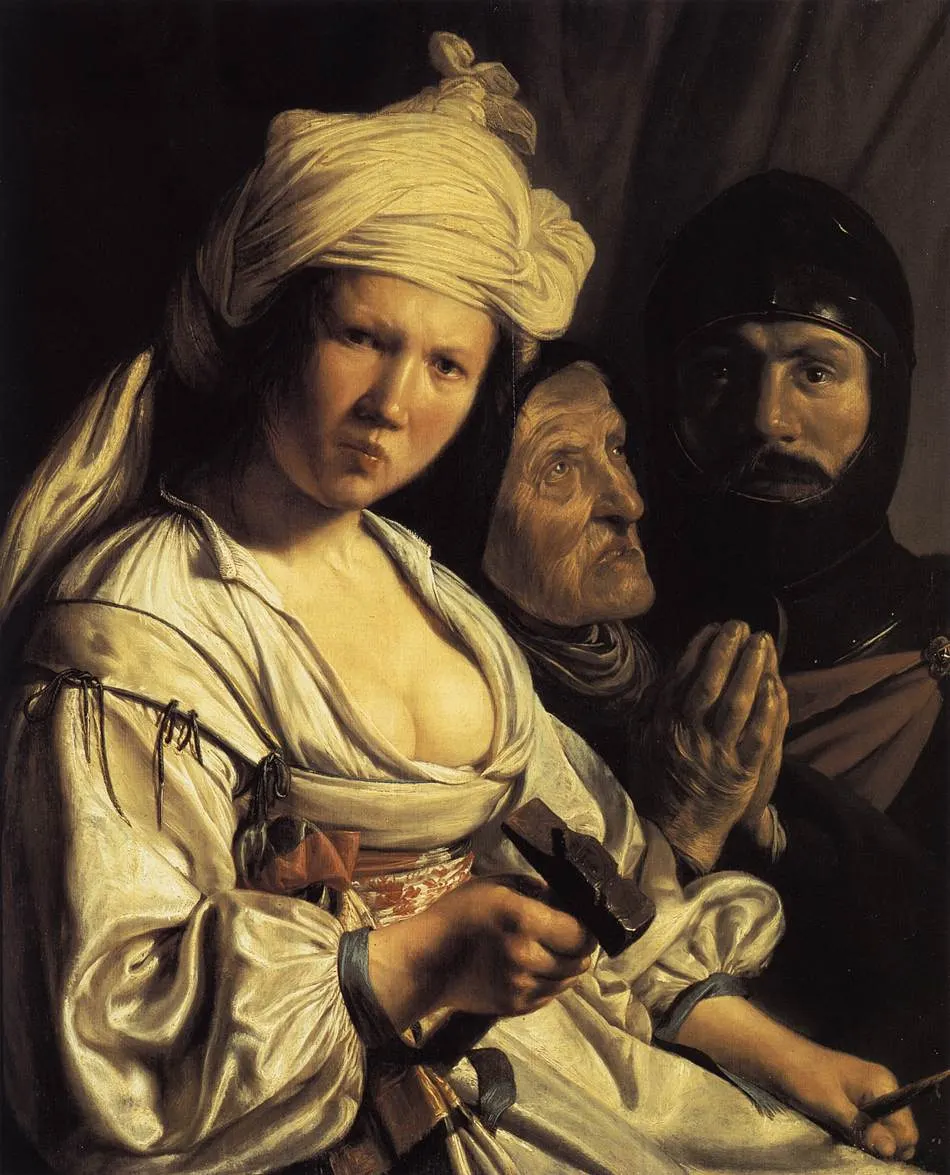
Jael, Deborah and Barak, Salomon de Bray, 1635. Public domain.
Old Testament · Book 7 of 66
Judges
Judges records Israel's life in Canaan between the death of Joshua and the rise of the kings. The people turn to other gods again and again, and each time God raises a judge to rescue them.
Judges records Israel's life in Canaan between the death of Joshua and the rise of the kings. The people turn to other gods again and again, and each time God raises a judge to rescue them.
What is Judges about?
Judges tells what happened in Israel between the death of Joshua and the first king. The tribes leave the Canaanites in the land, and a generation rises that does not know the LORD. Then the book runs one pattern again and again: Israel does evil, the LORD gives it into the hand of an oppressor, Israel cries out, and the LORD raises up a deliverer who saves it (2:16). The deliverers run from Othniel to Samson, and after Gideon no rest is recorded. The book closes with a stolen shrine and a civil war, under the refrain that Israel had no king (21:25).
All 21 chapters
Every chapter of the book, in one grid. Each cell opens that chapter.
- The land leftJudges 1 to 2
- Deliverers who brought restJudges 3 to 8
- Deliverers who brought no restJudges 9 to 16
- No king in IsraelJudges 17 to 21
The colour is the movement of the story the chapter stands in, and every cell opens that chapter's Study level. Chapter 3 opens with the last verses of the first movement (3:1 to 6).
Who wrote it, where, when, for whom, and why?
Judges names no author. Its asides place the writer after the events: the Jebusites live among the Benjamites to this day (1:21), the priests of Dan serve until the captivity of the land (18:30), and Micah's image stands at Dan the whole time the house of God is at Shiloh (18:31). The refrain at 17:6, 18:1, 19:1 and 21:25 speaks to a reader who knows a king. The rest of Scripture remembers these years: Ruth is set in the days when the judges ruled (Ruth 1:1), Samuel names Jerubbaal, Barak and Jephthah among those the LORD sent (1 Samuel 12:9 to 11), and the LORD speaks of the day he appointed judges over his people (2 Samuel 7:11). Psalm 106 sings the cycle (Psalm 106:34 to 44), Asaph prays against Sisera and Jabin at the Kishon (Psalm 83:9), Isaiah recalls the day of Midian (Isaiah 9:4 and 10:26), Hosea the days of Gibeah (Hosea 9:9 and 10:9), Paul the judges until Samuel (Acts 13:19 and 20), and Hebrews names Gideon, Barak, Samson and Jephthah (Hebrews 11:32 to 34).
In those days there was no king in Israel; everyone did what was right in his own eyes.
Judges 17:6, Berean Standard Bible.
The book ranges over the whole land, from Dan to Beersheba (20:1), and across the Jordan into Gilead (10:17). Its battles are fought at the City of Palms (3:13), at the River Kishon (4:13), in the Valley of Jezreel (6:33), in Gilead against the Ammonites (11:29), and on the Philistine border between Zorah and Eshtaol (13:25). The house of God stands at Shiloh (18:31).
Judges keeps its own count of the years. It begins after Joshua and the elders who outlived him (2:7 to 10) and ends on the eve of a king (21:25). It gives the years of each oppression and each rest, drawn below in the stepped bars, and Jephthah tells the Ammonites that Israel has lived in Heshbon and Aroer for three hundred years (11:26). How these figures date the period is set out under Where do readers disagree.
Judges is written for Israel under a king, looking back on the generations that had none. The refrain sets each of the last stories against the reader's own day (17:6; 21:25), and the pattern stated at 2:11 to 19 tells that reader how to read the stories that follow.
The book gives its own reasons. The LORD left the nations in the land to test whether Israel would keep his way (2:22) and to teach warfare to a generation that had not known it (3:1 and 2). He raised up judges because he was moved to pity by Israel's groaning (2:18), and each time a judge died Israel became more corrupt than before (2:19). The book ends on its verdict: there was no king in Israel, and everyone did what was right in his own eyes (21:25).
Judges stands in a Canaan of walled cities in the plains and villages in the hills. The book names the chariots of iron that kept Judah out of the plains (1:19) and Jabin's nine hundred (4:3), the Baal and the Ashtoreths Israel served (2:13), the Midianites who came with their camels like locusts (6:5), and Dagon, the god of the Philistines (16:23).
Sources. Judges 1:19, 1:21, 2:7 to 10, 2:11 to 19, 2:13, 2:18, 2:19, 2:22, 3:1 and 2, 3:13, 4:3, 4:13, 6:5, 6:33, 10:17, 11:26, 11:29, 13:25, 16:23, 17:6, 18:1, 18:30, 18:31, 19:1, 20:1 and 21:25; Ruth 1:1; 1 Samuel 12:9 to 11; 2 Samuel 7:11; Psalm 83:9; Psalm 106:34 to 44; Isaiah 9:4 and 10:26; Hosea 9:9 and 10:9; Acts 13:19 and 20; Hebrews 11:32 to 34. Every verse is read in the Berean Standard Bible.
How is Judges arranged, and what is it for?
The four movements the book falls into, what it teaches, what it was written to do, and the years it gives.
- The land leftJudges 1:1 to 3:6, 65 verses
The tribes leave the Canaanites in the land, a generation rises that does not know the LORD, and the pattern of the book is stated.
- Deliverers who brought restJudges 3:7 to 8:35, 180 verses
Othniel, Ehud, Shamgar, Deborah and Barak, and Gideon save Israel, and after four of them the land has rest.
- Deliverers who brought no restJudges 9:1 to 16:31, 226 verses
Abimelech makes himself king, Jephthah and Samson save Israel, and no rest is recorded after any of them.
- No king in IsraelJudges 17:1 to 21:25, 147 verses
A household shrine becomes a tribe's cult, a crime at Gibeah becomes a civil war, and the book ends on its refrain.
The theme
Israel forgets the LORD, serves the gods of Canaan and is given into the hand of its enemies, and when it cries out the LORD raises up a deliverer and saves it. The pattern does not heal Israel: after each judge dies the people turn more corrupt than before (2:19), and the deliverers themselves grow more compromised, from Othniel to Samson. The book ends with Israel doing to its own tribe what it had failed to do to the Canaanites.
The purpose
Judges shows a people under a king what their nation was when every man did what was right in his own eyes. It sets the LORD's faithfulness beside Israel's forgetting: he keeps raising up deliverers for a people that keeps turning away. It leaves Israel waiting for a king, which is where Ruth and 1 Samuel take up the story.
The rest the LORD gave ends with Gideon
- Years oppressed, the upper bar
- Years of rest, the lower bar
- No rest recorded
- The colour darkens one step per deliverer.
- Othnielagainst Cushan-rishathaim of Aram-naharaim
- Ehudagainst Eglon of Moab
- Deborahagainst Jabin of Canaan and Sisera
- Gideonagainst Midian
- Jephthahagainst the Ammonites18 years oppressed, 10:8no rest recorded
- Samsonagainst the Philistines40 years oppressed, 13:1no rest recorded
Samson judged Israel twenty years in the days of the Philistines (15:20).
How did Israel lose its hold on the land?
What the text says in these 2 chapters, and the pages they open on.
Judges opens after the death of Joshua with the land promised and only half taken. Judah and Simeon fight in the south, but tribe after tribe leaves the Canaanites living in its cities, and Dan is pushed back into the hills. The angel of the LORD comes up to Bochim and says the peoples left in the land will be thorns in Israel's sides. Joshua's generation dies, a generation rises that does not know the LORD, and the book states the pattern it will run: Israel serves the Baals, the LORD gives it to plunderers, and then he raises up judges who save it.
After that whole generation had also been gathered to their fathers, another generation rose up who did not know the LORD or the works that He had done for Israel.
- Study
Judges 1the tribes and the cities they did not takeShow the summary and 2 pagesShow summary, 2 pagesHide the summary
After Joshua dies, Israel asks the LORD who will go up first, and Judah is sent. Judah and Simeon take the hill country, and then tribe after tribe leaves the Canaanites living in its cities.
- Judah takes Jerusalem and Hebron in the south (1:8 and 10).
- Judah cannot drive out the people of the plains, who have chariots of iron (1:19).
- Seven tribes fail to drive out the peoples of the land, and Dan is forced into the hills (1:21 to 34).
On this chapter (2)
- Who wrote Judges, and when?
Answered under Where do readers disagree, lower on this page, with each reading and who holds it.
- Judges 1:19
The verse on its own page, with the commentators on it by era.
- Study
Judges 2the angel at Bochim and the pattern statedShow the summary and 2 pagesShow summary, 2 pagesHide the summary
The angel of the LORD comes up to Bochim and tells Israel that the peoples left in the land will be thorns in their sides. After Joshua's generation dies, a new generation serves the Baals, and the book states the pattern it will run.
- The people weep at Bochim and offer sacrifices (2:1 to 5).
- Another generation rises that does not know the LORD (2:10).
- The LORD raises up judges, and after each one dies Israel turns more corrupt than before (2:16 to 19).
On this chapter (2)
- The judges cycle
The pattern of the book, run from Othniel to Samson.
- Judges 2:16
The verse on its own page, with the commentators on it by era.
The land the tribes did not take
| Tribe | Left in the land | Verse |
|---|---|---|
| Judah | The inhabitants of the plains, who had chariots of iron | 1:19 |
| Benjamin | The Jebusites living in Jerusalem | 1:21 |
| Manasseh | Beth-shean, Taanach, Dor, Ibleam and Megiddo, with their villages | 1:27 |
| Ephraim | The Canaanites living in Gezer | 1:29 |
| Zebulun | Kitron and Nahalol | 1:30 |
| Asher | Acco, Sidon, Ahlab, Achzib, Helbah, Aphik and Rehob | 1:31 |
| Naphtali | Beth-shemesh and Beth-anath | 1:33 |
| Dan | Forced by the Amorites into the hill country and kept from the plain | 1:34 |
Characters (3)
Who the text follows. A name with a page carries its door.
- Judah
The tribe sent up first, at the opening of the book and again at 20:18.
- Caleb and Othniel
Othniel captures Kiriath-sepher, and Caleb gives him his daughter Acsah (1:12 and 13).
- The angel of the LORD
Comes up from Gilgal to Bochim and speaks the LORD's charge (2:1 to 3).
Places (2)
Where the chapters stand.
- Bochim
The place of weeping, where the people wept at the angel's word (2:4 and 5).
- Jerusalem
Taken by Judah at 1:8, while the Jebusites stay among the Benjamites (1:21).
Where the New Testament uses these chapters (1)each marked as a quotation or an allusion, with the evidence
- Named referenceThe judges after the conquest, Judges 2:16 at Acts 13:20. Paul, preaching at Pisidian Antioch, tells Israel's story and says God gave them judges until the time of Samuel the prophet. The period is named directly in a summary of Israel's history.
Whom did the LORD raise up to save Israel?
What the text says in these 6 chapters, and the pages they open on.
The pattern runs four times with rest at its end. Othniel saves Israel from a king of Aram, and Ehud, a left-handed Benjamite, kills Eglon of Moab in his own room; Shamgar strikes down six hundred Philistines with an oxgoad. Deborah, a prophetess judging Israel, sends Barak against Sisera and his nine hundred chariots, and Jael kills Sisera in her tent. The LORD calls Gideon at a winepress, cuts his army to three hundred, and routs Midian by night. Gideon refuses the crown, but makes an ephod that becomes a snare, and after the last rest Israel turns to Baal-berith.
Then the LORD said to Gideon, “You have too many people for Me to deliver Midian into their hands, lest Israel glorify themselves over Me, saying, ‘My own hand has saved me.’
- Study
Judges 3the nations left (3:1 to 6), then Othniel, Ehud and ShamgarShow the summary and 3 pagesShow summary, 3 pagesHide the summary
The LORD leaves the nations in the land to test Israel, and the first cycle runs. Othniel saves Israel from Aram, Ehud kills Eglon of Moab, and Shamgar strikes down six hundred Philistines.
- The Spirit of the LORD comes upon Othniel, and the land has rest forty years (3:10 and 11).
- Ehud, a left-handed Benjamite, kills Eglon in his upper room (3:15 to 25).
- Moab is subdued, and the land has rest eighty years (3:30).
On this chapter (3)
- The judges cycle
The pattern of the book, run from Othniel to Samson.
- Did the judges rule one after another, or at the same time in different regions?
Answered under Where do readers disagree, lower on this page, with each reading and who holds it.
- Judges 3:10
The verse on its own page, with the commentators on it by era.
- Study
Judges 4Deborah, Barak, Sisera and JaelShow the summary and 3 pagesShow summary, 3 pagesHide the summary
Jabin of Canaan oppresses Israel twenty years with nine hundred chariots of iron. Deborah, a prophetess judging Israel, sends Barak against Sisera, and Jael kills Sisera in her tent.
- Barak will not go unless Deborah goes with him (4:8).
- The LORD routs Sisera and all his chariots before Barak (4:15).
- Jael drives a tent peg through Sisera's temple (4:21).
On this chapter (3)
- Deborah and Jael
The prophetess who judged Israel and the woman who ended Sisera.
- What does the text say about Deborah's office?
Answered under Where do readers disagree, lower on this page, with each reading and who holds it.
- Judges 4:4
The verse on its own page, with the commentators on it by era.
- Study
Judges 5the song of DeborahShow the summary and 2 pagesShow summary, 2 pagesHide the summary
Deborah and Barak sing of the victory the LORD gave. The song praises the tribes who came, rebukes those who stayed home, and blesses Jael.
- Deborah arises as a mother in Israel (5:7).
- The stars fight against Sisera and the river Kishon sweeps his army away (5:20 and 21).
- The land has rest forty years (5:31).
On this chapter (2)
- Deborah and Jael
The prophetess who judged Israel and the woman who ended Sisera.
- Judges 5:31
The verse on its own page, with the commentators on it by era.
- Study
Judges 6Gideon called at the winepressShow the summary and 4 pagesShow summary, 4 pagesHide the summary
Midian and the peoples of the east strip the land for seven years, and the angel of the LORD calls Gideon at the winepress in Ophrah. Gideon tears down his father's altar to Baal and asks for the sign of the fleece twice.
- The angel of the LORD appears to Gideon, and Gideon fears he will die (6:22 and 23).
- Gideon pulls down the altar of Baal and is named Jerubbaal (6:25 to 32).
- The Spirit of the LORD comes upon Gideon, and he summons the tribes (6:34 and 35).
On this chapter (4)
- Gideon's fleece
The two signs Gideon asks for, and how they have been read.
- Christophany
The angel of the LORD and who he has been taken to be.
- Who is the angel of the LORD in chapters 6 and 13?
Answered under Where do readers disagree, lower on this page, with each reading and who holds it.
- Judges 6:22
The verse on its own page, with the commentators on it by era.
- Study
Judges 7the three hundred and the trumpetsShow the summary and 2 pagesShow summary, 2 pagesHide the summary
The LORD cuts Gideon's army from thirty two thousand men to three hundred, so that Israel cannot boast that its own hand saved it. At night the three hundred blow trumpets and break jars, and the Midianite camp turns on itself.
- The fearful go home, and the men who lap the water are kept (7:3 to 7).
- Gideon hears a Midianite tell a dream of a loaf that flattens a tent (7:13 and 14).
- Ephraim captures and kills the Midianite leaders Oreb and Zeeb (7:25).
On this chapter (2)
- The judges cycle
The pattern of the book, run from Othniel to Samson.
- Judges 7:2
The verse on its own page, with the commentators on it by era.
- Study
Judges 8the crown refused and the ephodShow the summary and 2 pagesShow summary, 2 pagesHide the summary
Gideon pursues the kings of Midian across the Jordan and punishes the towns that refused his men bread. He refuses the crown, but makes an ephod from the gold of the spoil, and it becomes a snare to his house.
- Gideon says the LORD shall rule over Israel (8:23).
- The land has rest forty years in the days of Gideon, the last rest the book records (8:28).
- After his death Israel turns to Baal-berith (8:33).
On this chapter (2)
- The judges cycle
The pattern of the book, run from Othniel to Samson.
- Judges 8:23
The verse on its own page, with the commentators on it by era.
Characters (6)
Who the text follows. A name with a page carries its door.
- Othniel
Son of Kenaz, Caleb's younger brother, and the first judge, on whom the Spirit of the LORD came (3:9 and 10).
- Ehud
The left-handed Benjamite who killed Eglon of Moab (3:15 to 21).
- Deborah
A prophetess who was judging Israel and sent Barak to battle (4:4 to 6).
- Barak
The commander who would not go without Deborah (4:8).
Show the next 2
- Jael
The Kenite woman who killed Sisera in her tent (4:21).
- Gideon
Called at the winepress, also named Jerubbaal (6:11 and 32).
Places (3)
Where the chapters stand.
- The river Kishon
Where Sisera's army was routed and swept away (4:13 and 5:21).
- Ophrah
Gideon's town, where the angel sat under the oak (6:11).
- The spring of Harod
Where Gideon's army camped before the LORD cut it (7:1).
Themes (4)
What these chapters raise, each on its own page.
- shaphat, to judge
The verb behind the book's name, to decide a case and to rule a people.
- yasha, to save
The LORD raised up a deliverer to save them (3:9).
- ruach, spirit
The Spirit of the LORD came upon Othniel and upon Gideon (3:10; 6:34).
- zaaq, to cry out
Israel cried out to the LORD, and he answered (3:9; 6:6).
Where the New Testament uses these chapters (1)each marked as a quotation or an allusion, with the evidence
- Named referenceGideon and Barak, Judges 4 to 8 at Hebrews 11:32. Hebrews names Gideon and Barak among those who through faith conquered kingdoms. Both men are named in the list of the faithful.
What happened when the rest stopped?
What the text says in these 8 chapters, and the pages they open on.
After Gideon the book records no more rest. His son Abimelech kills seventy brothers, is made king at Shechem, and dies under a millstone a woman drops from a tower. Tola and Jair judge, and Israel serves the gods of every people around it until the LORD refuses to save; when Israel puts away its foreign gods, he can no longer bear its misery. Jephthah, driven out by his brothers, is called back to fight Ammon and binds himself with a vow that costs him his only daughter, and Gilead and Ephraim fight over one word at the fords. Samson, a Nazirite from the womb, fights the Philistines alone, is betrayed by Delilah, and dies bringing down the temple of Dagon.
So they put away the foreign gods from among them and served the LORD, and He could no longer bear the misery of Israel.
- Study
Judges 9Abimelech made king at ShechemShow the summary and 1 pageShow summary, 1 pageHide the summary
Abimelech, Gideon's son, kills seventy of his brothers and is made king at Shechem. Jotham tells the fable of the trees, and God turns Shechem and Abimelech against each other until a woman drops a millstone on his head.
- The men of Shechem make Abimelech king (9:6).
- Jotham's fable asks who will rule over the trees (9:8 to 15).
- God repays Abimelech and Shechem for the murder of the seventy (9:56 and 57).
On this chapter (1)
- Judges 9:6
The verse on its own page, with the commentators on it by era.
- Study
Judges 10the LORD's refusal and his pityShow the summary and 2 pagesShow summary, 2 pagesHide the summary
Tola and Jair judge Israel, and then Israel serves the gods of the nations around it. The Ammonites oppress Gilead eighteen years, the LORD refuses to save, and when Israel puts away its foreign gods he can no longer bear its misery.
- Israel serves the Baals, the Ashtoreths and the gods of five peoples (10:6).
- The LORD tells Israel to cry out to the gods it has chosen (10:14).
- The Ammonites camp in Gilead, and the leaders look for a man to fight them (10:17 and 18).
On this chapter (2)
- The judges cycle
The pattern of the book, run from Othniel to Samson.
- Judges 10:16
The verse on its own page, with the commentators on it by era.
- Study
Judges 11Jephthah and his vowShow the summary and 2 pagesShow summary, 2 pagesHide the summary
The elders of Gilead bring back Jephthah, the son of a prostitute whom his brothers had driven out, to lead them against Ammon. He argues Israel's claim to the land, makes a vow before the battle, and his only daughter comes out to meet him.
- Jephthah counts three hundred years of Israel in the land (11:26).
- The Spirit of the LORD comes upon Jephthah (11:29).
- He does to his daughter as he had vowed, and the women of Israel lament her four days each year (11:39 and 40).
On this chapter (2)
- Did Jephthah sacrifice his daughter?
Answered under Where do readers disagree, lower on this page, with each reading and who holds it.
- Judges 11:31
The verse on its own page, with the commentators on it by era.
- Study
Judges 12Shibboleth at the fordsShow the summary and 1 pageShow summary, 1 pageHide the summary
The men of Ephraim cross the Jordan and threaten to burn Jephthah's house because he fought Ammon without them. Gilead fights Ephraim and holds the fords, and three minor judges follow Jephthah.
- A fugitive who says Sibboleth for Shibboleth is killed at the fords (12:6).
- Jephthah judges Israel six years and is buried in Gilead (12:7).
- Ibzan, Elon and Abdon judge Israel after him (12:8 to 15).
On this chapter (1)
- Judges 12:6
The verse on its own page, with the commentators on it by era.
- Study
Judges 13the birth of Samson announcedShow the summary and 3 pagesShow summary, 3 pagesHide the summary
Israel serves the Philistines forty years, and the angel of the LORD tells Manoah's wife she will bear a son who will be a Nazirite from the womb. The visitor will not give his name and goes up in the flame of the altar.
- No razor is to come over the boy's head (13:5).
- The angel says his name is beyond comprehension (13:18).
- Samson grows, and the Spirit of the LORD begins to stir him (13:24 and 25).
On this chapter (3)
- Christophany
The angel of the LORD and who he has been taken to be.
- Who is the angel of the LORD in chapters 6 and 13?
Answered under Where do readers disagree, lower on this page, with each reading and who holds it.
- Judges 13:5
The verse on its own page, with the commentators on it by era.
- Study
Judges 14the lion and the riddleShow the summary and 1 pageShow summary, 1 pageHide the summary
Samson sees a young Philistine woman at Timnah and tells his parents to get her for him as a wife. At the wedding feast he puts a riddle to thirty companions, and his wife draws the answer out of him.
- The Spirit of the LORD comes powerfully upon him, and he tears a lion apart (14:6).
- He takes honey from the lion's carcass and does not tell his parents where it came from (14:9).
- He kills thirty men of Ashkelon to pay the wager, and his wife is given to another man (14:19 and 20).
On this chapter (1)
- Judges 14:14
The verse on its own page, with the commentators on it by era.
- Study
Judges 15the foxes and the jawboneShow the summary and 1 pageShow summary, 1 pageHide the summary
Samson finds his wife given to his companion and burns the Philistines' grain with three hundred foxes. The men of Judah bind him and hand him over at Lehi, where he breaks the ropes and strikes down a thousand men.
- The Philistines burn his wife and her father to death (15:6).
- He kills a thousand men with the jawbone of a donkey (15:15).
- God opens a spring at Lehi when Samson cries out in thirst (15:18 and 19).
On this chapter (1)
- Judges 15:15
The verse on its own page, with the commentators on it by era.
- Study
Judges 16Delilah, and Samson's death at GazaShow the summary and 2 pagesShow summary, 2 pagesHide the summary
Samson goes to a prostitute at Gaza and then loves Delilah, who is paid to learn the secret of his strength. He tells her, his head is shaved, and he is blinded and set to grind in the prison until he pulls down the temple of Dagon.
- He does not know that the LORD has departed from him (16:20).
- He prays to be strengthened once more (16:28).
- In his death he kills more than he had killed in his life (16:30).
On this chapter (2)
- How should Samson be read, given how he lived?
Answered under Where do readers disagree, lower on this page, with each reading and who holds it.
- Judges 16:28
The verse on its own page, with the commentators on it by era.
The three Nazirite terms, and where Samson stands to each
- 1The vine
He is to abstain from wine and strong drink and eat nothing from the grapevine (Numbers 6:3 and 4).
No station in the text.
- 2The razor
No razor shall pass over his head (Numbers 6:5), laid on Samson from the womb (Judges 13:5).
He tells Delilah that his hair has never been cut, and she has the seven braids of his head shaved off. 16:17
- 3The dead body
He must not go near a dead body (Numbers 6:6).
He turns aside to the lion's carcass, takes honey from it and eats it. 14:8
Characters (6)
Who the text follows. A name with a page carries its door.
- Abimelech
Gideon's son, made king at Shechem, who killed seventy brothers (9:5 and 6).
- Jotham
The youngest son of Gideon, who escaped and told the fable of the trees (9:5 to 15).
- Jephthah
The Gileadite called back to fight Ammon, and bound by his vow (11:1 and 30 to 31).
- Manoah and his wife
Samson's parents, visited by the angel of the LORD at Zorah (13:2 to 22).
Show the next 2
- Samson
A Nazirite from the womb who judged Israel twenty years (13:5; 15:20).
- Delilah
The woman of the Valley of Sorek paid to learn Samson's secret (16:4 and 5).
Places (4)
Where the chapters stand.
Themes (2)
What these chapters raise, each on its own page.
- ruach, spirit
The Spirit came upon Jephthah and came powerfully upon Samson (11:29; 14:6).
- zaaq, to cry out
Israel cries out, and the LORD first refuses to save (10:10 to 14).
Where the New Testament uses these chapters (1)each marked as a quotation or an allusion, with the evidence
- Named referenceSamson and Jephthah, Judges 11 to 16 at Hebrews 11:32. Hebrews names Samson and Jephthah among those who gained strength from weakness. Both men are named in the list of the faithful.
What did Israel become without a king?
What the text says in these 5 chapters, and the pages they open on.
The last five chapters leave the judges behind and tell two stories under one refrain: in those days there was no king in Israel. Micah sets up a shrine with a silver idol and hires a Levite, and the tribe of Dan takes both and sets them up in the city it seizes in the north. A Levite's concubine is abused to death at Gibeah in Benjamin, in words that echo Sodom, and her body is sent through Israel. The tribes go to war against Benjamin until six hundred men are left, then find them wives by force at Jabesh-gilead and at Shiloh, and the book ends with everyone doing what was right in his own eyes.
In those days there was no king in Israel; everyone did what was right in his own eyes.
- Study
Judges 17Micah's silver idol and his LeviteShow the summary and 1 pageShow summary, 1 pageHide the summary
Micah of the hill country of Ephraim makes an idol from silver his mother dedicates to the LORD, and sets up a shrine in his house. He hires a wandering Levite from Bethlehem to be his priest.
- Micah makes an ephod and household gods and ordains one of his sons (17:5).
- In those days there was no king in Israel (17:6).
- Micah says the LORD will be good to him now that he has a Levite (17:13).
On this chapter (1)
- Judges 17:6
The verse on its own page, with the commentators on it by era.
- Study
Judges 18the Danites take the idol northShow the summary and 1 pageShow summary, 1 pageHide the summary
The Danites, still without an inheritance, send spies north and find a quiet people at Laish. Six hundred armed men take Micah's idol and his priest, burn Laish, and set up the idol in the city they rename Dan.
- In those days there was no king in Israel (18:1).
- The Levite goes gladly with the Danites as priest to a tribe (18:19 and 20).
- The idol stands at Dan the whole time the house of God is at Shiloh (18:31).
On this chapter (1)
- Judges 18:31
The verse on its own page, with the commentators on it by era.
- Study
Judges 19the crime at GibeahShow the summary and 1 pageShow summary, 1 pageHide the summary
A Levite fetches his concubine from Bethlehem and spends the night at Gibeah in Benjamin, where the men of the city surround the house. They abuse her through the night, and she dies at the door.
- The men of Gibeah demand the guest as the men of Sodom did (19:22).
- The Levite cuts her body into twelve pieces and sends them through Israel (19:29).
- Israel says nothing like this has happened since the day it came out of Egypt (19:30).
On this chapter (1)
- Judges 19:30
The verse on its own page, with the commentators on it by era.
- Study
Judges 20the war on BenjaminShow the summary and 1 pageShow summary, 1 pageHide the summary
Israel gathers at Mizpah as one man and demands that Benjamin hand over the men of Gibeah. Benjamin refuses, and after two defeats Israel destroys the tribe until six hundred men are left.
- Israel asks God who will go up first against Benjamin, and Judah is sent (20:18).
- Phinehas son of Eleazar stands before the ark in those days (20:28).
- Six hundred men of Benjamin flee to the rock of Rimmon (20:47).
On this chapter (1)
- Judges 20:18
The verse on its own page, with the commentators on it by era.
- Study
Judges 21wives for the six hundredShow the summary and 1 pageShow summary, 1 pageHide the summary
Israel has sworn not to give its daughters to Benjamin, and now grieves that a tribe is missing. It takes four hundred young women from Jabesh-gilead and lets the rest of the Benjamites seize wives at the feast at Shiloh.
- The people weep that one tribe is cut off (21:3 and 6).
- Jabesh-gilead, which did not come to Mizpah, is struck down (21:10 to 12).
- In those days there was no king in Israel, and everyone did what was right in his own eyes (21:25).
On this chapter (1)
- Judges 21:25
The verse on its own page, with the commentators on it by era.
The book asks the same question at both ends
- Judges 1:1
Israel asks the LORD which tribe will go up first to fight the Canaanites.
Sent first: Judah, 1:2
- Judges 20:18
Israel asks God which tribe will go up first to fight the Benjamites.
Sent first: Judah, 20:18
- Chapter 17refrain at 17:6
- Chapter 18refrain at 18:1
- Chapter 19refrain at 19:1
- Chapter 20no refrain
- Chapter 21refrain at 21:25
Characters (4)
Who the text follows. A name with a page carries its door.
- Micah
The man of Ephraim who set up a shrine in his house (17:1 to 5).
- The Levite of Bethlehem
Hired as Micah's priest, then taken by the Danites (17:7 to 13; 18:19 and 20).
- The Levite and his concubine
The couple who lodged at Gibeah on the way home (19:1 to 30).
- Phinehas
Son of Eleazar, who stood before the ark in those days (20:28).
Places (3)
Where the chapters stand.
Themes (1)
What these chapters raise, each on its own page.
- ra, evil
The LORD's sight is the measure, and every man's own eyes the closing refrain (21:25).
Where the New Testament uses these chapters (1)each marked as a quotation or an allusion, with the evidence
- Named referenceThe days of Gibeah, Judges 19 and 20 at Hosea 9:9 and 10:9. Hosea says Israel has corrupted itself as in the days of Gibeah. Hosea names the crime by the town where it was done.
- Author
- Anonymous; rabbinic tradition attributes to Samuel (Bava Batra 14b)
- Date
- Events c. 1375–1050 BC; compilation during the early monarchy
- Audience
- Israel under the monarchy, remembering what life without a king had been
Where do readers disagree?
One list: the readings with their holders, and what the evidence does not settle.
Who wrote Judges, and when?
- Samuel, or a prophetic circle around him, in the early monarchy. Albert Barnes reads the refrain at 17:6 as the mark of a writer who lived after the kings were established; the Talmudic tradition recorded in Bava Batra 14b, which assigns Samuel the writing of Judges along with his own book and Ruth; the note that the Jebusites still held Jerusalem alongside Benjamin (1:21), which fits a time before David took the stronghold (2 Samuel 5:6-9); and the historic Jewish and Christian reading following that tradition.
- A Deuteronomistic historian, compiled in the exile from older material. Martin Noth proposed Deuteronomy through Kings as one continuous history compiled during the exile (Überlieferungsgeschichtliche Studien, 1943), and the critical tradition follows him.
What the evidence does not settle: The book carries no signature, so the question turns on how its asides at 1:21, 18:30 and 18:31 are read.
The argument in full
Judges names no author anywhere in its twenty-one chapters. The book speaks about its own writing only indirectly, in asides that place the writer later than the events: the Jebusites 'to this day the Jebusites live there among the Benjamites' (1:21), and Micah's image stood among the Danites 'until the day of the captivity of the land' (18:30). The refrain 'In those days there was no king in Israel' (17:6; 18:1; 19:1; 21:25) is the clearest internal clue, since it belongs to a writer for whom a king now exists.
Samuel, or a prophetic circle around him, in the early monarchy. The tradition is old and specific, and Judges itself offers no counterclaim. It rests on the book's own chronological asides rather than on any signature in the text. The writer records that Micah's image stood 'the whole time the house of God was in Shiloh' (18:31), a period that ended when the Philistines took the ark (1 Samuel 4), and that the Jebusites still held Jerusalem, which David ended.
A Deuteronomistic historian, compiled in the exile from older material. Reads the cycle-preface of 2:11-19, with its vocabulary of covenant, anger and deliverance, as the compiler's own frame set around older hero traditions that circulated independently, and takes 18:30's 'captivity of the land' as a reference to a later deportation. Takes 18:30's 'until the day of the captivity of the land' as a reference to the Assyrian or Babylonian deportation, placing the final editing centuries after the events.
Did the judges rule one after another, or at the same time in different regions?
- Consecutive: the figures run one after another as given. The plain reading of the book's own sequence, Jephthah's three-hundred-year statement at 11:26, and the King James text of Acts 13:20; argued in detail by Leon Wood (Distressing Days of the Judges, 1975).
- Overlapping: several judgeships were local and ran at the same time. K. A. Kitchen, On the Reliability of the Old Testament (2003), and John Bright, A History of Israel (1959), among many historians of the period.
What the evidence does not settle: Whether the years the book gives are to be added end to end, since it never says that one judge's years began when another's ended.
The argument in full
Adding the years Judges gives, the oppressions and the rests and the individual judgeships, produces a total that runs past the space the rest of the Old Testament leaves for the period. First Kings dates the building of Solomon's temple from the exodus: 'In the four hundred and eightieth year after the Israelites had come out of the land of Egypt' (1 Kings 6:1), and the exodus, wilderness, conquest, Samuel, Saul, David and Solomon's first four years all have to fit inside that figure alongside the judges. Jephthah's own speech to the Ammonites gives 'three hundred years' since Israel took the Transjordan (11:26). Acts adds a figure whose placement differs between text traditions: the BSB, with the ASV, attaches 'All this took about 450 years' to the period before the judges and then says 'God gave them judges until the time of Samuel the prophet' (13:19-20), while the Received Text behind the King James attaches the four hundred and fifty years to the judges themselves.
Consecutive: the figures run one after another as given. Holds that Judges reports its own numbers in order, and works the surrounding chronology to accommodate them, which generally requires a fifteenth-century exodus date.
Overlapping: several judgeships were local and ran at the same time. Notes that the deliverers act in named regions against named local enemies, Ehud in Benjamin against Moab, Deborah and Barak in the north against Hazor, Jephthah in Gilead against Ammon, Samson in the Shephelah against the Philistines, and that the book nowhere says one judge's years began when another's ended.
Did Jephthah sacrifice his daughter?
- Jephthah offered her as a burnt sacrifice. Josephus (Antiquities of the Jews 5.7.10), who states the sacrifice plainly and calls it neither conformable to the law nor acceptable to God; Pseudo-Philo (Biblical Antiquities 39-40), which names the daughter Seila and tells her death; and modern commentators including Daniel Block (Judges, Ruth, New American Commentary, 1999) and Barry Webb (The Book of Judges, NICOT, 2012).
- She was given to the LORD in perpetual virginity, dedicated rather than slain. David Kimchi (Radak, c. 1160-1235) in his commentary on Judges, the standard medieval Jewish statement of this reading; Adam Clarke, Commentary on the Bible (1810-1826), who argues the case at length from the conjunction in 11:31; and many later conservative expositors.
What the evidence does not settle: What the conjunction at 11:31 carries, and what 11:39 means by he did to her as he had vowed.
The argument in full
Jephthah vows that 'whatever comes out the door of my house to greet me' on his return 'will belong to the LORD, and I will offer it up as a burnt offering' (11:31), and his only child comes out with timbrels. He tears his clothes, she asks for two months to bewail her virginity, and the text closes the account: 'he did to her as he had vowed. And she had never had relations with a man' (11:39). Two readings of that sentence are ancient, and the argument turns on real features of the Hebrew. The conjunction opening the second half of 11:31 can carry the sense 'or', giving a vow with two branches. The Law forbids burning a child (Deuteronomy 12:31 names the nations who 'burn their sons and daughters in the fire as sacrifices to their gods' as an abomination; Leviticus 18:21), and Leviticus 27 provides for a vowed person to be redeemed by payment, thirty shekels for a female (27:2-4). Against that, the narrative dwells on her virginity and on a yearly observance where 'each year the young women of Israel go out for four days to lament the daughter of Jephthah the Gileadite' (11:40), and it never says a priest intervened.
Jephthah offered her as a burnt sacrifice. Reads the plainest sense of 11:31 and 11:39 together, and takes the horror as the point: a man who bargains with God in the language of his Canaanite neighbors ends by doing what those neighbors did.
She was given to the LORD in perpetual virginity, dedicated rather than slain. Rests on rendering the conjunction 'or', on the Law's own provision for redeeming a vowed person (Leviticus 27:2-4), and on the narrative's repeated stress that 'she had never had relations with a man' (11:39) rather than that she died.
Who is the angel of the LORD in chapters 6 and 13?
Christophany, argued in full→- A pre-incarnate appearance of the Son. Justin Martyr's Dialogue with Trypho (c. AD 155-160), which argues the Old Testament theophanies are the pre-existent Christ; Tertullian's Against Praxeas (c. AD 213); and much of the church's later expositional tradition.
- A created messenger bearing God's name and speaking with his authority. Augustine's On the Trinity (Books II-III, c. AD 400-416), and the readers who follow his account of the theophanies as angelic mediation.
What the evidence does not settle: The book records the encounters without explaining the identity.
The argument in full
The figure at Ophrah is called the angel of the LORD and then answers as the LORD himself, and the narrative shifts between the two designations inside a single scene (6:11-14, 20-23). At Zorah the same title appears, the visitor refuses to give a name, 'since it is beyond comprehension' (13:18), rises in the flame of the altar (13:20), and Manoah concludes 'We are going to die … for we have seen God' (13:22). The book records the encounters without explaining the identity, and two readings run through the church's history.
A pre-incarnate appearance of the Son. Rests on the passages where the angel speaks as God in the first person, receives worship and sacrifice, and is addressed as God by those who meet him.
A created messenger bearing God's name and speaking with his authority. Holds that a sent messenger can speak in the sender's own words without being the sender, a normal convention of ancient envoys, and reads the shifting designations that way.
How should Samson be read, given how he lived?
- Samson is Israel in one man. Barry Webb, The Book of Judges: An Integrated Reading (1987) and his NICOT commentary (2012), and a wide line of literary readers of the book.
- Samson is a genuine believer whose faith and failures both stand in the record. The reading Hebrews 11:32-34 supports, held across the church's expositors including Matthew Henry (Exposition of the Old and New Testaments, 1708-1710).
What the evidence does not settle: How the narrator's silence on each failure is to be weighed beside Hebrews 11:32.
The argument in full
Samson is set apart before birth, 'no razor shall come over his head, because the boy will be a Nazirite to God from the womb' (13:5), and then spends his account touching a lion's carcass, marrying into the Philistines, going in to a harlot at Gaza, and finally telling Delilah the secret. The narrator records each of these without an editorial line excusing or condemning them. The judgment sits elsewhere: in the refrain about every man doing what was right in his own eyes, and in the flat sentence at Delilah's house, 'he did not know that the LORD had departed from him' (16:20). At the end, blind and grinding in the prison-house, he prays and dies pulling the temple down, and the text says 'in his death he killed more than he had killed in his life' (16:30). Hebrews names him among the faithful (Hebrews 11:32).
Samson is Israel in one man. Reads Samson's course as the nation's own: set apart from birth, entangled with the peoples around him, losing the presence he presumed on, and used by God at the end regardless.
Samson is a genuine believer whose faith and failures both stand in the record. Takes the final prayer at 16:28 as real faith, and holds the record of the failures as the text's own honesty about a man God still used.
What does the text say about Deborah's office?
Deborah and Jael, argued in full→- Deborah holds the office the text names, and it establishes a pattern. Adam Clarke, Commentary on the Bible, who reads Deborah at 4:4 as supreme in both civil and religious affairs; the plain sense of 4:4-5; and this site's own tradition, which runs through John Wesley's authorising of women preachers, the Azusa Street leadership, and the Assemblies of God's 1935 decision to lift restrictions on women's ministry.
- Deborah's role is judicial and prophetic, and the passage does not settle the question of teaching office. Wayne Grudem, Evangelical Feminism and Biblical Truth (2004), who reads her work as arbitration and prophecy given privately rather than a public teaching office over the assembly.
What the evidence does not settle: Readers agree on what 4:4 and 5 and 5:7 record, and divide on what it establishes for women in leadership.
The argument in full
Judges introduces her without qualification: 'Now Deborah, a prophetess, the wife of Lappidoth, was judging Israel at that time' (4:4), and 'the Israelites would go up to her for judgment' (4:5). She summons Barak, gives him the LORD's word, and goes with him when he refuses to march alone. Her song calls her 'a mother in Israel' (5:7) and credits the victory to heaven: 'From the heavens the stars fought; from their courses they fought against Sisera' (5:20). Readers agree on the record and divide on what it establishes for the wider question of women in leadership.
Does the refrain call for a king?
- A king is the remedy the book points to. Matthew Henry reads 17:6 this way, and Albert Barnes reads 21:25 the same.
- The LORD is Israel's king, and the lack is of a ruler under him. Adam Clarke, Commentary on the Bible, on 17:6; Jamieson, Fausset and Brown, Commentary Critical and Explanatory on the Whole Bible (1871), on 8:23.
What the evidence does not settle: Whether the refrain looks forward to David's house or only records the lack of any ruler, since the book never says which king would have mended it.
The argument in full
A king is the remedy the book points to. Henry reads 17:6 as the reason God's house was forsaken and his priests neglected, and calls government a mercy. Barnes reads the refrain, repeated at 17:6, 18:1 and 19:1, as meant to show that the disorders came from the want of an authority strong enough to suppress them.
The LORD is Israel's king, and the lack is of a ruler under him. Clarke notes that the Hebrew word for king can mean a supreme governor, judge or ruler of any kind, and thinks it should be read that way here. Jamieson, Fausset and Brown read Gideon's answer at 8:23 as the principle of the theocracy: he would act as judge, but the LORD alone was King of Israel. When Israel later asks Samuel for a king, the LORD says they have rejected him as their king (1 Samuel 8:7).
The pages Judges opens on
Studies73
Show the next 6 titles
- Abimelech and Jotham's Fable
- Baal and the religion of Canaan
- Ehud and the Deliverance from Moab
- Gideon
- Jabesh-gilead
- Jephthah's vow
Show the next 6 titles
- Judith
- Micah's idol and the migration of Dan
- No king in Israel: the refrain that closes Judges
- Othniel, the first judge
- Paul's Thorn
- Samson
Show the next 6 titles
- The Five Minor Judges
- The Haftarah
- The land Israel did not take
- The nations left in the land
- Genealogies of Christ
- Names of God
Show the next 6 titles
- Power Made Perfect in Weakness: 2 Corinthians 12:7-10
- The Kings of Israel & Judah
- Caleb
- Hard Questions in the Old Testament
- Jebusite Jerusalem before David
- The Blessing of Jacob: Genesis 49 Tribe by Tribe
Show the next 6 titles
- The devoted thing (herem)
- The Levitical Towns
- The Mixed Multitude and the Foreigner
- The Philistines
- The Register of the Thirty-One Kings
- The Urim and Thummim and Inquiring of the LORD
Show the next 6 titles
Show the next 6 titles
- Hazor
- Huldah, the Prophetess Who Authenticated Scripture
- The Judge
- Women in Ministry
- Armageddon
- Amalek and the Standing War
Show the next 6 titles
- Locusts in Scripture
- The Words Shalom and Eirene
- The Burning Bush: the Name Revealed
- The Spirit in the Old Testament
- The Threshing Floor
- Type-Scenes: the Stories Scripture Tells Twice
Show the next 6 titles
People and groups5
Sources for this page
The painting in the band is Jael, Deborah and Barak, Salomon de Bray, 1635. Public domain. The movements, the chapter entries, the graphics and the Context are read off the text of Judges. The works behind the readings under Where do readers disagree are the Babylonian Talmud, Bava Batra 14b; Martin Noth, Überlieferungsgeschichtliche Studien (1943); Leon Wood, Distressing Days of the Judges (1975); K. A. Kitchen, On the Reliability of the Old Testament (2003); John Bright, A History of Israel (1959); Josephus, Antiquities of the Jews; Pseudo-Philo, Biblical Antiquities; Daniel Block, Judges, Ruth (1999); Barry Webb, The Book of Judges (1987 and 2012); David Kimchi on Judges; Adam Clarke, Commentary on the Bible, 1810 to 1826; Justin Martyr, Dialogue with Trypho; Tertullian, Against Praxeas; Augustine, On the Trinity; Matthew Henry, Exposition of the Old and New Testaments, 1708 to 1710; Albert Barnes, Notes, Explanatory and Practical, on the Old and New Testaments, 1832 to 1869; Jamieson, Fausset and Brown, Commentary Critical and Explanatory on the Whole Bible (1871); and Wayne Grudem, Evangelical Feminism and Biblical Truth (2004). Every verse quoted on this page is the Berean Standard Bible, read from the store.