
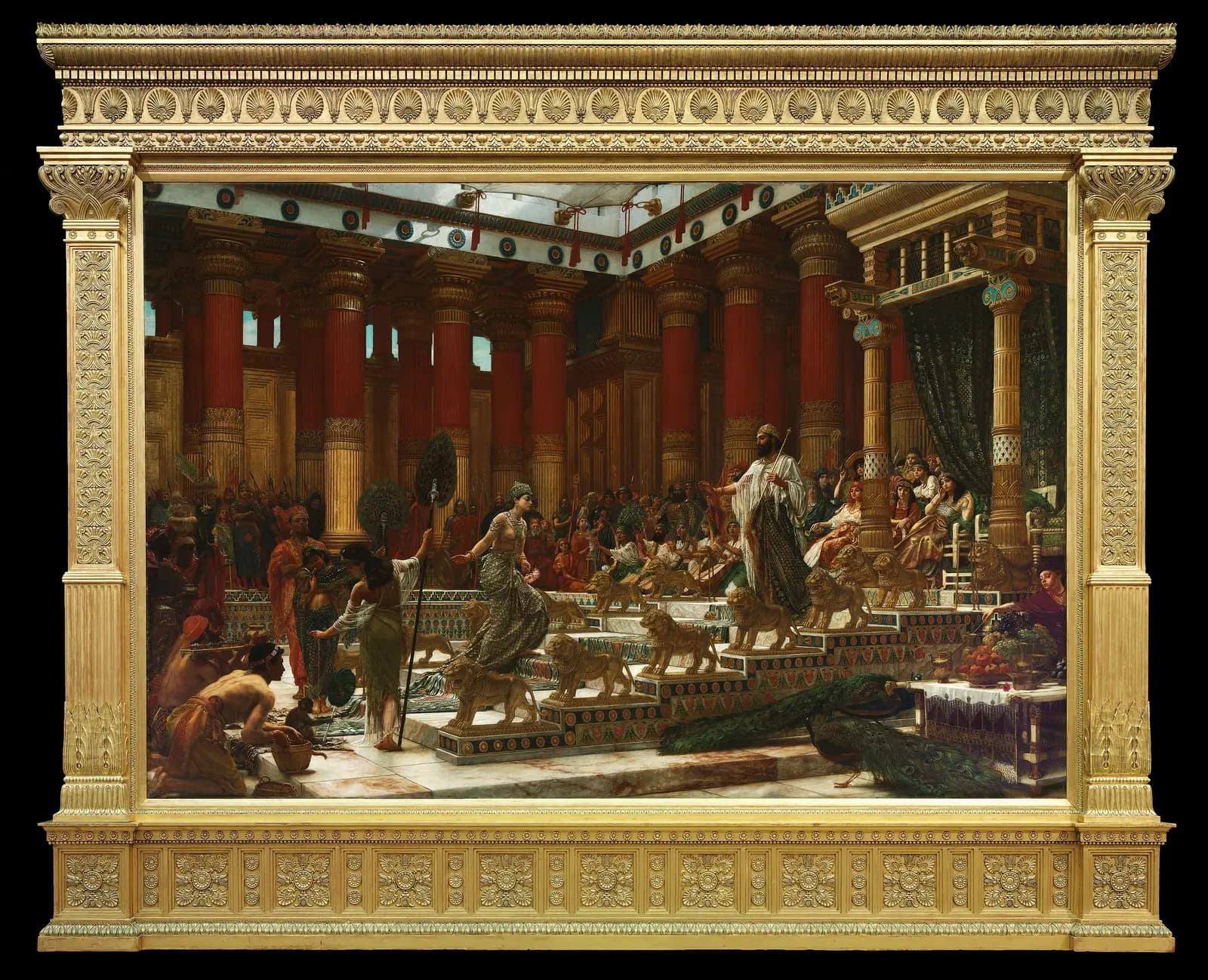
The visit of the Queen of Sheba to King Solomon, Sir Edward John Poynter, 1890. Public domain.
Old Testament · Book 11 of 66
1 Kings
1 Kings records Solomon's reign and the building of the temple, then the split of the kingdom into Israel and Judah. Its second half follows the prophet Elijah as he confronts King Ahab and Jezebel.
1 Kings records Solomon's reign and the building of the temple, then the split of the kingdom into Israel and Judah. Its second half follows the prophet Elijah as he confronts King Ahab and Jezebel.
What is 1 Kings about?
1 Kings opens at the bedside of David, old and failing, while one of his sons claims the crown. Solomon is anointed instead, and the kingdom is made firm in his hand. At Gibeon he asks God for an understanding heart, and in seven years he builds the house of the LORD. When the ark is brought in, the glory of the LORD fills the house. In his old age his wives turn his heart to other gods, and after his death ten tribes break away at Shechem. The book ends in the north, with Elijah against the prophets of Baal on Carmel and Ahab dying in battle at Ramoth-gilead.
All 22 chapters
Every chapter of the book, in one grid. Each cell opens that chapter.
- The throne secured1 Kings 1 to 2
- Wisdom given1 Kings 3 to 4
- The house of the LORD1 Kings 5 to 8
- The turning heart1 Kings 9 to 11
- The kingdom torn1 Kings 12 to 16
- Elijah and Ahab1 Kings 17 to 22
The colour is the movement the chapter stands in: the nearer the colour to the gold of the frame, the nearer the movement to the house of the LORD in chapters 5 to 8. Every cell opens that chapter's Study level.
Who wrote it, where, when, for whom, and why?
1 Kings never names its writer. It names the written records it drew on: the Book of the Acts of Solomon (11:41), the Book of the Chronicles of the Kings of Israel (14:19) and the Book of the Chronicles of the Kings of Judah (14:29). The rest of Scripture reads these chapters as history. Jesus speaks of the queen of the South who came to hear Solomon's wisdom (Matthew 12:42) and of the widow of Zarephath (Luke 4:25 and 26). Paul quotes Elijah at Horeb (Romans 11:2 to 4), and James holds up Elijah's prayer (James 5:17).
But it was Solomon who built the house for Him.
Acts 7:47, Berean Standard Bible.
The first half of the book stands in Jerusalem, where Solomon builds the house of the LORD and his own palace. After the kingdom divides, the story moves between Jerusalem and the northern kingdom, whose kings rule from Shechem (12:25), from Tirzah (15:33) and then from Samaria, the hill Omri bought and built on (16:24). Elijah's road takes the story to the brook Cherith, to Zarephath in Sidon, to Mount Carmel and to Horeb.
By the text's own count Solomon began the house in the four hundred and eightieth year after Israel came out of Egypt (6:1), and he reigned in Jerusalem forty years (11:42). The book closes when Ahaziah son of Ahab becomes king of Israel in the seventeenth year of Jehoshaphat of Judah (22:51). The writing reaches later than these events, since 1 and 2 Kings are one account that ends with Jehoiachin released from prison in Babylon (2 Kings 25:27). How these numbers become dates is set out under Where do readers disagree.
The book speaks to Israel, and the prayer at the dedication looks ahead to a people carried captive to an enemy's land who pray there toward the land, the city and the house (8:46 to 48).
At the summit the LORD sets the condition before Solomon: if he walks as David walked, his throne will stand, and if Israel turns to other gods, Israel will be cut off from the land and the house cast from his presence (9:4 to 7). The rest of the book measures each king by whether he walked as David walked (15:3 and 11).
Around the kingdom stand Tyre on the coast, whose king Hiram trades cedar and cypress for wheat and oil (5:10 and 11); Egypt, whose Pharaoh gives Solomon his daughter (3:1) and whose king Shishak later attacks Jerusalem and takes the gold shields (14:25 and 26); and Aram, whose king Ben-hadad besieges Samaria (20:1). Solomon's fleet sails from Ezion-geber on the Red Sea to Ophir for gold (9:26 to 28), and the queen of Sheba comes from far to the south.
Sources. 1 Kings 3:1, 5:10 and 11, 6:1, 8:46 to 48, 9:4 to 7, 9:26 to 28, 11:41 and 42, 12:25, 14:19, 14:25 and 26, 14:29, 15:3 and 11, 15:33, 16:24, 20:1 and 22:51; 2 Kings 25:27; Matthew 12:42; Luke 4:25 and 26; Acts 7:47; Romans 11:2 to 4; James 5:17. Every verse is read in the Berean Standard Bible.
How is 1 Kings arranged, and what is it for?
The six movements the book falls into, what it teaches, what it was written to do, and the house it turns on.
- The throne secured1 Kings 1 to 2, 99 verses, turning at 1:39
David is dying, Adonijah claims the crown, and Solomon is anointed at Gihon and made secure on his father's throne.
- Wisdom given1 Kings 3 to 4, 62 verses, turning at 3:9
At Gibeon Solomon asks for an understanding heart, judges between two mothers, and rules a kingdom fed by twelve governors.
- The house of the LORD1 Kings 5 to 8, 173 verses, turning at 8:11
Cedar comes from Hiram, the house is built in seven years, and at its dedication the glory of the LORD fills it.
- The turning heart1 Kings 9 to 11, 100 verses, turning at 11:4
The LORD sets the condition of the covenant before Solomon, the queen of Sheba praises his wisdom, and in old age his heart turns to other gods.
- The kingdom torn1 Kings 12 to 16, 166 verses, turning at 12:16
Ten tribes leave the house of David at Shechem, Jeroboam sets up the calves, and three northern houses fall as the prophets said they would.
- Elijah and Ahab1 Kings 17 to 22, 216 verses, turning at 18:39
Elijah shuts the sky, calls down fire on Carmel, hears the LORD at Horeb, and pronounces the sentence on Ahab, who dies at Ramoth-gilead.
The theme
1 Kings follows three things: the house, the throne and the word. The house of the LORD is built and filled with his glory, and the LORD puts his Name there. The throne of David stands while its king walks as David walked, and splits when Solomon's heart turns. The word of the LORD through his prophets names what will happen to each king and each house, and the narrator marks again and again that it came to pass.
The purpose
1 Kings shows Israel why the kingdom rose and why it broke. It sets the condition the LORD spoke at the summit beside the record of every king who kept it or did not. It keeps the prayer of the dedication for a people who will one day pray toward the house from far away, and it leaves the north under the prophet's sentence, which 2 Kings carries on.
The house Solomon built, read from the portico inward to the inner sanctuary
From the front inward (7)
- 1The two bronze pillars, Jachin on the south and Boaz on the north, 18 cubits high with capitals of 51 Kings 7:15
- 2The portico, 20 cubits across the front and 10 deep1 Kings 6:3
- 3The main hall, 40 cubits long1 Kings 6:17
- 4The inner sanctuary, the Most Holy Place, a cube of 20 cubits1 Kings 6:20
- 5The two cherubim of olive wood, 10 cubits high, their wings touching both walls1 Kings 6:23
- 6The side rooms on three floors, 5, 6 and 7 cubits wide, each 5 cubits high1 Kings 6:6
- 7The Sea of cast metal, 10 cubits across, at the southeast corner1 Kings 7:23
A line drawn dashed is placed by inference. The thirty cubits of the house against the twenty of the inner sanctuary leave ten cubits the text does not explain.
The throne secured, 1 Kings 1 to 2
What the text says in these 2 chapters, and the pages they open on.
King David is old and cannot keep warm, and his son Adonijah gathers Joab and Abiathar and a feast and makes himself king. Nathan and Bathsheba go in to David, who keeps his oath that Solomon will reign. Zadok anoints Solomon at Gihon, the people shout, and Adonijah's guests scatter. David charges Solomon to walk in the ways of the LORD and dies. Solomon then removes Adonijah, sends Abiathar home, and has Joab and Shimei put to death, and the kingdom is established in his hand.
So Solomon sat on the throne of his father David, and his kingdom was firmly established.
- Study
1 Kings 1Adonijah's feast, Nathan and Bathsheba, and the anointing at GihonShow the summary and 3 pagesShow summary, 3 pagesHide the summary
David is old and cold, and the succession is contested. Adonijah exalts himself, feasting at En-rogel with Joab and Abiathar, but without Nathan, Benaiah, or Solomon. Nathan coaches Bathsheba, and together they hold the aged king to his oath. David acts: Solomon is set on the king's own mule, brought down to Gihon, and anointed by Zadok the priest and Nathan the prophet, and the city rings until the earth is rent with the sound. Adonijah's guests scatter, every man his own way, and he flees to catch hold of the horns of the altar, spared, on condition.
On this chapter (3)
- Solomon
The king from his anointing to his death.
- Nathan
The prophet at David's court.
- 1 Kings 1:39
The verse on its own page, with the commentators on it by era.
- Solomon
- Study
1 Kings 2David's charge, his death, and the kingdom establishedShow the summary and 2 pagesShow summary, 2 pagesHide the summary
David's last charge is a father's and a king's at once: 'I am about to go the way of all the earth. So be strong and prove yourself a man' (2:2), keep the charge of Jehovah, and the promise of a man never cut off from the throne stands. Then the unfinished accounts: Joab, Shimei, and kindness to the sons of Barzillai. David sleeps with his fathers after forty years. Adonijah's request for Abishag reaches for the throne and costs him his life; Abiathar is deposed, fulfilling the word against Eli's house; Joab dies gripping the altar; Shimei crosses the Kidron he swore not to cross. 'Thus the kingdom was firmly established in the hand of Solomon.'
On this chapter (2)
- David
The king whose throne Solomon takes.
- 1 Kings 2:12
The verse on its own page, with the commentators on it by era.
- David
Characters (7)
Who the text follows. A name with a page carries its door.
- Solomon
David's son by Bathsheba, anointed king at Gihon.
- David
Old and cold in chapter 1, who names Solomon king and gives him his last charge.
- Nathan
The prophet who moves with Bathsheba to secure the crown for Solomon.
- Bathsheba
Solomon's mother, who reminds David of his oath.
Show the next 3
- Adonijah
David's son who makes himself king and later asks for Abishag.
- Zadok and Benaiah
The priest who anoints Solomon and the captain who carries out his orders.
- Joab and Abiathar
The general and the priest who backed Adonijah.
Places (3)
Where the chapters stand.
- Jerusalem
The city of David, where the house and the palace are built.
- Gihon
The spring where Solomon is anointed.
- En-rogel
The spring where Adonijah holds his feast.
Wisdom given, 1 Kings 3 to 4
What the text says in these 2 chapters, and the pages they open on.
Solomon marries Pharaoh's daughter and sacrifices at Gibeon, and there the LORD appears to him in a dream and tells him to ask for what he wants. He asks for an understanding heart to judge God's people, and God gives him wisdom and the riches and honour he did not ask for. Two women come before him with one living child, and his judgment shows the wisdom of God in him. Chapter 4 lists his officials and the twelve governors who feed his house, and says his wisdom was greater than all the wisdom of the east.
Therefore give Your servant an understanding heart to judge Your people and to discern between good and evil. For who is able to govern this great people of Yours?
- Study
1 Kings 3the dream at Gibeon and the two mothersShow the summary and 3 pagesShow summary, 3 pagesHide the summary
Solomon marries Pharaoh's daughter and worships at the great high place at Gibeon, where Jehovah appears in a dream: 'Ask, and I will give it to you!' He asks not for long life, riches, or the lives of his enemies, but 'an understanding heart to judge Your people and to discern between good and evil' (3:9). The request pleases God, who grants wisdom beyond any before or after. And the unasked riches and honor besides. Then the proof: two harlots, one living child, and a sword called for. The true mother's yielding exposes her, and all Israel fears the king, seeing that the wisdom of God is in him to do justice.
On this chapter (3)
- Solomon and the two mothers
The judgment that shows the wisdom given at Gibeon.
- Christ our wisdom
Wisdom in Scripture and the wisdom of God in Christ.
- 1 Kings 3:9
The verse on its own page, with the commentators on it by era.
- Solomon and the two mothers
- Study
1 Kings 4the officials, the twelve governors, and Solomon's wisdomShow the summary and 3 pagesShow summary, 3 pagesHide the summary
The golden age laid out in lists: Azariah over the priests, Jehoshaphat the recorder, Benaiah over the host, and twelve officers who each provision the king's household one month a year. Judah and Israel are 'many, as the sand which is by the sea,' eating and drinking and making merry, dwelling safely 'every man under his vine and under his fig-tree, from Dan even to Beer-sheba': Scripture's picture of peace under a good king. Solomon's wisdom exceeds all the east and Egypt: three thousand proverbs, a thousand and five songs, learning that ranges from the cedar of Lebanon to the hyssop in the wall, and kings sending to hear him.
On this chapter (3)
- The wisdom books
Proverbs, Ecclesiastes and the Song, and Solomon's part in them.
- Did Solomon have forty thousand stalls or four thousand?
Answered under Where do readers disagree, lower on this page, with each reading and who holds it.
- 1 Kings 4:29
The verse on its own page, with the commentators on it by era.
- The wisdom books
Twelve governors feed the king's table, each for one month of the year (12)
Station 1
Ben-hur
the hill country of Ephraim
Station 2
Ben-deker
Makaz, Shaalbim, Beth-shemesh and Elon-beth-hanan
Station 3
Ben-hesed
Arubboth, with Socoh and the land of Hepher
Station 4
Ben-abinadab
Naphath-dor
Station 5
Baana son of Ahilud
Taanach, Megiddo and Beth-shean
Station 6
Ben-geber
Ramoth-gilead and the region of Argob
Station 7
Ahinadab son of Iddo
Mahanaim
Station 8
Ahimaaz
Naphtali
Station 9
Baana son of Hushai
Asher and Aloth
Station 10
Jehoshaphat son of Paruah
Issachar
Station 11
Shimei son of Ela
Benjamin
Station 12
Geber son of Uri
the land of Gilead
Characters (4)
Who the text follows. A name with a page carries its door.
- Solomon
The king who asks for an understanding heart and is given wisdom beyond it.
- Pharaoh's daughter
Solomon's wife, brought to the city of David until the building is done.
- The two mothers
The women whose case shows the king's wisdom.
- The twelve governors
The officers who each supply the king's table for one month.
Places (1)
Where the chapters stand.
- Gibeon
The great high place where the LORD appears to Solomon in a dream.
Themes (3)
What these chapters raise, each on its own page.
- Solomon and the two mothers
The judgment and what it shows.
- Christ our wisdom
The wisdom of God, from Proverbs to Christ.
- The wisdom books
The books that carry Solomon's name.
The house of the LORD, 1 Kings 5 to 8
What the text says in these 4 chapters, and the pages they open on.
Hiram king of Tyre sends cedar and cypress by sea, and Solomon raises a levy to cut stone and timber. In the four hundred and eightieth year after the exodus he begins the house, and he finishes it seven years later, lined with cedar and overlaid with gold. He takes thirteen years over his own palace, and Hiram of Naphtali casts the bronze pillars, the Sea and the stands. The priests bring the ark into the inner sanctuary, the cloud fills the house, and Solomon prays that God will hear from heaven whenever his people pray toward this place.
And when the priests came out of the Holy Place, the cloud filled the house of the LORD so that the priests could not stand there to minister because of the cloud; for the glory of the LORD filled the house of the LORD.
- Study
1 Kings 5the treaty with Hiram and the levy for the buildingShow the summary and 1 pageShow summary, 1 pageHide the summary
Hiram of Tyre, ever a lover of David, sends to the new king, and Solomon opens the temple project with a reason: David could not build because of the wars round about, but now Jehovah has given rest on every side, and there is neither adversary nor evil occurrence. The bargain is struck. Lebanon's cedar and fir floated down in rafts by sea, paid in wheat and oil year by year. Hiram rejoices and blesses, and the two kings make a league. Solomon raises a levy: seventy thousand bearers of burdens, eighty thousand hewers in the mountains, and great costly stones quarried for the foundation.
On this chapter (1)
- 1 Kings 5:5
The verse on its own page, with the commentators on it by era.
- 1 Kings 5:5
- Study
1 Kings 6the house built, its rooms and its goldShow the summary and 2 pagesShow summary, 2 pagesHide the summary
The chronological hinge of the Old Testament: in the four hundred and eightieth year after Israel came out of Egypt, in Solomon's fourth year, the house of Jehovah is begun. Sixty cubits long, twenty broad, thirty high, with porch, side-chambers, and windows of fixed lattice-work. The stone is made ready at the quarry, 'so that no hammer or chisel or any other iron tool was heard in the temple while it was being built' (6:7). The inner oracle is overlaid with pure gold and guarded by two olive-wood cherubim ten cubits high, wing touching wing. The word comes with a condition: walk in my statutes, and I will dwell among my people. Seven years to finish.
On this chapter (2)
- What does the four hundred and eightieth year of 6:1 date?
Answered under Where do readers disagree, lower on this page, with each reading and who holds it.
- 1 Kings 6:1
The verse on its own page, with the commentators on it by era.
- What does the four hundred and eightieth year of 6:1 date?
- Study
1 Kings 7the palace, the pillars and the bronze SeaShow the summary and 1 pageShow summary, 1 pageHide the summary
Thirteen years go to Solomon's own house, a note the narrator lets stand beside the temple's seven. He builds the house of the forest of Lebanon on its rows of cedar pillars, the porch of pillars, the porch of the throne where he judges, and a house for Pharaoh's daughter. Then Hiram of Tyre, a widow's son of Naphtali filled with wisdom and skill to work in brass, casts the temple's bronze: the two pillars named Jachin and Boaz with capitals of lily-work and pomegranates, the molten sea on twelve oxen facing the four winds, the ten wheeled bases and their lavers, and vessels beyond weighing.
On this chapter (1)
- 1 Kings 7:21
The verse on its own page, with the commentators on it by era.
- 1 Kings 7:21
- Study
1 Kings 8the ark brought in, the glory, and the prayer of dedicationShow the summary and 2 pagesShow summary, 2 pagesHide the summary
The dedication. The ark is carried up, the staves left in place, and the cloud fills the house so the priests cannot stand to minister. Solomon blesses the assembly, then kneels with spread hands for the great prayer, whose center is a question no builder had asked so honestly: 'But will God indeed dwell upon the earth? Even heaven, the highest heaven, cannot contain You, much less this temple I have built.' (8:27: Stephen presses the point in Acts 7). Seven petitions follow for the days when Israel sins, 'for there is no one who does not sin', including the foreigner who comes from a far country. Then a fourteen-day feast.
On this chapter (2)
- The glory departed
Ezekiel sees the glory of the LORD leave this house, Ezekiel 8 to 11.
- 1 Kings 8:11
The verse on its own page, with the commentators on it by era.
- The glory departed
The building years, from the foundation to the glory (4)
Step 1
Fourth year, the month of Ziv, the second month
The foundation of the house is laid, in the four hundred and eightieth year after the exodus.
Step 2
Eleventh year, the month of Bul, the eighth month
The house is finished in every detail. The text counts seven years of building.
Step 3
Thirteen years
Solomon builds his own palace. The text does not say whether these years follow the seven or overlap them.
Step 4
The month of Ethanim, the seventh month
Israel gathers at the feast, the ark comes into the inner sanctuary and the glory fills the house. The text does not name the year.
Characters (4)
Who the text follows. A name with a page carries its door.
- Solomon
The builder of the house, who prays at its dedication.
- Hiram king of Tyre
David's friend, who trades cedar and cypress for wheat and oil.
- Hiram the bronze worker
A widow's son of Naphtali from Tyre, who casts the bronze.
- The priests and the Levites
Those who carry the ark in and cannot stand for the cloud.
Places (3)
Where the chapters stand.
- Jerusalem
The city of David, where the house and the palace are built.
- Tyre
Hiram's city on the coast, the source of the timber.
- Lebanon
The forests where the cedar is cut.
Themes (2)
What these chapters raise, each on its own page.
- The glory departed
Ezekiel sees the glory leave the house, Ezekiel 8 to 11.
- Ezekiel's temple
The later vision of a house measured by an angel.
Where the New Testament uses these chapters (1)each marked as a quotation or an allusion, with the evidence
- Named referenceThe house Solomon built, 1 Kings 6 and 8:27 at Acts 7:47 to 48. Stephen says that Solomon built the house for God, and that the Most High does not dwell in houses made by human hands. Stephen restates the building of 1 Kings 6 and sets beside it Solomon's own question at 8:27; he quotes Isaiah 66, not Kings.
The turning heart, 1 Kings 9 to 11
What the text says in these 3 chapters, and the pages they open on.
The LORD appears to Solomon a second time and sets the covenant before him: walk as David walked and the throne will stand, turn to other gods and the house will become a ruin. Solomon trades with Hiram, builds cities and a fleet, and the queen of Sheba comes to test him and blesses the LORD. Gold, horses and chariots pour in. Then the text turns: he loves many foreign women, and in his old age they turn his heart after other gods. The LORD raises up adversaries, and the prophet Ahijah tears a new cloak into twelve pieces and gives ten to Jeroboam.
For when Solomon grew old, his wives turned his heart after other gods, and he was not wholeheartedly devoted to the LORD his God, as his father David had been.
- Study
1 Kings 9the second appearing and the condition of the covenantShow the summary and 1 pageShow summary, 1 pageHide the summary
Jehovah appears to Solomon a second time with the answer to his prayer: the house is hallowed, the name put there, 'and mine eyes and my heart shall be there perpetually.' But the same speech carries the book's whole tragedy in advance. If you or your children turn away and serve other gods, Israel will be cut off from the land, this house cast out of my sight, and Israel become a proverb and a byword among all peoples. The rest is empire: twenty Galilean cities given to Hiram and named Cabul, the Millo and Hazor and Megiddo and Gezer built, forced labor levied, and a navy at Ezion-geber bringing gold from Ophir.
On this chapter (1)
- 1 Kings 9:3
The verse on its own page, with the commentators on it by era.
- 1 Kings 9:3
- Study
1 Kings 10the queen of Sheba and the wealth of the kingdomShow the summary and 3 pagesShow summary, 3 pagesHide the summary
The queen of Sheba comes with a very great train to prove Solomon with hard questions, and nothing is hid from the king that he tells her not. She sees the house, the food of his table, the sitting of his servants, and his ascent to the house of Jehovah, and there is no more spirit in her: 'behold, the half was not told me.' Jesus makes her a witness against his own generation, she came from the ends of the earth to hear Solomon, and a greater than Solomon is here (Matthew 12:42). Then the gold: six hundred threescore and six talents a year, an ivory throne with twelve lions, silver as common as stones in Jerusalem.
On this chapter (3)
- Solomon
The king from his anointing to his death.
- Does the ground show a kingdom as great as Solomon's?
Answered under Where do readers disagree, lower on this page, with each reading and who holds it.
- 1 Kings 10:9
The verse on its own page, with the commentators on it by era.
- Solomon
- Study
1 Kings 11the heart turned, the adversaries, and the torn cloakShow the summary and 2 pagesShow summary, 2 pagesHide the summary
The collapse is domestic. Solomon loves many foreign women, and when he is old they turn away his heart after Ashtoreth and Milcom and Chemosh, and he builds high places on the mount before Jerusalem: Deuteronomy's ban on kings broken point by point. Jehovah is angry with the man to whom he had appeared twice, and the sentence is the kingdom torn away, though for David's sake not in Solomon's day and not entirely. Adversaries rise: Hadad the Edomite, Rezon of Damascus, and the servant Jeroboam, whom the prophet Ahijah meets in the field and hands ten pieces of a new garment torn in twelve. Solomon reigns forty years; Rehoboam succeeds.
On this chapter (2)
- Solomon
The king from his anointing to his death.
- 1 Kings 11:4
The verse on its own page, with the commentators on it by era.
- Solomon
Characters (5)
Who the text follows. A name with a page carries its door.
- Solomon
The king whose wives turn his heart to other gods in his old age.
- The queen of Sheba
The ruler who comes with hard questions and blesses the LORD.
- Jeroboam
Solomon's officer, promised ten tribes by Ahijah.
- Ahijah the Shilonite
The prophet who tears the cloak into twelve pieces.
Show the next 1
- Hadad and Rezon
The adversaries the LORD raises against Solomon.
Places (2)
Where the chapters stand.
- Sheba
The queen's land, far to the south.
- Ophir
The land the fleet sails to for gold.
Where the New Testament uses these chapters (2)each marked as a quotation or an allusion, with the evidence
- Named referenceThe queen of Sheba, 1 Kings 10:1 to 13 at Matthew 12:42 and Luke 11:31. Jesus says the queen of the South came from the ends of the earth to hear the wisdom of Solomon, and that one greater than Solomon is here. Jesus names Solomon and the queen and retells the visit without quoting its words.
- Named referenceSolomon's splendour, 1 Kings 10:14 to 29 at Matthew 6:29 and Luke 12:27. Jesus says that not even Solomon in all his glory was adorned like one of the lilies of the field. Solomon is named and his glory is the point of comparison; no verse of Kings is quoted.
The kingdom torn, 1 Kings 12 to 16
What the text says in these 5 chapters, and the pages they open on.
At Shechem Rehoboam refuses to lighten his father's yoke, and ten tribes leave the house of David and make Jeroboam king. Jeroboam sets up golden calves at Bethel and Dan, and a man of God from Judah cries out against the altar and names Josiah. Ahijah sentences Jeroboam's house, and Baasha destroys it. Judah's kings Abijam and Asa follow, one bad and one mostly good. In the north Baasha's house falls to Zimri, Omri builds Samaria, and Ahab marries Jezebel and serves Baal.
When all Israel saw that the king had refused to listen to them, they answered the king: “What portion do we have in David, and what inheritance in the son of Jesse? To your tents, O Israel! Look now to your own house, O David!” So the Israelites went home, but Rehoboam still reigned over the Israelites living in the cities of Judah.
- Study
1 Kings 12the assembly at Shechem and the calves at Bethel and DanShow the summary and 2 pagesShow summary, 2 pagesHide the summary
All Israel gathers at Shechem to make Rehoboam king and asks only that the heavy yoke be lightened. The old men counsel him to be a servant to the people and they will be his servants forever; the young men he grew up with counsel swagger, and he takes it: 'my father scourged you with whips, I will scourge you with scorpions.' The answer comes back as a war-cry ('What portion do we have in David, and what inheritance in the son of Jesse?') Adoram the taskmaster is stoned, and the ten tribes go home. To keep them from Jerusalem, Jeroboam makes two calves of gold for Bethel and Dan: 'Here, O Israel, are your gods, who brought you up out of the land of Egypt.'
On this chapter (2)
- The golden calf
The calf at Sinai and the two calves Jeroboam set up.
- 1 Kings 12:16
The verse on its own page, with the commentators on it by era.
- The golden calf
- Study
1 Kings 13the man of God, the altar and the old prophetShow the summary and 2 pagesShow summary, 2 pagesHide the summary
A man of God out of Judah cries against the altar at Bethel while Jeroboam stands to burn incense, and names an unborn king three centuries early: Josiah, of the house of David, who will burn men's bones on it. The sign follows at once. The king's outstretched hand dries up until the man of God prays it back, and the altar is rent and the ashes poured out. But the messenger refuses the king's bread and then accepts an old prophet's lie that an angel had countermanded God's word. He eats, and a lion kills him on the road and stands by the carcass without eating it. Even so, Jeroboam does not return from his evil way.
On this chapter (2)
- Why did the man of God die when the old prophet lied to him?
Answered under Where do readers disagree, lower on this page, with each reading and who holds it.
- 1 Kings 13:2
The verse on its own page, with the commentators on it by era.
- Why did the man of God die when the old prophet lied to him?
- Study
1 Kings 14Ahijah's sentence and Shishak's raidShow the summary and 3 pagesShow summary, 3 pagesHide the summary
Jeroboam's son falls sick, and the king sends his wife in disguise to Ahijah at Shiloh, the prophet whose eyes are set with age but who calls her in by name before she crosses the threshold. The verdict is total: the house of Jeroboam swept away as a man sweeps away dung; only the boy Abijah will be buried and mourned, because in him alone is found some good thing toward Jehovah. He dies as her foot enters the city. Judah fares no better under Rehoboam, with high places and pillars and Asherim, until Shishak of Egypt strips the temple and the golden shields are replaced with brass.
On this chapter (3)
- The kings of Israel and Judah
Every king of the two kingdoms, reign by reign.
- Do the reign lengths of the two kingdoms add up?
Answered under Where do readers disagree, lower on this page, with each reading and who holds it.
- 1 Kings 14:10
The verse on its own page, with the commentators on it by era.
- The kings of Israel and Judah
- Study
1 Kings 15Abijam and Asa in Judah, and the end of Jeroboam's houseShow the summary and 1 pageShow summary, 1 pageHide the summary
The parallel chronicle begins its rhythm. Reign, verdict, and the book of the chronicles. Abijam walks in his father's sins, yet for David's sake Jehovah gives him a lamp in Jerusalem. Then Asa, who does right in the eyes of Jehovah: he puts away the sodomites and the idols, and removes even Maacah his mother from being queen for her abominable image, burning it at the Kidron. Still the high places remain, though his heart is called perfect all his days. Pressed by Baasha's fortifying of Ramah, he empties the treasuries to hire Ben-hadad of Syria; in old age he is diseased in his feet. In the north, Baasha destroys Jeroboam's house exactly as Ahijah said.
On this chapter (1)
- 1 Kings 15:11
The verse on its own page, with the commentators on it by era.
- 1 Kings 15:11
- Study
1 Kings 16Baasha, Zimri, Omri, and Ahab with JezebelShow the summary and 2 pagesShow summary, 2 pagesHide the summary
Four kings in one chapter, and the north spins. Jehu son of Hanani carries the word against Baasha, whose house falls as Jeroboam's did. Elah is killed drinking himself drunk; Zimri reigns seven days and, seeing the city taken, burns the king's house over himself. Omri prevails, buys the hill of Samaria from Shemer, and builds the capital that will carry the kingdom's name in Assyrian records. Then Ahab, who marries Jezebel the Sidonian, serves Baal, builds him a house in Samaria, and provokes Jehovah more than all the kings before him. Hiel rebuilds Jericho at the cost of his sons, and Joshua's old curse lands.
On this chapter (2)
- Samaria
The capital of the north from Omri on.
- 1 Kings 16:24
The verse on its own page, with the commentators on it by era.
- Samaria
Three northern houses, each ended as the prophet said (3)
House 1
The house of Jeroboam
The word, through Ahijah the prophet at Shiloh: 1 Kings 14:10
Baasha strikes down the whole household of Jeroboam, according to the word spoken through Ahijah.
House 2
The house of Baasha
The word, through Jehu son of Hanani: 1 Kings 16:3
Zimri destroys the whole household of Baasha, according to the word spoken through Jehu the prophet.
House 3
The house of Ahab
The word, through Elijah the Tishbite in Naboth's vineyard: 1 Kings 21:21
The dogs lick up Ahab's blood at the pool of Samaria, according to the word spoken. Because Ahab humbled himself the calamity on his house is put off to his son's days (21:29), and 2 Kings records it.
Characters (6)
Who the text follows. A name with a page carries its door.
- Rehoboam
Solomon's son, who answers the north harshly at Shechem.
- Jeroboam
The first king of the north, who sets up the calves.
- The man of God from Judah
The prophet who cries against the altar at Bethel.
- Asa
The king of Judah who removes the idols but leaves the high places.
Show the next 2
- Omri
The commander who becomes king and builds Samaria.
- Ahab and Jezebel
The king who did more evil than all before him and his Sidonian queen.
Places (3)
Where the chapters stand.
- Shechem
The assembly where the kingdom divides.
- Bethel and Dan
The two shrines of Jeroboam's calves.
- Samaria
The hill Omri bought from Shemer and made the north's capital (16:24).
Themes (2)
What these chapters raise, each on its own page.
- The golden calf
The calf at Sinai and the calves at Bethel and Dan.
- The kings of Israel and Judah
Every king of the two kingdoms, reign by reign.
Where the New Testament uses these chapters (1)each marked as a quotation or an allusion, with the evidence
- Probable allusionJezebel, 1 Kings 16:31 and 21:25 at Revelation 2:20. The church in Thyatira is rebuked for tolerating that woman Jezebel, who calls herself a prophetess and misleads his servants into sexual sin and into eating food sacrificed to idols. The name is Ahab's queen's, and the charge echoes what Kings says she brought into Israel; no verse is quoted.
Elijah and Ahab, 1 Kings 17 to 22
What the text says in these 6 chapters, and the pages they open on.
Elijah tells Ahab that no rain will fall except at his word, and he is fed by ravens at the brook Cherith and by a widow at Zarephath, whose son he raises. In the third year he calls the people and the prophets of Baal to Carmel, and the fire of the LORD falls on his altar. Jezebel threatens him and he flees to Horeb, where the LORD speaks in a low whisper and sends him to anoint Elisha. Ahab fights Aram twice, takes Naboth's vineyard by murder and hears his sentence, and dies at Ramoth-gilead as Micaiah had said.
When all the people saw this, they fell facedown and said, “The LORD, He is God! The LORD, He is God!”
- Study
1 Kings 17the drought, the ravens and the widow of ZarephathShow the summary and 2 pagesShow summary, 2 pagesHide the summary
Out of nowhere, with no genealogy, Elijah the Tishbite stands before Ahab: 'As surely as the LORD lives … the God of Israel before whom I stand … there will be neither dew nor rain in these years except at my word' (17:1). Then hiding by the brook Cherith, fed morning and evening by ravens, until the brook dries. Sent to a Sidonian widow at Zarephath. Baal's own country. Gathering two sticks for a last meal, he asks for it first, and 'The jar of flour will not be exhausted and the jug of oil will not run dry until the day the LORD sends rain upon the face of the earth.' When her son dies, Elijah stretches himself on the child three times: 'Look, your son is alive'. Jesus makes this widow his text in Luke 4.
On this chapter (2)
- Elijah
The prophet from Cherith to the chariot of fire.
- 1 Kings 17:1
The verse on its own page, with the commentators on it by era.
- Elijah
- Study
1 Kings 18the contest on Carmel and the rainShow the summary and 2 pagesShow summary, 2 pagesHide the summary
Three years on, Elijah meets Ahab ('Is that you, O troubler of Israel?'), the troubler being the house that forsook the commandments for the Baalim. On Carmel the nation is put to one question: 'How long will you waver between two opinions? If the LORD is God, follow Him. But if Baal is God, follow him.' The people answer not a word. Baal's prophets cry and cut themselves till the evening oblation; then twelve stones, a trench, three soakings of water, and a prayer of sixty words. Fire falls and licks up even the water: 'The LORD, He is God!' Then a cloud 'as small as a man’s hand', and rain, the prayer James 5 holds up.
On this chapter (2)
- Elijah on Carmel
The contest with the prophets of Baal and the still small voice.
- 1 Kings 18:39
The verse on its own page, with the commentators on it by era.
- Elijah on Carmel
- Study
1 Kings 19the flight to Horeb and the call of ElishaShow the summary and 2 pagesShow summary, 2 pagesHide the summary
Jezebel's threat undoes the man Carmel could not. He goes a day's journey into the wilderness and asks to die under a juniper tree: 'I have had enough, LORD … Take my life, for I am no better than my fathers.' Heaven answers with sleep, bread on hot stones, and water, twice. In that strength he walks forty days to Horeb and hears the question: 'What are you doing here, Elijah?' Wind, earthquake, and fire pass, and Jehovah is in none of them. Then 'a still, small voice.' He is sent back with three commissions and word that seven thousand knees have not bowed to Baal (Romans 11:4). Elisha is plowing with twelve yoke when the mantle falls.
On this chapter (2)
- Elijah on Carmel
The contest with the prophets of Baal and the still small voice.
- 1 Kings 19:12
The verse on its own page, with the commentators on it by era.
- Elijah on Carmel
- Study
1 Kings 20two wars with Ben-hadad of AramShow the summary and 1 pageShow summary, 1 pageHide the summary
Ben-hadad besieges Samaria with thirty-two kings and escalating demands, until Ahab's elders tell him not to consent. An unnamed prophet promises victory so that Ahab will know that Jehovah is God, and the young men of the provinces rout them. The Syrians reason that Israel's gods are gods of the hills, and return in the spring to the plain at Aphek, where Israel camps before them 'like two small flocks of goats' while the Syrians fill the country. Israel wins again, and Ahab spares Ben-hadad and calls him brother. A prophet in disguise traps the king with a parable of a lost prisoner: 'your life will be exchanged for his life, and your people for his people.'
On this chapter (1)
- 1 Kings 20:13
The verse on its own page, with the commentators on it by era.
- 1 Kings 20:13
- Study
1 Kings 21Naboth's vineyard and the sentence on AhabShow the summary and 2 pagesShow summary, 2 pagesHide the summary
Naboth the Jezreelite refuses to sell the inheritance of his fathers, and Ahab lies on his bed with his face to the wall and will eat no bread. Jezebel writes letters in the king's name, proclaims a fast, seats two base fellows to swear that Naboth cursed God and the king, and has him stoned outside the city. Ahab rises to take possession, and Elijah is waiting in the vineyard: 'Have you not murdered a man and seized his land?' Where dogs licked the blood of Naboth, dogs shall lick his own, and dogs shall eat Jezebel by the rampart of Jezreel. Then a hinge no one expects: Ahab rends his clothes and fasts, and the evil is deferred to his son's days.
On this chapter (2)
- Naboth's vineyard
The vineyard taken by false witness and the sentence on Ahab.
- 1 Kings 21:19
The verse on its own page, with the commentators on it by era.
- Naboth's vineyard
- Study
1 Kings 22Micaiah's vision and Ahab's death at Ramoth-gileadShow the summary and 2 pagesShow summary, 2 pagesHide the summary
After three years of peace Jehoshaphat joins Ahab against Ramoth-gilead, asking first for a word from Jehovah. Four hundred prophets say go up; Jehoshaphat asks for one more, and Ahab names Micaiah: 'I hate him because he never prophesies anything good for me, but only bad.' Micaiah first mimics the chorus, then tells the truth: 'I saw all Israel scattered on the hills like sheep without a shepherd', and behind it a heavenly council and a lying spirit in the mouth of the prophets. Struck by Zedekiah and jailed, he is vindicated: Ahab disguises himself, but an arrow drawn 'without taking special aim' finds the joint of the armor. Dogs lick his blood at the pool of Samaria.
On this chapter (2)
- How can the LORD send a lying spirit to Ahab's prophets?
Answered under Where do readers disagree, lower on this page, with each reading and who holds it.
- 1 Kings 22:38
The verse on its own page, with the commentators on it by era.
- How can the LORD send a lying spirit to Ahab's prophets?
Characters (8)
Who the text follows. A name with a page carries its door.
- Elijah
The Tishbite who shuts the sky, calls down fire on Carmel and meets the LORD at Horeb.
- Ahab
The king of Israel who troubles Israel and dies in battle.
- Jezebel
Ahab's queen, who kills the prophets and arranges Naboth's death.
- Obadiah
Ahab's steward, who hides a hundred prophets in caves.
Show the next 4
- The widow of Zarephath
The widow whose flour and oil do not run out.
- Elisha
The man ploughing with twelve yoke of oxen, called to follow Elijah.
- Naboth
The man of Jezreel who will not sell his fathers' vineyard.
- Micaiah son of Imlah
The one prophet who tells Ahab the truth.
Places (5)
Where the chapters stand.
- Mount Carmel
The mountain of the contest with the prophets of Baal.
- Zarephath
The town of Sidon where the widow feeds Elijah.
- Horeb
The mountain of God, where Elijah hears the low whisper.
- Jezreel
Ahab's city, beside Naboth's vineyard.
Show the next 1
- Ramoth-gilead
The town where Ahab falls in battle.
Themes (2)
What these chapters raise, each on its own page.
- Elijah on Carmel
The contest and the still small voice.
- Naboth's vineyard
The vineyard, the false witnesses and the sentence.
Where the New Testament uses these chapters (3)each marked as a quotation or an allusion, with the evidence
- Named referenceThe widow of Zarephath and the three years of drought, 1 Kings 17 and 18:1 at Luke 4:25 to 26. Jesus says there were many widows in Israel in the days of Elijah, and Elijah was sent to none of them but to a widow in Zarephath of Sidon. Elijah, the famine and Zarephath are named; the three and a half years are Luke's count, as at James 5:17; Kings says the rain came in the third year (18:1).
- Named referenceElijah's prayer for drought and for rain, 1 Kings 17:1 and 18:42 to 45 at James 5:17 to 18. James says Elijah was a man like us who prayed that it would not rain, and prayed again, and the sky gave rain. Elijah is named and the drought and the rain are retold; Kings does not say in words that he prayed for the drought, so James reads the account.
- Explicit quotationElijah at Horeb, 1 Kings 19:10, 14 and 18 at Romans 11:2 to 4. Paul quotes Elijah's complaint that he alone is left and the LORD's answer that seven thousand have not bowed the knee to Baal. Paul introduces the words with do you not know what the Scripture says about Elijah and gives the complaint and the answer in turn.
- Author
- Compiler anonymous; Jewish tradition attributes to Jeremiah (Bava Batra 15a). The book draws on court annals and prophetic records cited by name.
- Date
- Events c. 970–852 BC; compilation during the late Judahite monarchy or exile
- Audience
- The divided kingdom: and later the exilic community asking how the Land was lost
Where do readers disagree?
One list: the readings with their holders, and what the evidence does not settle.
Who compiled Kings, and when?
- An exilic compiler working from the royal archives. Held by D. J. Wiseman, 1 and 2 Kings (1993), who reads the source citations as records kept reign by reign.
- The close of the Deuteronomistic History. Held by Martin Noth (1943) and by Frank Moore Cross, Canaanite Myth and Hebrew Epic (1973).
What the evidence does not settle: Who the compiler was, since the book never names him, and whether it was finished in one pass after the fall of Jerusalem or built on an earlier edition. The Babylonian Talmud, Bava Batra 15a, names Jeremiah as its writer.
The argument in full
1 and 2 Kings were one book in the Hebrew Bible, split into two only when the Septuagint translators divided the material for Greek scrolls. The book never names its writer, and it does name its own sources: the record of Solomon's reign closes by asking whether the rest is not written 'the Book of the Acts of Solomon' (11:41), and each king afterward is signed off to 'the Book of the Chronicles of the Kings of Israel' (14:19) or 'the Book of the Chronicles of the Kings of Judah' (14:29). Whoever compiled Kings worked from written royal archives and said so.
An exilic compiler working from the royal archives. The book cites the Book of the Acts of Solomon and the two royal chronicles, so its compiler worked from written records and said so.
The close of the Deuteronomistic History. The judgment formula on each king and the vocabulary shared with Deuteronomy are read as one editorial hand from Deuteronomy to Kings, with an edition under Josiah and an exilic supplement in Cross's form.
The witnesses to the text, 4
The Masoretic Text (c. AD 900 (Leningrad and Aleppo Codices)). The standard Hebrew text behind English translations of Kings, and the text behind the BSB quoted on this page. The Aleppo Codex lost most of its Torah in 1947 but preserves Kings. The Septuagint, 3 Reigns (translated c. 3rd to 2nd century BC; major codices 4th to 5th century AD). The Greek tradition calls this book 3 Reigns and does not simply translate the Hebrew. It carries the Solomon and Jeroboam material in a different order, adds two collections of supplementary notes in chapter 2, and preserves an alternative account of Jeroboam's rise attached to chapter 12. Several of its readings are shorter than the Hebrew and several are longer. The differences are real and are named here rather than smoothed over: for this book the Greek is a witness to a genuinely different arrangement of the same history, and translators weigh it case by case. The Qumran fragments (c. 2nd to 1st century BC). There is no major Dead Sea witness to Kings. Three caves yielded small pieces, from chapters 3, 7, 8, 12, and 22 among them, and one is written on papyrus rather than skin. Nothing here approaches the Great Isaiah Scroll, and the honest statement is that Kings has no early Hebrew manuscript of substance to check the Masoretic Text against. The Old Latin and the Syriac Peshitta (2nd to 5th century AD). The Old Latin often preserves an early Greek text that stands closer to the Septuagint's arrangement than the later Vulgate does, which makes it a secondary route back to the Greek tradition of Kings. The Peshitta follows a Hebrew text close to the Masoretic one.
What does the four hundred and eightieth year of 6:1 date?
The Exodus, argued in full→- The number is a plain total: an exodus in the mid fifteenth century BC. Held by Eugene H. Merrill (Kingdom of Priests: A History of Old Testament Israel, 1987), Bryant G. Wood in his work on Jericho, and the conservative tradition reaching back to James Ussher's Annals.
- The number is twelve generations reckoned at forty years each: an exodus in the thirteenth century BC. Held by Kenneth A. Kitchen (On the Reliability of the Old Testament, 2003) and James K. Hoffmeier (Israel in Egypt, 1997).
What the evidence does not settle: Whether the number is a sum of calendar years or a count of generations. Read as a sum it places the exodus near 1446 BC, as Eugene H. Merrill holds; read as twelve generations of forty years it places the exodus in the thirteenth century BC, as Kenneth A. Kitchen and James K. Hoffmeier hold.
The argument in full
The verse gives the book's one explicit link between the exodus and the monarchy: 'In the four hundred and eightieth year after the Israelites had come out of the land of Egypt, in the month of Ziv, the second month of the fourth year of Solomon’s reign over Israel' (6:1). Solomon's fourth year is fixed within a decade or so by the regnal chronology, which makes this the single most load-bearing number in Old Testament dating. The Greek tradition carries its own figure at this verse: 3 Reigns 6:1 in Codex Vaticanus reads four hundred and forty years. Both exodus-date camps accept the verse and treat the number differently.
The number is a plain total: an exodus in the mid fifteenth century BC. Counts 480 literal years back from Solomon's fourth year and lands near 1446 BC, a date this camp cross-checks against Judges 11:26, where Jephthah reckons three hundred years of Israelite occupation east of the Jordan.
The number is twelve generations reckoned at forty years each: an exodus in the thirteenth century BC. Reads 480 as twelve times forty, a schematic generation count rather than a sum of calendar years, since an actual generation runs nearer twenty-five years and would yield about three hundred. This camp weighs the store cities named in Exodus 1:11 and the thirteenth-century destruction layers in Canaan against the earlier date.
Do the reign lengths of the two kingdoms add up?
The kings, reign by reign→- The numbers harmonize once the ancient counting conventions are supplied. Held by Edwin R. Thiele (The Mysterious Numbers of the Hebrew Kings, 1951; 3rd ed. 1983), the standard reconstruction, refined afterward by Leslie McFall and Rodger C. Young.
- The synchronisms are secondary and cannot be fully reconciled. Held by much of the critical tradition, including Mordechai Cogan (I Kings, Anchor Bible, 2001), who treats the synchronistic frame as editorial arithmetic laid over older reign notices.
What the evidence does not settle: Which counting conventions the scribes of each kingdom used, since the text states none of them.
The argument in full
Kings dates each northern king by the regnal year of his southern contemporary and each southern king by his northern one, then gives every reign a length. Added straight down the page, the two columns do not meet. The northern totals from Jeroboam to the fall of Samaria run longer than the southern totals across the same span, and individual synchronisms conflict with the reign lengths standing beside them.
The numbers harmonize once the ancient counting conventions are supplied. Thiele resolved the columns with three conventions the ancient scribes used and did not explain: co-regencies, where a son reigns beside his father and both years are counted; accession-year versus non-accession-year dating, which shifts every total by one; and two different calendar new years, Tishri in Judah and Nisan in Israel. MannaFest's own kings timeline follows Thiele's dates and says so.
Did Solomon have forty thousand stalls or four thousand?
- A copying error in the transmission of the number. Held by Keil and Delitzsch (Commentary on the Old Testament, 1861-75) and Gleason L. Archer (Encyclopedia of Bible Difficulties, 1982), who take four thousand as the original and forty thousand as a scribal slip in the Kings tradition.
- The two figures count different things. Held by John Wesley, Explanatory Notes upon the Old Testament (1765), at 4:26, who reads the two Hebrew words as different things: four thousand stables in Chronicles and forty thousand single stalls in Kings.
What the evidence does not settle: Which figure the first copy of Kings carried, since the Hebrew of 4:26 and 2 Chronicles 9:25 differ and the Berean prints the smaller.
The argument in full
The Masoretic Hebrew of 1 Kings 4:26 reads forty thousand stalls of horses for Solomon's chariots, and twelve thousand horsemen. The parallel in 2 Chronicles gives '4,000 stalls for horses and chariots, and 12,000 horses' (2 Chronicles 9:25). The horses match; the stalls differ by a factor of ten. The Berean Standard Bible follows the smaller figure in Kings as well, printing 'Solomon had 4,000 stalls for his chariot horses and 12,000 horses' (4:26), which is the reading this difficulty is about. Underneath the arithmetic sits a second problem, since Deuteronomy 17:16 told Israel's king not to multiply horses at all.
A copying error in the transmission of the number. Four thousand stalls housing twelve thousand horses works out to three horses a stall, the ordinary chariot team of the period, which is the strongest argument for the smaller figure.
Does the ground show a kingdom as great as Solomon's?
- A real kingdom of the tenth century BC. Held by Kenneth A. Kitchen, On the Reliability of the Old Testament (2003), and by those who date the gates of Hazor, Megiddo and Gezer to Solomon (9:15).
- A smaller kingdom, its monuments later. Held by Neil Asher Silberman and Israel Finkelstein, the two authors of David and Solomon (2006).
What the evidence does not settle: The dating of the pottery and the strata the argument rests on; the ground has not yet confirmed or ruled out the wealth the text describes.
The argument in full
A real kingdom of the tenth century BC. The gates of the three cities named at 9:15 share one plan, and the Tel Dan Stele names the house of David a century later.
A smaller kingdom, its monuments later. The low chronology dates the key strata to the ninth century and gives the monumental gates to Omri's dynasty.
The finds, 4
The six-chambered gates at Hazor, Megiddo, and Gezer (excavated 1950s to 1970s; dating disputed). Three cities with strikingly similar monumental gates and casemate walls, and 1 Kings 9:15 names those three cities together in one verse as Solomon's building projects. Yigael Yadin argued from that verse and from the shared plan that all three were built by one royal administration in the tenth century BC, and the identification stood as the standard reading for a generation. Israel Finkelstein's low chronology challenged it by lowering the pottery horizon roughly a century, which would move the gates into the Omride ninth century and leave the tenth century materially thin. Amihai Mazar's modified conventional chronology sits between the two. The verse is not in dispute; the calibration of the pottery is, and the question is live in the field rather than settled. The Kurkh Monolith of Shalmaneser III (inscribed c. 853 BC). Shalmaneser's account of the battle of Qarqar lists the coalition that met him and names Ahab of Israel among the kings, crediting him with a large chariot force. It is an Assyrian king's own record of a king 1 Kings spends six chapters on, written by an enemy with no interest in flattering him, and it places Ahab in the century the biblical chronology puts him in. The Mesha Stele (the Moabite Stone) (inscribed c. 840 BC; found at Dhiban, 1868). Mesha king of Moab records that Omri king of Israel oppressed Moab for many years, and then that Moab threw the occupation off. Omri is introduced in 1 Kings 16 in a handful of verses, and here he is named in a hostile foreign monument as the ruler who subjugated a neighboring kingdom, which is why Assyrian records went on calling Israel the house of Omri long after his dynasty was gone. The Tel Dan inscription (inscribed 9th century BC; found 1993 and 1994). An Aramaic victory stele naming the king of Israel and the house of David, the earliest extra-biblical reference to the Davidic dynasty yet found. It bears on 1 Kings indirectly but heavily, since the dynasty this book measures every southern king against is attested by name in a ninth-century monument written by an enemy of it.
The neighbours' own buildings and texts, 3
The temple at Ain Dara, Syro-Hittite, northern Syria, in use c. 1300 to 740 BC. A long-room temple entered through a columned porch, then an antechamber, then an inner sanctuary at the far end, the whole raised on a platform and surrounded by side chambers, with carved lions, sphinxes, and palmette decoration on the walls. The closest known architectural parallel to the plan described in 1 Kings 6, matching it in the three-part sequence, the flanking chambers, and the carved motifs the text names. What it shows is that Solomon's builders worked in the building tradition of their own region and century, which is what the text itself says when it credits Hiram of Tyre's craftsmen (5:18; 7:13-14). The shape is regional; the God who filled it is not. The temple beside the palace at Tell Tayinat, Syro-Hittite, on the Amuq plain in southern Turkey, c. 9th to 8th century BC. A three-part long-room temple with two columns at the porch, built directly alongside the royal palace as part of one compound. Confirms both the plan and the siting. In 1 Kings the house and the king's house go up together in one building program (7:1-12), and Tell Tayinat shows the same arrangement of a royal chapel next to a royal residence as standard practice in the region. The parallel corroborates the description rather than casting doubt on it. The Baal cycle from Ugarit, Canaanite, Ras Shamra, tablets copied c. 1400 to 1200 BC. Baal is the storm god who controls rain and fertility, and his absence brings drought on the land. Explains why Elijah's contest takes the shape it does. The drought announced in 17:1 and the fire that falls in 18:38 strike at Baal on the ground he was worshipped for, weather and fire from the sky. The tablets supply the background; they do not supply the account, since the point of chapter 18 is that the god of the storm cannot produce so much as a spark and the LORD answers at the hour of the evening offering.
Why did the man of God die when the old prophet lied to him?
- He set a later claimed word above the word he had been given. Held in Albert Barnes's Notes, Explanatory and Practical (1832 to 1869), at 13:21.
- The liar's account is left to a judgment still to come. Held by Matthew Henry in his Commentary on the Whole Bible (1710), at 13:19.
What the evidence does not settle: Why the deceived man dies while no judgment on the liar is recorded; the text reports and does not explain.
The argument in full
A man of God comes from Judah to Bethel, cries against Jeroboam's altar, and names Josiah generations before his birth: 'A son named Josiah will be born to the house of David' (13:2). He is told to eat nothing there and to go home by another way. An old prophet then overtakes him with a claim: 'I too am a prophet like you', and an angel has sent him to bring the man home for a meal. The narrator states flatly what the man of God could not verify, 'The old prophet was lying to him' (13:18). The man goes back, eats, and is killed by a lion on the road, and the sentence is given in the old prophet's own mouth: 'Because you have defied the word of the LORD' (13:21). The narrative holds two things together. The man who set a later claimed word above the command he had received himself bears the consequence of it, and the prophecy he carried stands anyway, fulfilled to the letter at that same altar in 2 Kings 23:15-18. Readers have long weighed the hard parts differently, why the deceived man dies while the text records no sentence on the prophet who lied, and the account leaves those weights where it set them.
He set a later claimed word above the word he had been given. The man of God had the LORD's command directly and turned back on a report of an angel, and the narrator says the report was a lie (13:18). Barnes holds that he should have asked for evidence as strong as the command before he counted himself released from it.
The liar's account is left to a judgment still to come. No sentence on the prophet who lied is recorded, and Henry reads that silence as a sign that the deceiver and the deceived both answer to God at a later judgment. The prophecy against the altar stands anyway and is kept at Bethel in 2 Kings 23:15 to 18.
How can the LORD send a lying spirit to Ahab's prophets?
- The LORD permits the spirit as judgment on a king who will not hear. Held by Adam Clarke in his Commentary on the Bible (1832), at 22:23.
- The scene is told in human terms to show how God carries out his purpose. Held by John Wesley in his Explanatory Notes upon the Old Testament (1765), at 22:20.
What the evidence does not settle: How far the scene describes the heavenly court and how far it is a prophet's parable; both readings keep the LORD sovereign over the outcome.
The argument in full
The LORD permits the spirit as judgment on a king who will not hear. Clarke reads the LORD as permitting what the verse says he does, as Scripture often speaks. Micaiah tells Ahab plainly what the vision means (22:23), so the king is warned before he goes, and the lie serves a sentence already spoken.
The scene is told in human terms to show how God carries out his purpose. Wesley says the council is not to be read as if God needed a plan, and that it brings divine things down to human understanding. The scene explains why four hundred prophets agree, and Ahab has chosen the prophets who tell him what he wants.
The pages 1 Kings opens on
Studies90
- Elijah on Carmel
- Naboth's vineyard
- Solomon and the two mothers
- Christ our wisdom
- The golden calf
- The glory departed
Show the next 6 titles
- Ezekiel's temple
- The wisdom books
- The historical books
- Jeroboam I and the Divided Kingdom
- Solomon
- The Date of the Exodus
Show the next 6 titles
- The Kings of Israel & Judah
- The Tabernacle
- The Remnant: she'erith
- The Entry into Jerusalem
- The Horn
- Shiloh
Show the next 6 titles
- The Words Rachamim, Chesed and Eleos
- The high places
- The Euphrates
- The Vine & the Vineyard
- Creation to New Creation
- Pharaoh
Show the next 6 titles
- Solomon's Temple
- The Exodus, Redemption's Master-Type
- The Glory That Filled the House
- The Hebrew Calendar
- The Second Temple
- The Tree of Life
Show the next 6 titles
- The Designer's Fingerprint
- The Bronze Laver
- The Spirit given for craft: Bezalel and Oholiab
- Weights, Measures, and Money in Scripture
- Daniel in the Lions' Den: Daniel 6
- God and the Nations, from Abraham to the New Jerusalem
Show the next 6 titles
- God Dwelling with His People, from Eden to the New Jerusalem
- Heaven
- Daniel's Open Window
- Locusts in Scripture
- Stephen, the First Martyr: Acts 6-7
- The Ark of the Covenant
Show the next 6 titles
- The Brickfields of Egypt
- The Heavens
- The Three Pilgrim Feasts
- The Third Temple
- Hazor
- The Words Shalom and Eirene
Show the next 6 titles
- The nations left in the land
- The King
- The Rise of the Monarchy and the Law of the King
- The Three Forbidden Mixtures
- Moab and Ammon
- Molech and Topheth
Show the next 6 titles
Show the next 6 titles
- The Fall of Samaria and the Indictment of 2 Kings 17
- The Yoke
- The Twelve Tribes
- Josiah Finds the Book (2 Kings 22-23)
- True and false prophets
- Egypt
Show the next 6 titles
- What the Chronicler Leaves Out, and Why
- Baal and the religion of Canaan
- Elijah the Tishbite
- Bread
- The Hall of Faith
- The Generous Will Prosper
Show the next 6 titles
Places3
Books beside it3
Sources for this page
The painting in the band is The visit of the Queen of Sheba to King Solomon, Sir Edward John Poynter, 1890. Public domain. The movements, the chapter entries, the graphics, the plan of the house and the Context are read off the text of 1 Kings. The works behind the readings under Where do readers disagree are the Babylonian Talmud, Bava Batra 15a; Martin Noth, Überlieferungsgeschichtliche Studien (1943); Frank Moore Cross, Canaanite Myth and Hebrew Epic (1973); D. J. Wiseman, 1 and 2 Kings (1993); Eugene H. Merrill, Kingdom of Priests (1987); Kenneth A. Kitchen, On the Reliability of the Old Testament (2003); James K. Hoffmeier, Israel in Egypt (1997); Edwin R. Thiele, The Mysterious Numbers of the Hebrew Kings (1951; third edition 1983); Mordechai Cogan, I Kings (2001); Keil and Delitzsch, Commentary on the Old Testament (1861 to 1875); Gleason L. Archer, Encyclopedia of Bible Difficulties (1982); Matthew Henry, Commentary on the Whole Bible (1710); John Wesley, Explanatory Notes upon the Old Testament (1765); Adam Clarke, Commentary on the Bible (1832); Albert Barnes, Notes, Explanatory and Practical, on the Old and New Testaments (1832 to 1869); and Israel Finkelstein and Neil Asher Silberman, David and Solomon (2006). Every verse quoted on this page is the Berean Standard Bible, read from the store.