
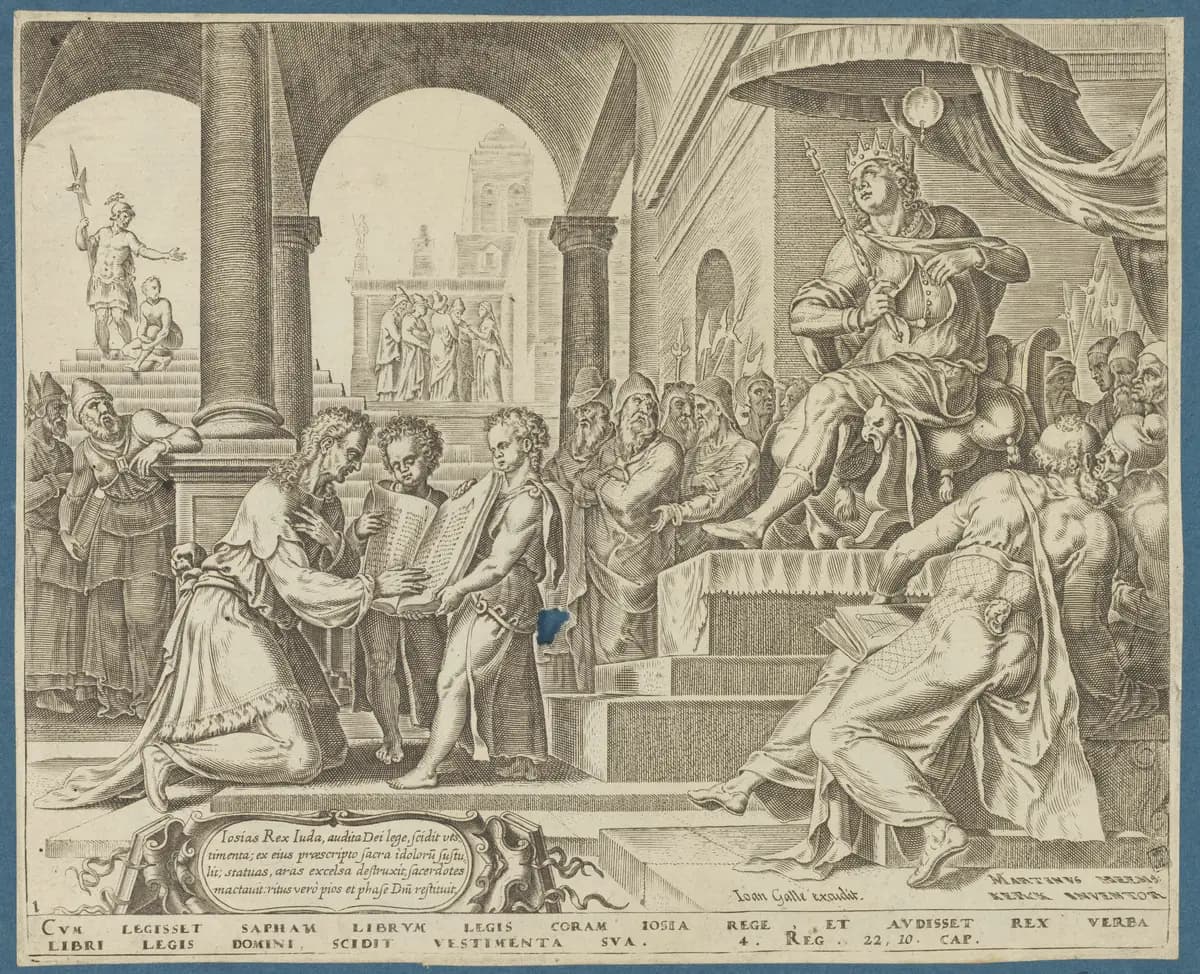
Saphan Reading the Book of the Law to Josiah, Philip Galle, engraving after Maarten van Heemskerck, 1569, Royal Library of Belgium. Public domain.
Old Testament · Book 14 of 66
2 Chronicles
2 Chronicles retells the reign of Solomon and the kings of Judah down to the exile in Babylon. It gives close attention to the temple and to the kings who restored its worship, and ends with Cyrus allowing the return.
2 Chronicles retells the reign of Solomon and the kings of Judah down to the exile in Babylon. It gives close attention to the temple and to the kings who restored its worship, and ends with Cyrus allowing the return.
What is 2 Chronicles about?
2 Chronicles opens with Solomon made strong and ends with a decree to go up and build. Solomon builds the house of God, and when he has prayed, fire falls and the glory of the LORD fills it. God answers him by night: “if My people who are called by My name humble themselves and pray and seek My face and turn from their wicked ways, then I will hear from heaven, forgive their sin, and heal their land” (7:14). Every king of Judah after him is measured by whether he sought the LORD or forsook him. The house burns, the land rests, and Cyrus of Persia proclaims that the people may go up.
All 36 chapters
Every chapter of the book, in one grid. Each cell opens that chapter.
- The house of God2 Chronicles 1 to 9
- The kingdom torn2 Chronicles 10 to 20
- The dark years2 Chronicles 21 to 28
- The doors opened2 Chronicles 29 to 35
- The fall and the decree2 Chronicles 36
The colour is the movement of the book the chapter stands in, and every cell opens that chapter's Study level.
Who wrote it, where, when, for whom, and why?
2 Chronicles names no writer. It sends the reader instead to the records of the prophets: the records of Nathan, the prophecy of Ahijah and the visions of Iddo for Solomon (9:29), the records of Shemaiah and Iddo for Rehoboam (12:15), the vision of Isaiah for Hezekiah (32:32), and the records of the seers for Manasseh (33:19).
As for the rest of the acts of Hezekiah and his deeds of loving devotion, they are indeed written in the vision of the prophet Isaiah son of Amoz in the Book of the Kings of Judah and Israel.
2 Chronicles 32:32, Berean Standard Bible.
The rest of Scripture meets the book at its last verses. Ezra opens with the same decree of Cyrus, word for word (Ezra 1:1). The seventy years the land rests are the word of Jeremiah (Jeremiah 25:11), and the Sabbaths it enjoys are the ones the law promised the land (Leviticus 26:34), both named in 36:21. Jesus names the blood of Zechariah, who was stoned in the temple court (Matthew 23:35; Luke 11:51; 2 Chronicles 24:20 to 22).
In the first year of Cyrus king of Persia, to fulfill the word of the LORD spoken through Jeremiah, the LORD stirred the spirit of Cyrus king of Persia to send a proclamation throughout his kingdom and to put it in writing as follows:
Ezra 1:1, Berean Standard Bible.
The book stands in Jerusalem, at the house of which Solomon asks whether God will indeed dwell on earth (6:18). It runs from Solomon's accession to the first year of Cyrus king of Persia (36:22), the last event it records, so it was finished after that year.
But will God indeed dwell with man upon the earth? Even heaven, the highest heaven, cannot contain You, much less this temple I have built.
2 Chronicles 6:18, Berean Standard Bible.
It ends with a people told that they may go up (36:23), and it gives them the terms on which God hears: if his people humble themselves, pray, seek his face and turn, he will hear, forgive and heal (7:14). Hezekiah's letter to the scattered north makes the same promise to those who return (30:9), and the prophet's word to Asa is the measure of every reign (15:2).
So he went out to meet Asa and said to him, “Listen to me, Asa and all Judah and Benjamin. The LORD is with you when you are with Him. If you seek Him, He will be found by you, but if you forsake Him, He will forsake you.
2 Chronicles 15:2, Berean Standard Bible.
The book's world is the kingdom torn in two after Solomon (10:19), with Egypt to the south under Shishak (12:2) and Neco (35:20), Aram to the north (16:2), and then the empires. Assyria besieges Jerusalem under Sennacherib (32:1) and takes Manasseh in chains (33:11). Babylon under Nebuchadnezzar burns the house and carries the survivors away (36:17 to 20), until the kingdom of Persia comes to power (36:20).
Sources. 2 Chronicles 6:18, 7:14, 9:29, 10:19, 12:2, 12:15, 15:2, 16:2, 24:20 to 22, 30:9, 32:1, 32:32, 33:11, 33:19, 35:20, 36:17 to 23; Ezra 1:1; Jeremiah 25:11; Leviticus 26:34; Matthew 23:35; Luke 11:51. Every verse is read in the Berean Standard Bible.
How is 2 Chronicles arranged, and what is it for?
The five movements the book falls into, what it teaches, what it was written to do, and every reign on one line.
- The house of God2 Chronicles 1 to 9, 201 verses; turns at 7:1
Solomon is given wisdom, builds the house, and prays at its dedication, and God fills it with his glory.
- The kingdom torn2 Chronicles 10 to 20, 229 verses; turns at 10:19
The north breaks away, and four kings of Judah are measured by whether they seek the LORD.
- The dark years2 Chronicles 21 to 28, 167 verses; turns at 24:17
The house of Ahab enters Judah, David's line hangs on one hidden child, and Ahaz shuts the doors of the temple.
- The doors opened2 Chronicles 29 to 35, 202 verses; turns at 29:3
Hezekiah and Josiah reopen the house and keep two great Passovers, and Manasseh returns from Babylon humbled.
- The fall and the decree2 Chronicles 36, 23 verses; turns at 36:16
Four last kings, the burning of the house, seventy years of rest for the land, and Cyrus's decree.
The theme
God chooses a house for his Name and a house of David to reign, and he fills the first with his glory. Every king after Solomon is measured by whether he sought the LORD, and the text shows the answer in his reign: help for those who seek and humble themselves, and trouble for those who forsake. The house burns when the people mock the prophets beyond remedy, and still the book ends with the door open.
The purpose
2 Chronicles was written after the exile for a people allowed to go up and build again. It tells them that the house and the line of David were God's choice, that their fathers fell by forsaking him, and that he still hears those who humble themselves and return. It ends where Ezra begins, with the decree of Cyrus.
Every reign of Judah, measured by whether the king sought the LORD or forsook him
- Above the axisRight of the axis: sought the LORD
- Below the axisLeft of the axis: forsook the LORD
- A turn inside the reign, with its verse
- A break in David's line
- Solomonsought, 1:1
- Rehoboamforsook, 12:14sought, 11:17turns at 12:1
- Abijahsought, 13:18
- Asaforsook, 16:12sought, 14:2turns at 16:12
- Jehoshaphatsought, 20:32
- Jehoramforsook, 21:6
- Ahaziahforsook, 22:4
- AthaliahSix years, David's line broken
- Joashforsook, 24:18sought, 24:2turns at 24:17
- Amaziahforsook, 25:14sought, 25:2turns at 25:14
- Uzziahforsook, 26:16sought, 26:5turns at 26:16
- Jothamsought, 27:6
- Ahazforsook, 28:1
- Hezekiahforsook, 32:25sought, 29:2sought, 32:26turns at 32:25 and 32:26
- Manassehforsook, 33:2sought, 33:12turns at 33:12
- Amonforsook, 33:22
- Josiahsought, 34:2
- Jehoahaz0no verdict, 36:2
- Jehoiakimforsook, 36:5
- Jehoiachinforsook, 36:9
- Zedekiahforsook, 36:12
The house of God, 2 Chronicles 1 to 9
What the text says in these 9 chapters, and the pages they open on.
Solomon is made strong in his kingdom, and at Gibeon he asks God for wisdom to govern the people. He brings cedar from Tyre and builds the house on Mount Moriah, where the LORD had appeared to David. When the priests bring the ark into the inner sanctuary, the cloud fills the house. Solomon kneels before the assembly and asks God to hear every prayer made toward it, and when he finishes, fire comes down from heaven and the glory of the LORD fills the temple. By night the LORD answers him with a promise and a warning. The queen of Sheba comes to test his wisdom, and after forty years Solomon dies.
If I close the sky so there is no rain, or if I command the locust to devour the land, or if I send a plague among My people, and if My people who are called by My name humble themselves and pray and seek My face and turn from their wicked ways, then I will hear from heaven, forgive their sin, and heal their land.
- Study
2 Chronicles 1wisdom asked for at GibeonShow the summary and 2 pagesShow summary, 2 pagesHide the summary
Solomon goes with the whole assembly to the tent of meeting at Gibeon and offers a thousand burnt offerings on the bronze altar.
- That night God tells him to ask for whatever he wants.
- Solomon asks for wisdom and knowledge to govern the people, and God gives him riches and honour as well.
On this chapter (2)
- Solomon
David's son, who asks for wisdom and builds the house of God.
- 2 Chronicles 1:10
The verse on its own page, with the commentators on it by era.
- Study
2 Chronicles 2Preparing to buildShow the summary and 2 pagesShow summary, 2 pagesHide the summary
Solomon resolves to build a house for the Name of the LORD and conscripts porters, stonecutters and supervisors.
- He writes to Hiram king of Tyre for cedar, cypress and algum logs and for a craftsman skilled in every kind of work.
- Hiram blesses the God who made heaven and earth, sends Huram-abi, and floats the timber by sea to Joppa.
On this chapter (2)
- Solomon
David's son, who asks for wisdom and builds the house of God.
- 2 Chronicles 2:6
The verse on its own page, with the commentators on it by era.
- Study
2 Chronicles 3The temple builtShow the summary and 2 pagesShow summary, 2 pagesHide the summary
Solomon begins to build the house of the LORD on Mount Moriah, where the LORD had appeared to his father David.
- He overlays the main room and the Most Holy Place with gold and sets two golden cherubim inside.
- He hangs the veil and sets up two pillars at the front, naming them Jachin and Boaz.
On this chapter (2)
- The ark of the covenant
The chest in the Most Holy Place and what it held.
- 2 Chronicles 3:17
The verse on its own page, with the commentators on it by era.
- Study
2 Chronicles 4The furnishingsShow the summary and 1 pageShow summary, 1 pageHide the summary
Solomon makes the bronze altar, the cast metal Sea standing on twelve oxen, and ten basins for washing.
- Huram-abi casts the bronze work in clay molds in the plain of the Jordan.
- Solomon makes the golden altar, the lampstands, the tables for the bread and the gold doors of the house.
On this chapter (1)
- 2 Chronicles 4:2
The verse on its own page, with the commentators on it by era.
- Study
2 Chronicles 5the ark brought in and the cloudShow the summary and 3 pagesShow summary, 3 pagesHide the summary
The temple is finished, and the priests bring the ark of the covenant into the Most Holy Place.
- The singers and trumpeters praise the LORD with one voice.
- The cloud fills the house, and the priests cannot stand to minister because the glory of the LORD fills it.
On this chapter (3)
- The ark of the covenant
The chest in the Most Holy Place and what it held.
- The glory departed
The glory that filled the house and the day it left.
- 2 Chronicles 5:14
The verse on its own page, with the commentators on it by era.
- Study
2 Chronicles 6Solomon's prayer of dedicationShow the summary and 3 pagesShow summary, 3 pagesHide the summary
Solomon stands on a bronze platform before the assembly, kneels and prays for the house he has built.
- He asks whether God can dwell on earth when the highest heaven cannot contain him.
- He asks God to hear every prayer made toward this house, in drought, defeat, sin and exile.
On this chapter (3)
- The glory departed
The glory that filled the house and the day it left.
- Who is 2 Chronicles 7:14 addressed to?
Answered under Where do readers disagree, lower on this page, with each reading and who holds it.
- 2 Chronicles 6:18
The verse on its own page, with the commentators on it by era.
- Study
2 Chronicles 7fire, glory and the answer by nightShow the summary and 4 pagesShow summary, 4 pagesHide the summary
When Solomon finishes praying, fire comes down from heaven and the glory of the LORD fills the temple.
- The people bow with their faces to the pavement, and the dedication runs seven days.
- The LORD appears at night and promises to hear and heal if his people humble themselves, pray, seek his face and turn.
On this chapter (4)
- Repentance
Turning back to God, from the prophets to the apostles.
- The glory departed
The glory that filled the house and the day it left.
- Who is 2 Chronicles 7:14 addressed to?
Answered under Where do readers disagree, lower on this page, with each reading and who holds it.
- 2 Chronicles 7:14
The verse on its own page, with the commentators on it by era.
- Study
2 Chronicles 8Solomon's worksShow the summary and 2 pagesShow summary, 2 pagesHide the summary
When the house and the palace are finished, Solomon rebuilds cities and builds store cities and fortresses.
- He makes forced laborers of the peoples left in the land, but no Israelite a slave.
- He keeps the offerings of the Sabbaths, New Moons and feasts as Moses commanded, and sends ships with Hiram's sailors to Ophir for gold.
On this chapter (2)
- Solomon
David's son, who asks for wisdom and builds the house of God.
- 2 Chronicles 8:16
The verse on its own page, with the commentators on it by era.
- Study
2 Chronicles 9the queen of Sheba and Solomon's deathShow the summary and 3 pagesShow summary, 3 pagesHide the summary
The queen of Sheba comes to test Solomon with hard questions and finds his wisdom greater than she had heard.
- The chapter counts Solomon's gold, his throne and his trade.
- Solomon reigns forty years and is buried in the city of David.
On this chapter (3)
- Solomon
David's son, who asks for wisdom and builds the house of God.
- Why does Chronicles leave out what Kings tells, Solomon's turn among them?
Answered under Where do readers disagree, lower on this page, with each reading and who holds it.
- 2 Chronicles 9:8
The verse on its own page, with the commentators on it by era.
The dedication of the house in five steps, in the order the text tells them
- 12 Chronicles 5:7
The priests bring the ark to its place in the inner sanctuary, beneath the wings of the cherubim.
- 32 Chronicles 6:12 to 42
Solomon kneels on the bronze platform and prays for every prayer made toward the house.
- 52 Chronicles 7:12 to 22
The LORD appears by night: he has heard, he has chosen the place, and he sets the terms.
Characters (3)
Who the text follows. A name with a page carries its door.
- Solomon
David's son, who asks for wisdom, builds the house and prays at its dedication.
- Huram of Tyre
The king who sends cedar and a skilled craftsman for the building.
- The queen of Sheba
She comes with hard questions and finds Solomon's wisdom greater than its report.
Places (3)
Where the chapters stand.
- Gibeon
Where the tent of meeting and the bronze altar stood, and Solomon asked for wisdom.
- Mount Moriah
The ground of the house, where the LORD had appeared to David (3:1).
- Jerusalem
The city of the house and the throne, burned at the end of the book.
Themes (3)
What these chapters raise, each on its own page.
- The ark of the covenant
The chest of the covenant, set beneath the wings of the cherubim.
- The glory departed
The glory that filled the house, and the day it left.
- Repentance
Humble, pray, seek and turn: the terms of 7:14.
Where the New Testament uses these chapters (2)each marked as a quotation or an allusion, with the evidence
- Probable allusionSolomon's question, 2 Chronicles 6:18 at Acts 7:47 to 49. Stephen says that Solomon built God a house, yet the Most High does not dwell in houses made by hands. Stephen names Solomon and the house and answers with Isaiah 66:1; the echo of Solomon's own question is unmarked.
- Probable allusionThe queen of Sheba, 2 Chronicles 9:1 to 12 at Matthew 12:42 and Luke 11:31. Jesus says the queen of the South came from the ends of the earth to hear Solomon's wisdom, and something greater than Solomon is here. Jesus names her visit without quoting the account, which 1 Kings 10 also tells.
The kingdom torn, 2 Chronicles 10 to 20
What the text says in these 11 chapters, and the pages they open on.
Rehoboam answers the people harshly at Shechem, and the north rebels against the house of David. From here the book follows Judah alone. Rehoboam forsakes the law and Shishak of Egypt comes against him, but the king humbles himself and is spared. Abijah wins against a larger army because Judah relied on the LORD. Asa leads Judah into a covenant to seek the LORD with all their heart, yet in his last years he relies on the king of Aram and in his illness seeks only the physicians. Jehoshaphat sends teachers of the law through the towns, and when Moab and Ammon come against him he prays, and the singers go out before the army.
So he went out to meet Asa and said to him, “Listen to me, Asa and all Judah and Benjamin. The LORD is with you when you are with Him. If you seek Him, He will be found by you, but if you forsake Him, He will forsake you.
- Study
2 Chronicles 10the north breaks away from David's houseShow the summary and 2 pagesShow summary, 2 pagesHide the summary
At Shechem the people ask Rehoboam to lighten the yoke his father laid on them.
- He rejects the elders' counsel and answers harshly, as the young men advised.
- Israel goes home and rebels against the house of David, and the book follows Judah alone from here.
On this chapter (2)
- The remnant
The part of the people God keeps when the whole falls away.
- 2 Chronicles 10:19
The verse on its own page, with the commentators on it by era.
- Study
2 Chronicles 11Rehoboam fortifiesShow the summary and 2 pagesShow summary, 2 pagesHide the summary
Rehoboam gathers an army to win back the north, but Shemaiah tells him not to fight his brothers, and he turns back.
- He fortifies cities across Judah and Benjamin.
- The priests and Levites whom Jeroboam rejected come south, and all who set their hearts to seek the LORD follow them to Jerusalem.
On this chapter (2)
- The remnant
The part of the people God keeps when the whole falls away.
- 2 Chronicles 11:16
The verse on its own page, with the commentators on it by era.
- Study
2 Chronicles 12Shishak, and a king who humbles himselfShow the summary and 2 pagesShow summary, 2 pagesHide the summary
Once his kingdom is secure, Rehoboam and all Israel forsake the law of the LORD.
- Shishak of Egypt comes up against Jerusalem, and Shemaiah says that because they forsook the LORD he has forsaken them.
- The king and the leaders humble themselves, and the LORD grants some deliverance.
On this chapter (2)
- Repentance
Turning back to God, from the prophets to the apostles.
- 2 Chronicles 12:6
The verse on its own page, with the commentators on it by era.
- Study
2 Chronicles 13Abijah's battleShow the summary and 3 pagesShow summary, 3 pagesHide the summary
Abijah stands on Mount Zemaraim and tells Jeroboam and all Israel that the kingdom belongs to David's line by covenant.
- Jeroboam's ambush closes around Judah, and the men of Judah cry out to the LORD while the priests blow the trumpets.
- God routs Israel before Judah, because Judah relied on the LORD, the God of their fathers.
On this chapter (3)
- The Davidic covenant
The promise to David's house and the throne established forever.
- Can the army numbers be taken at face value?
Answered under Where do readers disagree, lower on this page, with each reading and who holds it.
- 2 Chronicles 13:12
The verse on its own page, with the commentators on it by era.
- Study
2 Chronicles 14Asa reliesShow the summary and 2 pagesShow summary, 2 pagesHide the summary
Asa does what is good and right, removes the foreign altars and commands Judah to seek the LORD.
- The land has rest, and Asa builds fortified cities.
- Zerah the Cushite comes against him with a vast army, Asa cries out to the LORD, and the Cushites are struck down and flee.
On this chapter (2)
- Can the army numbers be taken at face value?
Answered under Where do readers disagree, lower on this page, with each reading and who holds it.
- 2 Chronicles 14:11
The verse on its own page, with the commentators on it by era.
- Study
2 Chronicles 15Asa's covenant to seek the LORDShow the summary and 3 pagesShow summary, 3 pagesHide the summary
Azariah son of Oded meets Asa and tells him that the LORD will be found if he is sought and will forsake those who forsake him.
- Asa removes the idols and repairs the altar.
- Judah enters a covenant to seek the LORD with all their heart, and God gives them rest.
On this chapter (3)
- Repentance
Turning back to God, from the prophets to the apostles.
- Is the reward or judgment in each reign a rule for every life?
Answered under Where do readers disagree, lower on this page, with each reading and who holds it.
- 2 Chronicles 15:2
The verse on its own page, with the commentators on it by era.
- Study
2 Chronicles 16Asa relies on Aram and the physiciansShow the summary and 2 pagesShow summary, 2 pagesHide the summary
Asa buys the help of the king of Aram against Baasha with silver and gold from the house of the LORD.
- Hanani the seer rebukes him for relying on Aram and not on the LORD, and Asa puts him in prison.
- In his illness Asa does not seek the LORD but only the physicians.
On this chapter (2)
- Is the reward or judgment in each reign a rule for every life?
Answered under Where do readers disagree, lower on this page, with each reading and who holds it.
- 2 Chronicles 16:12
The verse on its own page, with the commentators on it by era.
- Study
2 Chronicles 17Jehoshaphat teachesShow the summary and 2 pagesShow summary, 2 pagesHide the summary
Jehoshaphat seeks the God of his father and walks in his commandments, and the LORD establishes his kingdom.
- He sends officials and Levites through the towns of Judah to teach from the Book of the Law.
- The dread of the LORD falls on the kingdoms around Judah, and Jehoshaphat grows stronger and stronger.
On this chapter (2)
- Can the army numbers be taken at face value?
Answered under Where do readers disagree, lower on this page, with each reading and who holds it.
- 2 Chronicles 17:9
The verse on its own page, with the commentators on it by era.
- Study
2 Chronicles 18Micaiah's warningShow the summary and 2 pagesShow summary, 2 pagesHide the summary
Jehoshaphat allies himself with Ahab by marriage and agrees to go up with him against Ramoth-gilead.
- Ahab's prophets promise victory, but Micaiah son of Imlah sees all Israel scattered like sheep without a shepherd.
- Ahab disguises himself and is struck by an arrow shot without aim, and Jehoshaphat cries out and is spared.
On this chapter (2)
- Jesus on prayer
How Jesus taught his disciples to pray.
- 2 Chronicles 18:13
The verse on its own page, with the commentators on it by era.
- Study
2 Chronicles 19Judges appointedShow the summary and 1 pageShow summary, 1 pageHide the summary
Jehu son of Hanani rebukes Jehoshaphat for helping the wicked, yet says some good is found in him.
- Jehoshaphat goes out among the people from Beersheba to the hill country of Ephraim and turns them back to the LORD.
- He appoints judges in the fortified cities and tells them they judge for the LORD, who is with them.
On this chapter (1)
- 2 Chronicles 19:6
The verse on its own page, with the commentators on it by era.
- Study
2 Chronicles 20Jehoshaphat's prayer and the battle not theirsShow the summary and 3 pagesShow summary, 3 pagesHide the summary
Moab and Ammon come against Judah, and Jehoshaphat proclaims a fast and prays before the assembly.
- The Spirit comes on Jahaziel, who tells them the battle is not theirs but God's.
- The singers go out ahead of the army, and the enemies destroy one another.
On this chapter (3)
- Jesus on prayer
How Jesus taught his disciples to pray.
- Can the army numbers be taken at face value?
Answered under Where do readers disagree, lower on this page, with each reading and who holds it.
- 2 Chronicles 20:20
The verse on its own page, with the commentators on it by era.
Characters (4)
Who the text follows. A name with a page carries its door.
- Rehoboam
Solomon's son, under whom the north breaks away.
- Abijah
He speaks to Jeroboam's army from Mount Zemaraim before the battle.
- Asa
He seeks the LORD and makes a covenant, then relies on Aram.
- Jehoshaphat
He teaches the law, appoints judges and prays when the armies come.
Places (2)
Where the chapters stand.
- Shechem
Where Israel asks Rehoboam to lighten the yoke, and is refused.
- The Wilderness of Tekoa
Where Judah goes out singing against Moab and Ammon (20:20).
Themes (3)
What these chapters raise, each on its own page.
- Repentance
Rehoboam's humbling and Asa's covenant.
- Jesus on prayer
Jehoshaphat's prayer before the assembly.
- The remnant
The part of the people God keeps.
Where the New Testament uses these chapters (1)each marked as a quotation or an allusion, with the evidence
- Probable allusionAbraham the friend of God, 2 Chronicles 20:7 at James 2:23. James says Abraham was called the friend of God. The title stands in Jehoshaphat's prayer and at Isaiah 41:8; James does not say which he draws on.
The dark years, 2 Chronicles 21 to 28
What the text says in these 8 chapters, and the pages they open on.
Jehoram marries a daughter of Ahab and kills his brothers, yet the LORD will not destroy the house of David because of his covenant. When his son Ahaziah is killed, Athaliah sets out to destroy every royal heir, and one infant, Joash, is hidden six years in the house of God. Jehoiada the priest crowns him, and Joash does right while Jehoiada lives. When the priest dies, the officials turn the king to idols, and Joash has Jehoiada's son Zechariah stoned in the temple court. Amaziah worships the gods of Edom, Uzziah grows proud and burns incense in the temple, and Ahaz cuts up the vessels of the house and shuts its doors.
Then the Spirit of God came upon Zechariah son of Jehoiada the priest, who stood up before the people and said to them, “This is what God says: ‘Why do you transgress the commandments of the LORD so that you cannot prosper? Because you have forsaken the LORD, He has forsaken you.’”
- Study
2 Chronicles 21Jehoram, and the lamp promised to DavidShow the summary and 3 pagesShow summary, 3 pagesHide the summary
Jehoram kills his brothers, marries a daughter of Ahab and does evil.
- Yet the LORD will not destroy the house of David, because of the covenant and the lamp he promised David.
- A letter from Elijah announces judgment, and Jehoram dies of a disease of the bowels to no one's regret.
On this chapter (3)
- The Davidic covenant
The promise to David's house and the throne established forever.
- Elijah on Carmel
The prophet who writes to Jehoram, on the mountain where he met Baal.
- 2 Chronicles 21:7
The verse on its own page, with the commentators on it by era.
- Study
2 Chronicles 22Athaliah seizesShow the summary and 3 pagesShow summary, 3 pagesHide the summary
Ahaziah reigns one year and follows the counsel of the house of Ahab, his mother Athaliah among them.
- He is killed when Jehu executes judgment on the house of Ahab.
- Athaliah destroys the royal heirs, but Jehoshabeath steals away the infant Joash and hides him in the house of God.
On this chapter (3)
- The Davidic covenant
The promise to David's house and the throne established forever.
- The high-priestly line
The priests of Aaron's line, Jehoiada among them.
- 2 Chronicles 22:12
The verse on its own page, with the commentators on it by era.
- Study
2 Chronicles 23Joash crowned and Athaliah put to deathShow the summary and 3 pagesShow summary, 3 pagesHide the summary
In the seventh year Jehoiada the priest makes a covenant with the commanders and the Levites.
- They bring out the king's son, crown him and proclaim him king in the house of God.
- Athaliah is put to death, the house of Baal is torn down, and the people rejoice.
On this chapter (3)
- The Davidic covenant
The promise to David's house and the throne established forever.
- The high-priestly line
The priests of Aaron's line, Jehoiada among them.
- 2 Chronicles 23:3
The verse on its own page, with the commentators on it by era.
- Study
2 Chronicles 24Joash forgets Jehoiada and Zechariah is stonedShow the summary and 3 pagesShow summary, 3 pagesHide the summary
Joash does right all the days of Jehoiada the priest and restores the house of the LORD.
- After Jehoiada dies the officials of Judah turn the king to the Asherah poles and idols.
- The Spirit of God comes on Zechariah son of Jehoiada, and the people stone him in the courtyard at the king's command.
On this chapter (3)
- The high-priestly line
The priests of Aaron's line, Jehoiada among them.
- Which Zechariah does Jesus name?
Answered under Where do readers disagree, lower on this page, with each reading and who holds it.
- 2 Chronicles 24:20
The verse on its own page, with the commentators on it by era.
- Study
2 Chronicles 25Amaziah's idolsShow the summary and 2 pagesShow summary, 2 pagesHide the summary
Amaziah does what is right, but not wholeheartedly, and at a man of God's word he sends home the troops he hired from Israel.
- He defeats Edom in the Valley of Salt, then brings home the gods of Seir and bows to them.
- He silences the prophet sent to him, challenges Jehoash of Israel, and is captured at Beth-shemesh.
On this chapter (2)
- Is the reward or judgment in each reign a rule for every life?
Answered under Where do readers disagree, lower on this page, with each reading and who holds it.
- 2 Chronicles 25:15
The verse on its own page, with the commentators on it by era.
- Study
2 Chronicles 26Uzziah's pride and his leprosyShow the summary and 2 pagesShow summary, 2 pagesHide the summary
Uzziah seeks God in the days of Zechariah, and God gives him success in war and building.
- When he grows powerful he enters the temple to burn incense, which belongs to the priests.
- Leprosy breaks out on his forehead, and he lives apart until his death.
On this chapter (2)
- Is the reward or judgment in each reign a rule for every life?
Answered under Where do readers disagree, lower on this page, with each reading and who holds it.
- 2 Chronicles 26:16
The verse on its own page, with the commentators on it by era.
- Study
2 Chronicles 27Jotham's strengthShow the summary and 1 pageShow summary, 1 pageHide the summary
Jotham does what is right as his father Uzziah had done, but he does not enter the temple of the LORD.
- He rebuilds the Upper Gate of the house and builds cities, fortresses and towers.
- He defeats the Ammonites and grows powerful, because he ordered his ways before the LORD his God.
On this chapter (1)
- 2 Chronicles 27:2
The verse on its own page, with the commentators on it by era.
- Study
2 Chronicles 28Ahaz shuts the doors of the houseShow the summary and 2 pagesShow summary, 2 pagesHide the summary
Ahaz does not do what is right, makes images for the Baals and burns his sons in the fire.
- Aram and Israel defeat him, and the prophet Oded sends the captives of Judah home.
- In his distress Ahaz is more unfaithful still, cuts up the articles of the house of God and shuts its doors.
On this chapter (2)
- The glory departed
The glory that filled the house and the day it left.
- 2 Chronicles 28:24
The verse on its own page, with the commentators on it by era.
The line of David held by one hidden child, set beside the promise it hangs on
- Jehoram2 Chronicles 21:7
He kills his brothers and does evil, yet the LORD will not destroy the house of David, for the lamp he promised.
- Ahaziah2 Chronicles 22:1
Raiders have killed all his older brothers, so the youngest son reigns one year and is put to death by Jehu (22:9).
- Athaliah2 Chronicles 22:10
His mother sets out to destroy all the royal heirs of the house of Judah and rules the land.
- Joash hidden2 Chronicles 22:11 to 12
His aunt Jehoshabeath steals the infant away, and he stays hidden in the house of God six years.
- The king's son2 Chronicles 23:3
In the seventh year the assembly makes a covenant with the king in the house of God, as the LORD promised concerning David's descendants.
- Joash crowned2 Chronicles 23:11
Jehoiada and his sons bring out the king's son, crown him and anoint him.
God tells David that his son will build a house for the LORD's Name, and that he will establish the throne of that son's kingdom forever. 2 Chronicles 21:7 names the same covenant as the reason the house of David is not destroyed.
Characters (5)
Who the text follows. A name with a page carries its door.
- Jehoram
He kills his brothers and walks in the ways of Ahab's house.
- Athaliah
Ahab's daughter, who kills the royal heirs and rules six years.
- Joash
The hidden child made king, who turns after Jehoiada dies.
- Uzziah
He seeks God and prospers, then enters the temple to burn incense.
Show the next 1
- Ahaz
He burns his sons in the fire and shuts the doors of the house.
Places (2)
Where the chapters stand.
- The house of God
Where Joash is hidden six years, and Zechariah is stoned in its court.
- Edom
Amaziah defeats it in the Valley of Salt and brings its gods home (25:11 to 14).
Themes (3)
What these chapters raise, each on its own page.
- The Davidic covenant
The lamp promised to David, kept through the dark years.
- The high-priestly line
Jehoiada and the priests of Aaron's line.
- Elijah on Carmel
The prophet whose letter comes to Jehoram (21:12).
Where the New Testament uses these chapters (1)each marked as a quotation or an allusion, with the evidence
- Explicit quotationThe blood of Zechariah, 2 Chronicles 24:20 to 22 at Matthew 23:35 and Luke 11:51. Jesus names the righteous blood shed from Abel to Zechariah, murdered between the altar and the house. Jesus names the man and the place of the killing without quoting the account; which Zechariah he means is set out under Where do readers disagree.
The doors opened, 2 Chronicles 29 to 35
What the text says in these 7 chapters, and the pages they open on.
In the first month of his reign Hezekiah opens the doors of the house of the LORD and has the priests and Levites carry out the defilement. He sends letters through all Israel and Judah to keep the Passover in Jerusalem, and though many mock, some from the north humble themselves and come. When Sennacherib of Assyria besieges the land, Hezekiah and Isaiah pray, and the Assyrian camp is struck. Manasseh fills Jerusalem with idols and is taken to Babylon in chains, where he humbles himself and is brought back. Josiah seeks the LORD in his youth, the Book of the Law is found in the house, and he keeps a Passover like none since Samuel before he dies at Megiddo.
For if you return to the LORD, your brothers and sons will receive mercy in the presence of their captors and will return to this land. For the LORD your God is gracious and merciful; He will not turn His face away from you if you return to Him.”
- Study
2 Chronicles 29the doors opened and the house cleansedShow the summary and 2 pagesShow summary, 2 pagesHide the summary
In the first month of his reign Hezekiah opens and repairs the doors of the house of the LORD.
- He tells the priests and Levites to consecrate themselves and carry the defilement out of the holy place.
- The house is restored with sin offerings, burnt offerings and song, and the people rejoice.
On this chapter (2)
- The cleansing of the temple
The house cleared and restored to its use.
- 2 Chronicles 29:3
The verse on its own page, with the commentators on it by era.
- Study
2 Chronicles 30Hezekiah's Passover for all IsraelShow the summary and 2 pagesShow summary, 2 pagesHide the summary
Hezekiah sends letters through all Israel and Judah inviting them to keep the Passover in Jerusalem.
- Many mock the couriers, but some from Asher, Manasseh and Zebulun humble themselves and come.
- The Passover is kept in the second month, and nothing like it had happened since the days of Solomon.
On this chapter (2)
- Repentance
Turning back to God, from the prophets to the apostles.
- 2 Chronicles 30:9
The verse on its own page, with the commentators on it by era.
- Study
2 Chronicles 31Gifts restoredShow the summary and 2 pagesShow summary, 2 pagesHide the summary
After the Passover the people go out and break down the sacred pillars and high places throughout Judah.
- Hezekiah restores the divisions of the priests and Levites and commands gifts for their support.
- The people bring firstfruits and tithes in heaps, and Hezekiah prepares storerooms in the house of the LORD.
On this chapter (2)
- The high-priestly line
The priests of Aaron's line, Azariah of the house of Zadok among them.
- 2 Chronicles 31:21
The verse on its own page, with the commentators on it by era.
- Study
2 Chronicles 32Sennacherib defeatedShow the summary and 2 pagesShow summary, 2 pagesHide the summary
Sennacherib of Assyria invades Judah, and Hezekiah stops up the springs, rebuilds the wall and tells the people that the LORD is with them.
- When Sennacherib mocks the LORD, Hezekiah and Isaiah cry out to heaven, and an angel destroys the Assyrian camp.
- After his healing Hezekiah's heart grows proud, then he humbles himself, and the wrath does not come in his days.
On this chapter (2)
- Hezekiah's sundial
The sign given to Hezekiah in his illness.
- 2 Chronicles 32:7
The verse on its own page, with the commentators on it by era.
- Study
2 Chronicles 33Manasseh taken to Babylon and humbledShow the summary and 5 pagesShow summary, 5 pagesHide the summary
Manasseh rebuilds the high places, burns his sons in the fire and fills Jerusalem with idols.
- The Assyrian commanders take him to Babylon with hooks and bronze chains.
- In his distress he humbles himself, God hears him and brings him back, and he knows that the LORD is God.
On this chapter (5)
- The worst king's prayer
The Prayer of Manasseh, outside the 66 books, read as a study resource.
- Repentance
Turning back to God, from the prophets to the apostles.
- Why does only Chronicles record Manasseh's repentance?
Answered under Where do readers disagree, lower on this page, with each reading and who holds it.
- Is the Prayer of Manasseh the prayer 33:19 mentions?
Answered under Where do readers disagree, lower on this page, with each reading and who holds it.
- 2 Chronicles 33:12
The verse on its own page, with the commentators on it by era.
- Study
2 Chronicles 34the Book of the Law foundShow the summary and 3 pagesShow summary, 3 pagesHide the summary
Josiah begins to seek the God of David in his youth and cleanses Judah and Jerusalem of idols.
- While the house is being repaired, Hilkiah finds the Book of the Law, and it is read to the king.
- Huldah the prophetess announces judgment, and the king makes a covenant before the LORD.
On this chapter (3)
- Josiah finds the book
The Book of the Law found in the temple and read to the king.
- Huldah
The prophetess who told Josiah what the book meant.
- 2 Chronicles 34:31
The verse on its own page, with the commentators on it by era.
- Study
2 Chronicles 35Josiah's Passover and his death at MegiddoShow the summary and 3 pagesShow summary, 3 pagesHide the summary
Josiah keeps the Passover on the fourteenth day of the first month, with the priests and Levites in their divisions.
- No Passover like it had been kept since the days of Samuel the prophet.
- Josiah goes out against Neco at Megiddo, is struck by the archers and dies, and Jeremiah laments him.
On this chapter (3)
- The ark of the covenant
The chest in the Most Holy Place and what it held.
- Why does Josiah die in battle after Huldah promised him peace?
Answered under Where do readers disagree, lower on this page, with each reading and who holds it.
- 2 Chronicles 35:18
The verse on its own page, with the commentators on it by era.
The two great Passovers of the book, Hezekiah's and Josiah's, row by row
Hezekiah, 2 Chronicles 30Josiah, 2 Chronicles 35
- The month
- HezekiahThe second month, because the priests had not consecrated themselves in time (30:2, 30:15).
- JosiahThe fourteenth day of the first month (35:1).
- Who was called
- HezekiahAll Israel and Judah, from Beersheba to Dan, with letters to Ephraim and Manasseh (30:1, 30:5).
- JosiahThe priests, the Levites, all Judah, the Israelites present and the people of Jerusalem (35:18).
- Who came
- HezekiahMany in the north mocked the couriers, but some from Asher, Manasseh and Zebulun humbled themselves and came (30:10 to 11).
- JosiahThe Israelites who were present, and Josiah gave 30,000 lambs and goats from his own flocks (35:7, 35:17).
- The Levites' part
- HezekiahThey slaughtered the lambs for everyone who was not clean (30:17).
- JosiahThey skinned the animals and prepared the lambs for themselves, the priests, the singers and the gatekeepers (35:11 to 15).
- How long
- HezekiahSeven days of Unleavened Bread, and the assembly agreed to keep seven more (30:21, 30:23).
- JosiahThe Feast of Unleavened Bread for seven days (35:17).
- How the text ranks it
- HezekiahNothing like it in Jerusalem since the days of Solomon (30:26).
- JosiahNo Passover like it since the days of Samuel the prophet (35:18).
| Row | Hezekiah, 2 Chronicles 30 | Josiah, 2 Chronicles 35 |
|---|---|---|
| The month | The second month, because the priests had not consecrated themselves in time (30:2, 30:15). | The fourteenth day of the first month (35:1). |
| Who was called | All Israel and Judah, from Beersheba to Dan, with letters to Ephraim and Manasseh (30:1, 30:5). | The priests, the Levites, all Judah, the Israelites present and the people of Jerusalem (35:18). |
| Who came | Many in the north mocked the couriers, but some from Asher, Manasseh and Zebulun humbled themselves and came (30:10 to 11). | The Israelites who were present, and Josiah gave 30,000 lambs and goats from his own flocks (35:7, 35:17). |
| The Levites' part | They slaughtered the lambs for everyone who was not clean (30:17). | They skinned the animals and prepared the lambs for themselves, the priests, the singers and the gatekeepers (35:11 to 15). |
| How long | Seven days of Unleavened Bread, and the assembly agreed to keep seven more (30:21, 30:23). | The Feast of Unleavened Bread for seven days (35:17). |
| How the text ranks it | Nothing like it in Jerusalem since the days of Solomon (30:26). | No Passover like it since the days of Samuel the prophet (35:18). |
Characters (4)
Who the text follows. A name with a page carries its door.
Places (2)
Where the chapters stand.
- Babylon
Where Manasseh is taken in chains and humbles himself.
- Megiddo
Where Josiah goes out against Neco and is killed.
Themes (4)
What these chapters raise, each on its own page.
- The cleansing of the temple
The house cleared and restored.
- Josiah finds the book
The Book of the Law found and read.
- The worst king's prayer
The Prayer of Manasseh, beyond the 66 books.
- Hezekiah's sundial
The sign given to Hezekiah in his illness (32:24).
The fall and the decree, 2 Chronicles 36
What the text says in this last chapter, and the pages it opens on.
Four kings reign in turn after Josiah, and Egypt and then Babylon take them away. Zedekiah will not humble himself before Jeremiah and rebels against Nebuchadnezzar. The priests and the people multiply their unfaithfulness and mock the messengers God keeps sending, until his wrath rises beyond remedy. The Chaldeans burn the house of God and break down the wall of Jerusalem, and the survivors go into exile in Babylon. The land rests seventy years, as the LORD said through Jeremiah. In the first year of Cyrus king of Persia, the LORD stirs him to proclaim that God's people may go up and build the house again.
So the land enjoyed its Sabbath rest all the days of the desolation, until seventy years were completed, in fulfillment of the word of the LORD through Jeremiah.
- Study
2 Chronicles 36the last kings, the burning and the decreeShow the summary and 6 pagesShow summary, 6 pagesHide the summary
Four kings reign in turn as Egypt and then Babylon take Judah, and Zedekiah does not humble himself before Jeremiah.
- The people mock God's messengers until there is no remedy, and the Chaldeans burn the house of God.
- The land rests seventy years, and in the first year of Cyrus the LORD stirs him to proclaim that the people may go up.
On this chapter (6)
- The exile and the return
Judah carried to Babylon and brought back under Persia.
- Babylon
The city of the exile, from Babel to Revelation.
- The seventy weeks
Daniel's prayer over Jeremiah's seventy years and the answer he was given.
- When do the seventy years begin and end?
Answered under Where do readers disagree, lower on this page, with each reading and who holds it.
- Was Jehoiachin eight years old or eighteen?
Answered under Where do readers disagree, lower on this page, with each reading and who holds it.
- 2 Chronicles 36:23
The verse on its own page, with the commentators on it by era.
The last kings, the burning, the seventy years and the decree, with the two words they fulfil
- Jehoahaz2 Chronicles 36:1 to 4
Reigns three months; Neco of Egypt carries him off to Egypt.
- Jehoiakim2 Chronicles 36:5 to 8
Reigns eleven years and does evil; Nebuchadnezzar binds him for Babylon.
- Jehoiachin2 Chronicles 36:9 to 10
Reigns three months and ten days; he is brought to Babylon with the temple's treasures.
- Zedekiah2 Chronicles 36:11 to 13
Reigns eleven years and will not humble himself before Jeremiah.
- The house burned2 Chronicles 36:19
The Chaldeans set fire to the house of God and break down the wall of Jerusalem.
- The land's rest2 Chronicles 36:21
The land enjoys its Sabbath rest until seventy years are completed.
- Cyrus's decree2 Chronicles 36:22 to 23
In his first year the LORD stirs Cyrus to proclaim that God's people may go up.
The land will become a desolate wasteland, and the nations will serve the king of Babylon seventy years. Fulfilled, the chapter says, in 36:21 and 36:22.
The land will enjoy its Sabbaths all the days it lies desolate while the people are in the land of their enemies. Taken up in 36:21, where the land has its Sabbath rest.
Characters (4)
Who the text follows. A name with a page carries its door.
- Zedekiah
The last king, who will not humble himself before Jeremiah.
- Nebuchadnezzar
The king of Babylon who takes Judah into exile.
- Jeremiah
The prophet whose word of seventy years the chapter says is fulfilled.
- Cyrus
The king of Persia whom the LORD stirs to send the people home.
Places (3)
Where the chapters stand.
Themes (2)
What these chapters raise, each on its own page.
- The exile and the return
Judah carried to Babylon and brought back under Persia.
- The seventy weeks
Daniel's prayer over Jeremiah's seventy years.
- Author
- The Chronicler (traditional: Ezra)
- Date
- Post-exilic, c. 450–400 BC
- Audience
- The post-exilic community; the first and second temple eras in conversation
Where do readers disagree?
11 questions, each with the readings and their holders, and what the evidence does not settle.
Who wrote 2 Chronicles, and when?
- Ezra the scribe, near the return. The Babylonian Talmud, Bava Batra 15a, and John Wesley, Explanatory Notes upon the Old Testament (1765).
- An anonymous Chronicler, later. Sara Japhet argues against Ezra's authorship on grounds of language and theology, and Raymond B. Dillard reads the book as the work of an unnamed writer.
What the evidence does not settle: The book names no writer, and its last event, the first year of Cyrus, sets only the earliest date it can have been finished.
The argument in full
Ezra the scribe, near the return. The book ends on the decree that opens Ezra, and its interest in the priests, the Levites and the house fits a writer close to the returning community, in the late sixth or the fifth century BC. The Talmud credits Ezra with the genealogies of Chronicles, and Wesley, on 5:9, takes the history as reviewed by Ezra after the return.
An anonymous Chronicler, later. Japhet holds Chronicles and Ezra and Nehemiah to be separate works by separate hands. The line of David in 1 Chronicles 3 runs some generations past Zerubbabel, which places the finished work in the fourth century on the fullest count.
Who is 2 Chronicles 7:14 addressed to?
- Covenant-specific: Israel, the land, and the temple where prayer is made. Dillard reads it within 7:12 to 16, where God names this place his house of sacrifice.
- A pattern that holds for any people who turn back. Jonathan Cahn reads it as a call to his own nation to return and repent, in the statement announcing The Return (2020).
What the evidence does not settle: How far a promise made to Israel about its land and its temple reaches another nation, since the verse names neither.
The argument in full
The verse is spoken by God to Solomon at night, about the temple just dedicated, to a covenant nation in a covenant land, in answer to drought, locust and pestilence named one verse earlier (7:13). It has also been read for centuries as a summons to national repentance in other countries, and it is one of the most quoted verses in the Bible in that use.
A pattern that holds for any people who turn back. Even on this reading, the conditions come before the promise. The verse names humbling, prayer, seeking and turning, in that order, and the healing follows them.
Why does only Chronicles record Manasseh's repentance?
The Worst King's Prayer→- A genuine episode from a source Kings did not use. Dillard places the summons to Babylon in Assyrian practice in the seventh century BC, when vassal kings were summoned, held and sometimes reinstated.
- The Chronicler's theological shaping of a long reign. Japhet reads the repentance as the way this book resolves the problem of Judah's longest reign belonging to its worst king.
What the evidence does not settle: What the Records of the Seers held, since the book the Chronicler names is lost and no other record tells of the captivity.
The argument in full
2 Kings gives Manasseh as the worst king Judah had, whose sin sealed the nation's fate (2 Kings 21:16; 23:26). Chronicles gives the same wickedness (33:6) and then something Kings never mentions: the Assyrian commanders take Manasseh to Babylon in bronze shackles (33:11), and there he seeks the favor of the LORD and humbles himself (33:12), and is brought back. The Chronicler names his source for it, the Records of the Seers (33:19), a record that has not survived.
A genuine episode from a source Kings did not use. Esarhaddon's building inscriptions list Manasseh of Judah among the vassal kings summoned to supply materials, which puts a real Manasseh in the Assyrian court system the account describes.
Is the Prayer of Manasseh the prayer 33:19 mentions?
- A later composition written in the king's name. Albert Barnes's Notes on the Old Testament gives it to a Hellenistic Jew writing shortly before the Christian era.
- A prayer worth reading beside the account, whoever wrote it. Adam Clarke places it after 2 Chronicles 33 without holding it to be the king's own prayer.
What the evidence does not settle: What words Manasseh prayed in Babylon, since the record that held them has not survived.
The argument in full
The Prayer of Manasseh is a separate fifteen-verse composition, surviving in Greek and first attested in the Didascalia in the third century AD, printed in the appendix to the Vulgate and carried in the KJV Apocrypha of 1611. MannaFest keeps it on the shelf beyond the 66 as a labeled study resource, valuable as a window into how later readers imagined the king's repentance, and never as Scripture. The prayer the Chronicler points to at 33:19 was written in the Records of the Seers, which no longer exist.
Can the army numbers be taken at face value?
- Literal figures, taken as written. Matthew Henry takes Zerah's million men as the text gives them, a vast number brought so that Asa's faith might be tried.
- The Hebrew elep read as a military unit or clan contingent rather than the number one thousand. George E. Mendenhall, The Census Lists of Numbers 1 and 26 (1958).
- Numerals enlarged or corrupted in copying. Clarke holds the numbers of the chapter overcharged and asks whether the slain of 13:17 were fifty thousand.
What the evidence does not settle: What the word elep meant in each muster list, and how large Judah's population was in the ninth century BC.
The argument in full
Abijah's battle ends with 500,000 chosen men of Israel slain (13:17). Zerah comes against Asa with an army of a million men (14:9). Jehoshaphat's muster in 17:14 to 19 totals more than a million men from Judah and Benjamin alone. Set against what archaeology can estimate for the population of the region, the figures are very large, and three readings are in the field.
The Hebrew elep read as a military unit or clan contingent rather than the number one thousand. Read this way, the totals fall sharply while the text stays unchanged.
Was Jehoiachin eight years old or eighteen?
- Eighteen, with eight a slip in copying. Clarke holds eight a mistake, since a king of eight could hardly have had wives in Babylon, and Barnes's Notes on the Old Testament reads eighteen at 36:9.
- Eight when made king beside his father, eighteen when he reigned alone. John Gill's Exposition of the Old Testament, on 2 Kings 24:8, and the commentary of Jamieson, Fausset and Brown.
What the evidence does not settle: Which figure the first copy of 36:9 carried, since the Hebrew manuscripts and the early translations differ.
The argument in full
The Masoretic Hebrew of 36:9 gives Jehoiachin's age as eight when he began to reign, and 2 Kings 24:8 gives eighteen. Some Hebrew manuscripts, along with the Septuagint and the Syriac, read eighteen at 36:9 as well, and the Berean Standard Bible follows them. Similar tensions between Chronicles and Kings in regnal years are more often resolved by co-regency, the practice of a son ruling alongside his father, which Edwin R. Thiele worked out in detail in The Mysterious Numbers of the Hebrew Kings (1951).
Why does Josiah die in battle after Huldah promised him peace?
Huldah, the prophetess who authenticated Scripture→- The peace promised was to be spared the evil to come. Henry reads the promise as taking Josiah away before the calamity, so that his death kept its peace though it came in battle.
- Neco's warning came from God, and Josiah refused it. Barnes's Notes on the Old Testament, on 35:22, reads Neco's words as a warning God sent.
- The word Josiah refused was Jeremiah's. Jerome holds, in Against the Pelagians, that Josiah was killed because he would not listen to the word of the Lord from the mouth of the prophet Jeremiah.
What the evidence does not settle: How Josiah could have known that the words of a foreign king came from God, since the text records no prophet confirming them.
The argument in full
Huldah tells the king, “you will be gathered to your grave in peace. Your eyes will not see all the calamity that I will bring on this place and on its inhabitants” (34:28), and Josiah dies of arrow wounds at Megiddo (35:23 to 24). The promise, read in its own terms, is that he will be spared the destruction of Jerusalem, and he is; he dies before it and is buried in the tombs of his fathers. The Chronicler adds his own account of the battle: Neco warned him, “God told me to hurry; so stop opposing God, who is with me, or He will destroy you!” (35:21), and Josiah “did not listen to Neco’s words from the mouth of God” (35:22).
When do the seventy years begin and end?
The Exile and the Return→- 605 to 538 BC, first deportation to Cyrus' decree. Clarke dates them from the fourth year of Jehoiakim to the first year of Cyrus, and Gill counts the same span.
- From the burning of the temple, as Zechariah counts. Clarke reads the seventy years of Zechariah 1:12 as the time since the destruction of the temple.
What the evidence does not settle: Whether 36:21 counts the servitude to Babylon or the desolation of the land, since it names the term and neither year.
The argument in full
36:21 sets the desolation at seventy years, taking up Jeremiah's term (Jeremiah 29:10). The figure is counted from two different starting points, and both come out close to seventy.
Why does Chronicles leave out what Kings tells, Solomon's turn among them?
- A history written for its purpose. Japhet, The Ideology of the Book of Chronicles (1989), reads the book as Judah's history told from the house of God and the line of David.
- A second telling beside the first. Barnes's Notes on the Old Testament, on 4:1 and 7:1, calls Chronicles supplementary to Kings and holds that an omission is no contradiction.
What the evidence does not settle: How much the Chronicler expected his readers to hold Kings beside his account as they read.
The argument in full
A history written for its purpose. The Chronicler presumes a reader who knows Kings, so he leaves out the northern kingdom and Solomon's foreign wives of 1 Kings 11 and tells what serves his account.
A second telling beside the first. The book sends its reader to other records at the close of reign after reign (9:29, 12:15, 32:32), and it adds what Kings lacks, such as Manasseh's repentance and Hezekiah's Passover.
Is the reward or judgment in each reign a rule for every life?
- The Chronicler's emphasis in this history. Japhet and Dillard read it as the book's own pattern within each reign, set out in the works named in the sources for this page.
- A lesson for every believer. Clarke takes from Asa's illness the lesson to pray to the Lord in every affliction, and Henry takes from the wrecked ships a warning to every reader against joining with evildoers.
What the evidence does not settle: How far the pattern reaches beyond Judah's kings, since Job and John 9:3 refuse to read every suffering as the sufferer's sin.
The argument in full
The Chronicler's emphasis in this history. Asa's disease (16:12), Uzziah's leprosy (26:19) and the wreck of Jehoshaphat's ships (20:37) follow the king's own act inside his own reign, where Kings often gives no reason.
A lesson for every believer. Both read the pattern as teaching that holds beyond Judah's kings, applied to the reader's own trials and alliances.
Which Zechariah does Jesus name?
- Zechariah son of Jehoiada. Clarke holds, on Matthew 23:35, that Jesus refers to the Zechariah stoned in the court of the house at 24:21, and Bede says the same in his Homilies on the Gospels.
- Zechariah son of Berechiah, the prophet. Set out by Jerome in his Commentary on Matthew as the view of some in his day, because the father's name agrees with Zechariah 1:1.
- Zechariah the father of John the Baptist. Held by Origen, in the tradition Thomas Aquinas gathers in his Catena Aurea on Matthew, which tells of the priest killed in the temple.
What the evidence does not settle: Why Matthew names Berechiah, since no text records the prophet's murder.
The argument in full
Zechariah son of Jehoiada. Luke's telling names no father, and the place of the killing, between the altar and the house, matches the court of 24:21. His is the last murder told in the last book of the Hebrew order.
Zechariah son of Berechiah, the prophet. Matthew names Berechiah, the father of the prophet Zechariah, whose death Scripture does not record.
Zechariah the father of John the Baptist. Jerome rejects this reading because it rests on apocryphal stories and has no authority from Scripture.
The pages 2 Chronicles opens on
Studies63
- The Davidic Covenant
- The Ark of the Covenant
- The Glory Departed
- Josiah Finds the Book
- Huldah
- The Worst King's Prayer
Show the next 6 titles
- Hezekiah's Sundial
- The Cleansing of the Temple
- The Exile and the Return
- The Seventy Weeks
- Repentance
- The High-Priestly Line
Show the next 6 titles
- The Remnant
- The Kings of Israel and Judah
- The Historical Books
- The Tanakh
- Cyrus, the LORD's anointed
- Isaiah, the Study Guide
Show the next 6 titles
- Jeroboam I and the Divided Kingdom
- The Last Kings of Judah and the Fall of Jerusalem
- Zephaniah, the Study Guide
- What the Chronicler Leaves Out, and Why
- The Seventy Years
- Chaldea
Show the next 6 titles
- God Dwelling with His People, from Eden to the New Jerusalem
- Unequally Yoked
- The Tabernacle
- The Spirit given for craft: Bezalel and Oholiab
- Abraham
- The Binding of Isaac
Show the next 6 titles
Show the next 6 titles
- Weights, Measures, and Money in Scripture
- Thanks for Who He Is
- Solomon
- The Glory That Filled the House
- The Second Temple
- The Twelve Tribes
Show the next 6 titles
People and groups5
Books beside it4
Sources for this page
The painting in the band is Saphan Reading the Book of the Law to Josiah, Philip Galle, engraving after Maarten van Heemskerck, 1569, Royal Library of Belgium. Public domain. The movements, the chapter entries, the pendulum, the graphics and the Context are read off the text of 2 Chronicles. The works behind the readings under Where do readers disagree are the Babylonian Talmud, tractate Bava Batra 15a; Matthew Henry, Commentary on the Whole Bible (1710); John Gill, Exposition of the Old Testament; John Wesley, Explanatory Notes upon the Old Testament (1765); Adam Clarke, Commentary on the Bible (1832); Albert Barnes, Notes on the Old Testament; Robert Jamieson, A. R. Fausset and David Brown, Commentary Critical and Explanatory on the Whole Bible (1871); Sara Japhet, The Ideology of the Book of Chronicles and Its Place in Biblical Thought (1989) and I and II Chronicles: A Commentary (1993); Raymond B. Dillard, 2 Chronicles, Word Biblical Commentary (1987); George E. Mendenhall, The Census Lists of Numbers 1 and 26 (1958); Edwin R. Thiele, The Mysterious Numbers of the Hebrew Kings (1951); Jerome, Commentary on Matthew and Against the Pelagians; Bede, Homilies on the Gospels; Thomas Aquinas, Catena Aurea; and Jonathan Cahn, the statement announcing The Return (2020). Every verse quoted on this page is the Berean Standard Bible, read from the store. The picture in the band is Saphan Reading the Book of the Law to Josiah, Philip Galle, engraving after Maarten van Heemskerck, 1569, Royal Library of Belgium. Public domain.