
Genesis 11 to 25 · Person · Featured Study
Abraham
The life of Abraham from Ur to Machpelah in Genesis 11 to 25, and the New Testament's reading of him.
God promised Abraham the whole land of Canaan, and the only ground he ever owned there was a cave he bought to bury Sarah.
- The name means
- Father of many nations, as Genesis 17:5 explains the name; he was called Abram before it
- Died
- at 175 years, in Canaan
- Family
- father: Terah; wife: Sarah; wife: Hagar; wife: Keturah; son: Ishmael; son: Isaac; nephew: Lot
- Places
- Ur, Haran, Shechem, Bethel, Egypt, Hebron, Mamre, Beersheba, Moriah, Machpelah
- First named
- Genesis 11:26
- Last named
- 1 Peter 3:6
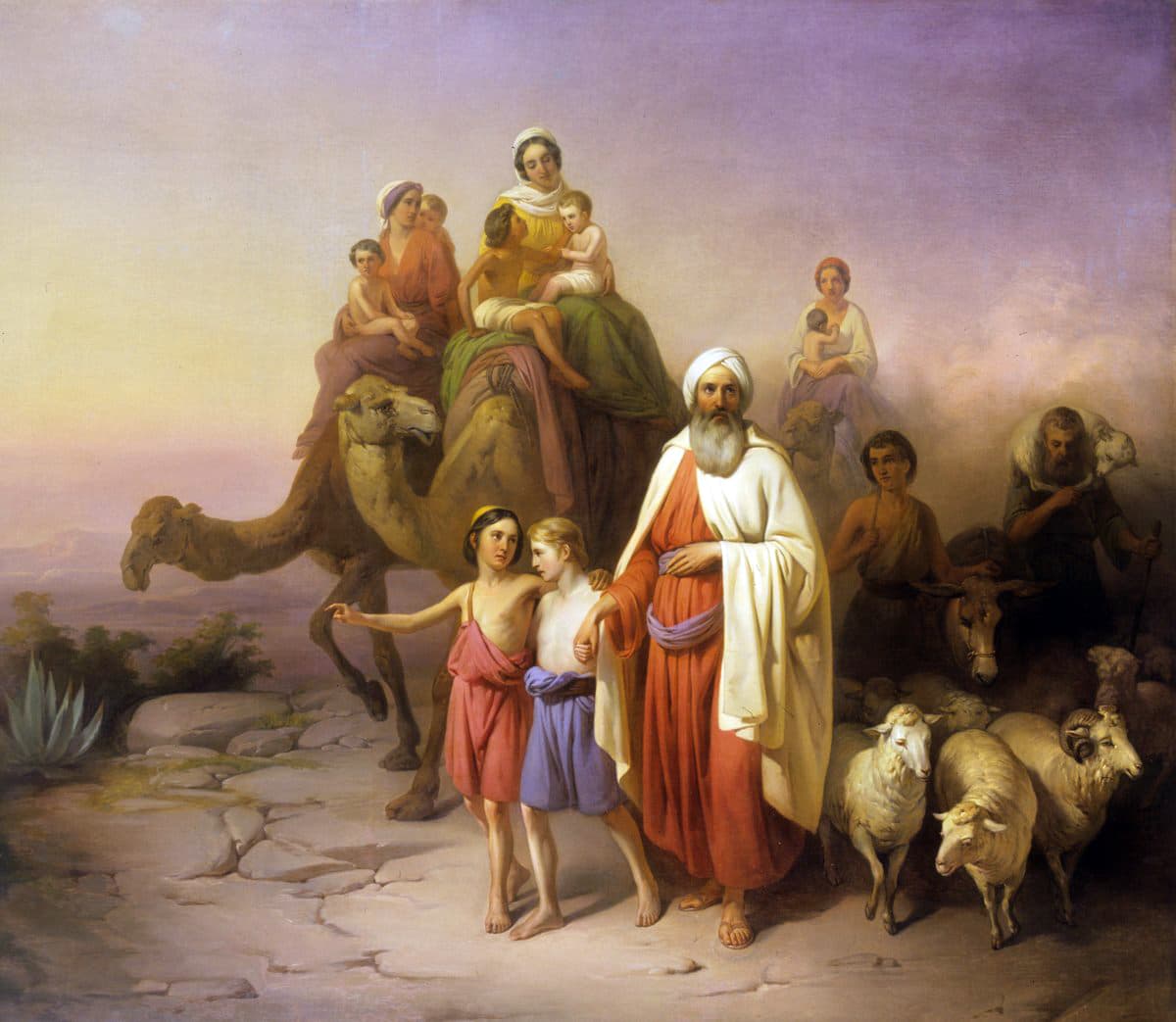
József Molnár, The March of Abraham, 1850, Hungarian National Gallery. Public domain, via Wikimedia Commons.
THE ARTWORKMolnár painted the household on the road out of Mesopotamia, the women, children and flocks behind Abraham: the departure with which Genesis opens his life.
Summary
God called Abram, son of Terah, out of Ur and promised him land, offspring and a blessing for every family on earth.
- He left Haran at 75. He lived in Canaan as a foreigner in tents.
- In Genesis 15 God made a covenant with him while he slept, passing alone between the pieces.
- His sons were Ishmael by Hagar, Isaac by Sarah, and six more by Keturah.
- On a mountain in Moriah he bound Isaac, and God provided a ram in his place.
- Paul says his faith was counted as righteousness before he was circumcised.
Where Abraham Stands in Scripture
His first line and his last
Genesis first names Abram among the three sons of Terah.
This is the account of Terah. Terah became the father of Abram, Nahor, and Haran. And Haran became the father of Lot.His first line: Terah's three sons, and Lot the son of Haran.
Genesis closes his life with Isaac and Ishmael burying him beside Sarah.
And at a ripe old age he breathed his last and died, old and contented, and was gathered to his people. His sons Isaac and Ishmael buried him in the cave of Machpelah near Mamre, in the field of Ephron son of Zohar the Hittite. This was the field that Abraham had bought from the Hittites. Abraham was buried there with his wife Sarah.His death, and the two sons together at the cave of Machpelah.
The Life, Turn by Turn
From Ur to Machpelah, with his age where Genesis gives it
- Leaves Ur with TerahUr of the Chaldeans, Genesis 11:31
- Called on from Haranage 75, Genesis 12:4
- First altar in CanaanShechem, Genesis 12:7
- The first sister lieEgypt, Genesis 12:13
- Lot takes the plainnear Bethel, Genesis 13:11
- Rescues Lot, meets MelchizedekSalem, Genesis 14:18
- The covenant cutbetween the pieces, Genesis 15:17
- Ishmael born to Hagarage 86, Genesis 16:16
- Named Abraham and circumcisedage 99, Genesis 17:1
- Pleads with God for SodomMamre, Genesis 18:23
- The second sister lieGerar, Genesis 20:2
- Isaac is born to Sarahage 100, Genesis 21:5
- Binds IsaacMoriah, Genesis 22:9
- Buys Machpelah for SarahHebron, Genesis 23:16
- Sends for a wife for Isaacto his kindred, Genesis 24:4
- Dies and is buriedage 175, Genesis 25:7
The ages are the five Genesis gives.
From Haran to Machpelah
Genesis 12 to 23
Abram leaves Haran at the word of the LORD, who promises him a nation, a great name and a blessing for all the families of the earth.
Still childless, he believes the promise of offspring like the stars, and God makes a covenant with him in a rite where only a firepot and a torch pass between the pieces.
Sarai gives him her servant Hagar, who bears him Ishmael. Years later Sarah bears Isaac, the son God had promised.
God then tests him with the command to offer Isaac on a mountain in Moriah, stops his hand at the altar, and provides a ram in the son's place.
When Sarah dies at Hebron, he buys the cave of Machpelah from Ephron the Hittite and pays the full price in silver.
The call and the land
Stephen says the God of glory first appeared to Abraham in Mesopotamia, before he lived in Haran.
Then the LORD said to Abram, “Leave your country, your kindred, and your father’s household, and go to the land I will show you. I will make you into a great nation, and I will bless you; I will make your name great, so that you will be a blessing. I will bless those who bless you and curse those who curse you; and all the families of the earth will be blessed through you.”The call and its promises: a great nation, a great name, and a blessing for all the families of the earth.
After Lot had departed, the LORD said to Abram, “Now lift up your eyes from the place where you are, and look to the north and south and east and west, for all the land that you see, I will give to you and your offspring forever.After Lot leaves, the LORD gives Abram all the land he can see, for him and his offspring forever.
The covenant God cut alone
Abram tells God that the heir of his house is his servant Eliezer of Damascus.
And the LORD took him outside and said, “Now look to the heavens and count the stars, if you are able.” Then He told him, “So shall your offspring be.” Abram believed the LORD, and it was credited to him as righteousness.Count the stars: the promise of offspring, and the verse Paul and James both quote.
He asks how he can know he will possess the land, and God tells him to bring a heifer, a goat, a ram, a turtledove and a young pigeon. He cuts the animals in two, and at sunset a deep sleep and a great terror fall on him.
When the sun had set and darkness had fallen, behold, a smoking firepot and a flaming torch appeared and passed between the halves of the carcasses. On that day the LORD made a covenant with Abram, saying, “To your descendants I have given this land—from the river of Egypt to the great River Euphrates—A smoking firepot and a flaming torch pass between the pieces, and the LORD makes the covenant.
Jeremiah names the rite: those who made a covenant walked between the halves of a calf they had cut in two.
Hagar and Ishmael
After ten years in Canaan with no child, Sarai gives Hagar to Abram as a wife. When the pregnant Hagar despises her mistress, Abram hands her back to Sarai, and Sarai treats her so harshly that she flees.
So Sarai said to Abram, “Look now, the LORD has prevented me from bearing children. Please go to my maidservant; perhaps I can build a family by her.” And Abram listened to the voice of Sarai.Abram listened to the voice of Sarai: Genesis records the plan and his part in it together.
So Hagar gave this name to the LORD who had spoken to her: “You are the God who sees me,” for she said, “Here I have seen the One who sees me!”Found by a spring on the road to Shur, Hagar gives the LORD a name: the God who sees me.
After Isaac is born, Sarah demands that Hagar and her son be sent away, and the matter distresses Abraham greatly.
But God said to Abraham, “Do not be distressed about the boy and your maidservant. Listen to everything that Sarah tells you, for through Isaac your offspring will be reckoned. But I will also make a nation of the slave woman’s son, because he is your offspring.”God tells him to listen to Sarah, and promises a nation from Ishmael as well.
The binding of Isaac
“Take your son,” God said, “your only son Isaac, whom you love, and go to the land of Moriah. Offer him there as a burnt offering on one of the mountains, which I will show you.”The command, naming the son of the promise three ways.
He rises early, splits the wood, and on the third day sees the place. He tells his servants that he and the boy will worship and then return to them, and Isaac carries the wood up the mountain and asks where the lamb is.
Abraham answered, “God Himself will provide the lamb for the burnt offering, my son.” And the two walked on together.Abraham's answer on the way up.
Then Abraham looked up and saw behind him a ram in a thicket, caught by its horns. So he went and took the ram and offered it as a burnt offering in place of his son. And Abraham called that place The LORD Will Provide. So to this day it is said, “On the mountain of the LORD it will be provided.”The ram offered in place of his son, and the name he gives the place.
Then the LORD swears by Himself to bless him and to bless all nations through his offspring.
A grave at Machpelah
Sarah dies in Kiriath-arba, which is Hebron. Abraham calls himself a foreigner among the Hittites, and when Ephron offers the field and its cave as a gift, he insists on paying.
Abraham agreed to Ephron’s terms and weighed out for him the price he had named in the hearing of the Hittites: four hundred shekels of silver, according to the standard of the merchants.Four hundred shekels of silver, weighed out in the hearing of the Hittites.
So the field and its cave were deeded by the Hittites to Abraham as a burial site.The field and its cave, deeded to him as a burial site.
What Genesis Sets Beside the Faith
Six things retellings often drop
AN ARRANGEMENT FROM THE START
At Gerar he explains that he had asked Sarah, when they first set out, to call him her brother wherever they went.
HE LAUGHED FIRST
Abraham fell facedown and laughed at the promise of a son before Sarah laughed at it in the tent.
A PRAYER FOR THE WRONGED
After the lie at Gerar, Abraham prays for Abimelech, and God heals his household.
ISHMAEL BLESSED BY NAME
God promises to bless Ishmael, make him fruitful and make him a great nation.
THE OTHER SONS SENT EAST
While he was still alive, he gave gifts to the sons of his concubines and sent them east, away from Isaac.
A STRANGER IN THE LAND
Stephen says God gave him no inheritance in the land, not even a foot of ground.
The World He Left
Ur, Haran and the gods of Terah's house
And Joshua said to all the people, “This is what the LORD, the God of Israel, says: ‘Long ago your fathers, including Terah the father of Abraham and Nahor, lived beyond the Euphrates and worshiped other gods.Terah's family lived beyond the Euphrates and worshiped other gods.
The road to Canaan and the towns near Haran
The road from Ur to Haran runs roughly 600 miles along the river, and from Haran to Shechem roughly 400 miles by the caravan roads.
Texts from Mari name towns in the Balikh valley near Haran, Nahur, Sarugi and Til-Turahi, that match the family names Nahor, Serug and Terah. The match places the names in that region and period, and it leaves open who founded or named the towns.
The Family of Abraham
Eleven ties, each with its verse
| Person | Tie to Abraham | Verse |
|---|---|---|
| Terah | His father, who died in Haran at 205. | Genesis 11:32 |
| Nahor | His brother, who married Milcah, Haran's daughter. | Genesis 11:29 |
| Haran | His brother, Lot's father, who died in Ur. | Genesis 11:28 |
| Lot | His nephew, who went with him from Haran. | Genesis 12:5 |
| Sarah | His wife, his father's daughter by another mother. | Genesis 20:12 |
| Hagar | Sarai's Egyptian servant, given to him as a wife. | Genesis 16:3 |
| Ishmael | His son by Hagar, born when he was 86. | Genesis 16:16 |
| Isaac | His son by Sarah, born when he was 100. | Genesis 21:5 |
| Keturah | The wife he took later in his life. | Genesis 25:1 |
| Keturah's six sons | Zimran, Jokshan, Medan, Midian, Ishbak and Shuah, the sons she bore him. | Genesis 25:2 |
| Rebekah | Isaac's wife, granddaughter of his brother Nahor. | Genesis 24:15 |
- Person
- Terah
- Tie to Abraham
- His father, who died in Haran at 205.
- Verse
- Genesis 11:32
- Person
- Nahor
- Tie to Abraham
- His brother, who married Milcah, Haran's daughter.
- Verse
- Genesis 11:29
- Person
- Haran
- Tie to Abraham
- His brother, Lot's father, who died in Ur.
- Verse
- Genesis 11:28
- Person
- Lot
- Tie to Abraham
- His nephew, who went with him from Haran.
- Verse
- Genesis 12:5
- Person
- Sarah
- Tie to Abraham
- His wife, his father's daughter by another mother.
- Verse
- Genesis 20:12
- Person
- Hagar
- Tie to Abraham
- Sarai's Egyptian servant, given to him as a wife.
- Verse
- Genesis 16:3
- Person
- Ishmael
- Tie to Abraham
- His son by Hagar, born when he was 86.
- Verse
- Genesis 16:16
- Person
- Isaac
- Tie to Abraham
- His son by Sarah, born when he was 100.
- Verse
- Genesis 21:5
- Person
- Keturah
- Tie to Abraham
- The wife he took later in his life.
- Verse
- Genesis 25:1
- Person
- Keturah's six sons
- Tie to Abraham
- Zimran, Jokshan, Medan, Midian, Ishbak and Shuah, the sons she bore him.
- Verse
- Genesis 25:2
- Person
- Rebekah
- Tie to Abraham
- Isaac's wife, granddaughter of his brother Nahor.
- Verse
- Genesis 24:15
The Places of His Life
Eleven places, from his family's city to his grave
| Place | What happened there | Verse |
|---|---|---|
| Ur | The LORD brought Abram out of Ur of the Chaldeans to give him the land of Canaan. | Genesis 15:7 |
| Haran | Abram set out for Canaan with the possessions and people the family had acquired there. | Genesis 12:5 |
| Shechem | Abram reached the great tree of Moreh there while the Canaanites were in the land. | Genesis 12:6 |
| Bethel | He pitched his tent between Bethel and Ai and built an altar. | Genesis 12:8 |
| Egypt | He went down to live there for a time because the famine was severe. | Genesis 12:10 |
| Sodom | Lot settled among the cities of the plain and pitched his tent toward Sodom. | Genesis 13:12 |
| Hebron | He made his home by the oaks of Mamre. | Genesis 13:18 |
| Mamre | Three visitors promised him Isaac there. | Genesis 18:1 |
| Beersheba | He swore an oath with Abimelech and planted a tamarisk. | Genesis 21:33 |
| Moriah | God sent him to the land of Moriah, to a mountain He would show him. | Genesis 22:2 |
| Machpelah | Its cave lies in a field near Mamre, which is Hebron. | Genesis 23:19 |
- Place
- Ur
- What happened there
- The LORD brought Abram out of Ur of the Chaldeans to give him the land of Canaan.
- Verse
- Genesis 15:7
- Place
- Haran
- What happened there
- Abram set out for Canaan with the possessions and people the family had acquired there.
- Verse
- Genesis 12:5
- Place
- Shechem
- What happened there
- Abram reached the great tree of Moreh there while the Canaanites were in the land.
- Verse
- Genesis 12:6
- Place
- Bethel
- What happened there
- He pitched his tent between Bethel and Ai and built an altar.
- Verse
- Genesis 12:8
- Place
- Egypt
- What happened there
- He went down to live there for a time because the famine was severe.
- Verse
- Genesis 12:10
- Place
- Sodom
- What happened there
- Lot settled among the cities of the plain and pitched his tent toward Sodom.
- Verse
- Genesis 13:12
- Place
- Hebron
- What happened there
- He made his home by the oaks of Mamre.
- Verse
- Genesis 13:18
- Place
- Mamre
- What happened there
- Three visitors promised him Isaac there.
- Verse
- Genesis 18:1
- Place
- Beersheba
- What happened there
- He swore an oath with Abimelech and planted a tamarisk.
- Verse
- Genesis 21:33
- Place
- Moriah
- What happened there
- God sent him to the land of Moriah, to a mountain He would show him.
- Verse
- Genesis 22:2
- Place
- Machpelah
- What happened there
- Its cave lies in a field near Mamre, which is Hebron.
- Verse
- Genesis 23:19
Questions the Life Raises
Four questions answered from their verses
How old was Isaac on the mountain?
Genesis 22 gives Isaac no age. The Hebrew word for him at 22:5 and 22:12, na'ar, is the word Genesis uses of Joseph at seventeen and of Benjamin when he is a grown man.
Sarah bore Isaac at ninety and died at 127 in the next chapter, so he was at most thirty-seven if the binding came shortly before her death.
He carried the wood for the burnt offering up the mountain, and he saw for himself that the lamb was missing.
Adam Clarke reports a targumic tradition in which Isaac tells Ishmael he is thirty-six years old.
Readers picture him three ways, as a boy, as a youth in his teens and as a grown man, and the text allows each.
Did Abraham lie when he told his servants both would return?
Adam Clarke puts the question plainly. Jamieson, Fausset and Brown answer that he spoke in confidence that his son would be restored.
I and the lad will go and come again - How could Abraham consistently with truth say this, when he knew he was going to make his son a burnt-offering?
Adam Clarke · Commentary on the Bible · on Genesis 22:5Evangelical
It is more likely that his words were spoken evasively to his son in ignorance of the issue, yet in unbounded confidence that that son, though sacrificed, would, in some miraculous way, be restored (Heb 11:19).
Jamieson, Fausset & Brown · Commentary Critical and Explanatory on the Whole Bible · on Genesis 22:5Reformed
Abraham reasoned that God could raise the dead, and in a sense, he did receive Isaac back from death.Hebrews reads his words as faith: he reasoned that God could raise the dead.
Was Abraham wrong to take Hagar?
John Wesley judges that he may be excused and cannot be justified.
Herein, though he may be excused, he cannot be justified; for from the beginning it was not so: and when it was so, it seems to have proceeded from an irregular desire to build up their families, for the speedier peopling of the world.
John Wesley · Explanatory Notes upon the Old Testament · on Genesis 16:2Evangelical
Where was Moriah?
Second Chronicles puts Solomon's temple on Mount Moriah, the only other place Scripture uses the name, and Josephus, Jerome and the rabbinic tradition place the binding on the Temple Mount. The Samaritan tradition places the binding at Mount Gerizim, and some readers weigh the three days' journey and the words one of the mountains toward a site further off or toward the wider ridge.
The one place that could settle the question has never been excavated.
Then Solomon began to build the house of the LORD in Jerusalem on Mount Moriah, where the LORD had appeared to his father David. This was the place that David had prepared on the threshing floor of Ornan the Jebusite.The second and last use of the name Moriah in Scripture.
What Genesis Leaves Unsaid
Two silences: the reason for his call and his heart at Moriah
How the New Testament Reads Him
Romans 4, Galatians 3, Hebrews 11, James 2 and Romans 11
Paul quotes Genesis 15:6 as the Scripture's own word on how Abraham was counted righteous.
He points to the order of the chapters: righteousness was credited in Genesis 15, and circumcision came in Genesis 17.
And he received the sign of circumcision as a seal of the righteousness that he had by faith while he was still uncircumcised. So then, he is the father of all who believe but are not circumcised, in order that righteousness might be credited to them.The sign sealed a righteousness he already had, so he is the father of believers circumcised and uncircumcised.
Hebrews names three acts of his faith: he went without knowing where, he lived in tents in the land of promise, and he offered Isaac. James reads the offering of Isaac as the working out of the faith credited in Genesis 15.
Paul keeps Israel in the promise: he asks whether God rejected His people, answers Certainly not, and names himself a descendant of Abraham.
Galatians 3: the promise to the nations
The Scripture foresaw that God would justify the Gentiles by faith, and foretold the gospel to Abraham: “All nations will be blessed through you.”Paul calls the promise to the nations the gospel announced in advance to Abraham.
The promises were spoken to Abraham and to his seed. The Scripture does not say, “and to seeds,” meaning many, but “and to your seed,” meaning One, who is Christ.The promise to Abraham's seed, read as one seed, who is Christ.
A Gentile who belongs to Christ becomes Abraham's seed and an heir of a promise already made to Abraham's family.
Hebrews 11 and James 2: faith that went and offered
By faith Abraham, when called to go to a place he would later receive as his inheritance, obeyed and went, without knowing where he was going. By faith he dwelt in the promised land as a stranger in a foreign country. He lived in tents, as did Isaac and Jacob, who were heirs with him of the same promise. For he was looking forward to the city with foundations, whose architect and builder is God.He lived as a stranger in tents because he was looking for the city whose builder is God.
Was not our father Abraham justified by what he did when he offered his son Isaac on the altar? You see that his faith was working with his actions, and his faith was perfected by what he did. And the Scripture was fulfilled that says, “Abraham believed God, and it was credited to him as righteousness,” and he was called a friend of God.Faith working with his actions, and the name friend of God.
Paul and James use the one verse for two questions: Paul for how a person is counted righteous, and James for how that faith shows itself in deeds. First Maccabees, a Jewish book of the second century BC, already joins the two chapters when Mattathias asks whether Abraham was found faithful in temptation and credited with righteousness.
Romans 11: the root and the branches
Regarding the gospel, they are enemies on your account; but regarding election, they are loved on account of the patriarchs. For God’s gifts and His call are irrevocable.Israel is loved on account of the patriarchs, and God's call is irrevocable.
The Gentile believer is a wild olive shoot grafted in among the branches, and the root supports the branch.
Voices on Abraham, Earliest First
Six teachers speak in their own words, from Irenaeus to Wesley
Irenaeus, in Against Heresies about AD 180, reads Abram's belief in Genesis 15 as faith in the Creator and in the promise of offspring like the stars. Tertullian, in On Patience about AD 200, holds the blessing, the faith and the patience together in one line. Origen, preaching on Genesis at Caesarea in the 240s, sees Isaac carrying the wood as both victim and priest.
And teaching this very thing, He said to the Jews: "Your father Abraham rejoiced that he should see my day; and he saw it, and was glad." What is intended? "Abraham believed God, and it was imputed unto him for righteousness." In the first place, [he believed] that He was the maker of heaven and earth, the only God; and in the next place, that He would make his seed as the stars of heaven. This is what is meant by Paul, [when he says,] "as lights in the world."
Irenaeus · Against Heresies Book IV · on Romans 4:3Patristic
Rightly then is he blessed because he was faithful; and rightly was he faithful because he was patient.
Tertullian · On Patience 6.2 · on Genesis 22:17Patristic
That Isaac carries on himself "the wood for the burnt offering" is a figure, because Christ also "himself carried his own cross," and yet to carry "the wood for the burnt offering" is the duty of a priest. He therefore becomes victim and priest. But what is added also is related to this: "And they both went off together." For when Abraham carries the fire and knife as if to sacrifice, Isaac does not go behind him but with him, that he might be shown to contribute equally with the priesthood itself.
Origen of Alexandria · Homilies on Genesis 8.6 · on Genesis 22:6Patristic
Three more voices
Athanasius, in his Festal Letter of AD 334, sets the limit of the picture: the death of Isaac could buy no one's freedom. Matthew Henry, in 1710, holds that all believers are justified as Abram was. John Wesley, in 1755, answers how Paul and James can both speak of Abraham's justification.
Thus the sacrifice was not for the sake of Isaac but for that of Abraham, who was tested by being called upon to make this offering. And of course, God accepted his intentions, but he prevented him from slaying Isaac. The death of Isaac would not buy freedom for the world. No, that could be accomplished only by the death of our Savior, by whose stripes we are all healed.
Athanasius of Alexandria · Festal Letters 6 · on Genesis 22:13Patristic
Note, A fiducial practical acceptance of, and dependence upon, God's promise of grace and glory, in and through Christ, is that which, according to the tenour of the new covenant, gives us a right to all the blessings contained in that promise. All believers are justified as Abram was, and it was his faith that was counted to him for righteousness.
Matthew Henry · Commentary on the Whole Bible · on Genesis 15:6Puritan
Was not Abraham justified by works - St. Paul says he was justified by faith, Rom. iv, 2, &c.: yet St. James does not contradict him; for he does not speak of the same justification. St. Paul speaks of that which Abraham received many years before Isaac was born, Gen. xv, 6.
John Wesley · Explanatory Notes upon the New Testament · on James 2:21Evangelical
Where Was Abraham's Ur?
Two identifications, each with its holders
Three verses bear on the address: Genesis 11:31, Acts 7:2 and Genesis 24:10.
The southern city, Tell el-Muqayyar
Millard argued in Biblical Archaeology Review in 2001 that the mound in southern Iraq is Abraham's Ur. The mound is certainly the ancient city, named in its own foundation deposits, and the words of the Chaldeans fit southern Babylonia, where the Kaldu tribes are attested. He called the case strong and allowed that the evidence precludes certainty.
The objection: the family keeps returning to Haran and Aram-naharaim in the north, and a southern Ur makes the route a long detour.
Then the servant took ten of his master’s camels and departed with all manner of good things from his master in hand. And he set out for Nahor’s hometown in Aram-naharaim.The servant goes back north, to Nahor's town in Aram-naharaim.
A northern Ur near Şanlıurfa
Gordon argued in the Journal of Near Eastern Studies in 1958 that Ur lay in the region of Urha, later Edessa and today Şanlıurfa, about forty kilometres from Haran. Shanks put the northern case to a wide readership in Biblical Archaeology Review in 2000. Jamieson, Fausset and Brown had already glossed Ur as Orfa in 1871.
The objection: the southern mound is certainly an ancient Ur, and the Chaldeans of the phrase are attested in the south.
And Stephen declared: “Brothers and fathers, listen to me! The God of glory appeared to our father Abraham while he was still in Mesopotamia, before he lived in Haran,Stephen's Mesopotamia, which the northern reading takes as the northern country.
Books to Read Next
Six books: early, classic and critical studies
Homilies on Genesis
Origen · about 245
Origen preaches through the binding of Isaac, with Isaac as victim and priest.
On Abraham
Ambrose of Milan · fourth century
Ambrose reads Abram's belief as faith that Christ would be his heir.
Commentary on the Whole Bible
Matthew Henry · 1710
Henry goes verse by verse through the whole life.
READ IT FREE AT CCEL →Ur of the Chaldees
C. Leonard Woolley · 1929
Woolley records his seven years of digging at the southern Ur.
Genesis, Anchor Bible 1
E. A. Speiser · 1964
Speiser reads the patriarchs beside the Nuzi tablets.
In print: find it wherever books are sold.
Abraham in History and Tradition
John Van Seters · 1975
Van Seters argues that the Nuzi parallels were overstated.
In print: find it wherever books are sold.
The LORD Will Provide
Abraham named the mountain for what God would do: The LORD Will Provide. When John the Baptist sees Jesus coming, he answers the question Isaac asked on the way up: Look, the Lamb of God, who takes away the sin of the world.
Paul says the words it was credited to him were written for everyone who believes in Him who raised Jesus from the dead. The life asks the reader to believe God as Abraham did, and to live as a stranger looking for the city God has prepared.
Keep studying
Studies5
Places13