
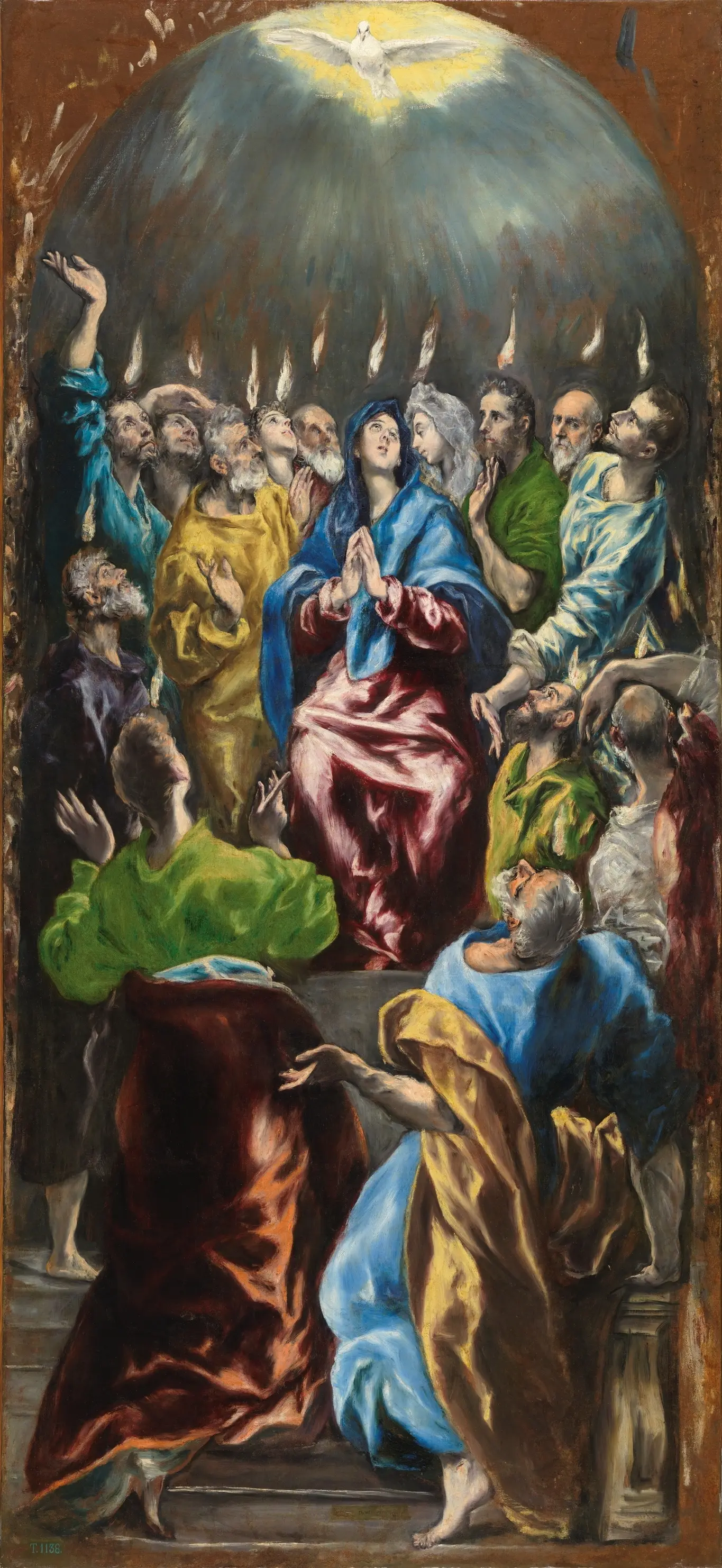
The Pentecost, El Greco, about 1600, Museo del Prado. Public domain.
New Testament · Book 44 of 66
Acts
Acts continues Luke's Gospel and records the spread of the church from Jerusalem to Judea, Samaria and the wider world. It follows Peter and then Paul, and ends with Paul preaching in Rome while under guard.
Acts continues Luke's Gospel and records the spread of the church from Jerusalem to Judea, Samaria and the wider world. It follows Peter and then Paul, and ends with Paul preaching in Rome while under guard.
What is Acts about?
Acts is the second book written to Theophilus, telling what Jesus went on to do through his apostles after he was taken up to heaven. Before he goes he tells them, “you will be My witnesses” (1:8), and the book follows that word outward. The Spirit comes at Pentecost, and the church grows in Jerusalem until Stephen is killed. The scattered believers carry the word to Samaria, and Peter preaches in a Gentile house. Saul the persecutor becomes Paul, sent across Asia Minor and Greece. Arrested, he appeals to Caesar, survives a shipwreck, and preaches the kingdom of God in Rome.
All 28 chapters
Every chapter of the book, in one grid. Each cell opens that chapter.
- JerusalemChapters 1 to 7
- Judea and SamariaChapters 8 to 12
- The first mission and the council13:1 to 15:35
- The second and third missions15:36 to 21:16
- Jerusalem to Caesarea21:17 to 26:32
- The voyage and RomeChapters 27 to 28
The colour is the movement of the book the chapter stands in, and every cell opens that chapter's Study level. The second and third missions begin at 15:36, inside chapter 15, and Jerusalem to Caesarea at 21:17, inside chapter 21; each chapter takes the colour of the movement it begins in.
Who wrote it, where, when, for whom, and why?
Acts addresses Theophilus and recalls a first book (1:1), and the Gospel of Luke is written to the same man (Luke 1:3). From 16:10 the account says we, so the writer places himself in Paul's company. Paul names Luke among those with him (Colossians 4:14; Philemon 1:24; 2 Timothy 4:11).
In my first book, O Theophilus, I wrote about all that Jesus began to do and to teach,
Acts 1:1, Berean Standard Bible.
The book moves outward from Jerusalem (1:4) through Samaria, Damascus, Caesarea and Antioch, then Cyprus, Galatia, Macedonia, Achaia and Ephesus, back to Jerusalem and Caesarea, and by sea to Rome (28:16).
The book runs from the forty days after the resurrection (1:3) to Paul's two full years in Rome (28:30), and names the rulers of its time: Claudius (11:28, 18:2), Herod (12:23), Gallio (18:12), Felix and Festus (24:27), and Agrippa (25:13).
The book is addressed to Theophilus (1:1), whom the first book calls most excellent and writes to so that he may know the certainty of the things he has been taught (Luke 1:3 and 4).
The book opens with the promise that the apostles will be witnesses in Jerusalem, Judea and Samaria, and to the ends of the earth (1:8), and follows it to its last verse, where Paul proclaims the kingdom of God boldly and freely in Rome (28:31).
Sources. Acts 1:1, 1:3, 1:4, 1:8, 11:28, 12:23, 16:10, 18:2, 18:12, 24:27, 25:13, 28:16, 28:30 and 28:31; Luke 1:3 and 4; Colossians 4:14; Philemon 1:24; 2 Timothy 4:11. Every verse is read in the Berean Standard Bible.
How is Acts arranged, and what is it for?
The six movements the book falls into, then what it teaches and what it was written to do.
- Jerusalem1 to 7, 253 verses, the turn at 2:4
Pentecost, the church in the city, and Stephen.
- Judea and Samaria8 to 12, 186 verses, the turn at 10:34
Samaria, Saul's call, and Cornelius.
- The first mission and the council13:1 to 15:35, 115 verses, the turn at 15:19
Barnabas and Saul sent, and the council.
- The second and third missions15:36 to 21:16, 203 verses, the turn at 16:9
Macedonia, Achaia and Ephesus.
- Jerusalem to Caesarea21:17 to 26:32, 175 verses, the turn at 25:11
Paul's arrest and five defences.
- The voyage and Rome27 to 28, 75 verses, the turn at 28:31
The shipwreck, Malta, and two years in Rome.
The theme
The risen Jesus pours out the Holy Spirit and sends his witnesses, and the word of God spreads from Jerusalem to Rome. Prisons, mobs, storms and courts each give way before it. Jew and Gentile are made one people by faith, and the church learns in its councils and letters how the two live together.
The purpose
Acts sets down for Theophilus how the promise of 1:8 was kept: the Spirit came, the witness went out from Jerusalem, and God opened the door of faith to the Gentiles (14:27). It shows why a Gentile church belongs to the promises made to Israel, and it ends with the kingdom of God preached in Rome.
Acts 1:8 as the book's map: three widening zones and six reports of growth
Jerusalem “in Jerusalem”, chapters 1 to 7
Judea and Samaria “in all Judea and Samaria”, chapters 8 to 12
The ends of the earth “to the ends of the earth”, chapters 13 to 28
- 1
“So the word of God continued to spread. The number of disciples in Jerusalem grew rapidly, and a great number of priests became obedient to the faith.” (6:7) It closes the church in Jerusalem.
- 2
“Then the church throughout Judea, Galilee, and Samaria experienced a time of peace. It grew in strength and numbers, living in the fear of the Lord and the encouragement of the Holy Spirit.” (9:31) It closes Saul's call and the churches at peace.
- 3
“But the word of God continued to spread and multiply.” (12:24) It closes the Gentile door and Herod's death.
- 4
“So the churches were strengthened in the faith and grew daily in numbers.” (16:5) It closes the council's letter delivered.
- 5
“So the word of the Lord powerfully continued to spread and prevail.” (19:20) It closes the years at Ephesus.
- 6
“Boldly and freely he proclaimed the kingdom of God and taught about the Lord Jesus Christ.” (28:31) It closes the book, in Rome.
Jerusalem, Acts 1 to 7
What these 253 verses say, and the pages they open on.
The risen Jesus is taken up in a cloud after forty days (1:3 to 9). At Pentecost the Holy Spirit fills the apostles, Peter preaches from Joel and the Psalms, and about three thousand are baptized (2:41). The apostles tell the council they must obey God rather than men (5:29), and Stephen, one of the seven, is stoned while Saul looks on (7:58).
And they were all filled with the Holy Spirit and began to speak in other tongues as the Spirit enabled them.
- Study
Acts 1the forty days, the ascension, and Matthias chosenShow the summary and 3 pagesShow summary, 3 pagesHide the summary
Prologue to Theophilus. Jesus' forty-day resurrection ministry; the program verse (1:8): 'you will be My witnesses in Jerusalem, and in all Judea and Samaria, and to the ends of the earth.' Ascension; the two men in white. Upper room; Matthias chosen to replace Judas.
On this chapter (3)
- The ascension
Taken up in a cloud, and the promise of his return.
- The great commission
Witnesses to the ends of the earth.
- Acts 1:8
The verse on its own page, with the commentators on it by era.
- The ascension
- Study
Acts 2the Spirit poured out, Peter's sermon, and the first churchShow the summary and 5 pagesShow summary, 5 pagesHide the summary
Pentecost. Tongues of fire; speaking in the languages of the nations. Peter's sermon: Joel's prophecy, David's Psalms (16, 110), 'let all the house of Israel know assuredly.' Three thousand added. The early fellowship. Apostles' doctrine, breaking of bread, prayers, all things common.
On this chapter (5)
- The three Pentecosts
The Spirit at Jerusalem, Caesarea and Ephesus.
- Speaking in tongues
Other tongues as the Spirit enabled them.
- Baptism in the Holy Spirit
The promise of the Father poured out.
- Are the speeches Luke's compositions or reports of what was said?
Answered under Where do readers disagree, lower on this page, with each reading and who holds it.
- Acts 2:4
The verse on its own page, with the commentators on it by era.
- The three Pentecosts
- Study
Acts 3the lame man at the gate, and Peter's second sermonShow the summary and 1 pageShow summary, 1 pageHide the summary
Peter and John at the temple Beautiful gate; the lame man healed. Peter's second sermon in Solomon's porch: 'The God of Abraham, Isaac, and Jacob … has glorified His servant Jesus.' 'Repent, then, and turn back, so that your sins may be wiped away, that times of refreshing may come from the presence of the Lord, and that He may send Jesus, the Christ, who has been appointed for you.'
On this chapter (1)
- Acts 3:6
The verse on its own page, with the commentators on it by era.
- Acts 3:6
- Study
Acts 4the first arrest, one name for salvation, and the prayerShow the summary and 2 pagesShow summary, 2 pagesHide the summary
Peter and John arrested; five thousand added. Sanhedrin interrogation. 'Judge for yourselves whether it is right in God’s sight to listen to you rather than God.' Boldness granted; the church prays; the place shakes; all things common (Barnabas named).
On this chapter (2)
- The church
The believers of one heart and soul.
- Acts 4:12
The verse on its own page, with the commentators on it by era.
- The church
- Study
Acts 5Ananias and Sapphira, and the apostles floggedShow the summary and 1 pageShow summary, 1 pageHide the summary
Ananias and Sapphira. Signs and wonders; healing by Peter's shadow. Apostles imprisoned and delivered by an angel. Gamaliel's counsel: 'if their purpose or endeavor is of human origin, it will fail. But if it is from God, you will not be able to stop them.'
On this chapter (1)
- Acts 5:29
The verse on its own page, with the commentators on it by era.
- Acts 5:29
- Study
Acts 6the seven chosen, and Stephen seizedShow the summary and 2 pagesShow summary, 2 pagesHide the summary
The seven chosen to serve tables (the first deacons). Stephen, full of faith and power, does great wonders. False witnesses charge him with blasphemy.
On this chapter (2)
- Elders and deacons
The seven chosen to serve.
- Acts 6:7
The verse on its own page, with the commentators on it by era.
- Elders and deacons
- Study
Acts 7Stephen's speech from Abraham to the temple, and his deathShow the summary and 2 pagesShow summary, 2 pagesHide the summary
Stephen's defense. Salvation history from Abraham to Moses to David to Solomon to the prophets: 'You stiff-necked people with uncircumcised hearts and ears!' The first martyrdom, Saul consenting. 'Lord Jesus, receive my spirit. … Lord, do not hold this sin against them.'
On this chapter (2)
- Stephen, the first martyr
His speech, his vision and his death.
- Acts 7:56
The verse on its own page, with the commentators on it by era.
- Stephen, the first martyr
Peter's sermon at Pentecost, built on three passages
Explicit quotationThe Spirit poured out
‘In the last days, God says, I will pour out My Spirit on all people. Your sons and daughters will prophesy, your young men will see visions, your old men will dream dreams.
Acts 2:17, Berean Standard Bible.
Acts 2:17, quoting Joel 2:28–32. What the crowd sees and hears is the Spirit Joel promised.
Joel 2:28–32, the passage quoted
And afterward, I will pour out My Spirit on all people. Your sons and daughters will prophesy, your old men will dream dreams, your young men will see visions. Even on My menservants and maidservants, I will pour out My Spirit in those days. I will show wonders in the heavens and on the earth, blood and fire and columns of smoke. The sun will be turned to darkness and the moon to blood before the coming of the great and awesome Day of the LORD. And everyone who calls on the name of the LORD will be saved; for on Mount Zion and in Jerusalem there will be deliverance, as the LORD has promised, among the remnant called by the LORD.
Joel 2:28–32, Berean Standard Bible.
Explicit quotationThe Holy One raised
because You will not abandon my soul to Hades, nor will You let Your Holy One see decay.
Acts 2:27, Berean Standard Bible.
Acts 2:27, quoting Psalm 16:8–11. David's tomb is still with them, so the Holy One who saw no decay is Jesus.
Psalm 16:8–11, the passage quoted
I have set the LORD always before me. Because He is at my right hand, I will not be shaken. Therefore my heart is glad and my tongue rejoices; my body also will dwell securely. For You will not abandon my soul to Sheol, nor will You let Your Holy One see decay. You have made known to me the path of life; You will fill me with joy in Your presence, with eternal pleasures at Your right hand.
Psalm 16:8–11, Berean Standard Bible.
Explicit quotationThe ascended Lord
For David did not ascend into heaven, but he himself says: ‘The Lord said to my Lord, “Sit at My right hand until I make Your enemies a footstool for Your feet.”’
Acts 2:34–35, Berean Standard Bible.
Acts 2:34–35, quoting Psalm 110:1. David did not ascend, so the Lord seated at the right hand is the ascended Jesus.
Psalm 110:1, the passage quoted
The LORD said to my Lord: “Sit at My right hand until I make Your enemies a footstool for Your feet.”
Psalm 110:1, Berean Standard Bible.
Characters (3)
Who the text names. A name with a page carries its door.
Themes (3)
What these chapters raise, each on its own page where one stands.
- The Spirit poured out
Pentecost as Joel foretold (2:4, 2:17).
- The ascension
Jesus taken up in a cloud (1:9).
- Suffering and boldness
Suffering for the Name (5:41).
Where these chapters take up the Old Testament (8)each marked as a quotation, with the evidence, then the letters
- Explicit quotationPsalm 69:25 and Psalm 109:8 at Acts 1:20. Peter joins two lines of the Psalms, a place deserted and another taking his position, to call for Judas's place to be filled. Held by Peter, as Luke records him: it is written in the book of Psalms.
- Explicit quotationJoel 2:28 to 32 at Acts 2:17 to 21. Peter reads the Spirit poured out on all people as what the crowd is seeing, and ends on everyone who calls on the name of the Lord. Held by Peter: this is what was spoken by the prophet Joel (2:16).
- Explicit quotationPsalm 16:8 to 11 at Acts 2:25 to 28. Peter reads the Holy One who will not see decay as the risen Jesus, since David died and was buried. Held by Peter: David says about Him (2:25).
- Explicit quotationPsalm 110:1 at Acts 2:34 to 35. Peter reads the Lord seated at the right hand as the ascended Jesus, made both Lord and Christ. Held by Peter: David did not ascend into heaven, but he himself says (2:34).
- Explicit quotationDeuteronomy 18:15 to 19 at Acts 3:22 to 23. Peter names Jesus as the prophet like Moses whom the people must hear. Held by Peter: For Moses said (3:22).
- Explicit quotationPsalm 118:22 at Acts 4:11. Peter tells the council that Jesus is the stone the builders rejected, now the cornerstone. Held by Peter before the council, who names the builders as its members.
- Explicit quotationPsalm 2:1 and 2 at Acts 4:25 to 26. The church at prayer reads the nations raging against the Anointed One as Herod and Pilate gathered against Jesus. Held by the believers' prayer: You spoke by the Holy Spirit through the mouth of Your servant, our father David (4:25).
- Explicit quotationGenesis 12:1, Genesis 15:13 and 14, Exodus 3:5 to 10, Amos 5:25 to 27 and Isaiah 66:1 and 2 at Acts 7:3, 7:6 and 7, 7:33 and 34, 7:42 and 43, 7:49 and 50. Stephen's speech runs through Israel's history in the words of its Scripture: the call of Abraham, the four hundred years, the burning bush, the idols in the wilderness, and heaven as God's throne. Held by Stephen, as Luke records him; Amos is introduced as written in the book of the prophets (7:42) and Isaiah as the prophet says (7:48).
The letters Luke 24:49 to 53 ends where Acts 1 begins, and Paul lists the risen Lord's appearances to Cephas, to the Twelve and to James in 1 Corinthians 15:5 to 7.
Judea and Samaria, Acts 8 to 12
What these 186 verses say, and the pages they open on.
A persecution scatters the church through Judea and Samaria (8:1 to 4). Philip preaches in Samaria and baptizes an Ethiopian official on the desert road (8:26 to 38). Saul is stopped by a light from heaven on the road to Damascus (9:3). Peter is sent to the centurion Cornelius, and the Spirit falls on the Gentiles who hear him (10:44). Herod kills James and is struck down (12:23).
Then Peter began to speak: “I now truly understand that God does not show favoritism,
- Study
Acts 8the church scattered, Philip in Samaria and on the desert roadShow the summary and 4 pagesShow summary, 4 pagesHide the summary
Great persecution scatters the church; Philip in Samaria; Simon the sorcerer. Peter and John lay hands and the Spirit is given. Philip and the Ethiopian eunuch on the Gaza road. Isaiah 53 preached; baptism.
On this chapter (4)
- Philip and the Ethiopian
Isaiah 53 on the desert road.
- Water baptism
What prevents me from being baptized?
- What is the Western text of Acts, and what are its longer readings?
Answered under Where do readers disagree, lower on this page, with each reading and who holds it.
- Acts 8:35
The verse on its own page, with the commentators on it by era.
- Philip and the Ethiopian
- Study
Acts 9Saul on the Damascus road; Peter at Lydda and JoppaShow the summary and 2 pagesShow summary, 2 pagesHide the summary
Saul on the Damascus road; blinded; Ananias lays hands; scales fall; Saul preaches Christ in the synagogues. Barnabas brings him to the apostles. Peter at Lydda (Aeneas healed) and Joppa (Dorcas raised).
On this chapter (2)
- The Damascus road
Saul's call, told three times.
- Acts 9:15
The verse on its own page, with the commentators on it by era.
- The Damascus road
- Study
Acts 10the vision of the sheet, and the Spirit on Cornelius's houseShow the summary and 2 pagesShow summary, 2 pagesHide the summary
Cornelius's vision at Caesarea. Peter's rooftop vision: 'Do not call anything impure that God has made clean.' Preaching at Cornelius's house; the Spirit falls on the Gentiles. 'I now truly understand that God does not show favoritism, but welcomes those from every nation who fear Him and do what is right.'
On this chapter (2)
- Cornelius and Peter
The vision of the sheet and the Gentile house.
- Acts 10:34
The verse on its own page, with the commentators on it by era.
- Cornelius and Peter
- Study
Acts 11Peter answers Jerusalem; the church at AntiochShow the summary and 2 pagesShow summary, 2 pagesHide the summary
Peter's Jerusalem report. Controversy settled: 'So then, God has granted even the Gentiles repentance'. The church at Antioch; the disciples first called Christians. Barnabas fetches Saul from Tarsus.
On this chapter (2)
- The grace of giving
The famine gift sent to Judea.
- Acts 11:26
The verse on its own page, with the commentators on it by era.
- The grace of giving
- Study
Acts 12James killed, Peter freed, and Herod's deathShow the summary and 2 pagesShow summary, 2 pagesHide the summary
Herod Agrippa. James beheaded; Peter imprisoned. The church's earnest prayer; the angel; Rhoda and the gate. 'The word of God grew and multiplied.' Herod smitten in his pride.
On this chapter (2)
- Peter freed from prison
The angel, the gate and Rhoda.
- Acts 12:24
The verse on its own page, with the commentators on it by era.
- Peter freed from prison
Saul's call, told three times
Luke tells it as the story unfolds.
“Saul, Saul, why do you persecute Me?” (9:4)
What this telling adds
Paul tells it in Hebrew to the crowd (21:40).
“Saul, Saul, why do you persecute Me?” (22:7)
What this telling adds
Paul tells it to Agrippa and Festus.
“Saul, Saul, why do you persecute Me?” (26:14)
What this telling adds
Characters (4)
Who the text names. A name with a page carries its door.
- Philip
Preaches in Samaria and on the road (8:5).
- Saul who is Paul
Called on the Damascus road (9:3 to 6).
- Cornelius
A centurion at Caesarea (10:1).
- James
The brother of John, killed by Herod (12:2).
Places (4)
Where the chapters stand.
Themes (3)
What these chapters raise, each on its own page where one stands.
- The gospel to the nations
Repentance granted to the Gentiles (11:18).
- The word growing
The word spreads and multiplies (12:24).
- The Damascus road
Saul's call, told three times.
Where these chapters take up the Old Testament (1)each marked as a quotation, with the evidence, then the letters
- Explicit quotationIsaiah 53:7 and 8 at Acts 8:32 to 33. The Ethiopian official is reading the lamb led to the slaughter, and Philip begins from that Scripture and tells him the good news about Jesus. Held by Luke: the eunuch was reading this passage of Scripture (8:32), and Philip began with this very passage (8:35).
The letters Paul tells his own call and his first visit to Jerusalem in Galatians 1:13 to 24 and 1 Corinthians 15:8 and 9, and his escape from Damascus in a basket in 2 Corinthians 11:32 and 33.
The first mission and the council, Acts 13:1 to 15:35
What these 115 verses say, and the pages they open on.
The Holy Spirit tells the church at Antioch to set apart Barnabas and Saul (13:2). At Pisidian Antioch, when the Jews reject the word, they turn to the Gentiles (13:46), and at Lystra they are hailed as gods and then Paul is stoned (14:12 to 19). When men from Judea teach that Gentiles must be circumcised (15:1), the apostles and elders meet at Jerusalem, and a letter goes to the Gentile churches (15:23 to 29).
It is my judgment, therefore, that we should not cause trouble for the Gentiles who are turning to God.
- Study
Acts 13the sending at Antioch, Cyprus, and the sermon at Pisidian AntiochShow the summary and 2 pagesShow summary, 2 pagesHide the summary
First missionary journey begins from Antioch. Barnabas and Saul set apart by the Spirit. Cyprus; Elymas the sorcerer blinded. Pisidian Antioch. Paul's sabbath sermon in the synagogue; 'lo, we turn to the Gentiles.' Iconium follows.
On this chapter (2)
- Are the speeches Luke's compositions or reports of what was said?
Answered under Where do readers disagree, lower on this page, with each reading and who holds it.
- Acts 13:47
The verse on its own page, with the commentators on it by era.
- Are the speeches Luke's compositions or reports of what was said?
- Study
Acts 14Iconium, Lystra and Derbe, and the return to AntiochShow the summary and 1 pageShow summary, 1 pageHide the summary
Iconium; Lystra (the lame man healed; the crowds call them gods; Paul stoned and left for dead); Derbe. Return through the cities, confirming the souls of the disciples. Return to Antioch; report on what God had done.
On this chapter (1)
- Acts 14:27
The verse on its own page, with the commentators on it by era.
- Acts 14:27
- Study
Acts 15the council at Jerusalem and its letter; Paul and Barnabas partShow the summary and 4 pagesShow summary, 4 pagesHide the summary
The Jerusalem Council. The circumcision question. Peter, Paul and Barnabas, James speak; the apostolic decree. Abstain from meats offered to idols, from blood, from things strangled, from fornication. The letter carried by Judas and Silas. Paul and Barnabas part over Mark; Paul takes Silas.
On this chapter (4)
- The Jerusalem council
What the Gentiles must keep.
- How do Acts 15 and Galatians 2 relate?
Answered under Where do readers disagree, lower on this page, with each reading and who holds it.
- What is the Western text of Acts, and what are its longer readings?
Answered under Where do readers disagree, lower on this page, with each reading and who holds it.
- Acts 15:19
The verse on its own page, with the commentators on it by era.
- The Jerusalem council
The first mission, from Antioch to Derbe and back
- 1Antioch 13:1 to 3
- 2Seleucia 13:4
- 3Salamis 13:5
- 4Paphos 13:6
- 5Perga 13:13
- 6Pisidian Antioch 13:14
- 7Iconium 13:51
- 8Lystra 14:6 to 8
- 9Derbe 14:20
- 10Attalia 14:25
- Solid line: the way out, 13:4 to 14:20.
- Dashed line: the way home, 14:21 to 26.
- Solid ring: located: the gazetteer fixes one site.
- Dashed ring: placed: the point stands for an area, or is rounded.
Characters (4)
Who the text names. A name with a page carries its door.
- Barnabas
Sent with Saul from Antioch (13:2).
- Saul who is Paul
Called Paul from 13:9.
- Peter
Speaks at the council (15:7).
- James
Gives the council's judgment (15:19).
Places (4)
Where the chapters stand.
Themes (2)
What these chapters raise, each on its own page where one stands.
- The missions
Elders appointed in each church (14:23).
- The church's councils and letters
The letter to the Gentiles (15:23).
Where these chapters take up the Old Testament (4)each marked as a quotation, with the evidence, then the letters
- Explicit quotationPsalm 2:7, Isaiah 55:3 and Psalm 16:10 at Acts 13:33 to 35. Paul reads the Son begotten today, the sure blessings of David and the Holy One who will not see decay as God raising Jesus from the dead. Held by Paul at Pisidian Antioch: as it is written in the second Psalm (13:33).
- Explicit quotationHabakkuk 1:5 at Acts 13:41. Paul ends his sermon with Habakkuk's warning to scoffers of a work they would never believe. Held by Paul: what was spoken by the prophets (13:40).
- Explicit quotationIsaiah 49:6 at Acts 13:47. Paul and Barnabas take the servant made a light for the nations as their own command when they turn to the Gentiles. Held by Paul and Barnabas: this is what the Lord has commanded us (13:47).
- Explicit quotationAmos 9:11 and 12 at Acts 15:16 to 17. James reads the fallen tent of David rebuilt, with the Gentiles who bear the Lord's name, as the ground for receiving the Gentiles without circumcision. Held by James: the words of the prophets agree, as it is written (15:15). Where Amos in the Berean reads the remnant of Edom, Acts reads the remnant of men, the wording of the Greek Old Testament.
The letters Galatians 2:1 to 10 tells of a visit to Jerusalem with Barnabas and Titus, read beside 11:30 or beside 15:1 to 29 as the Hard Questions set out, and 2 Timothy 3:11 names the persecutions at Antioch, Iconium and Lystra.
The second and third missions, Acts 15:36 to 21:16
What these 203 verses say, and the pages they open on. Chapter 15 is under the council.
Paul takes Silas (15:40), and at Troas a vision calls him to Macedonia (16:9). At Philippi Lydia believes and the jailer is baptized (16:14 to 33); Paul speaks at Athens of the unknown God (17:23 to 31) and stays a year and a half at Corinth (18:11). On the third mission he teaches two years at Ephesus (19:10) and bids the Ephesian elders farewell at Miletus (20:25).
During the night, Paul had a vision of a man of Macedonia standing and pleading with him, “Come over to Macedonia and help us.”
- Study
Acts 16Timothy joins, the call to Macedonia, and PhilippiShow the summary and 4 pagesShow summary, 4 pagesHide the summary
Second journey. Timothy joined at Lystra. The Macedonian vision at Troas. The 'we' passages begin. Philippi. Lydia's household baptized; the slave girl delivered; the jailer's household saved after the earthquake.
On this chapter (4)
- Paul and Silas at midnight
The hymns, the earthquake and the jailer.
- Luke the historian
The we that begins at Troas.
- Who wrote Acts, and what are the we passages?
Answered under Where do readers disagree, lower on this page, with each reading and who holds it.
- Acts 16:9
The verse on its own page, with the commentators on it by era.
- Paul and Silas at midnight
- Study
Acts 17Thessalonica, Berea, and Paul at the AreopagusShow the summary and 2 pagesShow summary, 2 pagesHide the summary
Thessalonica and Berea: 'more noble-minded than the Thessalonians … examined the Scriptures every day to see if these teachings were true.' Athens. Mars Hill; the unknown-god altar. 'For in Him we live and move and have our being.' Some mocked, some believed, some said 'We want to hear you again on this topic.'
On this chapter (2)
- Paul and the poets
The Areopagus and the unknown God.
- Acts 17:31
The verse on its own page, with the commentators on it by era.
- Paul and the poets
- Study
Acts 18Corinth with Priscilla and Aquila; Apollos at EphesusShow the summary and 1 pageShow summary, 1 pageHide the summary
Corinth. Aquila and Priscilla. Gallio's ruling. An eighteen-month stay. Paul's return through Ephesus, Caesarea, Antioch. Apollos mighty in the scriptures; Priscilla and Aquila expound the way of God more perfectly.
On this chapter (1)
- Acts 18:9
The verse on its own page, with the commentators on it by era.
- Acts 18:9
- Study
Acts 19the Spirit at Ephesus, two years of teaching, and the riotShow the summary and 4 pagesShow summary, 4 pagesHide the summary
Third journey centers on Ephesus. Twelve disciples baptized in the Spirit. The school of Tyrannus; all Asia heard. Handkerchiefs from Paul's body carry healing. The sons of Sceva, exorcists, overcome by the demon. The silversmiths' riot: 'great is Diana of the Ephesians.'
On this chapter (4)
- The three Pentecosts
The Spirit on the twelve at Ephesus.
- Spiritual gifts
Tongues and prophecy at Ephesus.
- What is the Western text of Acts, and what are its longer readings?
Answered under Where do readers disagree, lower on this page, with each reading and who holds it.
- Acts 19:20
The verse on its own page, with the commentators on it by era.
- The three Pentecosts
- Study
Acts 20Eutychus at Troas, and the farewell at MiletusShow the summary and 3 pagesShow summary, 3 pagesHide the summary
Troas. Eutychus falls from the window and is raised. Miletus farewell to the Ephesian elders: 'Keep watch over yourselves and the entire flock'; 'I am innocent of the blood of all men'; 'It is more blessed to give than to receive.'
On this chapter (3)
- Elders and deacons
Shepherds of the church of God.
- Was Paul released after the two years of 28:30, and what do the early witnesses say?
Answered under Where do readers disagree, lower on this page, with each reading and who holds it.
- Acts 20:28
The verse on its own page, with the commentators on it by era.
- Elders and deacons
- Study
Acts 21Agabus at Caesarea, and Paul seized in the templeShow the summary and 2 pagesShow summary, 2 pagesHide the summary
Journey to Jerusalem. Agabus binds Paul's girdle: 'so shall the Jews at Jerusalem bind the man that owneth this girdle.' Arrival; James's counsel; Paul takes a vow. A riot in the temple; Paul arrested; permitted to speak to the people.
On this chapter (2)
- Prophecy as a gift today
Philip's daughters and Agabus.
- Acts 21:13
The verse on its own page, with the commentators on it by era.
- Prophecy as a gift today
The second and third missions on one map
- 1Antioch 15:40; 18:22 to 23
- 2Lystra 16:1
- 3Troas 16:8; 20:6
- 4Philippi 16:12; 20:6
- 5Thessalonica 17:1
- 6Berea 17:10
- 7Athens 17:15
- 8Corinth 18:1; 20:2
- 9Ephesus 18:19; 19:1
- 10Caesarea 18:22; 21:8
- 11Jerusalem 18:22; 21:15
- 12Miletus 20:15
- 13Tyre 21:3
- Solid line: the second mission, 15:40 to 18:22.
- Dashed line: the third mission, 18:23 to 21:16, with three months in Greece (20:2 and 3).
- Solid ring: located: the gazetteer fixes one site.
Characters (5)
Who the text names. A name with a page carries its door.
- Silas
Paul's companion from Antioch (15:40).
- Timothy
A disciple at Lystra (16:1).
- Lydia
A dealer in purple cloth (16:14).
- Priscilla and Aquila
Tentmakers at Corinth (18:2 to 3).
Show the next 1
- Apollos
An eloquent man of Alexandria (18:24).
Places (6)
Where the chapters stand.
- Philippi
A Roman colony (16:12).
- Thessalonica
The synagogue and the uproar (17:1, 17:5).
- Athens
An altar to an unknown God (17:23).
- Corinth
A year and a half of teaching (18:11).
Themes (3)
What these chapters raise, each on its own page where one stands.
- The Spirit at Ephesus
Twelve disciples receive the Spirit (19:6).
- The word growing
The word spreads and prevails (19:20).
- Suffering and boldness
Hymns in prison at midnight (16:25).
Where these chapters take up the Old Testament (0)each marked as a quotation, with the evidence, then the letters
These chapters quote no Old Testament passage.
The letters 1 Thessalonians 2:2 and 3:1 name the suffering at Philippi and the stay at Athens; 1 and 2 Corinthians are written to the church of 18:1 to 11, Ephesians to the saints in Ephesus and Philippians to the church of 16:12 to 40; Romans 15:25 and 26 names the gift Paul carries to Jerusalem.
Jerusalem to Caesarea, Acts 21:17 to 26:32
What these 175 verses say, and the pages they open on. Chapter 21 is under the missions.
Jews from Asia seize Paul in the temple (21:28), and the Roman commander arrests him (21:33). He tells the crowd and the council of his call and his hope, and the Lord tells him he must testify in Rome (23:11). A plot sends him to Caesarea, where Felix holds him two years (24:27). Before Festus he appeals to Caesar (25:11), and Agrippa says he could have been released had he not appealed (26:32).
If, however, I am guilty of anything worthy of death, I do not refuse to die. But if there is no truth to their accusations against me, no one has the right to hand me over to them. I appeal to Caesar!”
- Study
Acts 22the speech on the temple steps, and the Roman citizenShow the summary and 2 pagesShow summary, 2 pagesHide the summary
Paul's Aramaic defense to the crowd. His upbringing under Gamaliel, the Damascus-road conversion retold. When he says 'the Gentiles,' the crowd interrupts. Revealed as a Roman citizen; scourging stopped.
On this chapter (2)
- The Damascus road
The second telling, on the temple steps.
- Acts 22:21
The verse on its own page, with the commentators on it by era.
- The Damascus road
- Study
Acts 23Paul before the council, the plot, and the night rideShow the summary and 2 pagesShow summary, 2 pagesHide the summary
Before the Sanhedrin. Pharisees and Sadducees divided on resurrection. The Lord stands by Paul by night: 'Take courage! … so also you must testify in Rome.' A plot to ambush; Paul's nephew; transfer to Felix at Caesarea.
On this chapter (2)
- The resurrection and the Sadducees
The hope that divides the council.
- Acts 23:11
The verse on its own page, with the commentators on it by era.
- The resurrection and the Sadducees
- Study
Acts 24Tertullus's charges and Paul's defence before FelixShow the summary and 2 pagesShow summary, 2 pagesHide the summary
Before Felix. Tertullus's charges; Paul's defense: 'the Way, which they call a sect.' Two years' detention; Drusilla; Felix hoped for a bribe. 'You may go for now. When I find the time, I will call for you.'
On this chapter (2)
- What is the Western text of Acts, and what are its longer readings?
Answered under Where do readers disagree, lower on this page, with each reading and who holds it.
- Acts 24:14
The verse on its own page, with the commentators on it by era.
- What is the Western text of Acts, and what are its longer readings?
- Study
Acts 25Festus, the appeal to Caesar, and Agrippa arrivesShow the summary and 2 pagesShow summary, 2 pagesHide the summary
Before Festus; Paul appeals to Caesar: 'I stand at Caesar's judgment seat, where I ought to be judged.' Agrippa and Bernice visit Festus, who lays the case before the king.
- Festus keeps Paul at Caesarea and hears the charges there (25:4 to 8).
- Festus lays Paul's case before King Agrippa, who asks to hear him (25:14 to 22).
On this chapter (2)
- Paul before Agrippa
Agrippa and Bernice come to hear Paul.
- Acts 25:11
The verse on its own page, with the commentators on it by era.
- Study
Acts 26Paul's defence before AgrippaShow the summary and 2 pagesShow summary, 2 pagesHide the summary
Paul's defense before Agrippa. The most extended retelling of the Damascus-road conversion; the heavenly vision; the Gentile mission. Agrippa's 'Can you persuade me in such a short time to become a Christian?' 'This man has done nothing worthy of death … This man could have been released if he had not appealed to Caesar.'
On this chapter (2)
- Paul before Agrippa
Almost persuaded.
- Acts 26:28
The verse on its own page, with the commentators on it by era.
- Paul before Agrippa
Paul's five defences, the charge and the answer
- 122:1
The crowd at the temple
The charge
“This is the man who teaches everywhere against our people” (21:28)
The answer
“I am just as zealous for God as any of you” (22:3)
The crowd listens until he names the Gentiles (22:21 to 22).
- 223:1
The Sanhedrin
The charge
“the real reason Paul was accused by the Jews” (22:30)
The answer
“my hope in the resurrection of the dead” (23:6)
The council divides, and the commander removes him (23:10).
- 324:10
Felix the governor
The charge
“He is a ringleader of the sect of the Nazarenes” (24:5)
The answer
“I worship the God of our fathers according to the Way” (24:14)
Felix adjourns and holds Paul two years (24:22, 24:27).
- 425:8
Festus the governor
The charge
“bringing many serious charges that they could not prove” (25:7)
The answer
“I have committed no offense against the law of the Jews” (25:8)
Paul appeals to Caesar (25:11 to 12).
- 526:1
King Agrippa, with Festus
The charge
“all the accusations of the Jews” (26:2)
The answer
“my hope in the promise that God made to our fathers” (26:6)
Agrippa says he could have gone free (26:32).
Characters (4)
Who the text names. A name with a page carries its door.
- Saul who is Paul
Arrested, and heard five times.
- Felix
Holds Paul in prison two years (24:27).
- Festus
Hears the appeal to Caesar (25:12).
- Agrippa
The king who hears Paul (25:13).
Places (2)
Where the chapters stand.
Themes (2)
What these chapters raise, each on its own page where one stands.
- Suffering and boldness
Paul speaks freely to the king (26:26).
- Rome
You must testify in Rome (23:11).
Where these chapters take up the Old Testament (1)each marked as a quotation, with the evidence, then the letters
- Explicit quotationExodus 22:28 at Acts 23:5. Paul apologizes for speaking against the high priest, since the law forbids speaking evil of the ruler of the people. Held by Paul: for it is written (23:5).
The letters Romans 15:31 asks prayer that Paul be delivered from the unbelievers in Judea and that his service in Jerusalem be acceptable to the saints, and 21:17 to 20 records his welcome.
The voyage and Rome, Acts 27 to 28
What these 75 verses say, and the pages they open on.
Paul sails for Italy under a centurion named Julius (27:1). A northeaster drives the ship for fourteen days, the ship runs aground, and everyone reaches land (27:44). After three months on Malta they sail on to Rome (28:11 to 16). Paul tells the leaders of the Jews that salvation has been sent to the Gentiles (28:28), and he stays two full years in his own rented house, welcoming all who come (28:30).
Boldly and freely he proclaimed the kingdom of God and taught about the Lord Jesus Christ.
- Study
Acts 27the voyage, the storm and the shipwreckShow the summary and 2 pagesShow summary, 2 pagesHide the summary
The voyage to Rome begins. Euroclydon storm; fourteen nights driven; jettisoned tackle; Paul's word: 'be of good cheer.' The angel, the promise that all 276 souls would be saved. Shipwreck at Malta.
On this chapter (2)
- Paul's shipwreck
Fourteen days in the storm, and every life saved.
- Acts 27:24
The verse on its own page, with the commentators on it by era.
- Paul's shipwreck
- Study
Acts 28Malta, the road to Rome, and two years in a rented houseShow the summary and 4 pagesShow summary, 4 pagesHide the summary
Malta. The viper on Paul's hand; healings. Voyage to Puteoli and Rome. Two years in his own hired house: 'preaching the kingdom of God, and teaching those things which concern the Lord Jesus Christ, with all confidence, no man forbidding him.' Acts ends open; the gospel has reached the capital.
On this chapter (4)
- Rome
The capital the book ends in.
- When was Acts written, and why does it end before Paul's trial?
Answered under Where do readers disagree, lower on this page, with each reading and who holds it.
- Was Paul released after the two years of 28:30, and what do the early witnesses say?
Answered under Where do readers disagree, lower on this page, with each reading and who holds it.
- Acts 28:31
The verse on its own page, with the commentators on it by era.
- Rome
The voyage to Rome, and the fourteen days of the storm
- 1Caesarea 27:1 to 2
- 2Sidon 27:3
- 3Myra 27:5
- 4Fair Havens 27:8
- 5Malta 28:1
- 6Syracuse 28:12
- 7Rhegium 28:13
- 8Puteoli 28:13 to 14
- 9Rome 28:14 to 16
The storm's days
- AThe first day: The northeaster strikes. 27:14
- BThe next day: The cargo is jettisoned. 27:18
- CThe third day: The tackle is thrown out. 27:19
- DMany days: No sun or stars. 27:20
- EThe fourteenth night: The sailors sense land. 27:27
- FThe fourteenth day: Paul urges all to eat. 27:33
- Solid line: the voyage, 27:1 to 28:16.
- Solid ring: located: the gazetteer fixes one site.
- Dashed ring: placed: the point stands for an area, or is rounded.
Characters (3)
Who the text names. A name with a page carries its door.
- Saul who is Paul
The prisoner who steadies the ship (27:22).
- Julius the centurion
Of the Imperial Regiment (27:1).
- Publius
The chief official of Malta (28:7).
Places (2)
Where the chapters stand.
Themes (3)
What these chapters raise, each on its own page where one stands.
- The shipwreck
Every life brought to land (27:44).
- Rome
The kingdom preached in the capital (28:31).
- The gospel to the nations
Salvation sent to the Gentiles (28:28).
Where these chapters take up the Old Testament (1)each marked as a quotation, with the evidence, then the letters
- Explicit quotationIsaiah 6:9 and 10 at Acts 28:26 to 27. Paul closes his word to the Jews of Rome with Isaiah's commission to a people ever hearing and never understanding. Held by Paul: the Holy Spirit was right when He spoke to your fathers through Isaiah the prophet (28:25).
The letters Romans 1:10 to 15 and 15:23 and 24 tell of Paul's long wish to see Rome, Philippians 1:13 names the palace guard, and 4:22 sends greetings from Caesar's household.
- Author
- Luke, companion of Paul: the 'we' passages begin in 16:10
- Date
- c. AD 62
- Audience
- Theophilus; the broader church to Caesar's household
Where do readers disagree?
One list: the readings with their holders, and what the evidence does not settle.
Who wrote Acts, and what are the we passages?
Luke the Historian→- Luke, the physician who travelled with Paul. Held by Irenaeus, Against Heresies 3.14.1, who argues it from the we passages, and by F. F. Bruce, The Book of the Acts (1988).
- A later writer using a travel source or a convention. Held by Ernst Haenchen, The Acts of the Apostles (1971), and by Vernon K. Robbins, By Land and By Sea: The We-Passages and Ancient Sea Voyages (1978).
What the evidence does not settle: Whether the we is the writer's own memory or a source he took over, since it begins on land at Troas and not at sea.
The argument in full
Luke, the physician who travelled with Paul. The we begins at Troas (16:10) and returns at 20:5 and 27:1, the stretches where a companion would be present, and Paul names Luke with him at Colossians 4:14, Philemon 1:24 and 2 Timothy 4:11.
A later writer using a travel source or a convention. The book is read as written a generation later, and Robbins reads the first person as a habit of ancient sea voyage stories.
When was Acts written, and why does it end before Paul's trial?
- About AD 62, while Paul waited in Rome. Held by Adolf von Harnack, The Date of the Acts and of the Synoptic Gospels (1911), and Colin J. Hemer, The Book of Acts in the Setting of Hellenistic History (1989).
- About AD 75 to 85, with the ending by design. Held by C. K. Barrett, The Acts of the Apostles, International Critical Commentary (1994 and 1998).
- Early in the second century. Held by Richard I. Pervo, Dating Acts (2006).
What the evidence does not settle: Why a writer who knew the outcome would leave it off the page, and whether Acts used Josephus.
The argument in full
About AD 62, while Paul waited in Rome. The book is silent on Nero's persecution and on the fall of Jerusalem, and it leaves Paul's case unheard because it was unheard when Luke wrote.
About AD 75 to 85, with the ending by design. The Gospel of Luke is dated after Mark and after 70, and Acts after it; the book ends where 1:8 aimed it, with the word in Rome unhindered.
Early in the second century. Acts is read as using Josephus's Antiquities, published about 93, and as sharing concerns with second century Christian writing.
How do Acts 15 and Galatians 2 relate?
The Jerusalem Council→- Galatians 2 tells the council of Acts 15. Held by J. B. Lightfoot, Saint Paul's Epistle to the Galatians (1865).
- Galatians 2 tells the famine visit of Acts 11:30. Held by William M. Ramsay, St. Paul the Traveller and the Roman Citizen (1895), and F. F. Bruce, The Epistle to the Galatians (1982).
What the evidence does not settle: Galatians names two visits to Jerusalem and Acts three (9:26, 11:30, 15:2), and neither text says which the other means.
The argument in full
Galatians 2 tells the council of Acts 15. Both accounts have Paul and Barnabas at Jerusalem, the question of circumcision, and the pillars agreeing that the Gentiles need not be circumcised.
Galatians 2 tells the famine visit of Acts 11:30. Galatians 2:1 to 10 is a private meeting that ends with a request to remember the poor, and Paul would have cited the council's letter had it been written.
Are the speeches Luke's compositions or reports of what was said?
- The substance of what was said. Held by F. F. Bruce, The Speeches in the Acts of the Apostles (1942).
- The author's own composition. Held by Martin Dibelius, The Speeches in Acts and Ancient Historiography (1949).
- Tradition shaped by the historian. Held by Conrad Gempf, Public Speaking and Published Accounts, in The Book of Acts in Its Ancient Literary Setting (1993).
What the evidence does not settle: How long the speeches were as given, since Paul at Troas speaks until midnight (20:7) and the longest in Acts takes minutes to read.
The argument in full
The substance of what was said. The speeches differ in idiom by speaker, and the early Jerusalem sermons carry Semitic features Luke did not need to invent.
The author's own composition. Ancient historians composed speeches to fit the moment, and the speeches of Acts share Luke's style and theology.
Tradition shaped by the historian. A speech in an ancient history is a faithful summary of an occasion, so the tradition and Luke's wording stand together.
What is the Western text of Acts, and what are its longer readings?
How We Got the Bible→- Later expansions by an editor. Held by Bruce M. Metzger, A Textual Commentary on the Greek New Testament (1971).
- Two editions from Luke's own hand. Held by Friedrich Blass, Acta Apostolorum (1895).
- Some readings keep early local knowledge. Held by F. F. Bruce, The Acts of the Apostles: The Greek Text (1951).
What the evidence does not settle: Which readings, if any, go back to the author; the store holds 8:37, 15:34, 24:7 and 28:29 as numbered rows with no words.
The argument in full
Later expansions by an editor. The longer readings of Codex Bezae and its allies fill gaps and smooth the story, so the shorter text of the older Alexandrian manuscripts is printed.
Two editions from Luke's own hand. The two forms differ too widely and too knowledgeably to be a copyist's work, so Luke issued a draft and a revised copy.
Some readings keep early local knowledge. The shorter text stands, and some Bezan details, such as Paul teaching in the hall of Tyrannus from the fifth hour to the tenth at 19:9, read as local knowledge.
Was Paul released after the two years of 28:30, and what do the early witnesses say?
- Released, and preaching again. Held by Eusebius in his Ecclesiastical History, 2.22, and by Clement of Rome in his letter to the Corinthians, chapter 5, who says Paul reached the farthest bounds of the west.
- Condemned at the end of the two years. Held by Ernst Haenchen in The Acts of the Apostles, on 20:25.
What the evidence does not settle: Acts ends before the verdict; the Muratorian Fragment names a journey of Paul to Spain, and Romans 15:24 shows he hoped to make one.
The argument in full
Released, and preaching again. Eusebius reports that Paul made his defence, preached again, and died at Rome under Nero on a second stay; the letters to Timothy and Titus are placed in those years.
Condemned at the end of the two years. Paul tells the Ephesian elders that none of them will see his face again (20:25 and 38), and Luke is read as writing in the knowledge that he died in Rome.
The Text and the Spade
- The Gallio inscription at DelphiAD 51 or 52, from a letter of the emperor Claudius
Fragments of a stone letter from Claudius to Delphi name Lucius Junius Gallio as proconsul of Achaia, and the emperor's imperial acclamation numbered in the text fixes the date within a year or two. Acts says 'While Gallio was proconsul of Achaia, the Jews coordinated an attack on Paul' (18:12). Since proconsuls served one year, the inscription puts Paul in Corinth in AD 51 to 52 and gives New Testament chronology its firmest anchor. Every other date in Paul's ministry is reckoned outward from this stone.
- The politarch inscriptions of Macedonia2nd century BC to 3rd century AD
Acts calls the city officials of Thessalonica by a title the Berean text renders city officials at 17:6 and 17:8, translating the Greek politarchai. The title appears in no surviving classical author, and nineteenth-century critics treated it as a mistake. More than thirty inscriptions from Macedonia have since turned up carrying it, a good number of them from Thessalonica itself, catalogued by G. H. R. Horsley ('The Politarchs,' in The Book of Acts in Its Graeco-Roman Setting, 1994). The correction is a small thing on its own and it matters because the pattern repeats: Acts uses proconsul for senatorial provinces and other titles elsewhere, and the titles keep checking out.
- The Asiarchs of Ephesus and the great theatretheatre in use from the 3rd century BC, enlarged under the emperors
Acts 19:31 says 'Even some of Paul’s friends who were officials of the province of Asia sent word to him, begging him not to venture into the theatre', and the riot itself is set in a civic assembly that the town clerk sends home to 'a legal assembly' (19:39). The office of Asiarch is attested in scores of inscriptions across the province of Asia, and the theatre at Ephesus, which held something on the order of twenty thousand people, still stands. The scene fits a real city with a real constitution.
- The temple warning inscription from Jerusalem1st century AD, before the destruction of the temple in AD 70
A Greek inscription found by Charles Clermont-Ganneau in 1871, with a second fragment found in 1935, warning that no foreigner may pass the barrier around the temple courts and that anyone caught will have himself to blame for the death that follows. This is the exact charge that starts the riot in Acts: 'he has brought Greeks into the temple and defiled this holy place' (21:28), a charge based on the crowd having 'previously seen Trophimus the Ephesian with him in the city' (21:29). The stone shows the accusation was a capital matter and not a matter of manners.
- Sergius Paulus at Paphos1st century AD, identification debated
Acts 13:7 names the Roman governor of Cyprus as 'the proconsul, Sergius Paulus. The proconsul, a man of intelligence'. Cyprus was a senatorial province and proconsul is the correct title for it, which is the part that is certain. Two inscriptions are often brought in, a fragmentary Greek text from Soloi in Cyprus mentioning a proconsul Paulus, and a Latin inscription from Rome listing a Lucius Sergius Paullus among the curators of the Tiber. Neither can be tied to this man with confidence, and the honest statement is that Acts gets the office right and the man himself is not yet identified in stone.
- The promontory palace at Caesarea Maritimabuilt by Herod the Great, c. 22 to 10 BC; excavated from 1976 onward
Paul spends two years in custody at Caesarea, and Felix 'ordered that Paul be kept under guard in Herod’s Praetorium' (23:35). Excavation on the promontory south of the harbour has uncovered a large seaside palace complex that served as the Roman governor's headquarters, along with the administrative buildings of the provincial capital. The setting Acts describes for chapters 23 to 26 is the building archaeologists have dug.
- Altars to unknown gods in Greecereported from the 2nd century AD and earlier
Paul at Athens says 'I even found an altar with this inscription: TO AN UNKNOWN GOD' (17:23). No altar with that exact singular inscription has been found in Athens. What exists is literary testimony that such altars stood there, from Pausanias (Description of Greece 1.1.4), who mentions altars of gods called unknown, and from Diogenes Laertius (Lives 1.110), who tells the story of Epimenides setting up nameless altars in Athens during a plague; a damaged second-century altar from Pergamum has also been read as carrying a dedication to unknown gods, though the restoration is contested. The practice is well attested and Paul's particular altar is not, which is the accurate way to state it.
The pages Acts opens on
Studies207
- The Three Pentecosts
- Baptism in the Holy Spirit
- The Ascension
- Stephen, the First Martyr
- Philip and the Ethiopian
- The Damascus Road
Show the next 6 titles
- Cornelius and Peter
- Peter Freed from Prison
- The Jerusalem Council
- Paul and Silas at Midnight
- Paul and the Poets
- Paul Before Agrippa
Show the next 6 titles
- Paul's Shipwreck
- Luke the Historian
- Speaking in Tongues
- Prophecy as a Gift Today
- Spiritual Gifts
- Elders and Deacons
Show the next 6 titles
- The Church
- The Great Commission
- Rome
- 1 Corinthians, the Study Guide
- 1 Timothy, the Study Guide
- 2 Corinthians, the Study Guide
Show the next 6 titles
- 2 Timothy, the Study Guide
- 3 John, the Study Guide
- Amos, the Study Guide
- Ananias and Sapphira (Acts 5)
- Acts
- The Fivefold Ministry (Ephesians 4:11-13)
Show the next 6 titles
- Gospel Of Mark
- James the Brother of the Lord
- Jesus on the Holy Spirit
- Joel, the Study Guide
- Lydia: Acts 16:11-15, 40
- Paul
Show the next 6 titles
- Philippians, the Study Guide
- Priscilla: She Explained the Way More Accurately
- The forbidden arts
- The Promise of the Father
- Titus: the Study Guide
- Joseph: Genesis 37-50
Show the next 6 titles
- Trees: Eden, Cross, New Jerusalem
- Son of Man
- The Burning Bush: the Name Revealed
- The Suffering Servant
- Habakkuk: the Study Guide
- The Just Shall Live by His Faith: Habakkuk 2:4
Show the next 6 titles
- The Seven Churches of Revelation
- Covenant Theology and Dispensationalism
- Jesus
- Mary of Nazareth
- The Second Coming
- The Imprecatory Psalms
Show the next 6 titles
- The Pillar of Cloud and Fire
- The Sects of Second Temple Judaism
- The Tent of Meeting Outside the Camp
- Afterlife Vocabulary
- Bread
- David
Show the next 6 titles
- David, a Type of Christ
- Dreams in Scripture and in Egypt
- The Fall Feasts
- The Hebrew Feasts
- Fire
- Father, Forgive Them
Show the next 6 titles
- God and the Nations, from Abraham to the New Jerusalem
- Head Coverings
- The Words Tiqvah and Elpis
- How Prophecy Works
- Infant Baptism and Believers' Baptism
- Joel 2:28-32 in Acts 2
Show the next 6 titles
Show the next 6 titles
- The Table of Nations
- The Appointed Times Read as a Calendar of Prophecy
- The Christian Year
- The early and the latter rain
- The Elders of Israel
- The Intertestamental Period
Show the next 6 titles
- The Jewish Day and the Watches of the Night
- The One They Have Pierced
- The Right Hand
- The seventy elders and the Spirit given to them
- The Spirit in the Old Testament
- The Three Pilgrim Feasts
Show the next 6 titles
- Water Baptism
- Who the Holy Spirit Is
- Women in Ministry
- Moses
- Prophet, Priest and King: The Threefold Office of Christ
- Samuel
Show the next 6 titles
- Samuel Hears His Name: 1 Samuel 3
- The prophet like Moses
- True and false prophets
- The Boldness of Peter and John
- Barnabas, a Good Man
- The Goodness of God and the Problem of Evil
Show the next 6 titles
- Scribes and the Sanhedrin
- The Hallel: Psalms 113 to 118
- The Name
- The Prayer for Unity
- The Stone
- The Two Gates: Psalms 1 and 2
Show the next 6 titles
- Hanged on a tree
- Holiness and Purity
- Integrity
- Daniel's Open Window
- Rejoice in the Lord Always
- Nadab and Abihu: the unauthorized fire
Show the next 6 titles
- The Sadducees
- Shiphrah and Puah, the Hebrew Midwives
- Suffering as a Christian
- The Shadow
- The stubborn and rebellious son
- The Tree
Show the next 6 titles
- The Trinity
- Words of Knowledge & Wisdom
- Abraham
- Brit milah: circumcision on the eighth day
- Chaldea
- Circumcision of the Heart
Show the next 6 titles
- Egypt's Famine Years and the Land of Pharaoh
- Grieving & Quenching the Spirit
- Haran
- Hebron
- The Intermediate State
- Jacob
Show the next 6 titles
- John on Patmos, Revelation 1
- Types of Christ: Joseph and Joshua
- Joseph and the Tale of Two Brothers
- Joshua son of Nun
- Amos and the Courts at the Gate
- Moses in the Bulrushes
Show the next 6 titles
- Mourning and Burial in Israel
- Outside the Camp
- Shechem
- Sinai, the Mountain of God
- Solomon
- The Brickfields of Egypt
Show the next 6 titles
- The Call of Abraham
- The Farmer's Creed
- The Heavens
- The Seventy Who Went Down and the Seventy-Five of Acts
- Ur
- Cush in Scripture
Show the next 6 titles
- Discerning of Spirits
- Eternal Security, and the Five Warnings of Hebrews
- Isaiah 53 and the Rabbis
- The Samaritans
- The Lamb
- The Woman at the Well: John 4
Show the next 6 titles
Show the next 6 titles
Show the next 6 titles
- Led by the Spirit
- Saul
- The Haftarah
- The Rise of the Monarchy and the Law of the King
- The Door & the Gate
- The blood rule after the cross
Show the next 6 titles
- The Christian Traditions
- The Sabbath in Jewish Practice
- The sign of circumcision
- The Yoke
- The Words Emunah and Pistis
- Lydia and the House Church
Show the next 6 titles
- Joy in Suffering
- The Words Simchah and Chara
- Phoebe: Servant, Patron, Letter-Carrier
- The Bible and the Ancient Near East
- The Apocrypha
- Hard Questions in the Old Testament
Show the next 6 titles
People and groups18
Places16
Words7
Books beside it5
Sources for this page
The page is read off the text of Acts, and the maps are drawn on the site atlas. The works cited are Clement of Rome, 1 Clement (about 96); Irenaeus, Against Heresies (about 180); the Muratorian Fragment; Eusebius, Ecclesiastical History (about 325); J. B. Lightfoot, Saint Paul's Epistle to the Galatians (1865); Friedrich Blass, Acta Apostolorum (1895); William M. Ramsay, St. Paul the Traveller and the Roman Citizen (1895); C. H. Turner, Chronology of the New Testament, in Hastings' Dictionary of the Bible (1898); Adolf von Harnack, The Date of the Acts and of the Synoptic Gospels (1911); F. F. Bruce, The Speeches in the Acts of the Apostles (1942), The Acts of the Apostles: The Greek Text (1951), The Epistle to the Galatians (1982) and The Book of the Acts (1988); Martin Dibelius, The Speeches in Acts and Ancient Historiography (1949); Ernst Haenchen, The Acts of the Apostles (1971); Bruce M. Metzger, A Textual Commentary on the Greek New Testament (1971); Vernon K. Robbins, By Land and By Sea (1978); Richard N. Longenecker, Acts, in The Expositor's Bible Commentary (1981); Colin J. Hemer, The Book of Acts in the Setting of Hellenistic History (1989); Conrad Gempf, Public Speaking and Published Accounts, in The Book of Acts in Its Ancient Literary Setting (1993); C. K. Barrett, The Acts of the Apostles (1994 and 1998); and Richard I. Pervo, Dating Acts (2006). Every verse quoted on this page is the Berean Standard Bible, read from the store.