Torah · Numbers
In the Wilderness, Between the Promise and the Land
Numbers is the book of the wilderness in-between: a redeemed generation that refuses to believe dies within sight of the land, while the God who could have started over instead re-counts, re-teaches, and re-leads a second generation all the way to the border — proving that unbelief forfeits the promise but never cancels the promise-Giver.

The Two Generations
— a wilderness road in three acts, bracketed by two censusesNumbers counts its people twice — once at Sinai, once on the plains of Moab, thirty-eight years apart — and the near-equal totals are the book's argument in numeral form: an entire generation dies for unbelief, and God's covenant survives His own judgment on it. The book's own outline is the road between the two counts.
- I. At Sinai — Ordering the CampNumbers 1:1–10:10
Who stands where around the holy tent?
The first census (603,550 fighting men), the tribes arranged in a four-quarter ring around the tabernacle, the Levites numbered as a living buffer between the holy tent and the camp, and the Aaronic Blessing given — then the cloud lifts and the trumpets sound.
- II. Sinai to Kadesh — the Old Generation's CollapseNumbers 10:11–20:13
Will a redeemed people trust the God who saved them?
Complaint at Taberah, the graves of craving, Miriam's challenge — then Kadesh-Barnea: ten spies bring an evil report, the people believe them over the two who trust God, and an entire adult generation is condemned to a forty-year death march. Korah's revolt against Aaron's priesthood follows, then Moses' own disqualifying sin at the waters of Meribah.
- III. Kadesh to Moab — the Second Generation's HopeNumbers 20:14–36:13
Does unbelief cancel the promise, or only forfeit it?
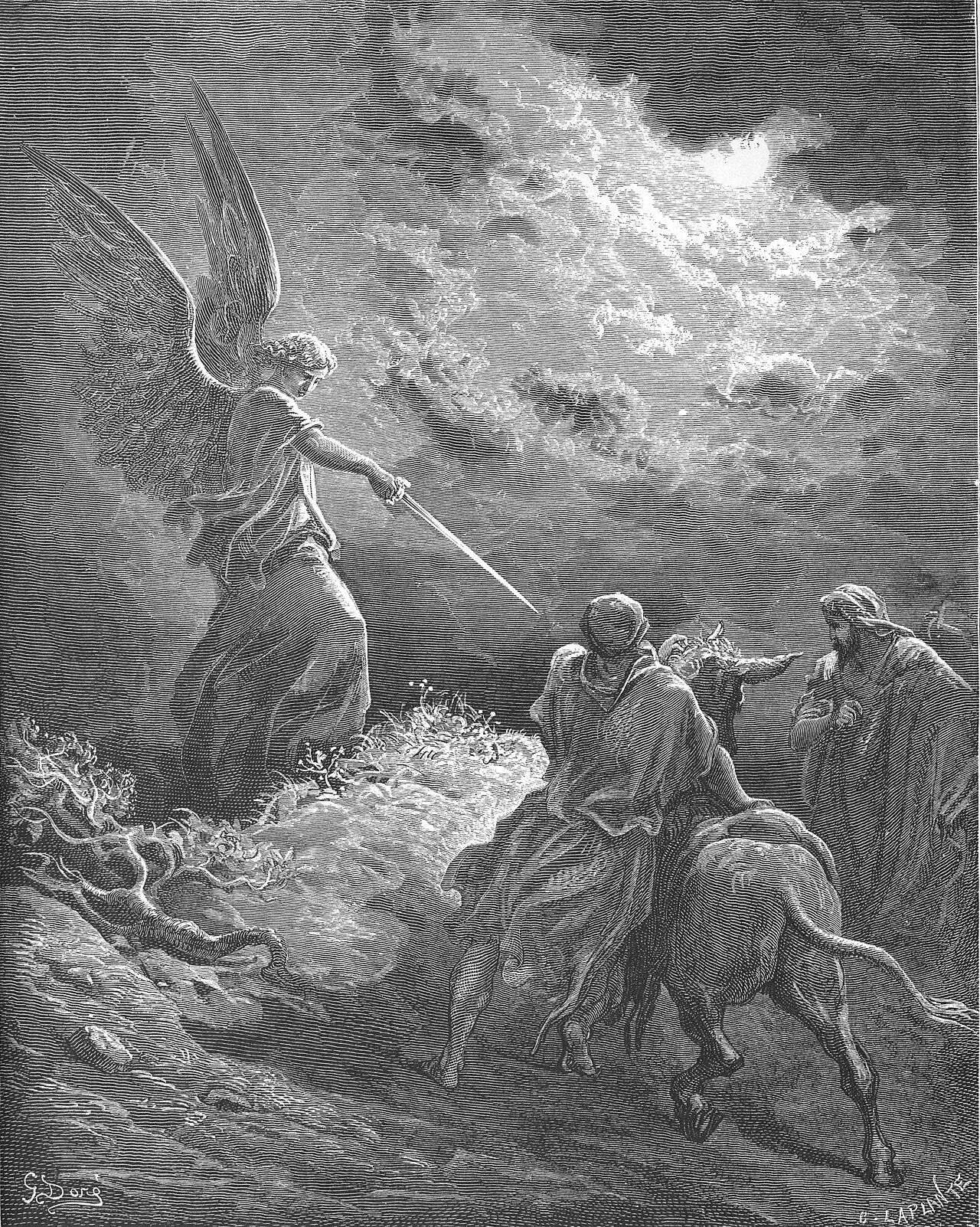
Aaron dies; the bronze serpent heals the dying; Israel's first territorial victories over Sihon and Og; Balaam hired to curse and forced instead to bless, climaxing in a Star out of Jacob; the second census counts a new generation — every man of the first roster gone, save two — and the book ends poised at the Jordan, the land not yet entered.
The Twin Census
“There was not left a man of them… save Caleb… and Joshua” (26:64–65). Of every name on the first roster, only two cross onto the second — the two who trusted God at Kadesh-Barnea.
The Argument
— the whole book in three sentences- Author
- Moses, by the book's own repeated witness (“Jehovah spake unto Moses”) and the canon's affirmation
- Hebrew title
- Bemidbar — “in the wilderness”, from 1:1
- Genre
- Narrative wrapped around law and census, with Balaam's oracles as an embedded poetic set-piece
- Shape
- 36 chapters · 2 censuses · 3 acts
- 1
God organizes a numbered, ordered, holy people around His dwelling tent and leads them from Sinai toward the land He swore — but at Kadesh-Barnea the nation believes ten faithless spies over two faithful ones, and an entire adult generation is condemned to die in the wilderness, one year for each of the forty days the spies searched the land.
- 2
Across the next thirty-eight years the narrative surfaces in flashes — Korah's revolt against Aaron's priesthood, the bronze serpent, Balaam hired to curse Israel and forced instead to bless it — the same pattern of complaint and consequence recurring until a whole generation is spent.
- 3
A second census counts a new generation, standing on the plains of Moab, ready — with new inheritance law, new leadership, cities of refuge already legislated — to cross into the land their parents forfeited. The book ends at the border, not across it.
Christ in Numbers
— six lines run from the wilderness book to Him“As Moses lifted up the serpent in the wilderness, even so must the Son of man be lifted up; that whosoever believeth may in him have eternal life” — Jesus' own words. A symbol of the very thing that killed, lifted up to heal.
Balaam's fourth oracle carries extraordinary ancient reception weight — Targum Pseudo-Jonathan names it “the Messiah”; Qumran's 4Q175 chains it with other royal texts. Christ claims the title directly: “I am… the bright, the morning star.”
The second rock incident. Moses is told to speak to the rock but strikes it as before — and is barred from the land for it. Paul's typology spans the whole wilderness water-supply, from the first rock at Horeb onward.
Open the companion page →Six cities where a manslayer may flee the avenger of blood, safe until the high priest's death. The refuge lasts only “until the death of the high priest” — the believer's refuge secured precisely by the great High Priest's death.
Hebrews grounds Christ's priesthood in the same principle Numbers settles by narrative: the office is not self-appointed but God-given, sealed by a rod that buds, blossoms, and bears almonds overnight.
The same glory that filled the finished tabernacle now visibly leads, moving and resting at God's pace, not Israel's — a picture of guided, present divinity carried forward into the Word who tabernacled among us.
Open the companion page →Themes
— seven load-bearing lines through the bookUnbelief and God's faithfulness
Numbers' distinctive contribution: not merely that God saves or legislates, but that He persists with a people who fail Him without abandoning the promise. “How long shall I bear with this evil congregation…?” is the book's central question.
Two censuses, two generations
The bracketing counts frame a death-and-rebirth structure: by ch. 26 every man of the first roster is dead “save Caleb… and Joshua” — God's promise to Abraham surviving His own judgment on unbelief.
Holiness ordering the camp
The tribes are arranged concentrically around the tabernacle, Levites as a living buffer — the same Sinai holiness-drama of Exodus and Leviticus given spatial, organizational form.
The pattern Paul draws on directly
“Written for our admonition, upon whom the ends of the ages are come.” Numbers is the OT book the NT most directly weaponizes as a warning to the church.
Sovereignty over blessing and cursing
Balak hires a famous pagan seer to curse Israel; God will not permit it, and turns every attempted curse into blessing — Gen 12:3 enacted in narrative.
The defended priesthood
Korah's revolt and Aaron's budding rod settle, narratively and irreversibly, who may approach God on Israel's behalf — a theme Hebrews later leverages for Christ's priesthood.
Intercession as the office that saves the nation
Moses intercedes at least three times to avert total judgment. The nation survives its own worst moments because one man stands in the gap.
Original Language
— the wilderness, the sceptre, the giants — and one debated number“Thousand” — but elsewhere in the OT also “clan, family division, military unit” (Judg 6:15). This single word is what the whole large-numbers debate (see Contested Points) turns on: the census totals read either as ~603,550 individual men or, on the alternative reading, as far fewer military units.
The noun nachash is “serpent” — the bronze image Moses raises (21:9), the same word for the Gen 3 tempter. The verb nachash, “to practice divination, enchant,” underlies 23:23's “there is no enchantment (nachash) against Jacob” — Balaam's own craft, named and declared powerless. Worth surfacing as a keynote even where the wordplay is coincidental rather than a deliberate authorial pun.
The Aaronic Blessing
— 6:24–26 — the oldest surviving words of Scripture“Jehovah bless thee, and keep thee: Jehovah make his face to shine upon thee, and be gracious unto thee: Jehovah lift up his countenance upon thee, and give thee peace.”
Three couplets, each longer than the last — an escalating structure
Two tiny rolled silver amulets excavated at Ketef Hinnom, Jerusalem (1979), inscribed with this exact text, are the oldest surviving fragment of any biblical passage yet discovered — predating the Dead Sea Scrolls by several centuries (⚠ the precise excavation date and excavator, commonly cited as Gabriel Barkay, awaits verification). A rare case where a keynote word-study and a hard archaeological anchor are the same fifteen words.
The Approved Voices on Numbers
— the roster applied — the specific work named, so you can go to itKHouse Numbers verse-by-verse study (exact title unconfirmed)
Marcus Brown's formative teacher, and the load-bearing voice for this book. Reads the camp's ordered design and the census in the integrated-design register; treats the bronze serpent and Balaam's Star-and-Sceptre oracle as strong, deliberate Christ-typology; also load-bearing on post-flood Nephilim presence at 13:33.
The Holiness of God (1985)
The holiness-of-God framing extends naturally to the camp's ordering and to the severity of Kadesh's judgment and Meribah's consequence — the God who is “too holy to look upon sin” disciplining even His own deliverer.
Blessing or Curse: You Can Choose! (exact title unconfirmed)
The roster's intercession-and-blessing teacher. Speaks directly to Balaam's oracles — God's spoken blessing over a covenant people cannot be reversed by any human curse-for-hire — and to the Aaronic Blessing as the paradigm spoken blessing.
The Fear of the Lord (1997) · The Awe of God (2023)
Reads Kadesh-Barnea's failure as, at root, a failure of holy fear and trust displacing the fear of the Anakim (13:28, 33) — the fear of the LORD as the foundational disposition, its absence the central pathology.
Intercessory Prayer
The believer's prayer as co-laboring participation in the kingdom's advance — the pattern Moses models at Kadesh (14:13–19) and at Korah's rebellion (16:22, 46–48).
Numbers That Preach
Reads OT numbers and star-imagery typologically; a natural anchor for Balaam's fourth oracle and the mazzaroth-gospel thread the Star out of Jacob feeds.
Commentary on the Whole Bible, on Numbers
Practical, Christ-centered exposition — strong on the bronze serpent, on Balaam, and on Moses standing between the living and the dead at Korah's rebellion.
Commentaries on the Four Last Books of Moses arranged as a Harmony (1563)
Numbers material woven with Exodus and Deuteronomy; strong on God's sovereignty over even a hired pagan tongue in the Balaam narrative.
Explanatory Notes upon the Old Testament (1765)
The founder's home tradition. Notes the severity and the mercy together in God's response to Kadesh-Barnea's unbelief.
The Pentateuch
The fullest public-domain philological treatment of the census, the camp plan, the Balaam oracles' Hebrew, and the Aaronic Blessing's threefold escalating structure.
sermons on the brazen serpent and on Balaam (exact titles/volumes unconfirmed)
His sermons on the brazen serpent are among his most-reprinted — looking, not working, that saves.
Marcus Brown's own commentary leads above all; within a tier, all voices are equal — no single voice, Spurgeon included, elevated above its tier.

Contested Points
— presented at full strength, then MannaFest's flagThe large census numbers — literal count, or the 'eleph-as-clan reading?
The literal reading
603,550 fighting men (ch. 1), implying a total population (with women, children, the elderly, and the non-fighting Levites) commonly estimated near two million — the plain sense of the Hebrew numerals, taken at face value by the historic church and most conservative commentary.
The 'eleph-reduction reading
Scholars including George Mendenhall (JBL 77, 1958) and J. W. Wenham (Tyndale Bulletin 18, 1967) — conservative textual critics, not historicity-deniers — argue 'eleph should sometimes read “clan” or “military unit” rather than “thousand,” yielding a far smaller fighting strength and total population, one some argue fits the wilderness's carrying capacity better.
MannaFest flag — Present both readings with their philological cases; the site's confessional posture affirms the text's historicity and does not require resolving the numbers question to affirm it — a real, provisioned wilderness generation, whatever its precise size, is the lead, with the 'eleph debate carried as an open textual-critical question, not adjudicated.
Balaam — genuine channel of true prophecy, or the NT's paradigm prophet-for-hire?
The text's own complexity
Balaam is hired as a professional curser-for-hire, is confronted by God directly (22:9–12, 20), speaks four unimpeachably true oracles under divine constraint — yet is later blamed for counseling the Baal-Peor seduction (31:16) and is condemned in the NT as a prophet who “loved the hire of wrong-doing” (2 Pet 2:15–16; Jude 11; Rev 2:14).
External corroboration
A plastered wall inscription discovered at Deir 'Alla, Jordan (1967), dated roughly 8th century BC, explicitly names “Balaam son of Beor” as a “seer of the gods” — the clearest instance in the whole OT of a named biblical figure independently attested outside Scripture as a known regional seer, centuries after the events.
MannaFest flag — Present Balaam's full moral complexity honestly — a genuine channel of true prophecy and the NT's paradigm of a corrupted prophet-for-hire — rather than flattening him into either “a good man” or “merely a villain.” The Deir 'Alla inscription is a striking, honest archaeological anchor, not overclaimed as proof of the biblical episode itself.
Moses' sin at Meribah (20:2–13) — why so severe a consequence?
The puzzle
The bare offense — striking the rock twice instead of speaking to it, as commanded — seems small beside forty years of faithful leadership, yet costs Moses the land.
Readings at their strongest
(i) Moses failed publicly to “sanctify” God before the congregation (20:12) — a leader's public unbelief carries heavier consequence than a private one; (ii) his anger (“hear now, ye rebels,” 20:10) usurped credit belonging to God alone; (iii) a lower-confidence typological reading contrasts the struck first rock (Exod 17:6) with the second rock, to be only spoken to — carried as devotional resonance, not settled exegesis.
MannaFest flag — The text's own stated reason (20:12) is the lead — public unbelief and dishonor before the whole congregation, not a minor procedural slip. The Christ-typological reading of the two rocks is carried as an interesting traditional resonance, clearly labeled lower-confidence.
A fourth seam — the Nephilim/Anakim link at 13:33 — is carried by the site's Watchers brief rather than re-derived here. See the Watchers & Nephilim study →
The Cast
— the leaders, the rebels, the diviner, and the daughters who changed the lawPlaces