
Genesis 4 and 5 · Person · Featured Study
Seth
Seth is the third named son of Adam and Eve, in Genesis 4 and 5, 1 Chronicles 1 and Luke 3.
Every father Genesis 5 names after Adam, down to Noah, descends from Seth.
- The name means
- Granted or placed, from the word Eve speaks over him at his birth
- Born
- in Adam's 130th year
- Died
- at 912 years
- Family
- father: Adam; mother: Eve; brother: Cain; brother: Abel; son: Enosh
- First named
- Genesis 4:25
- Last named
- Luke 3:38
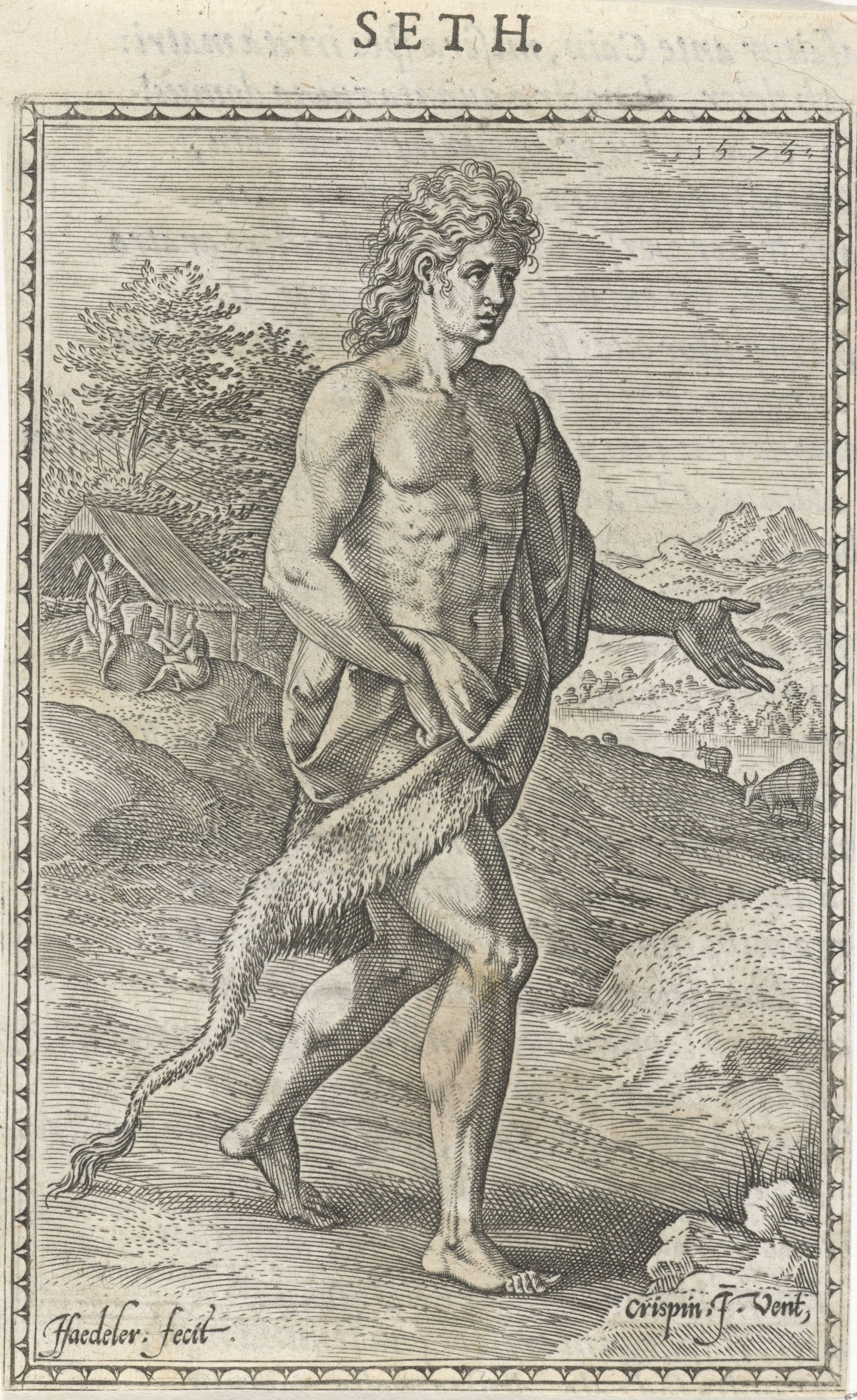
Johann Sadeler I after Crispijn van den Broeck, Seth, 1577, Rijksmuseum, Amsterdam, RP-P-OB-5442. Public domain, via Wikimedia Commons.
THE ARTWORKSadeler engraved Seth alone and at full length for Louis Hillesem's Sacrarum antiquitatum monumenta, printed by Christoffel Plantin at Antwerp in 1577. Adam and Eve sit at their hut behind him, the parents to whom Genesis 4:25 says he was born after Abel's death.
Summary
Seth was the son born to Adam and Eve after Cain killed Abel.
- Eve named him and said that God had granted her another seed in place of Abel.
- He became the father of Enosh at 105.
- Luke names him in the genealogy of Jesus.
Where Seth Stands in Scripture
Genesis names him in two chapters, and two later books count generations through him.
And Adam again had relations with his wife, and she gave birth to a son and named him Seth, saying, “God has granted me another seed in place of Abel, since Cain killed him.”Genesis first names him here, in the closing verses of Genesis 4.
So Seth lived a total of 912 years, and then he died.His last line in Genesis ends with the words and then he died, which Genesis 5 says of every father in the line but Enoch, whom God took away.
Seth's Life by the Years of Genesis 5
The timeline draws five turns of his life with the ages Genesis 4 and 5 give.
Seth's age at Adam's death is reckoned from the ages of Genesis 5, and the other ages stand in the text.
The Life in Genesis 4 and 5
Genesis 4 and Genesis 5 each give an account of his birth.
The account in Genesis 4 ends the story of Cain with a new son for Adam and Eve and a grandson named Enosh.
The account in Genesis 5 sets two likenesses side by side.
This is the book of the generations of Adam. In the day that God created man, He made him in His own likeness.The chapter opens its list at creation, so Seth's birth is measured from the day God made man.
When Adam was 130 years old, he had a son in his own likeness, after his own image; and he named him Seth.Genesis uses of Adam's son the two words it used of God's making of man, likeness and image.
The name Eve gave himShet and shat, Genesis 4:25
Eve's word for granted is shat, from the verb shit, to place, and the name Shet sounds like it. Her word for the son is zera, seed, and her word for in place of is tachat.
And I will put enmity between you and the woman, and between your seed and her seed. He will crush your head, and you will strike his heel.”God tells the serpent of the woman's seed in this verse, and Eve uses the same word zera of Seth.
In Adam's likenessMatthew Henry; Radak
Two readers of Genesis 5:3 take its likeness in opposite senses.
Matthew Henry, in his Commentary on the Whole Bible, holds that Adam had lost the divine likeness and so could not convey it to his seed.
Radak, in his commentary on Genesis, holds that Adam begot Seth after he had completed his penitence and become a thoroughly good person.
The Family of Seth
The table gives eight ties to Seth, each with the verse that names it.
| Person | Tie to Seth | Verse |
|---|---|---|
| Adam | His father. | Genesis 5:4 |
| Eve | His mother. | Genesis 4:1 |
| Abel | His brother, the second son of Adam and Eve. | Genesis 4:2 |
| Cain | His brother, the firstborn of Adam and Eve. | Genesis 4:1 |
| Other sons and daughters of Adam | His brothers and sisters, born after him, so Genesis names Seth third without making him the third child born. | Genesis 5:4 |
| Enosh | His son, the one child of Seth that Genesis names. | Genesis 5:6 |
| Kenan | His grandson, born when Enosh was 90. | Genesis 5:9 |
| Noah | His descendant, the son of Lamech. | Genesis 5:29 |
- Person
- Adam
- Tie to Seth
- His father.
- Verse
- Genesis 5:4
- Person
- Eve
- Tie to Seth
- His mother.
- Verse
- Genesis 4:1
- Person
- Abel
- Tie to Seth
- His brother, the second son of Adam and Eve.
- Verse
- Genesis 4:2
- Person
- Cain
- Tie to Seth
- His brother, the firstborn of Adam and Eve.
- Verse
- Genesis 4:1
- Tie to Seth
- His brothers and sisters, born after him, so Genesis names Seth third without making him the third child born.
- Verse
- Genesis 5:4
- Person
- Enosh
- Tie to Seth
- His son, the one child of Seth that Genesis names.
- Verse
- Genesis 5:6
- Person
- Kenan
- Tie to Seth
- His grandson, born when Enosh was 90.
- Verse
- Genesis 5:9
- Person
- Noah
- Tie to Seth
- His descendant, the son of Lamech.
- Verse
- Genesis 5:29
Questions the Life Raises
Three questions bear on his birth, on Adam's age at his birth and on the name Sheth in Numbers 24:17.
How long after Abel's death was Seth born?Genesis 4:25 and Genesis 5:3; John Gill
Why do some old copies give Adam 230 years at Seth's birth?Jerome
Jerome, in his Hebrew Questions on Genesis, says the codices of his day gave the fathers before the Flood two hundred and some years at the birth of a son. In the Hebrew, he says, those ages stand at one hundred. The Adam to Noah page sets the Hebrew, Greek and Samaritan numbers side by side.
Who are the sons of Sheth in Numbers 24:17?Balaam's fourth oracle
I see him, but not now; I behold him, but not near. A star will come forth from Jacob, and a scepter will arise from Israel. He will crush the skulls of Moab and strike down all the sons of Sheth.Outside Genesis 4 and 5 and 1 Chronicles 1:1, this is the one verse of the Hebrew Bible where the name stands, here beside Moab.
The Hebrew spells the name in this verse as it spells Seth's name in Genesis 4:25. Strong's Hebrew lexicon also lists a second word sheth, meaning tumult, and the verse itself does not say which people it means.
What Genesis Leaves Unsaid
The record of his life ends with his children and his years.
Seth in the Line of Christ
Commentators carry the line of the Messiah through Seth, and some read Genesis 6:2 of his descendants.
John Gill, in his Exposition of the Old Testament, says Genesis names Enosh because the line runs through him from Adam to Noah, from whom the Messiah was to spring.
the son of Enosh, the son of Seth, the son of Adam, the son of God.Luke calls Adam the son of God, so the line of Jesus through Seth runs back to the Creator.
The line of Seth and the sons of God of Genesis 6:2The Sethite reading and Rashi's two readings
the sons of God saw that the daughters of men were beautiful, and they took as wives whomever they chose.The verse names the sons of God and the daughters of men without naming the family of either.
The Sethite reading takes the sons of God as the godly line of Seth and the daughters of men as the line of Cain. It became the majority reading after Augustine's City of God, book 15, and Jamieson, Fausset and Brown hold it in their Commentary of 1871.
Rashi, in his commentary on Genesis, gives two readings: the sons of princes and rulers, and princely angels sent by God. The Watchers and the Nephilim page sets out the angelic reading with its holders and their works.
Voices on Seth's Line, Earliest First
Ambrose glosses the name Enosh, and Henry and Jamieson, Fausset and Brown weigh the long lives of the line.
“For it is the mark of a wise man to separate oneself from the pleasures of the flesh, to elevate the soul, and to withdraw from the body; for this is truly to recognize oneself as a human being. He who is called Enos in the Chaldean language is called, in Latin, homo.”
Ambrose of Milan · On Isaac and the Soul, Chapter I · on Genesis 5:9 to 11Patristic
“The present life surely was not to them such a burden as commonly it is now, else they would have been weary of it; nor was the future life so clearly revealed then as it is now under the gospel, else they would have been impatient to remove to it: long life to the pious patriarchs was a blessing and made them blessings.”
Matthew Henry · Commentary on the Whole Bible · on Genesis 5:8Puritan
“Since we cannot obtain satisfactory evidence on these points, it is wise to resolve the fact into the sovereign will of God. We can, however, trace some of the important uses to which, in the early economy of Providence, it was subservient. It was the chief means of reserving a knowledge of God, of the great truths of religion, as well as the influence of genuine piety.”
Jamieson, Fausset & Brown · Commentary Critical and Explanatory on the Whole Bible · on Genesis 5:5Reformed
What Began in the Days of Enosh?
The calling in the days of Enosh bears two readings, public worship and the taking of the name of the LORD.
And to Seth also a son was born, and he called him Enosh. At that time men began to call upon the name of the LORD.The verse names Enosh and dates the calling to his days, and both readings rest on its last words.
Men began to worship God in publicJohn Wesley, 1765
John Wesley, in his Explanatory Notes upon the Old Testament, reads the verse as the start of public and solemn worship, more than had been done since the defection of Cain.
The objection: the verse names no assembly, and the Hebrew allows another reading of the calling.
The followers of God took His nameAdam Clarke, 1832
Adam Clarke, in his Commentary on the Bible, reports the marginal reading that men began to call themselves by the name of the LORD. On that reading the followers of God were known as the sons of God, and the rest of Adam's family as the children of men.
The objection: the same Hebrew words stand in Genesis 12:8 and Genesis 26:25.
From there Abram moved on to the hill country east of Bethel and pitched his tent, with Bethel to the west and Ai to the east. There he built an altar to the LORD, and he called on the name of the LORD.Abram builds an altar and calls on the name of the LORD, so the phrase there names worship at an altar.
Books to Read Next
Four books are listed, from Jerome to Adam Clarke.
Hebrew Questions on Genesis
Jerome · about 391
Jerome works through Genesis question by question from the Hebrew text.
Rashi on Genesis
Rashi, translated by M. Rosenbaum and A. M. Silbermann · translated 1929 to 1934
Rashi comments on the whole of Genesis and gives the readings of Genesis Rabbah beside the plain sense.
In print: find it wherever books are sold.
Commentary on the Whole Bible
Matthew Henry · 1710
Henry's commentary on Genesis 5 runs from the day Adam was created to the taking of Enoch.
READ IT FREE AT CCEL →Commentary on the Bible
Adam Clarke · 1832
Clarke sets out the ages of the fathers in the Hebrew, the Samaritan and the Septuagint in tables.
The Son of Adam, the Son of God
Seth was born in the likeness of Adam. In 1 Corinthians 15:45 Paul calls Christ the last Adam, a life-giving spirit. In 1 Corinthians 15:49 he writes that as we have borne the likeness of the earthly man, so also shall we bear the likeness of the heavenly man.
Romans 10:13 promises that everyone who calls on the name of the Lord will be saved. Romans 10:9 asks the reader to confess with the mouth that Jesus is Lord and to believe in the heart that God raised Him from the dead.
Keep studying
Symbols1
Peoples and groups4