

Carl Ludwig Kuhbeil, God Shows Moses the Promised Land, 1818. Public domain.
Genesis 12 to 17 · Place · Featured Study
The Land of Israel
Ezekiel names the land of Israel in 19 of the 31 verses of the Berean text that use the name, more than the rest of Scripture together.
God told Abram to walk around the land, through its length and breadth.
Then the LORD said to Abram, “Leave your country, your kindred, and your father’s household, and go to the land I will show you.
- Today
- the southern Levant
- Region
- between the Mediterranean and the Jordan
- First named
- Genesis 12:1 “…household, and go to the land I will…”
- Last named
- Matthew 2:21 “…mother, and went to the land of Israel.”
God told Abram to walk around the land, through its length and breadth.
Summary
The land of Israel is the land God promised to Abraham and his descendants as an eternal possession.
- Genesis calls it the land of Canaan, and the name the land of Israel first stands in Judges and 1 Samuel.
- Abraham's only holding in it was the field and the cave he bought for Sarah's grave.
- The Philistines once kept every blacksmith out of the land of Israel.
Where the Land Stands in Scripture
God calls Abram, and an angel sends Joseph home from Egypt.
Then the LORD said to Abram, “Leave your country, your kindred, and your father’s household, and go to the land I will show you.Abram is called to a land God has not yet named to him.
“Get up!” he said. “Take the Child and His mother and go to the land of Israel, for those seeking the Child’s life are now dead.”Matthew is the one book of the New Testament to use the name the land of Israel.
“Get up!” he said. “Take the Child and His mother and go to the land of Israel, for those seeking the Child’s life are now dead.”Matthew is the one book of the New Testament to use the name the land of Israel.
The Land on the Map
Its northern and southern towns, its south-western border, its burial cave and the mountain of Moses' view.
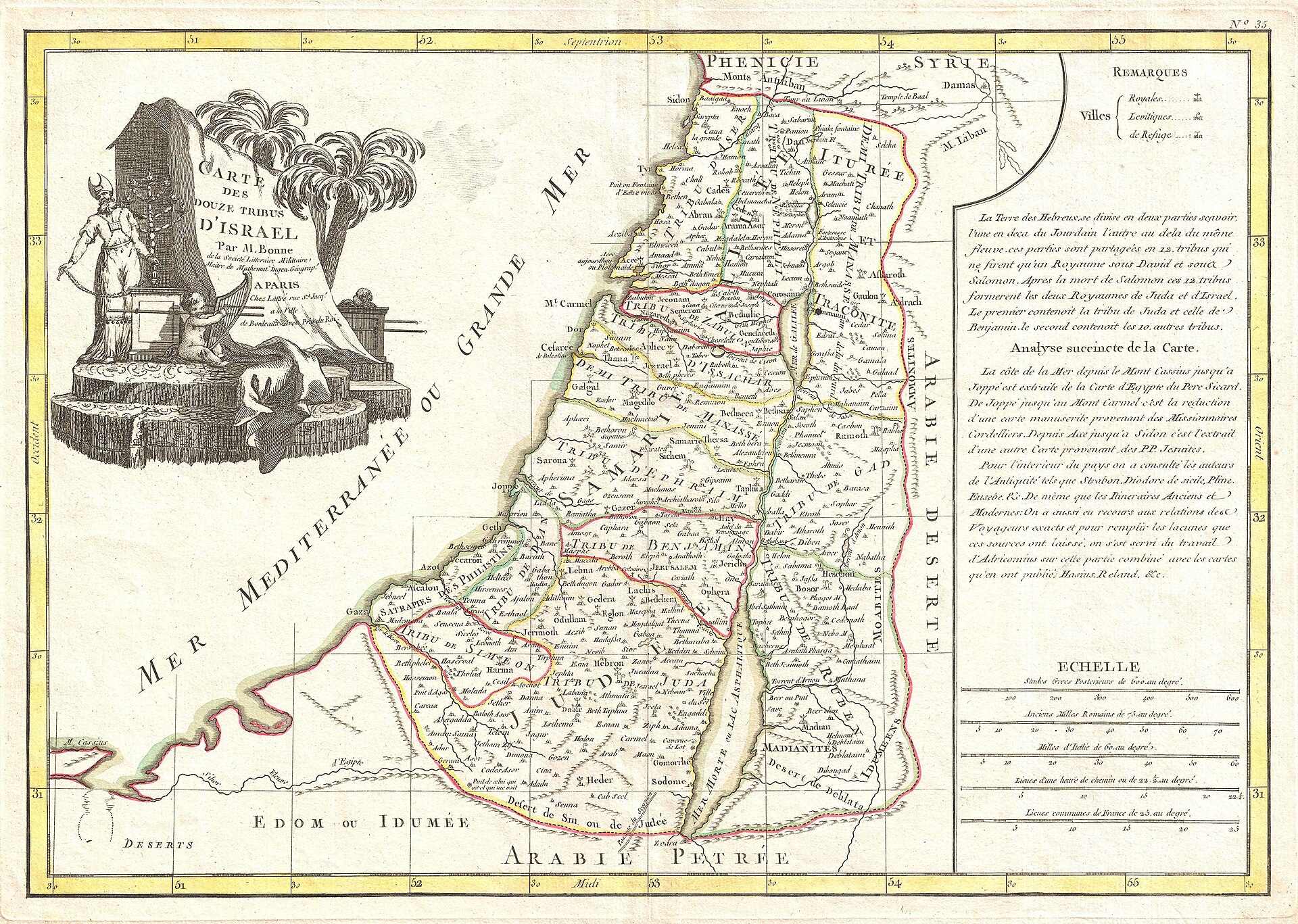
Bonne's plate of 1770 draws the twelve tribes on both sides of the Jordan.
- Located: the site is known
- Probable: OpenBible scores 500 to 799
- 1Dan, The northern town of the saying from Dan to Beersheba. Judges 20:1
- 2Beersheba, The southern town of the same saying. 1 Samuel 3:20
- 3Brook of Egypt, The south-western end of the border Numbers draws. Numbers 34:5
- 4Hebron, The town near the cave where Abraham, Isaac and Jacob were buried. Genesis 50:13
- 5Mount Nebo, The mountain east of the Jordan from which Moses saw the land. Deuteronomy 34:1
Base map: The Twelve Tribes of Israel, Rigobert Bonne (1770), public domain. Places with a place page stand at its coordinates and the others at the point cited for each, set on the plate by Hebron and Dan, as the plate prints them.
The Brook of Egypt is marked at the point OpenBible gives for Wadi al Arish.
The Promise of the Land
Seven promises from God and Joseph's last word.
God repeated the promise of the land to Abraham, Isaac and Jacob, and Joseph passed it on to his brothers.
- Abram at ShechemThis land to his offspringGenesis 12:7
- Abram after Lot leavesAll the land he can see, foreverGenesis 13:15
- Abram at the covenant of the piecesFrom the river of Egypt to the EuphratesGenesis 15:18
- Abraham at ninety-nineAll the land of Canaan, with God as their GodGenesis 17:8
- Isaac at GerarAll these lands, by the oath sworn to AbrahamGenesis 26:3
- Jacob at BethelThe land on which he layGenesis 28:13
- Jacob on his returnThe land given to Abraham and IsaacGenesis 35:12
- Joseph's brothersGod will bring them up to the land He promised on oath to Abraham, Isaac, and JacobGenesis 50:24
Genesis 12:7 to 50:24.
Jacob on his return, Joseph's brothers
The Land Before Israel
Genesis 12 and 15, and Numbers 34.
Abram traveled through the land as far as the site of the Oak of Moreh at Shechem. And at that time the Canaanites were in the land.Genesis notes who held the land on the day the promise was first spoken.
Where It Points
The letter to the Hebrews on the patriarchs in the land.
By faith he dwelt in the promised land as a stranger in a foreign country. He lived in tents, as did Isaac and Jacob, who were heirs with him of the same promise.The verse makes the patriarchs' tents an example of faith.
Instead, they were longing for a better country, a heavenly one. Therefore God is not ashamed to be called their God, for He has prepared a city for them.The letter names what the patriarchs were looking for beyond the land.
Voices on the Land
Three teachers on the promise to Abram and on Hebron, from Didymus the Blind to Matthew Henry.
died 398 · Didymus the Blind
ON GENESIS 210-11
The promise read in its plain sense
The quotation1 quotation
“As for the promise to make of him ‘a great nation,’ is it necessary to give a meaning other than the literal one? Because it is clear that it was realized in its historical sense.”
Didymus the Blind · On Genesis 210-11 · on Genesis 12:2Patristic
died 735 · Bede
Commentary on Genesis (Hexaemeron)
Hebron and its old name
The quotation1 quotation
“Moving therefore Abram his tent, he came and dwelt by the valley of Mamre, which is in Hebron. Hebron is a city situated about twenty-two miles south of Jerusalem, which in the times of Moses was called Arbe or Kiriath-Arba, that is, the city of …”
Bede · Commentary on Genesis (Hexaemeron) · on Genesis 13:18Patristic
1662 to 1714 · Matthew Henry
Commentary on the Whole Bible
The eye of faith
The quotation1 quotation
“The prospects of an eye of faith are much more rich and beautiful than those of an eye of sense. Those for whom the heavenly Canaan is designed in the other world have sometimes, by faith, a comfortable prospect of it in their present state; for we look at the things that are not seen, as real, though distant.”
Matthew Henry · Commentary on the Whole Bible · on Genesis 13:14Puritan
How Are Ezekiel's Borders to Be Read?
Two readings of Ezekiel 47:13 to 20, each with its holder and its work.
You are to divide it equally among them. Because I swore with an uplifted hand to give it to your forefathers, this land will fall to you as an inheritance.The verse gives the rule for the new division: equal shares for every tribe.
An ideal allotment that shows the promise keptAlbert Barnes, on Ezekiel 47:15
Barnes calls the occupation ideal and says the place names are given to show that the original promise will be fulfilled.
The objection: Ezekiel names the towns of the border one by one, Hamath, Damascus and Tamar, as a survey of land would.
A figure of Christ's kingdomMatthew Henry, on Ezekiel 47:14
Henry reads the allotments as belonging to the sealed ones and to all the subjects of Christ's kingdom, Jew and Gentile alike.
The objection: Ezekiel gives Joseph two portions among the twelve tribes, as in Jacob's blessing (Ezekiel 47:13).
Books to Read Next
Two works, each free to read online.
The Historical Geography of the Holy Land
George Adam Smith · 1894
Smith describes the land region by region, from the coast and the Shephelah to the Jordan valley and Gilead.
Read at archive.orgNotes, Explanatory and Practical, on the Old and New Testaments
Albert Barnes · 1832 to 1869
Barnes compares the borders of Ezekiel 47 with those of Numbers 34 place by place.
Read at CCELA Land and a Better Country
Joshua records that not one of the LORD's good promises to the house of Israel failed (Joshua 21:45).
The letter to the Hebrews asks the reader to fix his eyes on Jesus, the author and perfecter of faith (Hebrews 12:2).
Sources
Scripture is the Berean Standard Bible.
- Wikipedia, Land of Israel, revision 1379627120, read on 20 October 2026.
- OpenBible.info, Bible Geocoding Data, ancient.jsonl, CC BY.
- George Adam Smith, The Historical Geography of the Holy Land, 1894 (the archive.org copy printed 1897), public domain.
- Albert Barnes, Notes, Explanatory and Practical, on the Old and New Testaments, on Ezekiel 47:15.
- Jamieson, Fausset and Brown, Commentary Critical and Explanatory on the Whole Bible, 1871, on Ezekiel 47:13.
- Matthew Henry, Commentary on the Whole Bible, 1710, on Ezekiel 47:14.
- Matthew Henry, Commentary on the Whole Bible, 1710, on Genesis 13:14.
- Bede, Commentary on Genesis, on Genesis 13:18.
- Didymus the Blind, On Genesis, on Genesis 12:2.
Keep Studying
Read it5
Places7