
Judges · Group · Featured Study
The Five Minor Judges
Tola, Jair, Ibzan, Elon and Abdon judged Israel for seventy years, and the book of Judges gives none of them a battle.
The last notice counts one judge's household as “forty sons and thirty grandsons, who rode on seventy donkeys.”
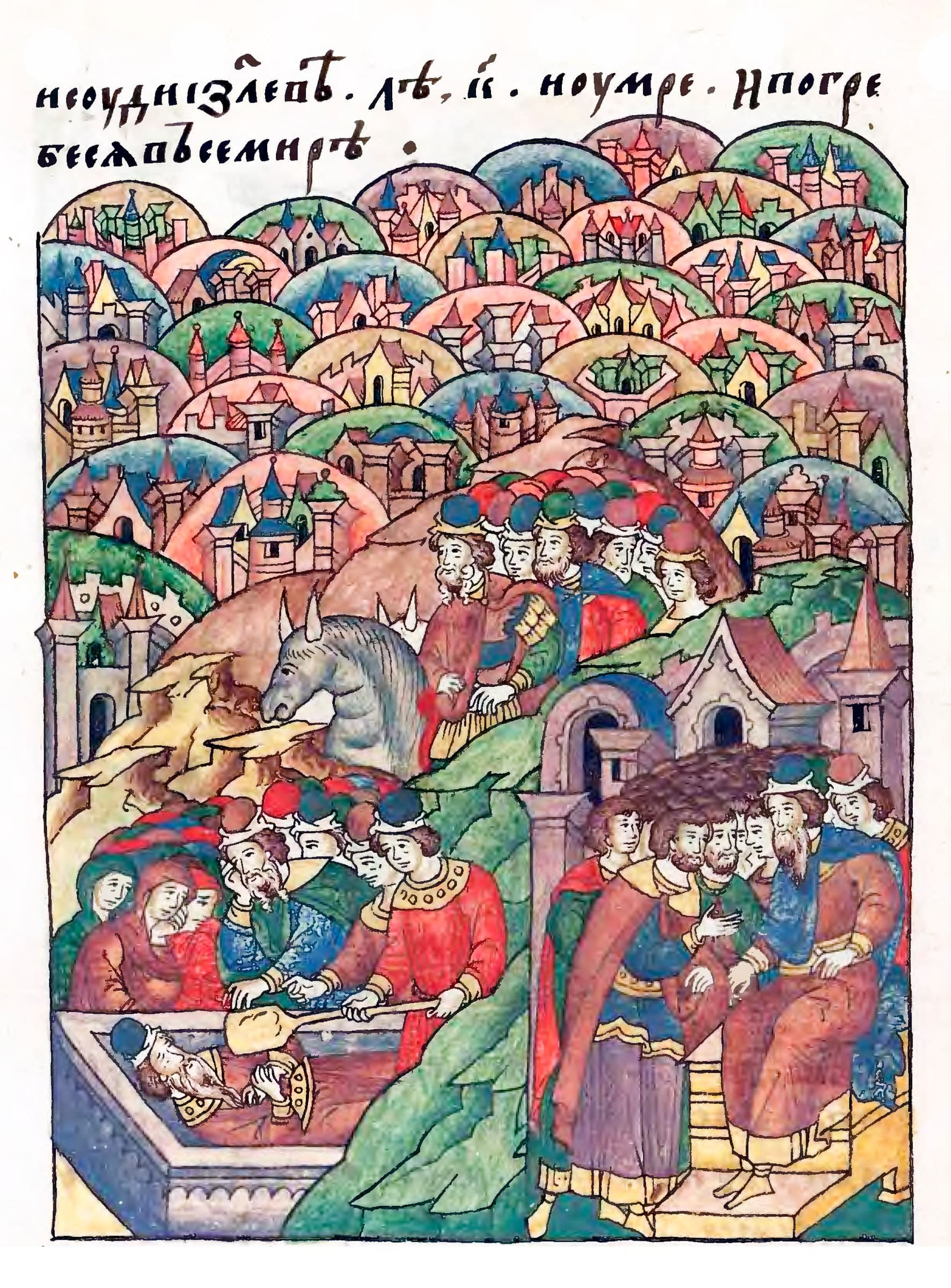
Illustrated Chronicle of Ivan the Terrible (Litsevoi Svod), volume 2, page 543, Moscow, 1560s to 1570s, tempera on paper. Public domain by date. Wikimedia Commons, File:Facial Chronicle - b.02, p.543 - Jair.jpg.
THE ARTWORKThe painters of Ivan the Terrible's chronicle illustrated the notices of Judges 10 in one scene. A judge is laid in his tomb at the lower left, and a ruler sits among his people at the lower right. Riders on a donkey cross hills crowded with towns, as Jair's thirty sons held thirty towns in Gilead.
Summary
Judges gives these five rulers a few lines each, between the long stories of Gideon, Jephthah and Samson.
- Tola and Jair followed Abimelech, and Ibzan, Elon and Abdon followed Jephthah.
- Each notice gives the judge's home, his years and his grave, and three count his sons.
- Readers divide over whether the names stand for single men or for the clans that bore them.
The Two Notices
Judges gives the five two short notices, in chapters 10 and 12.
| Judge | Home as the text gives it | Years | Household | Buried at |
|---|---|---|---|---|
| Tola son of Puah | Shamir in Ephraim, though of Issachar | 23 | Not given | Shamir |
| Jair the Gileadite | Gilead | 22 | 30 sons on 30 donkeys, holding 30 towns | Kamon |
| Ibzan | Bethlehem | 7 | 30 sons and 30 daughters | Bethlehem |
| Elon the Zebulunite | Zebulun | 10 | Not given | Aijalon in the land of Zebulun |
| Abdon son of Hillel | Pirathon in Ephraim | 8 | 40 sons and 30 grandsons on 70 donkeys | Pirathon |
After the time of Abimelech, a man of Issachar, Tola son of Puah, the son of Dodo, rose up to save Israel. He lived in Shamir, in the hill country of Ephraim. Tola judged Israel twenty-three years, and when he died, he was buried in Shamir. Tola was followed by Jair the Gileadite, who judged Israel twenty-two years. He had thirty sons who rode on thirty donkeys. And they had thirty towns in the land of Gilead, which to this day are called Havvoth-jair. When Jair died, he was buried in Kamon.The first pair of notices follows straight on from Abimelech's death at Thebez.
After Jephthah, Ibzan of Bethlehem judged Israel. He had thirty sons, as well as thirty daughters whom he gave in marriage to men outside his clan; and for his sons he brought back thirty wives from elsewhere. Ibzan judged Israel seven years. Then Ibzan died, and he was buried in Bethlehem. After Ibzan, Elon the Zebulunite judged Israel ten years. Then Elon the Zebulunite died, and he was buried in Aijalon in the land of Zebulun. After Elon, Abdon son of Hillel, from Pirathon, judged Israel. He had forty sons and thirty grandsons, who rode on seventy donkeys. And he judged Israel eight years. Then Abdon son of Hillel, from Pirathon, died, and he was buried at Pirathon in Ephraim, in the hill country of the Amalekites.The second group of three follows Jephthah's six years and closes before the Philistine years of Samson.
Elon's notice is the plainest of the five, and George Foot Moore found in it nothing beyond the name, the tribe, the years and the grave.
Where They Lived and Were Buried
The notices name Issachar, Gilead, Zebulun and Ephraim, on both sides of the Jordan, and two Bethlehems claim Ibzan.
Gilead lies east of the Jordan, and the other homes lie west of it.
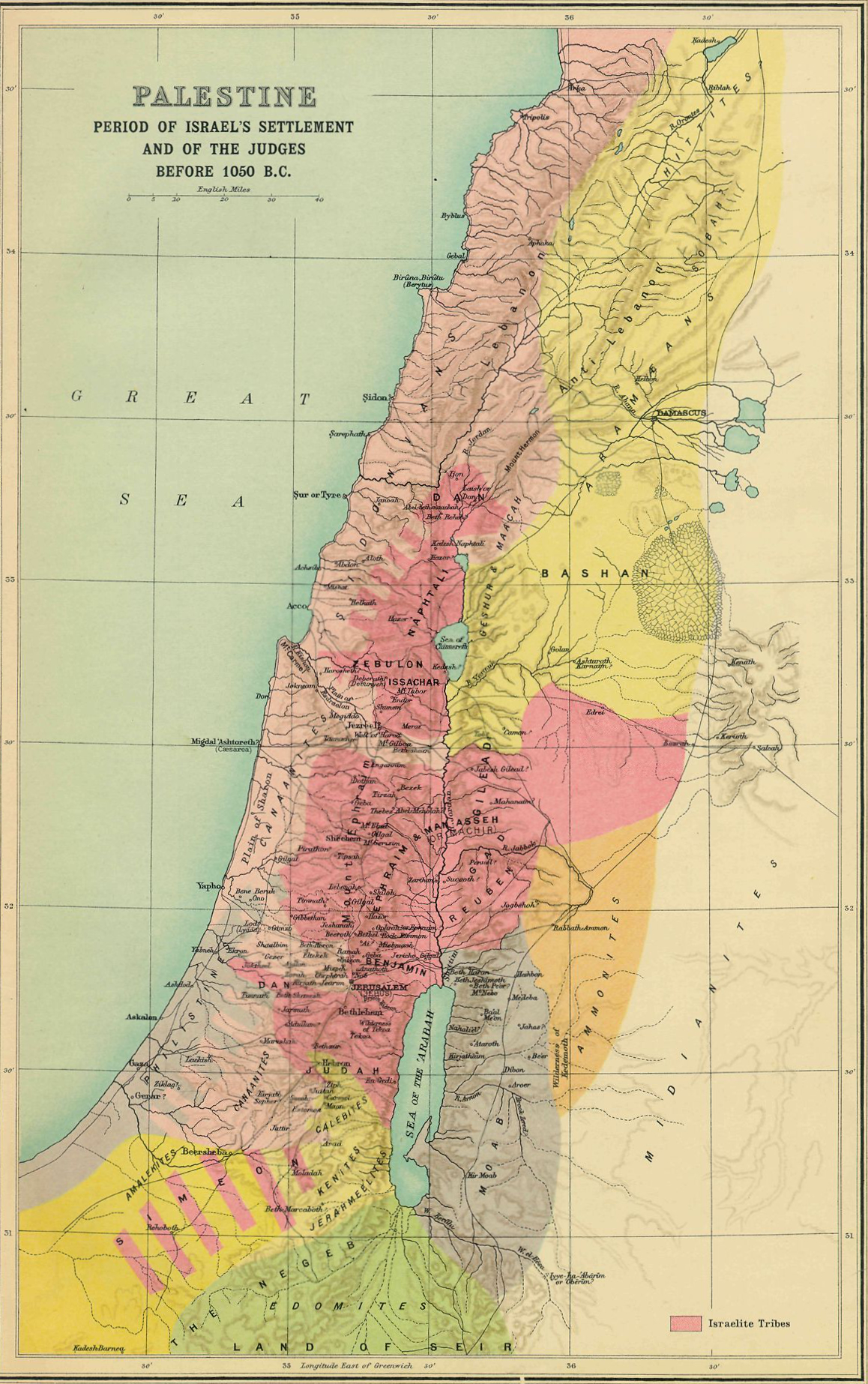
- IssacharTola belonged to this tribe.Judges 10:1
- Hill country of EphraimTola lived and was buried at Shamir here, a town no one has identified.Judges 10:1 to 2
- GileadJair's thirty sons held thirty towns here, called Havvoth-jair.Judges 10:4
- Kamon (Camon on the plate)Jair was buried at Kamon. The plate prints it in Gilead, where Josephus placed it.Judges 10:5
- BethlehemIbzan came from Bethlehem and was buried there, if the town is the Bethlehem of Judah.Judges 12:8 to 10
- ZebulunElon was buried at Aijalon in this tribe's land.Judges 12:11 to 12
- PirathonAbdon came from Pirathon in Ephraim and was buried there.Judges 12:13 to 15
George Adam Smith, Atlas of the Historical Geography of the Holy Land, 1915, plate: Palestine, Period of Israel's Settlement and of the Judges. Public domain.
Each number stands where the 1915 plate prints the name. The plate prints neither Shamir nor Aijalon, so their regions are marked.
C. F. Keil (1865) and Moore (1895) both place Pirathon at the village of Fer'ata, south west of Nablus, where Edward Robinson reported the name.
Shamir, Kamon and Aijalon3 graves without a sure site
Moore reports that Schwarz proposed Sanur, between Nablus and Jenin, for Tola's Shamir in 1852. Moore judges it too far south and west for a town of Issachar and leaves Shamir unidentified.
Josephus calls Kamon a city of Gilead. Eusebius and Jerome placed a Kamon in the plain of Jezreel, six Roman miles north of Legio, and Keil holds that the question cannot be decided.
Keil proposes the ruins of Jalun, east of Acre, for Elon's Aijalon, after the traveller Van de Velde. Moore holds the place otherwise unknown.
Between Abimelech and Samson
The book sets the five among twelve rulers from Othniel to Samson.
The book counts eighteen years of Ammon's oppression and forty of the Philistines' around the five.
- Judges 9:22 to 57Abimelech reigns three years and dies at ThebezJudges 9:22
- Judges 10:1 to 2Tola judges Israel 23 yearsJudges 10:1 to 2
- Judges 10:3 to 5Jair judges Israel 22 yearsJudges 10:3 to 5
- Judges 10:6 to 9Israel serves other gods, and Ammon oppresses Gilead 18 yearsJudges 10:6 to 9
- Judges 11:1 to 12:7Jephthah defeats Ammon and judges Israel 6 yearsJudges 12:7
- Judges 12:8 to 10Ibzan judges Israel 7 yearsJudges 12:8 to 10
- Judges 12:11 to 12Elon judges Israel 10 yearsJudges 12:11 to 12
- Judges 12:13 to 15Abdon judges Israel 8 yearsJudges 12:13 to 15
- Judges 13:1The Philistines rule Israel 40 yearsJudges 13:1
The book's order from Abimelech's reign to the Philistine years of Samson.
Ehud's eighty years of rest outlast the five notices together.
The 12 spans in years as a table
| Judge | Spans in years | Verse |
|---|---|---|
| Othniel | 40 | Judges 3:11 |
| Ehud | 80 | Judges 3:30 |
| Deborah and Barak | 40 | Judges 5:31 |
| Gideon | 40 | Judges 8:28 |
| Abimelech | 3 | Judges 9:22 |
| Tola | 23 | Judges 10:2 |
| Jair | 22 | Judges 10:3 |
| Jephthah | 6 | Judges 12:7 |
| Ibzan | 7 | Judges 12:9 |
| Elon | 10 | Judges 12:11 |
| Abdon | 8 | Judges 12:14 |
| Samson | 20 | Judges 15:20 |
The years of rest after Othniel, Ehud, Deborah and Gideon, Abimelech's reign, and the years judged by the rest, each read from zero.
How these numbers add up across the whole period is weighed on The Date of the Exodus.
What Judging Meant
Judges uses one verb for Othniel's war and for Elon's ten years of rule.
Then the LORD raised up judges, who saved them from the hands of those who plundered them.This verse is the measure the book sets for every judge in it.
The Hebrew verb is shaphat (Strong's H8199), which Strong defines as to judge, to vindicate or punish, and by extension to govern.
Keil reads the judges as men who procured justice for Israel by delivering the people and by governing them, as a king would.
Albert Barnes notes that the verb of rescue in Judges 10:1 is the one the book uses of every deliverer, and he counts Tola among the judges raised by divine providence.
Raised up, or rose upJudges 3:9, Judges 3:15 and Judges 10:1
And again they cried out to the LORD, and He raised up Ehud son of Gera, a left-handed Benjamite, as their deliverer. So they sent him with tribute to Eglon king of Moab.Of Ehud the book says that the LORD raised him up, as it says of Othniel in Judges 3:9.
Keil observes that the book never says the LORD raised up or called any of the five. He judges that they took the government at the wish of the tribes they served.
Sons, Donkeys and Towns
Three of the notices measure a judge by his household and its riders.
Abdon's seventy riders make the largest household the notices count.
The 7 numbers the text gives as a table
| Household | Numbers the text gives | Verse |
|---|---|---|
| Jair's sons | 30 | Judges 10:4 |
| Jair's towns | 30 | Judges 10:4 |
| Ibzan's sons | 30 | Judges 12:9 |
| Ibzan's daughters | 30 | Judges 12:9 |
| Abdon's sons | 40 | Judges 12:14 |
| Abdon's grandsons | 30 | Judges 12:14 |
| Abdon's riders on donkeys | 70 | Judges 12:14 |
Each bar is a number the text gives, read from zero.
You who ride white donkeys, who sit on saddle blankets, and you who travel the road, ponderDeborah's song calls on the riders of white donkeys, the people of standing in Israel.
Moore notes that the donkey was the riding beast of men and women of rank. Keil adds that riding one marked distinguished rank in an age when Israel kept no horses.
Havvoth-jair, the towns of JairNumbers 32 and Deuteronomy 3
Jair, a descendant of Manasseh, went and captured their villages and called them Havvoth-jair.Numbers gives the same name to a conqueror of Manasseh in the wilderness years.
Keil holds that the judge's sons revived the old name of Moses' day for their thirty towns. Moore holds that the Jair of all these texts is the judge of Judges 10, since the name Havvoth-jair goes with him in every one.
What the Text Leaves Unsaid
The five notices leave three things unrecorded.
No notice says that the land had rest, the line that closes the accounts of Othniel, Ehud, Deborah and Gideon.
Judges gives no wife or mother for any of the five.
Samuel's farewell in 1 Samuel 12:11 and the roll of faith in Hebrews 11:32 name other judges and none of the five.
Quiet Years in a Book of Decline
The five ruled in the years after the men of Shechem made Abimelech king.
But Gideon replied, “I will not rule over you, nor will my son. The LORD shall rule over you.”Gideon's words set the measure for every ruler after him.
Matthew Henry sees in Abdon the tribe of Ephraim beginning to recover its good name, since Abimelech the Shechemite had been a scandal to it.
In those days there was no king in Israel; everyone did what was right in his own eyes.The book closes with the want that no judge supplied.
Two Voices on the Five
Matthew Henry on Tola's home, and John Wesley on Ibzan's children
Matthew Henry begins from the meaning of the name Tola, a worm, and then explains where Tola chose to live.
“It signifies a worm, yet, being the name of his ancestor, he was not ashamed of it. Though he was of Issachar, yet, when he was raised up to the government, he came and dwelt in Mount Ephraim, which was more in the heart of the country, that the people might the more conveniently resort to him for judgment.”
Matthew Henry · Commentary on the Whole Bible · on Judges 10:1Puritan
John Wesley sets Ibzan's household beside the household of Jephthah.
“What a difference between his and his predecessor's family! Ibzan had sixty children, and all married: Jephthah but one, and she dies unmarried. Some are increased, others diminished: all is the Lord's doing.”
John Wesley · Explanatory Notes upon the Old Testament · on Judges 12:9Evangelical
How the Five Are Read
Readers divide over three questions: who the five were, which Bethlehem, and one after another or side by side.
The first question is who the five were and how their notices came into the book.
Five men who governed without warC. F. Keil (1865)
C. F. Keil, in his commentary on Judges of 1865, finds the reason no deeds of the five are recorded in the fact that they waged no wars and smote no foes. He reads them as men who took the lead of the tribes after Abimelech's short reign and kept Israel from fresh oppression and from idolatry.
The objection: Keil supplies a peace and a purpose that the notices themselves never state.
Five clans under the names of their headsGeorge Foot Moore (1895)
George Foot Moore, in his commentary on Judges of 1895, holds that most of the five names are those of clans. Tola and Puah are clans of Issachar and Elon a clan of Zebulun, and the large households of Jair, Ibzan and Abdon mark large clans with many branches.
The objection: Moore himself allows that single men may have borne these names, and each notice gives its judge a town and a grave.
Added by a later editorTheodor Nöldeke and Julius Wellhausen, as Moore reports them; against them Abraham Kuenen
Moore reports the conjecture of Theodor Nöldeke, in his Untersuchungen zur Kritik des Alten Testaments of 1869, that an editor added the five to make up twelve judges. Wellhausen strengthened it by observing that the seventy years of the five almost equal the seventy-one years between the judges in the book's scheme. Abraham Kuenen, in his Historisch-kritisch Onderzoek, rejected that sum, since the same closing formula ends Jephthah's story. He held that the five stood in an older form of the book and came from one of its sources.
The objection: Moore judges that beyond such conjectures the question can hardly go.
The second question is the town of Ibzan.
Bethlehem of JudahJosephus; the Talmud, as Moore reports it
Josephus, in the Antiquities of the Jews, writes that Ibzan was of the tribe of Judah and of the city of Bethlehem. Moore reports a Jewish tradition, in the Talmud's tractate Baba Bathra, that Ibzan was Boaz.
The objection: Keil answers that Scripture calls the southern town Bethlehem of Judah or Bethlehem Ephrathah when it means it.
Bethlehem of ZebulunC. F. Keil (1865); George Foot Moore (1895)
It also included Kattath, Nahalal, Shimron, Idalah, and Bethlehem. There were twelve cities, along with their villages.This list is the one place Scripture names a northern Bethlehem.
Keil and Moore hold that Ibzan came from this northern Bethlehem. Moore places it at Beit Lahm, about seven miles west north west of Nazareth, and notes that the other judges of the group belong to the northern tribes.
The objection: Judges 12:8 gives the town no tribe, and Josephus read it as the town of Judah.
The third question is whether the judges ruled one after another.
One after anotherGeorge Foot Moore (1895)
Moore holds that the words after him mean the writer set their rule end to end, with no interval between one judge and the next.
The objection: Judges 10:7 sets the Philistines and the Ammonites in one verse, and Keil reads their oppressions as running at the same time.
Side by side with the Philistine yearsC. F. Keil (1865)
Keil holds that Jephthah and his three successors were not judges over all Israel. He sets their rule over the tribes east of the Jordan, and perhaps the northern tribes, while the Philistines pressed the west for forty years.
The objection: Moore answers that the author would have said so more plainly, and in its place at Judges 13:1, if he meant the two oppressions to run together.
Books to Read Next
Three works on the minor judges and their towns
A Critical and Exegetical Commentary on Judges
George Foot Moore · 1895
Moore sets out the formula of the five notices, the case for clans and the chronology in full.
Read it free at the Internet ArchiveBiblical Commentary on the Old Testament: Joshua, Judges, Ruth
C. F. Keil and F. Delitzsch · 1865
Keil places each judge's town and argues that the five kept the peace by government.
Read it free at the Internet ArchiveThe Antiquities of the Jews, book 5
Flavius Josephus, translated by William Whiston · 1737
Josephus gives Ibzan a tribe and leaves Tola out of his history.
Read it free at Project GutenbergYears Kept in Peace
Abdon's burial in Judges 12:15 is the last quiet line before the Philistine years and the birth of Samson.
Keep studying
Words1