
Leviticus 4 to 7 · Chatta't and Asham
The Sin Offering and the Guilt Offering
The law of Leviticus 4:1 to 7:10 names who brings each offering for sin, what he brings and what the priests do with it.
An Israelite too poor to bring a lamb or two birds could bring a tenth of an ephah of fine flour as his sin offering, and he would be forgiven.
- First taught
- Exodus 29:14
- Fullest statement
- Leviticus 4:2 to 35
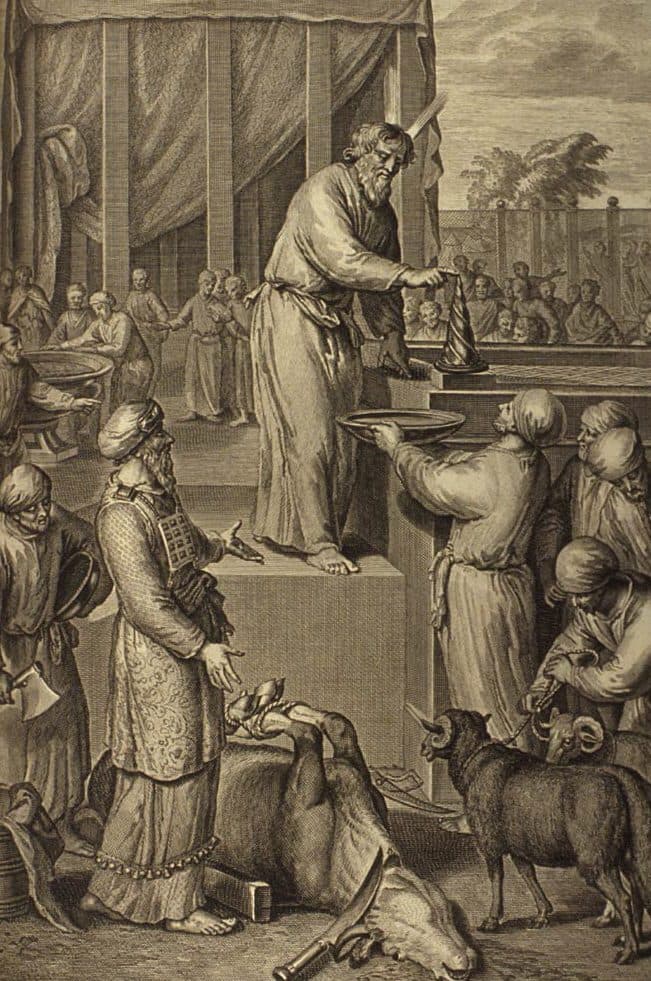
Gerard Hoet and others, Moses Consecrates Aaron and His Sons and Offers Their Sin Offering, Figures de la Bible, The Hague, P. de Hondt, 1728. Public domain by date (published before 1930), via Wikimedia Commons.
THE ARTWORKThe plate shows the sin offering at the ordination of Aaron and his sons in Leviticus 8:14 to 15. Moses serves at the altar in this rite, since Aaron is not yet ordained.
Summary
Leviticus 4:1 to 6:7 sets out two offerings for sin, the sin offering, chatta't in Hebrew, and the guilt offering, asham.
- The sin offering is brought for a commandment broken unintentionally, and its animal is set by the rank of the one who sinned.
- Where the guilt offering answers a wrong that took something, Leviticus 5:16 and 6:5 add restitution and a fifth of its value.
- The priests ate the flesh of both offerings in a holy place, except a sin offering whose blood had been brought into the Tent of Meeting.
- Isaiah 53:10 calls the Servant's soul a guilt offering, and Hebrews 13:11 to 12 sets Jesus' death outside the city gate beside the sin offering burned outside the camp.
Two Offerings for Sin
Leviticus 4 opens the law of the sin offering, and Leviticus 5:14 opens the law of the guilt offering.
“Tell the Israelites to do as follows with one who sins unintentionally against any of the LORD’s commandments and does what is forbidden by them:Every case in the chapter rests on this opening condition, which limits the offering to sin done without intent.
If the anointed priest sins, bringing guilt on the people, he must bring to the LORD a young bull without blemish as a sin offering for the sin he has committed.The chapter begins with the highest office, and the priest brings the largest animal it names.
“If someone acts unfaithfully and sins unintentionally against any of the LORD’s holy things, he must bring his guilt offering to the LORD: an unblemished ram from the flock, of proper value in silver shekels according to the sanctuary shekel; it is a guilt offering.This first case of the guilt offering prices the ram in the currency of the sanctuary.
The guilt offering is like the sin offering; the same law applies to both. It belongs to the priest who makes atonement with it.Leviticus names the two offerings together here, and the law of the priests' portions treats them as a pair.
Where the Offerings Differ
Leviticus 6:17 calls both offerings most holy, and in most else their law differs.
| Point | Sin offering | Guilt offering |
|---|---|---|
| Occasion | A commandment of the LORD broken unintentionally, or one of the sins named in Leviticus 5:1 to 4 | Unfaithfulness against the holy things of the LORD, a sin done unaware, or a wrong done to a neighbor |
| Animal | A young bull for the anointed priest or the congregation, a male goat for a leader, a female goat or lamb for one of the people | An unblemished ram valued in silver shekels, or a male lamb for the cleansed leper and the defiled Nazirite |
| The blood | Sprinkled before the veil and put on the horns of the incense altar for the priest and the congregation; put on the horns of the altar of burnt offering for a leader or one of the people | Sprinkled on all sides of the altar |
| Restitution | None named | Where something was taken, repaid in full with a fifth of its value added; none for a sin done unaware |
| For the poor | Two turtledoves or two young pigeons, or a tenth of an ephah of fine flour | No lesser grade named |
| The flesh | Eaten in the courtyard of the Tent of Meeting, or burned when its blood was brought inside | Eaten by every male among the priests in a holy place |
- Point
- Occasion
- Sin offering
- A commandment of the LORD broken unintentionally, or one of the sins named in Leviticus 5:1 to 4
- Guilt offering
- Unfaithfulness against the holy things of the LORD, a sin done unaware, or a wrong done to a neighbor
- Point
- Animal
- Sin offering
- A young bull for the anointed priest or the congregation, a male goat for a leader, a female goat or lamb for one of the people
- Guilt offering
- An unblemished ram valued in silver shekels, or a male lamb for the cleansed leper and the defiled Nazirite
- Point
- The blood
- Sin offering
- Sprinkled before the veil and put on the horns of the incense altar for the priest and the congregation; put on the horns of the altar of burnt offering for a leader or one of the people
- Guilt offering
- Sprinkled on all sides of the altar
- Point
- Restitution
- Sin offering
- None named
- Guilt offering
- Where something was taken, repaid in full with a fifth of its value added; none for a sin done unaware
- Point
- For the poor
- Sin offering
- Two turtledoves or two young pigeons, or a tenth of an ephah of fine flour
- Guilt offering
- No lesser grade named
- Point
- The flesh
- Sin offering
- Eaten in the courtyard of the Tent of Meeting, or burned when its blood was brought inside
- Guilt offering
- Eaten by every male among the priests in a holy place
The Law, Passage by Passage
Leviticus 4:1 to 7:10, with Numbers 5 and 15, falls into six parts, from the anointed priest to the defiant sin.
1. Leviticus 4:3 to 21, the anointed priest and the whole congregation3 passages, 2 quotations
Then the anointed priest shall take some of the bull’s blood and bring it into the Tent of Meeting. The priest is to dip his finger in the blood and sprinkle some of it seven times before the LORD, in front of the veil of the sanctuary. The priest must then put some of the blood on the horns of the altar of fragrant incense that is before the LORD in the Tent of Meeting. And he is to pour out the rest of the bull’s blood at the base of the altar of burnt offering at the entrance to the Tent of Meeting.The blood of the priest's offering is carried into the Tent of Meeting, farther than the blood of a leader's offering or a common person's.
Matthew Henry ties the blood on the golden altar to the priest's own service there.
“Some of the blood of the high-priest's sin-offering was to be sprinkled seven times before the veil, with an eye towards the mercy-seat, though it was veiled: some of it was to be put upon the horns of the golden altar, because at that altar the priest himself ministered; and thus was signified the putting away of that pollution which from his sins did cleave to his services.”
Matthew Henry · Commentary on the Whole Bible · on Leviticus 4:5 to 7Puritan
But the hide of the bull and all its flesh, with its head and legs and its entrails and dung— all the rest of the bull—he must take outside the camp to a ceremonially clean place where the ashes are poured out, and there he must burn it on a wood fire on the ash heap.No priest eats any part of this bull, and these verses send what remains of it outside the camp.
Rashi, Rabbi Shlomo Yitzchaki of Troyes (1040 to 1105), in his commentary on Leviticus, notes that outside Jerusalem there was a place for unclean things, the plague-stricken stones and the graves. On his reading verse 12 keeps the rite away from that ground.
Now if the whole congregation of Israel strays unintentionally and the matter escapes the notice of the assembly so that they violate any of the LORD’s commandments and incur guilt by doing what is forbidden, when they become aware of the sin they have committed, then the assembly must bring a young bull as a sin offering and present it before the Tent of Meeting.A whole people can go astray together, and this law treats the people as one offerer.
Henry reports what the Jewish writers held about the offering and repentance.
“The Jewish writers themselves say that neither the sin-offering nor the trespass-offering made atonement, except for those that repented and believed in their atonement. The bullock must be killed, and a great deal of solemnity there must be in disposing of the blood; for it was the blood that made atonement, and without shedding of blood there was no remission,”
Matthew Henry · Commentary on the Whole Bible · on Leviticus 4:4Puritan
2. Leviticus 4:22 to 35, the leader and one of the common people2 passages
When a leader sins unintentionally and does what is prohibited by any of the commandments of the LORD his God, he incurs guilt. When he becomes aware of the sin he has committed, he must bring an unblemished male goat as his offering.His case turns on the moment of knowledge, which the law makes the start of his duty.
Rashi connects the word that opens verse 22 with the Hebrew word for happy. In his reading, happy is the generation whose leader brings an offering even for a sin done unintentionally, and he will repent all the more of a sin done on purpose.
If, however, he brings a lamb as a sin offering, he must bring an unblemished female. And he is to lay his hand on the head of the sin offering and slaughter it as a sin offering at the place where the burnt offering is slaughtered. Then the priest is to take some of the blood of the sin offering with his finger, put it on the horns of the altar of burnt offering, and pour out the rest of its blood at the base of the altar. And he shall remove all the fat, just as the fat of the lamb is removed from the peace offerings, and he shall burn it on the altar along with the offerings made by fire to the LORD. In this way the priest will make atonement for him for the sin he has committed, and he will be forgiven.A common person may bring a female lamb in place of a goat, and the chapter ends with the same atonement for him as for a leader.
3. Leviticus 5:1 to 13, the sins named and the offerings of the poor3 passages
If someone incurs guilt in one of these ways, he must confess the sin he has committed, and he must bring his guilt offering to the LORD for the sin he has committed: a female lamb or goat from the flock as a sin offering. And the priest will make atonement for him concerning his sin.This is the first verse of Leviticus to require confession with an offering.
If, however, he cannot afford a lamb, he may bring to the LORD as restitution for his sin two turtledoves or two young pigeons—one as a sin offering and the other as a burnt offering.The first lesser grade keeps the order of the rite, with a sin offering first and a burnt offering after it.
He is to bring it to the priest, who shall take a handful from it as a memorial portion and burn it on the altar atop the offerings made by fire to the LORD; it is a sin offering. In this way the priest will make atonement for him for any of these sins he has committed, and he will be forgiven. The remainder will belong to the priest, like the grain offering.”Even the smallest offering of the law ends with the same words of atonement as the goat and the lamb of Leviticus 4.
4. Leviticus 5:14 to 6:7, the guilt offering and the added fifth3 passages, 2 quotations
Regarding any holy thing he has harmed, he must make restitution by adding a fifth of its value to it and giving it to the priest, who will make atonement on his behalf with the ram as a guilt offering, and he will be forgiven.The harm here falls on the LORD's holy things, so the payment goes to His priest.
Rashi reads ma'al, the word for acting unfaithfully in verse 15, as a changing, and he sets it beside the wife who goes astray in Numbers 5:12.
If someone sins and violates any of the LORD’s commandments even though he was unaware, he is guilty and shall bear his punishment. He is to bring to the priest an unblemished ram of proper value from the flock as a guilt offering. Then the priest will make atonement on his behalf for the wrong he has committed in ignorance, and he will be forgiven.The guilt offering is required here even though the man did not know the commandment he broke.
Rashi reads verses 17 to 19 as the guilt offering in suspense, brought by one who does not know whether he sinned at all. If he later learns that he did, he brings a sin offering.
John Wesley separates this case from the misuse of holy things before it.
“The former law concerns the alienation of holy things from sacred to common use; this may concern other miscarriages about holy things, and holy duties, as may be gathered from ver. 19, where this is said to be a trespass against the Lord, not in a general sense, for so every sin was; but in a proper and peculiar sense.”
John Wesley · Explanatory Notes upon the Old Testament · on Leviticus 5:17Evangelical
once he has sinned and becomes guilty, he must return what he has stolen or taken by extortion, or the deposit entrusted to him, or the lost property he found, or anything else about which he has sworn falsely. He must make restitution in full, add a fifth of the value, and pay it to the owner on the day he acknowledges his guilt.The payment to the wronged neighbor falls due on the day the man acknowledges his guilt, before he brings his ram.
Henry explains why a wrong done to a neighbor is counted as unfaithfulness against the LORD.
“Though all the instances relate to our neighbour, yet it is called a trespass against the Lord, because, though the injury be done immediately to our neighbour, yet an affront is thereby given to his Maker and our Master. He that speaks evil of his brother is said to speak evil of the law, and consequently of the Law-maker, Jam. iv.”
Matthew Henry · Commentary on the Whole Bible · on Leviticus 6:2 to 3Puritan
5. Leviticus 6:18 to 7:10 and 10:17, the priests' portions4 passages, 2 quotations
The priest who offers it shall eat it; it must be eaten in a holy place, in the courtyard of the Tent of Meeting.This rule makes the eating part of the rite, kept within the sanctuary.
Anything that touches its flesh will become holy, and if any of the blood is spattered on a garment, you must wash it in a holy place. The clay pot in which the sin offering is boiled must be broken; if it is boiled in a bronze pot, the pot must be scoured and rinsed with water.These rules on the garment and the pot show how far the holiness of the sin offering reached.
Henry reads the broken clay pot as a sign of what the offering could not remove.
“This intimated that the defilement was not wholly taken away by the offering, but did rather cleave to it, such was the weakness and deficiency of those sacrifices; but the blood of Christ thoroughly cleanses from all sin, and after it there needs no cleansing.”
Matthew Henry · Commentary on the Whole Bible · on Leviticus 6:28Puritan
“Why didn’t you eat the sin offering in the holy place? For it is most holy; it was given to you to take away the guilt of the congregation by making atonement for them before the LORD.Moses gives the reason the priests eat the sin offering, when Aaron's sons have burned it instead.
Adam Clarke, in his Commentary on the Bible, takes this verse to mean that the priest who ate the people's sin offering was counted as bearing their sin.
Henry explains who in the priest's household could eat the most holy things.
“Of the less holy things, as the first-fruits and tithes, and the shoulder and breasts of the peace-offerings, the daughters of the priests might eat, for they might be carried out of the court; but this was of the most holy things, which being to be eaten only in the tabernacle, the sons of Aaron only might eat of it.”
Matthew Henry · Commentary on the Whole Bible · on Leviticus 6:18Puritan
As for the priest who presents a burnt offering for anyone, the hide of that offering belongs to him. Likewise, every grain offering that is baked in an oven or cooked in a pan or on a griddle belongs to the priest who presents it, and every grain offering, whether dry or mixed with oil, belongs equally to all the sons of Aaron.These verses close the law of the portions with the burnt and grain offerings, so the priest's share of every offering is named.
The Mishnah, in tractate Zevachim 5:3 and 5:5, sets the blood of the sin offering on the four horns of the altar and the blood of the guilt offering in two placements that make four. It has the flesh of both eaten by male priests within the court until midnight.
6. Numbers 5:5 to 8 and 15:22 to 31, restitution and the defiant sin3 passages, 1 quotation
“Tell the Israelites that when a man or woman acts unfaithfully against the LORD by committing any sin against another, that person is guilty and must confess the sin he has committed. He must make full restitution, add a fifth to its value, and give all this to the one he has wronged.Numbers restates the restitution of Leviticus 6:5 for a wrong done to another, joined to confession.
But if the man has no relative to whom restitution can be made for the wrong, the restitution belongs to the LORD and must be given to the priest along with the ram of atonement, by which the atonement is made for him.This verse covers a case Leviticus 6 leaves open, so no payment owed is ever cancelled.
But the person who sins defiantly, whether a native or foreigner, blasphemes the LORD. That person shall be cut off from among his people. He shall certainly be cut off, because he has despised the word of the LORD and broken His commandment; his guilt remains on him.”After the sin offering for unintentional sin in verses 22 to 29, the passage names no offering for the one who sins defiantly.
The Mishnah, in tractate Keritot 1:2, lists the sins that bring cutting off when done on purpose and a sin offering when done unwittingly. Rashi on Leviticus 4:2 limits the sin offering to sins of that kind.
Henry reports the Jewish teaching on one such sin, the eating of forbidden fat.
“The Jews say, ‘If a man eat so much as an olive of forbidden fat--if he do it presumptuously, he is in danger of being cut off by the hand of God--if ignorantly, he is to bring a sin-offering, and so to pay dearly for his carelessness.’ To eat of the flesh of that which died of itself, or was torn of beasts, was unlawful; but to eat of the fat of such was doubly unlawful,”
Matthew Henry · Commentary on the Whole Bible · on Leviticus 7:23 to 25Puritan
What the Law Leaves Unsaid
Leviticus 4 to 7 leaves four questions open.
The anointed priest's offering in Leviticus 4:3 to 12 ends without the promise of forgiveness that closes the other three offerings of the chapter, and the text gives no reason.
In Leviticus 5:14 to 6:7 the guilt offering is a ram in every case, and the text does not say why its animal does not change with the rank of the one who sinned.
Leviticus 5:6 calls one offering both his guilt offering and a sin offering, and the text does not explain how the two names meet.
Leviticus 10:17 says the sin offering was given to the priests to take away the guilt of the congregation, and it does not say how their eating of it did so.
Where the Offerings Point
Isaiah, Paul and the writer to the Hebrews each take up one of the two offerings.
Isaiah uses asham, the word of Leviticus 5:15, for the Servant's soul.
Yet it was the LORD’s will to crush Him and to cause Him to suffer; and when His soul is made a guilt offering, He will see His offspring, He will prolong His days, and the good pleasure of the LORD will prosper in His hand.The offering of Leviticus 5 and 6 that came with restitution is named here for the Servant's death.
Henry ties the ram of Leviticus 6 to the Servant of Isaiah 53.
“This trespass-offering could not, of itself, make satisfaction for sin, nor reconciliation between God and the sinner, but as it signified the atonement that was to be made by our Lord Jesus, when he should make his soul an offering or sin, a trespass-offering; it is the same word that is here used, Isa. liii.”
Matthew Henry · Commentary on the Whole Bible · on Leviticus 6:6 to 7Puritan
God made Him who knew no sin to be sin on our behalf, so that in Him we might become the righteousness of God.Chatta't names both sin and the sin offering, and Henry reads Paul's words here as made a sin offering.
Henry reads the fat burned on the altar in Leviticus 4:8 to 10 as a sign of the sufferings of Christ.
“By this the intention of the offering and of the atonement made by it was directed to the glory of God, who, having been dishonoured by the sin, was thus honoured by the sacrifice. It signified the sharp sufferings of our Lord Jesus, when he was made sin (that is, a sin-offering) for us, especially the sorrows of his soul and his inward agonies.”
Matthew Henry · Commentary on the Whole Bible · on Leviticus 4:8 to 10Puritan
Although the high priest brings the blood of animals into the Holy Place as a sacrifice for sin, the bodies are burned outside the camp. And so Jesus also suffered outside the city gate, to sanctify the people by His own blood.The writer draws the law of Leviticus 6:30 and 16:27 into his account of the cross.
What Sets the Guilt Offering Apart
Josephus, the Mishnah and Albert Barnes each name a different mark of the guilt offering.
A sin known to the sinner and proved by no one
Flavius Josephus, in Antiquities of the Jews 3.9.3, in William Whiston's translation, gives the sin offering to one who sins by ignorance. He gives the ram to one who sins and is conscious of it himself, but whom nobody can prove guilty.
“If someone sins and acts unfaithfully against the LORD by deceiving his neighbor in regard to a deposit or security entrusted to him or stolen, or if he extorts his neighbor or finds lost property and lies about it and swears falsely, or if he commits any such sin that a man might commit—This reading rests on wrongs like these, where the man alone may know that a deposit was denied or an oath was false.
The objection rests on Leviticus 5:15 and 5:18, which bring the ram for a sin done unintentionally or unaware.
The cases the law names
The Mishnah, in tractate Zevachim 5:5, defines the guilt offering by its list of six cases. They are robbery denied under a false oath, the misuse of holy things, the betrothed maidservant, the Nazirite made impure, the leper's cleansing and the guilt offering in suspense.
The man, however, must bring a ram to the entrance to the Tent of Meeting as his guilt offering to the LORD.The Mishnah's list draws in cases from beyond Leviticus 5 and 6, such as this ram for the man and the slave girl.
The objection rests on two guilt offerings brought for no wrong done, the leper's in Leviticus 14:12 and the Nazirite's in Numbers 6:12.
A wrong that can be valued and repaid
Albert Barnes, in his Notes on Leviticus 5:14, holds that the guilt offering was brought for an injury to someone in respect of property, the LORD Himself included. He adds that it always came with a fine of the injury's value and a fifth more.
If anyone eats a sacred offering in error, he must add a fifth to its value and give the sacred offering to the priest.The added fifth also falls on the man who eats a holy thing in error, a loss to the LORD's own property.
The objection rests on the sin done unaware in Leviticus 5:17 to 19, which brings a guilt offering with no injury and no fine.
Confession and Restitution
Matthew 5 and 1 John 1 to 2 carry the law's two demands to the followers of Jesus.
The law of the two offerings asked the one who sinned to confess his sin and to repay the one he had wronged.
So if you are offering your gift at the altar and there remember that your brother has something against you, leave your gift there before the altar. First go and be reconciled to your brother; then come and offer your gift.Jesus makes reconciliation with a brother the condition of every gift brought to the altar.
If we confess our sins, He is faithful and just to forgive us our sins and to cleanse us from all unrighteousness.John joins confession to forgiveness, and in 1 John 2:2 he names Jesus Christ the atoning sacrifice for our sins.
Keep studying
Read it1
Studies1