MANNAFEST

Evidence · Archaeology · Featured Study

Archaeology and the Bible

Nothing dug out of the ground proves the Bible, and this page will never say that it does. What the ground does is narrower and far more interesting: it hands back names, dates, titles and events that can be set beside the text and measured. Sixteen objects are laid out below, sorted by how much each one actually carries — and every row states, in the same breath and at the same size, what it does not show. That second column is the instrument.

What a Stone Can Do, and What It Cannot

four verbs, in descending strength — and the one that is banned here

Names

The object spells out a person the Bible names, with enough around the name — a father, a title, a kingdom — that it can only be that person.

Sennacherib's prism writes Hezekiah king of Judah.

Corroborates

The object independently confirms something the text asserts — an event, a policy, a title, a piece of engineering — without necessarily naming anyone.

The Siloam inscription confirms the tunnel; it never mentions a king.

Is consistent with

The object shows the world the text describes was real, so the text's claim is at home in its period. The weakest honest verb, and the most often abused.

The Cyrus Cylinder shows a repatriation policy, and never mentions Judah.

Is contested

Specialists who have read the object disagree about what it shows, and the disagreement is about evidence rather than belief.

Line 31 of the Mesha Stele turns on one damaged letter.

The banned verb

Proves. An inscription that names Hezekiah establishes that Hezekiah lived and reigned. It says nothing whatever about whether the God of Hezekiah answered him. The two claims are different in kind, and a page that slides from the first to the second has stopped being evidence and started being advertising. Where this ledger can say names, it says names. Where it can only say is consistent with, it says that instead, and says it in the row.

The Ledger

22 objects, tiered by what each one carries
I

Named in the stone

12 objects

The object itself carries a name the Bible carries — a person, or in one case a people. The strongest thing archaeology can hand you.

The Merneptah Stele

c. 1208 BC · granite victory stele, ThebesTier I

A pharaoh's campaign hymn ends by listing the peoples he claims to have crushed in Canaan, and among them writes a name normally rendered Israel — carrying the hieroglyphic determinative used for a people rather than the one used for a settled land.

What it corroborates

That a group called Israel existed in Canaan, and was significant enough for an Egyptian king to name, in the late thirteenth century BC. It is the earliest occurrence of the name outside the Bible.

What it does not show

Nothing about the exodus, the conquest, or any person. It does not tell us where this Israel came from, what it believed, or whether it matched the Israel of Joshua and Judges. One line, one name, one date — no more.

Found
Excavated by Flinders Petrie, 1896
Held at
Egyptian Museum, Cairo
First published
Petrie & Spiegelberg, Six Temples at Thebes (1897) — public domain

The Bubastite Portal of Sheshonq I

c. 925 BC · relief and town-list, KarnakTier I

Sheshonq I — the Shishak of Kings and Chronicles — commemorates a Levantine campaign with a long list of captured towns carved beside the figure of the god Amun.

What it corroborates

Shishak himself, his campaign into the Levant, and its date early in Rehoboam's reign. On the vetted lists this pharaoh is the earliest biblical person securely attested outside the Bible.

What it does not show

Jerusalem is not securely readable in the surviving town list, and the relief says nothing of the temple treasure that 1 Kings 14 says he carried off. The campaign is attested; the biblical episode within it is not.

Found
Standing in situ; recorded through the nineteenth century
Held at
Temple of Amun, Karnak
First published
Standard corpus of the Karnak reliefs; campaign list widely re-edited

The Kurkh Monolith of Shalmaneser III

853 BC campaign · limestone steleTier I

Shalmaneser's account of the battle of Qarqar lists the coalition that met him, and among its members names Ahab the Israelite, credited with a very large chariot force.

What it corroborates

Ahab as a real king of a real state, in the right decade, powerful enough to field a serious army in a Syrian coalition. The name, the ethnic label and the period all converge.

What it does not show

The battle of Qarqar is not in the Bible at all. Nothing here touches Ahab's reign as Kings narrates it — not Jezebel, not Naboth, not Carmel. The chariot figure is an Assyrian scribe's number and is often judged inflated.

Found
Recovered at Kurkh (Üçtepe), 1861
Held at
British Museum
First published
Grayson, Assyrian Rulers of the Early First Millennium BC (RIMA 3, 1996)

The Mesha Stele (the Moabite Stone)

c. 840 BC · basalt victory stele, MoabiteTier I

Mesha king of Moab tells the story of his revolt from his own side: Omri king of Israel oppressed Moab many days, Mesha threw off that rule, and he dragged the vessels of Israel's God before Chemosh.

What it corroborates

Omri, the Omride domination of Moab, the revolt that 2 Kings 3 narrates, and — in the divine name he takes as spoil — the worship of Yahweh in Israel in the ninth century.

What it does not show

The outcome. Mesha claims victory and permanent liberation; 2 Kings 3 has the coalition prevailing and then withdrawing. Both are royal accounts, and neither is disinterested. The honest reading is that a war happened and each side wrote its own ending.

Found
Seen at Dhiban 1868; broken up before removal, reconstructed from a paper squeeze
Held at
Musée du Louvre
First published
Clermont-Ganneau, La stèle de Mesa (1870) — public domain

The Tel Dan Stele

9th century BC · basalt fragments, AramaicTier I

An Aramean king boasts of killing a king of Israel and a king of a house written bytdwd — read by the excavators, and now by most of the field, as the House of David.

What it corroborates

A ninth-century dynasty in Judah known to its enemies by the name of David — that is, David as the founder a kingdom was named after, roughly a century and a quarter after his lifetime.

What it does not show

One event of David's life. Nothing in 1 or 2 Samuel is touched by this stone. It attests a dynasty, and the distance between attesting a dynasty and attesting a biography is the whole discipline in one gap.

Found
Excavated at Tel Dan, 1993 and 1994
Held at
Israel Museum, Jerusalem
First published
Biran & Naveh, Israel Exploration Journal 43 (1993) and 45 (1995)

The Black Obelisk of Shalmaneser III

c. 827 BC · limestone obelisk, NimrudTier I

Five registers of tribute-bearers. The second names Jehu son of Omri, and shows a figure prostrate before the Assyrian king — the only likely contemporary depiction of an Israelite monarch.

What it corroborates

Jehu's reign, its date (the tribute is placed in 841 BC), and Israel's tributary standing under Assyria in exactly the period Kings describes.

What it does not show

Jehu's coup, and nothing else in 2 Kings 9–10. The phrase son of Omri is an Assyrian label for the land of the Omrides, not a genealogy — Jehu had destroyed Omri's house, which is precisely why the wording must not be read as the Bible reads sonship.

Found
Excavated by Austen Henry Layard, 1846
Held at
British Museum
First published
Layard, Nineveh and Its Remains (1849) — public domain; Grayson, RIMA 3 (1996)

The Hezekiah bulla

late 8th century BC · clay seal impressionTier I

A seal impression reading, in the standard restoration, belonging to Hezekiah son of Ahaz king of Judah, with a winged-sun emblem.

What it corroborates

Hezekiah as a person: name, patronymic and royal title together, which is the full three-part test a vetted identification requires. Its real strength is that it came out of a controlled dig rather than a dealer's tray.

What it does not show

Any event of his reign. A seal says a man existed and stamped documents. Reform, siege, illness and tunnel are all still known only from the text.

Found
Excavated in the Ophel, Jerusalem, 2009 — identified in wet sifting
Held at
Israel Antiquities Authority
First published
Mazar et al., The Ophel Excavations 2009–2013 (2015)

Sennacherib's Prisms (Taylor, Chicago, Jerusalem)

691–689 BC · hexagonal clay prisms, NinevehTier I

The royal annals of the 701 BC campaign: forty-six walled towns of Judah taken, Hezekiah named as king of Judah, and Hezekiah shut up in Jerusalem — in Luckenbill's rendering, like a bird in a cage — followed by a schedule of tribute.

What it corroborates

The campaign, its date, Hezekiah by name and title, the loss of the Judean fortress towns, and the tribute. And by a silence no Assyrian scribe would have chosen: the annals never claim Jerusalem was taken.

What it does not show

Why the siege ended. Assyrian annals do not record defeats, so the absence of a capture is suggestive, not decisive. The tribute figures also disagree — the prism reckons eight hundred talents of silver where 2 Kings 18:14 reckons three hundred, though both give thirty talents of gold.

Found
Recovered in the nineteenth- and twentieth-century Nineveh excavations
Held at
British Museum · ISAC, Chicago · Israel Museum
First published
Luckenbill, The Annals of Sennacherib (OIP 2, 1924) — public domain, Oriental Institute open access

The Lachish Reliefs

c. 700–692 BC · gypsum wall panels, Sennacherib's palace at NinevehTier I

A room-sized panorama of one siege: the ramp, the battering engines, archers and slingers, impaled defenders, and columns of deportees — with a caption naming Sennacherib enthroned while the spoil of Lachish passes before him.

What it corroborates

The fall of Lachish, and the incidental note in 2 Kings 18:14 that Hezekiah sent his surrender to the Assyrian king at Lachish rather than at Jerusalem. The siege ramp itself has been excavated at Tel Lachish.

What it does not show

Jerusalem. Sennacherib decorated a palace with the city he did take; the capital he did not take is not on the wall. Read the reliefs as the Assyrian court's own choice of what to celebrate.

Found
Excavated by Layard, 1847
Held at
British Museum
First published
Layard, Discoveries in the Ruins of Nineveh and Babylon (1853) — public domain

The Nabonidus Cylinder and the Verse Account

mid-6th century BC · clay cylinder (Ur) and a literary tabletTier I

Nabonidus prays for his firstborn son Belshazzar by name; the Verse Account and related texts describe Nabonidus withdrawing to Teima and entrusting the kingship to that son.

What it corroborates

Belshazzar as a real Babylonian figure exercising royal authority at the end of the empire — and it explains the otherwise odd detail of Daniel 5:29, where the highest reward on offer is the third place in the kingdom rather than the second.

What it does not show

Daniel's own titles for him. The cuneiform record calls Belshazzar crown prince, never king, and never son of Nebuchadnezzar; both remain harmonisation questions rather than settled ones. And Darius the Mede, in Daniel 5:31, still has no secure external identification at all.

Found
Excavated in the Babylonian campaigns of the nineteenth century
Held at
British Museum
First published
Schaudig, Die Inschriften Nabonids… und Kyros' (AOAT 256, 2001)

The Pilate Stone

c. AD 26–36 · limestone dedication block, reused in the Caesarea theatreTier I

A damaged Latin dedication, partly restored, naming Pontius Pilatus and giving his office as prefect of Judea.

What it corroborates

Pilate's existence, his province, and his exact rank. Prefect is the correct title for Judea in his years; Tacitus, writing later, calls him procurator, which is the looser and slightly anachronistic term. The stone is more precise than the Roman historian.

What it does not show

The trial of Jesus, or any episode in the Gospels. It confirms the officeholder, not the office's most famous morning.

Found
Excavated at Caesarea Maritima, 1961
Held at
Israel Museum, Jerusalem (replica on site)
First published
Frova, L'iscrizione di Ponzio Pilato a Caesarea (Rendiconti, 1961)

The Delphi (Gallio) Inscription

c. AD 51–52 · a letter of the emperor Claudius, cut in stoneTier I

Claudius writes to Delphi and names Lucius Junius Gallio as his friend and the proconsul of Achaia. An imperial acclamation number in the text dates the letter closely.

What it corroborates

Acts 18:12 word for word: the man, the title, the province, the moment. Because Acts places Paul before Gallio's judgment seat during the Corinth stay, this stone dates Paul — and everything before and after it in his life hangs on that peg.

What it does not show

The hearing itself, or anything Paul said. It fixes a calendar, which is a smaller thing than a story and a far more useful one.

Found
Fragments recovered at Delphi, reassembled and published in the twentieth century
Held at
Archaeological Museum of Delphi
First published
Plassart, Revue des Études Grecques 80 (1967)
II

The event, not the name

5 objects

The object corroborates a campaign, a policy, a practice, a piece of engineering or a text — without naming the biblical figure. Real weight, narrower reach.

The Siloam Tunnel Inscription

late 8th century BC · paleo-Hebrew, cut in the tunnel wallTier II

The tunnellers' own account of the moment two teams cutting from opposite ends heard each other through the rock and met, and the water ran from the spring to the pool.

What it corroborates

The engineering feat that 2 Kings 20:20 and 2 Chronicles 32:30 both credit to Hezekiah — a real conduit, cut in the right period, still walkable today.

What it does not show

Hezekiah. The inscription never names a king; it is a workmen's text about workmen. The name comes from the Bible, and the tunnel corroborates the project rather than the attribution.

Found
Discovered in Hezekiah's Tunnel, Jerusalem, 1880
Held at
Istanbul Archaeology Museums
First published
Sayce, PEQ (1881); Guthe, ZDPV 5 (1882) — public domain

The Ketef Hinnom Silver Scrolls

late 7th century BC · two rolled silver amuletsTier II

Unrolled after painstaking conservation, the tiny sheets carry a blessing closely matching the priestly benediction of Numbers 6 — Jehovah bless thee and keep thee — worn on the body.

What it corroborates

That these words were in devotional use before the exile. They are the oldest surviving physical witness to any text that is also in the Bible, by several centuries.

What it does not show

When the book of Numbers was composed. A blessing in circulation before the exile shows the words are old; it does not date the document that contains them, and that question stays open.

Found
Excavated in a burial chamber at Ketef Hinnom, Jerusalem, 1979
Held at
Israel Museum, Jerusalem
First published
Barkay et al., The Amulets from Ketef Hinnom, BASOR 334 (2004)

The Lachish Letters (Ostracon IV)

c. 588–586 BC · ink on potsherds, HebrewTier II

Field dispatches between Judean officers in the last months before Babylon closed in. One reports that the writer is watching for the fire-signals of Lachish, because he can no longer see Azekah.

What it corroborates

The situation Jeremiah 34:7 describes in a single clause: Lachish and Azekah as the last fortified cities holding out. The Bible's aside and the soldier's dispatch describe the same collapsing frontier.

What it does not show

Jeremiah, Zedekiah, or any named person of the book. This is corroboration of a moment, not of a prophet — and the reading of the Azekah line, while widely accepted, depends on damaged ink.

Found
Excavated in the burnt gate-chamber at Lachish, 1935 and 1938
Held at
Israel Museum and the British Museum
First published
Torczyner (Tur-Sinai), Lachish I: The Lachish Letters (1938)

The Cyrus Cylinder

539–538 BC · clay barrel cylinder, BabylonTier II

Cyrus's own foundation text, in the voice of a Babylonian king: Marduk chose him, he entered the city peacefully, and he returned displaced gods to their sanctuaries and displaced peoples to their homes.

What it corroborates

The policy. A Persian practice of repatriating deported communities and restoring their cults is exactly the political weather in which Ezra 1 and the Isaiah oracle make sense.

What it does not show

Judah, Jerusalem, the temple, or the Jews. None of them appears on the cylinder — not once. It is a pattern that makes the decree of Ezra 1 plausible; it is not that decree, and any page that calls it so has overclaimed.

Found
Excavated at Babylon, 1879
Held at
British Museum
First published
Schaudig, Die Inschriften Nabonids… und Kyros' (AOAT 256, 2001)

The Temple Warning (soreg) Inscription

Herodian, before AD 70 · Greek, cut in limestoneTier II

A public notice set into the balustrade around the inner temple courts, warning that no foreigner may pass the barrier, and that whoever is caught has himself to blame for the death that follows.

What it corroborates

Two texts at once. It is the barrier Paul is accused of breaching in Acts 21:28, and it is a literal dividing wall of the kind Ephesians 2:14 says Christ broke down — the metaphor turns out to have had a physical original with a death penalty carved on it.

What it does not show

That Ephesians means this stone and no other. Paul's phrase is a metaphor and may be reaching wider than one balustrade. The object illuminates the image; it does not decide the exegesis.

Found
A complete block recovered in Jerusalem 1871; a second fragment later
Held at
Istanbul Archaeology Museums (fragment in the Israel Museum)
First published
Clermont-Ganneau, Revue Archéologique (1872) — public domain
III

Genuinely contested

5 objects

A real, excavated object with a live scholarly dispute about what it shows. These rows are on the page because leaving them off would be the dishonest choice.

The Mesha Stele, line 31

c. 840 BC · one damaged line on an otherwise solid steleTier III

A restoration proposed by Lemaire reads a second House of David on the Moabite Stone, which would put the phrase on two ninth-century monuments rather than one.

What it corroborates

If the restoration holds, it strengthens the Tel Dan reading considerably. That is a real if.

What it does not show

Certainty. The reading turns on a single damaged letter and has been contested since it was proposed. It belongs on the page as a proposal under discussion, and it changes nothing about the Tel Dan stele, which stands on its own.

Found
Read from the paper squeeze taken before the stone was broken
Held at
Musée du Louvre
First published
Lemaire, Biblical Archaeology Review 20:3 (1994), with the dissenters

The Deir Alla plaster inscription

c. 800 BC · ink on wall plaster, TransjordanTier III

A wall text opens with the visions of Balaam son of Beor, the seer of the gods — same name, same patronymic, same profession as the figure of Numbers 22.

What it corroborates

That a Balaam-son-of-Beor tradition was alive in that region and remembered as a seer. Name, patronymic and role all match, which is more than most claimed parallels manage.

What it does not show

The man. The plaster is roughly five hundred years later than the biblical setting, and its Balaam is a regional legend. This corroborates a shared memory, not a datable person, and the vetted lists grade it accordingly.

Found
Excavated at Deir Alla, 1967
Held at
Jordan Archaeological Museum, Amman
First published
Hoftijzer & van der Kooij, Aramaic Texts from Deir Alla (1976)

The so-called Isaiah bulla

late 8th century BC · clay seal impressionTier III

The name Yesha'yahu is legible. The letters that would turn the following word into the prophet are damaged at the break, and could instead be a patronymic or a place name.

What it corroborates

Only a man named Isaiah in eighth-century Jerusalem — which was not a rare name.

What it does not show

The prophet. The excavator published it as a question, not an answer, and that is how it must be repeated. This row is on the page as the worked example of why an unflagged confirmation costs more trust than it buys.

Found
Excavated in the Ophel, Jerusalem, close to the Hezekiah bulla
Held at
Israel Antiquities Authority
First published
Mazar, Ophel excavation report and the 2018 publication

The Caiaphas ossuary

1st century AD · decorated limestone bone-boxTier III

Two scratched inscriptions give a name read as Yehosef bar Qayafa — Joseph son of Caiaphas.

What it corroborates

A Caiaphas family in first-century Jerusalem, in an ossuary that came out of a controlled dig rather than a dealer's hands. The high priest himself is independently attested by Josephus, so the person is not in doubt.

What it does not show

That this box held that man. Both the reading of the name and the link to the high-priestly family have been disputed in print. The identification is probable, and probable is the word that belongs on the label.

Found
Salvage excavation of a tomb in North Talpiot, Jerusalem, 1990
Held at
Israel Museum, Jerusalem
First published
Greenhut, Atiqot 21 (1992); Reich, IEJ 42 (1992)

Quirinius and the census

AD 6 · inscriptions and the Roman administrative recordTier III

Publius Sulpicius Quirinius is securely attested as a Roman commander and administrator, and his census of Judea is firmly dated to AD 6.

What it corroborates

Luke's officeholder, precisely. The man existed, held the office, and conducted the census Luke names.

What it does not show

The synchronism. That census falls about a decade after the death of Herod the Great, whom Luke also ties to the nativity. Proposed harmonisations exist — that Luke means a first or earlier registration, or an earlier Quirinian posting — and so does the straightforward critical reading that the two dates do not fit. This page presents both and settles neither.

Found
Several inscriptions, including the Lapis Venetus
Held at
Various collections
First published
The standard Roman prosopography; the debate is live in the commentaries

Where the Evidence Actually Sits

the ledger plotted by century — the shape is the argument
1
13thBC
12thBC
11thBC
1
10thBC
5
9thBC
1
8thBC
6
7thBC
3
6thBC
5thBC
4thBC
3rdBC
2ndBC
1
1stBC
4
1stAD

The empty end of the chart

Behind the tenth century BC this ledger has one object, and that object names a people rather than a person. There is no inscription naming Abraham, Moses, Joshua, or any judge. The earliest biblical person securely attested outside the Bible is a foreign king — Shishak — and David appears only as the name of a dynasty on a stele cut about a century and a quarter after his lifetime.

What that absence is, and is not

It is not evidence that the patriarchs are fiction. Writing on perishable material does not survive, tribal groups do not commission monuments, and Bronze Age Canaan has left almost no personal epigraphy of any kind — biblical or otherwise. But it is also not nothing, and a page that quietly left this chart out would be hiding the first thing an honest reader should be told. The absence is data. It goes in the ledger.

Two Kings, Two Annals

701 BC — the model panel, with each side omitting what embarrasses it

Jerusalem's account

“Now in the fourteenth year of king Hezekiah did Sennacherib king of Assyria come up against all the fortified cities of Judah, and took them.”
— 2 Kings 18:13 (ASV)

Kings concedes the defeat of the fortress towns and the humiliating tribute — three hundred talents of silver and thirty of gold, stripped from the temple doors — and then tells the siege of Jerusalem as a deliverance. What it does not dwell on is how comprehensively Judah lost the countryside.

Nineveh's account

Sennacherib's scribes count forty-six walled towns taken, name Hezekiah king of Judah, describe him shut up in his royal city — in Luckenbill's rendering, like a bird in a cage — and set down the tribute that followed.— the annals of Sennacherib, from the prisms; Luckenbill's translation (1924), public domain

The annals celebrate everything Assyria won, at length. What they never say — in a genre that exists to say it — is that the king went into Jerusalem. The city is besieged and then simply drops out of the account.

Set side by side, the two records agree on the campaign, the year, the king, the fall of the fortified towns, the tribute of gold, and the fact that Jerusalem was invested and not entered. They disagree on the weight of silver and, entirely, on the meaning. That is what corroboration looks like when it is real: not a text vindicated, but two hostile witnesses who turn out to be describing the same week.

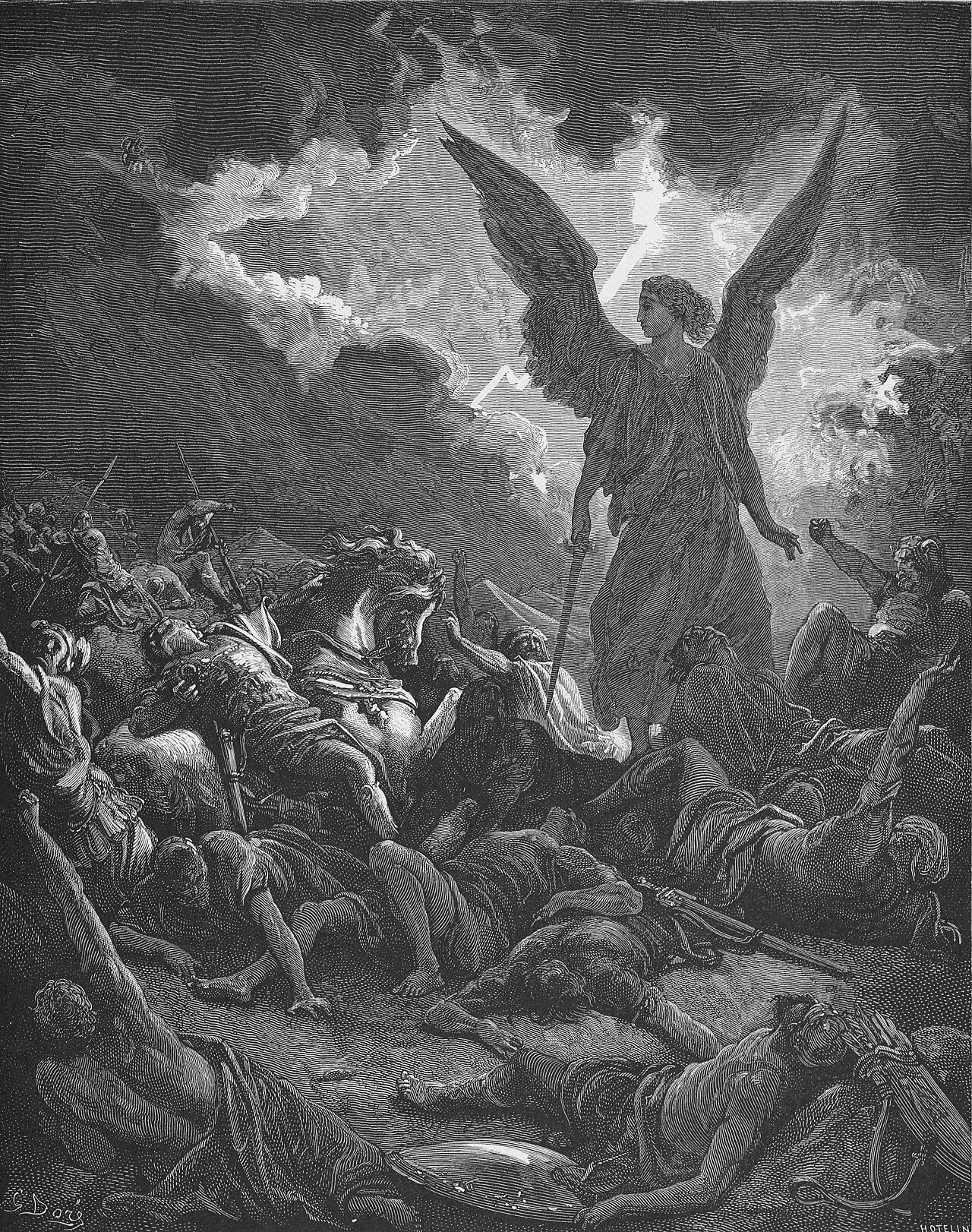
Sennacherib's Army Is Destroyed — Gustave Doré
Sennacherib's army destroyed — the deliverance as Jerusalem told it — Gustave Doré, Doré’s English Bible (1866), public domain · 2 Kings 19:35
A nineteenth-century commentator, watching the reliefs come out of the ground2 Kings 18:13
“Among the interesting illustrations of sacred history furnished by the recent Assyrian excavations, is a series of bas-reliefs, representing the siege of a town, which the inscription on the sculpture shows to be Lachish, and the figure of a king, whose name is given, on the same inscription, as Sennacherib.”
— Jamieson, Fausset & Brown, Commentary Critical and Explanatory on the Whole Bible (1871), on 2 Kings 18:13 — public domain

Layard had pulled the Lachish panels out of Nineveh only a generation before this was written, and the commentary is reacting in something close to real time. It is worth noticing what the note does and does not claim: it identifies a town and a king from the captions, and stops there.

How a person gets onto the ledger at allthe three-part test

A name on its own proves very little — ancient West Semitic naming pools were small, and Judah was full of men called Isaiah. The vetted method asks for three things to converge before an identification counts: the name, a patronymic or title that matches, and a setting — period, place and role — that fits the biblical figure and no one else. The Hezekiah bulla has all three. The Isaiah bulla has one and a half, which is why it sits in Tier III with the excavator's own question mark still attached.

Why provenance decides whether an object countsthe field's live scandal

An excavated object arrives with a findspot, a stratum, a season report and a chain of custody. A market object arrives with a price. Because collectors pay most for inscriptions carrying biblical names, that is exactly what the forgery trade manufactures — so the objects most flattering to a believing reader are the ones most likely to be fabricated. Every row above came out of a dig or a documented findspot. The most famous omission from this page is a market piece, and it is omitted for that reason.

What Did Not Make the Ledger

the omissions are load-bearing — a catalogue is only as good as what it refuses

The James ossuary

It surfaced on the antiquities market in 2002 rather than in a dig, and a forgery trial ended in acquittal on reasonable doubt with the authenticity of the second half of the inscription still disputed. James the brother of Jesus is attested by Josephus. This box is not that attestation, and an unprovenanced object cannot be made to carry weight it never earned.

Unprovenanced seals and bullae generally

Objects bought rather than excavated have no findspot, no stratum and no chain of custody, and the forger's trade exists precisely because the market rewards biblical names. Where a market piece and an excavated piece say the same thing, the excavated one does the work.

Ussher's 4004 BC as an archaeological date

It is a chronology derived from the biblical genealogies by a seventeenth-century archbishop. Whatever one concludes about it, it is not a finding from the ground, and this ledger only reports what came out of the ground.

The claim that Tyre was never rebuilt

Ezekiel 29:18–20 says plainly that Nebuchadnezzar's army got no wages from Tyre for all its labour. Scripture's own candour is the answer to the overclaim, and the honest display of the difficulty is stronger than the smoothed version.

The temptation in a page like this is to run the count up. Every item added on weak grounds, though, quietly devalues the items that are strong — because a reader who catches one overclaim reasonably assumes the rest are built the same way. A short ledger that holds is worth more than a long one that has to be defended.

What This Ledger Settles — and What It Leaves Open

the honest limits of an argument from artifacts

What it establishes

  • The biblical writers were describing a real world. Their kings ruled, their enemies campaigned, their officials held the titles they are given, and their cities stood where the text puts them.
  • They were often working close to their material. Titles that shifted within a generation are right; the vocabulary of a Macedonian city or a Judean water project is the local vocabulary.
  • They did not systematically flatter themselves. Kings records the tribute, the lost towns and the surrender; Ezekiel records that the siege of Tyre paid nobody. Propaganda does not usually keep its own receipts.

What it does not settle

  • Anything a spade cannot reach. No excavation can confirm that God spoke to Moses, that an angel struck the Assyrian camp, or that a tomb was empty. Archaeology reaches the checkable claims and stops at the edge of them, and the edge is exactly where faith begins.
  • The early periods. The patriarchs, the exodus and the conquest remain without direct epigraphic attestation, and the arguments there run on synthesis and inference rather than on named objects.
  • The contested rows. Four of the sixteen entries above are disputed by people who have read the objects in the original. This page reports the dispute; it does not adjudicate it.

MannaFest's flag

Scripture is the authoritative Word of God, and it does not need a stele to become so. That is precisely why this page can afford to be strict. A ledger built to defend the text would have to shade its weakest rows; a ledger built to report the evidence can leave the James ossuary off, mark the Isaiah bulla conjectural, and say plainly that the Cyrus Cylinder never mentions Jerusalem — and lose nothing at all. The confidence is in the text. The precision belongs to the evidence.

The Voices

who did this work, and where to read them
Lawrence J. Mykytiukmodern · ≤50w

Identifying Biblical Persons in Northwest Semitic Inscriptions of 1200–539 BCE (SBL, 2004); the Biblical Archaeology Review lists of confirmed people — cite-only

The vetting authority behind the persons half of this page. His method is a three-part test — name, plus patronymic or title, plus setting — and he grades every result instead of flattening it into a verdict. Preserving that grading is the single decision that separates a ledger from a listicle.

Daniel David LuckenbillPD

The Annals of Sennacherib (Oriental Institute Publications 2, 1924) — public domain

The open-access critical edition of the prisms, and the reason the Assyrian side of the 701 campaign can be set beside 2 Kings on this page rather than summarised at second hand.

Avraham Biran and Joseph Navehmodern · ≤50w

Israel Exploration Journal 43 (1993) and 45 (1995) — cite-only

The excavation and first publication of the Tel Dan fragments, including the reading of bytdwd that turned a broken basalt slab into the most discussed four consonants in the field.

William RamsayPD

St. Paul the Traveller and the Roman Citizen (1895); The Bearing of Recent Discovery on the Trustworthiness of the New Testament (1915) — public domain

The nineteenth-century reversal: a sceptic who went to Asia Minor expecting the inscriptions to embarrass Acts and spent his career arguing they vindicated it. The New Testament half of this argument is worked out in full on the Luke page.

Lee Strobelmodern · ≤50w

The Case for Christ (1998) — cite-only

His archaeology chapter frames the question the way a sceptic actually meets it: does this writer get right the things we can check, and if he does, what does that oblige us to do with the things we cannot?

Chuck Misslermodern · ≤50w

Learn the Bible in 24 Hours; the Koinonia House verse-by-verse studies — cite-only

Marcus Brown's formative teacher on this exact instinct: establish first what kind of document you are holding, using evidence anyone can check, and argue the theology afterwards on a text worth arguing about.

Modern scholarship here is summarised and cited, never quoted at length. Two further voices are read on this subject with their labels attached rather than as neutral ground: the Associates for Biblical Research, which does genuine fieldwork from a conservative position, and Bible Odyssey, which carries the mainstream-critical reading. Neither is the answer; both are on the record, and the reader weighs them.

Keep studying

— more from How We Got the Bible

Artwork: Sennacherib's Army Is Destroyed — Gustave Doré, Doré's English Bible (1866), public domain. Drafted from MannaFest's research brief on archaeology and the artifact-to-passage catalog, with the New Testament rows shared with the Luke-the-historian docket — primary editions cited per row (Luckenbill, Layard, Clermont-Ganneau, Sayce and Petrie in the public domain; Mykytiuk, Biran & Naveh, Grayson, Schaudig, Barkay, Strobel and Missler cite-only). Jamieson, Fausset & Brown quoted verbatim from the confirmed public-domain ledger. Scripture ASV. Every cited work — the sources registry →