
Numbers 6 · Judges 13 · Acts 21 · Subject · Featured Study
The Nazirite Vow
Numbers 6:1 to 21 read with Samson, Samuel, Amos and Paul, and with Josephus, the Mishnah and Christian commentators.
A man or a woman of Israel could vow to belong to the LORD for a time, and the vow showed in hair no razor touched.
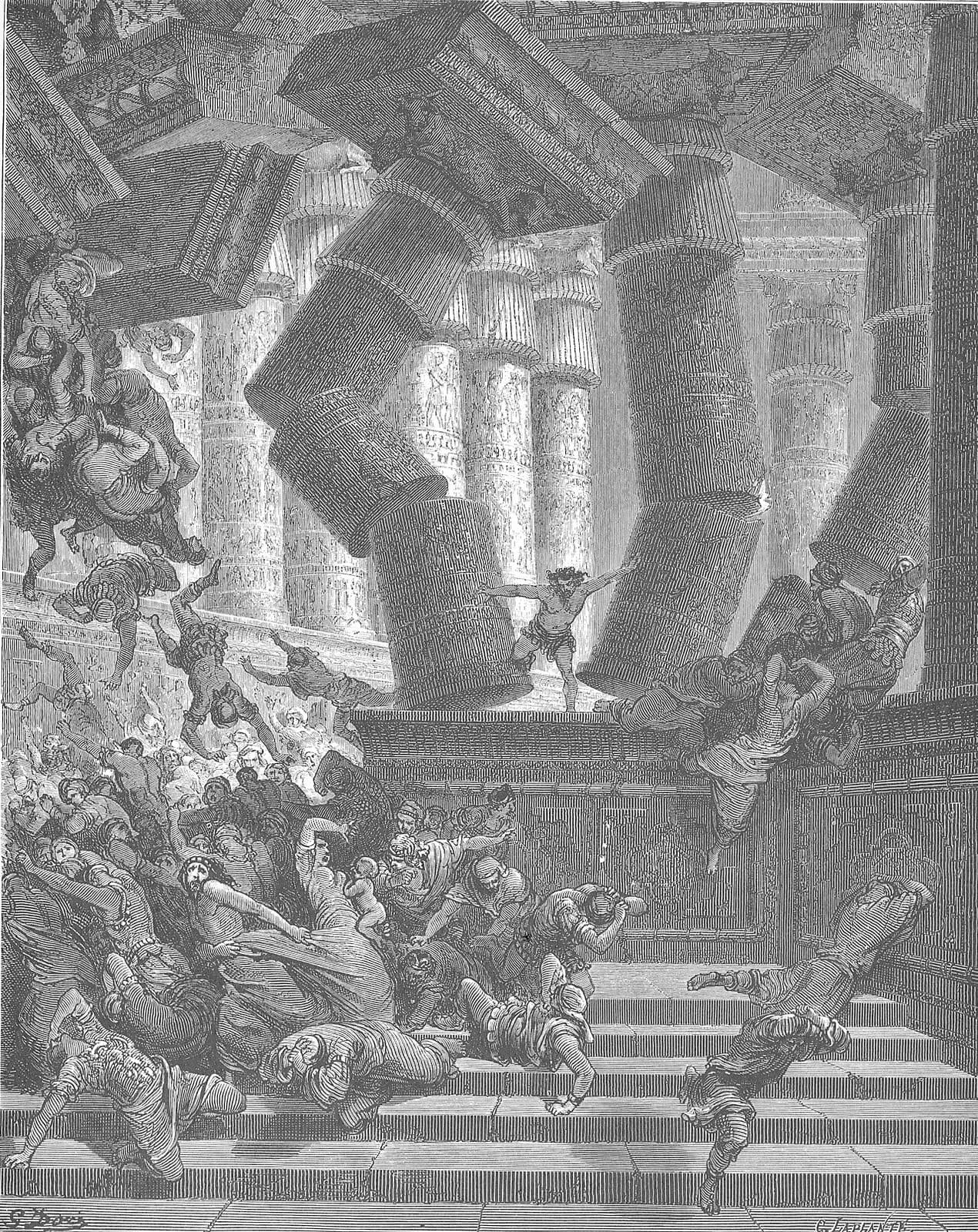
Gustave Doré, The Death of Samson, wood engraving, 1866, from the English edition of La Grande Bible de Tours. Public domain by date (Doré died in 1883).
THE ARTWORKDoré drew Samson bringing down the temple of Dagon on the Philistines, the act of Judges 16:29 to 30. Samson had been a Nazirite from his mother's womb, and his shaved hair had begun to grow back before that day (Judges 16:22).
Summary
Numbers 6 sets three rules for the days of the vow and ends it with offerings at the entrance to the Tent of Meeting.
- The Nazirite drank no wine and ate nothing from the grapevine, let no razor touch the head, and kept away from every dead body.
- A death in the Nazirite's presence cancelled the days already kept, and the vow began again after a week of cleansing.
- Samson and Samuel were given to the LORD before their births, Samson by an angel's word and Samuel by his mother's vow.
- Paul had his head shaved at Cenchrea to keep a vow, and at Jerusalem he paid for the offerings of four men under a vow.
The Vow from Numbers to Acts
Five passages in canon order, from the law of the vow to Paul in Jerusalem
The Berean text uses the word Nazirite in eleven verses of Numbers, Judges and Amos. Judges shows the vow laid on a child before birth, 1 Samuel a mother's promise that no razor would touch her son, and Acts an apostle keeping a vow.
“Speak to the Israelites and tell them that if a man or woman makes a special vow, the vow of a Nazirite, to separate himself to the LORD,The law calls it a special vow, the term Leviticus 27:2 also uses for a vow of a person's value to the LORD.
But he said to me, ‘Behold, you will conceive and give birth to a son. Now, therefore, do not drink wine or strong drink, and do not eat anything unclean, because the boy will be a Nazirite to God from the womb until the day of his death.’”Manoah's wife repeats the angel's charge to her husband, and her words add that the vow will last until the boy's death.
And she made a vow, pleading, “O LORD of Hosts, if only You will look upon the affliction of Your maidservant and remember me, not forgetting Your maidservant but giving her a son, then I will dedicate him to the LORD all the days of his life, and no razor shall ever come over his head.”Hannah made this vow before Samuel was conceived, and she kept it when she gave him to the LORD at Shiloh.
Paul remained in Corinth for quite some time before saying goodbye to the brothers. He had his head shaved in Cenchrea to keep a vow he had made, and then he sailed for Syria, accompanied by Priscilla and Aquila.Cenchrea was a port of Corinth, so this vow was kept in Greece.
Therefore do what we advise you. There are four men with us who have taken a vow. Take these men, purify yourself along with them, and pay their expenses so they can have their heads shaved. Then everyone will know that there is no truth to these rumors about you, but that you also live in obedience to the law.James and the elders call the four men their own, so the vow was still kept among believers at Jerusalem.
The Course of the Vow
The law of Numbers 6 in order, the vow on a timeline from Samson to Paul, and a plan of the court where it ended
- a man or a woman separates to the LORD by a special vow
- Numbers 6:2
- no wine, vinegar, grape juice, grapes or raisins, not even the seeds or skins
- Numbers 6:3 to 4
- the hair grows long until the time of separation is complete
- Numbers 6:5
- not even for a father, mother, brother or sister
- Numbers 6:6 to 7
- shaving on the seventh day, two birds on the eighth, a lamb as a guilt offering, and the days counted again
- Numbers 6:9 to 12
- three animals and bread offered, the head shaved at the entrance, the hair burned, then wine
- Numbers 6:13 to 20
A chain of six steps through Numbers 6, each with its verse.
Samuel and Samson were set apart from birth, about twelve hundred years before Paul's vow at Cenchrea.
To scale: 4 of 4 stops dated; a ring is approximate; a bar is a span.
- SamuelHe lived about 1156 to 1057 BC., Hannah gave him to the LORD for all his days, with no razor on his head.1 Samuel 1:11
- SamsonHe was born about 1155 BC, and the year of his death is not given., He was a Nazirite to God from the womb until the day of his death.Judges 13:7
- Paul at CenchreaThis was about 53 AD., He had his head shaved to keep a vow before he sailed for Syria.Acts 18:18
- Paul and the four menThis was about 58 AD., He purified himself with four men under a vow and paid their expenses.Acts 21:26
A timeline of Samuel, Samson and Paul twice, each with its verse, at the approximate dates of Richard Watson's dictionary of 1831.
The vow ended at the entrance of the tent, inside a court 100 cubits long and 50 wide.
10 cubits, about 4.5 m (15 feet)
- The court100 cubits by 50, its curtains 5 cubits highExodus 27:18
- The gate20 cubits wide, on the east sideExodus 27:16
- The altar5 cubits square, where the burnt offering and the sin offering were madeNumbers 6:16
- The entrance to the Tent of Meetingwhere the Nazirite was brought and shaved his headNumbers 6:18
- The fire under the peace offeringwhere the hair was burnedNumbers 6:18
- The wave offeringthe boiled shoulder, a cake and a wafer waved before the LORDNumbers 6:19 to 20
- The tent30 cubits long, the Holy Place and the Most Holy PlaceExodus 26:18
10 cubits, about 4.5 m (15 feet)
Drawn to the measures of Exodus 27:1 and 27:9 to 18. The tent is 30 cubits long by its twenty frames of a cubit and a half (Exodus 26:16 to 18); its width of 10 cubits, its place in the court and the places of the fire and the wave offering are not stated, so the drawing supplies them.
A plan of the tabernacle court drawn to scale, east to the right, with seven numbered parts and the verse for each.
The Law Part by Part
Four parts of Numbers 6 and the comments they have drawn
Barnes compares the Nazirite's rules with the rules of the priests and finds them alike, and in some points stricter.
The fruit of the vineNumbers 6:3 to 4
“You and your sons are not to drink wine or strong drink when you enter the Tent of Meeting, or else you will die; this is a permanent statute for the generations to come.The priests gave up wine only when they went into the Tent of Meeting, while the Nazirite gave it up for every day of the vow.
Clarke takes the vinegar of Numbers 6:3 to mean a fermented wine of strong body, so that the rule reached every intoxicating drink.
The crown on the headNumbers 6:5 to 8
Even if his father or mother or brother or sister should die, he is not to defile himself, because the crown of consecration to his God is upon his head.The reason the law gives is the crown of consecration on his head, which even a parent's death could not set aside.
Clarke takes the crown of consecration to be the hair itself, the proof and emblem of the vow.
He must not go near any dead body; he must not defile himself, even for his father or mother.Only the high priest was bound by this rule among the priests, and Wesley notes that the Nazirite was his equal in it.
Defilement and the restartNumbers 6:9 to 12
He must rededicate his time of separation to the LORD and bring a year-old male lamb as a guilt offering. But the preceding days shall not be counted, because his separation was defiled.The guilt offering is the offering Leviticus 5:15 requires for a sin against the LORD's holy things, here a lamb in place of a ram.
Anyone else who touched the dead was cleansed with water on the third and seventh days. Henry notes that the Nazirite needed more for his cleansing than any other person who had touched a dead body.
Whoever touches any dead body will be unclean for seven days.The law of the red heifer names seven days of uncleanness for anyone who touches a body, and it asks no animal of him.
The day of fulfilmentNumbers 6:13 to 21
Wesley takes the fire of Numbers 6:18 to be the one on which the ram's flesh was boiled, and Richard Watson's dictionary of 1831 puts the hair on the altar fire.
The priest shall then wave them as a wave offering before the LORD. This is a holy portion for the priest, in addition to the breast of the wave offering and the thigh that was presented. After that, the Nazirite may drink wine.The rite ends with leave to drink wine again, which lifts the first rule of the vow.
What the Text Says of the Vow
Three things often said of the vow, each tested by a verse
SAMSON TOOK THE VOW HIMSELF
The angel gave the charge to Samson's mother before he was born, and Judges records no vow made by Samson.
JESUS WAS A NAZIRITE
Matthew connects the name Nazarene with Nazareth, the town where Jesus lived.
EVERY NAZIRITE VOW WAS FOR LIFE
The law speaks of the day the time of separation is complete, so the common vow had an end.
The Vow in Josephus and the Mishnah
What Josephus, the Mishnah and Maimonides record of the vow
Josephus and the cost of a vowJosephus, Antiquities 4.4.4 and 19.6.1, and Jewish War 2.15.1; Clarke, on Numbers 6:21
Josephus, writing his Antiquities about AD 94, describes the Nazirites as those who let their hair grow long and use no wine. He says their consecrated hair was given to the priests to be thrown into the fire.
He tells of Queen Bernice in Jerusalem performing a vow that kept her from wine for thirty days before her sacrifices and required her to shave her head. He also records that King Agrippa, on his return to Jerusalem, offered his sacrifices and ordered many Nazirites to have their heads shorn.
Clarke cites Maimonides that one man might bear the cost of another's Nazirite offerings, which is what the elders asked of Paul.
The rules of the MishnahMishnah Nazir 1:2, 1:3 and 6:8
The Mishnah, compiled about AD 200, gives a whole tractate, Nazir, to the vow. It rules that a vow taken with no term named lasts thirty days, and that a lifelong Nazirite may thin heavy hair with a razor while a Nazirite like Samson may not. It also records that the Nazirite threw the shaved hair under the pot in which the peace offering was cooked, and that one who shaved outside the temple did not throw it there.
What the Text Leaves Unsaid
Three questions the passages on the vow leave open
Numbers 6 gives no reason a person would take the vow.
This is the law of the Nazirite who vows his offering to the LORD for his separation, in addition to whatever else he can afford; he must fulfill whatever vow he makes, according to the law of his separation.”The law ends by holding the Nazirite to whatever he vowed, and it names no number of days.
When Paul had landed at Caesarea, he went up and greeted the church at Jerusalem. Then he went down to Antioch.Luke follows Paul from the ship to the church at Jerusalem and on to Antioch in one verse.
Scripture names no woman who took the vow.
Set Apart to the LORD
How Amos and Luke carry the vow beyond Numbers
Amos counts the Nazirites among the LORD's gifts to Israel, beside the prophets.
I raised up prophets from your sons and Nazirites from your young men. Is this not true, O children of Israel?” declares the LORD. “But you made the Nazirites drink wine and commanded the prophets not to prophesy.Israel's sin was to press wine on the Nazirites and silence the prophets, so that both gifts were refused.
The angel's word about John the Baptist repeats the first rule of the vow, and Watson's dictionary counts John among the lifelong Nazirites.
for he will be great in the sight of the Lord. He shall never take wine or strong drink, and he will be filled with the Holy Spirit even from his mother’s womb.Gabriel spoke these words to Zechariah in the temple before John was conceived.
Two Teachers on the Vow
Matthew Henry, and Jamieson, Fausset and Brown
Henry finds the purity the vow pictured fulfilled in Christ and applies the vow to every Christian.
“Christ was called in reproach a Nazarene, so were his followers: but he was no Nazarite according to this law; he drank wine, and touched dead bodies, yet in his this type had its accomplishment, for in him all purity and perfection met; and every true Christian is a spiritual Nazarite, separated by vow unto the Lord.”
Matthew Henry · Commentary on the Whole Bible · on Numbers 6:2Puritan
Jamieson, Fausset and Brown explain why a vow kept to its end still closed with a sin offering.
“But even this full completion did not supersede the necessity of a sin offering at the close. Sin mingles with our best and holiest performances, and the blood of sprinkling is necessary to procure acceptance to us and our services.”
Jamieson, Fausset & Brown · Commentary Critical and Explanatory on the Whole Bible · on Numbers 6:14Reformed
Three Questions the Vow Raises
Samuel, the vow at Cenchrea and the charges of Acts 21, with two answers to each
Samuel was a Nazirite for lifeRabbi Nehorai, in Mishnah Nazir 9:5
The objection: Rabbi Yosei answers in the same Mishnah that the Hebrew word of Hannah's vow for a razor may be read as fear of man. Rabbi Nehorai replies that Samuel did fear man, since he feared Saul in 1 Samuel 16:2.
Hannah's vow named the razor aloneRabbi Yosei, in Mishnah Nazir 9:5
This reading rests on the words of the vow, which name no rule of wine or of the dead, and on 1 Samuel, which never calls Samuel a Nazirite.
The objection: the promise of no razor is the very promise Judges 13:5 joins to the word Nazirite, and Samuel was given to the LORD for all his days.
Paul kept a Nazirite vow at CenchreaJerome, Letter 75; Matthew Henry, on Acts 18:18
Jerome, writing to Augustine, takes Paul to have let his hair grow under a vow and to have cut it at Cenchrea in obedience to the law. Henry explains how a Nazirite living outside Judea could end the vow away from the temple.
“Those that lived in Judea were, in such a case, bound to do it at the temple: but those who lived in other countries might do it in other places. The Nazarite's head was to be shaved when either his consecration was accidentally polluted, in which case he must begin again, or when the days of his separation were fulfilled ( Num. vi. 18 ), which, we suppose, was the case here.”
Matthew Henry · Commentary on the Whole Bible · on Acts 18:18Puritan
The objection: the law joins the shaving to the offerings of the last day (Numbers 6:13 to 18), and Luke names no offering made at Cenchrea.
Aquila shaved his headJohn Wesley, Explanatory Notes upon the New Testament, 1755
Wesley's note on Acts 18:18 names Aquila as the one who shaved his head, as was the custom in a vow.
The objection: Jerome and Henry read the verse of Paul, and the Berean text renders it with Paul as the one shaved.
Paul made a concession for the sake of othersTertullian, Against Marcion 5; Theophylact; Matthew Henry
Tertullian sets the charges of Acts 21 beside the circumcision of Timothy.
“He therefore made some concession, as was necessary, for a time; and this was the reason why he had Timothy circumcised, and the Nazarites introduced into the temple, which incidents are described in the Acts.”
Tertullian · Against Marcion Book V · on Acts 21:23Patristic
Theophylact of Ohrid, in his Commentary on Acts, writes that Paul kept the rites because love is condescending. Henry adds that those weak in the faith are to be borne with.
The objection: Jews from the province of Asia seized Paul in the temple before the seven days were over.
Paul yielded too farJohn Wesley, Explanatory Notes upon the New Testament, 1755
Wesley asks whether Paul could follow the elders' advice in godly sincerity, and whether he ought to have answered plainly that he did not keep the Mosaic law.
The objection: Paul states his own rule for living among Jews in 1 Corinthians 9:20.
To the Jews I became like a Jew, to win the Jews. To those under the law I became like one under the law (though I myself am not under the law), to win those under the law.Paul wrote this to the Corinthians about two years before the events of Acts 21, in Watson's reckoning.
Books on the Vow
Three works to read whole
The Antiquities of the Jews
Flavius Josephus, translated by William Whiston · 1737
Josephus retells the law of the vow and records Nazirites shorn at Jerusalem in the first century.
Read the Antiquities at Project GutenbergMishnah Nazir
The Mishnah, in the William Davidson English edition · about AD 200
The tractate sets out the rules of the vow as the rabbis taught them, and it ends with the question of Samuel.
Read Mishnah Nazir at SefariaA Biblical and Theological Dictionary
Richard Watson · 1831
Its article on the Nazarites follows the vow from Numbers 6 to Paul in Acts 18 and 21.
Read the dictionary at Project GutenbergA Living Sacrifice
The Nazirite gave up wine, the razor and the house of mourning for the days of a vow and ended them with offerings at the entrance of the tent. Paul asks every believer to give the whole self to God for the whole of life.
Therefore I urge you, brothers, on account of God’s mercy, to offer your bodies as living sacrifices, holy and pleasing to God, which is your spiritual service of worship.This verse opens the chapters of Romans on how believers are to live.
Keep studying
Studies4