
The Lamb who was slain
The book's organising image: the slain Lamb is the only one worthy to open the scroll (5:1–14). The cross is not supplanted by the throne; the slain Lamb reigns.
New Testament · Book 66 of 66
John on Patmos sees the Lamb who was slain enthroned, the scroll opened, Babylon fallen, and the new Jerusalem descending. The canon's capstone: and its most interpretively contested book.
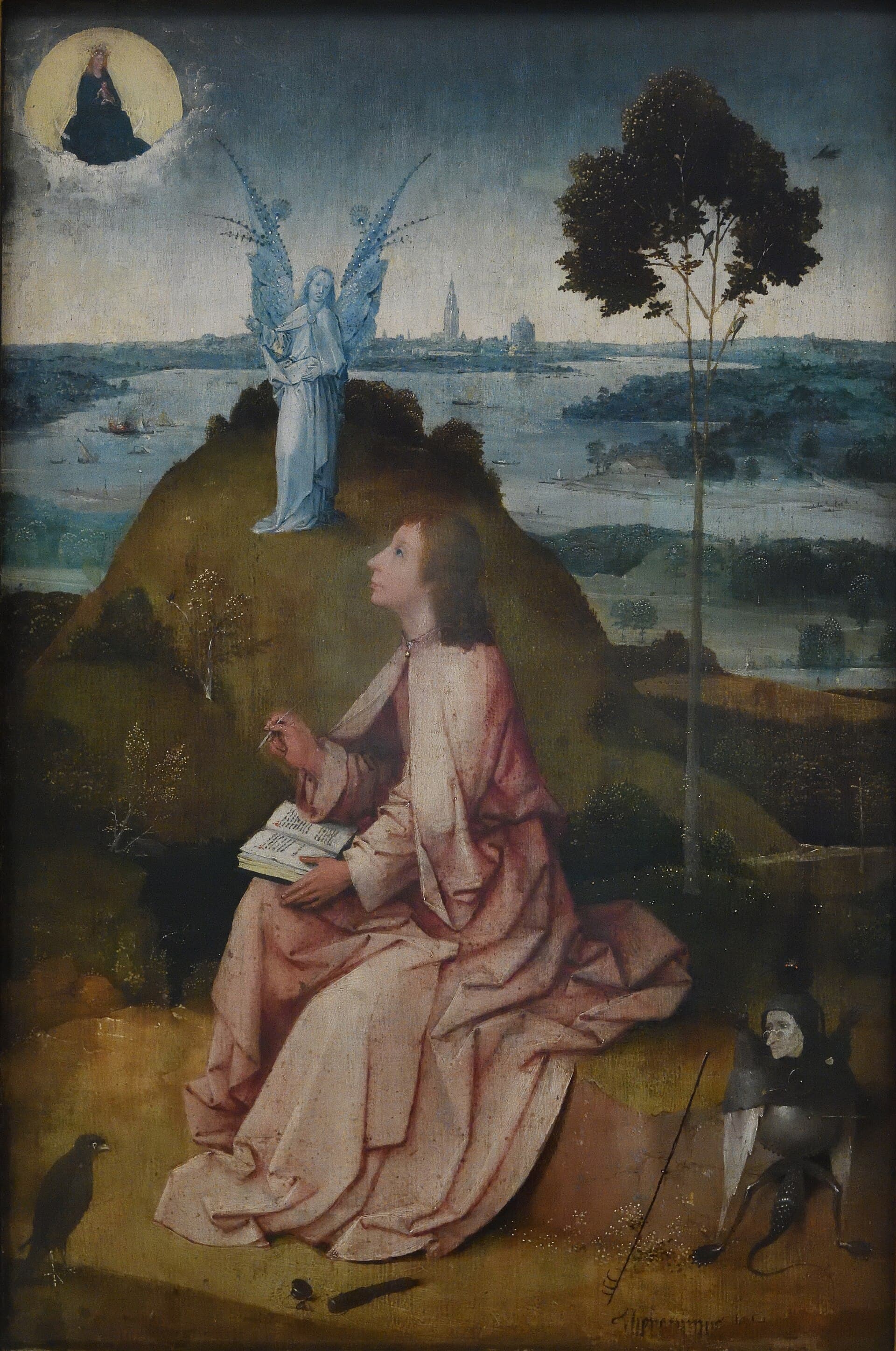
Bosch, St John on Patmos — photo Gemäldegalerie Berlin, CC BY-SA 4.0
“Behold, he cometh with clouds; and every eye shall see him, and they also which pierced him: and all kindreds of the earth shall wail because of him. Even so, Amen.”
If you only read a few chapters
Revelation · Book Workbench
The last book of the Bible answers the first. It opens by naming itself — apokalypsis, an unveiling — and what is unveiled is a Person: the risen Christ walking among His churches, and then the whole end of the story that runs from His throne. Genesis shut the gate of a garden behind a flaming sword. Revelation throws open the gates of a city that is a garden, where there is no curse any more and the Lamb is the lamp.
Summary
This hub is the workbench for the whole book: the three-fold key of 1:19, the four telescoping sevens (churches, seals, trumpets, bowls), and the throne room at the center. It doors out to the four schools of reading, the contested points, and every major page the book opens onto.
1:19: the risen Christ dictates the outline
Most books of the Bible have to be outlined from outside. This one hands you its outline in the middle of the first chapter: write down the things you have seen, and the things that are, and the things that will happen after this (1:19, BSB). Past vision, present church, future consummation — and the three panels are nothing like the same size.
Chapters to scale: one chapter of vision, two of letters, nineteen of what is still ahead. Whatever else Revelation is, by its own measure it is overwhelmingly a book about what has not happened yet.
The things which thou sawest
Revelation 1 · 1 chapter
Patmos, a Lord's-day voice like a trumpet, and the glorified Son of man walking among seven golden lampstands: white-haired, flaming-eyed, holding the keys of death and of Hades.
The things which are
Revelation 2–3 · 2 chapters
Seven real congregations on a Roman postal road, each read by the Christ who holds their stars: commendation, rebuke, call, and a promise to him that overcometh.
The things which shall come to pass hereafter
Revelation 4–22 · 19 chapters
A door opened in heaven, and from the throne outward: the sealed scroll and the Lamb, the seals, trumpets and bowls, the dragon and the beasts, Babylon fallen, the King returned, the thousand years, the great white throne: and a new heaven and a new earth.
A second spine: four times John says he was in the Spirit (1:10; 4:2; 17:3; 21:10), and each time the scene changes altogether — Patmos, the throne, a wilderness to see the harlot, a high mountain to see the Bride. The two women and the two cities are set opposite each other on purpose. The three-fold key gives the outline; the four transports give the drama.
Revelation in 6 parts. Each card opens one focused stretch of the book — what it is for, the verse it turns on, and where Christ stands in it. Roughly five minutes each.
01 · 1
The things which thou hast seen‘I am Alpha and Omega.’ John on Patmos; the commission to write to seven churches.Christ in this partI am Alpha and Omega (1:8). The opening vision of the glorified Christ is the book's template — every later vision unfolds the One first seen.02 · 2–3
Letters to the seven churchesEphesus, Smyrna, Pergamos, Thyatira, Sardis, Philadelphia, Laodicea: diagnoses and promises to him that overcometh.Christ in this partThe risen Christ walks among the lampstands, addressing each church by name and pattern. He who has the seven Spirits, holds the seven stars, has the…03 · 4–7
Throne room and sealsThe rainbow around the throne; the seven-sealed scroll; the Lamb as though slain who alone is worthy.Christ in this partThe Lion of the tribe of Judah, the Lamb as it had been slain (5:5–6) — the most concentrated Christological image in Scripture. Worthy is the Lamb.04 · 8–16
Trumpets and bowlsThe trumpets of judgment; the little scroll eaten sweet and bitter; the two witnesses.Christ in this partJudgment poured out — the Lamb who is also the Lion. The cosmic warfare is the working out of Christ's vindication.05 · 17–20
Fall of Babylon and return of the KingBabylon the great; her fall; the marriage supper of the Lamb; the rider on the white horse; the thousand years; the great white throne.Christ in this partThe KING OF KINGS, AND LORD OF LORDS (19:16). The white-horse rider, the supper of God, the millennial reign, the great white throne — Christ…06 · 21–22
New heavens and new earthThe holy city coming down; the tree of life; the river of life; ‘surely I come quickly. Amen.’Christ in this partThe Lamb is the temple (21:22) and the lamp (21:23). Behold, I come quickly. Even so, come, Lord Jesus.Also in this book
The book's organising image: the slain Lamb is the only one worthy to open the scroll (5:1–14). The cross is not supplanted by the throne; the slain Lamb reigns.
Seven churches, seven seals, seven trumpets, seven bowls, and seven distributed beatitudes (1:3, 14:13, 16:15, 19:9, 20:6, 22:7, 22:14). The structural spine of the book.
Preterist (most fulfilled by AD 70), Futurist (most awaits end-times fulfilment), Historicist (church-historical progression), Idealist (timeless spiritual conflict). All four are surfaced with their strongest public-domain defenders; the site does not adjudicate between them.
Premillennial (historic or dispensational), amillennial, postmillennial: the single most interpretively loaded passage in the canon. All three positions are represented with their strongest defenders; the site does not adjudicate between them.
The refrain of the seven letters (2:7, 2:11, 2:17, 2:26, 3:5, 3:12, 3:21): tree of life, crown of life, hidden manna, power over the nations, white raiment, pillar in the Temple, seat on the throne. The book's pastoral centre.
The canon's closing scene: the holy city descending, the tree of life restored (Rev 22:2 echoing Gen 3:24), the river of life, the face of God seen. Creation's arc completed.
The book names itself in its first four words, 'The Revelation of Jesus Christ, which God gave him to show unto his servants' (1:1), and the possessive runs both ways. The unveiling belongs to Christ and it is about Christ. The chain of delivery is spelled out: God gives it to the Son, the Son sends it by an angel, the angel gives it to John, John writes it for servants. Then comes the first of seven blessings in the book, and it falls on a reader and a listening congregation, 'Blessed is he that readeth, and they that hear the words of the prophecy, and keep the things that are written therein' (1:3). The verb is keep, so the book expects obedience and not only interest. Prophecy here is a living thing rather than a closed file. John receives while 'I was in the Spirit on the Lord’s day' (1:10), the Spirit speaks to each church in turn (2:7), two witnesses will prophesy in a coming day (11:3), and the angel at the end calls John's own colleagues prophets, 'I am a fellow-servant with thee and with thy brethren the prophets' (22:9). Daniel was told to 'shut up the words, and seal the book, even to the time of the end' (Daniel 12:4). John is told the opposite, 'Seal not up the words of the prophecy of this book; for the time is at hand' (22:10).
Revelation 1:1 · Revelation 1:3 · Revelation 1:10 · Revelation 22:10
Chapters 4 and 5 are one scene and they hold the theology of the whole book. A throne is set, and the living creatures say what Isaiah heard them say, 'Holy, holy, holy, is the Lord God, the Almighty, who was and who is and who is to come' (4:8), which is Isaiah's 'Holy, holy, holy is the LORD of Hosts' (Isaiah 6:3) carried over without apology. The elders give the Creator his due, 'Worthy art thou, our Lord and our God, to receive the glory and the honor and the power' (4:11). Then a second figure takes the sealed book, and the same worship is given to him: 'Worthy is the Lamb that hath been slain to receive the power, and riches, and wisdom, and might, and honor, and glory, and blessing' (5:12). At 5:13 every created thing sings one song to both together, 'Unto him that sitteth on the throne, and unto the Lamb, be the blessing, and the honor, and the glory, and the dominion, for ever and ever' (5:13), and heaven answers, 'And the four living creatures said, Amen. And the elders fell down and worshipped' (5:14). The book draws the boundary twice, and both times John himself is corrected. He falls at an angel's feet and is stopped: 'See thou do it not: I am a fellow-servant with thee and with thy brethren that hold the testimony of Jesus: worship God' (19:10). He does it again near the end and is stopped again with the same two words, 'worship God' (22:9). An angel of the highest rank refuses what the Lamb receives without a word of correction. Worship belongs to God, and the Lamb takes it on the throne.
Revelation 4:8 · Revelation 5:12 · Revelation 5:13 · Revelation 19:10
John is told to look at a Lion and he sees a Lamb. 'behold, the Lion that is of the tribe of Judah, the Root of David, hath overcome to open the book' (5:5), and then 'a Lamb standing, as though it had been slain, having seven horns, and seven eyes' (5:6). The marks of death are still on him and he is standing. The song that follows says how the victory was won and what it bought: 'for thou wast slain, and didst purchase unto God with thy blood men of every tribe, and tongue, and people, and nation' (5:9), and what they become, 'madest them to be unto our God a kingdom and priests; and they reign upon the earth' (5:10), which is Sinai's charter given to the nations, 'ye shall be unto me a kingdom of priests, and a holy nation' (Exodus 19:6). Chapter 7 shows two companies in one vision. The first is counted and tribal, 'a hundred and forty and four thousand, sealed out of every tribe of the children of Israel' (7:4), with twelve tribes named one by one. The second cannot be counted at all, 'a great multitude, which no man could number, out of every nation and of all tribes and peoples and tongues' (7:9). This site reads Israel as Israel here, so the sealed company is Israel's own and the multitude is the nations, and the two stand side by side without one swallowing the other. The reading that takes the 144,000 as a symbol for the whole church is held by careful men, among them William Hendriksen (More Than Conquerors, 1940) and G. K. Beale (The Book of Revelation, New International Greek Testament Commentary, 1999), who read the tribal list as the church described in Israel's language. The literal reading is held by John F. Walvoord (The Revelation of Jesus Christ, 1966), Robert L. Thomas and Chuck Missler, and rests on the plain tribal roll of 7:5-8 and on the last chapter, where the city's gates still carry 'the names of the twelve tribes of the children of Israel' (21:12) beside foundations carrying the apostles' names. God's promises to Israel stand.
Revelation 5:5 · Revelation 5:9 · Revelation 7:4 · Revelation 7:9
Three series of seven carry the judgment sections: seals opened by the Lamb (6:1-8:1), trumpets sounded by angels (8:2-11:19), and bowls poured out (16:1-21). The pattern is a rising one. The seals touch a fourth part of the earth, the trumpets a third part, and the bowls fall without measure. Between the sixth and seventh member of the first two series the scene stops for an interlude, and the silence after the seventh seal is one of the strangest moments in Scripture, 'there followed a silence in heaven about the space of half an hour' (8:1). Underneath the altar are the ones already killed, and their question is the oldest question in the Bible, 'How long, O Master, the holy and true, dost thou not judge and avenge our blood' (6:10). The answer given them is a white robe and a wait. What the plagues fail to produce is the thing they were meant to produce. After the sixth trumpet the survivors 'repented not of the works of their hands, that they should not worship demons' (9:20), and 'they repented not of their murders, nor of their sorceries' (9:21). Under the bowls the same line comes twice more, 'and they repented not to give him glory' (16:9), and again at 16:11. The judgments are just and they are also announced as just, from inside the vision, by the altar itself: 'Yea, O Lord God, the Almighty, true and righteous are thy judgments' (16:7).
Revelation 6:10 · Revelation 8:1 · Revelation 9:20 · Revelation 16:7
Chapter 12 pulls the camera back to the whole story. A woman appears 'arrayed with the sun, and the moon under her feet, and upon her head a crown of twelve stars' (12:1), which is the imagery of Joseph's dream where 'the sun and the moon and eleven stars made obeisance to me' (Genesis 37:9). She bears 'a son, a man child, who is to rule all the nations with a rod of iron: and her child was caught up unto God, and unto his throne' (12:5). This site reads the woman as Israel, out of whom the Messiah came, and the reading holds the whole chapter together: the dragon waits at the birth, fails at the ascension, is thrown out of heaven, pursues the woman into the wilderness for a set time, and then turns on everyone else. Roman Catholic exposition has long read the woman as Mary, and much Protestant commentary reads her as the covenant people across both testaments; the twelve stars point to the twelve tribes on every reading. The dragon is identified by name so nobody has to guess, 'the old serpent, he that is called the Devil and Satan, the deceiver of the whole world' (12:9). What he does when he loses is make war on those still in reach, 'went away to make war with the rest of her seed, that keep the commandments of God, and hold the testimony of Jesus' (12:17). The next chapter shows how that war is fought, by a beast given authority to 'make war with the saints, and to overcome them' (13:7). The saints are told plainly that they will lose in the short term and are given one instruction, 'Here is the patience and the faith of the saints' (13:10). Their victory is described in the past tense before the war is over: 'they overcame him because of the blood of the Lamb, and because of the word of their testimony; and they loved not their life even unto death' (12:11).
Revelation 12:1 · Revelation 12:9 · Revelation 12:11 · Revelation 13:10
Chapter 19 opens heaven and a rider comes out. 'a white horse, and he that sat thereon called Faithful and True; and in righteousness he doth judge and make war' (19:11). He is armed with his mouth, 'out of his mouth proceedeth a sharp sword, that with it he should smite the nations: and he shall rule them with a rod of iron' (19:15), which is Isaiah's shoot from Jesse who would 'smite the earth with the rod of his mouth' (Isaiah 11:4). His title is written where everyone can read it, 'KING OF KINGS, AND LORD OF LORDS' (19:16). The beast and the false prophet are taken and 'they two were cast alive into the lake of fire that burneth with brimstone' (19:20). Then chapter 20 follows in sequence. An angel 'laid hold on the dragon, the old serpent, which is the Devil and Satan, and bound him for a thousand years' (20:2), with a stated purpose, 'that he should deceive the nations no more, until the thousand years should be finished: after this he must be loosed for a little time' (20:3). Thrones are set, the martyrs of the beast's war are raised, 'and they lived, and reigned with Christ a thousand years' (20:4), and the text draws the line itself: 'The rest of the dead lived not until the thousand years should be finished. This is the first resurrection' (20:5). This site teaches what the sentence says. Christ returns, then the dragon is bound, then those who died under the beast rise bodily and reign with him on the earth for a thousand years, and 'Blessed and holy is he that hath part in the first resurrection: over these the second death hath no power' (20:6). That is the reading the churches of the second century held from men who had heard the apostles: Papias, whom Eusebius reports at Ecclesiastical History 3.39 teaching a thousand years of the kingdom of Christ on this earth after the resurrection; Justin Martyr in the Dialogue with Trypho 80 and 81, who says plainly that he and every right-minded Christian of his day expected a thousand years in Jerusalem; Irenaeus in the closing chapters of Against Heresies 5.32 to 5.36; and Tertullian. The other readings and their holders are set out in the difficulties.
Revelation 19:11 · Revelation 19:16 · Revelation 20:2 · Revelation 20:5
The last two chapters answer Genesis line by line. 'I saw a new heaven and a new earth: for the first heaven and the first earth are passed away' (21:1) is what Isaiah promised when God said 'I create new heavens and a new earth' (Isaiah 65:17). The city comes down 'made ready as a bride adorned for her husband' (21:2), and the oldest covenant sentence in Scripture is spoken over it, 'Behold, the tabernacle of God is with men, and he shall dwell with them, and they shall be his peoples' (21:3), which Ezekiel had heard as 'My tabernacle also shall be with them; and I will be their God, and they shall be my people' (Ezekiel 37:27). Then the losses are named and undone. 'he shall wipe away every tear from their eyes; and death shall be no more' (21:4) is Isaiah's word that 'The Lord GOD will wipe away the tears from every face' (Isaiah 25:8). The one on the throne says 'Behold, I make all things new' (21:5). The city needs no temple, 'for the Lord God the Almighty, and the Lamb, are the temple thereof' (21:22), and no sun, because 'the glory of God did lighten it, and the lamp thereof is the Lamb' (21:23). Eden itself is given back with interest. The tree that was guarded by a flaming sword, when God set the cherubim 'to keep the way of the tree of life' (Genesis 3:24), now stands open on both banks of a river, 'bearing twelve manner of fruits, yielding its fruit every month: and the leaves of the tree were for the healing of the nations' (22:2), which is Ezekiel's river where the trees 'bring forth new fruit every month' (Ezekiel 47:12). The sentence that ends the long trouble is four words long: 'there shall be no curse any more' (22:3). What follows it is the thing Moses was refused, 'they shall see his face' (22:4).
Revelation 21:1 · Revelation 21:3 · Revelation 22:2 · Revelation 22:4
four numbered series: and each seventh opening into the next
Seven Churches 2–3
Seven Seals 6:1–8:1
Seven Trumpets 8:2–11:19
Seven Bowls 15–16
Filled pip = the seventh. The seventh seal opens into the seven trumpets (8:1–2); the seventh trumpet carries the consummation and, on the reading this site's tradition follows, the seven bowls follow from it — so the drawing steps rightward rather than stacking. Colour escalates deliberately: lampstand-gold, ember, fire, wine-dark. Readers who take the three series as three passes over one period would draw these rows stacked instead of stepped — that debate is live, and named below.
Revelation 2–3 · lampstand-gold: the church on earth, still burning
Revelation 6:1–8:1 · ember: judgment begun, the scroll opening
Revelation 8:2–11:19 · deepening fire: creation itself struck
Revelation 15–16 · wine-dark: the wrath of God finished
The sevens nobody numbered
Four series are counted out for you. These are not — they simply reward counting, which is Bullinger's whole argument in Number in Scripture and the method Missler built his integrated-design reading on.
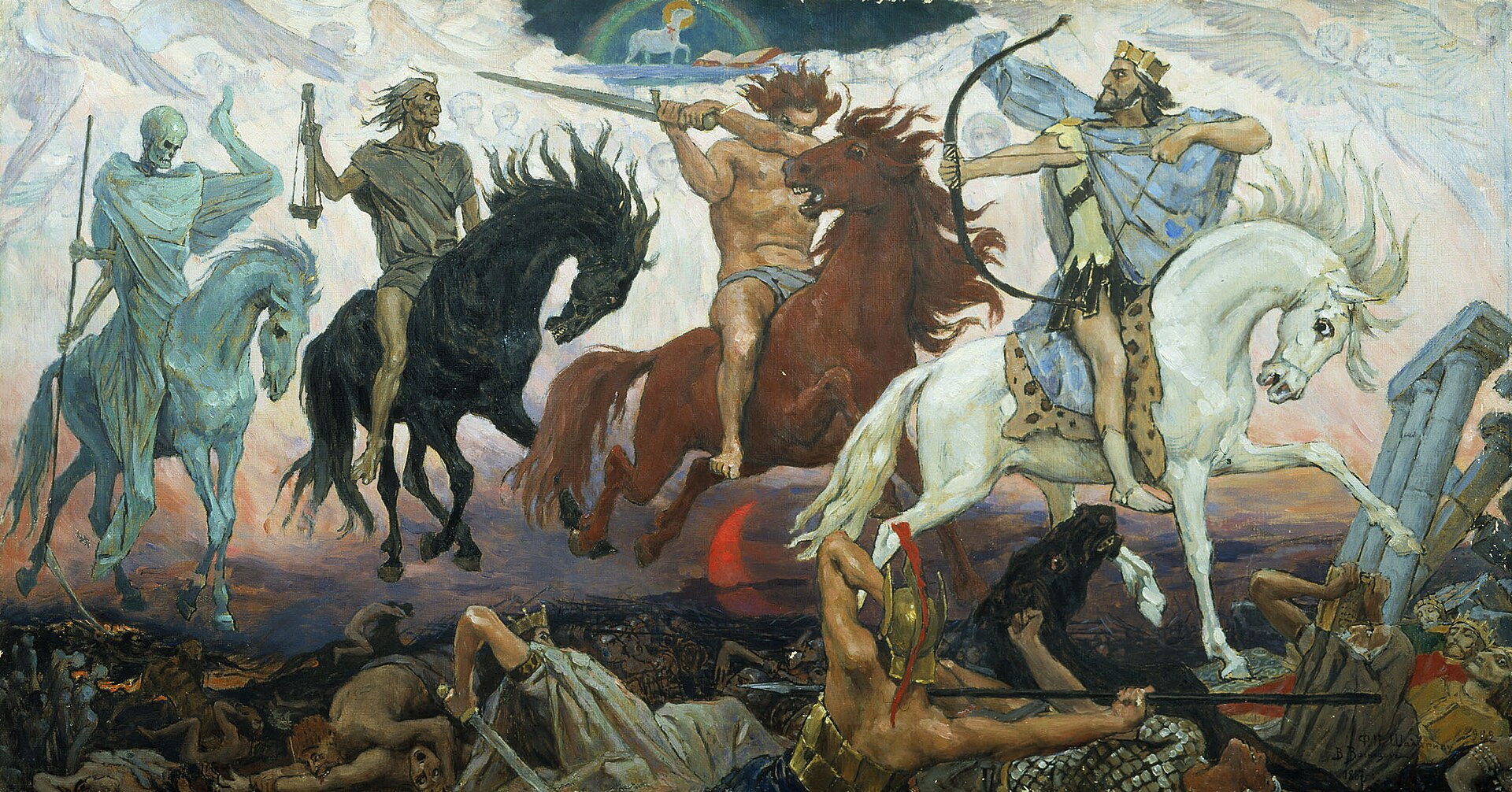
Viktor Vasnetsov, The Four Horsemen of the Apocalypse (1887, public domain) — the first four seals (6:1–8), painted as one charge. Vasnetsov keeps the traditional colour order — white, red, black, pale — the same order the seals array above steps through.
chapters 4–5: before one judgment falls
Nothing is opened, poured or blown until John has been shown two things: who is on the throne, and who holds the scroll. A sealed book lies in the right hand of Him that sat there, and a strong angel asks who is worthy to open it — and no one is, and John weeps. Then an elder tells him to stop weeping, because the Lion of the tribe of Judah hath overcome. He turns to look at a Lion — and sees a Lamb standing, as though it had been slain.
That substitution is the theological engine of everything that follows. History is not the emperor's to command and not chaos to be endured; it unrolls out of the hand of the enthroned God, and the only hand qualified to unroll it is a pierced one. The seals do not begin because the world has spun out of control. They begin because the Lamb is worthy.
the canon's outer frame: what was lost on the first page, given back on the last
A serpent speaks in the garden and deceives
Genesis 3:1 →The old serpent is bound, then cast into the lake of fire
Revelation 20:2, 10 →The ground is cursed for man's sake
Genesis 3:17 →There shall be no curse any more
Revelation 22:3 →The tree of life is barred by cherubim and a flaming sword
Genesis 3:24 →The tree of life bears twelve manner of fruits, its leaves for the healing of the nations
Revelation 22:2, 14 →The first marriage: a man and his wife, one flesh
Genesis 2:24 →The marriage supper of the Lamb, and the Bride made ready
Revelation 19:7–9 →Dust thou art, and unto dust shalt thou return
Genesis 3:19 →Death shall be no more, neither mourning, nor crying, nor pain
Revelation 21:4 →Man is sent forth from the garden, and the gate is shut
Genesis 3:23 →His servants dwell in the garden-city, and its gates are never shut
Revelation 22:3–5 →The dominion given to the first Adam is forfeited
Genesis 1:28 →They shall reign for ever and ever with the last Adam
Revelation 22:5 →The frame is not a coincidence noticed by later readers; it is engineered. The serpent named in Genesis 3 is finally identified by name in Revelation 12:9 — the great dragon, that old serpent — and the seed of the woman who was promised a bruised heel and a crushed serpent's head in Genesis 3:15 is the Lamb who takes the scroll. Salvation here is not escape from creation. It is creation made new.
every messianic title of Scripture laid on one Person
Daniel's Ancient of Days and Son of man fused in one figure: 'I am the first and the last, and the Living one'.
Jacob's royal lion (Gen 49:9–10) and Jesse's root (Isa 11:1, 10): the King who hath overcome.
Announced as Lion, seen as Lamb: the reversal that runs the whole book.
Isaiah's divine self-designation (Isa 44:6; 48:12) claimed by the risen Christ.
The returning Rider of Psalm 2 and Isaiah 63: the winepress trodden at last.
Balaam's star (Num 24:17) and David's root: the book's closing self-identification.
The literary fact under all of it: Revelation is the most Old-Testament-saturated book in the New — Daniel, Ezekiel, Isaiah, Zechariah, Exodus, Psalms, Joel are in nearly every paragraph — and it never once uses a “that it might be fulfilled” formula. The seer does not quote Scripture. He thinks in it.
four schools, four different books
From chapter 4 the visions describe events still ahead: a literal tribulation, a personal antichrist, a bodily return, a thousand-year reign.
The visions largely describe the first century: Nero, the fall of Jerusalem in AD 70, the collapse of pagan Rome. Partial preterism keeps the return and the new creation future.
An unrolling map of church history from John's day to the end: the Reformers' reading of the seals, trumpets and bowls as successive eras.
The symbols portray the timeless conflict of God and evil rather than datable events: poetry that arms the church in every generation.
As the earliest witnesses report them; positions and holders under Who Wrote It.
Patmos was small, rocky, and used by Rome for banishment. Sending a troublesome man to an island had a legal name, relegatio ad insulam. John says he was there "for the word of God, and for the testimony of Jesus."
The seven cities were real, and all seven have been excavated. Each letter trades on what its city was famous for. Smyrna was a proud center of emperor worship, the place where Polycarp would later be burned for refusing to swear by Caesar; the risen Christ tells that church to "be thou faithful unto death." Pergamum held the imperial cult's regional headquarters and a colossal altar of Zeus, and is called the place "where Satan's seat is." Sardis had twice been captured at night by climbers while it slept, secure, and is told "I will come as a thief." Philadelphia sat on an earthquake fault, and its people kept fleeing and returning; the overcomer there is promised he "shall go no more out." Laodicea was rich in banking, black wool, and a famous eye-salve, but had no water of its own; what arrived through its pipes came in lukewarm, and the letter calls the church neither cold nor hot, rich yet wretched, blind and naked.
Domitian, who ruled from 81 to 96, is reported to have taken the title dominus et deus, "lord and god." Refusing the emperor's cult could mean losing your trade, your livelihood, or your life, which is the world behind the mark of the beast and the ban on buying and selling. Antipas of Pergamum had already been killed.
Revelation is three things at once: an apocalypse (a disclosure of unseen realities), a prophecy, and a genuine letter to seven named churches. Its imagery comes almost entirely out of Israel's Scriptures, Isaiah, Ezekiel, Daniel, Zechariah, Joel, so John's first readers were not lost in it the way modern readers can be.
To seven small, harassed congregations, the first thing this book did was change the picture of who was actually in charge. Their world was run by an emperor who called himself god. John shows them the real throne room, and a slain Lamb who alone is worthy to open the scroll of history.
MannaFest reads the visions from chapter 4 onward as still to come: a future tribulation, a personal antichrist, the church taken out before that wrath falls, Christ's bodily return, and then his thousand-year reign on earth, the plain order of chapters 19 through 21, and the reading of Justin and Irenaeus in the early church. Other honest readings exist and are named here: that most of it was fulfilled in the first century, that it maps church history, and that it pictures the timeless struggle of good and evil in every age. Each has real strength, and none of them changes what it meant to Smyrna. Hold on. He wins. "Surely I come quickly."
Sources cited
John the apostle, the son of Zebedee
held by Justin Martyr, who in the Dialogue with Trypho names a man among the Christians called John, one of the apostles of Christ, as the one to whom the revelation was given; Irenaeus (Against Heresies 4.20.11 and 5.30.3), who had heard Polycarp; Clement of Alexandria; Tertullian; Origen; and the great weight of the church from the second century onward
Irenaeus is the load-bearing witness because of his own chain of hearing. He knew Polycarp, and Polycarp knew John. That does not settle the question by itself, and it is the closest testimony there is.
A different John, the elder, known in Asia
held by Dionysius of Alexandria, whose argument Eusebius reports in the Ecclesiastical History 7.25; he compared the Greek of the Fourth Gospel with the Greek of this book and concluded that one man did not write both, and he pointed out that two tombs at Ephesus were shown as John's. The proposal draws on Papias, whom Eusebius quotes at 3.39 listing an elder John beside the apostle. It has been carried in modern scholarship by R. H. Charles (A Critical and Exegetical Commentary on the Revelation of St. John, International Critical Commentary, 1920) and by others since
The stylistic observation is real. The Greek of Revelation breaks concord in ways the Fourth Gospel never does, and any reader of the Greek notices it. What the observation cannot settle is whether a man writing down visions on an island, perhaps without a secretary, would write as he wrote a considered gospel.
A Christian prophet named John, otherwise unknown to us
held by much of the modern academy, including David E. Aune (Revelation, Word Biblical Commentary, 1997 to 1998), who takes the writer as a prophet of the Asian churches with real authority among them and no claim to apostolic office
The strongest support is the book's own silence about apostleship and the way the writer speaks of the apostles at a distance, 'twelve names of the twelve apostles of the Lamb' (21:14). The cost is that a man of no known standing addresses seven churches with commands from Christ and expects to be obeyed.
AD 95 or 96, under Domitian
held by Irenaeus (Against Heresies 5.30.3), Eusebius, Victorinus of Pettau, Jerome, and the majority of modern commentary including R. H. Charles (1920), Robert H. Mounce (The Book of Revelation, New International Commentary on the New Testament, 1977), David E. Aune (1997 to 1998) and Grant R. Osborne (Revelation, Baker Exegetical Commentary on the New Testament, 2002)
The support is external and early, and it fits the condition of the churches: Ephesus has had time to leave its first love (2:4), Laodicea is rich enough to say 'I am rich, and have gotten riches, and have need of nothing' (3:17), and the imperial cult in Asia is well established.
Before AD 70, under Nero
held by Kenneth L. Gentry (Before Jerusalem Fell: Dating the Book of Revelation, 1989) in the fullest modern treatment, John A. T. Robinson (Redating the New Testament, 1976), and among older scholars Bishop Lightfoot, Westcott and Hort
The support is internal. The measuring of a temple at 11:1 reads most easily of a standing building, and the count of kings at 17:10 can be made to land on Nero. The cost is that the external witness runs the other way from the second century on, and that Irenaeus, who is two removes from John, says otherwise.
Seven historical congregations, addressed in their own circumstances
held by the reading of all commentary in every school, and the ground of the local studies made by William M. Ramsay (The Letters to the Seven Churches of Asia, 1904) and Colin J. Hemer (The Letters to the Seven Churches of Asia in Their Local Setting, 1986), who matched the details of each letter to what is known of each city
Seven congregations chosen to stand for the whole church
held by the ancient reading recorded in the Muratorian list, which observes that John writes to seven churches and thereby writes to all; carried since by commentary of every tradition, and supported by the plural address at the close of each letter
A sentence of banishment for his preaching
held by the reading of the ancient church and of most commentary, resting on 1:9 and on the Roman practice of relegation to islands, which Tacitus and Juvenal both describe as a punishment for men of standing
A stay on the island for the purpose of preaching there
held by a minority reading which takes the Greek preposition at 1:9 as purpose, so that John went to Patmos to carry the word; it is the reading of a few older expositors and has little support in the ancient testimony
Revelation timeline
AD 54
Nero becomes emperor.
AD 64
Rome burns, and Nero turns the blame on the Christians of the city; Tacitus describes the executions that followed.
AD 68
Nero dies by his own hand, and the rumor begins that he is alive in the east and will return with an army.
AD 70
Titus takes Jerusalem and the temple is burned, the event a pre-70 dating of this book would have to precede.
Revelation 11:2
AD 81
Domitian becomes emperor; the imperial cult in Asia reaches its height under him.
AD 89 or 90
Ephesus dedicates the temple of the Sebastoi and takes the title of temple warden of the province.
Revelation 2:4
c. AD 95
John is on Patmos for the word of God and the testimony of Jesus, and the visions are given.
Revelation 1:9
AD 96
Domitian is killed and Nerva succeeds him; the ancient writers say John returned to Ephesus and lived into Trajan's reign.
c. AD 155
Justin Martyr, in the Dialogue with Trypho, names John as the writer and states the expectation of a thousand years in Jerusalem.
c. AD 180
Irenaeus gives the Domitianic date, argues against the reading of six hundred and sixteen at 13:18, and sets out the earthly kingdom in the last book of Against Heresies.
Revelation 13:18
c. AD 200
Hippolytus writes On Christ and Antichrist, working from Daniel and from this book; Papyrus 47 is copied within a generation or two.
c. AD 250
Dionysius of Alexandria compares the Greek of this book with the Fourth Gospel and concludes a different John wrote it; Eusebius preserves the argument.
Revelation 1:9
c. AD 325
Eusebius lists Revelation twice in his survey of the canon, among the recognized books and among the disputed, which records how open the question still was in the east.
AD 367
Athanasius, in his thirty-ninth festal letter, lists the twenty-seven books of the New Testament with Revelation among them.
AD 397
The Council of Carthage names the same list, and the question of this book's place in the canon is closed in the west.
c. AD 420
Augustine sets out in The City of God the reading of the thousand years as the present age, having earlier held the earthly reign; the reading becomes the standard one in the west.
Revelation 20:4
5th century
Codex Alexandrinus and Codex Ephraemi Rescriptus are copied; both carry Revelation, and Codex Vaticanus does not.
1516
Erasmus prints the first Greek New Testament, filling the missing last leaf of his one Revelation manuscript by translating six verses back from the Latin.
Revelation 22:19
the vocabulary the book turns on
Two more carry weight without a workbench page yet. Martys — the ordinary Greek word for a witness in a lawcourt — becomes, in this book, the word for one whose testimony costs him his life (Antipas, 2:13; the souls under the altar, 6:9), which is how it entered English as martyr. And the number 666 is introduced with an invitation to count it (13:18) — an explicit puzzle, not a throwaway.
the positions, and who holds each
Reading the End: Where the Traditions Divide
Futurist
From chapter 4 the visions describe events still ahead: a literal tribulation, a personal antichrist, a bodily return, and a thousand-year reign: the reading built into a pre-trib premillennial dispensational framework.
Preterist, historicist, and idealist
Preterism reads most of the visions against the first century (Nero, the fall of Jerusalem, the collapse of pagan Rome); historicism unrolls the seals, trumpets and bowls across the span of church history; idealism reads the symbols as the timeless conflict of God and evil rather than datable events. Each is carried at full strength on the dedicated comparison page.
This site's tradition: the futurist reading, consistent with a pre-trib premillennial dispensational framework: the other three schools are carried at full strength on the dedicated comparison page.
Both sides, at length →Premillennial
Christ returns before the thousand years and reigns bodily on the earth with the resurrected saints: the reading of the ante-Nicene church (Justin Martyr, Irenaeus, Victorinus of Pettau) and of the text's own sequence, where the beast and false prophet are already destroyed (19:20) before the thousand years begins.
Amillennial and postmillennial
The thousand years is read symbolically for the present church age (amillennial), or as an era of gospel advance the church itself brings about before Christ returns (postmillennial): held across much of the historic Augustinian and Reformed tradition.
This site's tradition: the premillennial reading, with the ante-Nicene church behind it: the amillennial and postmillennial cases are carried at full strength on the dedicated millennium page.
Both sides, at length →Pre-tribulational
The church is removed before Daniel's seventieth week begins — 1 Thessalonians 4:16–17 and Revelation 3:10's promise to keep the church "out of the hour of trial" are read as a distinct event ahead of the second coming proper.
Mid-tribulational, pre-wrath, and post-tribulational
Each locates the same catching-up at a different point inside, or at the very end of, the seven years: reading 3:10 and the last-trumpet language differently. Each is carried at full strength on the dedicated rapture page.
This site's tradition: the pre-tribulational timing: the other readings are carried at full strength on the dedicated rapture page.
Both sides, at length →Date and Authorship: a Historical Question
Domitianic (c. AD 95)
The majority patristic testimony: Irenaeus, writing within living memory of the apostolic age, dates the vision to near the close of Domitian's reign (Against Heresies 5.30.3). The seven letters' picture of settled, institutionalized churches: Ephesus's first love already lost, Laodicea already lukewarm and wealthy: reads more naturally after a longer interval than the AD 60s allow.
Neronian (c. AD 65–68)
Some read the internal evidence as pointing earlier: the temple still apparently standing and measurable in 11:1–2, and the count of "five kings fallen, one is" (17:10) reckoned by some interpreters to land on Nero's own reign.
Where the readings meet: Both readings agree the book anticipates real, imminent persecution under Roman power; the dispute is only which emperor's reign the seven letters describe.
John the apostle
The book names its author simply "John" (1:1, 4, 9; 22:8), and the earliest external testimony: Irenaeus, who claims to have known Polycarp, a hearer of John: identifies him with John the son of Zebedee. The traditional and majority reading.
'John the Elder' (minority)
Dionysius of Alexandria (3rd century) argued from the Greek style — markedly different from the Fourth Gospel's — that Revelation was written by a different, separately-attested "John the Elder" rather than the apostle. Later scholarship has found the stylistic case suggestive without settling the question.
Where the readings meet: Both readings agree the author is a named eyewitness figure called John, writing from firsthand authority; the dispute is which John.
What the Symbols Name
Imperial Rome, with a final apostate form
The seven hills (17:9), the world-spanning commerce (18:11–19), and the power "drunk with the blood of the saints" (17:6) point first to the Rome John's readers knew: read by many as also prefiguring a final apostate world-system at the very end.
A future rebuilt Babylon, or a symbol without one capital
Some read the name literally, expecting a future rebuilt Babylon on the Euphrates, drawing on Isaiah 13 and Jeremiah 50–51's still-unfulfilled details; others read "Babylon" as a symbolic type for organized rebellion against God, with no single geographic referent required.
Where the readings meet: All three readings agree Babylon names a system persecuting the saints and seducing the nations; they differ on whether it has one capital, many, or a still-future one.
A revived Western/Roman empire
Held broadly within the dispensational futurist tradition: Daniel's fourth kingdom (Daniel 2, 7) continuing into a final revived form (see the statue-and-stone study).
An Islamic/Eastern empire
Joel Richardson (The Islamic Antichrist, 2006; Mideast Beast, 2012) argues the beast's territory maps onto historic Islamic lands rather than a revived Western Rome.
Where the readings meet: Both readings agree on a future, personal antichrist who heads a real empire; the dispute is only which empire he rises from.
Two literal end-time prophets
Widely read as two individual end-time prophets, empowered like Moses (turning water to blood) and Elijah (shutting the sky): Moses and Elijah themselves the traditional favorites, on the strength of their appearance together with Christ at the Transfiguration.
A symbolic figure: the witnessing church
Others read "two witnesses" as picturing the church's own corporate prophetic testimony under persecution: two being the number of a valid legal witness (Deuteronomy 19:15) rather than a headcount of individuals.
Where the readings meet: Both readings share the same commission, empowered by the same Spirit who worked through Moses and Elijah; they differ on whether it is carried by two individuals or the whole witnessing church.
Sequential and telescoping
The seals, trumpets and bowls follow one another in time, each seventh member opening into the next series: the reading this page's own cascade diagram draws, granting some overlap at the edges.
Recapitulation: three passes over one period
Each series of seven retells the same end-time period from a different angle rather than advancing further in time: a reading with roots in the earliest surviving commentary on the book, Victorinus of Pettau's (3rd century).
Where the readings meet: Both readings agree the three sevens describe the same final period of judgment; they differ on whether the drawing should step forward or stack in place.
signature voice
The Book of Revelation (KHouse); Cosmic Codes (1999)
the founder's formative teacher. The load-bearing modern treatment: pre-trib, premillennial, Daniel's seventieth week as the tribulation's chronology, and the integrated-design reading of the sevens and the OT allusion-web.
public domain
Metropolitan Tabernacle Pulpit sermons on Rev 1, 4–5, 21
No single commentary, but a rich seam of sermons on the throne, the Lamb, and 'Behold, I make all things new': and, rare among his Calvinist peers, premillennial and pro-Israel.
the in-roster counter-case
The Last Days According to Jesus (1998)
The partial-preterist case that the time-frame texts point to a real AD 70 referent: while affirming a future bodily return and rejecting full preterism as heresy. Carried at full strength; the flag stays where it is.
antichrist-identity counter-case
The Islamic Antichrist (2006); Mideast Beast (2012)
That the beast of Revelation 13 and 17 arises from an Islamic/Eastern rather than a Western-Roman framework: the geography contested, the coming personal beast not.
the pattern lens
The Harbinger (2011); The Return of the Gods (2022)
The Hebraic-roots prophetic-pattern reading: how a 'Babylon' spirit recurs across nations and empires: an angle on chapters 17–18 and on the feasts as a prophetic calendar.
/2 · millennium counter-case
Victorious Eschatology (Eberle)
The optimistic, victorious-eschatology reading of Revelation 20 and the church's advancing authority: carried for its emphasis under the premillennial flag.
Public domain
The Apocalypse: Lectures on the Book of Revelation (1865)
A full futurist, premillennial exposition: the PD commentary closest to the reading this site's tradition follows, and quotable in full.
Public domain
The Apocalypse, or 'The Day of the Lord'; Number in Scripture
The futurist, numeric-design anchor: the sevens and twelves read as engineering rather than ornament: the method Missler later carried forward.
Public domain
The Apocalypse of St John (1906)
The standard critical commentary of its era, and the source of the Old-Testament allusion data: the seer never cites, yet writes almost every line in the canon's own vocabulary.
Public domain · c. AD 260
Commentary on the Apocalypse
The earliest surviving commentary on the book: recapitulatory in structure and millennial in expectation, which is why the recapitulation reading cannot be dismissed as modern.
Public domain · 2nd century
Against Heresies 5.30–36; Dialogue with Trypho 80–81
The ante-Nicene premillennial witness, and the external testimony that the vision was seen toward the end of Domitian's reign: the two load-bearing early data.
Public domain
Commentaries on Revelation
The devotional and grammatical ballast: Henry broadly historicist, JFB mixed, Alford premillennial and exacting on the Greek.
Public-domain voices may be read and quoted in full. Living authors are summarised and cited here so you can go to the book itself — that is the point of naming them.
Drafted from MannaFest's research brief on Revelation (2026-07-27), which builds on ten prior briefs and applies the founder's approved-voices roster: Missler as signature voice; Sproul, Richardson, Eberle and Cahn carried as steelmen; Seiss, Bullinger, Swete, Alford, Victorinus, Irenaeus and Justin as the public-domain ballast. Modern authors are cited, never quoted at length.
Mapped by the chiastic reading of the book's structure set out by Kenneth A. Strand (Interpreting the Book of Revelation, 1976) and developed in his articles in Andrews University Seminary Studies, which arranges the visions in matched halves turning on a central section; the arrangement printed here is a reading of the book's structure and not an outline attested in antiquity.
The first word of the book and the source of the English title Apocalypse. It describes the removal of a covering from something already there, so the word promises sight rather than mystery. Paul uses the same noun for the return of Christ, and John uses it once, at 1:1, to name the whole document. Everything after that verse is what the uncovering shows.
Greek · G602 · open the word study →
The book's controlling title for Christ, used about thirty times from 5:6 onward and almost nowhere else in the New Testament. It is a diminutive, which makes the sentences that follow it strange on purpose. The little lamb opens the seals, receives worship at 5:12, has wrath at 6:16, shepherds his people at 7:17, wars against kings at 17:14, and marries at 19:7. The city at the end is lit by him: 'the lamp thereof is the Lamb' (21:23).
Greek · G721 · open the word study →
A courtroom word that this book pushes toward its later meaning. Christ is 'the faithful witness' at 1:5. Antipas is called 'my witness, my faithful one, who was killed among you' (2:13), where the testimony and the death arrive in one sentence. The two figures of 11:3 are witnesses who prophesy and are then killed for it. The English word martyr comes from this Greek word by exactly the road the book travels.
Greek · G3144 · open the word study →
Ordinary Greek for a dangerous animal, used here for the two figures of chapter 13 and about forty times through the book. Daniel had seen the same shapes, 'four great beasts came up from the sea' (Daniel 7:3), ending with 'a fourth beast, terrible and powerful, and strong exceedingly' (Daniel 7:7). John's beast gathers the features of all four of Daniel's into one and takes its authority from elsewhere: 'the dragon gave him his power, and his throne, and great authority' (13:2).
Greek · G2342 · open the word study →
The word for an official stamp on a document, a brand on an animal or a slave, and the impression on a coin. It occurs seven times in this book and once in Acts, of an image graven by art. What it names at 13:16-17 is a mark of ownership that doubles as a trading licence, since without it 'no man should be able to buy or to sell' (13:17). It is the counterfeit of the seal placed on the servants of God at 7:3 and of the name written on foreheads at 22:4.
Greek · G5480 · open the word study →
The plain numeral, used six times in 20:2 through 20:7 and nowhere else in the book with this force. Every question about the millennium starts here. The word carries no symbolic freight of its own; it is the same numeral that measures the furlongs at 14:20 and the days of 11:3 in its related forms. Whatever weight a reader puts on the thousand years has to come from the passage and from the rest of Scripture.
Greek · G5507 · open the word study →
A title that appears ten times in the New Testament, nine of them in this book, beginning at 1:8. The Greek Old Testament used it to render the name usually given in English as the Lord of hosts, the God who commands armies. Revelation keeps that sense. At 19:6 the multitude shouts 'Hallelujah: for the Lord our God, the Almighty, reigneth' (19:6), and at 21:22 the title stands beside the Lamb as the temple of the city.
Greek · G3841 · open the word study →
The places a careful reader stops, with the readings named and their holders.
The passage is short and its sequence is plain. An angel binds the dragon 'for a thousand years' (20:2), the martyrs of the beast's war are raised, 'and they lived, and reigned with Christ a thousand years' (20:4), and the text distinguishes them from everyone else: 'The rest of the dead lived not until the thousand years should be finished.
This is the first resurrection' (20:5). At the end Satan is released, gathers the nations 'Gog and Magog' (20:8), and is destroyed, and then the great white throne is set. This site teaches the reading the earliest church held. Christ returns in chapter 19, then reigns on the earth for a thousand years with a people raised bodily, then the last judgment follows. The other readings are named here with the men who hold them, and one of them is answered because the cost of holding it is high.
A coming thousand-year reign of Christ on the earth after his return
held by the second-century church, which is the closest witness there is: Papias, whom Eusebius reports at Ecclesiastical History 3.39 as teaching a thousand years of the kingdom of Christ on this earth after the resurrection of the dead; Justin Martyr (Dialogue with Trypho 80 and 81), who says he and every right-minded Christian of his day held it; Irenaeus (Against Heresies 5.32 to 5.36); and Tertullian. In modern exposition it is held by George Eldon Ladd (A Commentary on the Revelation of John, 1972) in its historic form and by John F. Walvoord (The Revelation of Jesus Christ, 1966), Robert L. Thomas and Chuck Missler in its dispensational form. This is this site's own tradition
The support is the sequence of the text and the weight of the earliest testimony. Papias and Justin and Irenaeus stand at one or two removes from the apostles' own hearers, and the reading was the common one until the fourth century.
The thousand years are the present church age, and the first resurrection is the new birth or the believer's entry into heaven at death
held by Augustine, who set out the reading in The City of God book 20 and who had earlier held the other one; the Reformers after him; and in modern commentary William Hendriksen (More Than Conquerors, 1940) and G. K. Beale (The Book of Revelation, New International Greek Testament Commentary, 1999)
These are careful and honored men, and the reading has three costs that should be stated plainly. It has to take the word for coming to life in two different senses inside one short paragraph, spiritual at 20:4 and bodily at 20:5, with nothing in the sentence marking the change. It has to read the binding of Satan at 20:3, so that he deceives the nations no more, as descriptive of the present age. And it leaves the land and temple promises of Ezekiel 36 to 48 without a period of history in which they are kept, since it places the new creation immediately after the return. It is also the reading that came later. The men who had been taught by the apostles' own hearers expected an earthly reign.
The gospel will bring in a long age of peace before Christ returns at its end
held by Jonathan Edwards, Benjamin B. Warfield, and in modern form Kenneth L. Gentry (He Shall Have Dominion: A Postmillennial Eschatology, 1992)
The reading shares the amillennial cost at 20:4-5 and adds a claim about the course of history that the seals, trumpets and bowls of this book do not support.
Scripture affords real ambiguity here and the site does not settle it. Paul describes the meeting: 'the Lord himself shall descend from heaven, with a shout, with the voice of the archangel' (1 Thessalonians 4:16), and believers 'shall together with them be caught up in the clouds, to meet the Lord in the air' (1 Thessalonians 4:17). Revelation describes a period of trouble that Jesus had called 'great tribulation, such as hath not been from the beginning of the world until now' (Matthew 24:21), and a multitude who 'come out of the great tribulation' (7:14). The four timings each read a set of texts as decisive, and each has scriptural basis. This site's own tradition is pre-tribulational, and it is named here once, without a verdict passed on the others.
Before the tribulation
held by John Nelson Darby, the Scofield Reference Bible (1909), Lewis Sperry Chafer, John F. Walvoord, Charles C. Ryrie and Chuck Missler; this is this site's own tradition
The support is the promise to Philadelphia, 'I also will keep thee from the hour of trial, that hour which is to come upon the whole world' (3:10), the absence of the church from the earth scenes of chapters 6 to 18, and the pattern of Noah and Lot taken out before judgment fell.
In the middle of the seven-year period
held by Gleason L. Archer among others, reading the catching up at the seventh trumpet
The support is 11:15, where the seventh angel sounds and the kingdom of the world becomes the kingdom of Christ, set against Paul's last trumpet, and the two halves of forty-two months at 11:2 and 13:5.
Before the outpouring of wrath, after the tribulation has begun
held by Robert Van Kampen, who developed the view, and Marvin Rosenthal, whose book The Pre-Wrath Rapture of the Church (1990) set it out for a wide readership
The support is the distinction the book itself draws between the persecution of the saints by the beast (13:7) and the wrath of God poured out in the bowls (16:1), with the church kept from the second and present for part of the first.
At the return itself, after the tribulation
held by the reading of most of the church before the nineteenth century, and in modern exposition George Eldon Ladd (The Blessed Hope, 1956) and Douglas J. Moo
The support is Matthew 24, where the gathering of the elect follows the tribulation in one sequence: 'immediately after the tribulation of those days the sun shall be darkened' (Matthew 24:29), and then 'they shall see the Son of man coming on the clouds of heaven with power and great glory' (Matthew 24:30).
Four ways of reading the book have been held across Christian history, and most careful readers use more than one of them. The futurist takes chapters 4 to 22 as still to come. The historicist takes the visions as a map of church history from the apostles to the return. The preterist takes them as answering the first century, either the fall of Jerusalem in AD 70 or the fall of Rome. The idealist takes them as a picture of the conflict between Christ and evil in every age. This site's tradition reads the book as futurist, and the futurist reading is the one the exposition on this site follows. The others are named with their holders and their grounds.
Futurist: the visions from chapter 4 forward describe events still to come
held by the ancient reading of Justin, Irenaeus, Hippolytus and Victorinus of Pettau, recovered in the modern era and held by John F. Walvoord (1966), Robert L. Thomas, Chuck Missler and the dispensational tradition; this is this site's own tradition
The support is 1:19, where John is told to write 'the things which thou sawest, and the things which are, and the things which shall come to pass hereafter' (1:19), and the call at 4:1 to come up and be shown 'the things which must come to pass hereafter' (4:1).
Historicist: the visions run in order through the history of the church
held by Joachim of Fiore in the twelfth century, then Wycliffe, Luther, Calvin's successors, Isaac Newton, and much English and American exposition into the nineteenth century
The reading fell out of use for a plain reason. Each generation of historicists found its own century at the point of climax, and the identifications kept having to be redrawn.
Preterist: the visions answer the first century
held by in its partial form, which keeps a future return and a future judgment, Kenneth L. Gentry (Before Jerusalem Fell, 1989), David Chilton (The Days of Vengeance, 1987) and R. C. Sproul (The Last Days According to Jesus, 1998)
The reading requires a date before AD 70 and reads Babylon as Jerusalem or as Rome. In its partial form it is a serious position held by serious men. Full preterism, which says every promise including the resurrection and the return was fulfilled in AD 70, is a different thing. Paul named that error and its effect: men 'saying that the resurrection is past already, and overthrow the faith of some' (2 Timothy 2:18), and the angels at the ascension said 'this Jesus, who was received up from you into heaven, shall so come in like manner as ye beheld him going into heaven' (Acts 1:11). This site does not present full preterism as a viable reading.
Idealist: the visions show the conflict of Christ and evil in every age
held by Origen and the Alexandrian tradition, Augustine, and in modern commentary William Hendriksen (More Than Conquerors, 1940) and G. K. Beale (1999) in combination with other approaches
The support is the way the imagery has spoken to persecuted congregations in every century. The cost is that the book announces particular events with particular numbers, and a reading with no landing point leaves those numbers doing nothing.
The second beast of chapter 13 'causeth all, the small and the great, and the rich and the poor, and the free and the bond, that there be given them a mark on their right hand, or upon their forehead' (13:16), and the mark works as a trading licence, since without it 'no man should be able to buy or to sell' (13:17). Then the text sets a puzzle and says it is one: 'Here is wisdom. He that hath understanding, let him count the number of the beast; for it is the number of a man: and his number is Six hundred and sixty and six' (13:18). Ancient readers counted with letters, since Hebrew and Greek both gave numeric values to the alphabet, and a graffito at Pompeii shows an ordinary man doing it for a girl he liked. Two things are worth saying before any candidate is named. The manuscripts do not all read the same number: Papyrus 115 and a few other witnesses read six hundred and sixteen, and Irenaeus already knew of that reading and argued against it around AD 180 (Against Heresies 5.30.1). And Irenaeus, who had heard Polycarp, who had heard John, declined to name the man. He said the number was in all the good and ancient copies and that guessing at the name was unsafe. This site keeps that restraint. No present-day technology, payment system, document or device is identified here with the mark, and no living person, office, state or movement is identified with the beast. No date is set or narrowed here or anywhere else on this site.
A person still to be revealed
held by Irenaeus (Against Heresies 5.30), Hippolytus (On Christ and Antichrist, about AD 200), and the futurist tradition including John F. Walvoord (1966), Robert L. Thomas and Chuck Missler; this is this site's own tradition
The support is that the figure is destroyed by the returning Christ at 19:20, an event that has not happened, and that 13:18 says the number is the number of a man.
Nero, counted in Hebrew letters
held by the preterist reading, argued by Kenneth L. Gentry (1989) and widely noted in commentary of every school as the strongest of the historical proposals
The Greek form of Nero Caesar, written in Hebrew letters, totals six hundred and sixty-six, and the shorter Latin form of the name totals six hundred and sixteen, which is exactly the variant reading in Papyrus 115. That coincidence is the reason the proposal has to be taken seriously. What it does not explain is 19:20, where the beast meets the returning Christ.
A number that means falling short, three times over
held by commentators in several traditions who note that six falls short of seven, the book's number of completeness, and that the beast's trinity of dragon, beast and false prophet at 16:13 is a counterfeit of God's
The support is the book's steady use of numbers as meaning rather than arithmetic. The cost is 13:18, which says the number is a man's number and invites a count.
A name we cannot recover
held by Irenaeus himself, who had the earliest access to the tradition and refused to guess, and a long line of commentators after him who have judged the same way
The support is the failure rate of every confident identification made in nineteen centuries.
A woman rides a scarlet beast with a title on her forehead, 'MYSTERY, BABYLON THE GREAT, THE MOTHER OF THE HARLOTS AND OF THE ABOMINATIONS OF THE EARTH' (17:5). She is 'drunken with the blood of the saints, and with the blood of the martyrs of Jesus' (17:6). The angel gives two clues that read as identification, 'The seven heads are seven mountains, on which the woman sitteth' (17:9), and 'the woman whom thou sawest is the great city, which reigneth over the kings of the earth' (17:18). Chapter 18 then reads as a merchant's inventory, ending with the item that gives the whole list its weight: 'and merchandise of horses and chariots and slaves; and souls of men' (18:13). Before the identification is argued, one command in the passage stands whatever answer is given: 'Come forth, my people, out of her, that ye have no fellowship with her sins' (18:4).
Rome
held by the ancient reading, which 1 Peter 5:13 appears to use as a code name, and the majority of commentary since; Robert H. Mounce (1977), David E. Aune (1997 to 1998) and Grant R. Osborne (2002) among moderns
The support is 17:9, since Rome was known everywhere as the city on seven hills, and 17:18, since one city reigned over the kings of the earth when John wrote. The merchant's list of chapter 18 matches what came into the ports of Italy.
A rebuilt literal Babylon on the Euphrates
held by part of the dispensational tradition, including Charles H. Dyer (The Rise of Babylon, 1991) and others who read Isaiah 13 and Jeremiah 50 to 51 as awaiting a final fulfilment
The support is that the prophets describe a destruction of Babylon more total than anything history records, and that the city is named plainly here. The cost is 17:9 and 17:18, which point at a city of seven hills reigning over kings.
Jerusalem, judged in AD 70
held by the preterist reading, argued by David Chilton (The Days of Vengeance, 1987) and Kenneth L. Gentry (1989)
The support is 11:8, where the great city is 'called Sodom and Egypt, where also their Lord was crucified' (11:8), and 18:24, where the blood of prophets is found in her. The cost is 17:18, since Jerusalem did not reign over the kings of the earth.
The world system of commerce, power and false worship in every age
held by the idealist stream, including William Hendriksen (1940) and G. K. Beale (1999), who read the harlot as the seduction of the world wherever it is exercised
The support is that 18:4 is addressed to readers in every century, and that the sins listed are ordinary commercial and religious sins. The cost is that 17:18 names a city.
They were seven real assemblies. Each is addressed with details that fit its own city, and the local studies of William M. Ramsay (1904) and Colin J. Hemer (1986) matched dozens of those details to what excavation and ancient writers report of the place. Laodicea is told 'thou art neither cold nor hot: I would thou wert cold or hot' (3:15) in a city whose water arrived tepid through a long aqueduct while its neighbors had hot springs and cold streams. Sardis, whose citadel had been captured twice by night, is told to 'Be thou watchful' (3:2). Philadelphia, which had been shaken to pieces by earthquakes more than once, is promised 'I will make him a pillar in the temple of my God, and he shall go out thence no more' (3:12). A second reading, held by part of the dispensational tradition since the nineteenth century, sees the seven letters in their given order as a prophetic outline of seven successive ages of church history. It is named here as a position with its holders.
Seven congregations in their own time and place
held by all commentary in every school, and the ground of the local studies by William M. Ramsay (The Letters to the Seven Churches of Asia, 1904) and Colin J. Hemer (The Letters to the Seven Churches of Asia in Their Local Setting, 1986)
Seven congregations chosen to speak to the whole church in every age
held by the ancient observation recorded in the Muratorian list that writing to seven is writing to all, carried by commentary of every tradition; the closing line of each letter is addressed to the churches in the plural (2:7)
Seven successive ages of church history, in the order given
held by the reading of John Nelson Darby, the notes of the Scofield Reference Bible (1909), Clarence Larkin, and later dispensational teachers including Chuck Missler
The support offered is the order of the letters and the way the seventh describes a wealthy and self-satisfied congregation. The cost is that the seven cities lie on a courier's road in exactly that order, which accounts for the sequence without any appeal to chronology, and that the letters give no signal of a change of subject from congregation to century.
Two men prophesy in Jerusalem for a set period: 'I will give unto my two witnesses, and they shall prophesy a thousand two hundred and threescore days, clothed in sackcloth' (11:3). They are identified with an image from Zechariah, 'These are the two olive trees and the two candlesticks, standing before the Lord of the earth' (11:4), where the prophet had seen 'two olive-trees by it' (Zechariah 4:3) and was told 'These are the two anointed ones, that stand by the Lord of the whole earth' (Zechariah 4:14). Their powers are borrowed from two named men: 'These have the power to shut the heaven, that it rain not during the days of their prophecy: and they have power over the waters to turn them into blood' (11:6), which is Elijah's drought and Moses' first plague. They are killed, they lie unburied three and a half days, and they are raised and taken up in sight of their enemies.
Moses and Elijah
held by a reading held from the early church, resting on the two miracles named at 11:6 and on the appearance of the same two men at the transfiguration; carried by many in the futurist tradition
The support is that the powers described belong to those two men specifically. The question raised against it is that Moses died, though he was also seen alive on the mountain.
Enoch and Elijah
held by Tertullian, Hippolytus and a broad line of patristic and medieval commentary
The support is that both men left the world without dying, which fits a return that ends in death at 11:7.
Two individuals not yet named
held by commentators who take the sackcloth, the days and the deaths as describing a coming ministry without identifying the men in advance
The support is that the text describes them by their work rather than by their names, and that the book names Antipas when it wants a name (2:13).
The witnessing church, pictured as two
held by the idealist and amillennial reading, including William Hendriksen (1940) and G. K. Beale (1999), who point to the two candlesticks of 11:4 against the candlesticks of 1:20, which are churches
The support is the candlestick image, which the book has already defined. The cost is that these two die on a particular day in a particular street and are raised in the sight of watching crowds.
A single damaged leaf from Egypt carrying part of the opening vision at the end of chapter 1. It was written on the back of a document already used for something else, which is what a poor congregation would do. If the early dating holds, it is the oldest surviving scrap of the book, within about a lifetime of its writing.
Ten leaves of a codex carrying Revelation from the middle of chapter 9 to the beginning of chapter 17, which covers the trumpets, the two witnesses, the woman and the dragon, and both beasts. It is the earliest substantial witness to the book and it reads with the great fourth-century codices far more often than against them.
Fragments of about a dozen leaves. Its importance is one line. At 13:18 it gives the number of the beast as six hundred and sixteen instead of six hundred and sixty-six. Irenaeus already knew that reading around AD 180 and argued against it, saying the higher number stood in all the good and ancient copies. The papyrus shows he was describing a real variant and not a rumor, and the variant is the anchor of the argument that the number was counted from a form of the name Nero Caesar.
Alexandrinus carries Revelation complete and is generally reckoned the best single Greek witness to this book, with Ephraemi Rescriptus, a fifth-century manuscript later scraped and written over, standing beside it. Codex Sinaiticus also carries the book complete. Codex Vaticanus does not: its New Testament breaks off in the middle of Hebrews, and the Revelation now bound with it was supplied by a copyist in the fifteenth century. That gap is worth knowing, because for most of the New Testament Vaticanus is the first witness scholars reach for and here it is unavailable.
Erasmus had one Greek manuscript of Revelation, a twelfth-century copy in which the text was mixed with a commentary, and its final leaf was missing. To finish his edition he translated the last six verses back into Greek out of the Latin Vulgate. The result entered the Textus Receptus and from there the King James Version, and a few words in 22:16-21 have no support in any Greek manuscript. The best known is at 22:19, where the Latin gave book of life and every Greek witness reads what the ASV prints, that God 'shall take away his part from the tree of life' (22:19). The episode is one of the clearest illustrations in the history of the printed Bible of why manuscripts are collated rather than assumed.
A small rocky island in the Aegean, about forty miles off the coast of Asia Minor and within reach of the mainland ports the seven churches used. Roman authority used islands like it for relegation, the banishment of men it wanted silenced without a trial that made martyrs, and Tacitus and Juvenal both describe the practice. The island had a harbor, a small town and an acropolis, so John was in a settled place under supervision. The cave shown to visitors as the place of the vision and the monastery above it are medieval, and the site is honest about that: the tradition is old and the buildings are not first-century evidence.
Laodicea drew its water by aqueduct from springs several miles away, and the stone pipe sections recovered from the line are furred inside with thick mineral deposit, which is what a long warm run produces. Hierapolis, visible across the valley, had hot springs that people traveled to use, and Colossae had cold water off the hills. The letter's charge lands on a city that had neither, 'So because thou art lukewarm, and neither hot nor cold, I will spew thee out of my mouth' (3:16). The other charges match the city as well. Laodicea was a banking center rich enough to refuse imperial relief after the earthquake of AD 60 and rebuild itself, which Tacitus records in the Annals, and it was known for black wool and for an eye ointment, which are the three things offered to it at 3:18: gold, white garments, and 'eyesalve to anoint thine eyes, that thou mayest see' (3:18).
Four of the seven cities have given up features that stand behind their letters. The Great Altar of Pergamum was excavated by Carl Humann between 1878 and 1886 and rebuilt in Berlin, where it still stands, and it is one of the three proposals for 'Satan’s throne' (2:13). The acropolis of Sardis rises on a spur so steep the city thought it needed no watch, and it was taken by surprise twice in antiquity, under Cyrus and again under Antiochus III, which is the point of 'Be thou watchful' (3:2) and of the warning that Christ will come as a thief. Sardis also produced one of the largest ancient synagogues known, showing a substantial and confident Jewish community in the city. Philadelphia sat on a fault and was destroyed by the earthquake of AD 17 and shaken repeatedly after it, and Strabo describes it as a place where the walls were never sound, which gives force to the promise of a pillar that 'shall go out thence no more' (3:12). Thyatira has yielded more trade-guild inscriptions than any city of its size in Asia, including the dyers, which is the trade of the woman Luke names as 'a seller of purple, of the city of Thyatira' (Acts 16:14).
Ephesus was granted a provincial imperial temple under Domitian and took the title of temple warden, and fragments of a colossal statue from it, including a head and a forearm, are in the museum at Selçuk. The scale of the thing is the point: a seated figure several times life size, in a city where the church at Ephesus was being told it had left its first love. Roman coinage carried the same message into every purse, with the emperor's head on one side and a divine claim or a temple on the other, and Nero's issues are among the most heavily propagandistic of the century. Coins are the reason a first-century reader understood at once what it meant that a mark decided who could buy and sell (13:17). This site names no modern parallel to that mark and identifies no present-day system with it.
The parallel
Almost every visual element in Revelation is already in these two prophets. The throne with a figure above it, the living creatures with four faces, the wheels and the fire come from Ezekiel 1, where 'they had the likeness of a man' (Ezekiel 1:5) and each had 'the face of a lion on the right side' (Ezekiel 1:10). The measuring of a temple and a river running from it come from Ezekiel 40 to 48. The beasts from the sea, the ten horns, the little horn speaking blasphemies, the period of 'a time and times and half a time' (Daniel 7:25), the books opened and the son of man coming with clouds all come from Daniel 7 and 12.
Read honestly
This is the real source and it is Scripture rather than a parallel from outside. Revelation quotes no Old Testament passage with a citation formula and alludes to it in almost every verse, which is why a reader who knows Daniel and Ezekiel finds the book far less strange. The differences are deliberate. Daniel is told to seal his words until the end (Daniel 12:4); John is told 'Seal not up the words of the prophecy of this book' (22:10).
The parallel
These works share the outward form of Revelation: a seer taken on a heavenly tour, an angel who interprets, symbolic beasts, sealed books, a fixed period of trouble and a final judgment. 4 Ezra in particular wrestles with the same question John's readers were asking, why God allows a pagan empire to trample his people. On this site both are labeled study resources and neither is Scripture.
Read honestly
Useful for the genre and misleading if pressed further. The form is shared and the content is not. The Jewish apocalypses are usually written under a borrowed ancient name; John signs his own and names his own island. They rarely call for repentance; John's letters do almost nothing else. And they have no Lamb. The center of this book is a slain and living person who is worshiped on the throne, and nothing in the surviving Jewish apocalyptic literature offers a parallel to that.
The parallel
Asia led the empire in emperor worship, and it did so eagerly rather than under compulsion. Cities competed for the right to host a provincial temple and advertised the title on their coins. Ordinary civic life ran through it: guild dinners, market days and public office all touched sacrifice at some point, which is what makes the pressure on Thyatira over food offered to idols (2:20) a matter of a man's trade and not of his opinions. Pergamum is told 'I know where thou dwellest, even where Satan’s throne is' (2:13), and three features of that city have been proposed for the phrase: the Great Altar on the acropolis, the temple of Augustus and Roma which was the first provincial imperial temple in Asia, and the sanctuary of Asclepius whose emblem was a serpent. The city was also the seat of Roman authority for the province.
Read honestly
A real and close background, and it explains the book's economics. When 13:17 says no man could buy or sell without the mark, the readers had already met a version of that problem in the market. What the parallel does not do is name a figure. Antipas was killed at Pergamum in John's own day (2:13), and this site draws no line from any Roman institution to any present-day state, office or movement.
The parallel
Nero died by his own hand in AD 68 and many people refused to believe it. Suetonius and Tacitus both record the belief that he was alive in the east and would come back with an army, at least three impostors appeared claiming to be him, and the Jewish Sibylline Oracles work the expectation into verse. Commentators have long connected the rumor with the beast whose head is described as though 'it had been smitten unto death; and his death-stroke was healed' (13:3), and with the riddle of 17:11, 'the beast that was, and is not, is himself also an eighth, and is of the seven' (17:11).
Read honestly
Genuine background, and it is background rather than explanation. The rumor was in the air John's readers breathed, and it makes the imagery of a returning dead ruler immediately intelligible to a first-century audience. It does not settle who the beast is, and the counterfeit resurrection in chapter 13 does its work in the text whether or not any reader thought of Nero. The book uses the shape of a story people already knew and gives it a subject the story never had.
The Glorious Master and the Swooning Disciple
The Metropolitan Tabernacle Pulpit, Sermon No. 1028: “The Glorious Master and the Swooning Disciple” (lightly modernized text, CCEL edition)
Charles SpurgeonRevelation 1:17-18
Laboring And Not Fainting
The Metropolitan Tabernacle Pulpit, Sermon No. 1069: “Laboring And Not Fainting” (lightly modernized text, CCEL edition)
Charles SpurgeonRevelation 2:3
Love's Complaining
The Metropolitan Tabernacle Pulpit, Sermon No. 1926: “Love's Complaining” (lightly modernized text, CCEL edition)
Charles SpurgeonRevelation 2:4-5
A Solemn Warning for All Churches
The New Park Street Pulpit, Sermon No. 68: “A Solemn Warning for All Churches” (lightly modernized text, CCEL edition)
Charles SpurgeonRevelation 3:4
A Great Mistake and the Way to Rectify It
The Metropolitan Tabernacle Pulpit, Sermon No. 1677: “A Great Mistake and the Way to Rectify It” (lightly modernized text, CCEL edition)
Charles SpurgeonRevelation 3:17-18
Preparing for the Week of Prayer
The Metropolitan Tabernacle Pulpit, Sermon No. 3282: “Preparing for the Week of Prayer” (lightly modernized text, CCEL edition)
Charles SpurgeonRevelation 8:3-4
The Blood of the Lamb, the Conquering Weapon
The Metropolitan Tabernacle Pulpit, Sermon No. 2043: “The Blood of the Lamb, the Conquering Weapon” (lightly modernized text, CCEL edition)
Charles SpurgeonRevelation 12:11
Satan in a Rage
The Metropolitan Tabernacle Pulpit, Sermon No. 1502: “Satan in a Rage” (lightly modernized text, CCEL edition)
Charles SpurgeonRevelation 12:12
Where Revelation leads
1,303 cross-references flow out of its 5 heaviest chapters · 8 words are distinctively its own · 6 featured studies cite it.
Counted from this book's own cross-references, its words, and the studies that cite it.
Heaviest chapter
Revelation 2Sends 330 cross-references outward: the most connected chapter in the book.Distinctive word
βύσσινος“made of linen (neuter a linen cloth)” (G1039): 5 of its 5 occurrences in all of Scripture fall in this book (100%).On this page
Studies107
People1
Books beside it1
By subject