
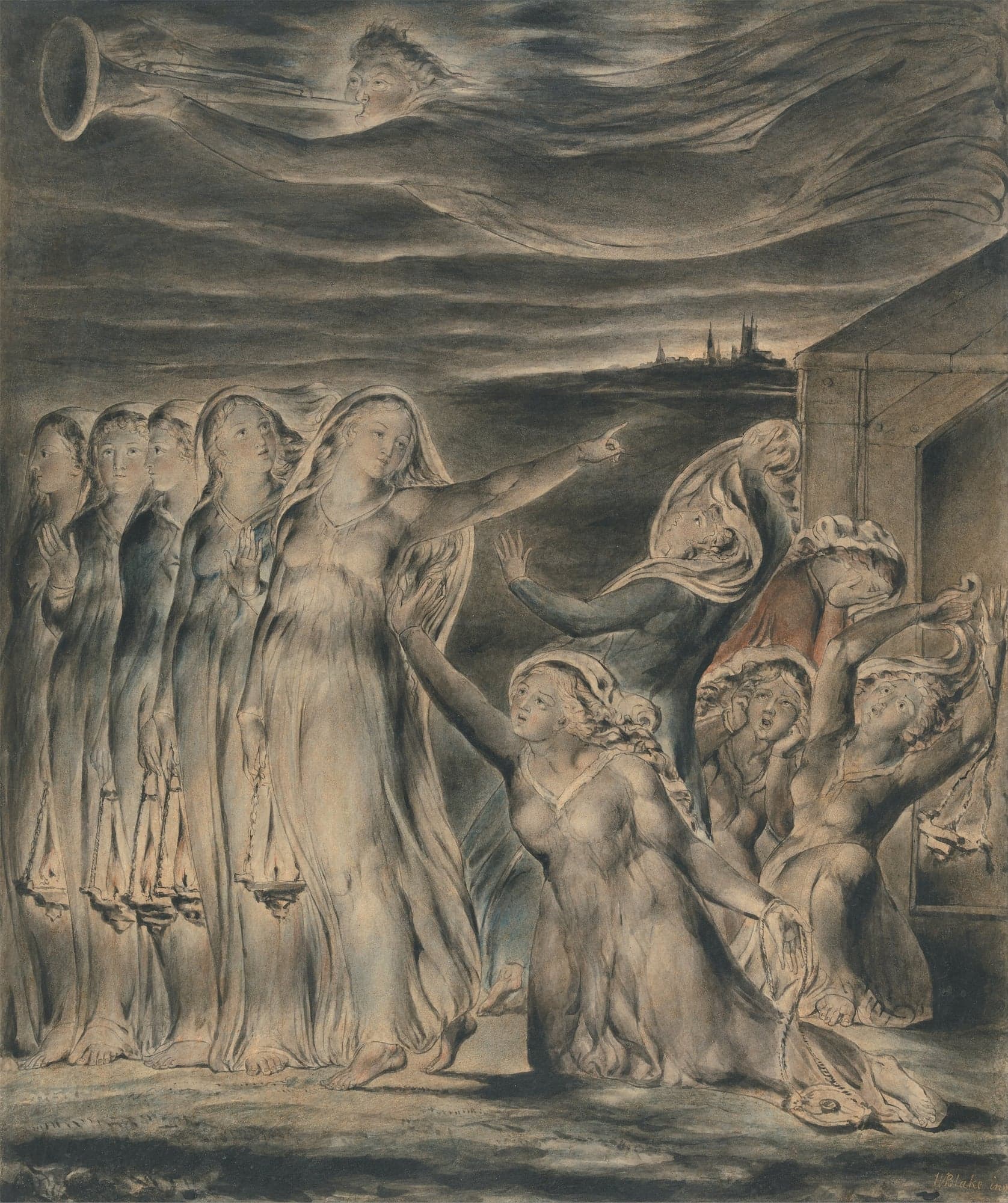
Matthew 25:1 to 13 · Story · Watchfulness
The Ten Virgins
Matthew 25:1 to 13 is the parable of ten virgins who waited at night with their lamps for a bridegroom, five of them wise and five foolish.
Jesus told this parable on the Mount of Olives two days before the Passover at which He was handed over to be crucified.
Therefore keep watch, because you do not know the day or the hour.
Summary
The parable of the ten virgins is Jesus' picture of readiness for His coming. The bridegroom's arrival divides the waiting party into those who are ready and go in with him to the banquet and those who are shut out. The difference between them is the oil the wise carried in flasks. The parable closes with the command to keep watch.
- All ten virgins became drowsy and slept while the bridegroom was delayed, and the cry came at midnight (Matthew 25:5 to 6).
- The wise would not share their oil, for fear there would not be enough for both, and they sent the foolish to buy their own (Matthew 25:9).
- The bridegroom's refusal at the shut door echoes what Jesus said He will tell those who call Him Lord without doing His Father's will (Matthew 25:12 and Matthew 7:21 to 23).
- The parable gives the oil no meaning. The church's teachers have read it as good works, love, the glory of a good conscience, the word of teaching and the grace of the Spirit.
The Setting in Matthew 24
The parable follows the thief and the household servant of Matthew 24:42 to 51.
The Ten Virgins is a study of watchfulness, the value of staying awake and ready for the Lord's return, in the parable Jesus told of a wedding at night. It stands in His answer to the disciples' question about His coming and the end of the age, and it is the first of the three teachings of Matthew 25 (Matthew 24:3).
The question this study answers is what the five foolish virgins lacked and what it means to be ready when the bridegroom comes. It gives the two parables of Matthew 24 that lead into it and the night in order. It sets the bridegroom's answer beside the words of Matthew 7 and gives the wedding customs as commentators described them. It ends with what the church's commentators made of the sleep and of the oil.
Near the close of His answer Jesus said that a homeowner who knew in which watch of the night the thief was coming would have kept watch (Matthew 24:43).
For this reason, you also must be ready, because the Son of Man will come at an hour you do not expect.Jesus turns the picture of the thief into the charge to be ready, the charge the parable of the virgins carries on.
The second picture is one servant set over his master's household and imagined two ways, faithful or wicked, with the master's return deciding between them. The parable of the virgins follows it with the words "At that time" (Matthew 25:1).
One servant in one office meets his master's return in two ways, and what he says in his heart decides which.
| In the text | The faithful and wise servant | The wicked servant |
|---|---|---|
| His charge | "whom the master has put in charge of his household" | The same servant in the same charge |
| What he says in his heart | Nothing is recorded | "My master will be away a long time." |
| What he does while the master is away | "to give the others their food at the proper time" | "to beat his fellow servants and to eat and drink with drunkards" |
| The master's return | "whose master finds him doing so when he returns" | "on a day he does not expect and at an hour he does not anticipate" |
| His end | "he will put him in charge of all his possessions" | "assign him a place with the hypocrites" |
The Night in Eight Events
The parable runs from the lamps taken up to the door shut against the five who came late.
The ten were divided at the bridegroom's coming by what each had brought before the night began.
- Ten virgins take their lamps and go out"ten virgins who took their lamps"Matthew 25:1
- Five take a supply of oil"took oil in flasks"Matthew 25:4
- The bridegroom is delayed, and all ten sleep"they all became drowsy and fell asleep"Matthew 25:5
- The cry is raised at midnight"At midnight the cry rang out"Matthew 25:6
- All ten wake and make ready their lamps"woke up and trimmed their lamps"Matthew 25:7
- The foolish ask the wise for oil"Give us some of your oil"Matthew 25:8
- The bridegroom comes, and the ready go in"and the door was shut"Matthew 25:10
- The five who came late are refused"I do not know you"Matthew 25:12
A timeline of eight events in Matthew 25:1 to 12, each with words of its verse from the Berean text.
The bridegroom comes, and the ready go in, The five who came late are refused
The Bridegroom's Answer and the Sermon on the Mount
Matthew 7 and Luke 13 hold sayings close to the bridegroom's answer, and two Greek words join the parable to the Sermon on the Mount.
Not everyone who says to Me, ‘Lord, Lord,’ will enter the kingdom of heaven, but only he who does the will of My Father in heaven. Many will say to Me on that day, ‘Lord, Lord, did we not prophesy in Your name, and in Your name drive out demons and perform many miracles?’ Then I will tell them plainly, ‘I never knew you; depart from Me, you workers of lawlessness!’Jesus closes the Sermon on the Mount with the same double cry of Lord and a refusal to know those who make it.
After the master of the house gets up and shuts the door, you will stand outside knocking and saying, ‘Lord, open the door for us.’ But he will reply, ‘I do not know where you are from.’Luke records a saying in which a householder refuses those who knock, in words close to Matthew 25:12.
Phronimos, wise
14 uses in the canon
Matthew uses this word for the wise builder, for the faithful and wise servant and for the five wise virgins.
Moros, foolish
12 uses in the canon
The same Gospel names the man who built on sand and the five who took no extra oil with this word.
Jamieson, Fausset and Brown follow Trench in comparing the virgins with the two builders of Matthew 7. In both, they write, "a certain degree of goodwill towards the truth is assumed".
The same commentators report that Olshausen, Stier and Alford read the bridegroom's answer as gentler than "I never knew you". They judge that this reading, with its milder fate for the foolish virgins, "is to be resisted".
Jerome reads the shut door as the end of the time for good works.
“But because the season for buying was now past, and the day of judgment was coming on, so that there was no room for penitence, they must not now lay up new works, but give an account of the old. After the day of judgment, there is no more opportunity for good works, or for righteousness, and therefore it follows, And the door was shut.”
Jerome · Catena Aurea by Aquinas · on Matthew 25:10Patristic
The door as a picture of entry into the kingdom is traced through Scripture in The Door and the Gate.
A Wedding at Night
Three commentators of the eighteenth and nineteenth centuries described the wedding customs the parable assumes.
John Wesley described the custom in his Explanatory Notes upon the New Testament (1755). He wrote that "The bridemaids on the wedding night were wont to go to the house where the bride was, with burning lamps or torches in their hands".
Adam Clarke, in his Commentary on the Bible (1832), wrote that "The Jewish weddings were generally celebrated in the night". He added that in the parable "there was a more than ordinary delay".
Albert Barnes described two parts of the wedding in his Notes, Explanatory and Practical, on the Old and New Testaments. "The marriage ceremony took place before the bride left her father’s house," he wrote, "but a feast was given at the house of her husband".
Be dressed for service and keep your lamps burning. Then you will be like servants waiting for their master to return from the wedding banquet, so that when he comes and knocks, they can open the door for him at once.The saying in Luke joins lamps kept burning to a master's return from a wedding banquet, the same pairing the parable of the virgins makes.
The bridegroom and his bride as a picture of Christ and the church are taught in The Bride and the Jewish Wedding.
The watches into which the night was divided, and where midnight fell among them, are taught in The Jewish Day and the Watches.
What the Sleep of the Ten Means
The wise slept as the foolish did, and readers have taken the sleep in three ways.
The parable records no rebuke from the bridegroom for the sleep of Matthew 25:5, which the wise and the foolish shared.
The sleep of deathJohn Chrysostom; Jerome; Augustine
John Chrysostom, in his Homily 78 on Matthew, read the delay as a sign that "the time intervening will not be short". He also took the sleep of the ten as death.
Jerome, in his Commentary on Matthew, wrote that "not a little time passes between the first and second coming of the Lord". He took the sleep as death: "They all slumbered, that is, they died, because the death of the saints is called sleep".
Augustine, in his Sermon 93, set aside the reading of the sleep as love growing cold, because the wise slept too. He wrote that "Whether the virgin is foolish or wise, all suffer equally the sleep of death".
Brothers, we do not want you to be uninformed about those who sleep in death, so that you will not grieve like the rest, who are without hope.Paul speaks of the dead as those who sleep, the use of the word on which this reading rests.
Drowsiness of soulJamieson, Fausset and Brown; Matthew Henry
Jamieson, Fausset and Brown read the two verbs of Matthew 25:5 as "two stages of spiritual declension", a drowsiness that steals over the inactive and then a yielding to it.
Matthew Henry applied the verse to believers who "grow remiss in their preparations for Christ's second coming".
So then, let us not sleep as the others do, but let us remain awake and sober.Paul uses sleep for the want of watchfulness, the sense this reading gives the parable.
A detail of the storyAlbert Barnes
Albert Barnes wrote that the sleep "is not to be pressed to prove that all Christians will be asleep, or cold and careless, when the Lord Jesus shall come". In his reading it serves to show more clearly the "duty of being ready".
Teachers on the Night
Matthew Henry and Jerome comment on three moments of the night, each under the line he teaches.
died 420 · Jerome
Catena Aurea by Aquinas
The quotation1 quotation
“For these wise virgins do not answer thus out of covetousness, but out of fear. Wherefore, each man shall receive the recompense of his own works, and the virtues of one cannot atone for the vices of another in the day of judgment. The wise admonish them not to go to meet the bridegroom without oil, Go ye rather to them that sell, and buy for yourselves.”
Jerome · Catena Aurea by Aquinas · on Matthew 25:9Patristic
1662 to 1714 · Matthew Henry
Commentary on the Whole Bible
The quotation1 quotation
“They took lamps for a present show, but not oil for after use. This incogitancy is the ruin of many professors; all their care is to recommend themselves to their neighbours, whom they now converse with, not to approve themselves to Christ, whom they must hereafter appear before; as if any thing will serve, provide it will but serve for the present.”
Matthew Henry · Commentary on the Whole Bible · on Matthew 25:3Puritan
1662 to 1714 · Matthew Henry
Commentary on the Whole Bible
The quotation1 quotation
“Note, We are all concerned to seek the Lord while he may be found; for there is a time coming when he will not be found. Time was, when, Lord, Lord, open to us, would have sped well, by virtue of that promise, Knock, and it shall be opened to you; but now it comes too late.”
Matthew Henry · Commentary on the Whole Bible · on Matthew 25:12Puritan
What Does the Oil Stand For?
Teachers from the third century to the nineteenth have held five readings of the oil.
Good works and mercy to the poorJerome; John Chrysostom
Jerome, as Thomas Aquinas gathered his words in the Catena Aurea, wrote that the virgins who have oil are those who, "besides their faith, have the ornament of good works".
John Chrysostom, in his Homily 78 on Matthew, read the parable as teaching "about diligence in almsgiving", and he named the poor as the sellers of the oil.
LoveAugustine; John Wesley
Augustine, in his Sermon 93, asked whether the oil might be charity, and he answered that "charity seems to be signified by the oil". His reason was that "oil swims above all liquids", as Paul sets love above the other gifts in 1 Corinthians 13.
John Wesley glossed the oil of the wise as "Love in their hearts" and wrote that "A lamp and oil with it, is faith working by love".
The glory of a good conscienceGregory the Great
Gregory the Great, in the twelfth of his Forty Gospel Homilies, wrote that the wise "retain the splendor of glory within their conscience", while the foolish "seek it from the lips of their neighbors". He grounded the reading in Paul's boast of the testimony of his conscience in 2 Corinthians 1:12.
The word of teachingOrigen of Alexandria
Origen, as the Catena Aurea gives him, wrote that "The oil is the word of teaching, with which the vessels of souls are filled". The foolish, in his reading, were "careless respecting the provision of doctrine which comforts faith, and enlightens the lamp of good deeds".
The grace of the SpiritJamieson, Fausset and Brown; Matthew Henry
Jamieson, Fausset and Brown wrote in their Commentary Critical and Explanatory on the Whole Bible (1871) that inward grace is set forth here "by the familiar symbol of oil". It is the symbol, they add, "by which the Spirit of all grace is so constantly represented in Scripture".
Matthew Henry, in his Commentary on the Whole Bible, wrote that this oil "is derived to the candlestick from Jesus Christ, the great and good Olive". He pointed to the lampstand and the olive trees of Zechariah 4.
Each reading keeps the point the parable itself makes in the answer of the wise, that the oil had to be gained beforehand and could not be borrowed when the bridegroom came (Matthew 25:9).
Ready When He Comes
The parables that follow in Matthew 25 and the words of the risen Christ carry the same call.
The command that ends the parable asks every hearer to be found ready at an hour no one can name, as the five wise were found ready at midnight.
“Behold, I am coming like a thief. Blessed is the one who remains awake and clothed, so that he will not go naked and let his shame be exposed.”The verse carries the call to stay awake into the last book of Scripture, addressed to every reader.
The parable of the talents follows in Matthew 25, in which three servants give account of the money entrusted to them.
After the talents the Son of Man comes in His glory and separates the nations, as a shepherd separates the sheep from the goats, a scene taught in The Sheep and the Goats.
Sources
Scripture is the Berean Standard Bible.
- STEP Bible TBESG, Tyndale House, CC BY 4.0, the Brief lexicon based on Abbott-Smith (1922)
- Matthew Henry, Commentary on the Whole Bible (1710), on Matthew 25.
- John Chrysostom, Homilies on the Gospel of Matthew, Homily 78.
- Thomas Aquinas, Catena Aurea on Matthew, the words of Jerome and of Origen on Matthew 25.
- Jerome, Commentary on Matthew, on Matthew 25:5.
- Augustine of Hippo, Sermon 93, in a modern English translation whose translator is not named.
- Gregory the Great, Forty Gospel Homilies, Homily 12, translated into English by a translator not named.
- John Wesley, Explanatory Notes upon the New Testament (1755), on Matthew 25.
- Jamieson, Fausset and Brown, Commentary Critical and Explanatory on the Whole Bible (1871), on Matthew 25.
- Adam Clarke, Commentary on the Bible (1832), on Matthew 25:6.
- Albert Barnes, Notes, Explanatory and Practical, on the Old and New Testaments, on Matthew 25.
Keep Studying
Read it1
In this value4
People and groups12
Places1
Symbols1