
Daniel 7 · Symbol · Featured Study
The Four Beasts and the Little Horn
Daniel 7 read with Daniel 2 beside it: the four kingdoms in their two main readings, and the little horn in three.
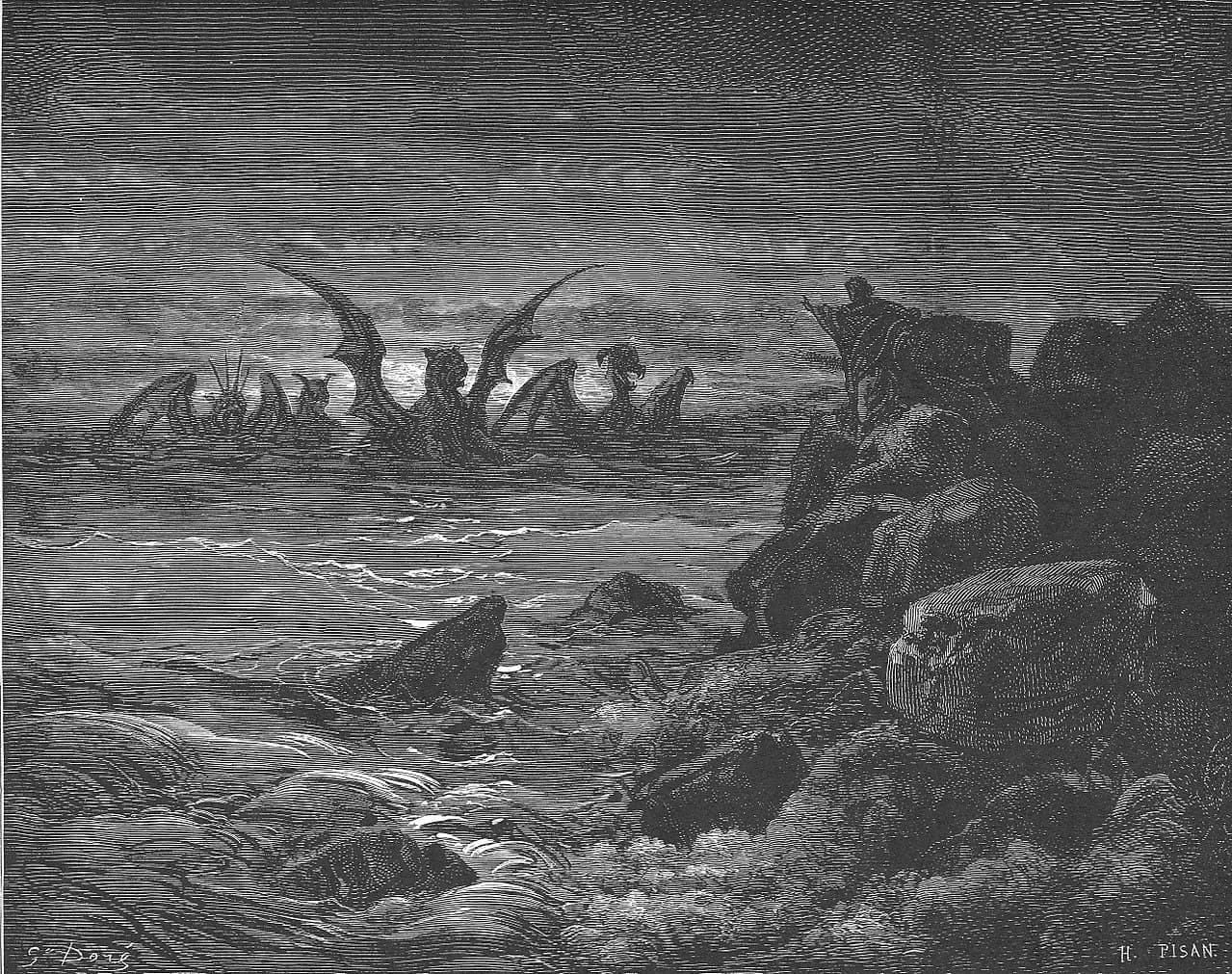
Gustave Doré, Daniel's Vision of the Four Beasts, 1866, from Doré's English Bible. Public domain, via Wikimedia Commons.
THE ARTWORKDoré drew Daniel standing on the rocks at the right and pointing across a stormy sea at a line of winged beasts under a low moon.
Four beasts came up out of the sea, and a little horn spoke arrogant words until the court sat.
Summary
Daniel 7 sets four kingdoms of the earth beside the everlasting kingdom that God gives to One like the Son of Man and to His saints. Daniel dates the vision to the first year of Belshazzar, king of Babylon.
- The four beasts are four kings, and the fourth is a kingdom with ten kings.
- The beasts match the four metals of the statue in Daniel 2.
- The kingdoms are read as Babylon, Medo-Persia, Greece and Rome, or as Babylon, Media, Persia and Greece.
- The little horn has been read as Antiochus IV, as a king at the end of the age, and as the papacy.
- Jesus answered the high priest in the words of Daniel 7:13.
Daniel 7 Read Plainly
Daniel 7:1 to 24, the vision in its order and the angel's first answer.
The four winds of heaven churn the great sea, and the beasts rise from it one by one, each different from the others.
THE LION
A lion with eagle's wings, which are torn off; it stands like a man and is given a man's mind.
THE BEAR
A bear raised up on one side, with three ribs in its mouth, told to gorge itself on flesh.
THE LEOPARD
A leopard with four wings of a bird and four heads, given authority to rule.
THE FOURTH BEAST
A dreadful, terrifying and very strong beast with large iron teeth.
THE LITTLE HORN
A little horn that uproots three horns, with eyes like a man's and a mouth speaking arrogance.
THE ANCIENT OF DAYS
Thrones are set, the Ancient of Days takes His seat, the court convenes and the books are opened.
‘These four great beasts are four kings who will arise from the earth. But the saints of the Most High will receive the kingdom and possess it forever—yes, forever and ever.’Every reading of the four kingdoms below starts from these verses.
This is what he said: ‘The fourth beast is a fourth kingdom that will appear on the earth, different from all the other kingdoms, and it will devour the whole earth, trample it down, and crush it. And the ten horns are ten kings who will rise from this kingdom. After them another king, different from the earlier ones, will rise and subdue three kings.Every reading of the little horn below starts from this answer.
The Beasts Beside the Metals
Daniel 2 and Daniel 7 name four kingdoms in the same order, then the kingdom of God.
| Kingdom | Daniel 2 | Daniel 7 |
|---|---|---|
| The first | A head of pure gold, which Daniel names as Nebuchadnezzar | The lion |
| The second | A chest and arms of silver, a lesser kingdom | The bear |
| The third | A belly and thighs of bronze | The leopard |
| The fourth | Legs of iron, feet of iron and clay | The fourth beast |
| The kingdom of God | A stone cut out, not by human hands, that becomes a mountain | An everlasting dominion |
- Kingdom
- The first
- Daniel 2
- A head of pure gold, which Daniel names as Nebuchadnezzar
- Daniel 7
- The lion
- Kingdom
- The second
- Daniel 2
- A chest and arms of silver, a lesser kingdom
- Daniel 7
- The bear
- Kingdom
- The third
- Daniel 2
- A belly and thighs of bronze
- Daniel 7
- The leopard
- Kingdom
- The fourth
- Daniel 2
- Legs of iron, feet of iron and clay
- Daniel 7
- The fourth beast
- Kingdom
- The kingdom of God
- Daniel 2
- A stone cut out, not by human hands, that becomes a mountain
- Daniel 7
- An everlasting dominion
The Beasts Across the Canon
Daniel 2 to Revelation 13, where the symbol returns.
In the third year of Belshazzar, two years after the vision of Daniel 7, Daniel sees a second vision.
The two-horned ram that you saw represents the kings of Media and Persia. The shaggy goat represents the king of Greece, and the large horn between his eyes is the first king.In Revelation 13 John sees one beast that carries the marks of all four of Daniel's.
Then I saw a beast with ten horns and seven heads rising out of the sea. There were ten royal crowns on its horns and blasphemous names on its heads. The beast I saw was like a leopard, with the feet of a bear and the mouth of a lion. And the dragon gave the beast his power and his throne and great authority.Which Four Kingdoms
Whether the fourth beast is Rome or Greece, with the holders and the objection to each.
| Beast | Ending in Rome | Ending in Greece |
|---|---|---|
| The lion | Babylon | Babylon |
| The bear | Media and Persia together | Media |
| The leopard | Greece under Alexander | Persia |
| The fourth beast | Rome | Greece under Alexander and the kings after him |
- Beast
- The lion
- Ending in Rome
- Babylon
- Ending in Greece
- Babylon
- Beast
- The bear
- Ending in Rome
- Media and Persia together
- Ending in Greece
- Media
- Beast
- The leopard
- Ending in Rome
- Greece under Alexander
- Ending in Greece
- Persia
- Beast
- The fourth beast
- Ending in Rome
- Rome
- Ending in Greece
- Greece under Alexander and the kings after him
Babylon, Medo-Persia, Greece and RomeHippolytus, Jerome, John Wesley, Jamieson, Fausset and Brown
Hippolytus, in his Commentary on Daniel, reads the fourth beast as the kingdom that arose after the Greeks and ruled in his own day. Jerome, in his Commentary on Daniel, names it: the fourth empire is the Roman Empire, the iron legs of the statue.
The objection rests on the silence set out under What Daniel Leaves Unnamed.
PERES means that your kingdom has been divided and given over to the Medes and Persians.”Daniel reads the writing on the wall the night Belshazzar is slain.
Babylon, Media, Persia and GreeceEphrem the Syrian, Porphyry
Ephrem the Syrian, in his Commentary on Daniel, reads the four beasts as the Babylonian, the Mede, the Persian and the Greek empires, and the fourth beast as Alexander. Porphyry is the other holder; his reading of the horn stands under Who Is the Little Horn.
The objection: Daniel 8 draws Media and Persia as one beast, so the second and third beasts are hard to part.
Then I lifted up my eyes and saw a ram with two horns standing beside the canal. The horns were long, but one was longer than the other, and the longer one grew up later.The Words of the Vision
Six words of the vision, from the beasts to the Son of Man.
Daniel 7 is written in Aramaic, which Wesley calls Chaldee.
| Word | Sense | Where it stands in Daniel 7 |
|---|---|---|
| chêyvâʼ, H2423 | an animal, a beast | four great beasts, verse 3 |
| rabrab, H7260 | huge in size, domineering in character | great beasts, verse 3; the horn's arrogant words, verse 8 |
| qeren, H7162 | a horn | the ten horns and another horn, verse 8 |
| zᵉʻêyr, H2192 | small | the little horn, verse 8 |
| ʼĕnâsh, H606 | a man | eyes like a man's, verse 8; the Son of Man, verse 13 |
| bar, H1247 | a son | like the Son of Man, verse 13 |
- Word
- chêyvâʼ, H2423
- Sense
- an animal, a beast
- Where it stands in Daniel 7
- four great beasts, verse 3
- Word
- rabrab, H7260
- Sense
- huge in size, domineering in character
- Where it stands in Daniel 7
- great beasts, verse 3; the horn's arrogant words, verse 8
- Word
- qeren, H7162
- Sense
- a horn
- Where it stands in Daniel 7
- the ten horns and another horn, verse 8
- Word
- zᵉʻêyr, H2192
- Sense
- small
- Where it stands in Daniel 7
- the little horn, verse 8
- Word
- ʼĕnâsh, H606
- Sense
- a man
- Where it stands in Daniel 7
- eyes like a man's, verse 8; the Son of Man, verse 13
- Word
- bar, H1247
- Sense
- a son
- Where it stands in Daniel 7
- like the Son of Man, verse 13
What Daniel Leaves Unnamed
The names in Daniel 7 and in the book around it.
One Like the Son of Man
Daniel 7:13 to 14, and the trial of Jesus.
When the high priest asked Jesus whether He was the Christ, He answered in the words of this vision, and the high priest called it blasphemy.
In my vision in the night I continued to watch, and I saw One like the Son of Man coming with the clouds of heaven. He approached the Ancient of Days and was led into His presence. And He was given dominion, glory, and kingship, that the people of every nation and language should serve Him. His dominion is an everlasting dominion that will not pass away, and His kingdom is one that will never be destroyed.“I am,” said Jesus, “and you will see the Son of Man sitting at the right hand of Power and coming with the clouds of heaven.”Jesus draws the first half of this answer from Psalm 110:1.
Voices on the Vision
Three voices from the third century to the nineteenth read the vision.
“‘Which shall not pass away.’ He exhibited all the dominion given by the Father to His own Son, who is manifested as King of all in heaven and on earth, and under the earth, and as Judge of all: of all in heaven, because He was born the Word, of the heart of the Father before all; and of all in earth, because He was made man, and created Adam anew of Himself; and of all under the earth, because He was also numbered among the dead, and preached to the souls of the saints, (and) by death overcame death.”
Hippolytus of Rome · Hippolytus Exegetical Fragments, Scholia on Daniel · on Daniel 7:14Patristic
“Like a leopard - This leopard was the Grecian monarchy; a leopard is less than a lion, so was this monarchy at first, but yet durst fight with a lion; so did Alexander encounter Darius with an inferior force.”
John Wesley · Explanatory Notes upon the Old Testament · on Daniel 7:6Evangelical
“The ‘mouth’ and ‘eyes’ are those of a man, while the symbol is otherwise brutish, that is, it will assume man's true dignity, namely, wear the guise of the kingdom of God (which comes as the ‘Son of man’ from above), while it is really bestial, namely, severed from God.”
Jamieson, Fausset & Brown · Commentary Critical and Explanatory on the Whole Bible · on Daniel 7:8Reformed
“Here, in the interpretation, ‘the saints,’ but in the vision (Da 7:13, 14), ‘the Son of man,’ takes the kingdom; for Christ and His people are one in suffering, and one in glory.”
Jamieson, Fausset & Brown · Commentary Critical and Explanatory on the Whole Bible · on Daniel 7:18Reformed
Who Is the Little Horn
Each reading with its holders, the objection it meets and the verse the objection rests on.
Antiochus IV EpiphanesPorphyry, Ephrem the Syrian
Porphyry read the horn as Antiochus Epiphanes and the three uprooted horns as two Ptolemies and a king of Armenia, as Jerome reports him in his Commentary on Daniel. Ephrem the Syrian, in his Commentary on Daniel, names the horn as Antiochus, the persecutor of the Jews, and reads Daniel 7:25 as the horn stopping the priests' holy service.
The objection: the verses below leave no age between the horn's fall and the everlasting kingdom.
But the court will convene, and his dominion will be taken away and completely destroyed forever. Then the sovereignty, dominion, and greatness of the kingdoms under all of heaven will be given to the people, the saints of the Most High. His kingdom will be an everlasting kingdom, and all rulers will serve and obey Him.’The angel's explanation ends here.
A king at the end of the ageHippolytus, Jerome, Jamieson, Fausset and Brown
Hippolytus, in his Commentary on Daniel, reads the time, times and half a time of Daniel 7:25 as three and a half years before the judgment. Jerome, in his Commentary on Daniel, says the horn is the Antichrist, whose kingdom is to be destroyed for ever.
Jamieson, Fausset and Brown, in their Commentary Critical and Explanatory, set the horn beside the man of lawlessness of 2 Thessalonians 2:3, destroyed by Christ at His coming.
The objection: the little horn of Daniel 8 grows out of the kingdom of Greece, which suits a Greek king.
In the latter part of their reign, when the rebellion has reached its full measure, an insolent king, skilled in intrigue, will come to the throne. His power will be great, but it will not be his own. He will cause terrible destruction and succeed in whatever he does. He will destroy the mighty men along with the holy people. Through his craft and by his hand, he will cause deceit to prosper, and in his own mind he will make himself great. In a time of peace he will destroy many, and he will even stand against the Prince of princes. Yet he will be broken off, but not by human hands.The papacyJohn Wesley, Adam Clarke
John Wesley, in his Explanatory Notes upon the Old Testament, reads the other king of Daniel 7:24 as the Romish antichrist. Adam Clarke, in his Commentary on the Bible, applies the horn's words against the Most High to the popes of Rome.
The objection: this reading stretches the horn's war on the saints over many centuries. Clarke himself sets the reading of Antiochus beside it.
As I watched, this horn was waging war against the saints and prevailing against them, until the Ancient of Days arrived and pronounced judgment in favor of the saints of the Most High, and the time came for them to possess the kingdom.Books on Daniel 7
The commentaries on Daniel 7 a student reads next.
Commentary on Daniel
Hippolytus of Rome · third century
Its fourth book treats the vision of Daniel 7.
READ HIS DANIEL NOTES →Commentary on Daniel
Jerome · fifth century
Its notes on Daniel 7 run from the beasts to the judgment.
READ HIS DANIEL NOTES →Commentary Critical and Explanatory on the Whole Bible
Jamieson, Fausset and Brown · 1871
Its notes read Daniel 2 and 7 verse by verse.
READ THEIR DANIEL NOTES →The Kingdom That Stands
All the readings end in one place. Whichever kingdoms the beasts are and whoever the horn is, the beasts lose their dominion and the horn is judged. Jesus is the Son of Man who receives the kingdom.
The chapter asks the reader to endure while the horn prevails, because the court will sit.
Keep studying
People2
Symbols2
Doctrines6
Peoples and groups1