
The Unseen Realm
Spiritual Warfare
A defeated enemy, reclaimed ground, and a soldier told to stand — the war behind the war, walked room by room.
Summary
A defeated enemy, reclaimed ground, and a soldier told to stand: the war behind the war, walked room by room.
- The battle already has a date: the cross.
- The weapons are not carnal: truth, righteousness, prayer.
- How far the authority reaches is contested ground, mapped honestly.
- Standing, not conquering, is the soldier's assignment.
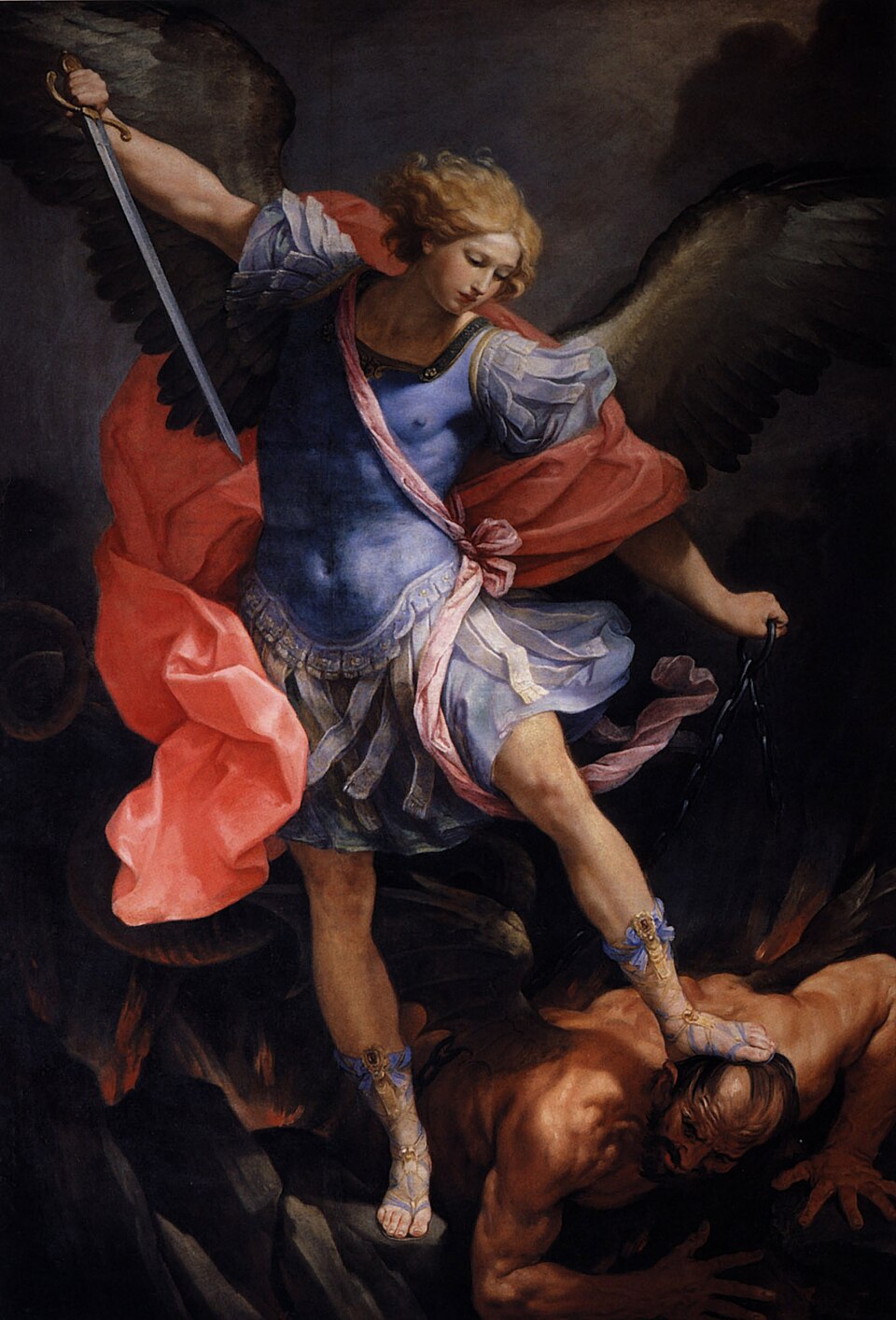
Saint Michael Defeating Satan — Guido Reni
Guido Reni, Saint Michael Defeating Satan (1635) — Public domain, via Wikimedia Commons
The Unseen Realm
The war behind the war
Scripture refuses to stage a fair fight between equal powers. Paul names the real front line in one sentence: "our wrestling is not against flesh and blood, but against the principalities, against the powers, against the world-rulers of this darkness, against the spiritual hosts of wickedness in the heavenly places" (Eph 6:12). The verb behind "wrestling" is pale, a wrestling, hand-to-hand and up close, not a distant exchange of fire. The flesh in front of you is never the enemy; it is at most the enemy's ground.
Naming the foe correctly is the first act of sobriety, and Scripture's tone here is striking for what it lacks. There is no fascination, no spectacle, no mapping of the dark. Peter frames the adversary as a roaring lion who "walketh about, seeking whom he may devour" (1 Pet 5:8), and then answers with a single unglamorous verb: withstand, "stedfast in your faith" (1 Pet 5:9). James does the same: "resist the devil, and he will flee from you" (Jas 4:7). The New Testament spends far more ink on standing, watching, and praying than on the enemy himself. That imbalance is the point. Sober, not sensational, is not a stylistic preference laid over the text, it is the text.
The combat for which we are to be prepared is not against ordinary human enemies, not barely against men compounded of flesh and blood, nor against our own corrupt natures singly considered, but against the several ranks of devils, who have a government which they exercise in this world.
— Matthew Henry, Commentary on the Whole Bible (1710), on Ephesians 6:12
The enemy's most effective weapon may not be assault but bait. John Bevere's diagnostic in The Bait of Satan (1994) reframes offense as a trap the enemy sets from the inside, unforgiveness that disarms a believer long before any direct confrontation ever arrives.
The Unseen Realm
The battle already has a date
The believer does not fight toward victory; he fights from it. Warfare in the New Testament is a mopping-up operation on ground the cross already reclaimed. Paul does not say the powers will be beaten: he says they were, publicly, at Golgotha: Christ, "having despoiled the principalities and the powers, he made a show of them openly, triumphing over them in it" (Col 2:15). The image is a Roman triumph: the defeated dragged in chains through the streets, shamed before the watching city.
Three witnesses fix the point. Christ tells the returning seventy, "I beheld Satan fallen as lightning from heaven" (Luke 10:18): past tense, already down. John sees the accuser "cast down" (Rev 12:10), and the final sentence already written (Rev 20:10). This is why the recurring command is stand (Ephesians 6 uses it three times (vv. 11, 13, 14)) and never conquer afresh. The territory is legally reclaimed; the fighting is the enemy's refusal to concede what the cross already settled. Understanding this reorders everything: it removes both the panic of a fight in doubt and the pride of a fight to be won by the soldier's own strength. The war is real, but its outcome is not.
The Unseen Realm
Weapons that are not carnal
If the enemy is spiritual, so is the arsenal. "The weapons of our warfare are not of the flesh, but mighty before God to the casting down of strongholds; casting down imaginations, and every high thing that is exalted against the knowledge of God" (2 Cor 10:4-5). The stronghold, Greek ochyroma, a fortress, is not a haunted place but an entrenched argument, a "high thing" set against the knowledge of God. So the weapons are truth, prayer, and the Word.
The armor Paul lists in Ephesians 6 is a heavy infantryman's full kit (panoplia), and it is almost entirely defensive: belt, breastplate, shoes, shield, helmet. Exactly one piece strikes, "the sword of the Spirit, which is the word of God" (Eph 6:17).
Put on the whole armour of God - The Greek word means a complete suit of armour. Believers are said to put on the girdle, breastplate, shoes; to take the shield of faith, and sword of the Spirit.
— John Wesley, Explanatory Notes upon the Bible (1765), on Ephesians 6:11
Christ demonstrated the whole armory in the wilderness: three assaults, three answers, each one "It is written" (Matt 4:1-11). Prayer runs underneath all of it, "praying at all seasons in the Spirit" (Eph 6:18), and in one case Christ named prayer and fasting together as the specific shortfall when a spirit would not yield. The fuller line, "this kind goeth not out but by prayer and fasting" (Mark 9:29, KJV), reflects a later manuscript tradition; the earliest texts read simply "by nothing, save by prayer" (Mark 9:29).
Either reading, fasting joined to prayer is the New Testament's normal appeal for breakthrough resistance. The authority to act is delegated, not owned, Luke 10:19's exousia is borrowed authority, handed down from the King. That is why the war is fought on the knees before it is fought anywhere else. Each piece of the armor gets its own room to breathe at Armor of God; the wider letter is at Ephesians.
The Unseen Realm
Contested ground: how far the authority reaches
Ephesians 6 states the war; it does not settle every question about how it is fought today. Three points below are held as clear positions, stated plainly, with the cautions that attach to each.
Deliverance (the Spirit-empowered expulsion of demonic influence) is treated here as normal pastoral ministry, not a fringe practice (Mark 16:17). Derek Prince's They Shall Expel Demons (1998) argues that born-again believers can be oppressed or bound in unsurrendered areas of soul and body (never in the regenerate spirit itself, which is sealed) and that deliverance restores what conversion did not automatically clear.
The cautions attach to method rather than to the ministry: sin is named and repented of as sin before any spirit is addressed, the Word and the counsel of the local church come first, and authority is exercised in Christ's name at the Spirit's leading rather than by formula.
Generational curses follow the same fault line. Prince's Blessing or Curse: You Can Choose (1990) reads Deuteronomy 28's covenant pattern as still transmitting consequence through bloodlines (ancestral idolatry, occult involvement, broken covenants) until renounced by name in Christ's authority. Reformed critics answer that the believer's position in Christ already nullifies every such curse outright, and that an ongoing-renunciation framework risks smuggling works back into a grace already total.
Territorial spirits (regional powers named the way Daniel's angel names "the prince of the kingdom of Persia" (Dan 10:13)) are affirmed here as biblically attested; Dutch Sheets's Watchman Prayer (2000) frames the believer's response as Spirit-led intercession that engages those powers rather than ignoring them. Not every tradition maps the territory the same way: some read Daniel 10 as a singular, unrepeatable disclosure rather than a method, and caution that Scripture nowhere teaches a technique for naming or targeting regional spirits. Held plainly, tested carefully: the authority is real (Luke 10:19); the method is Spirit-led, never formulaic.
Six rooms of the battlefield6
Walk the war, room by room
Scripture does not stage a fair fight between equal powers. It stages a defeated enemy in already-reclaimed territory, and a soldier told to stand. Walk the ground in order: the enemy named, the victory dated, the armor, the weapons, the authority, the end.
Room 1 of 6
The real enemy
Room 2 of 6
The ground already won
Room 3 of 6
The armor
Room 4 of 6
The weapons: prayer & fasting
Room 5 of 6
The authority delegated
Room 6 of 6
The certain victory
The real enemy
Not against flesh and blood
For our struggle is not against flesh and blood, but against the rulers, against the authorities, against the powers of this world’s darkness, and against the spiritual forces of evil in the heavenly realms.The Greek is pale: a wrestling, hand-to-hand and up close, not a distant volley. The flesh in front of you is never the front line.
Naming the enemy correctly is the first act of sobriety. Peter frames the same foe as "a roaring lion, walking about, seeking whom he may devour" (1 Pet 5:8) — and answers not with spectacle but with a single verb: resist, "stedfast in the faith" (1 Pet 5:9).
The ground already won
The battle has a date
Warfare in the New Testament is a mopping-up operation on ground the cross already reclaimed. Paul does not say the powers will be beaten: he says they were, publicly, at Golgotha.
The armor & the weapons
A soldier's kit, mostly defensive
panoplia
πανοπλία
- Sense
- the full armor of a heavy infantryman
- Point
- completeness: no gap left uncovered
- Offense
- one piece only: the sword, the Word
- Posture
- stand (v. 11, 13, 14): hold the line
Prayer & fasting
Weapons not carnal
“Though we walk in the flesh, we do not war after the flesh: (for the weapons of our warfare are not carnal, but mighty through God to the pulling down of strong holds;) casting down imaginations, and every high thing that exalteth itself against the knowledge of God.”
Paul of Tarsus · 2 Corinthians 10:3-5
/verse/2co/10/4
The stronghold (Greek ochyroma, a fortress) is not a haunted place but an entrenched argument, a "high thing" that exalts itself against the knowledge of God. So the weapons are truth, prayer, and the Word. When the disciples failed to cast out a spirit, Christ named the shortfall plainly: "this kind goeth not out but by prayer and fasting" (Matt 17:21; Mark 9:29). In the wilderness He modeled the whole armory Himself: three assaults, three answers, each one "It is written" (Matt 4:1-11).

Where the church divides
Contested ground
◈How far does the fight go: and by what method?contested · This site's tradition, with the limits Scripture sets on method
Deliverance (this site's Wesleyan-Pentecostal tradition): the authority Christ delegated in Luke 10:19, Greek exousia, delegated authority rather than raw force, is real and present today, and deliverance is normal pastoral ministry exercised in His name. The care belongs to method: sin is named and repented of as sin before any spirit is addressed, and no formula stands in for the Spirit's leading.
Territorial / strategic warfare: some read Daniel 10's "prince of Persia" (Dan 10:13, 20) and 2 Corinthians 10 as warrant for mapping and binding regional powers. Others judge this an over-reading: Scripture describes the angelic conflict but gives no method for it, and unsourceable technique is excluded here.
Scripture; standard Greek lexica (Thayer, Strong)
Keep walking
Doorways onward
The verse
They overcame himBy the blood of the Lamb and the word of their testimony: the two weapons named at the end of the war (Rev 12:11).Lens
The serpent threadFrom Genesis 3:15 to the dragon of Revelation 12: the one enemy, one wound, one crushing heel traced across the canon.The verse
Resist, and he will fleeJames 4:7 puts submission before resistance: the order matters. The flight is his, not ours to force.Word study
exousia: delegated authorityThe word behind Luke 10:19: authority handed down, borrowed from the King, never owned outright.Sober, not sensational: the New Testament spends far more ink on standing, watching, and praying than on the enemy himself. See 1 Peter 5:8-9 for the whole discipline in two verses.
Keep Studying
On this page
Studies6
People and groups2