
Place
Babylon
Also known as Babel · Babili · Babilu
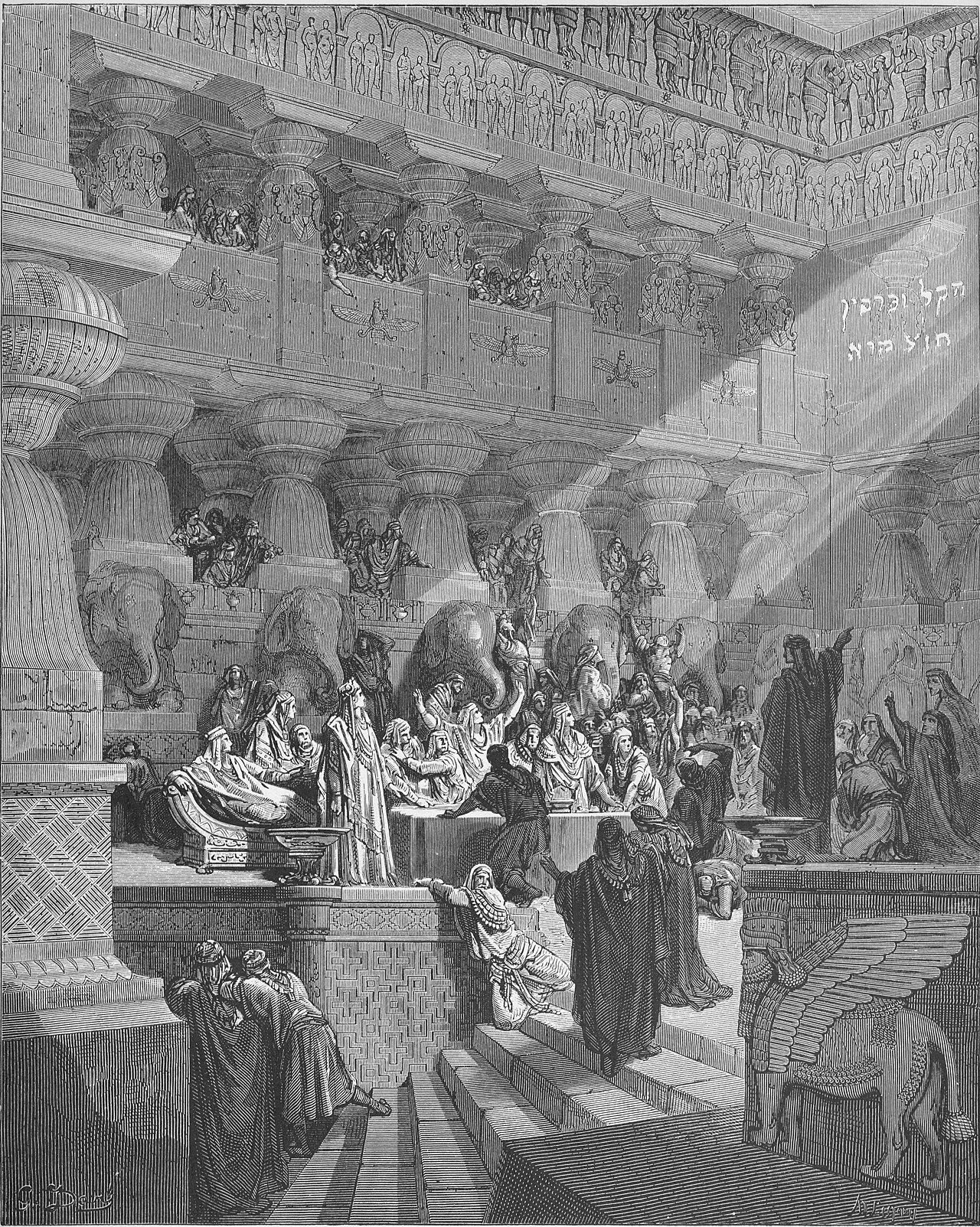
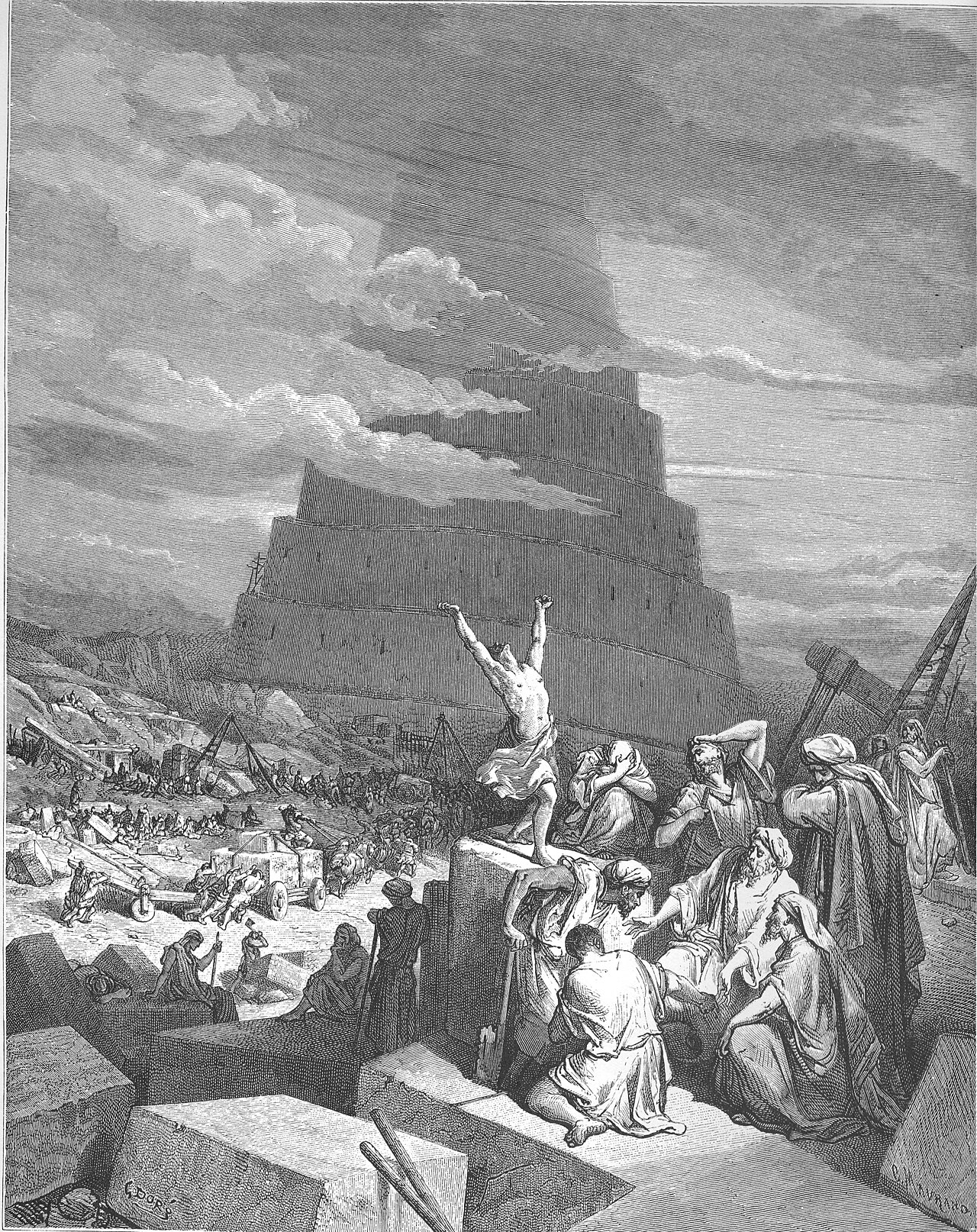
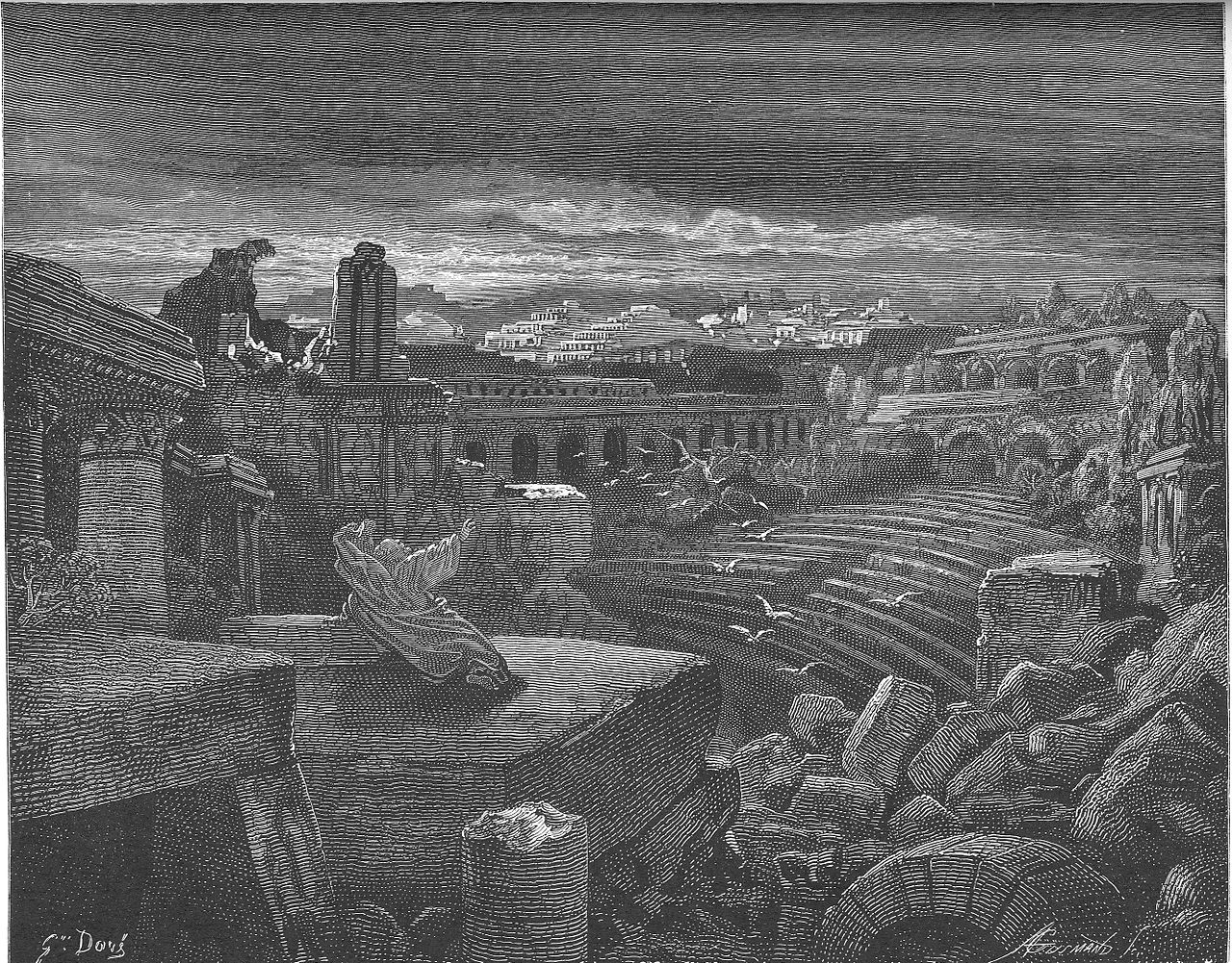
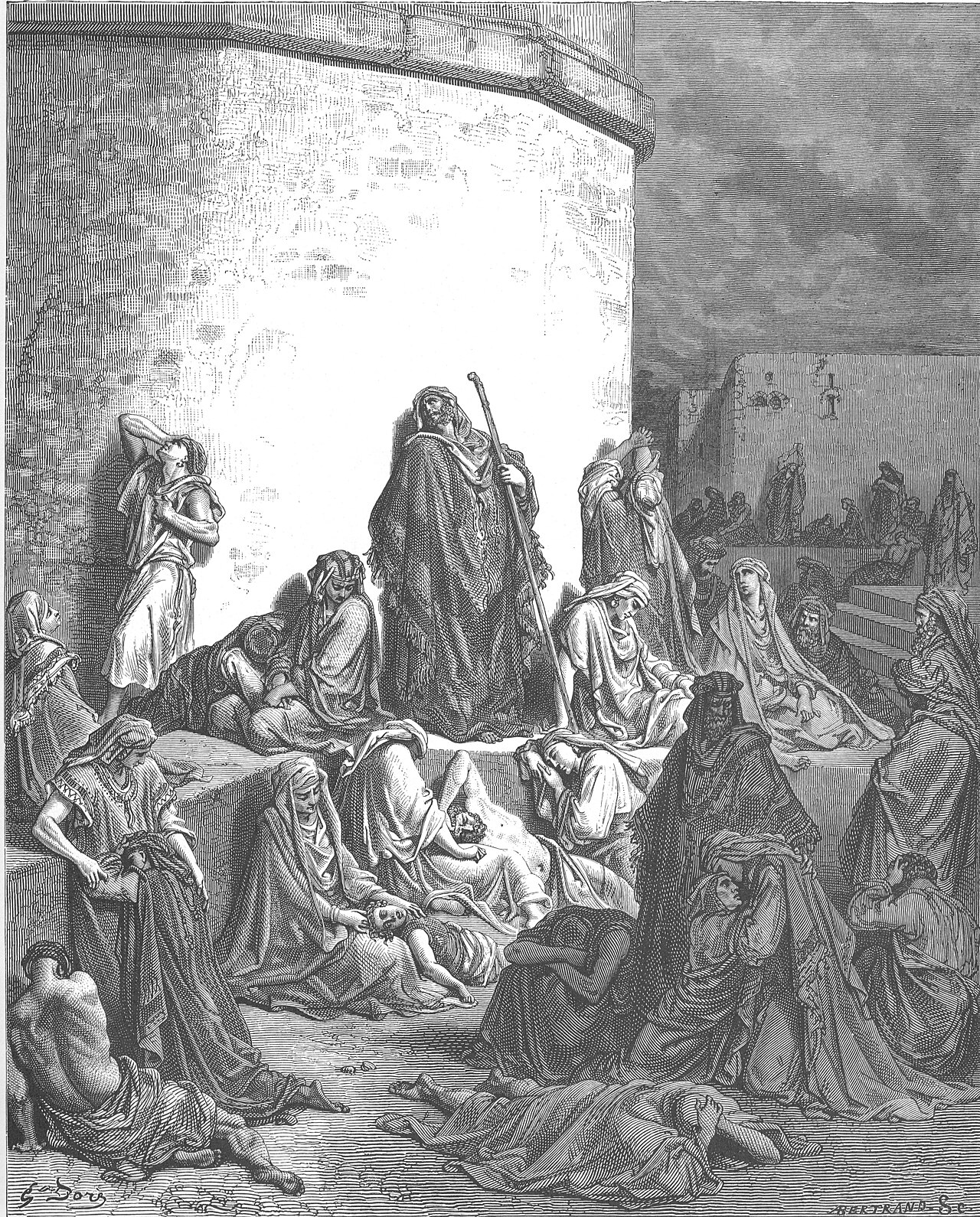
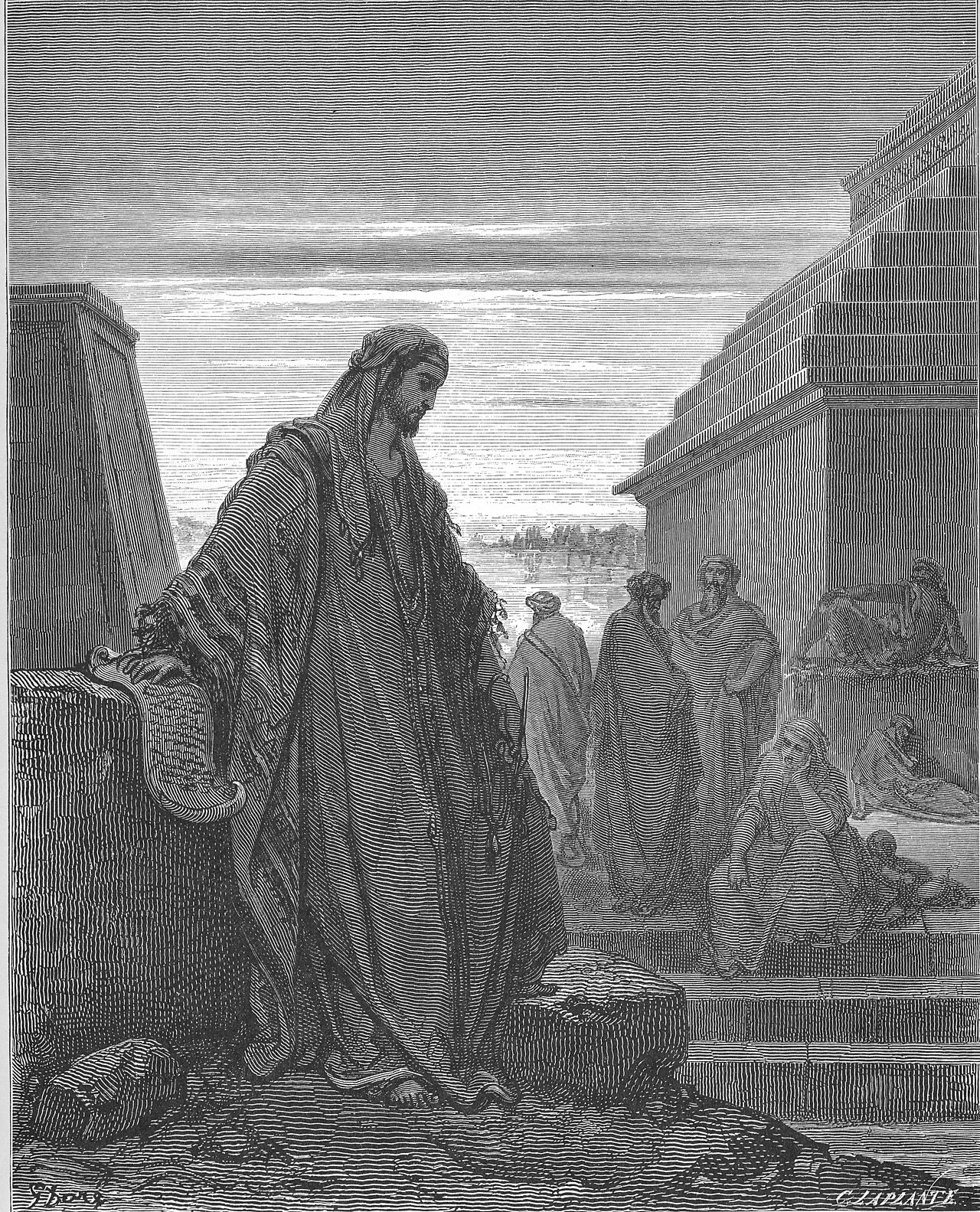
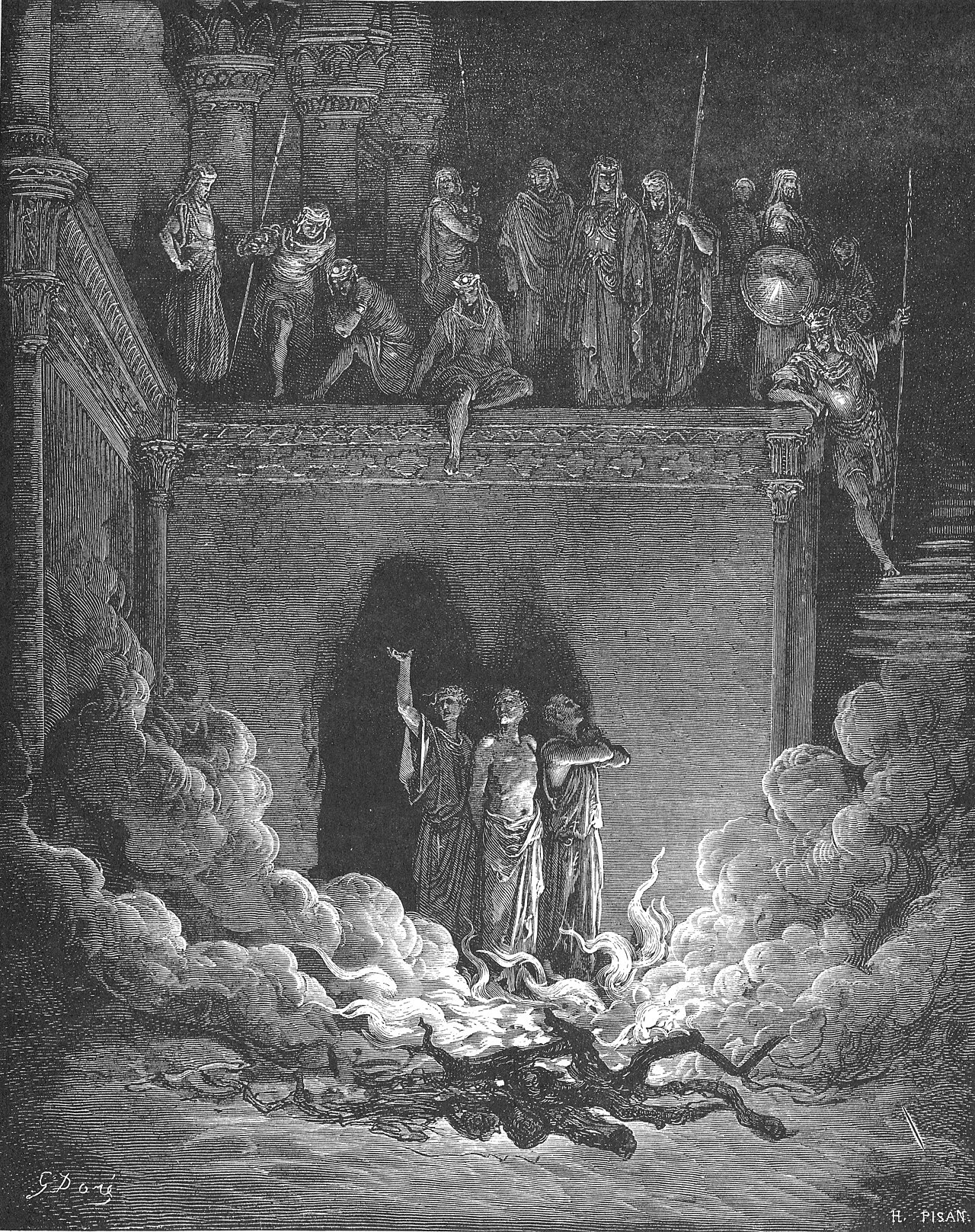
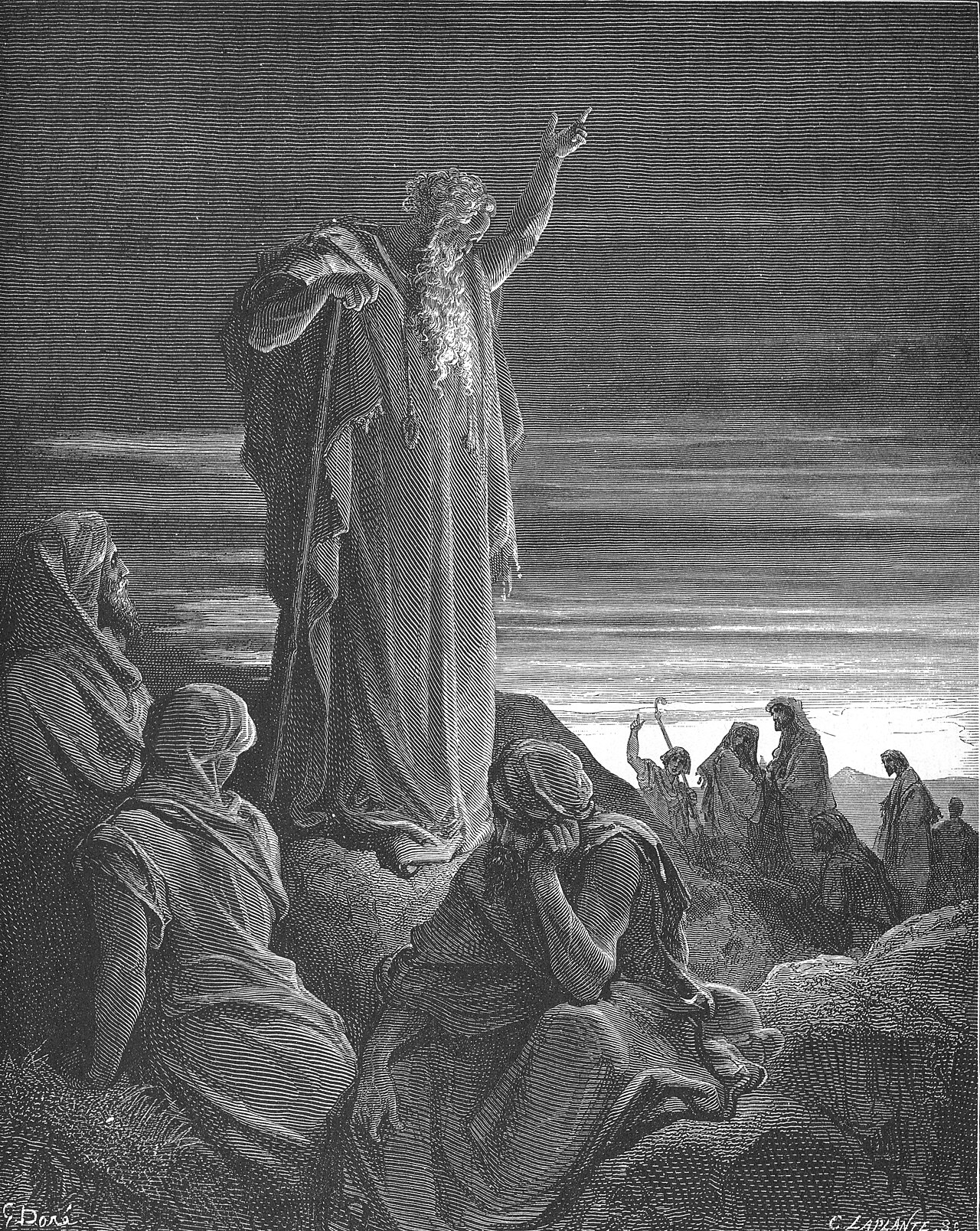
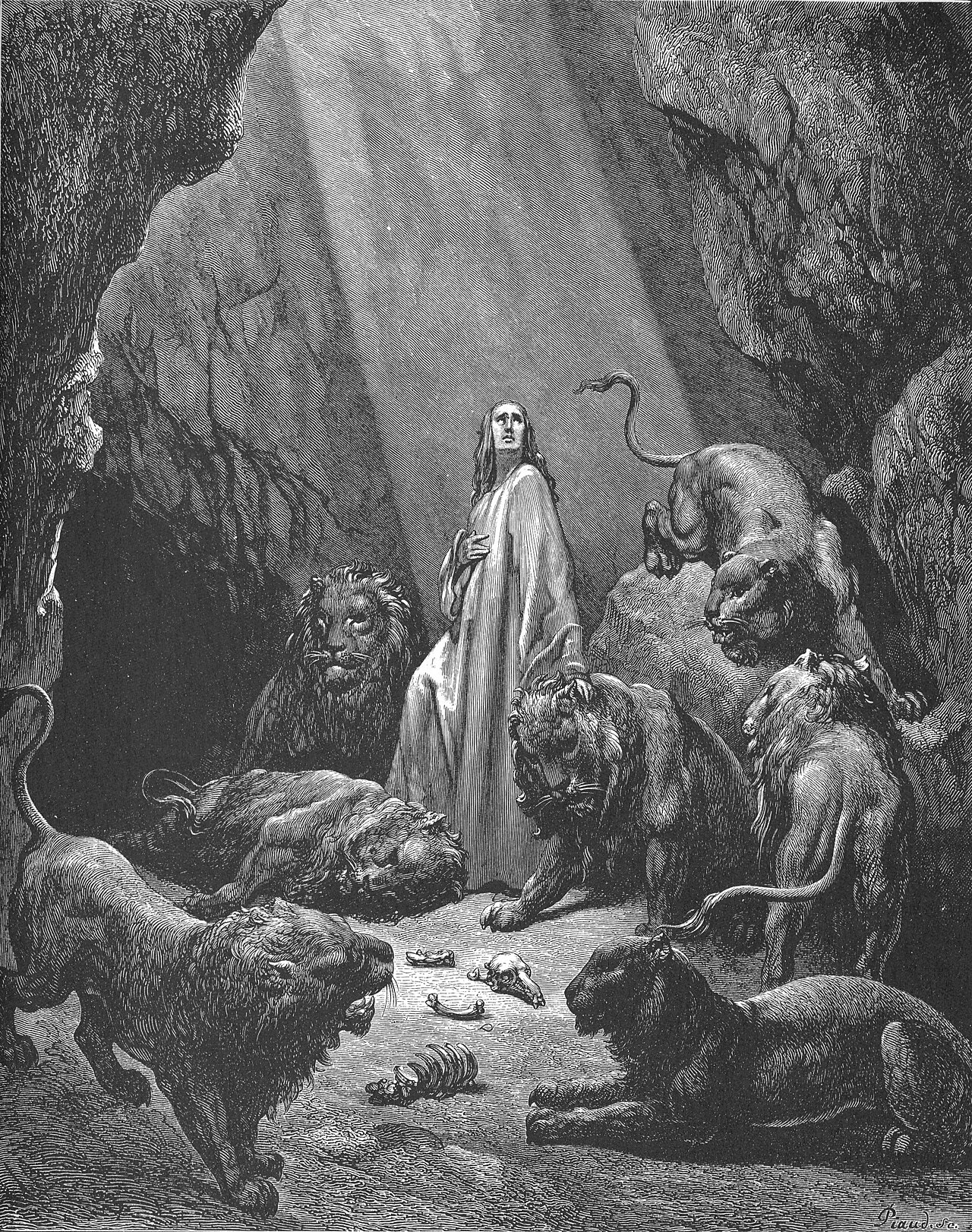
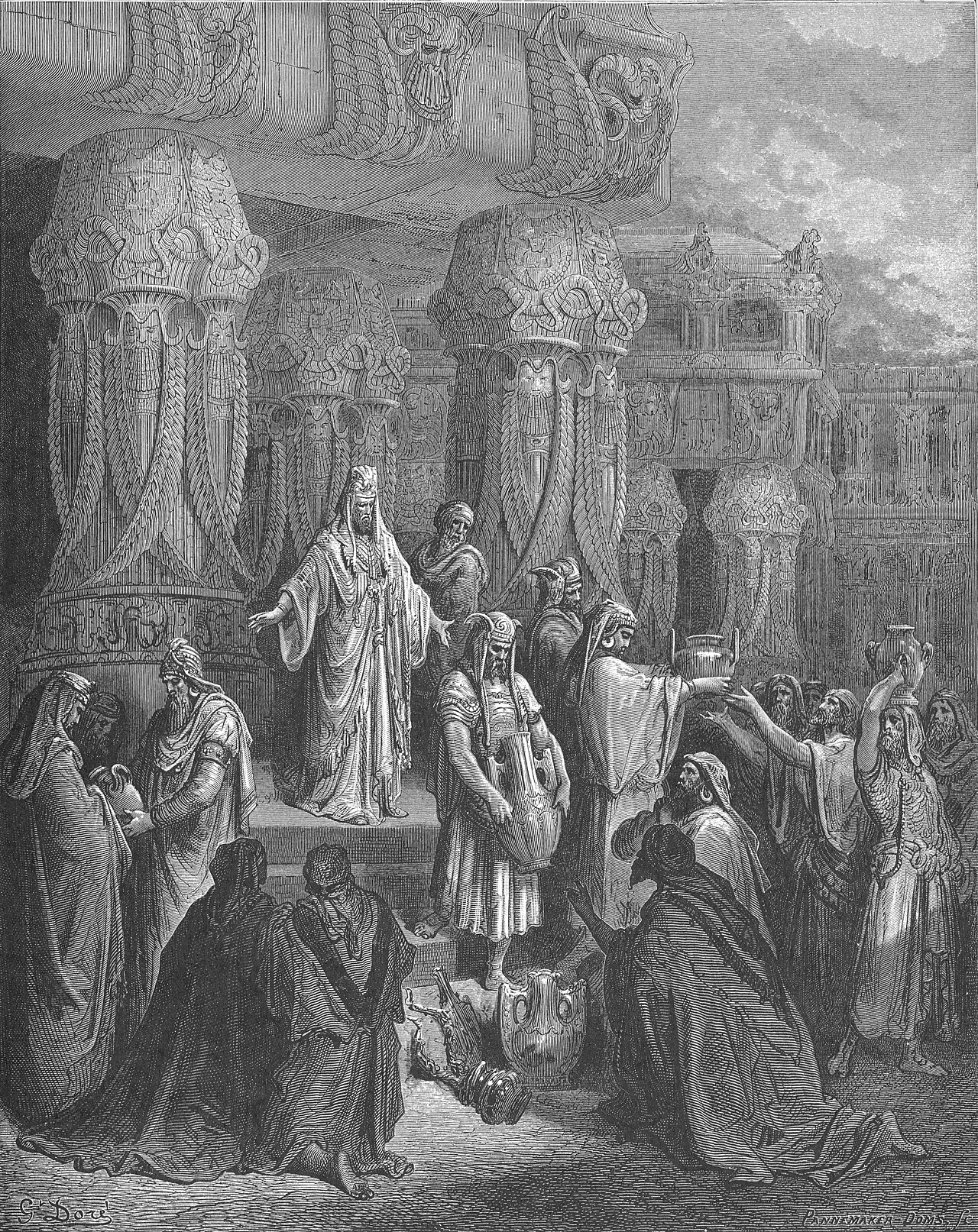
Gustave Doré, La Sainte Bible (Tours: Alfred Mame et fils, 1866). Public domain.
Summary
Ancient Mesopotamian city and imperial capital; site of the Israelite exile and a recurring biblical symbol of worldly power.
- Babylon is the one city that stands in the Bible's first book and its last, and it means the same thing in both.
- Nebuchadnezzar carried Judah away in three deportations across nineteen years and burned the temple in 587 or 586 BC.
- Jeremiah wrote to the deportees telling them to build houses in the city that had burned theirs, and that the term was seventy years.
- Cyrus of Persia took the city in a single night in October 539 BC, and within the year he ordered the house at Jerusalem rebuilt.
- Belshazzar was known from Daniel alone until 1854, when his name came out of the ground at Ur.
On this page
In Scripture
- Verses
- 266
- Books
- 18
Near Babylon
Straight-line distances, computed from the gazetteer coordinates.
Where it is
the country around it
- Modern name
- Babil Governorate (archaeological site)
- Country
- Iraq
- Coordinates
- 32.5422° N, 44.4217° Eopen the Atlas →
- Region
- Mesopotamia
- Kind of place
- City
- Era
- c. 1894 BCE – 539 BCE (political prominence); later Seleucid and Parthian settlement
1 place the record names with Babylon, the farthest 0.6 km away
- Located: the gazetteer fixes one site
- A dashed line ends at a place the gazetteer does not fix
Not located: Shinar. The gazetteer records no location for it, so it is not marked.
Why Babylon matters
What has been found
the evidence, and where it is disputed
How Judah came to Babylon
The warning, the three deportations, and the canals, in the order it happened
Read The warning, the three deportations, and the canals, in the order it happened
- The warning Hezekiah did not hear2 Kings 20:17The time will surely come when everything in your palace and all that your fathers have stored up until this day will be carried off to Babylon. Nothing will be left, says the LORD.
- The first deportation, and the temple vesselsDaniel 1:2And the Lord delivered into his hand Jehoiakim king of Judah, along with some of the articles from the house of God. He carried these off to the land of Shinar, to the house of his god, where he put them in the treasury of his god.
- Jehoiachin surrenders, 597 BC2 Kings 24:12Jehoiachin king of Judah, his mother, his servants, his commanders, and his officials all surrendered to the king of Babylon. So in the eighth year of his reign, the king of Babylon took him captive.
- Ten thousand carried into exile2 Kings 24:14He carried into exile all Jerusalem—all the commanders and mighty men of valor, all the craftsmen and metalsmiths—ten thousand captives in all. Only the poorest people of the land remained.
- Jeremiah's letter to the deporteesJeremiah 29:5“Build houses and settle down. Plant gardens and eat their produce.
- Ezekiel by the River KebarEzekiel 1:1In the thirtieth year, on the fifth day of the fourth month, while I was among the exiles by the River Kebar, the heavens opened and I saw visions of God.
- The house of the LORD burned2 Kings 25:9He burned down the house of the LORD, the royal palace, and all the houses of Jerusalem—every significant building.
- The bronze carried to Babylon2 Kings 25:13Moreover, the Chaldeans broke up the bronze pillars and stands and the bronze Sea in the house of the LORD, and they carried the bronze to Babylon.
- Seventy years of sabbath rest2 Chronicles 36:21So the land enjoyed its Sabbath rest all the days of the desolation, until seventy years were completed, in fulfillment of the word of the LORD through Jeremiah.
- By the rivers of BabylonPsalms 137:1By the rivers of Babylon we sat and wept when we remembered Zion.
Jeremiah's book does not end with a burned city. Its last paragraph reports Jehoiachin pardoned in 561 BC, brought out of prison, and eating at the table of the king of Babylon for the rest of his life.
The Exile and Return: the full studyWhat happened here, in order
in the order the canon tells it
- Nimrod's kingdom begins in Babylon, in the land of ShinarGenesis 10:10His kingdom began in Babylon, Erech, Accad, and Calneh, in the land of Shinar.
- A city, a tower, and a nameGenesis 11:4“Come,” they said, “let us build for ourselves a city with a tower that reaches to the heavens, that we may make a name for ourselves and not be scattered over the face of all the earth.”
- The place is called BabelGenesis 11:9That is why it is called Babel, for there the LORD confused the language of the whole world, and from that place the LORD scattered them over the face of all the earth.
- Isaiah names the country of the coming exileIsaiah 39:6The time will surely come when everything in your palace and all that your fathers have stored up until this day will be carried off to Babylon. Nothing will be left, says the LORD.
- The sentence on Babylon, spoken long before her riseIsaiah 13:19And Babylon, the jewel of the kingdoms, the glory of the pride of the Chaldeans, will be overthrown by God like Sodom and Gomorrah.
- God says He is raising up the ChaldeansHabakkuk 1:6For behold, I am raising up the Chaldeans— that ruthless and impetuous nation which marches through the breadth of the earth to seize dwellings not their own.
- Nebuchadnezzar called the LORD's servantJeremiah 25:9behold, I will summon all the families of the north, declares the LORD, and I will send for My servant Nebuchadnezzar king of Babylon, whom I will bring against this land, against its residents, and against all the surrounding nations. So I will devote them to destruction and make them an object of horror and contempt, an everlasting desolation.
- 605 BC, the siege that begins the exileDaniel 1:1In the third year of the reign of Jehoiakim king of Judah, Nebuchadnezzar king of Babylon came to Jerusalem and besieged it.
- Babylon puts Zedekiah on Judah's throne2 Kings 24:17Then the king of Babylon made Mattaniah, Jehoiachin’s uncle, king in his place and changed his name to Zedekiah.
- Judah taken into exile, away from its own land2 Kings 25:21There at Riblah in the land of Hamath, the king of Babylon struck them down and put them to death. So Judah was taken into exile, away from its own land.
- The exiles cannot sing in a foreign landPsalms 137:4How can we sing a song of the LORD in a foreign land?
- Daniel tells the king he is the head of goldDaniel 2:38Wherever the sons of men or beasts of the field or birds of the air dwell, He has given them into your hand and has made you ruler over them all. You are that head of gold.
- The golden statue on the plain of DuraDaniel 3:1King Nebuchadnezzar made a golden statue sixty cubits high and six cubits wide, and he set it up on the plain of Dura in the province of Babylon.
- The boast on the palace roofDaniel 4:30the king exclaimed, “Is this not Babylon the Great, which I myself have built by the might of my power as a royal residence and for the glory of my majesty?”
- 561 BC, Jehoiachin brought out of prisonJeremiah 52:31On the twenty-fifth day of the twelfth month of the thirty-seventh year of the exile of Jehoiachin king of Judah, in the first year of the reign of Evil-merodach king of Babylon, he pardoned Jehoiachin king of Judah and released him from prison.
- The hand writing on the plaster of the wallDaniel 5:5At that moment the fingers of a human hand appeared and wrote on the plaster of the wall, near the lampstand in the royal palace. As the king watched the hand that was writing,
- 539 BC, the last night of the empireDaniel 5:30That very night Belshazzar king of the Chaldeans was slain,
- Cyrus orders the house at Jerusalem rebuiltEzra 1:2“This is what Cyrus king of Persia says: ‘The LORD, the God of heaven, who has given me all the kingdoms of the earth, has appointed me to build a house for Him at Jerusalem in Judah.
- The city sentenced to become a heap of rubbleJeremiah 51:37Babylon will become a heap of rubble, a haunt for jackals, an object of horror and scorn, without inhabitant.
- The name returns in the last book of the BibleRevelation 18:2And he cried out in a mighty voice: “Fallen, fallen is Babylon the great! She has become a lair for demons and a haunt for every unclean spirit, every unclean bird, and every detestable beast.
Where it points
The voices
each quoted from the work named
I HAVE already explained to you, while expounding the 24th and 29th chapters of this Prophet, that these words were written by Jeremiah in a letter to the captives in Babylon. A considerable part of the people of Israel were carried away by Nebuchadnezzar into a far country. They were exhorted by the Prophet to build houses, form families and to abide peaceably there till the Lord should lead them back at the end of 70 years.
By the rivers of Babylon, there we sat down. Water courses were abundant in Babylon, wherein were not only natural streams but artificial canals: it was place of broad rivers and streams. Glad to be away from the noisy streets, the captives sought the river side, where the flow of the waters seemed to be in sympathy with their tears. It was some slight comfort to be out of the crowd, and to have a little breathing room, and therefore they sat down, as if to rest a while and solace themselves in their sorrow.
Note, Great conquerors are but great hunters. Alexander and Cesar would not make such a figure in scripture-history as they do in common history; the former is represented in prophecy but as a he-goat pushing, Dan. viii. Nimrod was a mighty hunter against the Lord, so the LXX; that is, (1.) He set up idolatry, as Jeroboam did, for the confirming of his usurped dominion.
4 more teachers on these versesAugustine of Hippo · Albert Barnes · Jamieson, Fausset & Brown · Ticonius
This city named "Confusion" was none other than Babylon, to whose marvelous construction pagan history brings testimonies. For Babylon means "confusion." It would seem that the founder of the city was the giant Nimrod, as was noticed above. In mentioning him, the Scripture tells us that Babylon was the head of his kingdom, meaning at the head of all the other cities, the capital where the government of the kingdom had its seat. However, the city never reached the kind of completion that the pride of impious men had dreamed. The actual plan called for an immense height—it was meant to reach the sky. This perhaps refers to one of its towers, which was to be higher than all the others, or perhaps the word tower may mean all the towers much as "horse" can mean thousands of horsemen.
Heaps - Of rubbish, formed in this case by the decay of the unburned bricks of which Babylon was built. It is these heaps which have yielded such a large wealth of historical documents in our own days. Dragons - Jackals Jer 10:22.
Belshazzar was joint king with his father (called Minus in the inscriptions), but subordinate to him; hence the Babylonian account suppresses the facts which cast discredit on Babylon, namely, that Belshazzar shut himself up in that city and fell at its capture; while it records the surrender of the principal king in Borsippa (see my Introduction to Daniel).
Babylon is interpreted as confusion. By it the city and the people of the devil are signified, as is also the entire seduction of the vices that it always exercises for its own ruin and for the ruin of the human race. It says that …
Babylon in Scripture
266 verses name it, or one of its other names (Babel, Babili, Babilu), in 18 books
Open a book to read its mentions here. Text: Berean Standard Bible.
Old TestamentNew Testamentsegment width = share of mentions
Old Testament14 books · 255 mentions
Genesis2 mentions
2 Kings28 mentions
- 2 Kings 17:24Then the king of Assyria brought people from Babylon, Cuthah, Avva, Hamath, and Sepharvaim and settled them in the towns of Samaria to replace the Israelites. They took possession of Samaria and lived in its towns.
- 2 Kings 17:30The men of Babylon made Succoth-benoth, the men of Cuth made Nergal, the men of Hamath made Ashima,
- 2 Kings 20:12At that time Merodach-baladan son of Baladan king of Babylon sent letters and a gift to Hezekiah, for he had heard about Hezekiah’s illness.
- 2 Kings 20:14Then the prophet Isaiah went to King Hezekiah and asked, “Where did those men come from, and what did they say to you?” “They came from a distant land,” Hezekiah replied, “from Babylon.”
- 2 Kings 20:17The time will surely come when everything in your palace and all that your fathers have stored up until this day will be carried off to Babylon. Nothing will be left, says the LORD.
- 2 Kings 20:18And some of your descendants, your own flesh and blood, will be taken away to be eunuchs in the palace of the king of Babylon.”
- 2 Kings 24:1During Jehoiakim’s reign, Nebuchadnezzar king of Babylon invaded. So Jehoiakim became his vassal for three years, until he turned and rebelled against Nebuchadnezzar.
- 2 Kings 24:7Now the king of Egypt did not march out of his land again, because the king of Babylon had taken all his territory, from the Brook of Egypt to the Euphrates River.
20 further mentions in 2 Kings, read them in the book.
1 Chronicles1 mention
2 Chronicles7 mentions
- 2 Chronicles 32:31And so when ambassadors of the rulers of Babylon were sent to him to inquire about the wonder that had happened in the land, God left him alone to test him, that He might know all that was in Hezekiah’s heart.
- 2 Chronicles 33:11So the LORD brought against them the military commanders of the king of Assyria, who captured Manasseh, put a hook in his nose, bound him with bronze shackles, and took him to Babylon.
- 2 Chronicles 36:6Then Nebuchadnezzar king of Babylon came up against Jehoiakim and bound him with bronze shackles to take him to Babylon.
- 2 Chronicles 36:7Nebuchadnezzar also took to Babylon some of the articles from the house of the LORD, and he put them in his temple in Babylon.
- 2 Chronicles 36:10In the spring, King Nebuchadnezzar summoned Jehoiachin and brought him to Babylon, along with the articles of value from the house of the LORD. And he made Jehoiachin’s relative Zedekiah king over Judah and Jerusalem.
- 2 Chronicles 36:18who carried off everything to Babylon—all the articles of the house of God, both large and small, and the treasures of the house of the LORD and of the king and his officials.
- 2 Chronicles 36:20Those who escaped the sword were carried by Nebuchadnezzar into exile in Babylon, and they became servants to him and his sons until the kingdom of Persia came to power.
Ezra13 mentions
- Ezra 1:11In all, there were 5,400 gold and silver articles. Sheshbazzar brought all these along when the exiles went up from Babylon to Jerusalem.
- Ezra 2:1Now these are the people of the province who came up from the captivity of the exiles carried away to Babylon by Nebuchadnezzar its king. They returned to Jerusalem and Judah, each to his own town,
- Ezra 4:9From Rehum the commander, Shimshai the scribe, and the rest of their associates—the judges and officials over Tripolis, Persia, Erech and Babylon, the Elamites of Susa,
- Ezra 5:12But since our fathers angered the God of heaven, He delivered them into the hand of Nebuchadnezzar king of Babylon, the Chaldean who destroyed this temple and carried away the people to Babylon.
- Ezra 5:13In his first year, however, Cyrus king of Babylon issued a decree to rebuild this house of God.
- Ezra 5:14He also removed from the temple of Babylon the gold and silver articles belonging to the house of God, which Nebuchadnezzar had taken and carried there from the temple in Jerusalem. King Cyrus gave these articles to a man named Sheshbazzar, whom he appointed governor
- Ezra 5:17Now, therefore, if it pleases the king, let a search be made of the royal archives in Babylon to see if King Cyrus did indeed issue a decree to rebuild the house of God in Jerusalem. Then let the king send us his decision in this matter.
- Ezra 6:1Thus King Darius ordered a search of the archives stored in the treasury of Babylon.
5 further mentions in Ezra, read them in the book.
Nehemiah2 mentions
- Nehemiah 7:6These are the people of the province who came up from the captivity of the exiles carried away to Babylon by Nebuchadnezzar its king. They returned to Jerusalem and Judah, each to his own town,
- Nehemiah 13:6While all this was happening, I was not in Jerusalem, because I had returned to Artaxerxes king of Babylon in the thirty-second year of his reign. Some time later I obtained leave from the king
Esther1 mention
Psalms3 mentions
- Psalms 87:4“I will mention Rahab and Babylon among those who know Me— along with Philistia, Tyre, and Cush— when I say, ‘This one was born in Zion.’”
- Psalms 137:1By the rivers of Babylon we sat and wept when we remembered Zion.
- Psalms 137:8O Daughter of Babylon, doomed to destruction, blessed is he who repays you as you have done to us.
Isaiah14 mentions
- Isaiah 13:1This is the burden against Babylon that Isaiah son of Amoz received:
- Isaiah 13:19And Babylon, the jewel of the kingdoms, the glory of the pride of the Chaldeans, will be overthrown by God like Sodom and Gomorrah.
- Isaiah 13:22Hyenas will howl in her fortresses and jackals in her luxurious palaces. Babylon’s time is at hand, and her days will not be prolonged.
- Isaiah 14:4you will sing this song of contempt against the king of Babylon: How the oppressor has ceased, and how his fury has ended!
- Isaiah 14:22“I will rise up against them,” declares the LORD of Hosts. “I will cut off from Babylon her name and her remnant, her offspring and her posterity,” declares the LORD.
- Isaiah 21:9Look, here come the riders, horsemen in pairs.” And one answered, saying: “Fallen, fallen is Babylon! All the images of her gods lie shattered on the ground!”
- Isaiah 39:1At that time Merodach-baladan son of Baladan king of Babylon sent letters and a gift to Hezekiah, for he had heard about Hezekiah’s illness and recovery.
- Isaiah 39:3Then the prophet Isaiah went to King Hezekiah and asked, “Where did those men come from, and what did they say to you?” “They came to me from a distant land,” Hezekiah replied, “from Babylon.”
6 further mentions in Isaiah, read them in the book.
Jeremiah150 mentions
- Jeremiah 20:4For this is what the LORD says: ‘I will make you a terror to yourself and to all your friends. They will fall by the sword of their enemies before your very eyes. And I will hand Judah over to the king of Babylon, and he will carry them away to Babylon and put them to the sword.
- Jeremiah 20:5I will give away all the wealth of this city—all its products and valuables, and all the treasures of the kings of Judah—to their enemies. They will plunder them, seize them, and carry them off to Babylon.
- Jeremiah 20:6And you, Pashhur, and all who live in your house, will go into captivity. You will go to Babylon, and there you will die and be buried—you and all your friends to whom you have prophesied these lies.’”
- Jeremiah 21:2“Please inquire of the LORD on our behalf, since Nebuchadnezzar king of Babylon is waging war against us. Perhaps the LORD will perform for us something like all His past wonders, so that Nebuchadnezzar will withdraw from us.”
- Jeremiah 21:4this is what the LORD, the God of Israel, says: ‘I will turn against you the weapons of war in your hands, with which you are fighting the king of Babylon and the Chaldeans who besiege you outside the wall, and I will assemble their forces in the center of this city.
- Jeremiah 21:7‘After that,’ declares the LORD, ‘I will hand over Zedekiah king of Judah, his officers, and the people in this city who survive the plague and sword and famine, to Nebuchadnezzar king of Babylon and to their enemies who seek their lives. He will put them to the sword; he will not spare them or show pity or compassion.’
- Jeremiah 21:10For I have set My face against this city to bring disaster and not good, declares the LORD. It will be delivered into the hand of the king of Babylon, who will destroy it with fire.’
- Jeremiah 22:25In fact, I will hand you over to those you dread, who want to take your life—to Nebuchadnezzar king of Babylon and to the Chaldeans.
142 further mentions in Jeremiah, read them in the book.
Ezekiel16 mentions
- Ezekiel 12:13But I will spread My net over him, and he will be caught in My snare. I will bring him to Babylon, the land of the Chaldeans; yet he will not see it, and there he will die.
- Ezekiel 17:12“Now say to this rebellious house: ‘Do you not know what these things mean?’ Tell them, ‘Behold, the king of Babylon came to Jerusalem, carried off its king and officials, and brought them back with him to Babylon.
- Ezekiel 17:15But this king rebelled against Babylon by sending his envoys to Egypt to ask for horses and a large army. Will he flourish? Will the one who does such things escape? Can he break a covenant and yet escape?’
- Ezekiel 17:16‘As surely as I live,’ declares the Lord GOD, ‘he will die in Babylon, in the land of the king who enthroned him, whose oath he despised and whose covenant he broke.
- Ezekiel 17:20I will spread My net over him and catch him in My snare. I will bring him to Babylon and execute judgment upon him there for the treason he committed against Me.
- Ezekiel 19:9With hooks they caged him and brought him to the king of Babylon. They brought him into captivity so that his roar was heard no longer on the mountains of Israel.
- Ezekiel 21:19“Now you, son of man, mark out two roads for the sword of the king of Babylon to take, both starting from the same land. And make a signpost where the road branches off to each city.
- Ezekiel 21:21For the king of Babylon stands at the fork in the road, at the junction of the two roads, to seek an omen: He shakes the arrows, he consults the idols, he examines the liver.
8 further mentions in Ezekiel, read them in the book.
Daniel15 mentions
- Daniel 1:1In the third year of the reign of Jehoiakim king of Judah, Nebuchadnezzar king of Babylon came to Jerusalem and besieged it.
- Daniel 2:12This response made the king so furious with anger that he gave orders to destroy all the wise men of Babylon.
- Daniel 2:14When Arioch, the commander of the king’s guard, had gone out to execute the wise men of Babylon, Daniel replied with discretion and tact.
- Daniel 2:18urging them to plead for mercy from the God of heaven concerning this mystery, so that Daniel and his friends would not be killed with the rest of the wise men of Babylon.
- Daniel 2:24Therefore Daniel went to Arioch, whom the king had appointed to destroy the wise men of Babylon, and said to him, “Do not execute the wise men of Babylon! Bring me before the king, and I will give him the interpretation.”
- Daniel 2:48Then the king promoted Daniel and gave him many generous gifts. He made him ruler over the entire province of Babylon and chief administrator over all the wise men of Babylon.
- Daniel 2:49And at Daniel’s request, the king appointed Shadrach, Meshach, and Abednego to manage the province of Babylon, while Daniel remained in the king’s court.
- Daniel 3:1King Nebuchadnezzar made a golden statue sixty cubits high and six cubits wide, and he set it up on the plain of Dura in the province of Babylon.
7 further mentions in Daniel, read them in the book.
Micah1 mention
New Testament4 books · 11 mentions
Matthew3 mentions
- Matthew 1:11and Josiah the father of Jeconiah and his brothers at the time of the exile to Babylon.
- Matthew 1:12After the exile to Babylon: Jeconiah was the father of Shealtiel, Shealtiel the father of Zerubbabel,
- Matthew 1:17In all, then, there were fourteen generations from Abraham to David, fourteen from David to the exile to Babylon, and fourteen from the exile to the Christ.
Acts1 mention
1 Peter1 mention
Revelation6 mentions
- Revelation 14:8Then a second angel followed, saying, “Fallen, fallen is Babylon the great, who has made all the nations drink the wine of the passion of her immorality.”
- Revelation 16:19The great city was split into three parts, and the cities of the nations collapsed. And God remembered Babylon the great and gave her the cup of the wine of the fury of His wrath.
- Revelation 17:5And on her forehead a mysterious name was written: BABYLON THE GREAT, THE MOTHER OF PROSTITUTES AND OF THE ABOMINATIONS OF THE EARTH.
- Revelation 18:2And he cried out in a mighty voice: “Fallen, fallen is Babylon the great! She has become a lair for demons and a haunt for every unclean spirit, every unclean bird, and every detestable beast.
- Revelation 18:10In fear of her torment, they will stand at a distance and cry out: “Woe, woe to the great city, the mighty city of Babylon! For in a single hour your judgment has come.”
- Revelation 18:21Then a mighty angel picked up a stone the size of a great millstone and cast it into the sea, saying: “With such violence the great city of Babylon will be cast down, never to be seen again.
The account
Read the account as one telling
Babylon begins in Genesis as a name in a list. Genesis 10:10 says Nimrod's kingdom began in Babylon, Erech, Accad and Calneh, in the land of Shinar. The next chapter tells what happened on that plain. Men built a city and a tower of baked brick and tar so that they would have a name and would not be scattered, and God confused their speech and scattered them anyway. Genesis does not say the tower was struck down. It says they stopped building, and that the place was called Babel.
- about 700 BC
For most of the Old Testament, Babylon is a distant power rather than a threat to Judah. Then, about 700 BC, envoys from a Babylonian king named Merodach-baladan arrive at Hezekiah's court, and Hezekiah shows them everything in his treasury. Isaiah tells him what it will cost. Everything in the palace will be carried off to Babylon, and nothing will be left. That is the first place in Scripture where the country of the coming exile is named.
- 626 BC
In 626 BC Nabopolassar took the throne of Babylon and broke Assyria's hold on Mesopotamia. Nineveh fell in 612 BC. Habakkuk watched the Chaldeans rise and asked God how a holy God could use a nation like that, and the answer he was given is that God Himself was raising them up. Jeremiah went further and called Nebuchadnezzar "My servant." The conqueror is the instrument in both books, and neither book pretends the instrument is clean.
- 562 BC
Nebuchadnezzar II ruled from 605 to 562 BC and rebuilt the city on a scale nothing else in Mesopotamia matched. He raised a double wall, the Processional Way, the Ishtar Gate, the Southern Palace and the ziggurat Etemenanki, and he stamped his own name and titles on the building bricks. Daniel 4:30 has him looking out over it and saying, "Is this not Babylon the Great, which I myself have built by the might of my power." Thousands of his bricks in museums worldwide make the same claim in his own hand.
Judah came to Babylon in three deportations across nineteen years, and Scripture treats each of them separately. That story is told above, from the warning Hezekiah did not hear to the exiles sitting down by the canals.
Life in the country of the exile was not slavery in a mine. Administrative tablets from the city list rations of oil and barley issued to foreigners living there, and the captive king of Judah is named among the recipients. Ezekiel prophesied by the River Kebar, a canal outside the city. Daniel and his three friends were trained for the king's service and given Babylonian names. Psalm 137 records what all of it felt like from the inside, with the harps hung up and the captors asking for a song of Zion.
Nebuchadnezzar's successors held the throne briefly. Nabonidus, the last king, spent years at Tema in Arabia and left his son Belshazzar holding royal authority in Babylon. On the night of the feast in Daniel 5 the army of Cyrus took the city. The Nabonidus Chronicle says they entered without a battle in October 539 BC. Herodotus and Xenophon, both writing later, say the Persians diverted the Euphrates and walked in along the riverbed while the city was at a festival.
Cyrus reversed the policy of deportation. In his first year he ordered the house at Jerusalem rebuilt and brought out the vessels Nebuchadnezzar had carried away. Babylon stayed a living city under Persian rule and then under Alexander, who died there in 323 BC having begun clearing Etemenanki with the intention of rebuilding it. Seleucus I founded Seleucia on the Tigris about 305 BC, and the population drifted there.
Common questions
Where is Babylon, and is there anything left to see?
The mounds sit on the east bank of the Euphrates in southern Iraq, near the town of Hillah and roughly 85 km south of Baghdad. Robert Koldewey excavated the city for the German Oriental Society from 1899 to 1917 and recovered its street plan, its double wall, the Southern Palace and the platform of the ziggurat.
The glazed brick Ishtar Gate and a stretch of the Processional Way were taken to Berlin and stand reconstructed in the Pergamon Museum. The site itself was inscribed on the UNESCO World Heritage List in 2019.
Was the Tower of Babel the ziggurat at Babylon?
Readers differ; the positions are named
The ziggurat of Marduk at Babylon was called Etemenanki, and Koldewey cleared its foundation platform. Some hold that it is the tower of Genesis 11, or stands where that tower stood, since Genesis sets the story in Shinar and describes baked brick and bitumen, which is Mesopotamian building exactly.
Others hold that the structure Koldewey found is a seventh and sixth century BC rebuild by Nabopolassar and Nebuchadnezzar, far later than the Genesis account, so the connection runs to a kind of building and a place rather than to a datable course of brick. What can be said plainly is that Genesis 11 describes the sort of tower Mesopotamia built, in the country where it built them, and that no excavated stage of Etemenanki has been shown to be the tower of Genesis 11.
Did the exile really last seventy years?
Readers differ; the positions are named
Jeremiah gives the number twice, at 25:11 and 29:10, and both 2 Chronicles 36:21 and Daniel 9:2 take it as a fixed term. Counted from the first deportation in 605 BC to the first return under Cyrus in 538 BC it is about sixty-seven years, near enough that many readers take that as the span. Counted from the burning of the temple in 587 or 586 BC to the finished second temple in 516 BC it is seventy almost exactly.
Jamieson, Fausset and Brown date the term instead from Jehoiachin's captivity in 597 BC. The site sets out both honest reckonings on the exile study rather than forcing one of them.
Did Belshazzar exist? Was Daniel wrong about him?
Readers differ; the positions are named
Until 1854 no source outside Daniel named Belshazzar, and the classical writers end the dynasty with Nabonidus, so Daniel 5 was treated as evidence that the book knew the period badly. Then cylinders recovered at Ur, published by Henry Rawlinson, named Bel-shar-usur as the eldest son of Nabonidus, and further texts showed that Nabonidus spent years at Tema in Arabia while his son held royal authority in Babylon.
Raymond Dougherty set the case out in Nabonidus and Belshazzar in 1929 and read Daniel's offer of the third place in the kingdom as the highest a co-regent could give. What remains discussed is that the inscriptions do not give Belshazzar the formal royal title, and that Daniel calls Nebuchadnezzar his father, which is usually answered from the Semitic use of father for an ancestor or a predecessor.
Who was Darius the Mede?
Readers differ; the positions are named
Daniel 5:31 says Darius the Mede received the kingdom at sixty-two, and no text outside Daniel names him. John Whitcomb argued he was Gubaru, the governor Cyrus set over Babylon. Donald Wiseman argued that Daniel 6:28 should be read as the reign of Darius, even the reign of Cyrus, which makes Darius a throne name of Cyrus himself. Older commentators including Jamieson, Fausset and Brown followed Xenophon and identified him with Cyaxares II, and much of critical scholarship holds the figure unhistorical.
This page names the four positions and does not choose between them. Note also that the site's character page for Darius is Darius the Great of Persia, a different man who reigned later.
Does the Cyrus Cylinder prove the decree in Ezra 1?
No, and this page will not say that it does. The cylinder, found at Babylon in 1879 and now in the British Museum, is Cyrus's own account of taking the city in 539 BC and of restoring sanctuaries and returning displaced peoples and their gods to their homes.
It never mentions the Jews, Judah or Jerusalem, and it issues no order to rebuild a temple there. What it establishes is that the policy Ezra 1 describes was Cyrus's actual practice, which is strong corroboration of the setting and not a copy of the decree.
When Peter writes "the church in Babylon," does he mean Rome?
Readers differ; the positions are named
The earliest Christian writers who comment on the line take Babylon as a figure for Rome. Eusebius says so in his Church History around AD 339, and Bede, Oecumenius, Andreas of Caesarea and Theophylact all repeat it. The reasons given are that Rome was the imperial city as Babylon had been, and that Mark is with Peter, which fits the Roman tradition of Mark's Gospel.
The minority reading takes the word plainly, that Peter was writing from the actual city on the Euphrates, where a substantial Jewish community still lived. John Wesley takes it that way in his Notes. Both readings are given here and the reader weighs them.
Who or what is "Babylon the great" in Revelation 17 and 18?
Readers differ; the positions are named
Three readings have carried the field for nineteen centuries. The first is Rome, the imperial city of John's own day, resting on the seven mountains of Revelation 17:9 and the great city that rules over the kings of the earth in 17:18, and continuous with how the earliest readers took 1 Peter 5:13. The second is a literal city rebuilt on the Euphrates, resting on the scale of Isaiah 13 and Jeremiah 50 to 51 and on a judgment described as sudden and final, and it is held by many futurist writers. The third is the world system, the whole order of pride, commerce and idolatry running from Genesis 11 to the end; Ticonius says so around AD 390 and Augustine builds City of God on it.
A fourth identification, made by Reformation-era and later Protestant writers, applied the harlot to the Roman church. This site names that as a historical position and prints no quote that attacks another Christian tradition. This site's tradition reads Revelation as futurist and premillennial, and it says so once here rather than stamping it on every line.
Why does Psalm 137 end the way it does?
The psalm was written by people who had watched Jerusalem sacked, and its last two verses ask God to repay Babylon in kind. Scripture records the prayer without commending the act, and the vengeance is handed to God rather than taken by the man praying.
Spurgeon, in The Treasury of David, says the desire for retribution here "is rather the spirit of the law than of the gospel," and Jesus tells His disciples to pray for those who persecute them. The site treats this whole class of psalm on its own study rather than trimming the words out.
Notable art
8 verified pieces depicting Babylon
Sources cited
- Easton's Bible Dictionary (1897): Babylonread 2026-04-17Public domain.
- ISBE (1915): Babylonread 2026-04-17Public domain.
- Wikipedia: Babylonread 2026-04-17CC-BY-SA.
- UNESCO World Heritage Site: Babylonread 2026-04-17Archaeological site description.
- OpenBible.info Bible GeocodingThe coordinates carried on this place row. CC-BY, attribution given.
- Robert Koldewey, The Excavations at Babylon (London: Macmillan, 1914)The excavation of 1899 to 1917, translated from Das wieder erstehende Babylon (Leipzig: Hinrichs, 1913).
- Donald J. Wiseman, Chronicles of Chaldaean Kings (626 to 556 BC) in the British Museum (London: British Museum, 1956)The publication of BM 21946, which dates the capture of Jerusalem to March 597 BC.
- Ernst F. Weidner, "Jojachin, König von Juda, in babylonischen Keilschrifttexten," in Mélanges syriens offerts à Monsieur René Dussaud (Paris: Geuthner, 1939)The ration tablets from Babylon naming Jehoiachin and his sons.
- The Cyrus Cylinder, British Museum 90920Found at Babylon by Hormuzd Rassam in 1879. Cited for what it says and for what it does not say.
- The Nabonidus Chronicle (BM 35382) and the Verse Account of Nabonidus (BM 38299)The contemporary record of the fall of the city in October 539 BC, and of Nabonidus leaving the kingship to his son.
- Raymond P. Dougherty, Nabonidus and Belshazzar (New Haven: Yale University Press, 1929)The assembled case for Belshazzar's co-regency, cited for the position it argues.
- John C. Whitcomb, Darius the Mede (Grand Rapids: Eerdmans, 1959)The Gubaru proposal, cited for the position it argues.
- Edwin R. Thiele, The Mysterious Numbers of the Hebrew Kings (Chicago: University of Chicago Press, 1951)The 586 BC reckoning for the fall of Jerusalem.
- William F. Albright, "The Seal of Eliakim and the Latest Preexilic History of Judah," Journal of Biblical Literature 51 (1932)The 587 BC reckoning, cited for the position it argues.
- Herodotus, Histories 1.178 and 1.191The classical figures for the walls, and the account of the Euphrates diverted. Public domain.
- Xenophon, Cyropaedia 7.5The second Greek account of the night the city was taken. Public domain.
- Augustine of Hippo, City of God and Expositions on the PsalmsPublic domain, CCEL edition. City of God 16.4 on Genesis 11, and the two cities reading.
- Eusebius of Caesarea, Church History, Book IIPublic domain, CCEL edition. The earliest dated witness that 1 Peter 5:13 means Rome.
- Ticonius, Commentary on the Apocalypse (c. 390)Public domain. The earliest named witness on this page for the world-system reading of Babylon the great.
- Bede, Commentary on Revelation and Commentary on the Catholic Epistles (c. 735)Public domain. Revelation 18:4 read back to Isaiah 52:11, and 1 Peter 5:13 read as Rome.
- Charles H. Spurgeon, The Metropolitan Tabernacle Pulpit, Sermon No. 1965, and The Treasury of David, Vol. 7Public domain, CCEL edition, lightly modernized text.
- Jamieson, Fausset & Brown, Commentary Critical and Explanatory on the Whole Bible (1871)Public domain. Quoted on Daniel 5:1, and cited for the Cyaxares II reading of Darius the Mede.
- Albert Barnes, Notes, Explanatory and Practical, on the Old and New Testaments (1832 to 1869)Public domain. Quoted on Jeremiah 51:37.
- Matthew Henry, Commentary on the Whole Bible (1710)Public domain. Quoted on Genesis 10:8, and cited on Isaiah 13:20 for Benjamin of Tudela's report of the ruin.
- John Calvin, Commentary on Daniel (1561)Public domain. Cited for the created-angel reading of the fourth man in Daniel 3:25.
- Gustave Doré, La Sainte Bible (Tours: Alfred Mame et fils, 1866)The engravings on this page. Public domain.
Keep studying
On this page
Studies18
- How Judah came to Babylon
- The Writing on the Wall (Daniel 5)
- Daniel in the Lions' Den: Daniel 6
- Faith Under Fire, the Furnace and the Lions' Den
- Habakkuk: the Study Guide
- Hezekiah's Sundial, 2 Kings 20 & Isaiah 38
- Jeremiah: the Study Guide
- The Fourth Man in the Fire: Daniel 3
- The Statue and the Stone: Daniel 2 and 7
- Babylon
- Daniel, the Study Guide
- The Seventy Weeks: Daniel 9:24-27
- Archaeology and the Bible (the Evidence Ledger)
- The Tower of Babel: Genesis 11
- The Table of Nations
- Persia
- Praying the Hard Psalms: the Imprecatory Problem
- Weights, Measures, and Money in Scripture
Books that name it6
Doorway2
Keep this page