
Leviticus 23 · Subject · Featured Study
The Christian Year
Each part of the Christian calendar entered the record at its own time, beginning with the Lord's day of the Didache. Rome and Asia divided over the date of Easter, and the Augsburg Confession and the Westminster Directory parted over feasts.
The church's year is kept from Advent to the Sundays after Pentecost, and its Easter is still found by the moon of the Passover.
- Books
- Leviticus, 1 Corinthians, Acts, Revelation, Romans, Colossians, Galatians
- Hold in memory
- 1 Corinthians 5:7 to 8, Romans 14:6
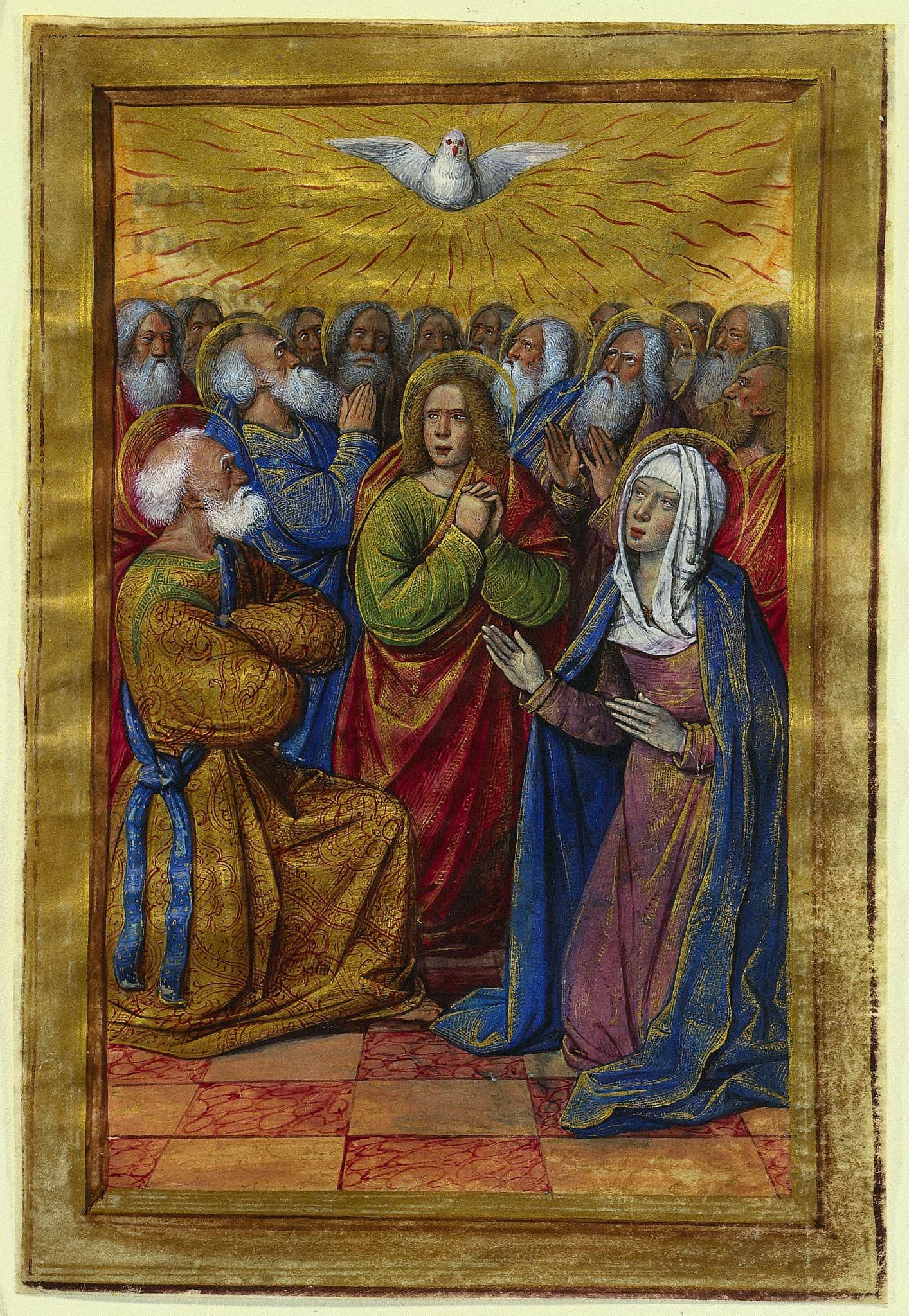
Jean Poyet, The Pentecost, a miniature from a Book of Hours, about 1500, tempera and gold on vellum, Cleveland Museum of Art 1924.426. Public domain (CC0), via the Internet Archive.
THE ARTWORKPoyet painted the apostles and Mary gathered in one room as the Spirit comes down on them in the form of a dove, in tempera and gold on vellum.
Summary
The church's year began with Easter and Pentecost, which answer the Passover and the Feast of Weeks, and grew by the sixth century into a round of seasons from Advent to Pentecost.
- Easter keeps the season of the Passover and, in Greek, its name, Pascha.
- Pentecost falls on the fiftieth day, the count Leviticus 23:16 gives from the sheaf to the new grain.
- Christmas was kept at Rome before 354, and Lent was known as a forty days' fast early in the fourth century.
- About AD 190 the churches of Asia and of Rome divided over the day of Easter, and the Council of Nicaea set one Sunday for all in 325.
- The liturgical churches keep the whole year, while the Westminster Directory of 1645 kept the Lord's day alone.
Passover, Weeks and the First Day
Six passages on the two appointed times the apostles kept and the new weekly day they met on.
The Passover to the LORD begins at twilight on the fourteenth day of the first month.Leviticus sets the Passover by the moon, so a feast tied to it moves through the solar year.
From the day after the Sabbath, the day you brought the sheaf of the wave offering, you are to count off seven full weeks. You shall count off fifty days until the day after the seventh Sabbath, and then present an offering of new grain to the LORD.The Feast of Weeks has no day of the month of its own and is found only by counting from the sheaf.
Get rid of the old leaven, that you may be a new unleavened batch, as you really are. For Christ, our Passover lamb, has been sacrificed. Therefore let us keep the feast, not with the old bread, leavened with malice and wickedness, but with the unleavened bread of sincerity and of truth.Paul grounds the call to keep the feast in the sacrifice of Christ.
When the day of Pentecost came, they were all together in one place.Luke dates the coming of the Spirit by the feast of Israel and gives the day no new name.
On the first day of the week we came together to break bread. Since Paul was ready to leave the next day, he talked to them and kept on speaking until midnight.Luke dates the gathering at Troas by the week, after a voyage he dated by the days of Unleavened Bread.
On the Lord’s day I was in the Spirit, and I heard behind me a loud voice like a trumpet,John names the day of his vision for the Lord, the name the Didache also gives the day of the church's gathering.
The Seasons from Advent to Advent
Each season of the Western church set on the days of one year, counted from Advent Sunday.
In the year counted here, the seasons from Advent to Pentecost fill a little under half the days and the Sundays after Pentecost the rest.
- Adventdays 1 to 25four Sundays before Christmas, from the Sunday nearest Saint Andrew's day; the year opens here
- Christmasdays 26 to 37twelve days, from 25 December to the eve of the Epiphany
- Epiphany and the Sundays afterdays 38 to 80from 6 January to the Sundays before Lent
- Lentdays 81 to 126forty days of fasting from Ash Wednesday, the Sundays not counted
- Holy Weekdays 120 to 126the last week of Lent, with the Supper on the Thursday and the Cross on the Friday
- Easterdays 127 to 176fifty days from Easter Day to Pentecost
- Ascension Dayday 166the fortieth day from the resurrection, the span of Acts 1:3Acts 1:3
- Pentecostday 176the fiftieth day, counted from Easter DayLeviticus 23:16
- The Sundays after Pentecostdays 177 to 364as many Sundays as the date of Easter leaves
- Advent Sundayday 36529 November 2026, where the next year opens
Ten numbered stops in the order of the year, each with its days counted from Advent Sunday, 30 November 2025: seven seasons and three single days. Easter Day fell on 5 April 2026, and in another year the seasons from Lent to Pentecost move with it.
Christmas and the Epiphany keep their dates in the solar calendar. The Book of Common Prayer provides collects for as many as six Sundays after the Epiphany and lessons for as many as twenty-seven Sundays after Trinity.
Lent and the fifty days of Easter are the longest seasons before Pentecost, and the Sundays after Pentecost outlast all of them.
The seven counts as a table
| Season | Days | Verse |
|---|---|---|
| Advent | 25 | |
| Christmas | 12 | |
| Epiphany and the Sundays after | 43 | |
| Lent | 46 | |
| Holy Week | 7 | |
| Easter | 50 | |
| The Sundays after Pentecost | 188 |
Each season's length in days in the year the stops above count, Sundays included.
How the Year Grew
The weekly day and the yearly Pascha are the oldest parts of the year, and most of the other seasons appear from the fourth century on.
Justin Martyr, in his First Apology, chapter 67, wrote that Christians in city and country met on the day called Sunday. He gave two reasons, that God made the world on the first day and that Christ rose from the dead on it.
The Catholic Encyclopedia finds no writer before Justin Martyr who mentions a yearly feast of the resurrection. The dispute over its day in the second half of the second century shows the weight the churches gave it. Pentecost was bound so closely to Easter that it closed the paschal season, and Tertullian, in On Baptism 19, treats it as an established feast. No writer before Eusebius attests a feast of the Ascension.
Lent, from a fast of days to forty daysIrenaeus, about 190; Nicaea, 325; Athanasius; Gregory the Great
Irenaeus, in his letter to Victor, wrote that some fasted one day before the feast, some two days, some more, and some forty hours (Eusebius, Church History 5.24). The fifth canon of the Council of Nicaea, in 325, orders a synod in each province twice a year, "the one before Lent" and the other about autumn. By the early fourth century Lent was known as a forty days' fast, as the Festal Letters of Athanasius show. Rome in the time of Gregory the Great (590 to 604) kept six weeks of six fast days, and the start was later moved back to Ash Wednesday to make the number forty.
In the Greek churches the Sunday called the Sunday of abstinence from flesh is the last day meat is eaten, and the next is called cheese Sunday.
Holy Week and the night vigilthe Thursday, the Friday and the eve of Easter
With Easter the church joined the Last Supper on the Thursday, the Crucifixion on the Friday and the vigil of the night before the feast. At the vigil the paschal candle and the font were blessed, and the catechumens were baptized after long weeks of preparation. Origen named the Friday the Pascha of the Cross and the Sunday the Pascha of the Resurrection.
Christmas and the EpiphanyRome before 354; Constantinople, 395; Tours, 566 or 567; McGowan, 2002
Rome kept the birth of Christ on 25 December before 354, the year of the Philocalian Calendar, whose list of martyrs records it on that day. John Chrysostom brought the feast to Constantinople, and it was adopted there in 395.
The Epiphany on 6 January began in the East, where its first theme was the baptism of Christ. Clement of Alexandria reports that the followers of Basilides kept the day of the baptism in January. The Second Council of Tours, in 566 or 567, proclaimed the twelve days from Christmas to the Epiphany holy.
Why Rome chose 25 December is disputed. One account sets the date against the feast of the sun that the emperor Aurelian fixed on 25 December in 274. The other, which Louis Duchesne first proposed in modern times, counts nine months from 25 March, the day Tertullian gave for the Passion, taken as the day of the conception. Andrew McGowan, weighing both in Bible Review in 2002, concludes, "We cannot be entirely sure."
Adventthe end of the fourth century; Mâcon, 581
No preparation for Christmas is found before the end of the fourth century. A synod at Mâcon in 581 ordered the Lenten rite on Mondays, Wednesdays and Fridays from 11 November to Christmas. Advent came to hold four Sundays and to open the Western year, and the Catholic Encyclopedia of 1907 gives it twenty-eight days at the longest and twenty-one at the shortest.
What Came from Israel and What Is New
Each appointed time of Leviticus 23 set beside the church's day on it, and whether Wesley's Sunday Service of 1784 keeps that day.
| The church's year | Leviticus 23 | Wesley, 1784 |
|---|---|---|
| The Lord's day, the first day of the week | the Sabbath, the seventh day (23:3) | kept: the book is a service for every Sunday |
| Good Friday | Passover, the 14th of the first month (23:5) | kept, with proper lessons and psalms |
| no feast of its own | Unleavened Bread, the 15th to the 21st (23:6) | no day |
| Easter Day | Firstfruits, the day after the Sabbath (23:11) | kept, with proper psalms |
| Pentecost, or Whitsunday | Weeks, the fiftieth day from the sheaf (23:16) | kept, with proper lessons and psalms |
| no counterpart | Trumpets, Atonement and Tabernacles, in the seventh month (23:24 to 36) | no day |
| Ascension Day | none | kept, with proper lessons and psalms |
| Advent | none | kept, with lessons for its Sundays |
| Christmas, 25 December | none | kept, with proper lessons and psalms |
| The Epiphany, 6 January | none | not named |
| Lent | none | not named |
Reckoning the Date of Easter
The rule of Nicaea, the reckoning given to Alexandria, and the two calendars of East and West.
The Council of Nicaea ruled that all should keep Easter on the same Sunday, the Sunday after the fourteenth day of the paschal moon. The paschal moon was the one whose fourteenth day followed the spring equinox. The decree does not survive, and the rule is known from Constantine's letter to the churches in Eusebius' Life of Constantine 3.18 and from later notices. The church of Alexandria, the most skilled in reckoning, was probably charged with giving the date to the rest.
By that rule Easter falls no earlier than 22 March and no later than 25 April. The Book of Common Prayer states it as the first Sunday after the full moon on or next after 21 March.
Pope Gregory XIII dropped ten days in October 1582 to bring the equinox back to 21 March. The Protestant states of Germany took the new calendar in 1700 and Great Britain in 1752. Russia and the other Orthodox lands kept the Old Style into the twentieth century, their dates thirteen days behind the rest of Christendom.
The Words of the Year
Four Greek words from Strong's dictionary of 1890, each with the count of its uses.
PASCHA
Strong gives the Passover, meaning the meal, the day, the festival or its sacrifices. The word stands 29 times in seven books, and Strong lists Easter among the King James renderings.
HEORTE
Strong gives a festival, rendered feast and holyday in the King James. The word stands 25 times, seventeen of them in John.
KURIAKOS
Strong gives belonging to the Lord. The word stands twice, for the Lord's Supper in 1 Corinthians 11:20 and for the Lord's day.
PENTEKOSTE
Strong gives the fiftieth day from the Passover. The word stands three times, at Acts 2:1, Acts 20:16 and 1 Corinthians 16:8.
What the Text Leaves Unsaid
Three matters on which the New Testament is silent.
The New Testament names no yearly feast of the resurrection, and it gives no day or month for the birth of Christ.
It commands no season of fasting before Easter.
The New Testament names the Lord's day once, without saying which day of the week it was.
The Gospel Told Through a Year
What the round of seasons teaches, and the verse both sides of the dispute over holy days read.
From Advent to Pentecost the seasons follow the gospel in its order. They begin with the waiting for Christ and His birth, and move through His showing to the nations, His fast and His passion. They end with His rising, His going up and the Spirit sent.
Therefore let no one judge you by what you eat or drink, or with regard to a feast, a New Moon, or a Sabbath. These are a shadow of the things to come, but the body that casts it belongs to Christ.One side reads this verse as freedom to keep days in Christ, and the other reads it as the end of days kept by rule.
Voices on Days and Feasts
The Didache, Irenaeus, Origen, Matthew Henry and Jamieson, Fausset and Brown, each with the work named.
The Didache on the gathering each Lord's dayThe Didache, chapter 14, on Acts 20:7
“But every Lord's day do ye gather yourselves together, and break bread, and give thanksgiving after having confessed your transgressions, that your sacrifice may be pure. But let no one that is at variance with his fellow come together with you, until they be reconciled, that your sacrifice may not be profaned. For this is that which was spoken by the Lord: In every place and time offer to me a pure sacrifice; for I am a great King, saith the Lord, and my name is wonderful among the nations.”
Didache · The Didache, Chapter 14 · on Acts 20:7Patristic
Irenaeus on keeping the feast in maliceFragments from the Lost Writings, on Colossians 2:16
“The apostles ordained, that ‘we should not judge any one in respect to meat or drink, or in regard to a feast day, or the new moons, or the sabbaths.’ Whence then these contentions? whence these schisms? We keep the feast, but in the leaven of malice and wickedness, cutting in pieces the Church of God; and we preserve what belongs to its exterior, that we may cast away these better things, faith and love. We have heard from the prophetic words that these feasts and fasts are displeasing to the Lord.”
Irenaeus · Fragments from the Lost Writings of Irenaeus · on Colossians 2:16Patristic
Origen on the thanks both giveCommentary on the Epistle to the Romans, on Romans 14:6
“He who is wise concerning the day, is wise for the Lord; and he who eats, eats for the Lord: for he gives thanks to God; and he who does not eat, for the Lord does not eat, and gives thanks to God. Thanks therefore are rendered to God by both: by the one indeed for the fruit of continence; by the other for the liberty of eating.”
Origen of Alexandria · Commentary on the Epistle to the Romans · on Romans 14:6Patristic
Matthew Henry on why Paul hurried to PentecostCommentary on the Whole Bible, on Acts 20:16
“He aimed to be there by the feast of pentecost because it was a time of concourse, which would give him an opportunity of propagating the gospel among the Jews and proselytes, who came from all parts to worship at the feast: and the feast of pentecost had been particularly made famous among the Christians by the pouring out of the Spirit.”
Matthew Henry · Commentary on the Whole Bible · on Acts 20:16Puritan
Jamieson, Fausset and Brown on days kept as a workCommentary Critical and Explanatory, on Galatians 4:10
“To regard the observance of certain days as in itself meritorious as a work, is alien to the free spirit of Christianity. This is not incompatible with observing the Sabbath or the Christian Lord's day as obligatory, though not as a work (which was the Jewish and Gentile error in the observance of days), but as a holy mean appointed by the Lord for attaining the great end, holiness.”
Jamieson, Fausset & Brown · Commentary Critical and Explanatory on the Whole Bible · on Galatians 4:10Reformed
The Day of Easter and the Keeping of Days
Two disputes, each reading with its holders, its case and the strongest objection.
Easter on the fourteenth dayPolycrates of Ephesus and the churches of Asia · the Quartodecimans
About 190 the churches of Asia ended the paschal fast on the fourteenth day of the moon, the day Israel slew the lamb, whatever day of the week it fell on. Polycrates of Ephesus wrote to Victor of Rome, "We observe the exact day; neither adding, nor taking away," and named Philip, John, Polycarp and Melito as having kept it. He added that seven of his kinsmen had been bishops before him.
The objection is that a feast kept on any weekday would part the yearly memorial of the resurrection from the Lord's day, its weekly memorial.
Easter on the SundayVictor of Rome; the synods of Palestine, Pontus and Gaul; the Council of Nicaea · Rome and Alexandria
The other churches held, from what they called apostolic tradition, that the fast should end on no day but the day of the resurrection (Eusebius, Church History 5.23). Synods in Palestine, Rome, Pontus and Gaul decreed it. Victor tried to cut the churches of Asia off from the common unity. Irenaeus rebuked him and recalled that Polycarp and Anicetus of Rome had each kept his own custom and parted in peace.
The objection is the tradition Polycrates claimed from John and Philip, and the day his kinsmen kept, the day "when the people put away the leaven."
Feasts kept for order and in memory of ChristThe Book of Common Prayer; the Augsburg Confession, 1530; Leo the Great; the Catholic Encyclopedia; John Wesley, 1784 · Anglican, Lutheran, Catholic and Methodist
The Augsburg Confession, Article 15, keeps the holy days and festivals that can be kept without sin and serve good order in the church. It warns that consciences are not to be burdened by them. The Book of Common Prayer orders all Sundays, the feasts of Christ and the saints, and the moveable feasts that hang on Easter. Leo the Great called Easter the feast of feasts and taught that Christmas is kept to prepare for it. The Catholic Encyclopedia of 1907 reads Advent as a preparation for the coming of Christ at Christmas, in grace and at the end of the world.
The Methodists stand on this side in the pared form John Wesley gave the Prayer Book's year. His Sunday Service (1784) keeps the Sundays from Advent to Trinity, Christmas, Good Friday, Easter, Ascension Day and Whitsunday, and makes every Friday of the year a fast, Christmas Day excepted.
Their case is that the apostles kept the Passover and Pentecost in Christ, so the church may keep yearly days in His memory. They add that Paul leaves a day kept to the Lord free.
One person regards a certain day above the others, while someone else considers every day alike. Each one should be fully convinced in his own mind. He who observes a special day does so to the Lord; he who eats does so to the Lord, for he gives thanks to God; and he who abstains does so to the Lord and gives thanks to God.This is the text the liturgical churches cite for a day kept to the Lord without a law binding others to keep it.
The objection is Galatians 4:10 to 11.
One holy day a weekThe Westminster Assembly, Directory for Public Worship; the General Assembly of the Church of Scotland, 1645 · Reformed and Puritan
The Directory teaches that no day is commanded in Scripture to be kept holy under the gospel but the Lord's Day. It rules, "Festival days, vulgarly called Holy-days, having no warrant in the Word of God, are not to be continued."
The General Assembly of the Church of Scotland approved the Directory in 1645 and ordered its use in every church of the kingdom. The Assembly at Perth in 1618 had permitted the five chief festival days under the king's orders, as the editor of the Book of Common Order of 1868 records.
You are observing special days and months and seasons and years!Paul counts the keeping of days and seasons among the signs that the Galatians were turning back.
The objection is Romans 14:5 to 6, and the Directory itself allows a day to be set apart for fasting or thanksgiving on a special occasion.
Books on the Church's Year
Five works on the church's year and its disputes, all five free to read.
The Church History, Book 5
Eusebius of Caesarea, translated by A. C. McGiffert · about 325; translation 1890
Its chapters 23 to 25 hold the letters of Polycrates and Irenaeus on the day of Easter.
Read at New AdventChristian Calendar
Herbert Thurston, in the Catholic Encyclopedia · 1908
Thurston traces the Easter cycle, the Nativity cycle and the saints' days from the first centuries to his own day.
Read at New AdventThe Book of Common Prayer
The Church of England · the text of 1662
Its tables give the feasts and fasts of the year and the rules for finding Easter and the feasts that hang on it.
Read at Project GutenbergThe Augsburg Confession
Philip Melanchthon · 1530
Melanchthon's confession was submitted to the Emperor Charles V at the Diet of Augsburg in 1530.
Read at Project GutenbergThe Directory for the Public Worship of God
The Westminster Assembly · 1645
The Directory is printed in this edition of 1868, with its appendix touching days and places on page 323.
Read at the Internet ArchiveChrist Our Passover
Paul's call to keep the feast stands behind every Easter the church has kept.
Israel kept its appointed times year after year, and the church kept two of them as Easter and Pentecost because Christ died at the Passover and sent the Spirit at Weeks.
Whether a church keeps the whole year or the Lord's day alone, the text asks the reader to keep the feast with the unleavened bread of sincerity and of truth. It also asks him to give thanks to God for whatever day he keeps.
After the Sabbath, at dawn on the first day of the week, Mary Magdalene and the other Mary went to see the tomb.Every Lord's day and every Easter looks back to this dawn on the first day of the week.
Keep studying
People2